


Introduction
Safety behaviours (SBs) are overt or covert behaviours people use to reduce anxiety in fear-provoking situations (Salkovskis, Reference Salkovskis1991). Although SBs are adaptive under certain circumstances (e.g. washing your hands after shaking hands with someone who has the flu), they become maladaptive when people use them excessively and repeatedly (e.g. washing your hands after touching any doorknob). These behaviours can contribute to the development and maintenance of anxiety disorders (Salkovskis, Reference Salkovskis1991; Sloan and Telch, Reference Sloan and Telch2002); because anxious individuals who use SBs are unable to acquire disconfirmatory evidence about their fears and the utility of their SBs, adaptive belief change may not occur (Clark and Wells, Reference Clark, Wells, Heimberg, Liebowitz, Hope and Schneier1995).
Safety behaviour during exposure: helpful or hindering?
Although cognitive behavioural therapy (CBT) researchers and clinicians agree almost universally about the deleterious effects of SB use for everyday anxiety (e.g. Deacon and Maack, Reference Deacon and Maack2008), they disagree about SB use within the therapeutic context. Over the last two decades, a debate has grown about the role of SBs in exposure therapy. Some assert that permitting SBs at any stage of exposure prevents individuals from learning that they can overcome their anxiety without this behaviour (e.g. Abramowitz and Moore, Reference Abramowitz and Moore2007; Deacon and Maack, Reference Deacon and Maack2008). Conversely, some contend that allowing the judicious use of SBs during initial exposures (i.e. permitting SBs as needed, and gradually diminishing these behaviours over time) may reduce anxiety during exposure, increase treatment acceptability, and thus decrease attrition rates (e.g. Levy and Radomsky, Reference Levy and Radomsky2014; van den Hout et al., Reference van den Hout, Engelhard, Toffolo and van Uijen2011).
Although exposure therapy for anxiety disorders is efficacious (Foa et al., Reference Foa, Liebowitz, Kozak, Davies, Campeas, Franklin and Simpson2005), some people find it too anxiety-provoking, which may contribute to high attrition rates. Mancebo et al. (Reference Mancebo, Eisen, Sibrava, Dyck and Rasmussen2011) found that more than 25% of participants who terminated CBT prematurely reported that it was due to fears of engaging in treatment activities (e.g. behavioural experiments, exposure). Participants viewed CBT with judicious SB as significantly more acceptable than standard CBT (Levy and Radomsky, Reference Levy and Radomsky2014; Milosevic and Radomsky, Reference Milosevic and Radomsky2013) and many researchers have been unable to replicate findings that judicious SB use has deleterious effects during exposure therapy (Rachman et al., Reference Rachman, Craske, Tallman and Solyom1986; van Uijen et al., Reference van Uijen, van den Hout, Schiphorst, Knol and Engelhard2017; but see Abramowitz and Moore, Reference Abramowitz and Moore2007; Sloan and Telch, Reference Sloan and Telch2002).
Various mechanisms of change have been proposed to explain treatment success in CBT (Olatunji et al., Reference Olatunji, Cisler and Deacon2010). Inhibitory learning theory (Craske et al., Reference Craske, Kircanski, Zelikowsky, Mystkowski, Chowdhury and Baker2008; Craske et al., Reference Craske, Treanor, Conway, Zbozinek and Vervliet2014) posits that during successful exposure, people develop new safety-related associations with the feared stimulus, which are more readily activated than the original threat-related association. The proposed mechanisms of change underlying inhibitory learning are expectancy violation and fear extinction processes. Although researchers suggest SB use detracts from these processes and interferes with optimal inhibitory learning conditions (e.g. Craske et al., Reference Craske, Treanor, Conway, Zbozinek and Vervliet2014; Blakey and Abramowitz, Reference Blakey and Abramowitz2019), it is possible that as long as clients and therapists work to reduce them gradually over time, judicious use of SBs may not detract from forming new safety-based associations.
Belief change is another primary mechanism of change in the successful treatment of anxiety. People with anxiety often hold maladaptive beliefs that maintain anxiety and perpetuate avoidance behaviours (e.g. ‘It would be catastrophic if I stutter during my speech’, ‘People will think I’m stupid if I forget my words’, ‘I’ll feel more prepared if I read off my cue cards’). The goal in CBT is to test and alter these unhelpful beliefs through psychoeducation, cognitive restructuring and engagement with feared stimuli using exposure and/or behavioural experiments (e.g. Clark and Beck, Reference Clark and Beck2011). Research has supported the benefits of using a belief change rationale when addressing exposure therapy and SB use with clients (e.g. Milosevic and Radomsky, Reference Milosevic and Radomsky2013; Ouimet and Ashbaugh, Reference Ouimet, Ashbaugh, O’Donohue, James and Snipes2017). Preliminary studies on belief change versus extinction rationales for exposure suggest that belief change exercises, such as behavioural experiments, may have advantages over extinction-based exposure therapy (McMillan and Lee, Reference McMillan and Lee2010). Ultimately, researchers propose that a combination of cognitive and behavioural techniques should be used to enhance outcomes for anxiety (Olatunji et al., Reference Olatunji, Cisler and Deacon2010).
Exploring potential mechanisms underlying safety behaviour use
We still know very little about what the resulting cognitive, behavioural, emotional and psychophysiological repercussions are for anxious individuals who use SBs in the moment. Moreover, it remains unclear why these repercussions occur (i.e. by what cognitive mechanisms). Although researchers have long agreed that SBs maintain anxiety, research findings are equivocal on whether they facilitate or impair treatment efficacy. Understanding the underlying processes during anxiety-provoking situations with or without SBs is critical to refining existing interventions. Working memory and ability to gather disconfirmatory evidence may be particularly fruitful candidates.
Working memory is a multicomponent system that is responsible for temporarily storing, processing, manipulating and retrieving information. Current models of working memory break down executive functioning into the following systems: the central executive, the phonological loop, the visuospatial sketchpad, and the episodic buffer (Baddeley, Reference Baddeley2000; Baddeley and Hitch, Reference Baddeley and Hitch1974). The central executive serves primarily as an attentional process that attends to the phonological loop (dedicated to storing and manipulating auditory information) and visuospatial sketchpad (dedicated to storing and manipulating visuospatial information) as needed, and filters out irrelevant information. Given the limited capacity of working memory, competing internal or external stimuli can reduce the cognitive resources needed to hold and process information (Baddeley, Reference Baddeley2000; Baddeley and Hitch, Reference Baddeley and Hitch1974). When anxiety is high, working memory capacity (WMC) suffers because cognitive resources are consumed by attention to the anxiety-provoking stimulus (Eysenck et al., Reference Eysenck, Derakshan, Santos and Calvo2007). Consequently, they may not process, retain or learn important information (Ashcraft and Kirk, Reference Ashcraft and Kirk2001; Eysenck et al., Reference Eysenck, Derakshan, Santos and Calvo2007). This selective attention is controlled by the central executive – when two activities come into conflict, the central executive directs attention and prioritizes certain activities. Indeed, researchers demonstrated that cognitive load (e.g. asking people to do mental calculation during a task) moderates attentional biases in social anxiety, such that people with social anxiety have greater difficulty avoiding or disengaging from threat-relevant social stimuli when cognitive load is high (Judah et al., Reference Judah, Grant, Lechner and Mills2013). Moreover, according to a recent meta-analysis, anxious individuals (and those with other mental health difficulties) exhibit WMC deficits when affective material is presented (Schweizer et al., Reference Schweizer, Satpute, Atzil, Field, Feldman-Barrett and Dalgleish2019). Another meta-analysis demonstrated that people with high state or trait anxiety exhibit decreased WMC on complex (e.g. o-span), simple (e.g. digit span) and dynamic span (e.g. n-back) tasks (Moran, Reference Moran2016).
There are several measures of working memory capacity, including simple, complex and dynamic span tasks that measure varying aspects of working memory. Complex span tasks, such as the o-span include both the processing (e.g. equation) and storage (e.g. letters to be recalled) of information (Oswald et al., Reference Oswald, McAbee, Redick and Hambrick2015). Moreover, complex span tasks (such as the o-span) have better psychometric properties (e.g. reliability, validity) than dynamic span tasks (such as the n-back); dynamic span tasks may map more closely onto short-term memory capacity, rather than overall working memory capacity (Conway et al., Reference Conway, Kane, Bunting, Hambrick, Wilhelm and Engle2005). We propose that engaging in an exposure exercise to elicit therapeutic change requires the processing and storage of information – clients must process what is being observed (e.g. are expectations being violated?) and store it. Thus, a complex span task is likely to be most appropriate.
The effect of anxiety on WMC may have implications for the cognitive processes implicated during exposure tasks. Exposure success probably depends on both expectancy violation (e.g. ‘Nobody actually laughed at me when I gave my speech’) and belief change (e.g. ‘Maybe my presentation wasn’t as embarrassing as I thought it was going to be’), both of which depend on executive functioning and cognitive processing. If high state anxiety reduces WMC, individuals may struggle to disconfirm their initial predictions, and their maladaptive beliefs may persist. Consequently, we wonder whether using SBs during exposure may maintain WMC and facilitate disconfirmatory learning. Indeed, researchers have found equivalent levels of fear reduction, belief change and ability to gather disconfirmatory evidence between SB and no SB conditions (Milosevic and Radomsky, Reference Milosevic and Radomsky2008; Salkovskis et al., Reference Salkovskis, Clark, Hackmann, Wells and Gelder1999).
In social anxiety, even the threat of an exposure task causes substantial increases in anxiety (Price and Anderson, Reference Price and Anderson2011) and psychophysiological arousal (Carrillo et al., Reference Carrillo, Moya-Albiol, González-Bono, Salvador, Ricarte and Gómez-Amor2001). This anticipatory anxiety occurs when people hold negative predictions for their upcoming social performance. If state anxiety decreases WMC, it may not only impact one’s ability to learn during exposure, but also prior to in-session exposure (i.e. psychoeducation).
State anxiety during exposure therapy with and without safety behaviours
Compared with standard exposure, individuals report decreased anxiety during exposure with judicious SB (Rachman et al., Reference Rachman, Craske, Tallman and Solyom1986), as measured by the Subjective Units of Distress Scale (SUDS; Wolpe, Reference Wolpe1958). Researchers demonstrated that the SUDS correlates highly with physiological arousal (i.e. hand temperature; Thyer et al., Reference Thyer, Papsdorf, Davis and Vallecorsa1984), yet few studies have directly assessed people’s physiological responses during exposure with versus without SB.
The role of physiological arousal during a speech task may be particularly salient in social anxiety. Socially anxious individuals are highly attuned to their physiological responses (e.g. sweating), which they interpret as indicators of anxiety and poor social performance (e.g. Clark and Wells, Reference Clark, Wells, Heimberg, Liebowitz, Hope and Schneier1995). Social (but not general) anxiety correlated with increased physiological reactivity in anticipation of a speech task (Cornwell et al., Grillon, Reference Cornwell, Johnson, Berardi and Grillon2006). Socially anxious participants who reported more SB use were evaluated more poorly by objective speech raters (Rowa et al., Reference Rowa, Paulitzki, Ierullo, Chiang, Antony, Mccabe and Moscovitch2015). The effects of SBs on people’s subjective and objective performance remain unclear.
Current study
We tested the effects of SB (vs NoSB) use on features of responding to an exposure-like task among people with high speech anxiety. Our primary goal was to understand the effect of SB use on cognitive processes implicated during an anxiety-provoking task – specifically WMC and ability to gather disconfirmatory evidence. Our secondary goal was to understand the impact of SB use on multiple speech anxiety outcomes, including subjective state anxiety, psychophysiological arousal, subjective (self-rated) and objective (other-rated) speech performance, speech duration, and willingness to engage in another speech task. In sum, we aimed to better understand the cognitive mechanisms underlying whether SBs are helpful or harmful during an anxiety-provoking speech task, and to examine additional outcomes (e.g. willingness to engage in additional exposure-like exercises) that may help to inform future research on exposure therapy.
Given the premise that SBs may reduce state anxiety (e.g. Chu et al., Reference Chu, Colognori, Yang, Xie, Bergman and Piacentini2015; Levy and Radomsky, Reference Levy and Radomsky2014; van den Hout et al., Reference van den Hout, Engelhard, Toffolo and van Uijen2011), and thus be less taxing on WMC, we hypothesized that, compared with the NoSB condition, participants in the SB condition would:
H1 Demonstrate less restricted WMC during the anticipatory anxiety phase.
H2 Gather more disconfirmatory evidence about their feared predictions, demonstrated by greater changes in pre-to-post comparisons of speech predictions.
H3 Report lower anxiety during the anticipatory and speech task phases.
H4 Display lower psychophysiological arousal (i.e. electrodermal activity, EDA) during the anticipatory and speech task phases.
Recent findings suggest that individuals with high social anxiety use more SBs than non-anxious individuals (Vassilopoulos, Reference Vassilopoulos2009). However, people who use more SBs also receive less favourable speech evaluations by objective observers (Rowa et al., Reference Rowa, Paulitzki, Ierullo, Chiang, Antony, Mccabe and Moscovitch2015). Thus, we hypothesized that, compared with the NoSB condition, participants in the SB condition would:
H5 Demonstrate poorer speech performance, as rated by objective observers.
Finally, as people have rated CBT including judicious SB as more acceptable than standard CBT (Levy and Radomsky, Reference Levy and Radomsky2014; Milosevic and Radomsky, Reference Milosevic and Radomsky2013), we hypothesized that participants in the SB condition, compared with the NoSB condition would feel more at ease during their speech, and thus would:
H6 Report better perceived speech performance following the speech.
H7 Speak longer during the speech task.
H8 Endorse greater exposure acceptability (i.e. lower distress and greater tolerability) and greater willingness to deliver another speech.
Method
Participants
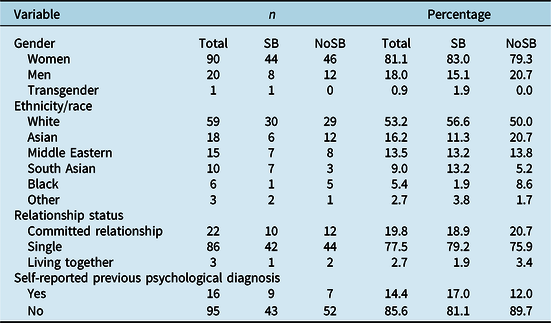
Following institutional review board approval, undergraduate students (N = 111)Footnote 1 aged 17 to 24 years (mean = 18.85, SD = 1.27) were recruited through a Canadian university’s participant pool for course credit. Participants were eligible if they scored five or greater on two questions on a pre-screener questionnaire: On a scale of 1 (‘not at all’) to 7 (‘extremely’), how much do you: (1) fear public speaking?, (2) avoid public speaking? Participants were unaware that their responses determined their eligibility for this study. Our overall sample endorsed high levels of social anxiety (minimum = 7, maximum = 53, mean = 27.70, SD = 11.34), with 74.8% (n = 83) of participants reporting social anxiety symptoms at or above the clinical threshold of 19 on the Social Phobia Inventory (Connor et al., Reference Connor, Davidson, Churchill, Sherwood, Weisler and Foa2000). Whereas 25.2% of the sample reported symptoms below the clinical cut-off, everyone reported some social anxiety symptoms (minimum = 7, maximum = 18; mean = 13.25, SD = 3.32). For self-reported sociodemographic characteristics, see Table 1.
Sociodemographic characteristics by condition

n = 111.
Self-report measures
Exposure Distress and Tolerability Scale (EDTS)
The EDTS is a four-item measure created for this study to assess the acceptability of the exposure-like task. Using a 5-point Likert-type scale (0 = ‘not at all’ to 4 = ‘extremely’), participants rated how distressing and tolerable they found the speech, and how willing they were to deliver another speech both with and without SBs.
The Performance Questionnaire (PQ; Rapee and Lim, Reference Rapee and Lim1992)
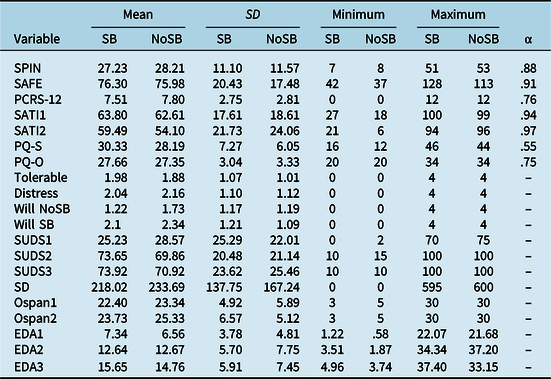
The PQ is a 17-item self-report measure of perceived public speaking performance, which can be completed by a speaker and/or an objective observer. We used it to assess subjective (i.e. completed by the participant; PQ-S) and objective (e.g. completed by five fully blinded research assistants using the video recordings of each speech; PQ-O). People rated specific (e.g. ‘Kept eye contact with audience’) and global (e.g. ‘Kept audience interested’) performance items on a 5-point scale (0 = ‘not at all’, 4 = ‘very much’). See Table 2 for internal consistency in our samples for all measures.
Descriptive statistics by condition for all variables of interest

SPIN, Social Phobia Inventory; SAFE, Subtle Avoidance Frequency Examination; PRCS-12, Personal Report of Confidence as a Speaker-Short Form; SATI1, Speech Anxiety Thoughts Inventory, First Administration; SATI2, Speech Anxiety Thoughts Inventory, Second Administration; PQ-S, Performance Questionnaire-Self Report; PQ-O, Performance Questionnaire-Other Report; Tolerable, Exposure Distress and Tolerability Scale, Tolerability; Distress, Exposure Distress and Tolerability Scale, Distress; Will SB, Exposure Distress and Tolerability Scale, Willingness with SBs; Will NoSB, Exposure Distress and Tolerability Scale, Willingness without SBs; SUDS1, Subjective Units of Distress Scale, Baseline; SUDS2, Subjective Units of Distress Scale, Anticipatory; SUDS3, Subjective Units of Distress Scale, Peak during speech; SD, Speech Duration (in seconds – a score of 0 indicates the participant did not complete the speech task); Ospan1, Operation Span Partial Score, First Administration; Ospan2, Operation Span Partial Score, Second Administration; EDA1, Electrodermal Activity, Baseline Phase; EDA2, Electrodermal Activity, Anticipatory Phase; EDA3, Electrodermal Activity, Speech Phase.
Personal Report of Confidence as a Speaker-Short Form (PRCS-12; Hook et al., Reference Hook, Smith and Valentiner2008)
The PRCS-12 is a 12-item, true-false, self-report measure of public speaking self-confidence, which we used to assess participants’ baseline ratings of their public speaking self-confidence. Sample items include ‘I am terrified at the thought of speaking before a group of people’ and ‘I feel disgusted with myself after trying to address a group of people’.
Social Phobia Inventory (SPIN; Connor et al., Reference Connor, Davidson, Churchill, Sherwood, Weisler and Foa2000)
The SPIN is a 17-item self-report measure of social anxiety, which we used to assess participants’ baseline social anxiety symptoms. People rated items related to fear (e.g. ‘Being criticized scares me a lot’), avoidance (e.g. ‘I avoid talking to people I don’t know’), and physiological arousal (e.g. ‘I am bothered by blushing in front of people’) on a 5-point Likert-type scale (0 = ‘not at all’ to 4 = ‘extremely).
The Speech Anxiety Thoughts Inventory (SATI; Cho et al., Reference Cho, Smits and Telch2004)
The SATI is a 23-item measure that assesses maladaptive beliefs related to speech anxiety, which we used to assess participants’ predictions about their impending speech performance (SATI-1). People rated items related to predictions of poor performance (e.g. ‘My speech will be incoherent’) and fear of negative evaluation by the audience (e.g. ‘If I make a mistake the audience will think I’m stupid’) on a 5-point scale (0 = ‘I do not believe the statement at all’ to 4 = ‘I completely believe the statement’). We added two items to facilitate measuring speech predictions and learning: ‘My anxiety will last the whole speech’ and ‘I will shake, tremble, or blush noticeably when I give my speech’.”
Additionally, we modified the SATI (SATI-2) to measure belief change related to speech-performance following the exposure-like task (SATI-2). All items in the SATI are future-oriented (e.g. ‘I’ll get tongue-tied’). In this modified version, we changed all items to the past tense (e.g. ‘I got tongue-tied’) to assess participants’ ability to gather disconfirmatory evidence.
Subjective Units of Distress Scale (SUDS; Wolpe, Reference Wolpe1958)
We used the SUDS we used to assess participants’ self-reported anxiety during baseline, anticipatory and speech phases. People rated the extent to which they felt anxious on a scale from 0 (‘not at all anxious’) to 100 (‘the worst anxiety you can imagine’).
The Subtle Avoidance Frequency Examination (SAFE; Cumming et al., Reference Cumming, Rapee, Kemp, Abbott, Peters and Gaston2009)
The SAFE is a 32-item self-report measure of SB use related to social anxiety, which we used to assess the degree to which participants typically used SBs. People rated items that measure active SB use (e.g. ‘Avoid eye contact’), subtle restriction of behaviour (e.g. ‘Rehearse sentences in your mind’), and concealment behaviour (e.g. ‘Wear clothes or make-up to hide blushing’) on a 5-point Likert-type scale (1 = ‘never’ to 5 = ‘always’).
Computerized tasks
Operation span task (o-span; Oswald et al., Reference Oswald, McAbee, Redick and Hambrick2015)
The shortened o-span is a computerized task that measures current WMC (for complete details, see Oswald et al., Reference Oswald, McAbee, Redick and Hambrick2015). Participants solve a series of simple mathematical equations, each of which is followed by a letter they must remember in the correct order. We used an E-Prime template (Psychology Software Tools, 2017; available at: http://englelab.gatech.edu/shortenedtasks.html) to be identical to that used by Oswald et al. (Reference Oswald, McAbee, Redick and Hambrick2015).
Behavioural tasks
Behavioural speech task
Participants were asked to present a speech in front of a judge wearing a lab coat and carrying a clipboard, who they were told would evaluate the content and quality of their performance. Participants were also informed that their speech would be videotaped for further analysis by a group of psychologists, who would rate their speech on clarity, accuracy, interest, content, poise and style. They had five minutes to prepare and were encouraged to speak for 10 minutes. Participants were asked to choose up to three topics from a list ten (e.g. terrorism, obesity, gun control). To end the speech, participants held up a ‘STOP’ card. Similar speech task paradigms have elicited strong anxiety and physiological arousal responses (e.g. Larson et al., Reference Larson, Ader and Moynihan2001).
Apparatus
Electrodermal activity recording (EDA)
EDA measures eccrine sweat gland activity (i.e. skin conductance). Changes in emotional reactivity and arousal directly impact sweat gland reactivity (Cacioppo et al., Reference Cacioppo, Tassinary and Berntson2007). Two electrodes were placed on the thenar and hypothenar eminences of the non-dominant hand. Data were collected using Biopac TSD203 transducers.
Respiration rate recording
Respiration rate was recorded using a MindWare Belt for Transducer, placed around participants’ sternums, as per recommendations by Schmidt and Walach (Reference Schmidt and Walach2000), to reduce the likelihood of artefacts in the EDA data caused by breathing. Both the respiration belt and the electrodermal transducers were connected to a MindWare Mobile Recorder ambulatory device.
Procedure
Participants were informed that they were participating in a study testing new measures of cognition and attention related to academic achievement. After informed consent, participants completed an online baseline questionnaire package including a demographic questionnaire, followed by the SPIN, PCRS-12 and SAFE in a randomized order. These questionnaires were administered for the purposes of characterizing our sample at baseline. Participants then rated their current anxiety using the SUDS. Participants completed the o-span as a baseline measure of their WMC. A research assistant applied two electrodes to the palm of the participant’s non-dominant hand; participants placed the respiration belt around their sternums. Participants then rested, closed their eyes, and stayed seated for 3 minutes to assess their baseline EDA.
Participants were informed of the speech, and were then given a hard copy of the SATI to complete. They were then randomly assigned to one of two conditions: SB or no SB. Participants in the SB condition received the following instructions:
We know that people tend to get really anxious right before and during a speech. Different people manage their anxiety in different ways, and will often use different tools or strategies to help them reduce their anxiety while they are giving a speech. There are many strategies that people can use, but the most common include standing behind a podium so that you can hide your body, holding onto a stress ball, having a bottle of water, sitting down, and taking small breaks to engage in deep breathing. You have been assigned to the condition that gets to use one of these tools.
Participants in the no SB condition received identical instructions, but were told: You have been assigned to the condition that doesn’t get to use one of these tools.
Once participants identified their preferred SB, they were given 5 minutes to prepare for their speech while their EDA was recorded. After the 5 minutes had passed, the judge entered the room and began to set up the video camera. Participants were informed that the speech was about to start, and were asked to rate their anticipatory anxiety using the SUDS. The researcher then ran hurriedly back into the room and informed the participant that the computerized task they completed did not record properly, and noted that it was very important to have this data prior to the speech task. This was done to assess WMC immediately prior to speech, when anxiety levels would be elevated, while reducing respondent bias due to repeated measurement of WMC. Participants completed the o-span a second time. Participants then delivered their speech in front of the judge while their EDA was being recorded. Following the speech, participants retrospectively rated their peak anxiety during the speech, using the SUDS. Speech duration was recorded.
Participants were then given their original, completed copy of the SATI-1 and a blank copy of the modified SATI-2. Participants were asked to review their original copy of the SATI-1, and to fill out the SATI-2 by rating what they believed actually happened during their speech. Our goal was to mimic the process typically used for behavioural experiments during CBT (i.e. writing down predictions prior to engaging in an anxiety-provoking situation and re-evaluating the results afterwards). Participants then completed the EDS, PQ and a brief interview to assess whether they used any additional strategies to reduce their anxiety during the speech (i.e. covert SBs, such as mental distraction). Electrodes were removed, and participants were fully and thoroughly debriefed. Research assistants assessed participants’ level of distress and ensured that no participant left the laboratory feeling distressed or anxious. Moreover, all participants were provided with a list of resources outlining various psychological services.
Data analysis
Of 111 participants, 12 withdrew after learning about the speech task (6 SB; 6 NoSB). Thus, 11% of total scores are missing for post-speech measures. The data set was visually scanned for impossible values; none was identified. All variables fell in the normal range of skewness and kurtosis (i.e. no values above 2.0 or below –2.0), with the exception of o-span scores for both groups at both time points, which were platykurtic. See Table 2 for descriptive statistics.Footnote 2 There were no pre-existing statistically significant between-condition differences for any baseline measures (all t < .92; all p > .36).
Manipulation check
All participants in the SB condition used their chosen SB during their speech. Although participants chose from five different SBs, an overwhelming majority (75%) chose to sit down or to use the podium. CBT models of social anxiety focus on beliefs about physiological symptoms and observable anxiety signs (e.g. Clark and Wells, Reference Clark, Wells, Heimberg, Liebowitz, Hope and Schneier1995; Moscovitch, Reference Moscovitch2009). These two SBs were the options most likely to reduce focus on the participants’ bodily sensations. Thus, it appears that people chose the SB they thought would be most helpful/anxiety-reducing.
Hypothesis testing
To test if condition affected WMC (H1), a 2 (condition) × 2 (time) mixed ANOVA was conducted. Partial scores were used as the outcome measure (Oswald et al., Reference Oswald, McAbee, Redick and Hambrick2015). To assess if condition impacted gathering disconfirmatory evidence (H2; SATI), a 2 (condition) × 2 (time: pre-speech, post-speech) mixed ANOVA was conducted. To test whether condition affected self-reported state anxiety (H3; SUDS), a 2 (condition) × 3 (time: baseline, anticipatory, speech) mixed ANOVA was conducted. To assess whether condition impacted psychophysiological arousal (H4; EDA), a 2 (condition) × 3 (time: baseline, anticipatory, speech) mixed ANOVA was conducted.
An intraclass correlation coefficient (ICC) was calculated to determine inter-rater reliability and consistency in PQ-O scores between the five video coders. Consistent with Rowa et al. (Reference Rowa, Paulitzki, Ierullo, Chiang, Antony, Mccabe and Moscovitch2015), the ICC for global scores on the PQ was .76. To test whether perceptions of objective speech success differed between groups (H5), a one-way ANOVA was conducted, with an average of PQ-O scores across each rater as the dependent variable. To test whether subjective speech performance (PQ-S) differed between groups (H6), a one-way ANOVAs was conducted. To test whether speech duration (in seconds) differed between groups (H7), a one-way ANOVA was conducted.
To test whether participants’ willingness to complete another speech and participants’ perceptions of exposure task tolerability and distress differed between groups (H8), four one-way ANOVAs were conducted for each of the items on the EDTS.
Results
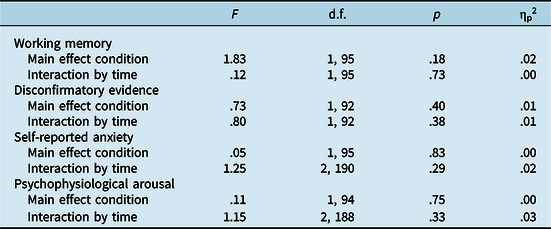
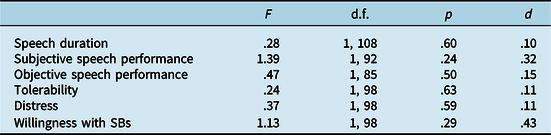
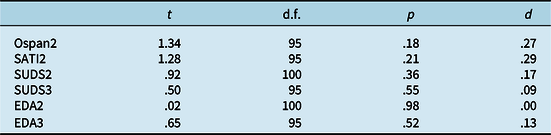
There were no significant effects of condition on WMC, ability to gather disconfirmatory evidence, self-reported anxiety, psychophysiological arousal, subjective and objective speech performance, speech duration, speech tolerability and distress, and willingness to deliver a speech with SBs (see Tables 3, 4 and 5). However, participants in the SB condition reported significantly lower willingness than those in the NoSB condition to deliver a speech without SBs [F (1,98) = 4.74, p = .03, d = .22], which was a small effect.
Non-significant main effect and interaction estimates for working memory, disconfirmatory evidence, self-reported anxiety, and psychophysiological arousal

Statistics for significant effects are available in the main text.
Non-significant one-way ANOVA estimates for speech duration, subjective and objective speech performance, tolerability, distress, and willingness to deliver another speech with SBs

Statistics for significant effects are available in the main text.
Between conditions planned comparisons for primary hypotheses

Ospan2, Operation Span Partial Score, Second Administration; SATI2, Speech Anxiety Thoughts Inventory, Second Administration; SUDS2, Subjective Units of Distress Scale, Second Administration; SUDS3, Subjective Units of Distress Scale, Third Administration; EDA2, Electrodermal Activity, Anticipatory Phase; EDA3, Electrodermal Activity, Speech Phase.
There were significant and large main effects of time on WMC, ability to gather disconfirmatory evidence, state anxiety, and psychophysiological arousal. Participants’ scores on the o-span improved over time [F (1,95) = 9.64, p = .003, ηp2= .10].Footnote 3 Participants’ post-speech beliefs were less negative than their pre-speech predictions [F (1,92) = 10.35, p = .002, ηp2= .10]. Participants’ state anxiety increased over time [F(2,190) = 259.08, p < .001, ηp2= .79]. Pairwise comparisons revealed that anticipatory and peak SUDS scores were both greater than baseline SUDS scores; there was no significant difference between anticipatory and peak SUDS scores. Participant’s psychophysiological arousal increased over time [F (2,188) = 228.54, p < .001, ηp2 = .81]. Pairwise comparisons revealed significant within-group differences between all three EDA time points (baseline, anticipatory, during speech).
We also conducted post-hoc exploratory analyses to control for potential effects of baseline SB on outcomes of interest (see Appendix C in Supplementary Material). We re-conducted each of our hypothesis tests, while entering SAFE scores as a covariate (i.e. ANCOVAs). The majority of the effects were largely unchanged when controlling for baseline SAFE scores. However, the main effect of time on both WMC and SATI scores, became non-significant.
Discussion
We explored the cognitive, physiological, emotional and behavioural consequences of SB use during an exposure-like task. Our primary aim was to understand the processes underlying anxiety-provoking tasks, by testing whether people who used SB would demonstrate less restricted WMC performance and ability to gather disconfirmatory evidence compared with those who did not. Our secondary aim was to test whether people who used SB (compared with NoSB) would demonstrate reduced anxiety (both self-report and psychophysiologically); increased subjective, but decreased objective speech performance; longer speech duration; and increased willingness to engage in additional exposure exercises. Ultimately, we sought to better understand what happens when individuals use SBs during a speech and how this may relate to and inform exposure therapy for future research.
Overall, we found no differences between groups on emotional, cognitive or performance outcomes. In fact, the most important implication of our findings is that there were almost no differences across the board on any measure between conditions. We did not observe a detrimental impact of SB use on ability to gather disconfirmatory evidence or on speech performance. We hypothesized that SB use would influence working memory, using the assumption that as state anxiety decreases with SB use, working memory would be less taxed. It is relevant to note that while some SBs may be less taxing on working memory capacity, others may have the opposite effect. For example, a commonly used SB in speech anxiety is to prepare notes and rehearse or memorize sentences prior to saying them. If participants in the SB condition had been permitted to bring notes with them into their speech as an SB, they may also have experienced less taxation on their working memory because they would not need to rehearse mentally as much as people in the NoSB condition (who would not have notes). Conversely, standing behind a podium or sitting down probably has minimal impact on WMC directly, but rather may reduce WMC indirectly via its impact on anxiety. To reduce potentially confounding explanations for SB use effects on WMC, we selected SBs that we believed would have high anxiolytic, but low cognitive impact.
These findings are consistent with several other studies that failed to replicate the findings that SB use significantly interfered with exposure success (e.g. Milosevic and Radomsky, Reference Milosevic and Radomsky2008; Sy et al., Reference Sy, Dixon, Lickel, Nelson and Deacon2011). They also extend past findings by showing a similar impact of SB use not only on anxiety, but on cognitive processes likely to be related to potential changes in anxiety. As such, although clients may think SBs are helpful for them in the moment, they may not actually have any impact on reducing anxiety or improving performance.
Despite the lack of statistically significant differences between conditions, we nonetheless observed small effect sizes for some of our analyses, in the hypothesized directions (main effect of condition on WMC and disconfirmatory evidence; interaction of condition and time on SUDS scores, psychophysiological arousal, subjective speech performance, and willingness to deliver another speech with SBs). However, given that the effects were small, statistical significance may not imply clinical significance. Rather, our findings support a lack of impact of SB use on multiple features of responding to an exposure-like task.
Not surprisingly, participants became more anxious as they learned about and then participated in the speech task, regardless of whether they were allowed to use SBs. Yet, they still demonstrated the ability to gather disconfirmatory evidence during their speech, as evidenced by a decrease in their pre-to-post speech assessments. This finding contradicts the notion that complete immediate elimination of SBs is required to gather disconfirmatory evidence during exposure (Salkovskis, Reference Salkovskis1991). There is little evidence to suggest that SBs necessarily interfere with gathering disconfirmatory evidence (Rachman et al., Reference Rachman, Radomsky and Shafran2008). A notable finding here is that individuals across conditions reported an increased willingness to deliver another speech with SBs compared with without SBs. Taken together with our disconfirmatory evidence findings, individuals who are permitted to use SBs may be willing to engage in exposure exercises, and may still benefit (i.e. gather disconfirmatory evidence) just as much as those who are encouraged to drop SBs.
On the other hand, individuals in the NoSB condition were more willing to deliver a second speech without SBs than the SB group. This finding has important implications for CBT and the acceptability of exposure interventions. This difference would probably be even more exaggerated with a clinically anxious sample that routinely use idiosyncratic SBs. Indeed, it is notable that even after one exposure-like experience with SBs, participants were less willing to give them up. Clinically, this suggests that once clients are permitted to judiciously use SBs, they may have more reservations about reducing and eliminating them at a subsequent session. For this reason, it is critical that clinicians spend appropriate time on psychoeducation, particularly as it relates to mechanisms of exposure and how SBs interfere with these mechanisms if not eliminated completely.
We offered our participants five pre-determined SBs to increase internal validity. However, external validity may have suffered as a result. This is a difficult balance when designing research protocols investigating SB use. Safety behaviours are idiosyncratic (Salkovskis, Reference Salkovskis1991); individuals in either condition may have used SBs other than those offered; we were not able to measure the effects of these SBs on any of our outcome variables. We did assess SB use informally during debriefing. Many participants reported using strategies to help them reduce their anxiety during the speech – most commonly avoiding eye contact with the judge. Consequently, the differences between our two groups may have been diluted (or augmented). Unlike the NoSB condition, however, the SB condition had access to clear, physical, salient SBs that allowed them to largely hide their anxiety symptoms (e.g. by hiding their bodies). Even if participants across both conditions used additional covert SBs, having one very salient SB that helped to mask anxiety symptoms probably created an important imbalance between the two conditions. We conducted exploratory analyses by controlling for baseline safety behaviour use. Overall, it appears that baseline safety behaviour use had limited impact on our manipulation; however, these findings support our previous suggestion that people may have used other SBs during the task. Given the exploratory nature of these analyses, we hesitate to interpret these results beyond this suggestion. Although a limitation is the lack of a formal manipulation check, researchers have demonstrated that just the availability of safety behaviours can be sufficient to impact emotions and beliefs (e.g. Powers et al., Reference Powers, Smits and Telch2004). As such, we contend that the need to check how participants used their safety behaviours may not be absolutely vital, given that people in the safety behaviour condition in our study were informed about the availability of the safety behaviours and were actively encouraged to choose one.
Given that our sample consisted largely of White undergraduate women with speech anxiety, our results may not generalize to a more diverse or clinical population. This is a limitation of our study, given that we are exploring processes at play during an exposure-like task with the hope of informing clinical research on exposure therapy with anxious samples. However, our sample was highly speech anxious and mean scores on the SPIN indicated elevated levels of social anxiety. Moreover, we were interested in understanding the underpinnings of SB use during a speech task (i.e. at a particular moment in time). The purpose of this study was to understand how SBs impact relevant cognitive, behavioural, emotional and psychophysiological outcomes during a social stress task as a precursor to understanding the processes at play during exposure therapy. This was an exploratory study that served to act as a snapshot of the mechanisms at play during an exposure-like task. Future researchers who wish to extend these findings to exposure therapy would benefit from including multiple exposure sessions over time to assess whether SB use influences belief change, anxiety and willingness to engage in additional exposure exercises at a subsequent visit.
This was the first study to explicitly test cognitive mechanisms that could explain effects of SB use (vs NoSB use) during exposure-like tasks. We took an experimental multi-method approach, incorporating self-report, cognitive, psychophysiological and behavioural measures, to allow us to explore potential causal, rather than corollary, effects of safety behaviour use. Moreover, research on SB in exposure to social and speech anxiety is minimal, despite that socially anxious individuals frequently use SBs in their everyday lives (e.g. McManus et al., Reference McManus, Sacadura and Clark2008). A continued focus on SB use in social and speech anxiety – and in its treatment – is warranted to clarify the impact of SBs on the lives of socially anxious individuals. We hope that our findings may inspire future researchers to explore similar outcomes in a formally assessed clinical sample.
Supplementary material
To view supplementary material for this article, please visit https://doi.org/10.1017/S135246582000017X
Acknowledgements
Thank you to Titania Dixon-Luinenburg, Kelsey Bowie, Alex-Anne Lamoureux, Midhula Kalpak and Molly Rooyakkers for their help with data collection and data entry. Thank you to Ariane Gauthier, Danika Levesque, Sara-Emilie Mcintee, Ashley Ruest and Bradley Quach for their assistance with video coding.
Financial support
This work was supported by a Frederick Banting and Charles Best Canada Doctoral Award (grant number 379554) and the Natural Sciences and Research Council (grant number RGPIN-2017-05295).
Conflicts of interest
The authors report no conflict of interest.
Ethics statement
All authors have abided by the Ethical Principles of Psychologists and Code of Conduct as set out by the APA. This study received institutional review board approval at the University of Ottawa.




Comments
No Comments have been published for this article.