Introduction
From the late nineteenth century onwards, advertisements for a new range of European and American technologies, powered by electricity and gas, began to appear in Manila's newspapers. Advertisements for technologies intended for use on the body and in the home, especially devices for the domestic kitchen, were targeted at the affluent female consumer with promises to improve her physical appearance and health or make her daily life more comfortable. The emergence in the late 1880s of establishments that specialized in therapeutic treatments for the body, for instance, advertised machines that delivered mild electric currents or warm jets of water to the face and body to treat nervous disorders, invigorate, rejuvenate, beautify, and relax. These treatments, aimed at wealthy Spanish-speaking local women, were promoted alongside other technologies and goods—photography, bicycles, sewing- and ice-making machines, the telegraph, imported comestibles, and other luxuries—that were rapidly changing the cultural landscape of the Spanish colonial city. At the turn of the century, after Spain relinquished rule of the Philippines to the United States, machines for the body and domestic appliances for kitchen use were aggressively marketed by newly established American companies not only to European and American residents in the colony but also to the burgeoning Tagalog middle class.
Advertisements have long presented social historians with a range of puzzles. How far do advertisements reflect actual behaviour, consumer values, and preoccupations? Do they create fantasies or fuel already present aspirations?Footnote 1 As will be evident in this paper, the social values and meanings that were attached to electric and gas powered kitchen appliances and technologies for the body in Manila owed a lot to Western advertising, particularly the language of American-style messages that appeared in the 1920s and which, to paraphrase Marchand, promised assimilation into a ‘culture of high technology’ and ‘urbane sophistication’.Footnote 2 The introduction of Western technologies in Manila during the late nineteenth century and the first three decades of the twentieth century can tell a number of compelling stories—the desirability of European or American bourgeois culture, how the trappings of Western lifestyles were imagined, the extent to which the use and purchase of certain technologies aimed at replicating or emulating those lifestyles, or, as this paper will explore, the ‘technological infrastructure of the good life’.Footnote 3 In this story, modern technologies designed for domestic settings and for use on women's bodies made manifest a myriad of desires and aspirations—prestige, status, cosmopolitanism, modernity, and urbanity. They also articulated a particular sensuousness and pleasure. Electro-vibratory devices, hair styling machines, and kitchen appliances could be experienced by all the senses and thus exerted a visceral appeal. Their use proclaimed an enthusiasm for modern technology which, for the first time, emphasized the relevance of modern technology for women's everyday lives by the transformative effects they promised. Of course, they were far from economically necessary. Yet such technologies aimed to be incorporated into definitions of a woman's personal identity and social self. Moreover, they had visual impact—whether it was the exhibition of modern kitchen appliances in the home, a fashionable hair-do, or looking radiant after vibratory treatment. Marketed to well-to-do women, these technologies impressed themselves on the everyday consciousness of a reading public and surely incited desire. For all these reasons, it seems, these technologies for women can be treated as technologies of conspicuous consumption par excellence. Footnote 4
Although the term ‘technologies of conspicuous consumption’ has been adopted, the cluster of technologies that this paper surveys—electro-mechanical vibratory devices and steam-powered massagers for the body; hair waving and curling machines; and a multitude of technologies for the domestic kitchen, from stoves and water heaters to a gamut of electric and gas gadgetry that includes percolators, boilers, electric waffle-irons, grills, and refrigerators (or ice-boxes, their precursor)—appear to an extent to elude collective general categorization. Kitchen appliances, and those that supplied homes with heated water and electricity, appear to readily fall under the rubric of household technologies that industrialized homes, purportedly increased productivity, brought real changes to the daily life of the majority of middle class households, though not necessarily lessening the burden of household work on women.Footnote 5 In contrast, one would be hard pressed to think of the technologies for the body discussed here, with their origins outside the home (spas, beauty parlours, and so forth) and their association with fashions, pleasure, leisure time, and affluent lifestyles, in the same terms. Nor, it seems, would it be wholly appropriate to bracket vibrators and permanent hair waving machines under the sort of technological health care system elaborated upon by Cowan that shifted important health care work, such as the preparation of home remedies done by women within the home, to trained health specialists, particularly nurses and physicians, in institutions, especially hospitals, and to manufacturers of patent medicine.Footnote 6
The electric vibratory and massage apparatuses referred to in this paper are to be distinguished from vibrating dildos—vertical projectiles designed for vaginal or anal insertion—that have been explicitly marketed as sexual aids since the 1960s. Discussed here are electromechanical devices that imparted rhythmic pulses and exerted pressure with the use of a flat applicator or rubber ‘vibratodes’ placed on surface areas of the body—the advertisements suggested use on the face, scalp, gums, even fingernails; ‘violet ray’ devices that delivered pulsation massage using glass or rubber applicators; and electrodes, commonly used in electrotherapy, that passed a mild electric current to skin tissues causing the user to experience a mild tingling sensation to the face or breasts upon which the electrodes were recommended to be attached.Footnote 7 Such technologies were developed for home use and marketed as home appliances by the first two decades of the twentieth century. Maines has noted that the vibrator was in the top five of the first home appliances to be electrified following the sewing-machine (1889), the fan, the tea-kettle, and the toaster (1899).Footnote 8 Prior to the twentieth century, users had to travel to spas or doctor's clinics that offered mechanized therapeutic treatments. Thus, the use of such technologies was long restricted to an affluent clientele. Spas involved high costs, often entailing expenditure for travel to the spa, accommodation and meals, fees for the use of particular machines, and for specialist attention. Even when they became suitable for domestic use and were sold as portable hand-held kits, they remained relatively expensive and therefore exclusive.
Similarly, machines that styled hair into the deep undulating permanent waves that were in vogue during the 1920s and 1930s were only available in beauty parlours and hairdressing shops. It was not until the 1940s and 1950s that kits for home permanent waving were produced.Footnote 9 Known as the ‘Marcel Wave’ after Marcel Grateau, the Frenchman who created the style in the early 1870s, the procedure was time-consuming, originally taking 12 hours; involved the application of chemicals and heating electric curlers to the correct temperature before placing them in the hair; and was expensive. Although the ‘cold wave’ procedure developed in the 1930s cut the cost and amount of time it required, which further popularized the hairstyle, a visit to the beauty parlour still required both time and money.
A summary of the commonalities these technologies shared would include, first, their gender identification. They were marketed to women and quickly became associated with female-identified consumer culture. Second, slowly but surely, all the technologies discussed here found their way into homes. By the first two decades of the twentieth century kitchen appliances and vibrating devices had been developed for domestic use and were designed to be aesthetically pleasing, elegant-looking, compact, and simple to use. Frequently, what had been large, heavy, unwieldy apparatuses located in sites outside the home and necessitating special training in their use, became miniaturized, sold as hand-held kits, and simplified in their application. And third, the acquisition or use of such technologies was associated with cosmopolitan and modern lifestyles.
The introduction and impact of Western domestic technologies for use in everyday life is a subject that has not been addressed in relation to the Philippines.Footnote 10 In the spirit of exploring this wholly new terrain, what follows is an attempt to understand how certain technologies—electric and gas appliances for the home and the body—entered colonial Manila and what effect they had on the lives of women. This paper will discuss the emerging culture of consumption and range across the new technological innovations and imports that were making late nineteenth century Manila a brighter city (from electric lighting), better connected with the outside world with the use of new communication technologies (such as the telephone), and filled with new gustatory experiences for those with refined palates and deep pockets—those who could afford to shop in the city's upmarket bazaars and La Estrella del Norte, the newly established department store at Escolta, Manila's premier shopping street. Amid the constellation of technologies and new tastes, treatments known as teràpico-funcional, using electro-therapeutic machines that aimed to relieve physical disorders, made their first appearance.
With the advent of American colonial rule at the turn of the twentieth century, the market was soon flooded with new technological goods that forged an image of the style-conscious, modern woman and the concept of a hygienic home kitchen. This paper will speculate on the extent of a ‘trickle-down’ effect and will explore how advertising, combined with the new field of domestic science taught in public schools, and the spread of the English language, helped to bring American imports to the attention of Filipinos and educate them with regard to their value and social importance. Kitchen appliances and technologies for the female body were viewed as innovations whose use marked a woman out as ‘modern’. But there was also a sense that the Americanization of Filipino tastes, a process that was linked to these technologies, was being thought of as unacceptable, at least by the 1920s.
Brighter lights, bigger city: city-life in late nineteenth-century Manila
Electricity in 1880 was still a novelty. Anacleto del Rosario and Felix Roxas, two elite schoolboys, made people gasp at their experiments with electricity and fascinated them with a contraption they had assembled—an electric lamp—that disturbingly crackled and flashed, before finally emitting a continuous white glow.Footnote 11 John Foreman, an Englishman who visited the Philippines in the late 1890s, noticed a few electric lamps had been placed to illuminate the quays, and gaslights had also begun to be used for home lighting.Footnote 12 In 1892, La Electricista, Manila's first electric light company, was established to provide improved street lighting and supply up-scale businesses and the more affluent residences that could afford to switch to electricity. The use of firewood and charcoal continued, however. Poor households remained dependent on biomass fuels, and the manner in which households prepared most foods—grilling and roasting meats outdoors to ensure smoke and ash stayed outside—remained unchanged.Footnote 13
The vogue for electric lighting in homes was reflected in shops from the late 1880s. Bazar de Velasco in Binondo, for instance, sold a ‘great variety of electricity’, and crystal lamps fitted with up to 12 lights.Footnote 14 Shops that sold a range of imported industrial machinery from sugar, rope, and rice-milling machines, to steam and electric powered boats—‘botes de vapour y electricidad’—also offered electric lighting installation services to public and private establishments.Footnote 15 Electricity also ushered in new and faster ways to communicate. Manila's first telecommunications office was established in 1885.Footnote 16 From 1888, advertisements began to appear for domestic telephone equipment—‘nuevos teléfonos domésticos’—that could readily be bought and substituted for the use of electric bells.Footnote 17 The introduction of electric telephony, like the telegraph before it, revolutionized communication.Footnote 18
Manila's population was expanding. A sense of Manila's changing demography, and ethnic and gender composition at the end of the nineteenth century and the beginning of the twentieth is given by the 1903 census. Manila's population in 1887 stood at 176,777. By 1903, even after the devastation wrought by the Philippine revolution against Spain in 1896 and the war of resistance against the United States in 1899–1902, the number of Manila's inhabitants had risen to 219,928.Footnote 19 Of this total population, 185,351 were natives (classified as the ‘brown’ race); 21,083 were Chinese; almost 8,000 were white; 4,564 were of mixed race; 4,300 were American; and just over 2,000 were Spanish. Of the city's inhabitants, 86 per cent were natives, and nearly 60 per cent of the total population were males.Footnote 20
Economic historians have attributed the rapid social, spatial, technological, and demographic changes that occurred in Manila during the late nineteenth century to the country's booming export economy. The profits that were made from export agricultural commodities, principally sugar, coffee, hemp or abaca, and tobacco, enabled the Philippines to buy increasingly large amounts of imported goods and machinery.Footnote 21 European countries, specifically Spain, Germany, Holland, and France, but also Britain, were among the most important sources of imports in the Philippines.Footnote 22 A cursory perusal of a few Spanish trade newspapers of the time shows the availability in the colony of a wide and diverse choice of European luxuries—Parisian perfumes and colognes, Viennese beers and furniture, cheeses from Holland, medicines and shoes from England. Equally striking was the prevalence of small mechanical goods on sale—Swiss-made watches, Singer sewing-machines, the ‘maquinillas para hacer hielo’ (small ice-making machines), and bicycles. In 1896, for instance, members of the secret revolutionary organization, the Katipunan, peddled away on bicycles to recruit supporters outside Manila.Footnote 23 Exiled in remote Dapitan in the same year, the Filipino patriot José Rizal asked his sisters to send him a bicycle, stipulating that it should be inexpensive, ‘sturdy’ rather than ‘deluxe’, and able to ride over sand and bad roads.Footnote 24
If ‘imports’ are thought of in a broader sense, rather than confined to goods, the appearance of new sorts of services offered by foreigners gained importance. There was a proliferation of photography studios run by Europeans, which became exceedingly popular with the Filipino bourgeoisie and the middle class.Footnote 25 European-style ‘boticas y droguerias’ (pharmacies and drugstores) presented fierce competition to the city's Chinese-owned boticas, introducing new patented medicines and remedies into the colony.Footnote 26 The most famous, the English-owned Botica Inglesa, sold cameras and photographic equipment as well as medicines, soaps, and perfumes. The shopping lists Rizal mailed to his sisters from Dapitan included a box of ‘Pear's Fine Soap’ from the Botica Inglesa, and a remedy for flatulence, with a preference for the American brand ‘Dr Jayne's Carminative Balsam’.Footnote 27
The demand for European technological and consumer goods in the late nineteenth century was predictably confined to the upper echelons of Spanish-speaking society. The wealth they had made from export agriculture permitted provincial native elites to furnish their homes, entertain guests, dress in high European style, and even send their sons to Europe to complete their education and obtain doctorates.Footnote 28 Foreign visitors invited to dine in the homes of the affluent took note of their host's ability to speak excellent Spanish, in addition to Tagalog and other local languages, indicating their extensive connections, their urbanity and education—elements that together made upper class Filipinos indistinguishable and quintessentially Hispanic in orientation.Footnote 29 Spanish-language papers were quick to pick up on the latest shopping fads and trends. The satirical Manila Alegre sharply caricatured the consumption habits of elite Manileños and highlighted the Manileña woman's penchant for having her portrait taken, and her taste for elegant clothing, footwear, and department store jewels.Footnote 30 The achievement of modern looks, indeed, a healthy aspect, involved more than these goods. Increasingly, it appeared to require not only the medicated creams and lotions that were arriving in Manila boticas from Europe and America but also the use of the newest electrical technologies on the body. One important area of female consumer culture was the purchase of treatments to improve the physical appearance of their body or relieve physical disorders.
Drainage, irrigation, and electrical stimulation: Technologies for the bodies of nervous women
Throughout the nineteenth century, fashionable spa resorts all over Europe offered a range of mechanized treatments for a variety of female disorders: hysteria, chlorosis or ‘green sickness’ (a condition recognized by a multitude of vague symptoms that included nausea, lassitude, sexual excitation, frustration or nymphomania), and neurasthenia.Footnote 31 By the early twentieth century electro-mechanical vibrators and massagers, instruments marketed to American consumers initially by the brand name ‘Vibratile’, could be purchased from American mail order catalogues in hand-held, portable, battery, and steam-powered models designed for convenient home use and self-treatment.Footnote 32
In Spain, the use of electricity in medicine began in earnest during the mid-nineteenth century with the pioneering work on electrotherapeutics undertaken by the Spanish neurologist Eduardo Bertrán Rubio (1838–1909). With the publication of Rubio's treatise on the application of medical electricity in 1871, hydro- and electrotherapies became available a year later through the founding of el Grande Establecimiento Terápico Funcional in Barcelona. Institutes and hospital clinics in Madrid specializing in electro-, balneo-, and mechanotherapy soon followed suit throughout the 1880s.Footnote 33 These developments were felt, to a limited extent, in Spain's Southeast Asian colony.
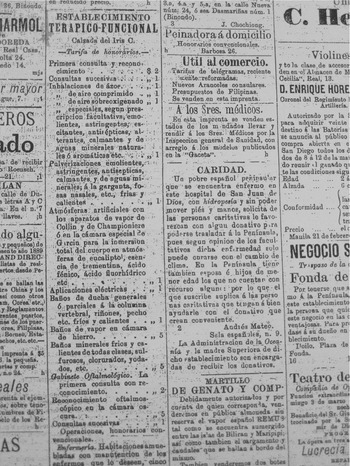
Sometime in the 1880s, an Establecimiento Terápico Funcional—what might be known as Manila's first spa—opened its doors to fashionable Manila society. Very little is known about this establishment and the entrepreneurs behind such a business, but its presence was announced in numerous advertisements that first appeared in early 1889 within the pages of the Spanish newspaper, El Comercio.Footnote 34 The building was situated in the Calzada del Iris, an upmarket location not far from Malacañang, the Governor-general's palace. The number of attending medical staff is unclear and the establishment did not seem to have any connections with Manila's hospitals, though it appeared to employ several physicians. There was a senior physician, the médico director, with whom a patient consulted and whose presence could be requested at certain treatments. A patient would be assigned a physician who had the authority to prescribe, without prior consultation with the médico director, the number of sessions and treatment that only involved inhalation, baths, showers, and sprays. This physician could accompany the patient during treatment. Facilities seemed to have been state of the art: on offer was use of the electric powered carbolic steam apparatus pioneered by the renowned French surgeon and advocate of massage treatments, Just Lucas-Championnière (1843–1913); an ophthalmology gabinete; an ‘iron chamber’ for steam baths; a dark chamber (cámara oscura) for examining the eyes using an ophthalmoscope; bath chambers; and recovery rooms (the enfermería), which offered serviced and furnished places for rest and repose (see Figure 1).
Advertisement for Manila's Establecimiento Terápico Funcional.

Potential customers were spoilt for choice by the variety of treatments available in Manila's Terápico Funcional. Hydrotherapeutic treatments ran the gamut of fashionable water cures that were all the rage in late nineteenth century Europe: steam baths; baths of hot and cold mineral waters (sulfurous, iodinated, or with chloride); hot and cold bath chambers for whole body immersion with a choice of heady, aromatic atmospheres—eucalyptus, hydrofluoric acid, carbolic acid, arsenicals, and mercuriales; showers that could be locally applied to the chest, spinal column or kidneys; emollient, astringent, antiseptic, and mineral water sprays for specific regions of the body, or for small delicate areas such as the throat and nasal cavities; electric applications; and inhalations of compressed or oxygenated ‘air’.Footnote 35
As it is today, the cost of luxurious pampering was prohibitively high. A first consultation was two Mexican silver dollars (known as pesos).Footnote 36 The priciest treatments, costing a small fortune of five pesos, were for the steam and mineral baths, and ophthalmoscopic examinations. Electrical stimulation and use of the Championnière steam apparatus were bargains at only one peso. A room in the enfermería cost five pesos daily without ‘apparatus’.Footnote 37 That the delights of the Terápico Funcional lay out of reach of most of Manila's inhabitants is best illustrated by comparing wage earnings and prices. Salaries of middle class workers at the lower end of the scale, such as clerks and skilled workers in the tobacco and printing industries, ranged from between 15 and 20 pesos to 25 pesos a month; male and female house servants received five and ten pesos a month respectively; and women who worked as seamstresses and did laundry earned around five pesos a month.Footnote 38
The advertisements placed in El Comercio tell little of the well-heeled clientele who crossed the doorways of the Terápico Funcional. Neither can the gender composition of users be ascertained—the advertisements were not overtly directed at men or women and contained little in the way of eye-catching detail or drawings. Many of the ailments and complaints treated at the establishment afflicted both men and women—illnesses of the heart, chronic pain, catarrh, and other kinds of congestion, phthisis (known today as tuberculosis), conditions of the throat and chest, scrofulous, and rickets, for example, all of which could be treated, the advertisements claimed, with inhalations of compressed or oxygenated air or hydrofluoric acid. But it is reasonable to infer that some of the treatments offered were intended to treat the ‘disorders’ that related to women. The warm water douche, for instance, had been commended for hysteria at the Salpêtrière hospital in Paris by 1890; in England ‘congestion’ in the pelvic region was reportedly cured using localized irrigation in conjunction with electrotherapy.Footnote 39 In a number of advertisements for Manila's Terápico Funcional, electrical machines and apparatus were recommended for nervous conditions and weakness; similarly, water treatments—spraying, the hot and cold baths, and showers—explicitly addressed ‘nervous illnesses’ (enfermedades nerviosas), ‘mental conditions’ (afecciones mentales), and ‘feebleness’ (debilidad).Footnote 40 Application of these therapies must have involved the use of the same sorts of mechanical apparatus and procedures followed in European spas, such as the projection or pumping of water, and the mechanized stimulation of the vulva using hydriatic massage.
Since the high cost of these treatments excluded all but the truly wealthy, it is likely that few Filipinos had an opportunity to use the rejuvenating facilities on offer at the Terápico Funcional. This did not mean, however, that knowledge of the treatments and their efficacy was completely unheard of. Filipino physicians, returning to the Philippines in the 1890s after completing their medical training in Paris and Madrid, established their own practices specializing in the lucrative field of obstetrics and gynaecology. Men such as Felipe Zamora (1854–1919), Ariston Bautista Lin (1863–1928), and Galicano Apacible (1863–1928) were at the vanguard of medical care for parturient women and the treatment of women's illnesses.Footnote 41 Elite Filipino women, often acting on the recommendation of their male relatives who were, as in the case of Rizal, personal friends with the physicians, sought out their expertise and consulted them regarding a range of female bodily complaints. Zamora, for instance, was called upon to treat Saturnina Hidalgo, Rizal's elder sister, whose uterus had become, according to Zamora's diagnosis, ‘swollen, out of place and dirty’. Zamora advised her to purchase vaginal syringes presumably to administer the medicine he had prescribed.Footnote 42 Paciano, Rizal's elder brother, who regularly corresponded with Rizal in Europe and liked to keep abreast of modern innovations, discussed with Rizal whether their younger sister Narcisa, suffering from ‘la locura’ (madness), would benefit from a course in hydrotherapy.Footnote 43
While it is not known whether patients were advised by their doctors to visit the Terápico Funcional, Filipino physicians, it is certain, were introducing the treatment methods they had learned in Europe and employed some of the associated technologies—at the very least, the use of vaginal syringes, pumps, and douches—to address uterine disorders. At the turn of the twentieth century, mechanized therapies for afflictions concerning the female body underwent a radical change in terms of how they were marketed and to whom. European and American chemists in Manila began to stock American-made electromechanical vibrators, signalling an effort to sell ‘vibratory therapy’ as beneficial to a woman's health, and also to help her achieve a look that was modern and part of a modern lifestyle. Electromechanical devices for women were things any woman could—and—should use. Under new American marketing strategies, this fresh message sought to bring vibrators to a general public, joining other new electric and gas appliances that purported to transform a woman's physical appearance and the home kitchen.
The modern look
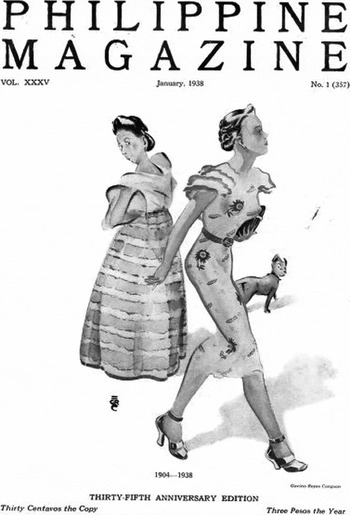
The revolutionary change that was said to have occurred in Filipino women dating from the arrival of the Americans in the Philippines was nicely depicted on the front cover of the January 1938 anniversary edition of the Philippine Magazine (see Figure 2). Captioned by the dates 1904–1938, the cover shows a drawing of two women and a dog in what is imagined to be a random scene in a city street. The differences between the women—in their styles of dress, hair, stance, and stride—sought to represent the progress made by Filipino women over three-and-a-half decades. The woman shown slightly in the foreground embodies the change: she is a striking image of youth, vitality, confidence, and style. She wears Western clothing that provocatively reveals her bare arms, legs, and a graceful neck. She wears the latest fashions: high-heeled, ankle-strap shoes, a belted dress that emphasizes her svelte figure, and a clutch bag that gives her the sort of panache that came from studious attention to current styles. Her hair, ‘bobbed’ short and waved, is of the latest style that could only have been produced by knowledgeable hairstylists with machines that waved the hair just so. She is seen striding out, dynamic and busy looking. She gazes ahead, with a hint of disdain, a hint of eagerness. She is a product of modernity and a picture of cosmopolitan femininity. With her little turned up nose, ‘bee-stung’ lips, and upward tilt of the head, she is the iconic ‘modern girl’ that emerged in the 1920s and 1930s, trim, polished, and glamorous, whose sisters could be found all around the world.Footnote 44
The Filipina ‘modern girl’.

Many stare; even the dog cocks an ear. The woman shown slightly in the background and seen from behind looks over her shoulder with a backward glance that appears shocked; her pursed lips and raised eyebrow indicating either disapproval or amazement or both. She is of the past. Her stance gives the impression that she will remain in the past. She appears static, stiff, and almost immobile. Her hair is piled into the chignon of old; her clothing is the Hispanic baro't saya of a bygone era that weighs her down with long, heavy skirts in outdated stripes, and the camisa and panuelo blouse made from local cloth that was starched to rigidity. She is literally and figuratively in a backward position. Implicitly, she is the woman who would continue to speak Spanish, the outdated language of yesterday, and belong to a country that appeared to no longer exist.
The modern Filipino ‘girl’ that advertising campaigns and magazine editors in Manila liked to depict possessed a Westernized aesthetic—wide-eyed, with an elongated body. To achieve the modern look required fashionable clothing and accessories but also, more emphatically, the consumption of a host of the latest imported cosmetics, creams, and soaps. Advertising copy extolled the benefits of beautiful skin, lips, dazzling teeth, firm mouth, and glossy hair that could be obtained from imported ‘beauty aids for busy women’ which held the promise of a flawless, odourless physical existence. The ‘Modern Girl's beauty and youthfulness,’ Weinbaum et al. wryly observe, was ‘linked to scientific hygiene.’Footnote 45 In an article published in 1928 in the Philippine Education Magazine entitled ‘The Road to Beauty’, women were advised to follow a routine of morning exercises, bathing, and a modest breakfast.Footnote 46 Writing on women's health in the tropics, Mrs Samuel Gaches, chief nurse at the Philippine General Hospital, extolled the virtues of regular vaginal douching using scalding hot water ‘for cleanliness, to check haemorrhage, arrest inflammation, and to relieve pain. The douche should be as hot as can be tolerated from 110f to 115f.’Footnote 47
Sensible advice, however, did not have quite the same impact as beauty treatments, which offered the most decisive transformation, especially to those who utilized mechanized vibrating electric devices or electric hair irons. The 1920s witnessed a boom in local beauty parlours.Footnote 48 These were often establishments that conveniently offered hairdressing, facial, and body treatments. At this time, mechanized treatments and electrotherapeutic devices came into their own and entered the mainstream. The 1920s style of fashioning the hair into the ‘Marcel Wave’ distinguished by undulating ‘finger’ waves in bobbed hair, a style that became popular around the world, necessitated the use of heated electric irons.Footnote 49 The Rizal Province Directory contained numerous advertisements for beauty parlours whose services were advertised in Tagalog with English words, illustrating the emergence of the new lingua franca, a linguistic hybrid that came to be known as ‘Taglish’.Footnote 50 Rosa's Beauty Parlor, for example, curled hair day and night and offered: ‘flat wave, round wave, finger wave, at [and] ringlets’ and sold assorted hairdressing products to keep waves in place: ‘kagaya ng [just like] Frederick's liquid, hair trane at Brilliantine’.Footnote 51 Mrs T. M. Nicol's Hair Dressing Parlor in Ermita specialized in the latest ‘permanent hair waving’, but also seemed to be a successor to the earlier Terápico Funcional. The parlour offered ‘Turkish Baths’, which included steam rooms, vapour boxes, mineral baths, body massaging by hand, use of the electric vibrator, and ‘violet rays’.Footnote 52 The latter was particularly novel and Mrs Nicol, advertising in 1923, seemed to be ahead of the game. The violet ray devices and equipment that combined the emission of violet rays and electromechanical vibration only became available in the US, Canada, and Britain in 1932. The machines, fitted with glass and rubber applicators, provided women with ‘pulsation massage’ or ‘suction massage’ on ‘the delicate parts of the face and body’.Footnote 53
A new section that appeared in the American Chamber of Commerce Journal entitled ‘In and Out of the Shops’ detailed the latest vogue in more upmarket luxurious beauty treatments. Aimed at the American woman who felt she was wilting in the tropical climate of the Philippines, the treatments addressed the ‘queer faded drawn look about the mouth and eyes’ that seemed to afflict the complexions of American women. Electric massage machines and ice to stimulate the face were thought to be particularly effective:
The patient holds the electrodes, one in each hand. The operator then massages the face and throat. A current is set up between the two and a delightfully tingly sensation seems to ooze from the tips of the operators fingers where ever they touch the patient's face. This treatment brings the blood to the surface and relieves the sluggishness of the skin.Footnote 54
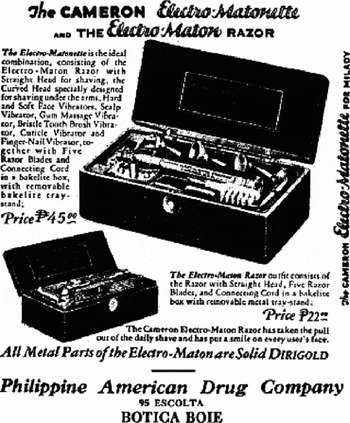
Electric vibrating devices for home use had been advertised in the US since the turn of the century through to the 1930s. It is unclear when advertisements for home vibrators first made an appearance in Manila, but by the 1920s and 1930s, their presence in print advertisements had become relatively common. A popular kit seemed to have been the Cameron Electro-Matonette and the Electro-Maton Razor (see Figure 3). The kits were sold by the Philippine American Drug Company and could be bought in upmarket Escolta, at the German-run chemist Botica Boie. The Electro-Matonette, with a price tag of 45 Filipino pesos (or 22.50 US dollars), was a Bakelite box filled with vibrating and massaging equipment. The razor came with straight and curved heads for shaving underarm hair; ‘hard and soft face vibrators’; ‘scalp vibrator’; ‘gum massager vibrator’; ‘bristle tooth brush vibrator’; and ‘cuticle vibrator and finger-nail vibrator’. The second set, for 22 pesos, only contained the razor with assorted heads. Both boxes came with a connecting electrical cord and both, according to their endorsers, took the ‘pull out of the daily shave and put a smile on every user's face’. This might seem as if they were for men's use, but the sets were for women, or as the advertisement stated, for ‘milady’.Footnote 55
Advertisement for the ‘Cameron Electro-Matonette’.

If electrovibrating devices and electric hot irons in beauty parlours and for use at home offered women consumers ways to look modern and Western, the purchase of appliances for the home, especially for the kitchen, brought American bourgeois living into Filipino homes. One of the most powerful advertising campaigns, which generated high sales, was for electric- and gas-powered kitchen appliances. The expanded availability of electricity and gas must have contributed to their popularity. Since 1900 the US colonial government had been taking measures to enlarge the provision of electricity to urban spaces, public, and private establishments.Footnote 56 In 1903, the government granted a franchise to the newly formed Manila Electric Railroad and Light Company (MERALCO) to build, maintain, and supply an electric light, heat and power system in Manila and the surrounding suburbs.Footnote 57 The Manila Gas Corporation, owned mainly by a company based in Chicago, piped gas into city homes.Footnote 58 Sustained and intensive advertising campaigns, conducted by both these companies over three decades, promoted gas and electricity as modern fuels, even encouraged the belief that they were ‘part of the reward civilization had brought’, ‘within the reach of the humblest citizen today. . . the cheapest good thing in existence’, and convenient and time-saving—‘you just touch a button’.Footnote 59
Frequently, these messages were explicitly directed at women. Electricity was a ‘liberating service’ that entered the home: ‘strong, reliable, willing, it responds to a snap of the fingers, and relieves woman of household tasks that have burdened her for centuries’.Footnote 60 Advertisements for kitchen appliances promoted the same ideas. Electric water heaters, percolators, toasters, waffle-irons, and grills ‘all help to make life more comfortable’; they made manifest a mother's care—‘use hot water for baby's bath and clothes’; they were easy to use, even the expensive and impractical gas refrigerator had ‘no moving parts. . . to annoy’,Footnote 61 and affordable, monthly payment plans were available for gas water heaters and stoves.Footnote 62 When advertisements appealed to men, women were still thought of as the primary users. Messages stressed the product's durability and a man's thoughtfulness: electric kitchen appliances made lasting gifts that were bought by a mindful husband ‘to remind the recipient that you remembered her’; or were meant to encourage wives to cook their husband's favourite food: ‘YOU like waffles; tell the Mrs about these and ask her to order one.’Footnote 63
Powerfully persuasive, these advertising campaigns targeted magazines with a female readership. Advertising expenditure for the Ladies Home Journal was the second highest in 1921.Footnote 64 This foreign magazine, available in Manila newsstands, had the second largest circulation, and the Woman's Home Companion, the fifth largest. It was argued that these periodicals were mainly read by the ‘English-speaking young Filipino’.Footnote 65 Advertising messages also found resonance in the new field of domestic science. Since the early 1920s, school curricula included a highly influential domestic science component whose teachers worked hard to inculcate the value of sanitation and hygiene in food preparation and healthy living in the tropics. Manuals sought to change Filipino eating habits, which were deemed to be nutritionally deficient, dirty, and literally worm-ridden, and to raise the standard of public health to a level ‘compatible to a progressive people.’Footnote 66 This thinking resonated with America's own prevailing obsession with germs, and the conflation of hygiene and cleanliness with modernity.Footnote 67 A modern kitchen was one in which stoves and kitchen utensils operated without the soot and smoke that came from fires and, importantly, could be scrubbed clean unlike the old-style kalan (firewood-using stove), and earthenware palayok pot whose scorched, cracked presence was banished to the outdoor cooking area, where food had always been prepared, but was now fast becoming a space referred to as the ‘dirty kitchen’.Footnote 68
However, it was unlikely that the mistress of a household that could afford American kitchen appliances would herself toil in the kitchen preparing the family's meals. That task was left to servants who lived with the family and often endured a master-servant relationship that was fraught with tension and suspicion.Footnote 69 Data for the late nineteenth century show elite Filipino and Spanish households hiring, at a minimum, a domestic servant, a laundry woman, and a cook. Rizal's family, for instance, employed a 46-year-old male Chinese cook. In the 1902 census, the household cook was revealed to be the eighth largest occupation in the country. From the late nineteenth century on, and in Filipino, European or bourgeois American households, cooks were expected to prepare daily, varied meals on a budget.Footnote 70 Rafael's observation that domestic order in American homes relied on the labour of servants might very well be applied more generally.Footnote 71 The ubiquity of servants in households, and a family's dependence on their labour, indicates that the appeal of modern appliances lay not in their labour-saving qualities, but in their symbolic dimensions.
Gas and electrical kitchen appliances were touted as emblems of modernity and affluence, synonymous with an American lifestyle and epitomizing American-ness. The grand opening of the showroom of the Manila Electric Railroad and Light Company and shops for electric appliances in Manila underlined how America and a modern, affluent lifestyle were thought of as one and the same:
New York has come to Manila. . . Personally [the stores] made me so homesick I had to go inside. . . the spaciousness, the uncluttered orderliness, the simplicity, the arrangement of the fixtures and furnishings, so different from that found in most stores in the orient, bespoke moderness [sic] down to the smallest detail. Manila is indeed progressing.Footnote 72
During the 1920s and 1930s, Manila consumer culture revolved around the pursuit of a modern look that informed the most quotidian and intimate aspects of a woman's life—the clothes she wore, how she styled their hair, how she washed and kept her body and face looking healthy, how food was prepared, in what part of the house, and using what kinds of equipment. Modernity, the image of an affluent lifestyle, and the American identity that knit these elements together coalesced in technological objects whose use and possession promised to change a woman forever.
Technology and the Americanization of everyday life
A major economic consequence of American state-building in the early years of US colonization was the massive increase of American imports. In 1910, less than ten years after Roosevelt had officially declared the Philippine-American war over, it was calculated that US imports in just one year, 1909, had risen by 129 per cent, with an increase of total imports amounting to almost 20,000,000 US-Filipino pesos.Footnote 73 The combined efforts of nationwide public school education through instruction in English and advertising campaigns helped, in no small measure, to open the hearts and minds of ordinary Filipinos to American goods. As the first few hundred American schoolteachers disembarked the refitted battleship USS Thomas in the summer of 1901, and fanned out across the archipelago, with the same zeal as religious missionaries, to educate Filipinos for citizenship, advertising campaigns sought to persuade Filipinos of the desirability of American manufactures and foodstuffs and the modern American lifestyle they symbolised.Footnote 74 Domestic science courses taught in public schools introduced new apparatus for the kitchen, and tutored Filipinos in kitchen sanitation and refrigeration. Manuals written in Tagalog advised on ‘modern table manners’, hygiene in food preparation, and the use of assorted tableware, including knives and forks.Footnote 75 Such advice often went hand-in-hand with advertisements for American foods and kitchen appliances.
In contrast to previous European merchandizing strategies, American advertising methods strove to reach as many people as possible. Advice to American businesses on how to successfully market products in the colony emphasized understanding Filipino habits, customs, and the country's climate; and bombarding private residences (through direct house-to-house leafleting) and the public domain (from newspapers to billboards and streetcars) with posters, handbills, pamphlets, and slides (shown in cinemas). Advertising messages, it was advised, should be written in simple English, with translations in Philippine languages, and heavily illustrated with drawings.Footnote 76
As we have seen, new technologies, fuels (especially electricity), and European luxury food imports were introduced to Manila in the last decades of Spanish rule and became part of the fabric of city life. By the first decade of American rule, greater numbers of urban Filipinos had become familiar with a host of new small foreign technologies—cylinder record players, moving pictures, lantern slides, telephones, and typewriters.Footnote 77 American advertising campaigns employed aggressive tactics that capitalized on a pre-existing familiarity with foreign goods, and exploited existing social conditions. ‘Salmon and milk are quite well-known to the Filipino,’ observed publicity men, but previously unheard of comestibles such as breakfast foods and canned goods required ‘considerable educational literature to introduce them’.Footnote 78 To take other examples, the country's high infant mortality was viewed as a good opportunity to sell canned sweetened condensed milk, a product promoted as a healthful food for babies. Advertising men linked the special social circumstances to the product's success. Most effective was the use of ‘drawings showing Filipino babies, doctors and mothers and testimonials from doctors and mothers in the Islands. . .’.Footnote 79
Although the acceptance of American domestic technological goods was, inevitably, most visible on the bodies and in the homes and culinary practices of bourgeois Filipino women, the burgeoning suburban Filipino middle class was purchasing a range of domestic technologies by the 1920s, investing in gas water heaters, and oil or gas cooking stoves for their homes.Footnote 80 Recalling in her memoirs the comfortable Manila middle class upbringing she enjoyed as a child, Celia Mariano proudly detailed the family's ownership of a car, an ice-box, and a Victrola gramophone upon which her father would play opera and classical music records.Footnote 81
A growing taste for American foodstuffs, particularly canned fruit and meats, leavened cakes made with wheat flour instead of rice, food and drinks that required chilling or to be kept cold, spurred the sale of electric and gas cooking ranges, pressure cookers, ice-boxes and refrigerators, goods that were directly targeted at women consumers. American cuisine was celebrated in local newspapers and housekeeping manuals that printed ideal menus for ‘summer dinners’ featuring iced beverages, jellies, and cakes. The Instituto de Mujeres, a college for women in Manila, served tinned evaporated milk with coffee and chocolate.Footnote 82 Less affluent women could still modernize their kitchen in accordance with American ideals by buying cheaper alternatives to electric and gas appliances. Advertisements for the popular ‘smokeless Mayon stove’, a Filipino-designed stove that still used firewood and coconut husks but directed smoke away through an attached flue, endeavoured to convince husbands to buy the stove for their wives: ‘Treat your wife. . . it'll mean so much less drudgery in the kitchen. . .’.Footnote 83
Even attempts by nationalist Filipino women to wean Filipinos away from imported American food did not reject imported kitchen appliances and domestic technologies. Maria Y. Orosa (1893–1945), a Filipina educated in the US who returned to the Philippines to work as a chemist and food technologist at the Bureau of Science, struggled hard to undermine the desirability of imported fruit and canned goods and return local food to popularity. Famously, her recipes for fruit preserves substituted imported fruit, such as peaches and grapes, for locally grown fruit and she modified the palayok to function like an oven to bake cookies made with rice bran, darak, rather than wheat flour in the fight against beriberi among the poor.Footnote 84 But, without irony, the arsenal of equipment she advised Filipino women to use in preserving food included gas or electric steam ovens and steam pressure cookers.Footnote 85
Conclusion
From the 1880s to the first decades of the twentieth century, technological goods for the home and for the body were associated with the country's ruling elites, be they Spanish, American or Filipino. Growing prosperity by the late 1920s, however, enabled the newly emerged Filipino middle class to acquire or, at least, have access to imported technologies. Domestic science classes in public schools, the spread of the English language, and aggressive advertising campaigns combined to bring the message to Filipino women that American technological goods were part of an American identity that was thoroughly advanced, egalitarian, and economical. In reality, beauty parlours were visited only by women who could afford the treatments. Electric and gas kitchen appliances did not end dependence on the labour of servants by the upper and middle classes, nor did they stop the use of firewood stoves and clay pots, the kalan and palayok. However, there were no signs that the appeal of these technologies would wane. The promises they held, the possibilities they offered brought a perceptual and experiential understanding of the good life. Further, the technologies discussed here—from vibrators to waffle-irons—belonged to the category of new worldly goods whose possession denoted not mere materialism, affluence or vanity. Rather, luxury technological goods came to embody certain moral qualities that an individual could assert—a fine discerning taste regarding material things, even the demonstration of such moral virtues as healthful living, cleanliness, and physical good looks, and a cosmopolitan outlook.Footnote 86 In other words, technologies of conspicuous consumption claim an important history in Manila's consumer culture—they played a part in new ways of thinking about a woman's body, the spatial organization of the home, how it felt to be modern and, even, what it meant to have good taste and a knowledge of the world.