INTRODUCTION
Central to effective emergency preparedness is the engagement of public audiences before a crisis occurs.Reference Coppola and Maloney1 In engaging the public, health and safety organizations must design their messages to clearly describe the concrete steps that individuals can take in order to prepare for and respond to emergencies when they occur. On one hand, these messages must be clear in advocating for specific actions, so that the message content is readily understood and remembered by the target audience.Reference Coppola and Maloney1 On the other hand, these messages should restrain from being overly forceful, lest they arouse psychological reactance.Reference Brehm2
Psychological reactance theory (PRT) relies on the foundational premise that individuals cherish their autonomy.Reference Brehm2 Psychological reactance is the motivational state that occurs when an external stimulus is perceived as threatening one's freedom to choose.Reference Brehm2 Psychological reactance is operationalized as an amalgamation of anger and negative cognitions,Reference Dillard and Shen3 which is preceded by a freedom threat.Reference Quick, Shen, Dillard, Dillard and Shen4 From the standpoint of designing persuasive messages, the arousal of reactance should be avoided whenever possible, as reactance is associated with undesirable persuasive outcomes, including diminished attitudes and intentions.Reference Quick, Shen, Dillard, Dillard and Shen4 Given the undesirable consequences of reactance, considerable research has examined the language and message features most likely to elicit or inhibit reactance.Reference Quick, Shen, Dillard, Dillard and Shen4,Reference Rosenberg and Siegel5 In particular, messages featuring choice-restricting language have been shown to elicit greater freedom threat and subsequent reactance than messages using choice-enhancing language.Reference Rosenberg and Siegel5
The current study seeks to use PRT as a framework for developing effective emergency preparedness messages. The use of choice-restricting language in an emergency preparedness message (eg, “you must”) is anticipated to elicit greater freedom threat and subsequent reactance than a message featuring choice-enhancing language (eg, “the choice is yours”). Expected outcomes of reactance include diminished attitudes and subsequent intentions toward the advocated behavior.Reference Quick, Shen, Dillard, Dillard and Shen4 The logic of the current study is formalized below as hypotheses,
H1: Choice-restricting language will elicit greater freedom threat than choice-enhancing language.
H2: Freedom threat will be positively associated with psychological reactance.
H3: Psychological reactance will be negatively associated with attitude.
H4: Attitude will be positively associated with behavioral intention.
METHODS
This study was a between-subjects-posttest-only online survey experiment. Participants (N = 174) were randomly assigned to view 1 of 2 messages (choice-restricting language vs choice-enhancing language), advocating for preparing an emergency kit. Participants were recruited via Amazon's Mechanical Turk (MTurk). Participants were eligible to complete the study if they met the following criteria: (1) 18 years of age or older, (2) US citizens or residents, and (3) MTurk reliability rating of 0.80 or higher.
Participants (N = 174) ranged in age from 20 to 98 years (M = 36.06, SD = 12.37) and were mostly female (61.5%). Most participants were white, or Caucasian (73.6%); followed by African American, or black (9.8%); Asian (7.5%); Hispanic, Latino, or of Spanish origin (6.9%); American Indian or Alaskan Native (1.7%); or some other racial/ethnic background (2.3%). Participants were well represented in terms of annual household income (< US $15 000 [10.9%], $15 000–$24 999 [9.8%], $25 000–$34 999 [17.2%], $35 000–$49 999 [13.8%], $50 000–$74 999 [23.6%], $75 000–$99 999 [10.3%], $100 000–$149 999 [8.6%]; $150 000–$199 999 [1.1%], ≥ $200 000 [2.3%], did not answer [2.3%]). Half of the participants (50.0%) had personally experienced a disaster at some point in their lives. Few participants (39.1%) had an emergency kit in their home.
Messages were text-only and approximately 140 words in length. Messages were based off of Centers for Disease Control and Prevention (CDC) recommendations (see https://www.cdc.gov/disasters/earthquakes/supplies.html). The experimental manipulation was included in the last line of the message. In the choice-restricting condition, the message concluded by stating, “You must create an emergency kit to protect yourself in case of a disaster. You simply have to do it!” In the choice-enhancing condition, the message concluded by stating, “Consider creating an emergency kit to protect yourself in case of a disaster. The choice is yours!” See Supplementary Material for message stimuli.
MEASURES
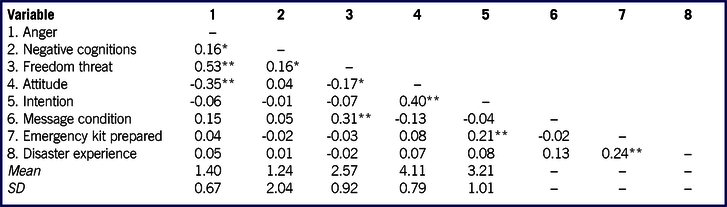
Unless otherwise noted, all items were measured on a 5-point Likert scale (1 = strongly disagree to 5 = strongly agree). See Table 1 for a correlation matrix, means, and standard deviations for all variables. See Supplementary Material for all study measures.
Zero-Order Correlation Matrix, Means, and Standard Deviations

Note: *P < 0.05, **P < 0.01. Message condition was coded: 0 = choice-enhancing language, and 1 = choice-restricting language. Emergency kit prepared and disaster experience were both coded: 0 = no, 1 = yes.
Psychological reactance is operationalized as a latent construct comprising anger and negative cognitions.Reference Dillard and Shen3,Reference Quick, Shen, Dillard, Dillard and Shen4 Anger (α = 0.92) was assessed on a 4-point Likert scale (1 = none of this feeling to 4 = a great deal of this feeling) with 4 items (irritated, angry, annoyed, aggravated)Reference Dillard and Shen3 prefaced by the stem, “How did you feel while viewing this message?” Negative cognitions were assessed via the thought-listing procedure.Reference Petty and Cacioppo6 Participants wrote down all of the thoughts they had while viewing the message, and coded each thought for relevance (ie, if the thought was relevant or irrelevant to the message) and valence (ie, if the thought was negative, neutral, or positive).Reference Quick, Shen, Dillard, Dillard and Shen4 For subsequent analysis, only participants’ relevant, negative thoughts were retained (see Quick et al.Reference Quick, Shen, Dillard, Dillard and Shen4 for more on this method).
Freedom threat was measured with 4 itemsReference Dillard and Shen3 (eg, “The message tried to pressure me”; α = 0.83). Attitude was measured with 4 itemsReference Fishbein and Ajzen7 (eg, “Preparing an emergency kit for my home is a good thing for me to do”; α = 0.94). Behavioral intention was measured with 3 itemsReference Fishbein and Ajzen7 (eg, “In the next month, I plan to prepare an emergency kit for my home”; α = 0.87).
RESULTS
Analyses were conducted using structural equation modeling with the maximum likelihood robustFootnote * estimator in Mplus 8.0 for Mac. Model fit was considered “good” when CFI ≥ 0.95, and SRMR ≤ 0.08.Reference Kline8 Model fit was considered “acceptable” when CFI ≥ 0.90, and SRMR ≤ 0.09.Reference Holbert, Stephenson, Hayes, Slater and Snyder9 RMSEA is not reported because the sample size of the current study is less than 250.Reference Holbert, Stephenson, Hayes, Slater and Snyder9 Consistent with established procedures, the 2-step analysis procedure was employed.Reference Kline8 Before examining the hypothesized structural model, the measurement properties of all 4 latent variables (freedom threat, anger, attitude, intention) were examined via a confirmatory factor analysis. The measurement model demonstrated acceptable fit, χ2 (83, N = 174) = 161.50, P < 0.001, CFI = 0.93, SRMR = 0.06.
For the main analysis, message condition was modeled as an observed variable (0 = choice-enhancing language, 1 = choice-restricting language). Reactance was modeled as a latent variable comprising anger and negative cognitions. A preliminary analysis revealed that having an emergency kit was associated with behavioral intention and was controlled for in the analysis. The hypothesized structural model demonstrated acceptable fit, χ2 (85, N =174) = 19.24, P < 0.001, CFI = 0.92, SRMR = 0.07. The unstandardized path coefficients (UPC) and standardized path coefficients (SPC) are included below. See Figure 1 for a visual representation of the structural model.
Structural Model.

In support of H1, choice-restricting language elicited greater freedom threat than choice-enhancing language (UPC = 0.40/SPC = 0.29, P < 0.01). In support of H2, freedom threat was positively associated with psychological reactance (UPC = 0.64/SPC = 0.74, P < 0.001). In support of H3, psychological reactance was negatively associated with attitude (UPC = -0.48/SPC = -0.40, P < 0.001). In support of H4, attitude was positively associated with behavioral intention (UPC = 0.44/SPC = 0.37, P < 0.001). The structural model accounted for the following variance in endogenous variables: (1) freedom threat (R 2 = 0.08), (2) reactance (R 2 = 0.54), (3) attitude (R 2 = 0.16), and (4) intention (R 2 = 0.16).
DISCUSSION
The purpose of this study was to apply PRT in order to identify effective messaging strategies for public engagement of emergency preparedness behaviors. Consistent with existing PRT research,Reference Quick, Shen, Dillard, Dillard and Shen4,Reference Rosenberg and Siegel5 the use of choice-restricting (vs choice-enhancing) language in an emergency preparedness message elicited greater freedom threat (H1) and subsequent reactance (H2). Reactance was associated with diminished attitude (H3) and subsequent behavioral intention (H4). From a practical standpoint, public health practitioners tasked with developing emergency preparedness messages for public audiences should use choice-enhancing language, while avoiding choice-restricting language.
The study also speaks to the practicality of applying PRT during the formative stages of message design. In particular, to prevent potential boomerang effects, message content and language should be pretested to ensure that reactance is not unintentionally elicited among target audiences. The study adds to the existing toolkit of theories that emergency preparedness scholars can draw on for formative research, design, and evaluation.
Future research can improve upon this study in several ways. First, the study was limited by the use of behavioral intention in lieu of a behavioral outcome. Second, the study examined a single topic (preparing an emergency kit). Third, participants were predominantly white. Racial minority groups in the United States are more vulnerable to natural disasters and suffer disproportionally from their consequences.Reference Bolin, Kurtz, Rodríguez, Donner and Trainor10 Future research could build on the current study by measuring behavioral outcomes, examining additional topics, and recruiting a more diverse sample in terms of race.
CONCLUSION
Emergency preparedness messages featuring choice-enhancing language were found to be more effective – via reduced freedom threat and reactance, resulting in more favorable attitudes and intentions – than messages with choice-restricting language. Public health practitioners would benefit from including choice-enhancing language in their communications, while avoiding choice-restricting language. Pretesting messages to ensure that reactance is not elicited among target audiences is also recommended.
CONFLICT OF INTEREST STATEMENT
The authors have no conflicts of interest to declare.
SUPPLEMENTARY MATERIAL
To view supplementary material for this article, please visit https://doi.org/10.1017/dmp.2020.11.