INTRODUCTION
The exceptional diversity and biomass of invertebrates in grassland ecosystems as well as their strong influence on ecosystem functioning and the provision of ecosystem services have been studied frequently (Andersen Reference ANDERSEN1990, Buckley Reference BUCKLEY and Buckley1982, Dosso et al. Reference DOSSO, KONATE, AIDARA and LINSENMAIR2010, Josens et al. Reference JOSENS, DOSSO and KONATE2016, New Reference NEW2000, Underwood & Fisher Reference UNDERWOOD and FISHER2006, Wilson Reference WILSON1987). Fire can be one of the most important sources of disturbances in grassland ecosystems being both frequent and widespread across Australian, African and South American savannas (Bond & Keeley Reference BOND and KEELEY2005). Hence both fire and invertebrates are key components influencing the functioning and dynamics of savannas (Van Wilgen et al. Reference VAN WILGEN, GOVENDER and BIGGS2007).
However, changes in fire regimes, i.e. the intensity and frequency of fire, may also lead to significant changes in the dynamics and composition of invertebrate communities. Ants are abundant and diverse in almost all terrestrial habitats (Hölldobler & Wilson Reference HÖLLDOBLER and WILSON1990) and sensitive to environmental changes (Andersen Reference ANDERSEN1990, Majer Reference MAJER1983). For this reason, they are widely used as bioindicators for invertebrates and are included in monitoring programmes focusing on the impact of human activities on biodiversity and ecosystems (Andersen Reference ANDERSEN1993, Heterick et al. Reference HETERICK, LYTHE and SMITHYMAN2013).
In the Lamto savanna, the mid-season fire (up of 50 years of burning) is the fire regime implemented since the creation of the reserve in 1961 to maintain the structure of the savanna: i.e. the coexistence between grasses and trees. Although this fire regime is the most frequently employed management tool for the maintenance of the humid savanna, it now seems inefficient because of the increase in tree density observed during the last three decades (Dauget & Menaut Reference DAUGET and MENAUT1992, Dembélé Reference DEMBÉLÉ2008, Gautier Reference GAUTIER1990). To slow down tree encroachment, alternative fire regimes should be implemented. In fact, the effect of prescribed mid-seasonal fire on savanna vegetation is well-known in Lamto (Gignoux et al. Reference GIGNOUX, CLOBERT and MENAUT1997, Reference GIGNOUX, LAHOREAU, JULIARD and BAROT2009; Mordelet Reference MORDELET1993, N'Dri et al. Reference N'DRI, GIGNOUX, DEMBELE and KONATE2012, Reference N'DRI, GIGNOUX, BAROT, DEMBELE and WERNER2014). According to these studies, fire destroys much of the herbaceous stratum and affects adult trees. Furthermore, the mortality of tree stems is known to increase with fire intensity. In short, the action of fire results in modified plant abundance and distribution, creating spatial heterogeneity, and thus maintaining a mosaic pattern of the vegetation. Also, it plays a crucial role in determining the system's structure and also some of its functional properties (Abbadie et al. Reference ABBADIE, GIGNOUX, LE ROUX and LEPAGE2006, Ménaut & Abbadie Reference MENAUT, ABBADIE, Abbadie, Gignoux, Le Roux and Lepage2006). In spite of several studies on fire ecology in Lamto, very few studies make reference to the change in fire regime. The application of other fire regimes, if they were used more regularly to prevent natural afforestation, could have some consequences on savanna fauna and particularly on soil fauna and invertebrates (Andersen Reference ANDERSEN1991).
The aim of the present study was to explore the immediate effects of three different fire regimes (early, prescribed mid-season and late fires) on ground-dwelling ants. We predicted that ant species richness and abundance would variably change due to specific alterations associated with each fire regime. Williams et al. (Reference WILLIAMS, COOK, GILL and MOORE1999) showed that the late fire regime has a negative impact on trees. As it is known that soil organisms are linked to vegetation structure, we advanced the hypothesis that ant species composition will be more affected by late fire than the two other fire regimes.
METHODS
Study site
To test our hypotheses we sampled ants in Lamto Reserve (6°13′N, 5°02′W) which is located at the transition between the savanna and forest areas in Côte d'Ivoire. In this reserve, we applied three fire regimes on experimental plots: early fire in November 2013, prescribed mid-seasonal fire in January 2014 and late fire in March 2014. The annual precipitation range was 1000–1500 mm y−1 while the mean monthly temperature was about 28°C. In the Lamto region, the long rainy season occurs from February to July, followed by a short dry season in August. A shorter rainy season occurs from September to mid-November and is followed by a longer dry season from mid-November to January.
Experimental design and sampling
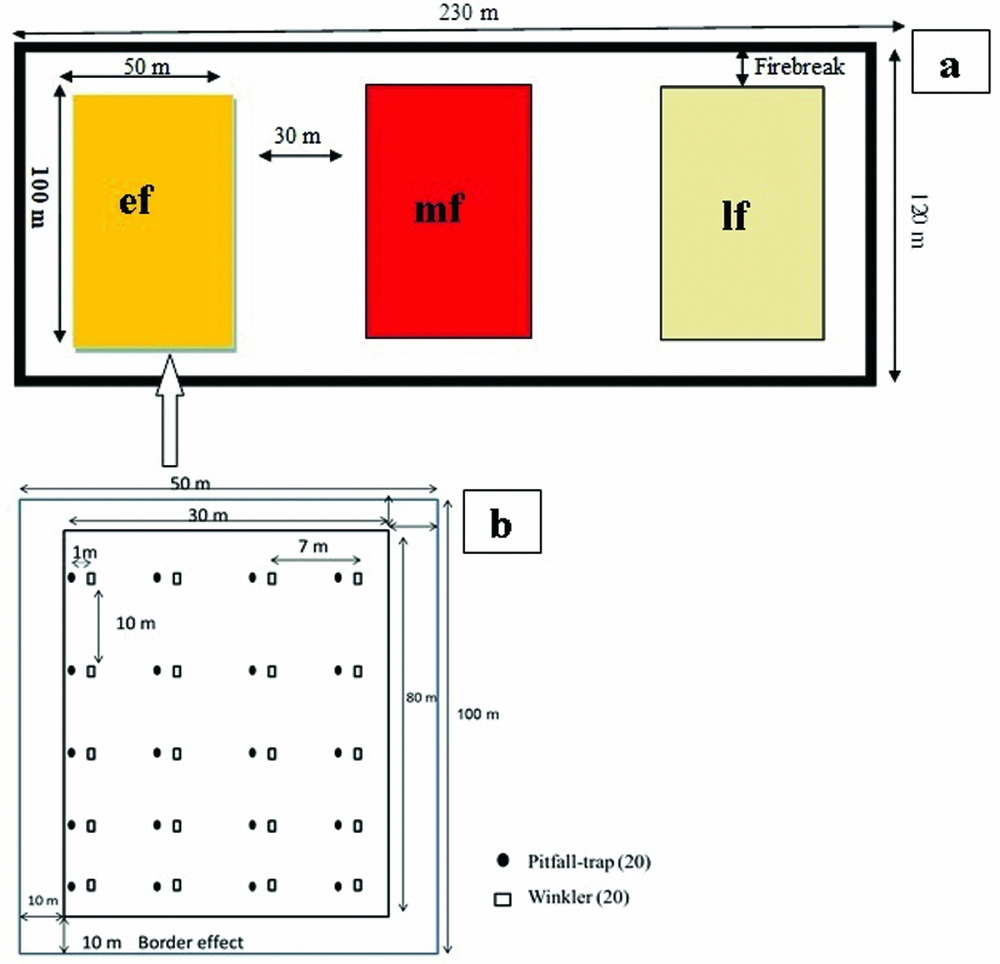
Additionally to the prescribed fire in Lamto (mid-seasonal fire in January), we introduced two other fire regimes (early and late fires) for our investigation. We established three plots of shrubby savanna (Figure 1), of 2.76 ha each (230 m × 120 m). Each plot was divided into three subplots (100 m × 50 m) separated by a 30-m-wide firebreak. A firebreak represents a space delimited all around plots (or subplots) to prevent them from uncontrolled fires. It is a border band where vegetation was removed to prevent continuation of the fire. Within each subplot, four parallel line transects, 50 m long and separated by 7 m (Figure 1) were investigated. Samples were taken at 10-m intervals along transect line. In sum, three replicate subplots were investigated for each fire regime, i.e. a total of 3 × 20 sampling points per fire regime. Ants were collected along all transects in plots using a standardized method described in the ants of leaf litter (ALL) protocol (Agosti et al. Reference AGOSTI, ALONSO, Agosti, Majer, Alonso and Schultz2000) which uses winkler and pitfall traps. This ALL protocol has been commonly used in several studies to understand ant community structure in tropical regions (Agosti et al. Reference AGOSTI, ALONSO, Agosti, Majer, Alonso and Schultz2000). Along each transect five sampling points were set up at 10-m intervals resulting in 20 sampling points per subplot. For each fire regime we obtained 3 × 20 sampling points and at each sampling point, we used a winkler and a pitfall trap. In total, the ants collected with 60 winklers and 60 pitfalls were analysed before and after setting fire.
Scheme of the sampling plot (a) and subplot (b) in the Lamto Scientific Reserve, Côte d'Ivoire. ef: early fire, mf: mid-season fire; lf: late fire.

Winkler traps: At each sampling point the leaf litter inside a 1-m² quadrat was collected and sifted in order to sort out large leaves and twigs (Martin Reference MARTIN1983). The sifted litter containing small invertebrates was poured into a bag and ants were extracted from this litter using a mini-Winkler apparatus (Fisher Reference FISHER1998). The litter in each sample bag was poured into a mesh inlet sack (mesh size 4 mm) that was suspended inside the Winkler bag. As the litter in the inlet sack dries, ants abandon the substrate and fall into a cup, partially filled with a 70% ethanol solution, at the bottom of the Winkler bag. The Winkler extraction was set up for 48 h.
Pitfall traps: In the field, after collecting the leaf litter, a pitfall trap (plastic cup of 7.5 cm diameter, 10.5 cm deep) partially filled with alcohol and glycerin was placed 1 m away from each litter quadrat. The pitfall traps remained at the sampling point for 48 h (Bestelmeyer et al. Reference BESTELMEYER, AGOSTI, ALONSO, BRANDÃO, BROWN, DELABIE, SILVESTRE, Agosti, Majer, Alonso and Schultz2000). Each transect was considered to be independent, as they were 500–1000 m apart from each other for each fire regime.
Identification
All ants were identified to genus level using the key of Bolton (Reference BOLTON1994). For species level identification, the keys of Bolton (Reference BOLTON1973, Reference BOLTON1976, Reference BOLTON1982, Reference BOLTON1986, Reference BOLTON1987, Reference BOLTON2000, Reference BOLTON2003), Brown (Reference BROWN1978) and Bolton & Fisher (Reference BOLTON and FISHER2011), and reliable digital keys (antweb.org; antcat.org and Ants of africa.org) were used. When species-level identification was impossible, distinct specimens were sorted according to morphospecies. Morphospecies were numbered according to the reference collection for Côte d'Ivoire hosted at Lamto ecological research station. In addition, representative samples of all species identified were sent to Royal Belgian Institute for Natural Sciences (RBINS) of Brussels (Belgium) and stored there.
Each ant species was assigned to a functional group based on its competitive interactions, foraging strategies, habitat requirements and microclimate preferences (Koné et al. Reference KONÉ, KONATE, YEO, KOUASSI and LINSENMAIR2012).
Data analysis
Ant species richness was determined by adding up the number of species observed over the whole transects. To obtain a measurement of our sampling success, expected species richness was estimated using the second order and non-parametric estimators (Chao 2) included in the EstimateS v.7.5 (http://purl.oclc.org/estimates). This software was used to generate data for the construction of sample-based rarefaction curves and confidence intervals for species richness. The Simpson index, calculated with the program ‘Ecological Methodology’ (www.Zoology.ubc.ca/Krebs) was used as a diversity measure of encountered ant assemblages. The evenness, i.e. the equitability of the distribution of species abundance, was also calculated with this software. The non-parametric analysis of variance of Kruskal–Wallis was performed with the software Statistica 7.1 (www.statsoft.com) to test variations across mean values while Mann–Whitney U-test and paired t-tests were respectively used to compare ant species richness between fire regimes and between fire periods (pre- and post-fire).
Spatial autocorrelation between transects was assessed using Mantel tests using the program Past v.2.17 (http://folk.uio.no/ohammer/past). Similarity matrices were constructed based on normalized Euclidean distance between the locations of the sampling sites. To assess the similarity of ant assemblages before and after each fire regime, we used the Bray–Curtis similarity index using the EstimateS v.7.5 (http://purl.oclc.org/estimates). Assemblages were ordinated by non-metric multidimensional scaling (NMDS). ANOSIM analyses were carried out to determine the effect of the period of sampling (pre- and post-fire) on ant composition using the program Past v. 2.17 (http://folk.uio.no/ohammer/past).
RESULTS
Overall taxonomic structure of sampled species
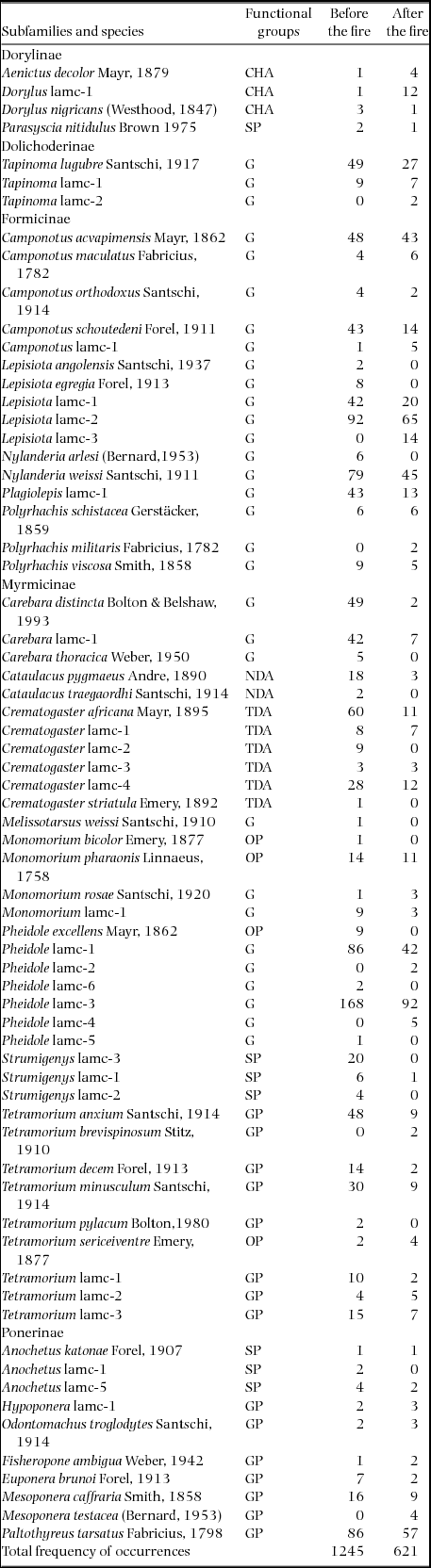
In total 68 ant species were collected. These species belonged to 25 genera, five subfamilies and seven functional guilds. Of this total, 61 ant species (belonging to 24 genera and five subfamilies) were sampled one day before the fires and 52 species (belonging to 23 genera and five subfamilies) on the day after each fire (Table 1).
List of ant species and functional groups collected before and after the fires in the Lamto Scientific Reserve, Côte d'Ivoire. CHA, column-hunting ants; G, generalists; GP, generalist predators; NDA, non-dominant arboreal species; OP, opportunists; SP, specialist predators; TDA, territorially dominant arboreal species. Lamc: species classified at Lamto level.

Regardless of fire regime, the Myrmicinae, the Formicinae and the Ponerinae were the dominant subfamilies both before (early fire: Myrmicinae 25 species, Formicinae 14 species, Ponerinae 7 species; mid-seasonal fire: Myrmicinae 25 species, Formicinae 8 species, Ponerinae 7 species; late fire: Myrmicinae 20 species, Formicinae 10 species, Ponerinae 4 species) and after the fire (early fire: Myrmicinae 15 species, Formicinae 10 species, Ponerinae 5 species; mid-seasonal fire: Myrmicinae 11 species, Formicinae 9 species, Ponerinae 4 species; late fire: Myrmicinae 19 species, Formicinae 9 species, Ponerinae 6 species). The mean number of species in the Myrmicinae subfamily significantly decreased from the day before fire to the day after fire (early fire: P = 0.04; mid-season fire: P = 0.004; late fire: P = 0.04).
Sampling efficiency, species richness, diversity and spatial distribution
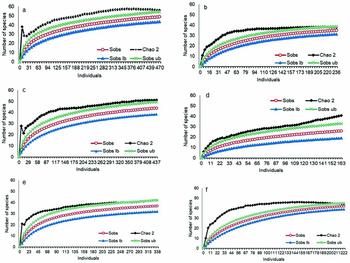
The curves corresponding to observed species accumulation curves (Sobs) with increasing sampling size (number of individuals) reached plateaus for all sampling periods. Only the estimated species accumulation curve (Chao2) for the day following the mid-seasonal fire steadily increased with sampling size (Figure 2). The sampling coverage ranged between 64 and 95%, illustrating access to a significant part of the investigated ant assemblage. There was no significant correlation between spatial locations within treatments (P = 0.34; R = 0.5).
Randomized individual-based species accumulation curves of ant assemblages for three fire regimes in the Lamto Scientific Reserve, Côte d'Ivoire: early fire (a, pre-fire; b, post-fire); mid-season fire (c, pre-fire; d, post-fire); late fire (e, pre-fire; f, post-fire).
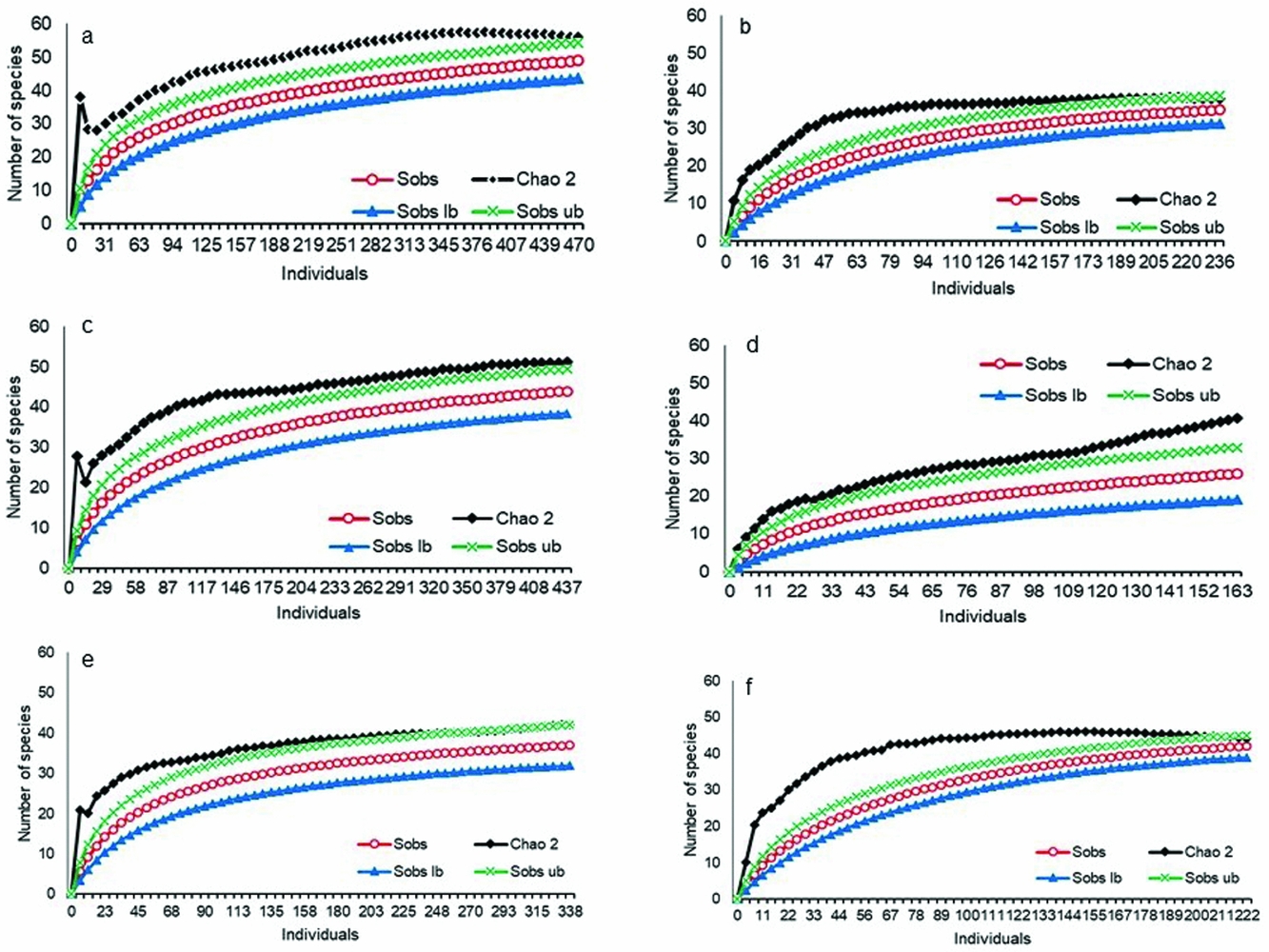
Respectively 49 and 35 species were collected before and after the early fire, respectively 44 and 26 species before and after the mid-seasonal fire and respectively 37 and 42 species before and after the late fire. The species richness of ants collected one day before the fires continuously decreased from the early fire to the late fire. In contrast, the number of ant species collected one day after the late fire was higher than those collected the days following the early and mid-seasonal fires (Table 2).
Metrics of ant diversity during the different fire regimes in the Lamto Scientific Reserve, Côte d'Ivoire. ef: early fire; msf: mid-seasonal fire; lf: late fire.

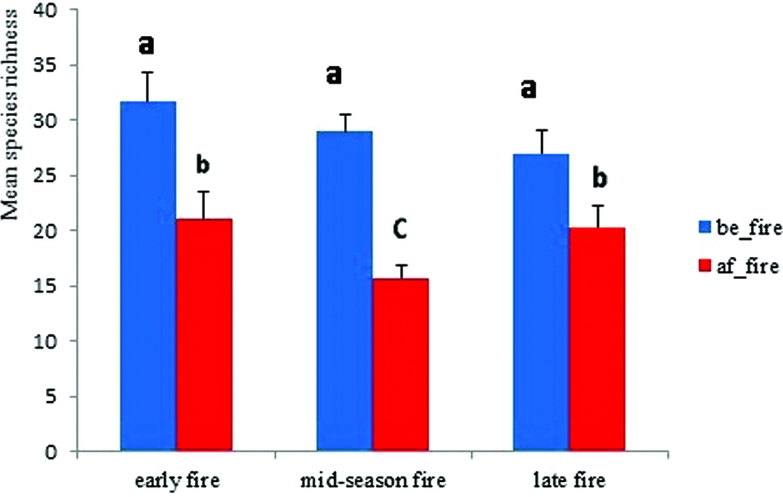
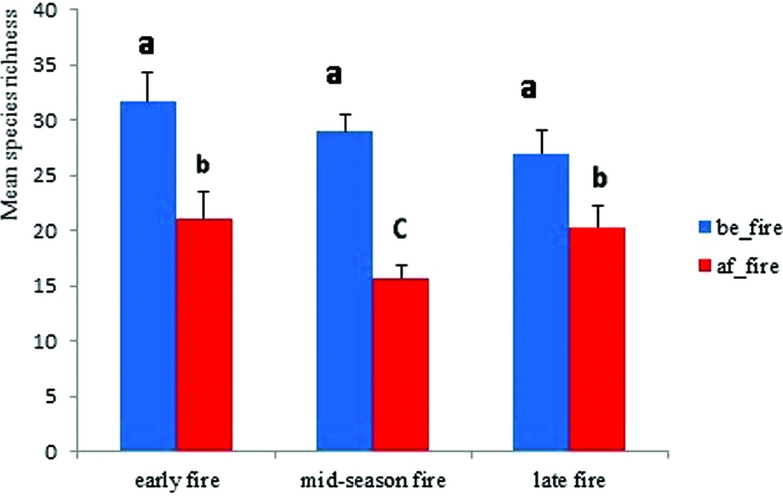
Globally, the mean species richness of ants after the fire significantly varied across fire regimes (ANOVA of Kruskal–Wallis, H = 3.41, P = 0.03). The community in the subplots undergoing the early fire was significantly richer than that of the mid-seasonal community (U-test of Mann–Whitney, U = 3.83, P = 0.0001). Post-late fire community (42 species) was significantly richer than that of the mid-seasonal fire (26 species) (U-test of Mann–Whitney test, U = 2.6, P = 0.008). In contrast, post-early fire community (35 species) did not differ statistically from that of late-fire (U-test of Mann–Whitney test, U = 0.62, P = 0.54). Paired t-tests revealed significant variation in species richness between pre- and post-fire for each fire regime; early fire: P < 0.005; mid-seasonal fire: P < 0.005; late fire: P < 0.001) (Figure 3). The Simpson diversity index was high for all fire ant communities. Regarding the evenness values, ant specimens were relatively equitably distributed among species collected (Table 2).
Mean species richness (± SE) of ants collected during three fire regimes (be_fire: 1 d before the fire; af_fire: 1 d after the fire) in the Lamto Scientific Reserve, Côte d'Ivoire.
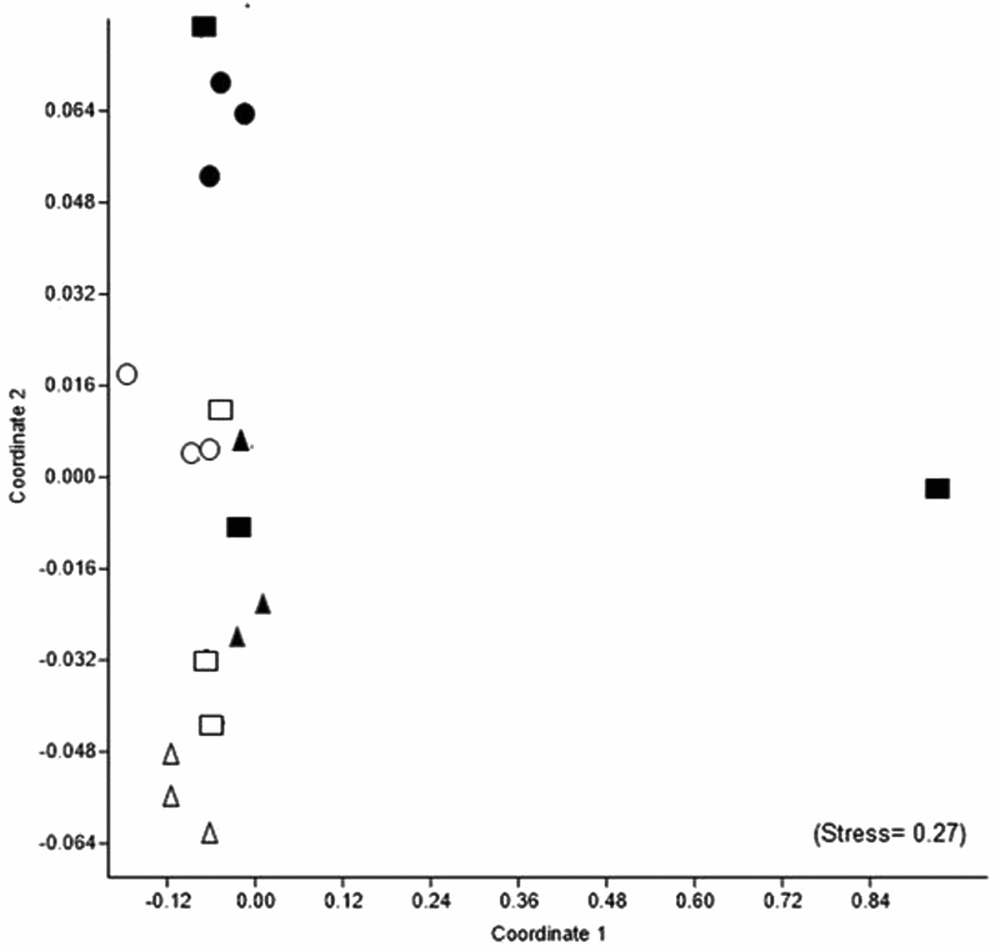
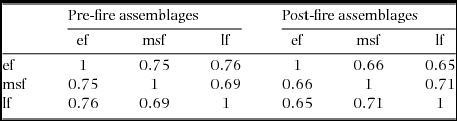
Globally, NMDS ordination based on species composition did not illustrate a clear separation between different fire regimes (i.e. spatially) (Figure 4). Also, the percentage similarity showed that the communities collected before fire were relatively similar, sharing at least 69% of their species. The similar trend was observed for post-fire communities that shared at least 65% of their species (Table 3). The comparison of pre- and post-fire communities for each fire regime indicated high similarity; early fire: 71% of shared species; mid-seasonal fire: 66% of shared species; and late fire: 68% of shared species.
Non-metric multidimensional scaling (NMDS) for ant assemblages in three fire regimes in the Lamto Scientific Reserve, Côte d'Ivoire: early fire (open circles for pre-fire; closed circles for post-fire); mid-season fire (open triangle for pre-fire; closed triangles for post-fire); late fire (open squares for pre-fire; closed squares for post-fire).

Similarity index between ant assemblages described during fire regimes in the Lamto Scientific Reserve, Côte d'Ivoire. ef: early fire; msf: mid-seasonal fire; lf: late fire.

Anosim tests revealed no significant difference between pre- and post-fire ant assemblage compositions (R = 0.02; P = 0.74).
Functional groups
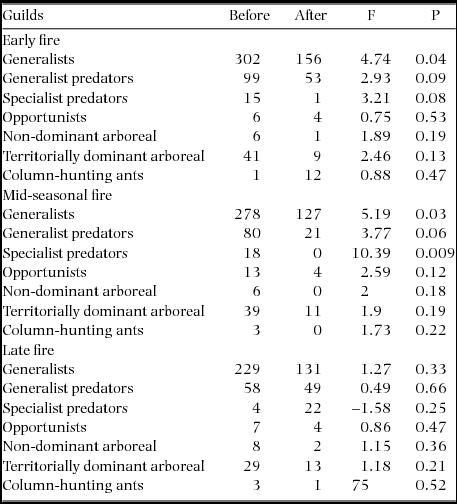
In total, seven functional guilds were recorded and among these four were dominant. Generalists constituted the most frequently collected group (31 species), followed by generalist predators (15 species), specialist predators (7 species) and territorially dominant arboreal (6 species) (Table 4). While the abundances of functional groups did not vary between fire regimes one day before the fire, that of the specialist predators significantly varied one day after the fire (P = 0.04). However, the pairwise comparison before and after fire showed significant differences in generalists during mid-seasonal (P = 0.03) and early fires (P = 0.04) and for specialist predators during mid-seasonal fire (P = 0.009).
Variation of the occurrences of ant functional guilds between the sampling periods of different fire regimes in the Lamto Scientific Reserve, Côte d'Ivoire.

DISCUSSION
The evaluation of sampling efficiency was done with individual-based species accumulation curves and sample coverage. With 60 pitfall traps and 60 Winkler, the ant assemblage was efficiently described for all sampling periods. This fact was illustrated by the plateau attained by all observed species accumulation curves as well as by high values of sample coverage. However, the increase of the non-parametric estimator after the mid-seasonal fire did not imply a stable estimate of total species richness. These trends indicated that additional sampling was required to provide an accurate picture of the pool of local species richness (Koné et al. Reference KONÉ, KONATE, YEO, KOUASSI and LINSENMAIR2012).
Our results suggest that the total ant species richness from the day before increased one day after the late fire, whereas in contrast, it significantly decreases during the same time interval for the early fire and especially for the mid-seasonal fire. As shown in this study, the late fire (more intense fire) seems to have little direct effect on communities of ground-foraging ants. This might be due to the protection afforded by their soil nests. In addition, because of use of dry fuel, late fire crosses quickly and might have no severe effect on ants. This partially contrasts to the findings of other researchers who noticed that a more intense fire releases more heat into the soil and kills more animals, resulting in lower species richness (Satyam & Jayakumar Reference SATYAM and JAYAKUMAR2012, Steward et al. Reference STEWARD, PETER and RICHON1990). Gillon (Reference GILLON and Bourlière1983) also stated that fire can directly affect many arthropod groups by killing them, or by forcing them to disperse to unburned sites.
However the decrease of the species richness the day after fire for early and mid-seasonal fire could be explained by the fact that fires alter the vegetative composition and physical structure of habitats, so we expected that associated animal communities would be impacted in terms of structure and richness. A reduction in the activities of ants due to sudden changes in the habitat structure could explain this decrease. The effects of fires are modifications of the habitat, food supply and interspecific competition (Andersen Reference ANDERSEN1988, Andersen & Yen Reference ANDERSEN and YEN1985, Levieux Reference LEVIEUX and Bourlière1983, Ostoja & Schupp Reference OSTOJA and SCHUPP2009, Whelan Reference WHELAN1995). The high pre-fire ant species richness seems coherent with the presence of variable sources of nourishment and niches. Thus, according to Andrew et al. (Reference ANDREW, RODGERSON and YORK2000), the unburned litter microhabitats are often associated with different objects such as logs, acting as refuges both for vertebrate and for invertebrate fauna. The poorest post-fire communities can be explained by the modification of habitat complexity (Parr et al. Reference PARR, ROBERTSON, BIGGS and CHOWN2004), affecting the species richness which might be more a surrogate of ant activities. Globally, ant community structure was strongly influenced by the indirect effects of fire (i.e. habitat structure) (Silveira et al. Reference SILVEIRA, LOUZADA, BARLOW, ANDRADE, MESTRE, SOLAR, LACAU and COCHRANE2016).
The complementarity index indicates high similarity between pre-fire and post-fire ant communities both for all fire regimes combined and fire regimes considered separately. Ants seem to perfectly exploit the basis of unburned and badly burned tussocks that constitute shelters to escape from fire (Levieux Reference LEVIEUX1971). In addition, the availability of food through remnants of burned plants and their roots stimulate the proliferation of organisms (such as ants) and the functioning of some soil-dwelling animals that survive the flames (Blair Reference BLAIR1997). These results are consistent with previous studies that found thrice-burned forests were marginally more similar to the unburned controls than once burned forest (Silveira et al. Reference SILVEIRA, LOUZADA, BARLOW, ANDRADE, MESTRE, SOLAR, LACAU and COCHRANE2016).
The functional group analysis reveals that generalists and specialist predators are significantly affected by the early and mid-seasonal fires. The significant decrease of the species richness of the generalists (the dominant group among the ant communities studied here) during the early and mid-seasonal fires, might result in a severe effect of burning on those species. In addition to habitat modification, the reduction in their abundance may be explained by nesting site availability and exposure to predators. As for specialist predators, their great decrease after the mid-seasonal fire suggests a lack of nourishment sources through limited prey diversity. Our results show that the savanna ant fauna responds to fires with a significant decrease in the species richness. Presently, such a decline can be partly explained by the harmful high temperature that ants suffer during burning, habitat modification and destruction of nourishment sources. However, with regard to the short time devoted to sampling in this study, the recovery process of this fauna should be studied during a longer period before making reliable recommendations to preserve the savanna and its associated faunal diversity. We suggest sampling other invertebrate fauna groups in similar savanna plots to find out if other insect groups have similar reactions to the applied fire regimes. Probably insect groups living mainly in the soil litter or grass tufts and the first top layer of the soil, such as termites, many spider species and soil active beetles may have a similar reaction to those of ant communities to these different fire regimes.
ACKNOWLEDGEMENTS
The work was supported by funding from the Institut de Recherche pour le Développement (IRD), through the Jeune Equipe Associée programme and a grant issued by the capacity building Programme of the Belgian Global Taxonomic Initiative National Focal Point that runs under the CEBioS programme with financial support from the Belgian Directorate-General for Development Cooperation (DGD). We also want to thank the Scientific Service Patrimony of RBINS for the support to this project. We are particularly grateful to Tadu Zephirin (University of Yaoundé I) for helpful comments on the English version of the manuscript.