Implications
This study investigated the use of a topical anaesthetic (TA) formulation for post-operative pain relief of castrated calves, which offers a practical option for producers to provide pain relief on-farm. In this study, TA had no significant effect on the cortisol response to surgical castration of unweaned Angus calves. However, there was a trend for calves treated with TA to have lower cortisol concentrations than untreated castrated calves at some time points after castration. No conclusions can be drawn from the current study regarding the effectiveness of TA to ameliorate pain during castration and further research is required.
Introduction
Castration of male calves is an important management practice routinely performed in beef cattle (Earley and Crowe, Reference Earley and Crowe2002; Coetzee, Reference Coetzee2011) to prevent unwanted breeding, facilitate fattening (Puig et al., Reference Puig, Greiner, Huchery, Perkins, Bowen, Collier and Garnett2011) and improve meat quality (Coetzee, Reference Coetzee2013). Castration also reduces aggression and mounting behaviours that cause injury and stress to other cattle (Earley and Crowe, Reference Earley and Crowe2002).
Pain and suffering in animals used in agriculture is of increasing concern to consumers of livestock products (Earley and Crowe, Reference Earley and Crowe2002). Although the pain of castration in cattle has been well documented (Fisher et al., Reference Fisher, Crowe, Alonso de la Varga and Enright1996; Coetzee, Reference Coetzee2011), the procedure is commonly performed without analgesic or anaesthetic intervention. Considerable research on pain alleviation in castrated calves has been published (Fisher et al., Reference Fisher, Crowe, Alonso de la Varga and Enright1996; Earley and Crowe, Reference Earley and Crowe2002). However, the practicality and cost-effectiveness of these pain management strategies are a major limitation to their implementation (Petherick, Reference Petherick2005). To address these issues, a farmer-applied ‘spray-on’ topical anaesthetic (TA) was recently studied in calves undergoing castration (Lomax and Windsor, Reference Lomax and Windsor2013). This TA was shown to reduce pain-related behaviours and sensitivity of wounds and surrounding tissue for at least 24 h post-procedure (Lomax and Windsor, Reference Lomax and Windsor2013). This followed previous studies demonstrating successful pain management during mulesing and castration of lambs (Lomax et al., Reference Lomax, Sheil and Windsor2008; Reference Lomax, Dickson, Sheil and Windsor2010 and Reference Lomax, Sheil and Windsor2013). The TA (Tri-Solfen®; Bayer Animal Health, Pymble, NSW, Australia) used in these studies and the current study consists of lidocaine (40.6 g/l), bupivacaine (4.2 g/l), adrenalin (24.8 mg/l) and cetrimide (5.0 g/l). This product is currently only registered for use in lambs undergoing mulesing. Experimental use of the product in cattle is conducted under a research permit issued by the Australian pesticides and veterinary medicines authority.
Assessment of cortisol concentration has been widely used as a measure of acute distress in animals. Cortisol concentration as a measure of pain-induced distress is used extensively because the response magnitude and duration, as measured by peak height and integrated cortisol response, usually accord with the predicted noxiousness of certain procedures (Mellor et al., Reference Mellor, Cook and Stafford2000). Measurement of cortisol has been used in cattle to quantify the effects of different painful procedures such as dehorning (Sylvester et al., Reference Sylvester, Mellor, Stafford, Bruce and Ward1998), branding (Lay et al., Reference Lay, Friend, Bowers, Grissom and Jenkins1992) and castration (Fisher et al., Reference Fisher, Crowe, Alonso de la Varga and Enright1996).
The aim of this study was to investigate the effect of TA on the cortisol response to surgical castration of beef calves and evaluate the effectiveness of TA as an option for pain relief. It was hypothesised that provision of TA would reduce the post-operative cortisol response of calves following surgical castration.
Material and methods
Animals and housing
A total of 24 unweaned, Angus bull calves (3 months old) were sourced from a commercial herd at the University of Sydney property ‘Arthursleigh’ (Marulan, NSW, Australia) in November 2013. The experimental protocol was approved by the institutional animal ethics committee (Approval No. 5832). Calves had not previously undergone any husbandry procedures. Calves were held with their mothers for 5 days before the experiment in a 4 ha paddock, adjacent to the cattle handling facilities. During this time, cows and calves had ad libitum access to water and pasture. Cows and calves were supplemented with lucerne hay daily due to low pasture levels in the holding paddock and to encourage a positive association with the experimental environment. Calves were ear-tagged 2 days before experimentation and weighed using cattle scales (Weigh scale and data recorder W810; Gallagher Group Ltd, Hamilton, New Zealand). Calf BW ranged from 77 to 102 kg. Before ear-tagging, calves had not been separated from their mothers and had minimal exposure to humans. Calves were habituated to movement through handling facilities twice daily (at 0930 and 1600 h) for 4 days before experimentation. Cows and calves were mustered into a holding yard and quietly moved through the race with their mothers; 1 day before experimentation, calves were restrained in the cattle crush (‘Ultimate’ Crush; RPM Rural Products, QLD, Australia) for 2 min before exiting the race. Restraint involved manually catching the calf in the head bale in a standing position, and applying the squeeze on the chute to reduce movement. This emulated how the calves would be handled during the trial for treatment and blood collection. Cows and calves were released into the 4 ha paddock between habituation periods.
Experimental design and treatments
The experiment was conducted over 2 days, with treatment groups evenly represented across each day. Maximum daily temperatures for these days were 26.4 and 31.0°C. On each day, cows and calves were moved from the paddock into the holding yard adjacent to the cattle race. Calves were separated from their mothers into a separate holding pen, and the cows were released back into the paddock. Calves were moved through the race, restrained in the head bale and released after treatment and blood sampling for every time point. Calves generally moved through the race well. If required, calves were gently touched on the back to encourage movement. Incorporated within the race were manual slide gates, which were used to separate calves. This avoided over-filling of races and facilitated with ordering of animals. Calves were randomly assigned to one of three treatment groups: (1) sham castration/control (CON, n=8); (2) surgical castration (C, n=8); and (3) surgical castration with post-operative application of TA (CTA, n=8). Four calves from each treatment group were treated each day. The random order of treatments was predetermined before calves entering the race using the animals’ identification numbers.
All calves were treated within a 0.5 h time period, between 1000 and 1030 h on each of the 2 experimental days. For castration, the side gate of the crush was opened after the calves were restrained in the head bale. A single, experienced operator manually restrained the calves in a standing position while performing the procedure. Calves were castrated standing up, instead of employing the use of a calf cradle, to eliminate any potential stress associated with lateral recumbency (Tagawa et al., Reference Tagawa, Okano, Sako, Orima and Steffey1994; Pesenhofer et al., Reference Pesenhofer, Palme, Pesenhofer and Kofler2006). Castration was performed using a technique that required initial transverse excision of the distal third of the scrotal skin with a sterilised knife. Each testis was manually exteriorised by pulling from the tunica vaginalis, and the spermatic cord cut ~12 cm proximal to the head of the epididymis. This method ensured that all tissue that had been handled or contaminated was exteriorised and removed from the calf, reducing the chance of infection of retracted material. For CTA calves, before removal of each testis, the exposed testicular tissue was coated with Tri-Solfen® by inserting the applicator nozzle along the spermatic cord inside the tunica vaginalis, into the inguinal cavity and applying 3 ml of TA. A quantity (2 to 3 ml) of TA was also applied to the cut skin edge of the scrotum. This application of TA aimed to provide maximum coverage of exposed cut tissue and ensured the retracted spermatic cord was covered in a pool of anaesthetic within the inguinal canal.
Blood sample collection
Calves were numbered (1 to 24) on each flank with white road marking spray paint at the first blood sample collection to facilitate ordering of the calves for each sampling time point. Calves were always sampled in the same order. Blood samples (~4 to 9 ml) were collected into 9 ml EDTA vacutainers (Vacuette®, West Heidelberg, VIC, Australia) via jugular venipuncture within 2 min of securing the calves in the head bale and manually restraining their heads. Samples for baseline cortisol were drawn 0.5 h and immediately (0 h) before treatment. Thereafter, samples were drawn at 0.5, 1, 1.5, 2, 4 and 6 h post-treatment. The first and last blood samples were collected at 0930 and 1600 h, respectively, on each day. Calves were kept as a group in the holding yard adjacent to the cattle race between sampling time points where they had ad libitum access to water and lucerne hay and where they could see and hear their mothers through a fence. Blood samples were placed on ice immediately after collection and stored until centrifugation. Blood samples were centrifuged within 4 h of collection at 3000 r.p.m. for 15 min. The plasma component of the samples was separated using 1 ml sterile pipettes and stored in 2 ml collection vials at −20°C.
Plasma cortisol determination
Plasma cortisol concentrations were determined using a commercially available radio-immunoassay kit (Coat-A-Count Cortisol RIA; Siemens Pty Ltd, Los Angeles, CA, USA). The inter-assay and intra-assay coefficients of variation were 5.05% and 5.15%, respectively.
Statistical analysis
The program GenStat® (VSN International Ltd, Hemel Hempstead, UK) was used to conduct all statistical analyses and generate LSD values. Data on cortisol concentrations were subjected to residual maximum likelihood for repeated measures. The fixed effects of the model were treatment (CON, C, CTA), time (−0.5, 0, 0.5, 1, 1.5, 2, 4, 6 h), day (1, 2) and BW (covariate). The random effect of the model was calf. The integrated cortisol response, or area under the curve (AUC−0.5 to 6), was calculated for each calf and then analysed using a one-way ANOVA. The suitability of the AUC data for parametric ANOVA was tested using a probability plot of the residuals to determine the normality of the data, and a plot of residuals against fitted values to determine the homogeneity of variance. For all statistical calculations, P⩽0.05 was considered statistically significant and P⩽0.05⩽0.1 were considered statistical tendencies. Differences between means were considered statistically significant if they were greater than the generated LSDs.
Results
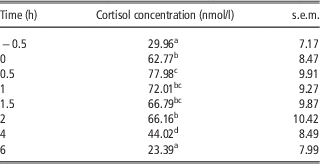
There was no significant interaction between time and treatment (F=0.99; d.f.=14, 147; P=0.463, Table 1). There was a significant effect of time on cortisol response across all treatment groups (F=25.49; d.f.=7, 161; P<0.001, Table 2). Cortisol concentrations increased between −0.5 and 0.5 h relative to castration, and decreased between 1 and 6 h after castration. Lowest concentrations were at −0.5 h (29.96 nmol/l) and 6 h (23.39 nmol/l) and peak concentration at 0.5 h (77.98 nmol/l) was significantly higher than the cortisol response at 0 h (62.77 nmol/l). The cortisol response at 0 h was significantly higher than the cortisol response at −0.5 h. There was a statistical tendency for treatment to be significant (F=2.95; d.f.=2, 19; P=0.077). CON, C and CTA calves had mean cortisol concentrations of 44.11±10.05, 63.02±11.5 and 59.03±10.68 nmol/l, respectively. There was a significant effect of treatment on integrated cortisol response (F=3.78; d.f.=2, 21; P=0.04). The mean AUC for CON calves (253±40.49 nmol/l per h) was significantly lower than the mean AUCs of C (394±38.22 nmol/l per h) and CTA (372±31.39 nmol/l per h) calves.
Mean cortisol concentration (nmol/l±s.e.m.) of calves in each treatment group over time

CON=sham castrated; C=castrated; CTA=castrated+topical anaesthetic.
Descriptive statistics are based on predicted means (±s.e.m.). No significant interaction was found (P=0.463).
Mean cortisol concentration (nmol/l±s.e.m.) of all calves over time

a,b,c,dValues within a column with different superscripts differ significantly at P<0.05. Descriptive statistics are based on predicted means (±s.e.m.). A significant effect was found (P<0.001).
Discussion
The results of this study did not support our hypothesis that provision of TA would reduce the post-operative cortisol response of calves following surgical castration. The main finding was that TA had no significant effect on cortisol concentrations of surgically castrated calves. This was the first time that the cortisol response of castrated calves treated with TA had been studied.
In this study we elected to use cortisol as an indirect measure of pain associated with castration as the cortisol response to castration of cattle, and the amelioration of this response by use of anaesthetics and analgesics, has been well documented (Coetzee, Reference Coetzee2011). However, despite this, it is still widely accepted that cortisol secretion occurs in response to a variety of stressors other than pain (Molony and Kent, Reference Molony and Kent1997). These stressors include weaning, social isolation, transport, social mixing, novelty, restraint and handling (Stilwell et al., Reference Stilwell, Carvalho, Carolino, Lima and Broom2010). In addition, there are other variables, such as diurnal changes and individual variation that influence cortisol concentration. This can implicate interpretation of experimental results (Molony and Kent, Reference Molony and Kent1997). The results of the current study highlight the responsiveness of cortisol to factors other than pain. While it is ideal to combine multiple physiological, neuroendocrine and behavioural measures to reduce the impact of non-painful factors on results, this usually requires using separate groups of animals for each measure. As we only utilised a single group of calves for this study, our options for obtaining other data in addition to cortisol concentrations were limited due to the constant movement and repeated handling of the calves for blood sampling. In addition, other measurements could have caused distress which would have affected our cortisol findings. However, a previous study conducted by the same research group, on the same property, provides information on the behavioural response and wound sensitivity of calves subjected to the same treatments as those in the current study (Lomax and Windsor, Reference Lomax and Windsor2013). The study found that calves treated with TA expressed significantly less pain-related behaviour than untreated calves and withstood greater pressure applied to the wound and surrounding skin as measured by an electric von Frey anaesthesiometer (0 to 1000 g; IITC Life Sciences, Woodland Hills, CA, USA). There were no significant treatment differences when wound sensitivity was measured with a von Frey monofilament (300 g; Bailey Instruments Ltd, Manchester, UK) (Lomax and Windsor, Reference Lomax and Windsor2013).
In this study, an increase in plasma cortisol from −0.5 to 0 h was apparent for all treatment groups (Tables 1 and 2). This may reflect the stress of separation from mothers (Loberg et al., Reference Loberg, Hernandez, Thierfelder, Jensen, Berg and Lidfors2008), handling through a race, and restraint in a head bale (Cooke et al., Reference Cooke, Arthington, Austin and Yelich2009) before treatment. Cortisol concentration further increased from 0 to 0.5 h to reach a peak, with the rise more apparent in C and CTA calves than CON calves (Table 1). In addition, the integrated cortisol response of CON calves was significantly lower than those of C and CTA calves. The significantly greater AUCs of C and CTA calves, along with the tendency for these calves to display higher peak cortisol concentrations, is indicative of a response to castration which involves tissue damage, stimulation of nociceptors (Earley and Crowe, Reference Earley and Crowe2002) and haemorrhage (Gann and Egdahl, Reference Gann and Egdahl1965).
This study is not the first to find a non-significant effect of locally administered anaesthetic on the cortisol response of castrated calves (Fisher et al., Reference Fisher, Crowe, Alonso de la Varga and Enright1996; Webster et al., Reference Webster, Morin, Jarrell, Shipley, Brown, Green, Wallace and Constable2013). The effect of lidocaine HCl, a component of TA, has been widely investigated for its effects on the cortisol response to castration of calves (Coetzee, Reference Coetzee2011). One study found that 2% lidocaine HCl, injected into the testes and scrotum 15 min before castration, did not reduce the integrated cortisol response to surgical or burdizzo castration of Friesian calves (Fisher et al., Reference Fisher, Crowe, Alonso de la Varga and Enright1996), despite significantly reducing cortisol concentrations from 0.25 to 1 h. Fisher et al. (Reference Fisher, Crowe, Alonso de la Varga and Enright1996) suggested that this was likely attributable to the short duration of action (~1 h) (Reichl and Quinton, Reference Reichl and Quinton1987) of lidocaine HCl. This suggestion is not suitable to explain the lack of difference between the integrated cortisol response of CTA and C calves in the current study. The TA in the current study consists of the anaesthetic agent bupivacaine HCl in addition to lidocaine HCl. Bupivacaine is a long acting local anaesthetic with a duration of action of ~5 to 8 h (Coetzee, Reference Coetzee2011). In addition, the adrenaline component of TA has been suggested to slow the rate of systemic absorption of lidocaine and bupivacaine, thereby prolonging their duration of action (Lomax et al., Reference Lomax, Sheil and Windsor2013). Another study that measured cortisol concentrations of surgically castrated dairy calves found that 20 ml of 2% lidocaine HCl administered in a subcutaneous ring block at the neck of the scrotum, just above the testes, did not reduce the cortisol response to castration (Webster et al., Reference Webster, Morin, Jarrell, Shipley, Brown, Green, Wallace and Constable2013). It is likely that administration of lidocaine alone as a subcutaneous ring block was ineffective at mitigating the pain of castration. It was suggested that the relatively high dose rate and the injection into the testes rather than the spermatic cords may have caused tissue irritation or inflammation. It was also proposed that the twisting and severing of spermatic cords by the Henderson tool may have stimulated nociceptors proximal to the site of lidocaine injection (Webster et al., Reference Webster, Morin, Jarrell, Shipley, Brown, Green, Wallace and Constable2013). In the current study, the castration procedure and the mode of anaesthetic application differs to the study by Webster et al. (Reference Webster, Morin, Jarrell, Shipley, Brown, Green, Wallace and Constable2013). The spermatic cords were severed using a knife after the distal third of the scrotum was excised and the testes were exposed. TA was applied postoperatively, directly onto exposed, injured tissue. Therefore, a more likely explanation for the lack of difference between C and CTA calves in the current study is that the castration procedure itself caused tissue damage, inflammation, stimulation of nociceptors, and haemmorhage, all of which can induce a rise in cortisol (Gann and Egdahl, Reference Gann and Egdahl1965; Earley and Crowe, Reference Earley and Crowe2002). This explanation is also applicable when comparing the results of the current study to contrasting results from previous literature. In some studies, local administration of 2% lidocaine HCl has been shown to significantly reduce the acute cortisol response to castration of Friesian calves, though not completely eliminating it (Ting et al., Reference Ting, Earley, Hughes and Crowe2003; Stewart et al., Reference Stewart, Verkerk, Stafford, Schaefer and Webster2010). In these studies, lidocaine HCl was injected 10 (Stewart et al., Reference Stewart, Verkerk, Stafford, Schaefer and Webster2010) or 20 min (Ting et al., Reference Ting, Earley, Hughes and Crowe2003) before castration. Pre-operative administration of lidocaine HCl would have ensured amelioration of both peri-operative and acute post-operative pain. TA, being applied postoperatively, had no effect on peri-operative pain, which may induce a rise in cortisol (Mellor et al., Reference Mellor, Cook and Stafford2000). In addition, the study by Ting et al. (Reference Ting, Earley, Hughes and Crowe2003) employed the burdizzo method for castration, which causes a restriction in blood flow to the testes before removal. This reduces haemorrhage (Stafford and Mellor, Reference Stafford and Mellor2005), of which cortisol secretion is a concomitant (Gann and Egdahl, Reference Gann and Egdahl1965).
It is important to note that in the previously mentioned studies (Stafford et al., Reference Stafford, Mellor, Todd, Bruce and Ward2002; Webster et al., Reference Webster, Morin, Jarrell, Shipley, Brown, Green, Wallace and Constable2013), cortisol concentrations of uncastrated calves were significantly lower than those of untreated castrated calves. In the current study, although the integrated cortisol response of CON calves was significantly lower than that of C and CTA calves, there was no significant difference between the mean cortisol concentrations of any treatment group. These findings have been demonstrated previously in a study comparing plasma concentrations of substance P and cortisol in beef calves after castration or simulated castration (Coetzee et al., Reference Coetzee, Lubbers, Toerber, Gehring, Thomson, White and Apley2008). In this study, mean cortisol concentrations of castrated and uncastrated calves were not significantly different at any point up to 4 h following the procedure. In addition, the mean cortisol response of castrated and uncastrated calves was similar regardless of whether castrated calves vocalised or displayed aversive behaviour during the procedure. Similar to the current study, Coetzee et al. (Reference Coetzee, Lubbers, Toerber, Gehring, Thomson, White and Apley2008) used Angus crossbred calves and habituation for the experiment consisted of restraint in a head bale and a rope halter for 15 to 30 min daily for 5 days. It was proposed that non-painful stressors, such as handling, had an effect on cortisol that was disproportional to that of the nociceptive stimulus of castration (Coetzee et al., Reference Coetzee, Lubbers, Toerber, Gehring, Thomson, White and Apley2008). Non-painful stressors experienced by the calves in the current study include separation from their mothers, novel exposure to human handling, and restraint. Other studies have habituated calves to intensive handling and holding facilities for 3 weeks before experimentation commenced (Ting et al., Reference Ting, Earley, Hughes and Crowe2003; Stewart et al., Reference Stewart, Verkerk, Stafford, Schaefer and Webster2010). This extensive habituation reduced the effect of handling on treatment outcomes, resulting in a significant effect of castration on cortisol response (Ting et al., Reference Ting, Earley, Hughes and Crowe2003; Stewart et al., Reference Stewart, Verkerk, Stafford, Schaefer and Webster2010). The calves used in the current study underwent a less intensive, shorter habituation process. Hence, the intensity and duration of habituation may not have been sufficient to eliminate the stress caused by handling and restraint in a head bale. Furthermore, previous studies also inserted indwelling jugular catheters 1 day before experimentation to facilitate intensive blood sampling and minimise animal handling (Ting et al., Reference Ting, Earley, Hughes and Crowe2003; Stewart et al., Reference Stewart, Verkerk, Stafford, Schaefer and Webster2010). Calves in one of these studies were held in individual pens for the duration of the trial. For that reason, manual restraint for each blood sample was possible (Ting et al., Reference Ting, Earley, Hughes and Crowe2003). In the other study, blood samples were only taken −20, −10, 15 and 20 min relative to castration, which meant that each calf could be restrained one at a time in a squeeze chute for the duration of sample collection (Stewart et al., Reference Stewart, Verkerk, Stafford, Schaefer and Webster2010). Therefore, in both of these studies, access to the catheter did not require movement or head restraint of calves. Due to the design of the current study, calves needed to be moved through the race and into the crush and restrained in a head bale in order to collect blood samples, regardless of indwelling catheter or jugular venipuncture. The risk of the catheters being damaged or pulled out by this form of restraint meant that jugular venipuncture was a more practical option. Furthermore, there are contradictory results in the literature on the effects of venipuncture on cortisol, with some suggestions that it has no effect (Alam and Dobson, Reference Alam and Dobson1986) and some suggestions that it causes an increase in cortisol (Veissier and Le Neindre, Reference Veissier and Le Neindre1988). Hopster et al. (Reference Hopster, van der Werf, Erkens and Blokhuis1999) suggest that jugular venipuncture may induce an increase in cortisol concentration, but it seemingly relates to the handling experience of cattle. In the current study, manual restraint for sampling, and jugular venipuncture, may have increased cortisol concentrations. Further, in the current study, calves had never experienced separation from their mothers before the experimental days, where they were separated for a period of 7 to 8 h. Studies investigating the stress of weaning have found that separating calves from their mothers (Lay et al., Reference Lay, Friend, Randel, Bowers, Grissom, Neuendorff and Jenkins1998; Loberg et al., Reference Loberg, Hernandez, Thierfelder, Jensen, Berg and Lidfors2008; O’Loughlin et al., Reference O’Loughlin, McGee, Doyle and Earley2014), and additionally, altering normal milk intake (Lay et al., Reference Lay, Friend, Randel, Bowers, Grissom, Neuendorff and Jenkins1998), results in an elevated cortisol response (Lay et al., Reference Lay, Friend, Randel, Bowers, Grissom, Neuendorff and Jenkins1998; Loberg et al., Reference Loberg, Hernandez, Thierfelder, Jensen, Berg and Lidfors2008; O’Loughlin et al., Reference O’Loughlin, McGee, Doyle and Earley2014). The calves used in the current study were unweaned beef calves that before experimentation had minimal exposure to humans. Studies reporting an effect of castration on cortisol (Ting et al., Reference Ting, Earley, Hughes and Crowe2003; Stewart et al., Reference Stewart, Verkerk, Stafford, Schaefer and Webster2010) used dairy calves, which under commercial conditions are permanently separated from their mothers and artificially reared by humans within hours of their birth (Budzynska and Weary, Reference Budzynska and Weary2008). Commercial beef production systems typically wean calves at ~6 months of age, hence the period of separation from mothers in the current study likely caused distress and hence a major cortisol response.
The effect of TA on the cortisol response to painful husbandry procedures has been explored in other production animal species. A study investigating a short acting TA, and a long acting TA found that both formulations were unsuccessful at reducing the cortisol response to castration in piglets. The short acting TA contained 14% Benzaine, 2% Butamben and 2% Tetracaine hydrochloride and the long acting TA was the same product as that used in the current study (Sutherland et al., Reference Sutherland, Davis, Brooks and McGlone2010). Sutherland et al. (Reference Sutherland, Davis, Brooks and McGlone2010) suggests that as TA is applied postoperatively, the pain of the castration procedure itself may have overshadowed any effect of TA on cortisol. It was also suggested that the anaesthetic or application method was inadequate (Sutherland et al., Reference Sutherland, Davis, Brooks and McGlone2010). These limitations can be applied to the current study. A study investigating the pain relieving effects of the same TA for mulesing and tail docking in lambs found that TA significantly, yet only moderately, reduced the peak cortisol response to the procedure and it had no effect on the AUC (Paull et al., Reference Paull, Lee, Colditz, Atkinson and Fisher2007). Paull et al. (Reference Paull, Lee, Colditz, Atkinson and Fisher2007) found that combining this TA with the non-steroidal anti-inflammatory drugs (NSAIDs) carprofen and flunixin, resulted in a greater decrease in peak cortisol than TA alone, as well as a significant reduction in AUC. Therefore, the effect of TA in combination with an NSAID on the cortisol response of calves to castration is worth future investigation.
Conclusion
In this study there was no significant effect of treatment on the cortisol response of unweaned beef calves. It is likely that an insufficient habituation period, in addition to separation of calves from their mothers, may have caused an increase in calf cortisol concentrations independent of pain. This may have masked any effects of TA on the pain of castration. The tendency for castrated calves treated with TA to have reduced cortisol concentrations at some time points after castration and a reduced integrated cortisol response compared with untreated castrated calves warrants further investigation. Future studies should incorporate more extensive habituation of calves to reduce the impact of stress on results.
Acknowledgements
The authors gratefully acknowledge the financial support of Meat and Livestock Australia and Bayer Animal Health Australia. The authors are grateful for the technical assistance of Steve Burgun and his staff at Arthursleigh, Marulan, NSW, and honours students Charissa Harris and Samantha Faber from the University of Sydney. The authors thank Kim Heasman from the University of Sydney for assistance with laboratory work. Statistical advice provided by Peter Thomson from the University of Sydney is greatly appreciated.