Currently, the Irish dairy processing industry generates large volumes of dairy wastewater that is treated at on-site wastewater treatment plants. The current treatment technologies require large volumes of chemicals and are energy intensive. The Intermittently Aerated Sequencing Batch Reactor (IASBR) technology, which is a biological wastewater treatment system, offers a more sustainable solution to this growing problem. The IASBR is a biological wastewater treatment system, which has been adapted from conventional Sequencing Batch Reactor (cSBR) operation in order to achieve higher removal efficiencies of Chemical Oxygen Demand (COD) and nutrients such as nitrogen and phosphorus (Tarpey, Reference Tarpey2016), whilst reducing the operational cost of the system. An IASBR operation can be imposed on a cSBR by changing the way in which the react phase occurs in the system. In an SBR the operation follows the order of fill, react, settle and draw/decant. In a cSBR the react phase is made up of one non-aeration period followed by an aeration period, in comparison to an IASBR, where periods of non-aeration and aeration are cycled to maximise the performance of the system (Henry, Reference Henry2014), simultaneously removing nitrogen and phosphorus. During aeration periods Dissolved Oxygen (DO) levels are increased, allowing the oxidation of ammonium-nitrogen (NH4+-N) to nitrite (NO2-N) and nitrate (NO3-N) by aerobic nitrifying bacteria. During the following non-aerobic periods the DO is once again decreased, allowing anaerobic denitrifying bacteria to reduce the oxidised nitrogen to nitrogen gas (N2) (Li et al. Reference Li, Healy, Zhan, Norton and Rodgers2008).
IASBR technology has been applied in the treatment of high strength wastewaters in other industries (Pan et al. Reference Pan, Henry, Liu, Huang and Zhan2014) and for use at laboratory-scale for treating dairy wastewaters (Tarpey, Reference Tarpey2016). If managed correctly, the technology has shown to be superior in certain industries in the removal of nitrogen and phosphorus than the more traditionally used Sequencing Batch Reactor (SBR) technology for the treatment of the wastewater (Henry, Reference Henry2014; Pan et al. Reference Pan, Henry, Liu, Huang and Zhan2014).
Phosphorus and nitrogen are two of the main contributing factors to eutrophication in a receiving water body, and are two nutrients present in high concentrations in dairy wastewater (Kushwaha et al. Reference Kushwaha, Srivastava and Mall2011). Biological treatment of dairy wastewater is also favoured due to its high organic content, as such systems have large capacity to break down organic compounds which, if left untreated, have the potential to overload municipal sewage treatment systems (Demirel et al. Reference Demirel, Yenigun and Onay2005). cSBRs are listed as a suitable treatment for dairy wastewater by the European Environment Agency as a Best Available Technique (BAT) in the treatment in these wastewaters (EPA, 2008).
In this paper, the potential for the IASBR technology as a viable option within the Irish and other dairy industries is investigated. Nutrient removal efficiencies (nitrogen and phosphorus) will be monitored, to determine whether it is a more efficient and effective solution when compared to current technologies used in the industry (Pan et al. Reference Pan, Chen, Hu and Zhan2013). Three laboratory-scale experiments are presented in this paper and the results compared with respect to the removal of ammonium and ortho-phosphate (PO43−-P). Operational parameters are varied in each of the experiments to gain a greater understanding into the operation of the technology and to generate initial parameters for designing a pilot-scale IASBR system.
Material and methods
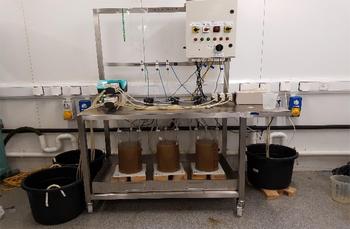
The laboratory-scale IASBR system is composed of three reactors, each with a working volume of 8 l, as shown in Fig. 1. Three peristaltic pumps were used to mediate the flow of influent, effluent and sludge. A circulation pump was attached low on the wall of each reactor to ensure that adequate mixing of the biomass with the wastewater was maintained during react phases. Aeration was supplied to the reactors using three air pumps with air regulators to control the flow. The system operation was controlled by a programmable logic controller (PLC: Siemens S7-200), which can control the system components. The laboratory scale system was operated in a temperature-regulated cold room at 11 °C. Over the course of this investigation, several different system operations were evaluated during a total of 11 phases. In order to monitor the performance of the system and evaluate the operation parameters, a detailed nutrient and contaminant analysis of the wastewater was performed. Additionally, dissolved oxygen and pH were monitored through full cycles periodically to monitor the cycle oxygen consumption and pH within the system.
Laboratory-scale IASBR system in operation in a temperature controlled room (11 °C).

Wastewater analysis
The untreated (influent) and treated (effluent) wastewater samples were analysed periodically and the results compared in order to access the amount of removal occurring in each of the individual reactors. Removal being assessed was total nitrogen (TN), NH4+-N, NO2-N, NO3-N, total phosphorus (TP), PO43−-P, total organic carbon (TOC), COD and suspended solids. TOC, TN and TP were monitored using a Biotector analyser. NH4+-N, NO2-N, NO3-N and PO43−-P were all measured using a Konelab 20 Nutrient analyser (Thermo Scientific). COD and suspended solids testing were done following the corresponding sections of Standard Methods (APHA, 2005).
Experiment 1
The laboratory-scale reactors were initially seeded with sludge from a municipal wastewater treatment plant (WWTP) and the influent for all 3 reactors was synthetic wastewater for the duration of experiment 1. The synthetic wastewater fed to the reactors was prepared to contain 48·9 mg/l of NH4+-N and 25·4 mg/l of PO43−-P. The operation for this experiment, for cycle length, HRT and aeration rate (in LPM), is as follows:
• Phase 1 (0–7 d): 8-h cycle, 2·7 d HRT, 2 LPM
• Phase 2 – Was made up of 2 parts
➢ Part 1 (8–38 d): Aeration rate change
✓ 8-h cycle, 2·7-d HRT, 1 LPM
✓ Reduced aeration rate
➢ Part 2 (39–59 d): Cycle length change
✓ 12-h cycle, 4-d HRT, 1 LPM
✓ Increased cycle length to 12 h
✓ Lowered organic loading rate (OLR)
• Phase 3 (60–75 d): 12-h cycle, 4-d HRT, 0·8 LPM
✓ Reduced aeration rate
• Phase 4 (76–162 d): 12-h cycle, 4-d HRT, 0·6 LPM
✓ Reduced aeration rate
• Phase 5 (163–201 d): 12-h cycle, 4-d HRT, 0·4 LPM
✓ Reduced aeration rate
Experiment 2
After a thorough analysis was done on the aeration rate with a constant SRT, the effect of varied SRT with constant aeration rate was explored. The seed sludge for this experiment was obtained from a full-scale cSBR at an Irish dairy processing factory. The influent for Reactor 2 (R2) was real wastewater from day 92 onwards, with Reactor 1 (R1) and Reactor 3 (R3) remaining on synthetic wastewater for the duration of the experiment. The operational conditions for this experiment were as follows:
• Phase 6 (1–28 d): 20-d SRT, 0·6 LPM
• Phase 7 (29–91 d): 15-d SRT, 0·6 LPM
➢ Reduced SRT (high volatile suspended solids (VSS) was observed at the beginning of this phase)
• Phase 8 (92–138 d): 20-d SRT, 0·6 LPM
➢ Increased SRT to increase VSS content
➢ When stable NH4+-N removal occurred, next phase commenced
• Phase 9 (139–168 d): 16-d SRT, 0·6 LPM
➢ Reduced SRT
• Phase 10 (169–230 d): 16-d SRT, 0·8 LPM
➢ Increased aeration rate
During experiment 2, average concentrations of NH4+-N were 40·8 mg/l in R1, 27·9 mg/l in R2 and 41·4 mg/l in R3. Average concentrations of PO43−-P were 24·0, 17·2 and 24·1 mg/l for R1, R2 and R3 respectively.
Experiment 3
The third experiment is ongoing and the system is currently following a 12-h cycle. All 3 reactors were seeded using activated sludge from a wastewater treatment plant at a dairy processing factory. The results from the first two experiments allowed the operational parameters to be decided for the third experiment, which are given as:
• Fill volume: 1·25 l
• HRT: 4 d
• Wastewater type: real dairy wastewater
• Aeration rate: 0·8 LPM
• React phase: 10 h, 40 min (4 non-aeration periods, 4 aeration periods)
• SRT: 16 d (0·25 l removed per cycle)
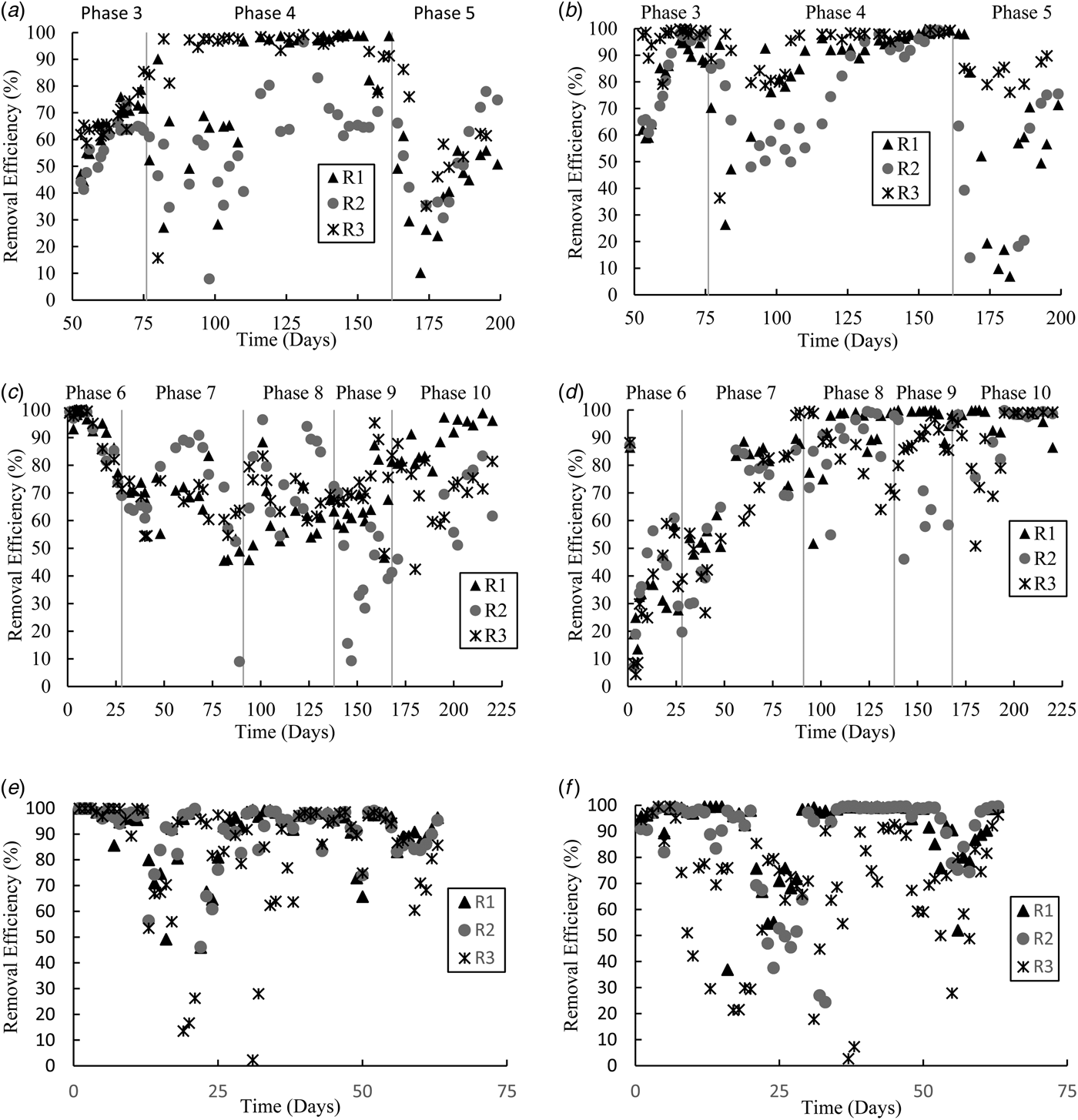
R1 and 2 have been treating real dairy wastewater for the entire experiment. R3 was initially running on synthetic wastewater (1–38 d), but after extended periods of poor performance and unstable state in this reactor it was decided to re-seed it. After restart R3 was also put on real dairy wastewater like R1 and R2. Since this restart R3 has been performing much better as can be seen in Fig. 2(e and f). Given that real dairy wastewater was being fed to these reactors, a high fluctuation was observed in concentrations of NH4+-N and PO43−-P. NH4+-N concentrations ranged from 1·5 to 101·5 mg/l during experiment 3 with an average concentration of 37·9 mg/l. Concentrations of PO43−-P ranged 0·1 to 82·5 mg/l with an average concentration of 27·7 mg/l over the course of experiment 3.
Results containing the removal efficiencies in each of the three experiments, where: (a): ortho-phosphate (PO43−-P) in experiment 1; (b): ammonium (NH4+-N) in experiment 1; (c): PO43−-P in experiment 2; (d): NH4+-N in experiment 2; (e): PO43−-P in experiment 3; and (f): NH4+-N in experiment 3.

Results and discussion
Experiment 1 found an optimal aeration rate of 0·6 LPM as stable NH4+-N removal, along with Enhanced Biological Phosphorus Removal (EBPR), occurred in 2 out of the 3 reactors. The average removal efficiencies, in phase 4 (0·6 LPM aeration rate), in R1, R2 and R3 for NH4+-N were 79, 77 and 91%, respectively, whilst PO43−-P removal efficiencies in R1, R2 and R3 were seen to be 73, 59 and 92%, respectively. Therefore, EBPR may be occurring in R1 and R3. In phase 3 (0·8 LPM aeration rate) the reactors exhibited stable NH4+-N removal but no EBPR, this was thought to be due to the high levels of DO in the reactors. Conversely, in phase 5 (0·4 LPM aeration rate) when there were low levels of DO the reactors performed poorly with low removal efficiencies in all nutrients.
In Experiment 1, phases 1 and 2 exhibited unstable states and removal rates during the adjustment period to the new operation of the reactors, these first 2 phases are considered in this paper. Experiment 2 was an investigation into the effect of varying SRT and aeration rate simultaneously. The optimum SRT tested was found to be 16 d. This SRT combined with an aeration rate of 0·8 LPM, along with a reduction in the aeration/non-aeration rates was found to yield the best removal rates as can be seen on Fig. 2. With this regime, NH4+-N removal in R1, R2 and R3 was found to be very efficient, yielding removal rates of 96·6, 93 and 87·3% respectively. The average removal rates of PO43−-P observed in R1, R2 and R3 were seen to be 88, 48 and 70%. R1 and R3 were seen to be carrying out EBPR.
There were some conflicting conclusions drawn throughout these two experiments, and the overall conclusion reached was that SRT and aeration rate must be considered together as they are unequivocally linked and must be varied individually to assess the effect that the change will have on the system. However, the optimum operation parameters, which were established in Experiments 1 and 2, was a 16-d SRT combined with an aeration rate of 0·8 LPM.
Experiment 3 was performed using these optimum operation parameters. From Fig. 2e and f, it can be observed that there have been periods of operation where the removal efficiency has declined. This decrease in reactor performance was caused by inadequate aeration during these times, which was subsequently resolved. Overall, the removal rates are high and initial testing has shown good potential for this combination of parameters. This investigation has proven that IASBR technology can, if managed correctly, treat dairy wastewater to simultaneously remove nitrogen and phosphorus.
In conclusion, this research has shown that the IASBR is a viable option for treatment of dairy processing wastewater. The optimum operational parameters that have been established are a 16-d SRT, which is combined with an aeration rate of 0·8 LPM, and should be used as initial operational and design parameters for a pilot-scale IASBR system. The research has demonstrated that the IASBR may offer the industry a biological treatment solution to remove both nitrogen and phosphorus, without the need for expensive/polluting chemicals.
The authors would like to acknowledge the funding provided by the Department of Agriculture, Food and the Marine for the DairyWater project (Ref.: 13-F-507). For additional details please see http://www.dairywater.ie. Additionally, the DairyWater research team would like to thank the members of the Irish dairy sector for their cooperation and contributions throughout the research project.