Background
Syntactic network, constructional relations, and L1 and L2 representations
Syntactic constructions are interrelated as an associative network, and each of them is situated in a particular position determined by its relationship to other relevant constructions (Diessel, Reference Diessel2019, p. 200). On the one hand, constructions that belong to the same semantic category are categorized as one constructional family (Goldberg & Jackendoff, Reference Goldberg and Jackendoff2004); on the other hand, “wherever there is a difference in form in a language, there is a difference in meaning” (Clark, Reference Clark and MacWhinney1987, p. 1). Members of a syntactic family usually exhibit a great deal of idiosyncrasy.
In Mandarin Chinese, for instance, a variety of syntactic constructions are available to express a causative event such as “The older sister kicked the door broken,” including the Ba- (1a), Bei- (1b), topic-comment constructions (1c), and the basic SVO structure (1d). However, their syntactic features entail different pragmatic priorities due to the intrinsic relationship between form and function (Hoffmann & Trousdale, Reference Hoffmann, Trousdale, Hoffmann and Trousdale2013). Specifically, they use different word orders (OV in 1a-c vs. canonical VO in 1d) and function words (把 bǎ and 被 bèi in 1a and 1b, respectively) to encode grammatical relations (Tai, Reference Tai and Haiman1985). As a result, compared to 1d, 1a-c have a contrastive/emphatic interpretation (Sun & Givón, Reference Sun and Givón1985) and highlight the causative result, as their VP takes up the sentence-final position (Xu, Reference Xu2004). They further differ in the relative salience of referents in the expression of the causative event, owing to the presence or absence of the causer (1a and 1b vs. 1c) and the placement of the causer and causee (1a vs. 1b) (Shi, Reference Shi2019).

It is worth noting that while native speakers can recognize this kind of dynamic relationship between the constructions in a constructional family, L2 learners are less aware of their subtle differences, particularly when there are discrepancies between L1 and L2. Consequently, native speakers’ usage is usually characterized by asymmetric statistical distributions (Ellis, Reference Ellis, Pütz and Sicola2010) and partial productivities (Goldberg, Reference Goldberg2016), whereas L2 learners are generally less sensitive to competing alternatives during comprehension (Robenalt & Goldberg, Reference Robenalt and Goldberg2016) and tend to produce them interchangeably without any discrimination (Teixeira, Reference Teixeira2020).
L1 and L2 acquisition of Mandarin Ba-construction and its SVO counterpart
The Mandarin Ba-construction and its SVO counterpart belong to the same syntactic family and both express the same semantic causation. The different usage patterns between native speakers and L2 learners have been repeatedly observed. Native speakers tend to show syntactic preference in specific contexts, whereas most L2 learners seem to use them interchangeably.
In over thirty years of investigations, L1 studies have discovered that L1 children are particularly receptive to the Ba-construction (Erbaugh, Reference Erbaugh1982). They start to produce Ba sentences as early as two years old and reach adult-like capacity by the age of five (Tsung & Gong, Reference Tsung and Gong2020). Their use of the Ba-construction is regulated by its semantic and syntactic constraints (Deng, Mai, & Yip, Reference Deng, Mai and Yip2017; Li, Reference Li1993), and it is highly sensitive to pragmatic factors (Chang & Zheng, Reference Chang and Zheng2017; Yang & Xiao, Reference Yang and Xiao2008).
More recently, research has started to pay increasingly more attention to the interaction between the Ba-construction and its competing alternatives, particularly with regard to its SVO counterpart. Zhang (Reference Zhang2020), for instance, examined under what conditions SVO sentences in the classical version of Diary of An Envoy to Britain were converted into Ba sentences in the vernacular version of the same book. The results, which supported observations made by several researchers in the field, showed that the Ba-construction was commonly employed when (i) the communicative intention focused on the resultant state of the predicate, for example, the focus of the predicate of sentence (2) below was on the complement 完 wán “finish” (Sun, Reference Sun, Wang and Sun2015); (ii) the VP was structurally complex and semantically bounded; for instance, Liu (Reference Liu1997) stated that there must be some element (e.g., 完 wán “finish” in (2)) other than the basic verb (e.g., 看 kàn “read” in (2)) in the predicate of the Ba-construction to indicate the terminal point or resultative state of an event; (iii) subjectivity was expressed (Jing-Schmidt & Tao, Reference Jing-Schmidt and Tao2009), such as in sentence (2), where the imperative sentence was used for a command or request, which inherently involved the speaker’s attitude.

Most L2 studies reveal the divergent use of the Ba-construction by L2 learners. Since most world languages do not have corresponding constructions, the Ba-construction presents a seemingly universal challenge to L2 learners. Unlike native speakers, L2 learners are less sensitive to the constraints of the Ba-construction, which results in either erroneous Ba productions (Liu & Wang, Reference Liu and Wang2003; Wen, Reference Wen2012) or non-target-like usage patterns, either avoiding the Ba-construction (Du, Reference Du and Tao2016; Yu, Reference Yu2000) or overusing it (Xu, Reference Xu2012; Zhang, Reference Zhang2010). Importantly, L2 non-target-like use of the Ba-construction persists even to advanced levels. For instance, Du (Reference Du, Everson and Shen2010) used a picture description task to collect written productions by L2 learners at three proficiency levels and found that all L2 learners, regardless of their proficiency, tended to substitute the Ba-construction with its SVO counterpart.
L2 learners’ non-target-like usage patterns indicate the general difficulty of L2 acquisition of the Ba-construction, especially when the L1 does not feature an equivalent structure. Such difficulty has conventionally been attributed to its complex linguistic characteristics (See Wen, Reference Wen2012 for a summary), but this fails to explain the differences between L1 and L2 acquisition, considering that linguistic complexity is something both native speakers and L2 learners have to deal with.
A complementary view, which takes learners’ cognitive aspects into account, has recently started to emerge. Hou (Reference Hou2021) proposed that, for L2 learners whose L1 does not have the equivalent of the Ba-construction, the acquisition of the Ba-construction is subject to a blocking effect from competing constructions. Utilizing a design that embedded an overshadowing treatment in a construction learning paradigm, this study asked beginning-level L2 learners without the equivalent of the Ba-construction in their native language to learn the Ba-construction and its SVO counterpart simultaneously. It was found that although they were able to quickly notice the semantic overlap between the Ba-construction and its SVO counterpart, L2 learners exhibited a reduced learning of the Ba-construction due to its unfamiliarity. They not only tended to replace the Ba-construction with its SVO counterpart but also made more mistakes when producing Ba sentences. The present study intends to further explore the blocking effect in L2 acquisition of the Ba-construction and examines whether or not the blocking effect can be identified in later stages of acquisition and how it manifests at the level of syntactic representations.
Blocking in second language acquisition
The term blocking broadly refers to a learning bias, whereby the learning of the association between a cue and an outcome is attenuated by the presence of a second relevant cue (Kamin, Reference Kamin, Campbell and Church1969). Despite having been repeatedly observed in language acquisition and processing (Andrews, Reference Andrews1990; Blutner, Reference Blutner, Horn and Ward2004; Embick, Reference Embick2007; Poser, Reference Poser, Sag and Szabolcsi1992, to name a few), blocking effects have only recently started to be used to account for L2 acquisition challenges (Ellis, Reference Ellis2006).
Blocking and L2 morphological acquisition
Ellis and colleagues found the acquisition of L2 morphological inflections to be particularly susceptible to blocking. They conducted a series of investigations to provide evidence of how L2 acquisition of verbal inflections was blocked by lexical adverbs and to demonstrate how L2 morphological acquisition was filtered through the lens of the native language (Cintrón-Valentín & Ellis, Reference Cintrón-Valentín, Ellis, Blumenthal-Dramé, Hanulíková and Kortmann2017; Ellis et al., Reference Ellis, Hafeez, Martin, Chen, Boland and Sagarra2014; Ellis & Sagarra, Reference Ellis and Sagarra2010a, Reference Ellis and Sagarra2010b, Reference Ellis and Sagarra2011; Sagarra & Ellis, Reference Sagarra and Ellis2013).
For example, Ellis & Sagarra (Reference Ellis and Sagarra2010a, experiment 2) asked Chinese and English native speakers to first learn congruent Latin adverb-verb combinations and their temporal reference (e.g., hodie cogito “today I think”). They then instructed them to judge whether an adverb-verb combination referred to the past, present, or future, including incongruent ones (e.g., hodie cogitavi “today I thought”). The results showed that Chinese native speakers overwhelmingly relied on adverbs, while English native speakers used both cues in a more balanced fashion. The results indicated that morphological blocking was dependent on the bias shaped by L1. Due to the absence of verb morphology in their native language, Chinese native speakers were less able than English speakers to acquire (hence rely on) Latin verbal inflection.
Ellis and Sagarra (Reference Ellis and Sagarra2011) replicated the investigation and extended it to four L1 groups. They found that successful acquisition of Latin verbal inflections correlated with the L1. Spanish learners were the most reliant on verbs, followed by Russian learners, English learners, and Chinese learners (who were the least reliant on verbs). The results thus suggested that L2 learners’ sensitivity to Latin tense morphology depends on the degree to which the L1 makes use of morphological inflections and the similarity between Latin and L1 verbal inflection.
Morphological blocking was also found at later stages of acquisition. Ellis and Sagarra (Reference Ellis and Sagarra2010b) employed an eye-tracking technique to compare cue reliance between English and Spanish monolinguals, and beginning and intermediate L2 Spanish learners of English. Participants were asked to read sentences containing both lexical and morphological cues for temporal reference. The experimental sentences had a tense conflict between verbal and adverbial cues. By gauging participants’ gaze times, the study found that (i) cue reliance was language-dependent, with English and Spanish monolinguals having longer gaze times on adverbs and verbs, respectively; (ii) L1 processing bias blocked the acquisition of L2 morphological cues, with beginning L2 Spanish learners spending significantly more time on adverbs and proving insensitive to tense incongruencies; and (iii) blocking was also detected in L2 learners who already had eight semesters of Spanish learning experience, and although intermediate L2 Spanish learners increasingly attended to verbal cues, they continued to rely primarily on adverbs, diverging from Spanish monolinguals.
Blocking and L2 syntactic acquisition
A limited number of studies examined blocking effects at the syntactic level. Hou (Reference Hou2021) exposed thirty L2 Chinese learners, whose native language did not have the equivalent of the Ba-construction, to the Ba-construction (3a) and its SVO counterpart (3b) via videos. When they were tested for comprehension and production of the target constructions, it was found that the comprehension of both constructions was equally accurate, but the production of the Ba-construction was vulnerable to interference from its SVO counterpart, resulting in avoidance of use and higher error rate.

Since L2 morphological blocking was found both at the initial and later stages of acquisition, it is natural to inquire whether L2 syntactic blocking can also be found at later stages of acquisition. To our knowledge, no studies have pursued this issue to date. It is therefore important to decide what the most appropriate method would be.
For morphological blocking, lexical and morphological cues often appear together in the same sentence. This makes investigation of the overt attentional bias possible (e.g., Sagarra & Ellis, Reference Sagarra and Ellis2013, with eye-tracking techniques). However, competing syntactic constructions rarely, if ever, appear in the same context (Goldberg & Jackendoff, Reference Goldberg and Jackendoff2004). Attentional bias as a consequence of syntactic blocking is mainly covert, which is more appropriately inferred from analyzing learners’ usage patterns during comprehension and production tasks.
More importantly, different usage patterns of the Ba-construction and its SVO counterpart between native speakers and L2 learners suggest their different representational relations. Specifically, the Ba-construction should be represented taxonomically from its SVO counterpart in native speakers’ mind, allowing them to show a preference toward the Ba-construction in certain contexts in order to fulfill certain pragmatic functions (e.g., expressing subjectivity). On the contrary, L2 learners, whose L1 lacks an equivalent for the Ba-construction, seem to represent the two target constructions less distinctly. As a consequence, they are less sensitive to the pragmatic functions specific to the Ba-construction and tend to use the two constructions interchangeably without any discrimination.
Syntactic priming as a tool for representational relations
To examine the representational relation of the Ba-construction and its SVO counterpart, I adopted syntactic priming as the method for data elicitation, as it has proven to be a fruitful experimental approach to syntactic representation (Branigan & Pickering, Reference Branigan and Pickering2017). Syntactic priming is affected by speakers’ recent as well as prior experience (Jaeger & Snider, Reference Jaeger and Snider2013). The prime sentence serves as recent experience and activates the representation of an embedded syntactic construction, making it more readily available than the other alternatives. However, whether or not the activated construction ends up being used in the subsequent task also depends on which syntactic construction is most suitable based on prior experience, and on how likely language users are to overcome pre-existing expectation biases. Therefore, the occurrence of the syntactic priming effect can reflect the overall similarity between syntactic constructions (Francis, Reference Francis2017): the more similarly two constructions are represented in the mind, the more likely they are to be used indistinguishably.
Few studies on adult native speakers have used syntactic priming to investigate the Ba-construction and its SVO counterpart. However, corpus-based studies have revealed that native speakers do not show a general tendency to repeat the Ba-construction just after having encountered or produced it. For instance, based on an analysis of 907 sentences derived from a large-scale corpus, Fang and Liu (Reference Fang and Liu2021) found that the percentage of reuse of the Ba-construction in two consecutive sentences was only 5%, which suggested a lack of priming effect in natural language production. Instead, it was common to use syntactic alternations in adjacent contexts. Su (Reference Su2017), adapting a discourse analysis method, examined 191 adjacent alternation episodes from an authentic Mandarin talk show. It was found that native speakers consistently responded to an SVO sentence with a Ba sentence if the function of the expression was not merely narrative but emphasized the importance of performing an action or involved subjective evaluations, such as praise or blame. On the contrary, a handful of L2 studies observed the priming effect of the Ba-construction in L2 learners (Cao & Mu, Reference Cao and Mu2013; Hsu & Lin, Reference Hsu and Lin2014; Zhang & Wang, Reference Zhang and Wang2013). For instance, Cao and Mu (Reference Cao and Mu2013) asked L2 learners to complete a sentence formation task after being primed with the Ba-construction and found that L2 learners tended to reuse the prime Ba-construction to construct a sentence.
It is worth noting that the nature of syntactic priming is vigorously debated. Particularly if one considers syntax as the primary generative engine with the power of deriving phonology and semantics (Chomsky, Reference Chomsky2000), syntactic priming is believed to arise solely due to the similarity of linear or hierarchical constituent structure, independent of semantics (Branigan & Pickering, Reference Branigan and Pickering2017). This view falls short of accounting for the following observations: (i) the asymmetrical priming effect between syntactic alternatives (Gries, Reference Gries2005), (ii) the moderating role of semantics (Romano, Reference Romano2018), (iii) the priming effect observed even when constituent structures were different between prime and target (Shin & Christianson, Reference Shin and Christianson2009), and (iv) the null priming effect observed despite structural similarity between prime and target (Ziegler et al., Reference Ziegler, Bencini, Goldberg and Snedeker2019). In addition, without the recognition of different types of information involved in syntactic priming, it is challenging to model all instances of priming in a unitary fashion (Günther, Reference Günther2017). Syntactic priming should instead be theoretically sensitive to all aspects of syntactic representation, as both form and meaning relations have an impact on priming effects in other domains, such as lexical words (Jiang, Reference Jiang2018, p. 151) and collocations (Ellis & Frey, Reference Ellis, Frey, Corrigan, Moravcsik, Ouali and Wheatley2009).
The present study
The main aim of the present study is to investigate the blocking effect in L2 acquisition of the Mandarin Ba-construction. Unlike Hou (Reference Hou2021), I investigate a later learning stage, where L2 learners are already familiar with and have repeatedly used the Ba-construction. The rationale is that blocking prevents L2 learners, whose L1 does not have the equivalent of the Ba-construction, from developing taxonomic representation of the Ba-construction. I conducted a syntactic priming experiment with a picture description paradigm (e.g., Bock, Reference Bock1986) to compare the representational relations of the Ba-construction and its SVO counterpart between native speakers and L2 learners without the equivalent of the Ba-construction in their L1. I predicted that L2 learners, who represented the two constructions more interchangeably, might show a greater priming effect from the Ba-construction than native speakers, who represented them in a more taxonomic fashion.
Note that a stronger L2 priming effect can be alternatively attributed to the reversed frequency effect and weaker L2 representations. That is, because of limited exposure, the L2 representation of the Ba-construction is weaker, triggering a stronger L2 priming effect (Flett, Reference Flett2006; Reitter, Keller & Moore, Reference Reitter, Keller and Moore2011). To eliminate this possibility, I recruited a third group comprising L2 learners whose L1 has an equivalent of the Ba-construction.
Despite most world languages not having corresponding constructions, the Ba-construction is NOT unique to Mandarin. Languages that belong to the Sinitic language family, such as the Dungan language used by a small ethnic minority in Central Asia (Ding, Reference Ding2005), do have similar constructions. The root of the Dungan language is Chinese, but due to geographical isolation from China and the influence of various languages in Central Asia over the past one and a half centuries, it has changed tremendously and has even developed a new writing system using the Cyrillic alphabet (Lin, Reference Lin2016). A systematic comparison between Mandarin and Dungan is beyond our scope (for a comprehensive overview see Dyer, Reference Dyer1977), but two points are worth mentioning. First, the Dungan language has an equivalent of the Ba-construction (4), which not only structurally resembles the Mandarin one but also shares the same pragmatic functions, that is, it expresses subjectivity, such as emotions or evaluations, toward a causative event (Hai & Wang, Reference Hai and Wang2003). Second, the Ba-construction in Dungan is used more frequently and in a more flexible way than in Mandarin. For instance, in Dungan, the “ba + NP” phrase can often be placed before the subject (Wang, Reference Wang2000). As to its frequency, Jiao (Reference Jiao2014) calculated the use of the Ba-construction in Chinese and Dungan translations of the Russian novel Mumu by Ivan Turgenev and found that the Dungan ba-construction appeared three times more often than the Mandarin Ba-construction.

Participants
In total, 35 Mandarin native speakers and 61 L2-Mandarin learners took part in the experiment. Five L2 participants were excluded due to an incomplete vocabulary test used to assess proficiency (n = 1), technical difficulties (n = 1), or low accuracy (n = 3). Table 1 summarizes the descriptive data of their demographic information. The two groups were comparable in terms of age (t = -.492, p = .624), but there was a significant gender difference (χ2(1, N = 91) = 5.232, p = .022).
Participant information

L2 participants were international students from a university in China, who came from Central Asia (Kazakhstan, Kyrgyzstan, Tajikistan, and Uzbekistan), Russia, and Sudan. They were all multilingual except for one Russian participant who was bilingual in Russian and Chinese. Besides Mandarin, participants from Central Asia and Russia were also fluent in Russian and a Turkic language (e.g., Kazakh, Uzbek) and/or Dungan, and participants from Sudan were all Arabic native speakers with advanced proficiency in English. They were further divided into two subgroups based on whether they spoke the Dungan language. Accordingly, L2 Dungan (L2DG) and Non-Dungan (L2NDG) groups were formed, each consisting of 28 participants. The two L2 groups did not differ significantly with respect to age (t = −.822, p = .415) or gender (χ2(1, n = 56) = .664, p = .415).
Irrespective of their L1 background, all L2 learners could be considered as having an intermediate Mandarin proficiency level and had been abundantly exposed to the Ba-construction. They had at least passed Level 3 of the HSK (a standardized Chinese language proficiency test), and the majority had actually passed Level 4, which is supposed to be the counterpart of the B2 Level of the CEFR. Their average length of residency in China was 2.2 years (SD = 0.9), meaning they had been exposed to and practiced the Ba-construction for at least 1.5 years by the time of the experiment, as the Ba-construction was introduced by the end of the first semester.
The proficiency level of the two L2 groups was comparable based on the results of a vocabulary test and participants’ self-evaluations. The vocabulary test was adopted from Zhang (Reference Zhang2017), and the full score was 99. The self-evaluation was a 7-point scale survey, with 1 meaning very poor and 7 meaning excellent (adapted from Bernolet, Hartsuiker, & Pickering, Reference Bernolet, Hartsuiker and Pickering2013). The descriptive data are shown in Table 2. No statistical differences were found in the results of the vocabulary test (t vocab = –1.628, p = .109) and self-evaluations (t overall = –1.263, p = .212; t grammar = –1.584, p = .119; t listening = –1.195, p = .237; t speaking = −.473, p = .638).
Chinese proficiency evaluation results

Note: SD in parentheses.
Materials, procedure, and coding
The critical trials consisted of 24 target pictures depicting common resultative causative events and 24 pairs of prime sentences. To create the target pictures, 24 Ba sentences were first constructed. Three native speakers with zero linguistics training were asked to perform a structural transformation task to ensure that every sentence could be successfully converted to their SVO counterpart. Then, 24 pictures were created based on those sentences, going through two rounds of ratings and revisions to make sure they accurately depicted the meaning of the sentences. Each VP was printed below its corresponding picture in both Chinese characters and Pinyin (see Figure 1).
The Presentation of the Picture in the Experiment; the Vp used in this Example Means ‘emptied’.

We expected that native speakers would be more likely to use the Ba-construction for the target pictures because of the salience of the causative result as well as the inevitable involvement of the subjectivity in picture description. To verify this, 25 native speakers were recruited to complete a picture description task without syntactic priming. They produced 321 Ba sentences, 196 SVO sentences, and an additional 83 sentences with other constructions. The proportions between the Ba and SVO production were 62.1% vs. 37.9%, confirming a bias toward the use of the Ba-construction (χ2 (1, n = 517) = 29.741, p < .001).
The prime sentences corresponded to two prime conditions (see Table 3). Naturalness was evaluated by 10 native speakers on a 5-point scale. All the sentences were judged highly natural (m = 4.9, SD = 0.3). Since L2 participants were involved, lexical complexity was also controlled, with over 90% of the words within the 1 to 2,500 frequency band (Xiao, Rayson, & McEnery, Reference Xiao, Rayson and McEnery2009). The remaining words were also supposed to be familiar to our L2 participants based on feedback from their instructors.
Sample prime sentences

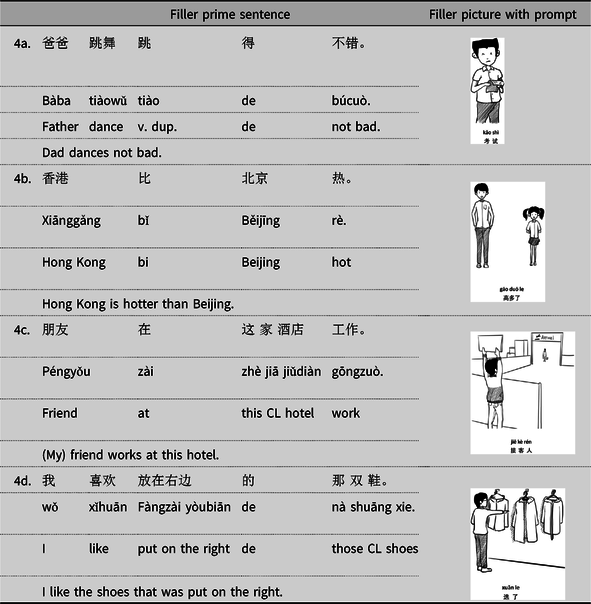
An additional 24 pairs of prime sentences and their paired pictures were created as filler items. Four L2 error-prone syntactic constructions were used, namely the manner complement (4a), comparative (4b), preverbal locative (4c), and attributive clause constructions (4d) (see Table 4 for samples and paired pictures).
Filler item examples

Each trial of syntactic priming began with a headphone icon displayed for 1 second, after which the audio prime sentence started to play. Participants were instructed to repeat out loud the sentence they had just heard before completing the picture description task (Figure 2). The events represented in the prime sentence and the paired picture were semantically unrelated to avoid content word repetition.
Flowchart of the Procedure of the Syntactic Priming Task.

In addition, (backward) digit recall tasks were constructed to further disguise the research purpose by increasing the variety of task types and the number of filler items. All the materials were then compiled as PowerPoint slideshows. The repeated sequences of digit recall, filler syntactic priming, backward digit recall, and critical syntactic priming gave 24 blocks in total (see Figure 3). One potential drawback to using PowerPoint was that the slides could only be presented in a fixed order. In order to avoid discernible patterns caused by the fixed sequence of trials, twelve lists of critical items were created, in which (1) the order of the critical pictures was randomized; (2) the order of the prime sentences was randomized; (3) each picture was paired with a different prime sentence in different slideshows; and (4) the first prime sentence in the first block was the Ba-construction in half of the slideshows, and its SVO counterpart in the other half to avoid the primacy effect.
Order of the Tasks in Each Block.

Participants were randomly assigned to one of the lists. They were briefed on how each task would work and given 2 blocks of practice trials. Three breaks were placed after blocks 6, 12, and 18. It took about 25 and 40 minutes for L1 and L2 participants, respectively, to complete all 24 blocks. L2 participants also completed a vocabulary size test, which took them another 30 minutes on average.
The coding was as follows: the recall of prime sentences was coded as “Y” or “N” depending on whether or not participants correctly repeated the prime sentence. The responses for the picture description were coded as “Ba,” “SVO,” “Other,” (i.e., non-target construction), and “X” (i.e., erroneous production). Twenty-five percent of the participants’ responses were independently coded by a second coder, with strong intercoder agreement in coding of the sentence recall (Cohen’s kappa κ = .826, p < .001) as well as the picture description (κ = .899, p < .001) (McHugh, Reference McHugh2012). Disagreement was resolved through discussion.
Data analysis
The 91 participants produced 2,184 sentences in the critical trials. Trials in which participants failed to correctly recall the prime sentence or in which responses for the picture description were coded as “Other” and “X” were eliminated. This screening process led to a loss of 79 and 203 sentences, respectively. The analysis was based on the remaining 1,902 data points.
Analyses were conducted in R (Version 4.0.2), employing generalized linear mixed models (GLMM). Models were built with the glmer function from the lme4 package (Version 1.1.21). The procedure followed the steps outlined in (Gries, Reference Gries2021). After initial screening, a full model was built: the fixed effects structure (FES) consisted of Group (L1, L2DG, and L2NDG), Prime Type (Ba and SVO) and their interactions as independent variables, and the First (block construction) Type (Ba and SVO) as a covariate. First Type was effect coded, and Group and Prime Type were dummy coded, with the L1_Group and the SVO_Prime as the reference levels. As to the random effects structure (RES), a maximal RES was constructed with random intercepts for subjects and items, by-subject random slopes for Prime Type, and by-item random slopes for Prime Type, Group, First Type, and L1.
A series of variable selection and model comparisons was then implemented to determine the best RES, followed by the best FES. The best RES was decided based on the results of principal component analysis. Following the principle of marginality, I simplified the RES by removing what seemed to do least. Each time a random effect component with the smallest variance was removed, a model comparison using likely ratio tests was performed to see if the removal of the component negatively impacted the model fitting. This process resulted in removing by-subject random slopes of Prime Type and removing by-item random slopes of L1, First Type, and Group were removed sequentially. The best FES was decided by computing likelihood ratio tests with a significance threshold set to .05. The result indicated that no predictors should be removed. Last, model diagnostics were performed for the model with the best FES and RES. The influential Subject 1 and Item 11 were removed as they were the influential data points. Neither collinearity nor overdispersion was identified in the final model.
Results
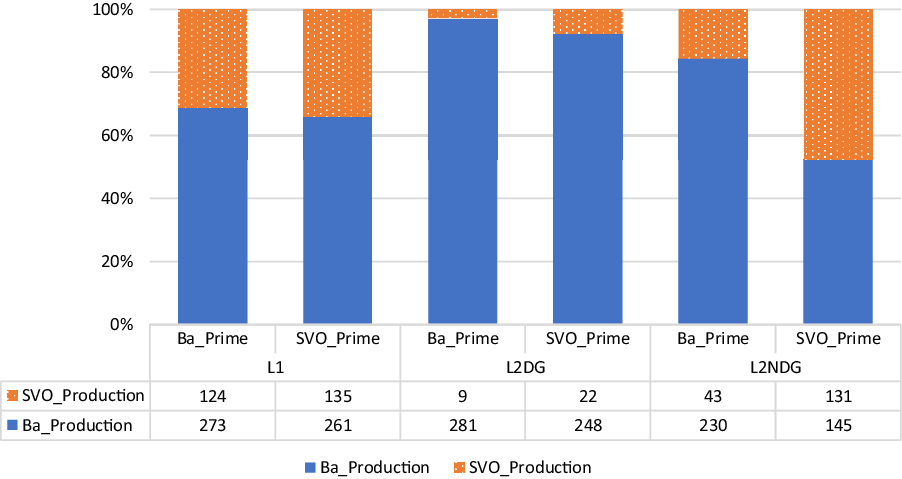
Descriptive data are visualized in Figure 4. Participants in all three groups overall used the Ba-construction more than the SVO construction. However, the Ba preference in the L1 and L2DG groups was across the prime conditions, and the change of the prime construction did not drastically alter the proportions of Ba and SVO production. By contrast, the prime condition had an obvious impact on the L2NDG group’s production, as the use of the Ba-construction was at chance level in the SVO prime condition (i.e., 52.5%), the proportion increasing to 84.2% in the Ba prime condition.
Responses Under Different Prime Conditions Across the Three Groups.

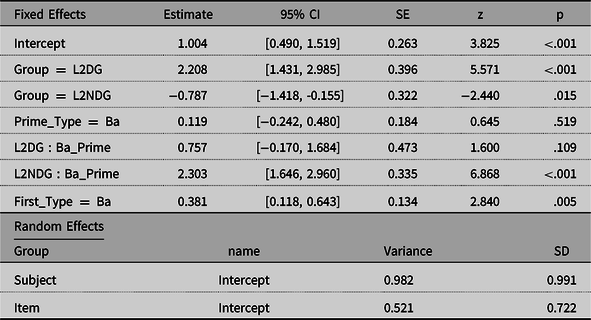
The results of the GLMM shown in Table 5 confirm the above-mentioned observations with statistical significance. The intercept (b = 1.004) is represented as the log-odds of the Ba production of reference group (i.e., L1) under the reference prime condition (i.e., the SVO condition), averaged over the levels of First_Type. Under the same SVO prime condition, the L2DG group produced significantly more Ba sentences (b = 2.208, p < .001), while the L2NDG group significantly fewer Ba sentences (b = −.787, p = .015), compared to the L1 group. For the L1 group and L2DG, changing the prime to the Ba condition did not significantly increase the production of the Ba-construction (L1: b = .119, p = .519; L2DG = .757, p = .109). However, for the L2NDG group, the Ba prime led to significantly more Ba production (b = 2.303, p < .001). In addition, a primacy effect was found. If the Ba-construction was used in the first block, participants tended to produce more Ba sentences (b = .381, p = .005).
Mixed model parameters

Note: a. The final model formula is Production ∼ Group * Prime_Type + First_Type + (1 | Participants) + (1 | Item); b. Marginal r2 = 0.281, Conditional R2 = 0.510.
Discussion
The findings are summarized as follows: (i) Participants were sensitive to the Ba-construction on account of the primacy effect. First encounters with the Ba prime sentence increased the likelihood of the Ba production in the subsequent blocks. (ii) L2NDG participants exhibited a significant syntactic priming effect causing them to repeat the Ba-construction after a Ba prime sentence. However, there was no syntactic preference in the SVO prime condition. (iii) Both L1 and L2DG participants favored the Ba-construction over its SVO counterpart across the prime conditions, and their syntactic choice was NOT significantly influenced by the prime construction. (iv) There was more variance in L1 participants’ choices of alternative constructions (i.e., 67.3% Ba and 32.7% SVO sentences). L2DG participants used the Ba-construction nearly exclusively, as shown by the overall proportion of Ba production (94.5%) and SVO production (5.5%).
Syntactic blocking of the L2 acquisition of the Ba-construction
The present syntactic priming experiment revealed that L1 and L2DG participants were likely to represent the two target constructions taxonomically, whereas L2NDG participants were likely to have reduced differentiation of the representations. In the reference SVO prime condition, L2NDG participants produced the Ba-construction at chance level, indicating the two constructions were used interchangeably without any discrimination. L1 and L2DG participants, on the other hand, preferred the Ba-construction to its SVO counterpart, suggesting that the Ba-construction enjoyed a primary status in the picture description task.
More importantly, only L2NDG participants were responsive to syntactic priming with the Ba-construction. In other words, Ba production significantly increased from the SVO to Ba prime condition in the L2NDG group, but not in the other two groups. Since the prime condition was identical for all three groups, the between-group differences should be attributed to different representational relations (Jaeger & Snider, Reference Jaeger and Snider2013). Specifically, the presence of the priming effect in the L2NDG group suggests a lack of taxonomic representations of the Ba-construction in relation to its SVO counterpart. The absence of the priming effect in the L1 and L2DG groups may be due to “a conflict with another potential source of priming” (Maldonado, Spector, & Chemla, Reference Maldonado, Spector and Chemla2017). Recall the result of the picture description task without syntactic priming (p. 14), where the Ba-construction was preferred by native speakers. It was highly probable that the pragmatic appropriateness of the Ba-construction overrode syntactic priming, leading L1 and L2DG participants to show a robust syntactic preference and resistance to priming.
How does a lack of taxonomic representations lend credence to syntactic blocking? Construction grammar holds that the learning of syntactic constructions is essentially the formation of syntactic categories (Ellis, Reference Ellis, Pütz and Sicola2010; Goldberg, Casenhiser, & White, Reference Goldberg, Casenhiser and White2007), which requires learning all aspects, including but not limited to form, semantic meaning, discourse function, and their mappings. L2NDG participants were able to use the Ba-construction to describe causative events, which indicates they had successfully established form-meaning mapping at the semantic level. Nonetheless, their optionality regarding the syntactic choice manifests their insensitivity to the pragmatic features of the Ba-construction, suggesting the acquisition of its pragmatic aspect was blocked.
The finding of this blocking effect in the Ba-construction conforms to the well-established fact that L2 Mandarin learners whose native language does not have the equivalent of the Ba-construction experience difficulties learning the Ba-construction (Lu & Ke, Reference Lu, Ke and Ke2018). Hou (Reference Hou2021) found that they were prone to syntactic blocking at the initial stage of acquisition due to unfamiliarity. The present study extended this to a later stage of acquisition. L2NDG participants, after being exposed to the Ba-construction for 1.5 years, still suffer from reduced differentiation between the Ba-construction and its SVO counterpart. At the same time, the finding of an L2 syntactic blocking effect is also in line with the literature showing the existence of optionality in L2 speakers’ use of syntactic constructions, which is also mostly tied to the challenge of integrating pragmatic information (Sorace, Reference Sorace2011; Taguchi, Reference Taguchi and Taguchi2019).
The role of L1
One alternative explanation for the priming effect being detected in the L2NDG group (and not in the L1 group) is due to weaker L2 representation, which is more susceptible to syntactic priming (Flett, Reference Flett2006). This possibility was ruled out with the additional L2DG group. Although L2DG participants also had weaker L2 syntactic representations because of their limited usage of the target constructions and comparable proficiency to L2NDG participants, they resisted syntactic priming just as L1 participants did. Therefore, the presence of the priming effect in the L2NDG group could be better understood as the consequence of syntactic blocking induced by L1, rather than as the weaker representation of an additional language.
Usage-based theories recognize a privileged role of L1 (Ortega, Reference Ortega, VanPatten and Williams2015). L1 influence pervades every aspect of SLA, as the initial state for SLA is already committed to the L1, and L1-tuned attention limits the amount of intake from L2 (Ellis, Reference Ellis2006). The discrepancy between the L2NDG and L2DG groups is especially pertinent to the role of L1 in syntactic blocking because the crucial difference is whether or not there exists an equivalent of the Ba-construction in the native language. It was shown that the presence or absence of L1 syntactic equivalent might be the key determinant of syntactic blocking.
For L2DG learners, pragmatic knowledge attached to the Dungan ba-construction is readily available to regulate the use of the Ba-construction (Kasper, Reference Kasper1992). Since the pragmatic usage of the Ba-construction and the Dungan ba-construction largely overlap in terms of expressing emphasis and subjectivity (Hai & Wang, Reference Hai and Wang2003), L2DG learners have an advantage in learning and assimilating the pragmatic information of the Ba-construction. As a result, they behave qualitatively like native speakers in terms of syntactic preference and resistance to priming in the present experiment.
For L2NDG participants, the pragmatic aspect of the Ba-construction is underspecified in the L1 due to the absence of the equivalent of the Ba-construction (Sorace & Serratrice, Reference Sorace and Serratrice2009). This creates learning difficulties because it is context-dependent and requires extensive inferential processing (Taguchi, Reference Taguchi2008). From the syntactic choices made by L2NDG participants in the priming experiment, pragmatic knowledge of the Ba-construction had clearly not yet been acquired (i.e., was blocked), resulting in their tendency to use the two target constructions indiscriminately.
It is also necessary to further compare the production of the Ba-construction between the L1 and L2DG groups. Although the Dungan ba-construction indeed promotes the taxonomic representation of the Ba-construction, there was an apparent quantitative difference between the two groups in the amount of the production of the Ba-construction under both prime conditions: L2DG participants overall produced significantly more Ba utterances than native speakers (94.5% vs. 67.3%). The discrepancy could also be considered a phenomenon of L1 transfer. Their heavier reliance on the Ba-construction mimics the more prevalent use of the ba-construction in the Dungan language (Wang, Reference Wang2000). Therefore, while the presence of an equivalent of the Ba-construction in the L1 helped L2DG participants largely reduce, if not eliminated, the influence of syntactic blocking, its higher usage frequency also had the negative effect of making them overuse the Ba-construction.
Implications for syntactic priming
The present study provides evidence for L2 syntactic blocking, which in turn contributes to the ongoing discussion of issues in syntactic priming. First, syntactic priming is a useful tool for investigating representational relations of syntactic constructions (Diessel, Reference Diessel2019, p. 204). Since syntactic priming is affected by prime-target similarity (Francis, Reference Francis2017), the absence of the syntactic priming effect in the present investigation suggests more clearly delimited representations of the Ba-construction from its SVO counterpart, while its presence indicates imprecise and noisier representations, where the two constructions are represented in a more indistinct fashion (Tachihara & Goldberg, Reference Tachihara and Goldberg2020).
Second, the present study challenges the abstract view of syntactic representations devoid of semantic content and pragmatic purpose (e.g., Branigan & Pickering, Reference Branigan and Pickering2017). If abstract representations were not bound to semantic and pragmatic content, the priming effect should have occurred in the L1 group, as the two target constructions share core semantic meaning and only differ mainly in their pragmatic functions. More importantly, if abstract representations were not bound to semantic and pragmatic content, the priming effect should have occurred in both L2DG and L2NDG groups, considering the two groups had similar L2 experience and comparable Chinese proficiency. Nevertheless, only L2NDG participants who had not yet completed the form-function mapping of the Ba-construction exhibited a priming effect.
In fact, the meaning side of syntactic constructions has been found to independently drive syntactic priming and pure abstract structure is not sufficient for priming to occur. For the former, Hare and Goldberg (Reference Hare, Goldberg, Hahn and Stoness1999) found that provide-with sentences primed semantically similar double-object construction, even though they were more structurally similar to a propositional dative construction. For the latter, Ziegler et al. (Reference Ziegler, Bencini, Goldberg and Snedeker2019) demonstrated that unless intransitive locatives contained the preposition by, they could not prime passives even though they had similar surface structure. The present study further supports the construction view to show an inseparable relationship between the form and meaning of syntactic constructions (Goldberg & Suttle, Reference Goldberg and Suttle2010).
Third, syntactic constructions are horizontally interrelated due to formal, semantic, and functional similarities (or contrasts) (Diessel, Reference Diessel2019, pp. 199–200), and each aspect can potentially contribute to the occurrence of syntactic priming (Kwon & Lee, Reference Kwon and Lee2017). The existing literature indeed shows how syntactic priming is sensitive to different aspects of syntactic construction (Günther, Reference Günther2017). The results of the present investigation add evidence to this growing body of research. The pragmatic function of the Ba-construction produces a context-dependent preference in use, which encourages L1 and L2DG participants to resist priming. However, since this information is not attached to L2NDG participants’ representation of the Ba-construction, they are not able to utilize it to guide their syntactic choices, resulting in the occurrence of the priming effect.
Concluding remarks
Blocking is a widely studied phenomenon that constrains associative learning, but it was not proposed as a cognitive mechanism to influence SLA until recently (Ellis, Reference Ellis2006). The present study provides evidence for the blocking effect at a later stage of L2 syntactic acquisition. It shows the challenge that L2 learners have in establishing a taxonomic representation of the Ba-construction because of imprecise or incomplete form-function mapping and discusses the role of the L1 in inducing such a blocking effect.
The current research suggests several fruitful avenues for future study. First, due to the limited number of L2 learners and to the COVID-19 pandemic, our sample size barely exceeded the recommended minimum requirement (i.e., 24 per group) (Mahowald et al., Reference Mahowald, James, Futrell and Gibson2016). It is likely that the statistical analysis is underpowered. Future studies are needed to replicate the findings by either recruiting more participants or conducting local meta-analysis (e.g., Ellis, Reference Ellis, Pütz and Sicola2010, Ellis & Sagarra, Reference Ellis and Sagarra2011). Secondly, the implication for instruction is to direct learners’ attention to the pragmatic aspect of the Ba-construction. Instructional intervention studies focusing on consciousness-raising techniques and their effectiveness are needed. Third, since the blocking effect on Ba-construction has been found at the initial (Hou, Reference Hou2021) and later learning stages, it would be useful to use longitudinal or cross-sectional design to compare the blocking effect at different learning stages to gain more insight into long-term nature of the blocking effect. Finally, this study contributes to current discussions about syntactic priming and also encourages a more in-depth understanding of representational relations between syntactic constructions and the nature of syntactic priming.
Acknowledgements
This manuscript is based on the second experiment of my PhD dissertation at the University of Macau. I would like to express my gratitude to Dr. Kun Luo for arranging the data collection at Northwest Normal University in China. I am also thankful to my advisor Professor Hong Gang Jin, my thesis committee members (Professors Wei Deng, Sun-A Kim, and Matthew Wallace), Journal Editor Professor Carla Contemori, and the anonymous Reviewers for their constructive feedback on earlier versions of the manuscript.
Conflicts of interest
The author(s) declare none.
Replication package
Stimuli sentences, analytical scripts, and raw data are available at https://osf.io/ws8zb/.