The so-called Tea Party movement came into its own in the 2010 midterm elections, when popular discontent with the recession, Obama-initiated bailouts, and the Obama presidency in general led to historic Republican legislative victories in federal and state legislatures. This led to “Tea Party” demonstrations against the federal government as well as numerous Republican primary challenges from “Tea Party candidates” on the right. In addition to extensive coverage of the movement by journalists and pundits, social scientists began to publish research on the Tea Party (see, e.g., Gervais and Morris Reference Gervais and Morris2012; Karpowitz et al. Reference Karpowitz, Monson, Patterson and Pope2011; Mead Reference Mead and Russell2011; Williamson, Skocpol, and Coggin Reference Williamson, Skocpol and Coggin2011). Until recently, this research tended to focus narrowly on (1) the identity and motivations of sympathizers with the Tea Party movement, and (2) the electoral success of so-called Tea Party candidates (particularly in Republican primary elections).
In this article, we take a different approach to test directly the proposition that the positions associated with the Tea Party movement (i.e., antitaxation, antigovernment, and antiregulation—comprising an “anti-Washington” ideology) found their way into the messaging of mainstream Republican candidates. In fact, the 2012 Republican candidate positions reflected the radicalized Tea Party discourse more so than the traditional social conservative Republican discourse, which dominated the 2008 elections. To assess this claim, we examined the ideological stances taken by the Republican candidates in televised presidential-primary debates in 2008 and 2012—specifically, the debates early in the primary competitions. Our findings indicate that the positions taken by Republican presidential candidates in 2012—measured by their words spoken and ideological positions they revealed in the presidential-primary debates—were less representative of traditional social conservative Republican positions than those of anti-Washington Tea Party themes. This suggests that either (1) the emergence of the Tea Party has indeed had an impact on the Republican messaging and ideological positions, or (2) the conditions that led to the emergence of the Tea Party simultaneously pushed the Republican Party in an anti-Washington direction. In either case, it appears that the Republican Party has been radicalized in a direction consistent with the libertarian, small-government ideology.
EXISTING LITERATURE
Much of the earliest work about the Tea Party was written by journalists who placed a premium on enhancing its general understanding of the Tea Party as a social movement, particularly with respect to its base (see, e.g., Zernike Reference Zernike2010). Academics, meanwhile, debated the individual-level determinants of Tea Party support—namely, whether they tend to have latent racist attitudes (Arceneaux and Nicholson Reference Arceneaux and Nicholson2012; Barreto et al. Reference Barreto, Cooper, Gonzalez, Parker and Towler2011; Williamson, Skocpol, and Coggin Reference Williamson, Skocpol and Coggin2011).
…in the course of presidential primaries, candidates produce numerous shorter written and spoken statements that encompass their positions on all important campaign issues, particularly those that concern their general approach toward governance.
Other researchers explored the electoral impact of the movement. Karpowitz et al. (Reference Karpowitz, Monson, Patterson and Pope2011) demonstrated that an endorsement by a Tea Party group had a negligible impact on the outcome of general elections; however, in some cases, it helped to secure the victory of Tea Party favorites over Republican moderates in primary elections. Jacobson (Reference Jacobson2011) found that the movement energized an older, whiter, more conservative electorate, which helped to deliver a historic victory to the Republicans in the 2010 midterms. Abramowitz (Reference Abramowitz2011) analyzed survey data, which revealed that Tea Party members overwhelmingly identified with the Republican Party and were, by far, the most conservative and most activist bloc within the party. Libby (Reference Libby2013) argued that the Tea Party movement had already an important impact on the Republican Party and was likely to retain its influence for many years to come. Others tested the “Tea Party effect” by evaluating the messaging of Tea Party candidates versus establishment candidates (Livne et al. Reference Livne, Simmons, Adar and Adamic2011).
For this article, we devised a direct test of whether the language and principles associated with the Tea Party movement have had a radicalizing effect on the positions taken by Republican candidates in the 2012 primaries as compared to those of 2008. If we are correct, then the candidates in 2012 voiced positions more characteristic of an anti-Washington Tea Party ideology than the traditional social conservative ideology. We tested this proposition using text analysis, extracting the candidates’ respective positions from their announcements and primary debates in both 2008 and 2012 and announcements in 2012.
HYPOTHESES AND METHODS
Williamson, Skocpol, and Coggin (Reference Williamson, Skocpol and Coggin2011) discussed a range of scenarios likely to emerge as a result of the Tea Party movement and concluded that the most likely outcome was that “the presence of newly elected Tea Party representatives will only reinforce the 2009–10 Republican strategy of total opposition to the Obama agenda.” This suggested that rather than serving as a political sideshow, the Tea Party would radicalize the mainstream Republican position in national (i.e., presidential) elections. Our study directly tested this hypothesis by analyzing shifts in the messaging of Republican politicians in two presidential elections that “bookended” the emergence of the Tea Party movement.
Specifically, we test the claim that the messages of mainstream Republican presidential candidates in 2012 were significantly different than those of Republican candidates in the 2008 primaries. If, as we claim, the emergence of the Tea Party movement in 2009 had a radicalizing effect on the Republican presidential candidates in 2012, then we should expect that they had an overall more anti-Washington (versus traditional social conservative) message in the 2012 versus the 2008 primary elections. Our claim receives even stronger support if we can observe ideological radicalization of individual candidates who ran in both elections (i.e., Mitt Romney and Ron Paul).
Candidates in US presidential primaries are expected to take positions on a number of issues, yet they rarely generate manifestos that reliably address all important issues. However, in the course of presidential primaries, candidates produce numerous shorter written and spoken statements that encompass their positions on all important campaign issues, particularly those that concern their general approach toward governance. We used a subset of these statements to extract the positions of the main Republican candidates in 2008 and 2012.
Scholarly analysis of texts approaches the problem as either discourse or content. The most widely used text-analytic methods are highly labor-intensive, relying heavily on human judgment. Computer-assisted content analysis is largely free of these problems. Footnote 1 We applied a computer-assisted content-analytic method, known as Wordfish (Slapin and Proksch Reference Slapin and Proksch2008) and as implemented by Lowe (Reference Lowe2013), that relies on factor analysis of word frequencies. The method has been shown to produce valid estimates of positions, Footnote 2 and it has been applied to a variety of political documents. Footnote 3 Each count W of word j in document i is modeled as a draw from a Poisson distribution with rate λij (1). In the following equations, (2) the rate is modeled as a function of the sum of the document fixed effect αi, the word fixed effect ψj, and the product of the word slope βj with the document position θi. The document positions and word slopes are the crucial inferential quantities. The fixed effects account for the fact that some documents are longer and some words are more common.
 $${{\rm{W}}_{{\rm{ij}}}}\, \sim \,{\rm{Poisson}}\left( {{\lambda _{{\rm{ij}}}}} \right)$$
 $${\rm{log}}\left( {{\lambda _{ij}}} \right)\, = \,{\alpha _{\rm{i}}}\, + \,{\Psi _{\rm{j}}}\, + \,{\beta _j}\,{\theta _i}$$
Much of the scholarship on the Tea Party focuses on what is driving the movement, what attracts people to it, and what influence it has on policy. Our study asked whether the movement directly influences the positions of Republicans running for national office.
DATA
Our analysis focused on the pre-Iowa caucus Republican presidential debates because, in this period, the candidates had yet to maneuver in response to competition in the primary battles. Therefore, their positions were more likely to reflect their own ideological positions. For the sensitivity analysis, we used the candidates’ presidential candidacy announcements. The debates and candidacy announcements differ substantially—the debates are spoken words whereas the announcements are prewritten. The sensitivity analysis was restricted to the 2012 cycle because the 2008 cycle announcements were not in a consistent format. Footnote 4
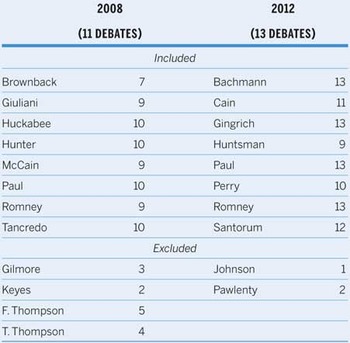
For the analysis, we selected those candidates who participated in at least two thirds of the televised presidential debates before the Iowa caucus—that is, in at least seven of the 11 pre-Iowa debates of the 2008 cycle or nine of the 13 pre-Iowa debates of the 2012 cycle. Included and excluded candidates are listed in table 1. Tables 5 and 6 in the online appendix (available on the PS website at http://dx.doi.org/10.1017/S1049096514001085) report details about the debates and announcements, including the sources of their transcriptions.
Candidates
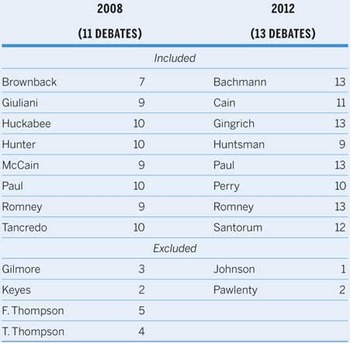
Candidates who took part in the debates selected for the analysis and the number of the selected debates they have attended. Candidates excluded from the analysis are at the bottom of the list.
We treated all utterances of each candidate in all selected debates as a single document. The resulting compiled texts can be expected to encompass the majority of relevant issues because individual debates tend to focus on a narrow subset.
In our analysis, we made no ex-ante assumptions about how informative each word (i.e., “stem”) is relative to an ideological position other than assuming that the most common function words are not informative. Instead, we used the data and the model to assess how informative each included word is. Thus, we excluded only the most common function words (i.e., “stop-words”) and numbers. Footnote 5 Including primary-specific issues would have artificially inflated the differences between the 2008 and 2012 candidates because related words often are common in one cycle but rare in the other. Therefore, we selected the stems that were used in each cycle by at least two (i.e., 15%) of the selected candidates; we included a total of 1,513 stems in our analysis. Footnote 6
RESULTS
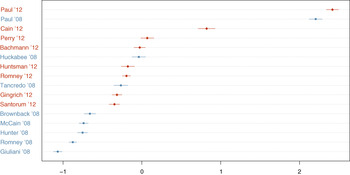
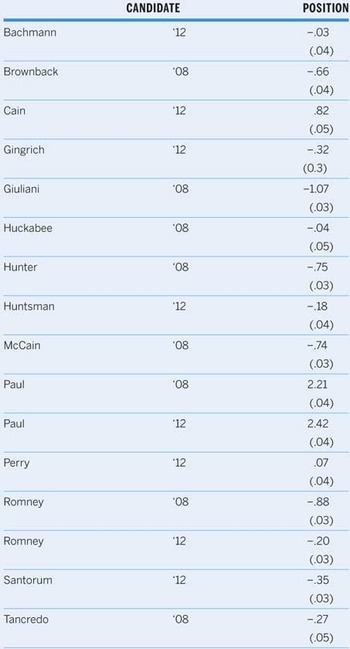
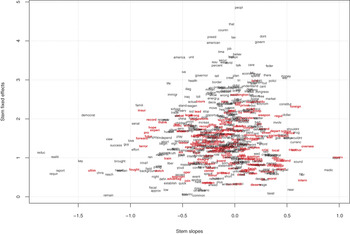
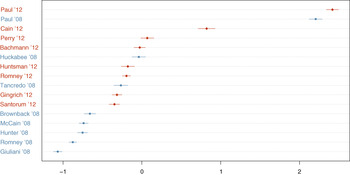
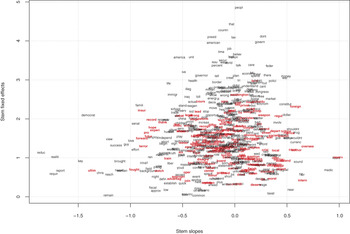
The positions of candidates on the extracted dimension are shown in figure 1 and reported in table 2. The most widely used word stems and the extent to which they discriminate on the dimension are shown in figure 2. When we discuss the extracted dimension, we use the labels “negative” and “positive” in a purely numerical sense.
Candidate Positions
Candidate positions extracted from their pre-Iowa debate speeches with bootstrapped 95% confidence intervals (1,000 replications). 2008 candidates denoted by circles (blue) and 2012 candidates by diamonds (red). (Color online)
Candidate Positions
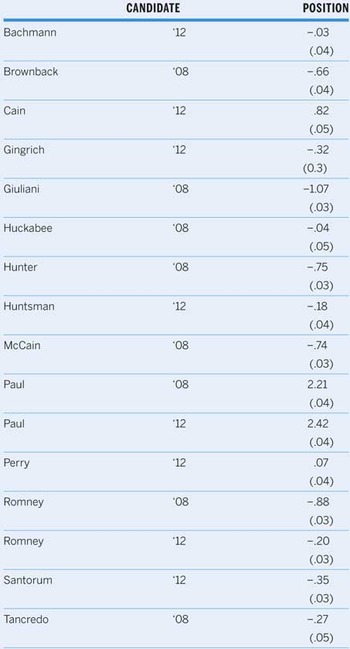
Note: Candidate positions extracted from pre-Iowa debates. Bootstrapped standard errors (1000 replications) in parentheses.
Stems Used by At Least Five Candidates in Each Primary
The X-axis captures loadings on the extracted dimension and the Y-axis captures the stem fixed effects. Stems used more in 2012 are shown in bold (red). The stem “citi” is not plotted (weight = −2.9; slope = 1.2). (Color online)
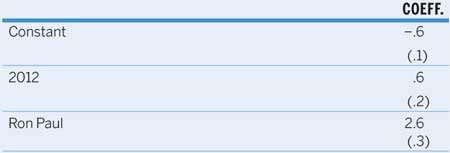
Several factors are immediately apparent in figure 1. First, in both campaigns, Ron Paul staked out the farthest position on one end of the dimension. This corresponds with the popular assessment of his position as the most extreme among the mainstream Republican candidates. Paul’s 2012 position also was significantly more extreme than his 2008 position. Furthermore, his distance from the second most-extreme candidate decreased in 2012: in 2012, Herman Cain was considerably closer to Paul than was the second most-extreme candidate of 2008, Mike Huckabee. The Republican candidate field of 2012 moved so significantly toward the positive end that only two 2008 candidates other than Paul (i.e., Tancredo and Huckabee) took positions that resembled those of the 2012 field. The median 2008 candidates (i.e., Brownback and McCain) were significantly more moderate than the median 2012 contenders. The only candidate from both 2008 and 2012 other than Paul (i.e., Mitt Romney) also moved significantly to the positive end of the dimension. In 2008, Romney was the second farthest on the negative end of the dimension, whereas in 2012, his estimated position was above both the 2008 median position and Tancredo’s position. The results of the linear regression reported in table 3 summarize the fact that a 2012 candidate who is not Ron Paul was, on average, more than 0.5 point to the right of a 2008 candidate. The distance between Ron Paul and the other candidates as well as the shift of the overall field to the right in 2012 are so prominent that they jointly account for most—almost 90%—of the variance in the extracted positions.
Linear Regression with Normally Distributed Error
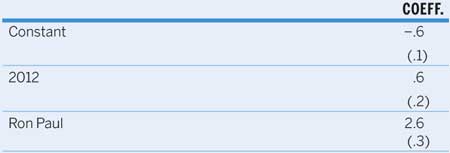
Conditioned (i.e., left-hand side) variable: candidate placement on the extracted dimension. Conditioning (i.e., right-hand side) variables: binary variables indicating whether the campaign was in 2012, and whether the candidate was Ron Paul. Standard errors in parentheses. N = 16, residual S.D. = 0.4, and multiple R2 = 0.9.
In short, it appears that the entire 2012 field—and the Republican Party as a whole—clearly moved to the positive end of the dimension. The question is how to substantively characterize this position. Given the popular perception of Ron Paul, our first intuition is to look for libertarianism.
To understand what is captured by the extracted dimension, it is helpful to look at the stem parameters. Figure 2 shows the parameters of stems used by at least five candidates in each primary. Word stems that correspond to Paul’s side of the dimension strongly suggest opposition to government—especially the federal government in Washington—and, in particular, federal taxation and regulations.
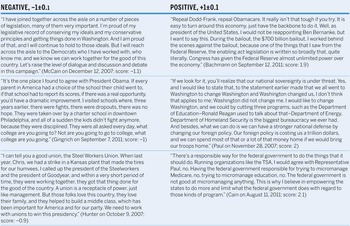
To better understand the extracted dimension, we divided the candidate speeches into all possible segments of five consecutive sentences by a single candidate. We then reviewed several hundred of those segments positioned close to −1, 0, +1, and +2. Table 4 shows six representative five-sentence sequences from the debates, positioned within ±0.1 of −1 or +2 on the extracted dimension. The speech segments in table 4 reveal a marked contrast between the two parts of the dimension. The displayed speech segments close to −1 are concerned with issues such as cooperation with Democrats and unions, as well as using the federal government to achieve policy goals. Similarly positioned speech segments not shown in table 4 refer to national policies on security, foreign policy, energy, schooling, and family. By contrast, displayed speech segments close to +2 strongly favor restricting the scope of federal government. In short, they agree that the best federal policy is no federal policy. Based on this evidence, we labeled the negative and positive ends of the dimension as “pro-Washington” and “anti-Washington,” respectively.
Selected Five-Sentence Sequences Spoken by a Single Candidate in a Single Debate
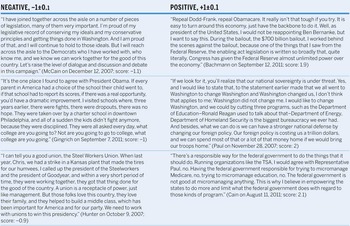
Sequences were selected from all such sequences longer than 500 characters and within ±0.1 to two points on the dimension: −1 and +2. Sequences in the first column characterize the negative end of the extracted dimension and sequences in the second column the positive end.
There is good reason to associate this position with the Tea Party movement, broadly construed. Indeed, the tenets of the Tea Party movement include a massive rollback of the federal government and a corresponding devolution of competencies to the states. Among the candidates we analyzed, Ron Paul most embodies these ideals, and a compelling interpretation of the scale is that it represents a traditional Republican versus Tea Party (arguably, Libertarian) dimension. It is interesting that Michele Bachmann, the founder of the Congressional Tea Party Caucus, falls much closer to a traditional social conservative Republican position. This may be due to her preoccupation with traditional social issues as well as issues that the Tea Party movement claims as its own.
SENSITIVITY ANALYSIS
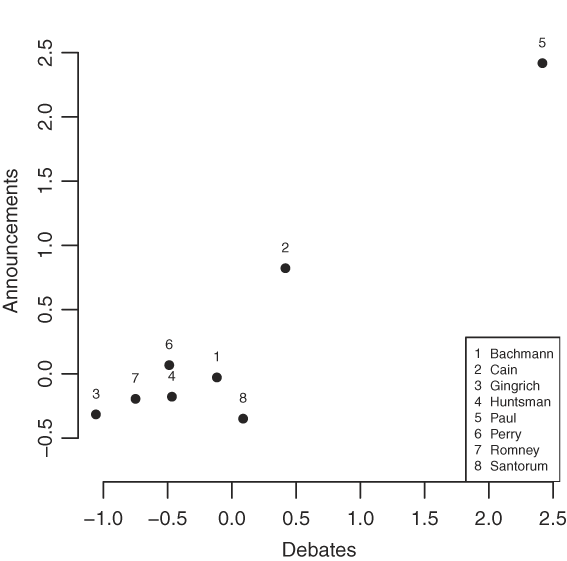
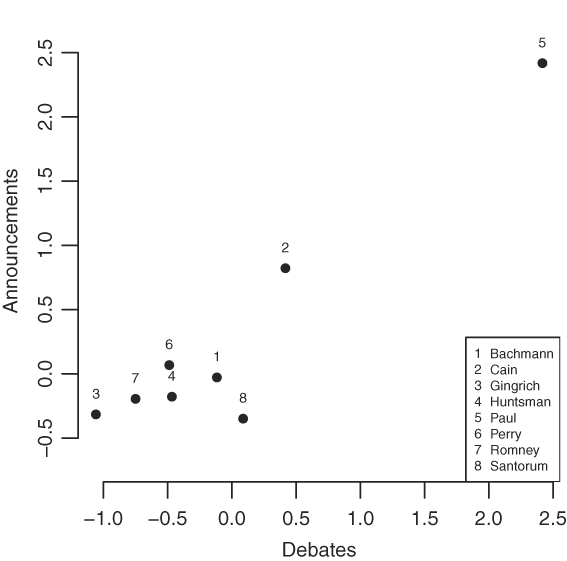
To test the sensitivity of the analysis, we compared the ideological dimensions derived from the 2012 candidate announcements with the 2012 debates. Footnote 7 Whereas the debates can be expected to encompass a larger set of specific issues, the announcements—much shorter texts produced at the beginning of a campaign—focus on two very general topics: namely, the general values emphasized by the candidate and the qualities of the candidate. Furthermore, although candidates prepare carefully, the messages they convey in the debates are considerably more improvised than those embedded in their announcements. We selected stems that were used by at least two candidates. Although this analysis did not consider the 2008 announcements, the dimensions extracted from both the announcements and the debates are remarkably close to one another (as shown in figure 3) and strongly correlated: Pearson’s ρ = 0.94 (95% confidence interval: 0.69, 0.99).
Positions of 2012 Candidates
Positions of 2012 candidates extracted from pre-Iowa debates and candidacy announcements.
CONCLUSION
Much of the scholarship on the Tea Party focuses on what is driving the movement, what attracts people to it, and what influence it has had on policy. Our study asked whether the movement directly influences the positions of Republicans running for national office. We focused on pre-Iowa debates assuming that these early debates provide a more accurate reflection of candidate preferences and positions going into the election unaffected by election maneuvering.
To better understand the candidate positions, we used quantitative text analysis and extracted a single factor from frequencies of words spoken in presidential-primary debates. The result was a scale that clearly extends from a moderate, traditional Republican point of view to a more radical view in line with the values of the anti-Washington Tea Party. To ensure that our scale was not simply an artifact of the selected texts, we cross-validated it with the 2012 candidacy announcements, which yielded highly comparable results.
When comparing the 2008 and 2012 candidates, there is both a drastic and a statistically significant shift toward the overall positions of the anti-Washington Tea Party. There also is a clear and significant shift for both candidates who ran in both the 2008 and 2012 presidential campaigns. In 2012, Mitt Romney moved from the moderate to the extreme side of the 2008 field. By the standards of the 2012 election, this move placed him near the median of the 2012 candidates. Although the causal mechanism underlying this shift is still uncertain, it is clear that Tea Party positions moved Republican politics to an ideologically anti-Washington, anti-government position. It remains to be seen whether these effects herald a lasting shift in Republican ideology.