Does religious identity and activity inhibit or encourage the accumulation of political knowledge in America? We know that religion shapes the political attitudes of adherents and can motivate civic engagement (Wald et al. Reference Wald, Owen and Hill1988; Verba, Schlozman, and Brady Reference Verba, Schlozman and Brady1995; Djupe and Grant Reference Djupe and Grant2001; Djupe and Gilbert Reference Djupe and Gilbert2009; Smidt, Kellstedt, and Guth Reference Smidt, Kellstedt, Guth, Smidt, Kellstedt and Guth2009; Wald and Calhoun-Brown Reference Wald and Calhoun-Brown2011). Religion also serves as an extremely potent predictor of vote choice (Layman Reference Layman2001; Dalton Reference Dalton2006). However, despite the large number of individuals who attend church in America and consider themselves to be “born again” ChristiansFootnote 1—and the profound influence this behavior is thought to have on political beliefs and activities—the effects of religion on politics have long been considered “peripheral subject matter” in political science research (Gill Reference Gill2001, 118).
While there is a growing literature on the effect of religion on political engagement and voting, there is little systematic analysis of the effect of religion on one of the key components of democratic citizenship: political knowledge. Scholars argue that political knowledge plays a vital role in people's ability to form political opinions and incorporate new information (Zaller Reference Zaller1992; Gilens Reference Gilens2001). Delli Carpini and Keeter (Reference Delli Carpini and Keeter1996) provide perhaps the most vigorous endorsement for the importance of citizens knowing basic political structures, political figures, and public policies, asserting that knowledge is intimately tied to political and economic power. Those who have high levels of knowledge are better able to get the political system to work for them and better understand the consequences of their voting behavior (e.g., Converse Reference Converse, Ferejohn and Kuklinski1990; Althaus Reference Althaus2003). But as Smidt et al. (Reference Smidt, den Dulk, Penning, Monsma and Koopman2008) lament, “Despite the significant body of research on political knowledge, the relationship between it and religion has rarely, if ever, been probed” (163). The studies that do examine the effect of religion on political knowledge tend to consider knowledge in passing as one of many political outcomes influenced by individuals’ religious commitment—usually focusing instead on voting, policy opinions, participation, etc.
As a result, the few studies on religion and political knowledge acquisition (1) do not take into account the fact that various kinds of political knowledge exist, (2) typically do not examine the causal mechanisms underlying this relationship—or at best make claims about the causal effect of religion on civic skills generally, and (3) produce contradictory results. For example, while some scholars show that religion increases political knowledge (Hougland and Christenson Reference Hougland and Christenson1983; Smidt et al. Reference Smidt, den Dulk, Penning, Monsma and Koopman2008), others show it has no effect (Verba, Schlozman, and Brady Reference Verba, Schlozman and Brady1995), and still others find a negative relationship (Scheufele, Nisbet, and Brossard Reference Scheufele, Nisbet and Brossard2003, though only for doctrinal commitment). Some works, such as Monsma and Penning (Reference Monsma and Penning2010), find that religiosity has both positive and negative effects on political knowledge, depending on which aspects of religion are examined.
In addressing these contradictory findings, I examine a key cause of variation in political knowledge—namely the motivation and ability to learn political facts from the media environment—and discuss the political implications of religion-driven knowledge gaps. In doing so, I make three contributions to the literature. First, whereas previous studies discuss the effect of religion on a multitude of civic skills, I focus on political knowledge alone.Footnote 2 Doing so allows me to carefully analyze the aspects of religion that affect knowledge acquisition, since religion is a multi-dimensional concept. Secondly, I divide political knowledge into conceptually distinct types, based on the topical and temporal dimensions of the knowledge area, following the typology of Barabas et al. (Reference Barabas, Jerit, Pollock and Rainey2014). Finally, I provide a theoretical account for how Evangelical identity and religious attendance affects the acquisition of these different types of political knowledge—both positively and negatively.Footnote 3 Given the lack of studies linking religion to knowledge, it should be no surprise that causality issues have received little attention.
RELIGION AND GENERATING CIVIC SKILLS
The literature on religion and politics demonstrates considerable variation in answering the question of whether religion is beneficial or detrimental to democratic citizenship. On the positive side, scholars have long seen religious involvement as a key avenue through which individuals become a part of discussion/recruitment networks and acquire various civic skills, as well as political awareness, mobilization, and social activism (Verba, Schlozman, and Brady Reference Verba, Schlozman and Brady1995; Putnam Reference Putnam2000; Djupe and Grant Reference Djupe and Grant2001; Djupe and Gilbert Reference Djupe and Gilbert2006; Reference Djupe and Gilbert2009). Since the time of Tocqueville, religious institutions have been viewed as vital intermediaries between the American state and the individual. Involvement in places of worship helps to produce civic involvement, organized political action, and understanding of important political issues—especially for individuals who have few secular means for obtaining these political resources (Scheufele, Nisbet, and Brossard Reference Scheufele, Nisbet and Brossard2003; Djupe and Gilbert Reference Djupe and Gilbert2009; Wald and Calhoun-Brown Reference Wald and Calhoun-Brown2011).
Religious institutions promote civic skills and political knowledge/engagement in a number of ways. First, they provide a network of individuals who come together for a common purpose. In doing so, these individuals can be mobilized to take part in a wide range of activities, including political ones (Djupe and Grant Reference Djupe and Grant2001). Second, religious institutions are forums in which individuals learn specific skills that lead to increased political efficacy, engagement, and interest (Verba, Schlozman, and Brady Reference Verba, Schlozman and Brady1995; Djupe and Gilbert Reference Djupe and Gilbert2009). Skills, knowledge, and motivation individuals learn from taking part in religious activities may have a “spill-over” effect onto the political arena (Peterson Reference Peterson1992; Djupe and Grant Reference Djupe and Grant2001; Djupe and Gilbert Reference Djupe and Gilbert2008). Religious institutions endow individuals with the motivation to engage in politics, providing information and resources vital to accomplish these tasks (Greenberg Reference Greenberg2000).
RELIGION, THE MEDIA ENVIRONMENT, AND KNOWLEDGE ACQUISITION
Individuals learn about politics and public policy primarily through the mass media, as media largely determine the availability of information about politics and public policy (Delli Carpini and Keeter Reference Delli Carpini and Keeter1996; Gilens Reference Gilens2001; Graber Reference Graber2001, Reference Graber2002, Reference Graber2004; Jerit, Barabas, and Bolsen Reference Jerit, Barabas and Bolsen2006; Barabas and Jerit Reference Barabas and Jerit2009). Various individual factors, such as socio-economic status, race, and education, condition how well citizens translate the information environment into political knowledge, though again religion is rarely included in this list of important individual variables (e.g., Hutchings Reference Hutchings2001). Despite this, I argue that religion should influence the way individuals construct their information environment and how they subsequently interact with it—for better (as argued above) or worse, as I discuss next.
One pessimistic argument regarding religion and democratic citizenship comes from scholars linking personal religious commitment to decreased interaction with secular society. Many see religious commitment—or some aspects of religiosityFootnote 4—as detrimental to individuals’ engagement with the secular world, particularly with the mass media. For instance, Blom (Reference Blom2010) argues that religion plays a key role in determining whether individuals find media sources credible and whether individuals perceive the media as being hostile to their beliefs. This is quite important, as Tsfati and Cohen (Reference Tsfati and Cohen2005) state that trust in the media influences trust in democracy and individuals’ willingness to abide by democratic decisions. Earlier work shows that elite cues are powerful in generating mistrust in the media, especially from the conservative side (Domke et al. Reference Domke, Watts, Shah and Fan1999; Watts et al. Reference Watts, Domke, Shah and Fan1999). Given the modern fusion between white Evangelical Christianity and conservative/Republican politics (Patrikios Reference Patrikios2013), it is highly likely that many Christian elites provide anti-media cues that their followers absorb. Distrust in secular media may well lead individuals to retreat to alternative information sources of dubious quality, and may inhibit other types of political participation.
Along these lines, Putnam (Reference Putnam2000) worries about a dark side to religious engagement, namely that doctrinal commitment and religious absolutism lead to social distrust and disengagement from society. In their study of the effect of churches on political activities, Djupe and Gilbert (Reference Djupe and Gilbert2009) argue that when individuals partake in greater personal religious practices, these individuals may become insulated from outside information (2009). As I argue above, religious activity and Evangelical identity may lead to distrust of non-religious individuals and the mass (secular) media, isolating individuals from the larger political world (Wuthnow Reference Wuthnow, Skocpol and Fiorina1999; Greenberg Reference Greenberg2000; Uslaner Reference Uslaner2000). Scheufele, Nisbet, and Brossard (Reference Scheufele, Nisbet and Brossard2003) argue that dogmatic belief can lead to civic disengagement, closed-mindedness, fatalistic worldviews, and retreat from the world (also see Alport Reference Alport1954; Rokeach Reference Rokeach1954, Reference Rokeach1960).
Further, scholars have shown that strongly religious individuals engage in “cognitive processes that undermine efficacy and self-exposure to heterogeneous sources of political information (such as the mass media) that can sponsor political participation” (Scheufele, Nisbet, and Brossard Reference Scheufele, Nisbet and Brossard2003, 304). Evangelical Christians, in particular, are less committed to worldly pursuits and are especially likely to selectively expose themselves to information outlets they see as friendly to their beliefs and values (Barker and Bearce Reference Barker and Bearce2013). Other research has shown that individuals with fatalistic views use media less than the rest of society and also have far less interaction with individuals with opposing viewpoints or worldviews (McLeod, Sotirovic, and Holbert Reference McLeod, Sotirovic and Holbert1998). Lower levels of deliberation in turn result in less trust, less tolerance, and less knowledge of opposing ideas (Page Reference Page1996; McClurg Reference McClurg2006; Mutz Reference Mutz2006).Footnote 5 As Wald, Silverman, and Fridy (Reference Wald, Silverman and Fridy2005) state, “a black and white moral universe does not provide the necessary cognitive tools to comprehend a political system painted in shades of gray” (126).
I contend that religion endows individuals with a wide variety of skills. While many (if not most) of these skills are beneficial for democratic citizenship, others may be more detrimental. Among the most important religious skills individuals derive from religion is the ability and motivation to maintain their beliefs by ignoring or countering information sources that would challenge those beliefs. Religion helps individuals become, in the parlance of Tetlock (Reference Tetlock2005), hedgehog-like thinkers. That is, religion encourages individuals to adhere to big ideas, eschew evidence that contradicts the faith, and interpret events in keeping with the worldview of their faith. As a result, individuals become skilled at resisting new, suspect information, especially if the source of that information is distrusted. Religion in America, especially Evangelical Christianity, often teaches people to reject dissonant information, and counter-argue opinions that run against deeply-held beliefs.Footnote 6
Just as organizing a small group and picking up political cues in church may prepare and motivate individuals for political activity outside church, the motivation and ability to maintain religious dogmas are then applied to the political realm. As individuals practice behaviors that guard their religious beliefs against negative influence by outside sources, the same holds true for their political learning. In other words, while political knowledge is not itself a civic skill, skills learned via religious activity directly affect the motivation to acquire factual knowledge from non-trusted sources. To be clear, while religion affects the way people learn about politics, I do not argue that it affects underlying cognitive capacity or abilities.
Religion is a multidimensional concept incorporating a wide variety of inputs. One reason why the literature has shown disparate effects of religion on political knowledge is that studies have employed different measures of religion. While all studies, including this one, are limited by the availability of religion variables, it is helpful to review how religious metrics can be conceived and operationalized. Perhaps the most famous breakdown of religious elements is into the so-called “Three Bs”: belonging, belief, and behavior (see Beard et al. Reference Beard, Ekelund, Ford, Gaskins and Tollison2013 for a discussion). For instance, numerous studies show that religious traditions/denominations differ with respect to political activity and values. Certain beliefs, i.e., biblical literalism, may lead to the more negative effects of dogmatism discussed above. Lastly, religious activities (behavior) may serve as the basis for political activity, network building, and being able to apply belief to action. Another approach emphasizes placing individuals into religious traditions based on the denomination with which they affiliate (Steensland et al. Reference Steensland, Park, Regnerus, Robinson, Wilcox and Woodberry2000). One significant problem with the religious traditions approach is that there exists significant diversity within traditions as to political beliefs, voting behavior, and exposure to political cues (see Djupe and Burge Reference Djupe and Burge2017).
While it is not possible in a single paper to develop a theory about how all religious variables and traditions uniquely affect the acquisition of political knowledge, I argue that basic religiosity measures will largely capture how political learning occurs across the different types of knowledge categories. Based on the literature reviewed above, I predict that activity in religious institutions will generally produce civic skills and political motivation in keeping Tocqueville's findings. On the other hand, religious dogmatism and insular social networks will be more associated with negative civic/political outcomes, especially when it comes to political information. While no single operationalization of religion perfectly captures either concept, I will use two measures to partially capture both: attendance at religious services and Evangelical identification. I do this in part for two reasons. First, both operationalizations transcend religious denomination, capturing a wider role of religion on media trust and political knowledge than religious traditions alone.Footnote 7 While Evangelical Christians have long been associated with specific traditions and a religious-cultural movement, Djupe and Burge (Reference Djupe and Burge2017) show that there is a non-insignificant number of believers who attend churches considered “Evangelical” but nonetheless do not consider themselves to be born again or Evangelical, while many members of non-Evangelical churches do identify as Evangelical.Footnote 8 As a result, I define Evangelicals by their self-identification as born again (i.e., having a born again experience) or as an Evangelical Christian, rather than by categorizing Evangelicals by membership in specific denominations.
Second, both measures separately address the complexity of the interplay between religion and political learning from the media. For instance, religious attendance (imperfectly, of course) reflects greater involvement in a religious institution and religious social networks, as well as implying greater commitment to the doctrines of that institution, often to the exclusion of other sources of knowledge.Footnote 9 Further, I show that attendance serves as a good empirical proxy for a more fully operationalized commitment to ones’ religious tradition—regardless of what that tradition may be. I will demonstrate that—at least as far as political knowledge is concerned—reporting membership in a religious tradition and reporting attendance at religious services (presumably of that tradition) tap into much—though not all—of the same underlying effect of religion on media perception and knowledge. Thus attendance by itself captures much of the positive and negative aspects of religion for acquiring civic skills and political knowledge, while also serving as a proxy for overall identification with and commitment to ones’ faith.Footnote 10 Similarly, as described above, while Evangelicals are often seen as merely a religious tradition, Evangelicals may also be defined by their theology, high religious commitment, and highly religious social networks. Measuring the effect of Evangelical identification on political knowledge serves as a good test of my hypotheses, as Evangelicals represent a reasonably coherent set of beliefs, orientations, and behaviors that differentiate them from non-Evangelicals, while also generally capturing the positive and negative theoretical effects of religious involvement and dogmatism outlined above.Footnote 11
HYPOTHESES
As argued above, dogmatic factors associated with religious adherence—particularly of the Evangelical variety—play a strong role in defining how individuals construct their information environment and learn from it (McLeod, Sotirovic, and Holbert Reference McLeod, Sotirovic and Holbert1998; Domke et al. Reference Domke, Watts, Shah and Fan1999; Scheufele, Nisbet, and Brossard Reference Scheufele, Nisbet and Brossard2003). High attenders and Evangelicals will be wary of secular media and news sources that present perspectives or views counter to their beliefs (Brock and Balloun Reference Brock and Balloun1967). This leads to my first hypothesis:
Media Distrust Hypothesis
Evangelical identifiers and high religious service attenders will be more likely than individuals who are less religious to view the media as being hostile to them and their values.
As Ladd (Reference Ladd2010) argues, increased media distrust leads individuals to rely on their own political predispositions (and party identification) when making political choices rather than mediated messages. These partisan predispositions encourage selective media usage and seeking-out of likeminded sources (Stroud Reference Stroud2008). Religiosity should affect political knowledge, but I argue that the effect should be largely determined by media perception and what type of information is at stake. According to Martin Gilens (Reference Gilens2001), political knowledge can be divided into two basic types: general and policy-specific. As Gilens argues, focusing solely an individual's level of general knowledge misses many of the drawbacks to political ignorance. For example, the effect of policy ignorance appears to be strongest for those who have high general knowledge. Assuming that policy awareness will be more dependent on learning from the media compared with general knowledge, I would expect that if media distrust affects political learning among highly religious Americans, it would be most evident in policy-specific knowledge.
However, it is not enough to simply divide policy from general knowledge, as some policies may be well-enough established that even the most media-distrusting Americans will still be aware of them. Building on Gilens, Barabas et al. (Reference Barabas, Jerit, Pollock and Rainey2014) add a temporal dimension to the topical (policy versus general) knowledge dimension. Thus, any political knowledge question can be categorized as general or policy-specific, and as static or surveillance, depending on how recently the fact was available to be learned.Footnote 12 The primary question of the paper, then, is for which of these four types of political knowledge will religious attendance and Evangelical identification be beneficial, detrimental, or irrelevant—and which dimension might better account for differences in political knowledge along the religious divide. Specifically, I expect that if media trust (rather than merely exposure) is the key factor affecting political knowledge, the topical dimension will evince the greatest difference between high and low attenders (and Evangelicals and non-Evangelicals), rather than the temporal dimension.Footnote 13 For religious attendance, the positive and negative civic aspects of religiosity will mean that on average, high attenders will do at least as well as those who attend services less often on the types of political knowledge that do not depend as heavily on media learning to achieve. Stated slightly differently:
Religious Attendance Hypothesis
People who attend religious services more often will, ceteris parabus, be at least as informed as low (or non-)attenders on general and static types of political knowledge. Religious attendance will inhibit political knowledge acquisition for surveillance-policy information, which relies the most on media learning.
On the other hand, to the degree that Evangelical identification represents a general retrenchment from and skepticism for secular politics (Noll Reference Noll1995), I would expect identifiers to have lower levels of all types of political knowledge, and for the gap to widen for questions that are temporally recent and topically policy-based.
Evangelical Identification Hypothesis
Evangelical identifiers will be less informed on all four types of political knowledge, though the gap between Evangelicals and non-Evangelicals will widen only for surveillance-policy knowledge.
DATA AND METHODS
The data used to test the hypotheses are drawn from an array of national surveys that tap into individuals’ political knowledge, media usage, and perception of the media. While no single survey contains a sufficiently wide number of policy and general political questions, when taken together, my data cover a wide range of issues—including policy-specific and general facts across a range of temporal domains—over the course of more than a decade. Next, for each political question in these surveys I determined the number of media stories containing the correct answer. In this way, I can assess how religious attendance and Evangelical identification affect knowledge for all four types of political knowledge on their own, as well as whether increased media coverage of a topic increases political learning equally across the religious divide.
As discussed earlier, I am only examining the effect of religious attendance and Evangelical identification on the four types of political knowledge. While I argue this will provide a fairly comprehensive examination of the link between religion in America and political knowledge, ideally I would be able to examine a much wider array of religious inputs and traditions.Footnote 14 However, apart from a handful of large-scale surveys such as the American National Election Study (ANES), a religion battery is almost never included in surveys assessing political knowledge. In large studies such as the ANES, the political knowledge batteries are ultimately quite limited, especially when breaking down these questions into four distinct types. Religious attendance and Evangelical identification are much more commonly asked, and therefore allows for a much more extensive examination of political knowledge.
From a practical sense, it is empirically true that various metrics of religiosity are correlated to a high degree. According to analysis of the 2016 ANES, religious attendance is highly correlated (r > 0.5) with self-reported religious importance, religious guidance, biblical literalism, and (according to the 2012 ANES) personal prayer. Meanwhile, attendance is only slightly less correlated with identifying as born again/Evangelical (r = 0.45). Evangelical identification is highly correlated (r > 0.5) with biblical literalism and religious guidance. Finally, principle component factor analysis shows that all of these variables load onto the same, single factor. Being born again has the weakest factor loading (0.58) and the highest uniqueness score of these variables. Thus, I am reasonably confident that my measures of religious attendance and Evangelical identification serve as a good proxy for religious identification/commitment in general and, especially in the case of attendance, are capturing an underlying factor I call “religiosity.”
MEDIA PERCEPTION AND POLITICAL KNOWLEDGE
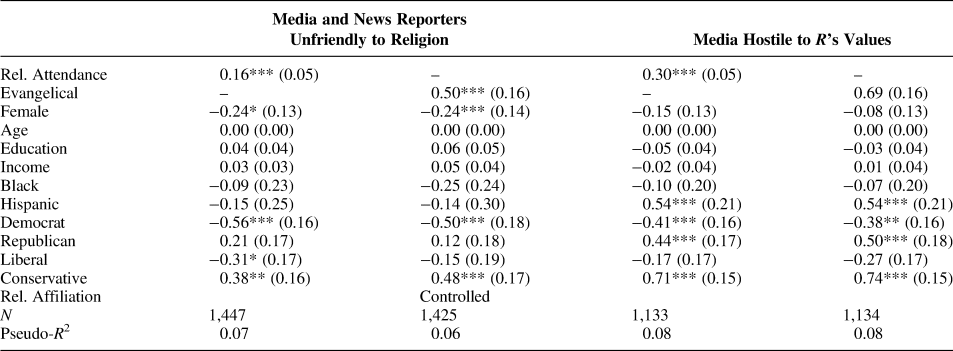
My first hypothesis asserts that religious attendance and Evangelical ID lead individuals to perceive the media as hostile to their beliefs/values, with the ultimate expectation that such negative perceptions will affect the likelihood that individuals will learn from the media. The data come from two sources: a 2004 U.S. News and World Report poll focusing on U.S. evangelicals and the 2009 Pew Religion and Public Life survey (see Appendix for information on sampling procedures and sample size).Footnote 15 Respondents in the Pew survey were asked whether “news reporters and the news media” are friendly, unfriendly, or neutral to religion. Using an ordered logit model, I assess whether religious attendance and Evangelical identification affect whether the media is seen as unfriendly to religion. Looking at the first two columns of Table 1, religious attendance and Evangelical identification have strongly positive and significant effects on perceiving the media as hostile, controlling for demographics, political affiliation, political ideology, and religious tradition.
The Effect of Religion on Media Perception

*p < 0.10; **p < 0.05; ***p < 0.01 (two-tailed).
The first two columns come from the 2009 Pew Religion & Public Life poll. The final column comes from the 2004 U.S. News and World Report poll.
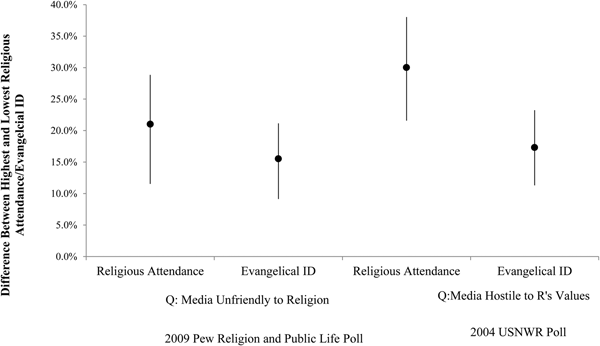
Figure 1 illustrates the differences between the predicted probabilities for individuals with the lowest and highest religious attendance and Evangelical identification arising from the models in Table 1, with all variables kept at their mean or modal values. The left side of Figure 1 demonstrates that there is a substantial difference in media perception between those with high religious attendance and those with low attendance—about 21 percentage points.Footnote 16 Further, Evangelicals are predicted to be over 15 percentage points more likely to view the media as unfriendly to religion.
First Differences in Negative Media Perception by Religious Attendance and Evangelical Identification

The next survey question—from the Religion and Ethics Newsweekly 2004 U.S. News and World Report poll—personalizes media perception, asking respondents whether they agree with the following statement: “The mass media is hostile toward my moral and spiritual values.” Again, the people with highest religious attendance are predicted to be over 30 percentage points more likely to say the media is hostile to their values than people with lowest level of attendance, with Evangelicals being over 17 points more likely to say that. The Media Distrust Hypothesis, therefore, receives considerable support and suggests that religiosity predicts significantly more suspicion toward the news media.Footnote 17
Looking at more recent data gives a fuller account of the relationship between religious attendance/Evangelical ID and media perception. A July 2011 Pew survey finds that Evangelicals are significantly less likely (again controlling for demographics, partisanship/ideology, and religious tradition) to believe that news organizations “get their facts straight” and more likely to report stories that are inaccurate. Evangelicals are also less likely to believe that the media “cares about the people they report on” and less likely to say that news organizations are moral. A 2015 American Values Survey conducted by PRRI asks respondents “Which of the following television news sources do you trust the MOST to provide accurate information about politics and current events?” Analyzing this survey shows that, controlling for the same factors as above, religious attendance decreases the likelihood of choosing broadcast news (i.e., ABC, CBS, and NBC) as their most trusted source.Footnote 18 Evangelicals are less likely to choose public television as their most trusted source. If mainstream news is the most likely to convey neutral information about public policy to viewers, then this lack of trust will restrict learning by those who are highly religious and/or are Evangelical.Footnote 19
LINKING MEDIA COVERAGE AND MEDIA PERCEPTION WITH POLITICAL KNOWLEDGE
Before moving to my main analysis, I first illustrate the problem with much of the literature on religion and political knowledge. Assume that a researcher wants to examine this relationship, and turns to the American National Election Survey (ANES), one of the largest and most widely used data sources for studies on American politics. Depending on which religious variables are examined, and how one divides the concept of political knowledge, a researcher would get wildly different conclusions of the effect of religion on knowledge. I have included the tables of coefficients for various religious variables in the Appendix, but to quickly summarize: according to the 2012 ANES, religious attendance increases political knowledge overall, but only because it increases both types of general knowledge. Being born again/Evangelical increases surveillance-general knowledge, but decreases the static-policy type. The only consistent effect is the negative effect of biblical literalism. Turning to the 2016 ANES, religious attendance no longer has a significant effect on any type of political knowledge, while the born again/Evangelical variable only has a negative effect on surveillance-general, the exact opposite effect it had in 2012. Once again, the only consistent effect is the negative relationship between biblical literalism and all kinds of political knowledge, as the literature on dogmatism would predict. It is easy to see how researchers could report a positive, negative, or null effect based on which religious variable they chose and which knowledge questions they were given.Footnote 20 Another problem is that this approach cannot say anything about political learning, as there is no way of knowing how much opportunity individuals had to learn these political facts. Overall, very little understanding of any relationship between religion and political knowledge is gained from this method. In the rest of the paper, I attempt to improve on the “ANES” approach to get a better understanding of how media perception affects learning and then empirically gauge how well religious individuals actually learn different types of political facts from media coverage.
My first task is to examine the link between media perception and political knowledge. Given that highly religious individuals have a much more negative view of the news media, religion will have a negative effect on knowledge questions requiring media attention to learn. The 2009 Pew survey includes very few knowledge questions, like the ANES,Footnote 21 but does include one that allows for a test of the hypothesis that media trust mediates the relationship between religious attendance/Evangelical ID and surveillance-policy knowledge. Following Baron and Kenny (Reference Baron and Kenny1986), the data show that viewing the media as unfriendly to religion is a significant mediator between religious attendance and knowledge about whether Barack Obama favors allowing churches and other houses of worship to apply for government funding to provide social services. Next, by employing a Sobel–Goodman mediation test, I find that over a quarter (27%) of the effect of religious attendance on knowing the surveillance-policy fact is mediated through media perception. Repeating this process using Evangelical identification shows over half (54%) of the negative effect of being Evangelical on policy knowledge is mediated via media perception. Clearly, religious individuals perceive the media as being unfriendly to their beliefs, and this perception is responsible for a significant reduction in their ability to learn facts about recent policy stances from the media.
Next, I further test my theory by expanding the number and range of political knowledge questions across different levels of media coverage. That is, I am examining how well people learn different types of political facts given the opportunity to do so from the media. I argue that distrust in the media will diminish learning for precisely the type of knowledge most dependent on such sources: surveillance-policy information.
For Tables 2 and 3, I constructed a data set containing 19 separate surveys—between the years 1997 and 2006—that contained political knowledge questions and data on religious attendance and/or Evangelical identification.Footnote 22 Overall, I identified 86 unique knowledge questions: 25 general-static, 12 general-surveillance, 17 general-policy, and 32 policy-surveillance. Next, I (along with two other coders) employed a Lexis-Nexis search of nine different media outletsFootnote 23—both print and television—for articles/transcripts containing the correct answer to each of the 86 knowledge questions in the 6 weeks leading up to the time the survey was put into the field, with a low of zero news stories to a high of 691.Footnote 24 Thus, I can establish generally how much information the media is providing about these topics, and therefore how well individuals are translating media coverage into recallable knowledge.
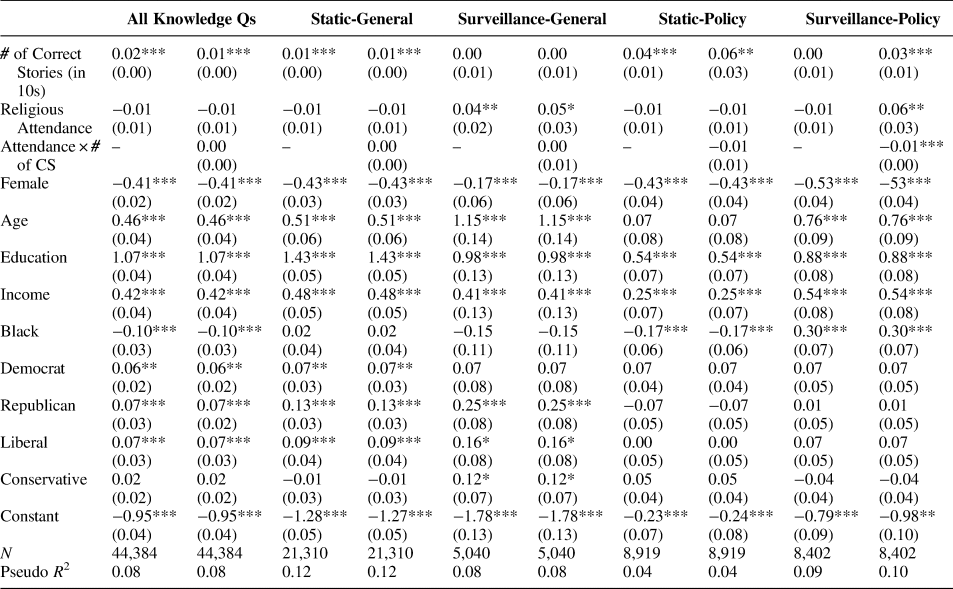
Media Coverage, Religious Attendance, and Political Knowledge

*p < 0.10; **p < 0.05; ***p < 0.01 (two-tailed).
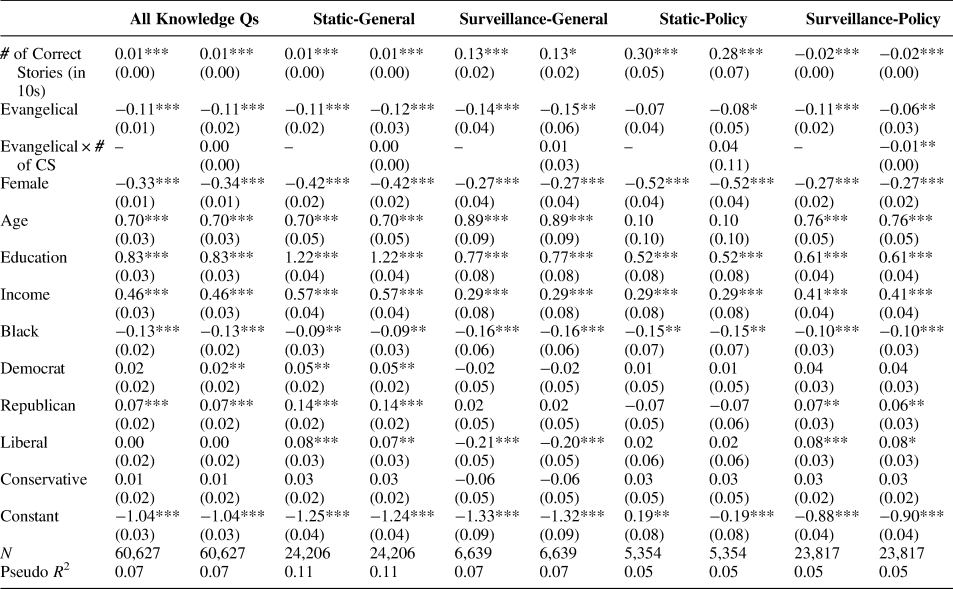
Media Coverage, Evangelical Identification, and Political Knowledge

*p < 0.10; **p < 0.05; ***p < 0.01 (two-tailed).
Table 2 contains models using religious attendance to predict political knowledge for all knowledge questions and across each of the four subtypes.Footnote 25 In the second model for each knowledge type, I have included an interaction between attendance and the number of news stories containing the correct answer, which is my key explanatory variable. A negative and significant coefficient on this interaction variable would be in keeping with a growing religious gap in political knowledge as media coverage increases, and with religious attendance restricting media learning.
Looking at all knowledge questions in the first two models, as the media increases its coverage of an issue, the overall performance of poll respondents improves significantly as expected—meaning people are more likely to get political questions correct when the media covers that specific fact more frequently. Religious attendance is not significantly related to overall political knowledge, while the control variables play out as would be expected. Once the knowledge questions are divided into separate types, a more nuanced picture emerges. Again, this is not particularly surprising given the contradictory findings in past studies, but we do see evidence that the performance of religious individuals varies across different knowledge areas—specifically as media coverage changes. For static-general knowledge, religious attendance has no effect on political knowledge across the spectrum of media coverage, as my hypothesis predicts.
The results for surveillance-general questions show that increased religious attendance predicts higher levels of knowledge for these questions, suggesting that attendance might incorporate the sort of civic engagement outlined by many scholars by increasing awareness of who is in power and similar. The second model shows that this relationship remains unchanged by media coverage—religious attendance predicts higher levels of surveillance-general knowledge when the media conveys no correct information as when it extensively covers a fact in this category. For static-policy facts as well, the coefficients on religious attendance and the interaction between religious attendance and media coverage are negative, but do not reach significance. This suggests that given enough time, religious individuals are just as likely to learn and know about policies as less-religious individuals. Once these policy facts are established, religious attendance has no effect on knowledge retention, again showing that religiosity may well increase individuals’ engagement in the political realm.
But what about policies that are recent, requiring both attention to and acceptance of media coverage in order to learn? Will distrust of and disdain for the mainstream media affect acquiring knowledge about policy facts that are in the process of being established, deliberated, and explained? The first column shows no significant effect of media coverage or religious attendance on getting surveillance-policy questions correct, while the control variables all work as before. However, moving to the interaction model we see the effect of religiosity on political learning, and the importance for including (at minimum) religious attendance in any analysis of political knowledge. The main effects for media coverage and religious attendance are both positive and significant. This demonstrates that for people who never attend services, increased media coverage has the expected strongly positive effect on knowledge about recent public policy. Similarly, when media coverage is at its lowest, religious attendance predicts higher levels of political knowledge, again showing that religious individuals do not suffer from lower knowledge capacity and may in fact be more informed on a variety of issues. However, when interacted, the product term is negative and significant, indicating that as the media covers these issues more, highly religious individuals are less likely to correctly answer policy questions.Footnote 26 This effect is somewhat similar to the findings of Jerit and Barabas (Reference Jerit and Barabas2012) who show that when the media intensely covers issues on topics that are “unfriendly” to partisans, that increased coverage perversely decreases knowledge among those partisans. Here, I show a similar effect on a much broader set of issues—in fact across all policies that relate to current events or discussions.
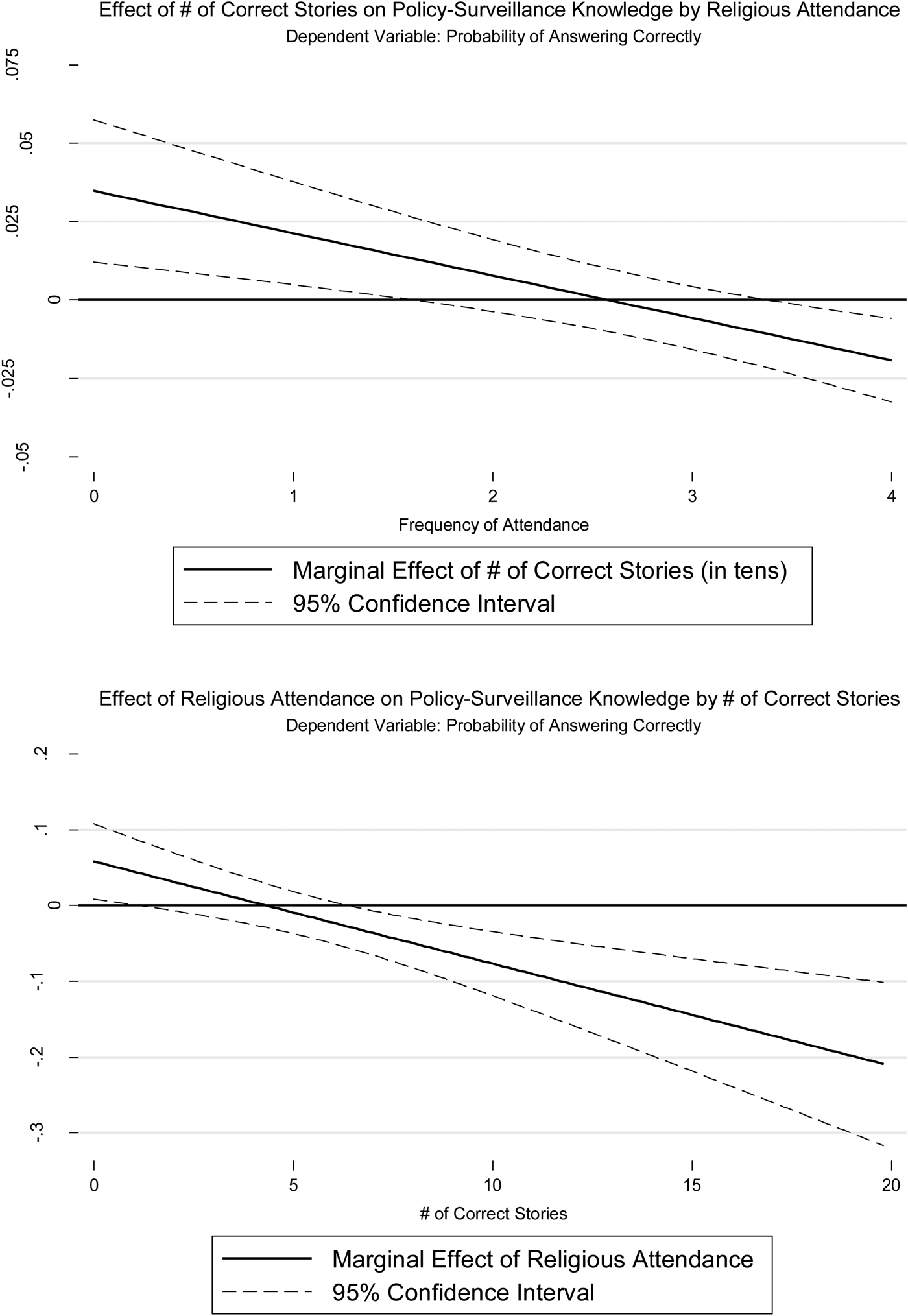
In order to get at the substantive effects of the interaction, I plot in Figure 2 the effect of each of these variables on policy knowledge across the range of the other (Brambor, Clark, and Golder Reference Brambor, Clark and Golder2006). The top panel of the figure shows the marginal effect of the number of stories with the correct answer across the range of religious attendance levels, while the bottom panel shows the marginal effect of religious attendance across the range of the number of stories with the correct answer (in 10s).Footnote 27 The top panel shows that for non-attenders (i.e., religious attendance is at zero), going from the least to most amount of accurate media coverage of surveillance-policy facts leads to a positive and significant effect on the probability of answering correctly. However, at high levels of attendance such media coverage actually leads to lower levels of political knowledge for these questions. So not only are highly committed religious individuals doing worse than less committed ones, they are perversely less likely to answer policy questions correctly that get more media coverage than policies that are covered less often.
The Interaction Between Religious Attendance and Factual Media Content on Surveillance-Policy Knowledge

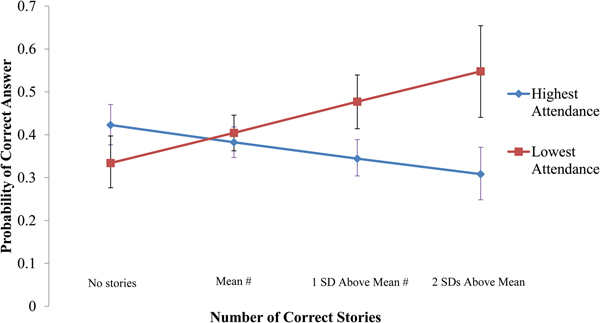
Figure 3 presents the lower pane of the interaction graph into a more easily interpretable comparison of the effect. Controlling for all the variables in the model, this shows the predicted level of knowledge for those with the lowest and highest religious attendance across four levels of media coverage. When there are no stories, high attenders are predicted to get about 42% of questions correct, while low attenders get only 33% correct (a significant difference). For issues with an average amount of coverage, low attenders are slightly, but not significantly, more likely to get the questions correct (40% to 38%). The positive trend continues for low attenders, as increased media coverage steadily increases knowledge, up to nearly 55%. High attenders, on the other hand, slip in their predicted levels of knowledge, getting only 31% of questions correct when the media has high levels of coverage of the issue. Those with low religious attendance more readily learn surveillance-policy facts from the media, while those with high attendance not only do not learn at the same levels, but also actually perform worse as media attention increases. Clearly, the effect is not about exposure to information but differential reception of that information. Given that the media plays a vital role in educating citizens about public policy, this is certainly a troubling finding.
The Effect of Religious Attendance and Media Coverage on Surveillance-Policy Knowledge
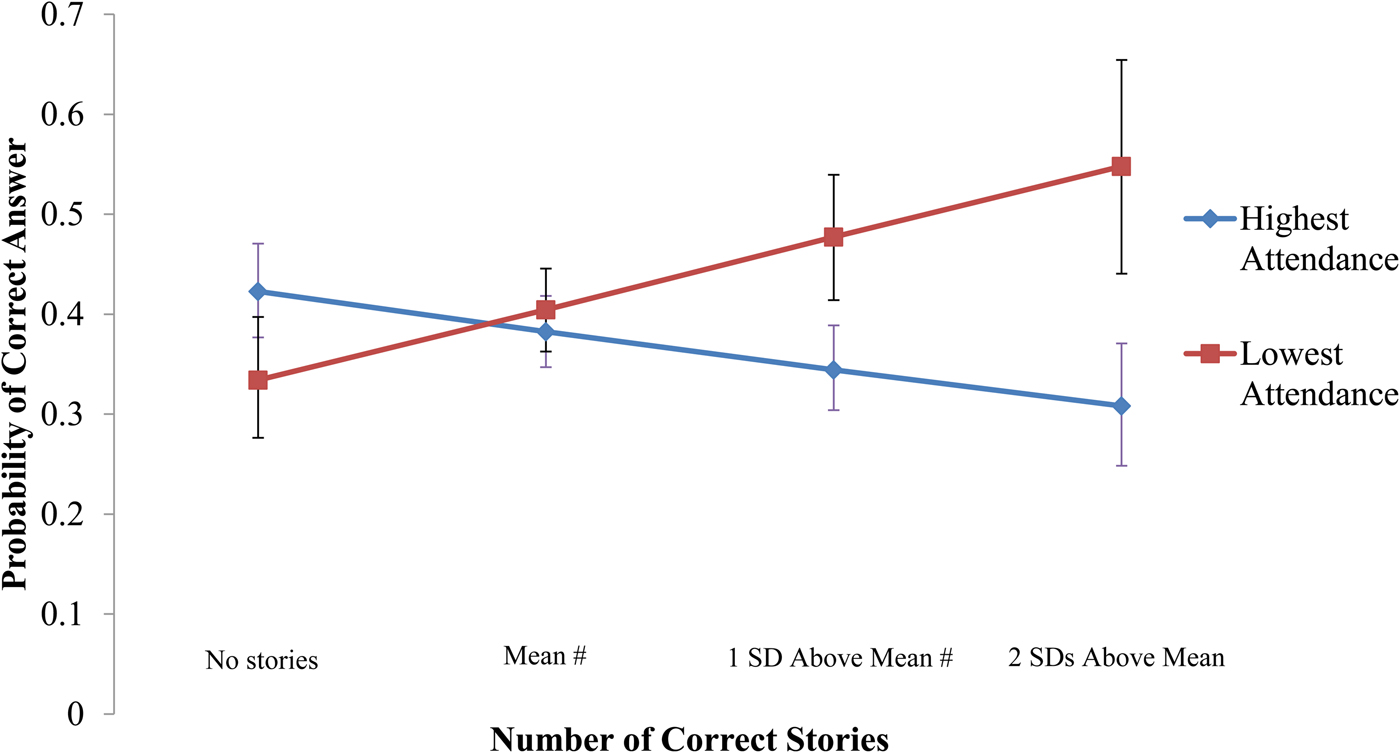
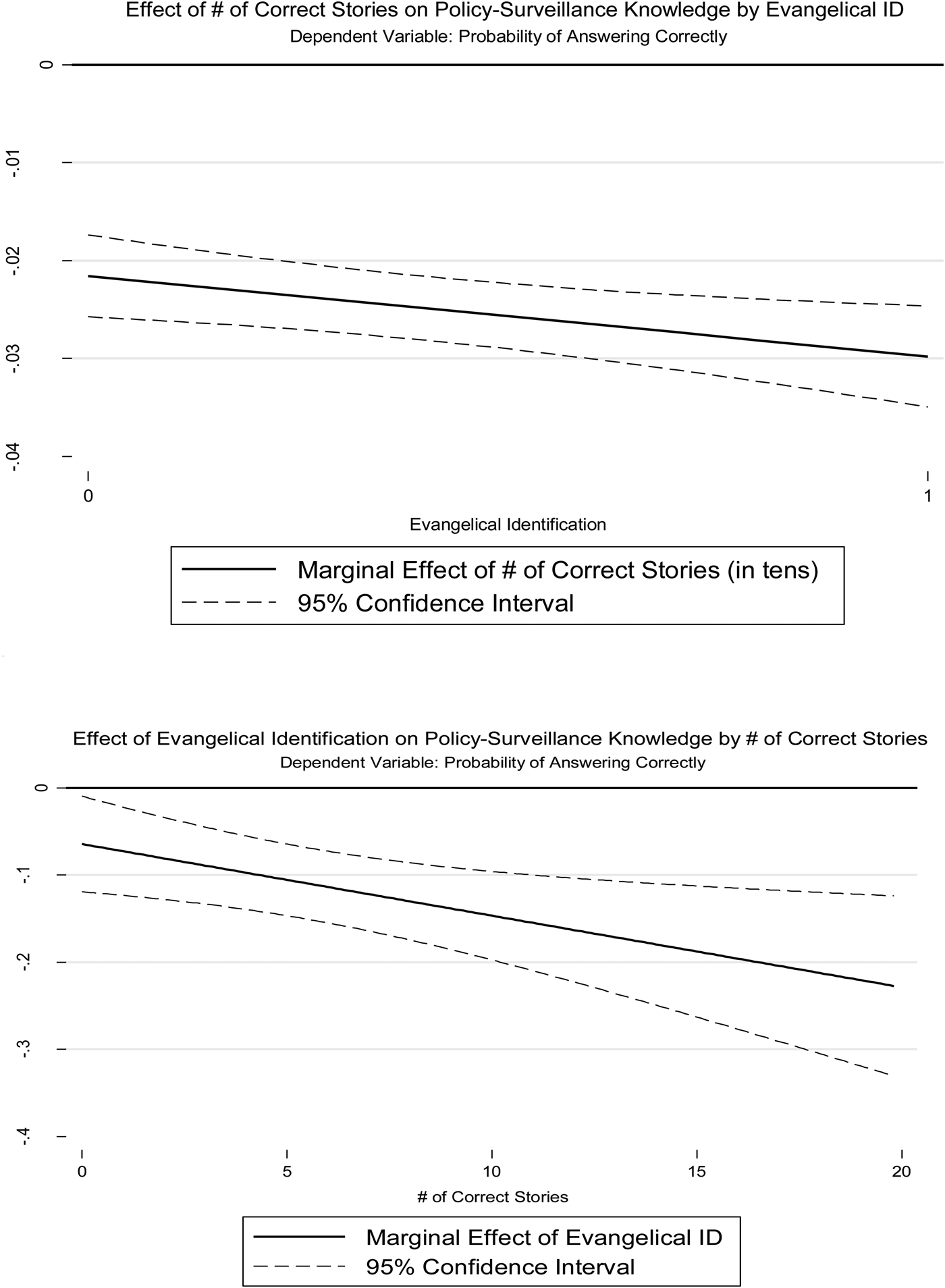
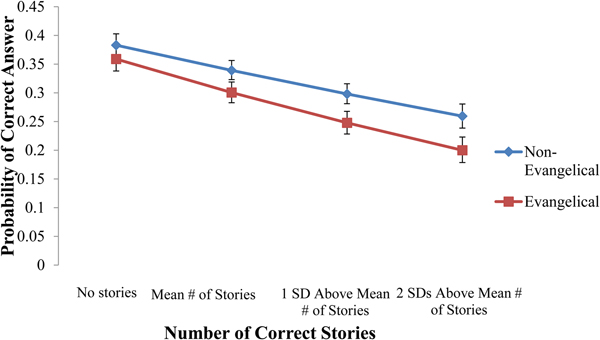
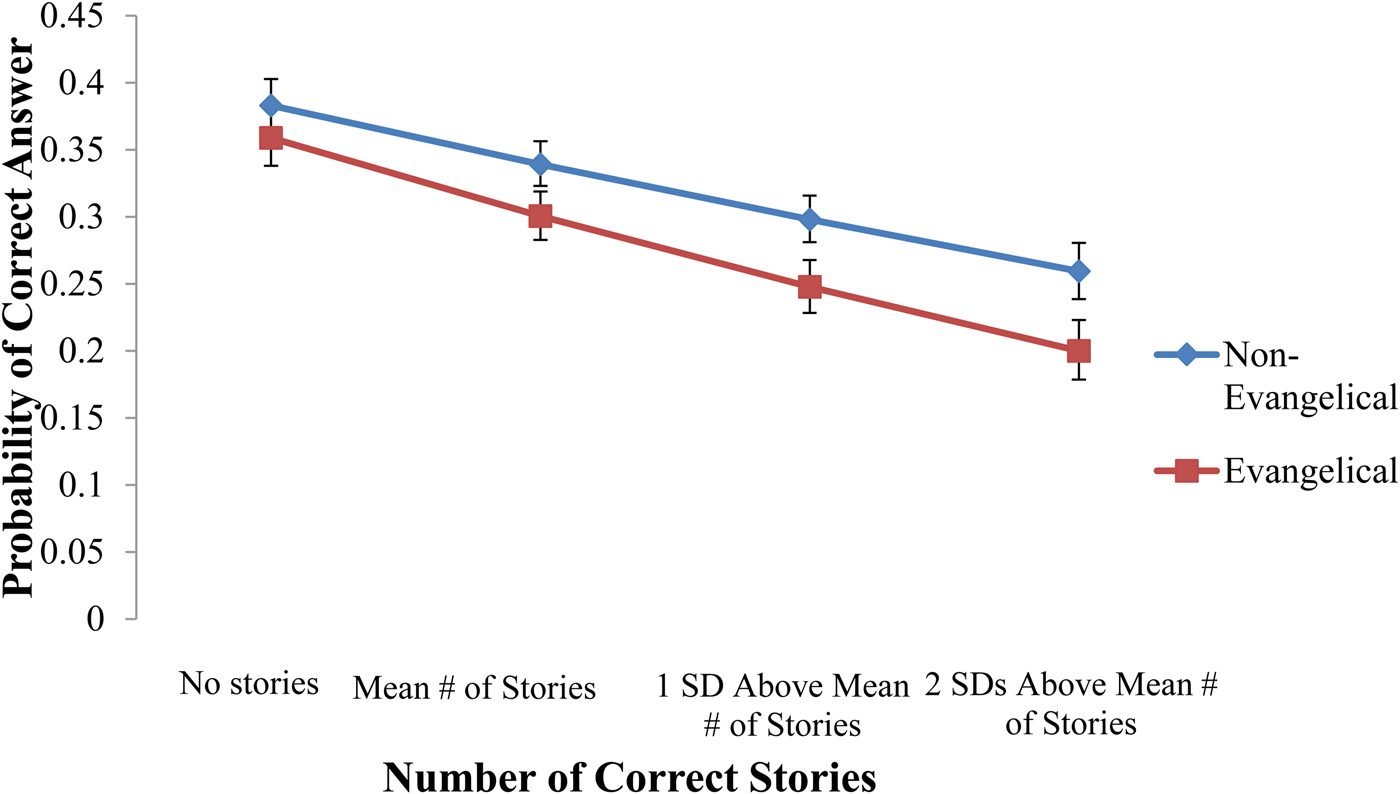
Table 3, along with Figures 4 and 5, repeats the same process using Evangelical/born again Christians as the main explanatory variable. The results are much the same as for religious attendance, with the main difference being that Evangelicals are consistently less knowledgeable about all kinds of political facts, regardless of media coverage. This is consistent with my prediction and the literature on Evangelicals and secular political engagement. However, the interaction between Evangelical ID and media coverage is insignificant for all types of political knowledge except for surveillance-policy, again as predicted. Here, the widening gap between Evangelicals and non-Evangelicals is not as stark as with religious attendance—in large part because Evangelicals are already so much less knowledgeable about politics than non-Evangelicals.Footnote 28 Still, it is clear that Evangelicals are less likely to learn from the media when it covers recent policy, as my third hypothesis predicts.
The Interaction Between Evangelical Identification and Factual Media Content on Surveillance-Policy Knowledge

The Effect of Evangelical ID and Media Coverage on Surveillance-Policy Knowledge
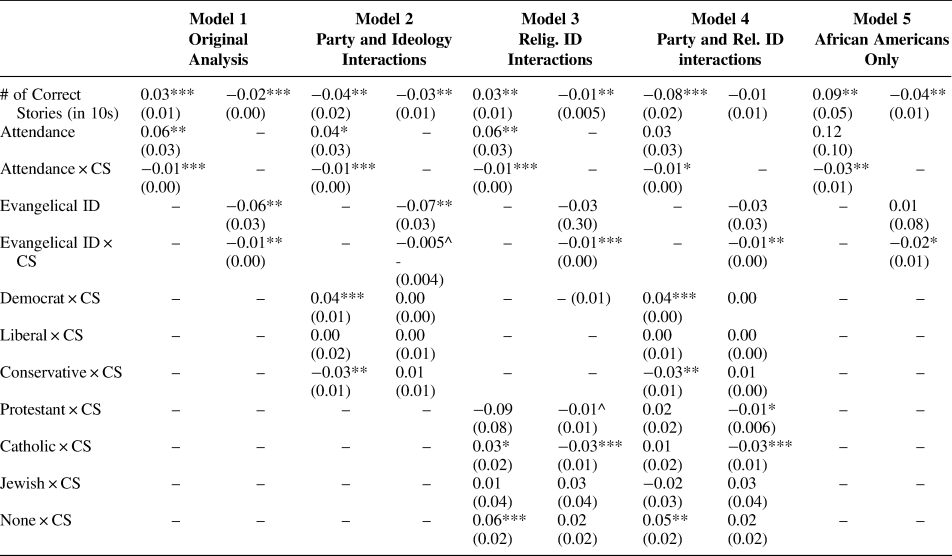
Finally, to ensure my results are robust to competing explanations, I tested whether the significant effect of religious attendance and Evangelical identification on surveillance-policy knowledge remains when including interactions between the number of correct stories and other relevant variables (Table A2 in the Appendix). Specifically, I examined interactions between correct stories and party affiliation, political ideology, and religious tradition. Additionally, I re-ran the model for only African Americans, to see whether the learning effect remained for a group that is traditionally Democratic. If the religious effects remained, then this would provide greater support for my theory that religious individuals are turned off by secular sources of information, rather than partisanship or ideology driving the results. Even though my analyses controlled for these variables, the close ties between my key religious explanatory variables and partisanship, ideology, tradition, and race merit further exploration.Footnote 29
Results of these auxiliary analyses show that the effect of religious attendance on surveillance-policy knowledge remains effectively unchanged when including these interactions. Even for African Americans, greater religious attendance decreases political learning from the media. For Evangelicals, a similar story can be told, as the interactions and race model do not change the effect of identifying as Evangelical on surveillance-policy knowledge. The effect of religious tradition is more varied. For the Catholic interaction, in the religious attendance model learning is positive and, in the more limited model (Model 3), significant. However, in the Evangelical model, the Catholic interaction is negative and significant. This suggests that among more committed Catholics, a similar negative learning effect to Evangelicals emerges.Footnote 30 People with no religious tradition tend to do better as the opportunity to learn from the media increases, as expected. Lastly, in the religious attendance models, the effect of Democratic partisanship has significantly positive and conservative ideology has significantly negative effects on knowledge as the number of correct stories increase, also as expected.
DISCUSSION
Religion strongly influences a wide range of political phenomena, including how individuals view the world, how civic skills are generated and allocated, and the motivation to get involved in politics in order to protect one's interests and values. While civic skills are vital for citizens to acquire in a democracy, so is knowledge about how the political system works, who is responsible for public policy, what is going on in the political world, and what policies are being proposed/enacted (Delli Carpini and Keeter Reference Delli Carpini and Keeter1996; Gilens Reference Gilens2001). Without such knowledge, citizens will struggle to participate meaningfully in politics and influence policy outcomes. However, scholars who have researched the effects of religion on political knowledge have missed much of the complexity in this relationship, as they generally combine different types of knowledge into a single metric. As a result, the literature contains virtually no theory as to why such variation would exist, nor any consistent results for the religion–political knowledge relationship. This paper has filled these gaps by constructing a theory explaining how and when religious attendance and Evangelical identification will affect political knowledge, linking surveillance-policy knowledge in particular with the ability to learn from the news media. By doing so, and evaluating the effect of attendance on different types of political knowledge, I help to resolve the contradictory and null results other scholars have found while also providing a much-needed account for how religion affects individuals’ information environment.
Overall, this paper shows that religion affects knowledge in two main ways. First, religiosity may promote (or at the very least not impede) the ability of adherents to understand political processes, and therefore individuals who attend religious services frequently are as likely as others to be aware of how the political system works and who is in charge of government (general political knowledge of both types). Thus, I am not suggesting that religion causes individuals to become political simpletons or any less capable of civic/political activity, nor are such individuals less intelligent. Religion may well increase civic capabilities and interest in politics, though such benefits must be qualified by the downsides associated with dogmatism and skepticism about secular information. Second, religious attendance and Evangelical identification diminishes political learning when it is largely determined by the coverage of the mainstream news media. Highly religious individuals tend to view the secular news media as hostile and unfriendly, and so do not learn information about public policies that are covered by the news media. These individuals are not less likely to report consuming news, nor are they more likely to report segregating their news consumption to conservative-leaning outlets like Fox News or by going online to receive news. Instead, even as individuals with high religious attendance appear to be exposed to roughly the same information as everyone else, they learn policy-relevant facts at lower rates—thereby likely affecting their opinions and political choices.
Finally, this paper reinforces the worries of Evangelical scholars such as Noll (Reference Noll1995), who lament the low quality of Evangelical political thinking and engagement. I find that Evangelicals are especially—though not uniquely—underinformed about political events, figures, and (especially) policies. Why might this matter for politics more broadly? For one, there is growing concern that in the age of Trump, highly religious Americans—particularly white Evangelicals—are responding to their perceived (and real) decline in social influence and political control with anger, anxiety, and grievance politics (Jones Reference Jones2016a, Reference Jones2016b). If religious adherence leads people to retreat into political and social echo chambers, including rejecting media coverage of objective political facts, then their ability to make informed political judgments will likely be compromised and may also decrease their feelings of political efficacy. Given that nearly half of the American populace attends religious services at least monthly—and nearly 40% identifying as born again—this is not some fringe phenomenon nor is it restricted to only a small set of religious traditions. Whether the perception that the news media is unfriendly to religion is justified or not, an unfortunate side effect is that religious individuals will be more likely to reject factual information that they encounter. Religious individuals may turn to other sources that they perceive as friendlier to their worldview, even if the factual quality of those sources is more questionable. The political opinions gained from this information may well be biased and of poor quality.
There is much left to be done when assessing the religion–media–knowledge links. The next logical step would be to examine whether religious individuals are more or less knowledgeable about topics for which they constitute an “issue public” (Krosnick Reference Krosnick1990). For instance, do religious individuals have greater knowledge about abortion policy than less religious people? Or do motivational biases prevent them from updating their knowledge about issues for which they have clear and (perhaps) unalterable opinions? Finally, a more in-depth analysis of religious individuals’ media consumption habits and related attitudes is clearly needed.
It should be clear that when looking at the effect of any variable on political knowledge, one should not conceive of knowledge as a singular, unified factor. Instead, political knowledge is made up of innumerable types of information, many of which require attention and trust in news sources for learning. Additionally, when scholars seek to explain variation in political knowledge at the individual level, measures of religion and religiosity should be included. Most studies of knowledge take into account the standard socio-economic and demographic variables, but for various reasons (not the least of which is a frustrating lack of data on religion in many surveys) religious variables are missing from too many models explaining political knowledge. Incorporating religion into studies of information processing will help explain how people receive, incorporate, and use facts from their environments to judge political events.
APPENDIX
Effect of Various Religion Variables on Types of Political Knowledge (Tables)
2012 ANES

2016 ANES

The Effect of Correct Stories and Interactions on Surveillance-Policy Knowledge

Question wording
Media Perception Variables:
Pew Research Center Poll: 2009 Religion & Public Life
Field Dates: August 11–17 and 20–27, 2009
Sample: National adult
Sample Size: 4,013
Sample Notes: This study contains sampling using landline telephones and cellular phones.
Interview Method: Telephone
As I name some groups, please tell me whether you feel each one is generally FRIENDLY toward religion, NEUTRAL toward religion, or UNFRIENDLY toward religion? First, do you feel that news reporters and the news media are generally friendly toward religion, neutral toward religion, or unfriendly toward religion?
1. Friendly toward religion
2. Neutral toward religion
3. Unfriendly toward religion
Religious Attendance:
Aside from weddings and funerals, how often do you attend religious services…more than once a week, once a week, once or twice a month, a few times a year, seldom, or never?
1. More than once a week
2. Once a week
3. Once or twice a month
4. A few times a year
5. Seldom
6. Never
Religion and Ethics Newsweekly/U.S. News and World Report Poll # 2004-EVANG: America's Evangelicals
Field Dates: March 16–April 4, 2004
Sample: National adults including an oversample of White Evangelicals, African Americans, and Hispanics
Sample Size: 1,610
Sample Notes: The survey included an oversample of 401 White Evangelicals, 160 African Americans, and 149 Hispanics.
Interview Method: Telephone
Now I am going to read to you a list of statements about religious life. For each one please tell me whether you agree or disagree with it:
The mass media is hostile toward my moral and spiritual values.
1. Strongly agree
2. Somewhat agree
3. Somewhat disagree
4. Strongly disagree
Religious Attendance
How often do you attend religious services––more than once a week, once a week, once or twice a month, several times a year, or hardly ever?
1. More than once a week
2. Once a week
3. Once or twice a month
4. Several times a year
5. Hardly ever
6. (Never)
PEW RESEARCH CENTER FOR THE PEOPLE & THE PRESS
JULY 2011 POLITICAL AND MEDIA SURVEY
July 20–24, 2011
N = 1,501
Q38. In general, do you think news organizations get the facts straight, or do you think that their stories and reports are often inaccurate?
Q39. In presenting the news dealing with political and social issues, do you think that news organizations deal fairly with all sides, or do they tend to favor one side?
Q42. I'm going to read you some pairs of opposite phrases. After I read each pair, tell me which ONE phrase you feel better describes news organizations generally. If you think that NEITHER phrase applies, please say so. First, would you say news organizations (are)…
Care about the people they report on, OR
Don't care about the people they report on
Moral, OR Immoral
PRRI 2015 American Values Survey
September 11–October 4, 2015
N = 2,695
Which of the following television news sources do you trust the MOST to provide accurate information about politics and current events?
[RANDOMIZE LIST]
Broadcast network news, such as NBC, ABC, or CBS
CNN
Fox News
MSNBC
The Daily Show or Last Week Tonight with John Oliver
Public television
BBC/Al Jazeera
Other [SPECIFY]
None/Do not watch television news
Don't know/Refused (VOL.)
Coding procedure and questions forming the second analysis (information about the individual surveys available on request)
This effort builds on and modifies the coding procedure of two larger projects (specifics available as needed for review). Out of a larger coding project dealing with coding media coverage, I identified a subset of surveys that included questions about the respondent's religious attendance or Evangelical identification in addition to the political knowledge questions listed below. Inter-coder reliability analyses indicate high levels of agreement for identifying relevant articles (κ = 0.71) and identifying articles containing the correct answer (κ = 0.84).
Following the guidelines of Barabas et al. (2014, especially pp. 844–846), I placed the knowledge questions into one of the four categories.
STATIC GENERAL KNOWLEDGE
What is the name of the president of Russia?
Do you happen to know what name Muslims use to refer to God? (Two different surveys)
Do you happen to know the name of the Islamic equivalent to the Bible? (Two different surveys)
Can you tell me the name of the current Secretary of State? (Two different surveys)
Can you tell me the name of the current vice president of the United States?
Can you tell me the name of the current Secretary of Defense?
Do you happen to know who Yasser Arafat is?
What is the name of the president of Russia? (Two different surveys, asked well over 100 days since the previous election, thus making this a static fact.)
Do you happen to know which political party has a majority in the U.S. House of Representatives? (Two different surveys)
Do you happen to know who Bill Gates is?
For each one, please tell me if you happen to know who that person is…Alan Greenspan
For each one, please tell me if you happen to know who that person is…Trent Lott
For each one, please tell me if you happen to know who that person is…Louis Freeh
For each one, please tell me if you happen to know who that person is…John Huang
For each one, please tell me if you happen to know who that person is…Kenneth Starr
For each one, please tell me if you happen to know who that person is…Tony Blair
For each one, please tell me if you happen to know who that person is…Ralph Reed
For each one, please tell me if you happen to know who that person is…Ellen DeGeneres
For each one, please tell me if you happen to know who that person is…Webster Hubbell
For each one, please tell me if you happen to know who that person is…Garry Kasparov
SURVEILLANCE GENERAL KNOWLEDGE
Just your best guess, would you say Wesley Clark is a liberal, a moderate, or a conservative?
Just your best guess, would you say Howard Dean is a liberal, a moderate, or a conservative?
The following four questions come from a 2001 survey surrounding findings from the 2000 census and the 2001 census report, hence the inclusion in this category rather than the static general category.
What percentage of the United States population is white?
What percentage of the United States population is African American?
What percentage of the United States population is Hispanic American?
What percentage of the United States population is Asian American?
Do you happen to know who lent Newt Gingrich some of the money he needed to pay off his ethics fine?
Do you happen to know the name of the person who will soon be taking over as the anchor of the CBS Evening News later this summer?
Do you happen to know the name of the Democratic senator from Connecticut who recently lost in the state's primary election?
Do you happen to know who will probably be the Democratic presidential nominee?
Do you happen to know who will probably be the Republican presidential nominee?
STATIC POLICY KNOWLEDGE
As far as you know, does North Korea now have nuclear weapons, or not?
As far as you know, does Great Britain now have nuclear weapons, or not?
As far as you know, does Pakistan now have nuclear weapons, or not?
As far as you know, does South Africa now have nuclear weapons, or not?
As far as you know, does Russia now have nuclear weapons, or not?
As far as you know, does India now have nuclear weapons, or not?
As far as you know, does Israel now have nuclear weapons, or not?
As far as you know, does China now have nuclear weapons, or not?
As far as you know, does Germany now have nuclear weapons, or not?
As far as you know, does Brazil now have nuclear weapons, or not?
As far as you know, does France now have nuclear weapons, or not?
As far as you know, does Japan now have nuclear weapons, or not?
As far as you know, does Libya now have nuclear weapons, or not?
For each, please tell me if this is something government officials can do specifically because of the Patriot Act, or if it is something they could have done prior to the Patriot Act being passed. How about––[Hold terrorism suspects indefinitely without charging them with a crime or allowing them access to a lawyer.].
For each, please tell me if this is something government officials can do specifically because of the Patriot Act, or if it is something they could have done prior to the Patriot Act being passed. How about––[Require non-U.S. citizens who are suspected of terrorism offenses to face a trial before a military tribunal.].
For each, please tell me if this is something government officials can do specifically because of the Patriot Act, or if it is something they could have done prior to the Patriot Act being passed. How about––[Enter houses of worship or attend political rallies].
Do you think––[North Korea]––currently has weapons of mass destruction/is trying to develop these weapons but does not currently have them, or is not trying to develop weapons of mass destruction?
Do you happen to know the name of the province in Yugoslavia where there is conflict between Serbians and ethnic Albanians?
SURVEILLANCE POLICY KNOWLEDGE
The United States and other nations are conducting talks with North Korea. What is the main issue these nations are discussing?
Recently, the Palestinians were given control of the Gaza Strip. Do you know which country gave them this control?
As far as you know, does Iran now have nuclear weapons, or not?
Based on what you have learned, please tell me whether you believe each of the following is true or is not true. Iraq had weapons of mass destruction.
Based on what you have learned, please tell me whether you believe each of the following is true or is not true. Iraq was connected to the September 11th terrorist attacks.
Based on what you have learned, please tell me whether you believe each of the following is true or is not true. Saddam Hussein represented a threat in the Middle East.
Based on what you have learned, please tell me whether you believe each of the following is true or is not true. Saddam Hussein represented a threat to the United States.
Do you think Iran currently has weapons of mass destruction/is trying to develop these weapons but does not currently have them, or is not trying to develop weapons of mass destruction?
Do you think Iraq currently has weapons of mass destruction/is trying to develop these weapons but does not currently have them, or is not trying to develop weapons of mass destruction?
Earlier this year, a U.S. spy plane collided with a fighter jet from another country. The American air crew was held for several days. Do you know in what country this took place?
Recently, President Bush withdrew U.S. support for an international treaty known as the Kyoto Protocol. What issue does this agreement address?
To the best of your knowledge, did the Senate approve George W. Bush's 1.6 trillion dollar tax cut proposal, did they vote for a LARGER tax cut or did they vote for a SMALLER tax cut?
Do you happen to know whether the Senate passed the McCain–Feingold campaign finance reform bill, or did they vote it down?
Do you happen to know whether George W. Bush has decided to place limits on carbon dioxide emissions from power plants, or has he decided NOT to do this?
Do you happen to know whether George W. Bush has decided to TIGHTEN regulations on the amount of arsenic that can be allowed in drinking water, or has he decided to make these regulations LESS stringent?
Do you know whether George W. Bush has decided that the United States will continue to SUPPORT the global warming agreement, enacted in Kyoto, Japan in 1997, or has he decided to WITHDRAW U.S. support from that agreement?
In his budget proposal, do you happen to know whether George W. Bush proposed INCREASING spending on education, DECREASING spending on education, or keeping spending on education about the same?
Do you happen to know whether George W. Bush has decided to impose STRICTER regulations on manufacturers who release LEAD into the environment, or has he decided to make these regulations LESS stringent?
Do you happen to know whether Slobodan Milosevic, the former president of Yugoslavia, has been arrested, or not?
Do you happen to know whether the families of the bombing victims will be allowed to watch the execution on a closed-circuit TV, or won't they be able to do this?
Do you happen to know which candidate has proposed allowing workers to invest some of their Social Security contributions in stocks and bonds?
Do you happen to know which candidate's wife has spoken out about the need to help Americans with mental illnesses?
Do you happen to know which candidate has proposed a missile defense system and to reduce the number of U.S. nuclear warheads, even if Russia refuses to do the same?
Do you happen to know which candidate has proposed using surplus Medicare funds to protect the program's future?
Do you happen to know which country in the Mideast has been the target of U.S. air attacks in recent months?
Do you happen to know which country was recently accused of stealing nuclear technology from the United States?
As far as you know, does the United States currently have troops stationed in Bosnia, or not?
As far as you know, does the United States currently have troops stationed in Haiti, or not?
Recently the Institute of Medicine of the National Academy of Sciences delivered a report about medical errors in hospitals. To the best of your knowledge, did this report say that these medical errors were…a big problem that causes a lot of deaths, or a small problem that causes relatively few deaths?
And to the best of your knowledge, did this report (delivered by the Institute of the National Academy of Sciences about medical errors in hospitals) call for each of the following actions, or not?…A new government agency to protect patients against medical errors in hospital.
(And to the best of your knowledge, did this report (delivered by the Institute of the National Academy of Sciences about medical errors in hospitals) call for each of the following actions, or not?)…Tougher malpractice laws against doctors and hospitals who commit medical errors.
And to the best of your knowledge, did this report (delivered by the Institute of the National Academy of Sciences about medical errors in hospitals) call for each of the following actions, or not?)…More severe punishments of doctors and nurses who commit medical errors.