Foramen ovale is a cardiac anatomical structure allowing right-to-left shunt during foetal life. In over 70% of the general population, it comes to closure after birth. In the remaining 30% of cases, it is left “patent”, that is, “open” and it represents a potential substrate for right-to-left shunt during adult life.Reference Lechat, Mas and Lascault1 Given its high prevalence in the general population, patent foramen ovale cannot be considered a pathology in itself. Nevertheless, a consistent body of epidemiological evidence suggests a causal relationship between patent foramen ovale and strokes without any ascertainable cause, particularly in patients 55 years or less.Reference Homma and Sacco2–Reference Kizer and Devereux5 A meta-analysis of case–control studies revealed an increased prevalence of patent foramen ovale in patients with cryptogenic stroke compared with patients with stroke of known cause.Reference Overell, Bone and Lees6 Such increased prevalence seemed to be age dependent, being diluted as the age of the population increases. Indeed, cryptogenic stroke patients less than 55 years of age had a significantly higher risk of having a patent foramen ovale than patients of the same age with a stroke of known origin (odds ratio: 6; 95% confidence interval: 3.72–9.68), whereas among patients who were 55 years or older there was only a trend for those with cryptogenic stroke to have a higher prevalence of patent foramen ovale than those with a stroke of known origin (odds ratio: 2.26; 95% confidence interval: 0.96–5.31). Nevertheless, a more recent study found an association between patent foramen ovale and cryptogenic stroke in both young and old patients.Reference Handke, Harloff, Olschewski and Hetzel Ageibel7 Such association was even stronger for concomitant atrial septal aneurysm independently of age. Such data keep in line with a number of case–control studies, suggesting the possibility to stratify stroke risk according to patent foramen ovale-associated atrial septal anatomic and functional characteristics, such as the presence of an associated atrial septal aneurysm,Reference Pearson, Nagelhout, Castello, Gomez and Labovitz8 a persistent Eustachian valve or Chiari's network,Reference Schuchlenz, Saurer, Weihs and Rehak9 and right-to-left shunt entity quantified by means of contrast-enhanced transcranial Doppler.Reference Serena, Segura, Perez-Ayuso, Bassaganyas, Molins and Davalos10, Reference Anzola, Morandi, Casilli and Onorato11 Indeed, this method allows to directly quantify right-to-left shunt impact on cerebral vessels.Reference Onorato, Melzi and Casilli12 Notwithstanding all these retrospective data, there are only few prospective epidemiological studies addressing the risk of stroke recurrences in patients with atrial septal abnormalities. Their results are somehow contradictory among them and compared with retrospective studies.Reference Messè, Silverman and Kizer13 Indeed, the only two population-based prospective studies aiming at studying the association between atrial septal abnormalities and stroke in the general population did not confirm the higher stroke risk connected with patent foramen ovale and atrial septal aneurysm suggested by retrospective studies.Reference Meissner, Khandheria and Heit14, Reference Di Tullio, Sacco, Sciacca, Jin and Homma15 In addition, such studies were addressed to a population with a mean age of more than 65 years, in which other common factors, such as atherosclerosis, hypertension, or cardiac arrhythmias, may be more relevant causes of stroke.Reference Meissner, Khandheria and Heit14
At the moment, the natural history of stroke patients with a patent foramen ovale and/or an atrial septal aneurysm without any treatment is unknown.Reference Messè, Silverman and Kizer13 A number of randomised controlled trials (RCT) comparing medical treatment and percutaneous atrial repair are still ongoing;16 however, patient enrolment rate is very low for several reasons, such as patients and operators preference and the vested interest of the industries that sponsor the trial. Results from CLOSURE-I trial, the only concluded RCT comparing medical versus interventional treatments, are not yet published.Reference Furlan17 Studies comparing the effects of warfarin and aspirin on the risk of subsequent stroke or death among patients with cryptogenic strokes and atrial septal abnormalities are somehow inconsistent. Overall, there is insufficient evidence to determine the superiority of one over the other, although the risks of minor bleeding could be higher with warfarin.Reference Messè, Silverman and Kizer13, Reference Homma, Sacco, Di Tullio, Sciacca and Mohr18
Consistently, international and Italian guidelines are somehow contradictory not only in terms of best medical treatment, but also in terms of medical versus endovascular treatment.Reference Kizer and Devereux5, 19–23
The discrepancy among different guidelines is evident and denotes the lack of consensus. Patent foramen ovale is a very common medical issue, often requiring a challenging therapeutic decision, which is not strongly supported by the available scientific evidence. Patients receive heterogeneous treatments according to the local expertise or their own expectations based on a case-by-case evaluation. In this scenario, the choice between medical and interventional treatment depends more on who is responsible for the final decision than on scientific evidence.
Owing to the perceived need for standardisation of the management of young patients with stroke and patent foramen ovale, in Verona we investigated whether implementation of an organised team approach model was useful to reduce the gap between insufficient evidence on a specific topic and clinical practice,Reference Kim, Valdiserri, Wright, Manos and Do24 creating a dedicated, multi-disciplinary working group with the following aims:
• to standardise the diagnostic pathway for patent foramen ovale-related stroke;
• to elaborate a therapeutic decision-making algorithm;
• to discuss every single suitable case on scheduled monthly meetings;
• to set up a follow-up schedule for each patient included in the database for the systematic assessment of immediate and long-term outcome.
Methods
Study type: cohort prospective observational study.
The multi-disciplinary working group
The “Group for the diagnosis and treatment of atrial septal abnormalities in patients of 55 years or less and stroke of unknown origin” (the VEROSTROKE group) of the University Hospital of Verona was composed of neurologists with expertise in stroke management and neurosonology, cardiologists with expertise in echocardiography, and interventional cardiologists with experience in structural procedures. As needed, neuroradiologists were asked to participate in neuro-imaging interpretation. Similar multi-disciplinary models have been previously testedReference Rigatelli, Braggion and Chinaglia25and follow the recently proposed “Heart Team” approach by the European Society of Cardiology, a working group dedicated to the decision making of controversial clinical settings for myocardial revascularisation.Reference Wijns, Kolh and Danchin26
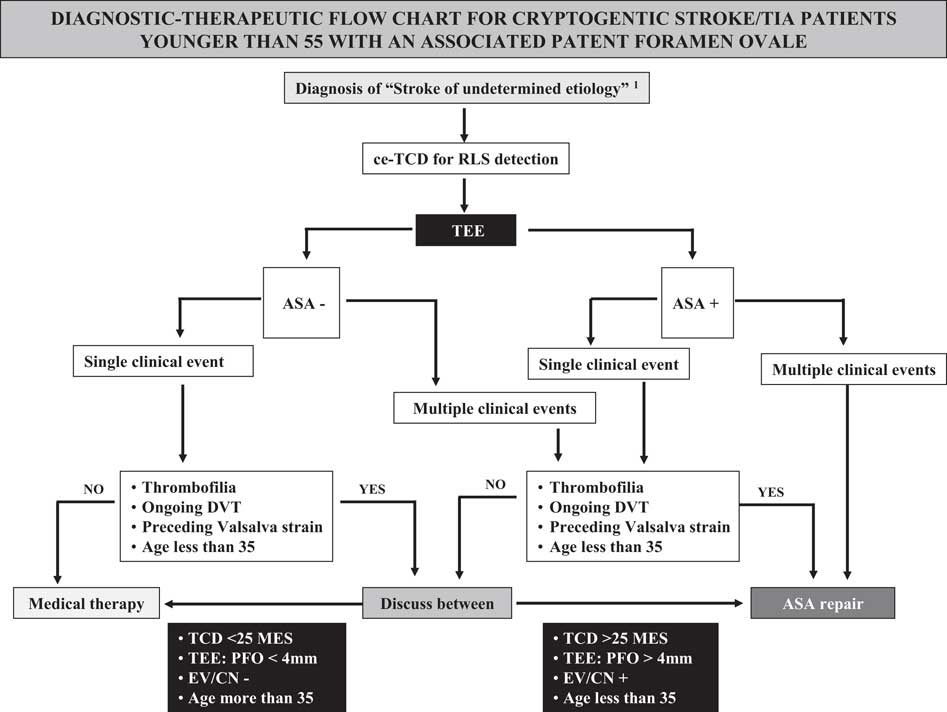
The group set up a flow chart for the diagnosis and treatment of patients with stroke of unknown origin and associated atrial septal abnormalities. This flow chart was based on the best available evidence in this field,Reference Lechat, Mas and Lascault1, Reference Webster, Chancellor and Smith3, Reference Di Tullio, Sacco, Gopal, Mohr and Homma4, Reference Overell, Bone and Lees6–Reference Messè, Silverman and Kizer13 and according to the existing American, European, and Italian guidelines (Fig 1).Reference Kizer and Devereux5, 19, 21 The group undergoes monthly discussions for therapeutic decisions of clinical cases admitted to the hospital or referred to the neurologists or cardiologists of the group.
Reference Lechat, Mas and Lascault1 According to the TOAST classification (see Table 1 for diagnostic work up). ASA = atrial septum aneurysm; ce-TCD = contrast-enhanced transcranial Doppler; CN = Chiari network; EV = Eustachian valve; TEE: transoesophageal echocardiography. Thrombophylia: see Table 1 for diagnostic work-up.
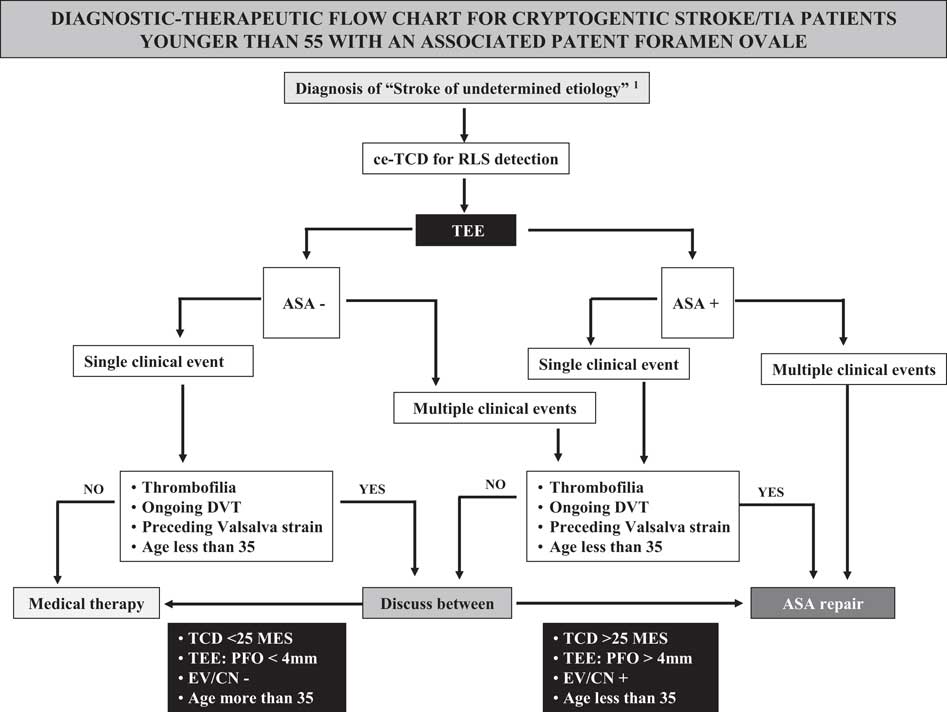
Diagnostic and therapeutic algorithm
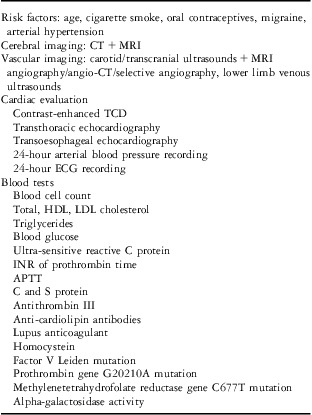
The diagnosis of “stroke” and “stroke of undetermined aetiology” was given according to the TOAST classification.Reference Adams, Bendixen and Kappelle27 Patients underwent diagnostic evaluation as summarised in Table 1. This included standard blood tests, including blood cell count, lipid and glucose level, C-reactive protein, and homocysteinaemia; coagulation tests – including prothrombin and activated partial thromboplastin times, fibrinogen, C protein, S protein, activated protein C resistance, antithrombin III, antiphospholipid antibodies – together with genetic analysis for inherited prothrombotic conditions – that is, G1691A mutation in factor V gene, G20210A mutation in the factor II gene, and C677T mutation in the methylenetetrahydrofolate reductase gene – and acid α-galactosidase levels; lower limb venous ultrasound evaluation for deep vein thrombosis; brain magnetic resonance imaging; intracranial magnetic resonance angiography or conventional angiography to rule out dissections; extracranial carotid and vertebral ultrasound evaluation; contrast-enhanced transcranial Doppler for right-to-left shunt detection; transthoracic echocardiography and transoesophageal echocardiography; standard and 24-hour recording electrocardiogram. Detailed personal and family history of each patient was recorded with particular regard to migraine history,28 ongoing contraceptive therapy, Valsalva strain before the clinical event, and previous clinical events in the same or in other vascular territories.
Diagnostic work-up for the diagnosis of “stroke of undetermined aetiology”.

APTT = activated partial thromboplastin time; angio-CT = angio-computerised tomography; ECG = echocardiogram; HDL = high-density lipoprotein; INR = international normalised ratio; LDL = low-density lipoprotein; MRI = magnetic resonance imaging; TCD = transcranial Doppler
Contrast-enhanced transcranial Doppler
According to existing guidelines,Reference Jauss and Zanette29 the diagnosis of right-to-left shunt was made by means of transcranial Doppler recording with intravenous injection of agitated saline as contrast-enhancing agent. In brief, 9 millilitres of saline mixed with 1 millilitre of air were injected in the right antecubital vein while recording transcranial Doppler signal from the right middle cerebral artery, both at rest and before Valsalva strain. The highest number of micro-embolic signals recorded was used to classify right-to-left shunt: absent – 0 micro-embolic signals; grade I – 1–10 micro-embolic signals; grade II – >10 micro-embolic signals; “persistent” – if present at rest; and “latent” – if present only under Valsalva strain.
Transoesophageal echocardiography
Transoesophageal echocardiography was performed according to standard practice guidelines with commercially available ultrasonographic instruments.Reference Meissner, Khandheria and Heit14 In addition to the standard views, the region of the fossa ovalis was studied to detect a separation between the septum primum and the septum secundum, and the maximum opening diameter of the communicating channel was measured at the entrance into the left atrium. Agitated saline was used as a contrast-enhancing agent.
Follow-up
To validate the effectiveness of the diagnostic and therapeutic algorithm, a long-term follow-up has been undertaken as follows: patients undergoing percutaneous patent foramen ovale closure – transthoracic echocardiography 24 hours after procedure; contrast-enhanced transcranial Doppler and transoesophageal echocardiogram at 1, 6, 12, and 24 months; patients receiving medical therapy – at 12, 24, and 36 months, in the absence of a recurrent event, patients underwent a structured telephone interview by a neurologist in order to assess the occurrence of possible stroke symptoms.
Endpoints
Primary endpoints
This included the combined occurrence of recurrent transient ischaemic attack or stroke; major bleeding, including fatal bleeding, symptomatic intracranial bleeding, intraocular haemorrhage, retroperitoneal haemorrhage, overt bleeding resulting in a decrease in haemoglobin greater than 3 grams per decilitre, and bleeding requiring transfusion of at least 2 units of red blood cells or emergency procedures; and percutaneous device-related complications requiring removal, that is, migration in acute, or surgical repair, erosion of a cardiac or vascular structure in chronic. Such events will be considered at any time of the follow-up observation.
Secondary endpoints
Drug-related or procedure-related side effects such as minor bleeding, every bleeding not included within major bleedings, gastric intolerance to aspirin, blood dyscrasias related to thienopyridines; persistence of right-to-left shunt, as assessed by contrast-enhanced transcranial Doppler at 6 and 12 months in patients who underwent atrial septal repair, grade I or more; persistent cardiac arrhythmia of new onset. Secondary endpoints are analysed at 12 months.
Statistical methods
Continuous data are expressed as means and standard deviations; discrete variables are given as absolute values and percentages. The Student t-test or Kruskal–Wallis test was used to compare differences between continuous variables, where appropriate. The chi-square statistic with Yates’ correction, or Fisher's exact test when appropriate, was used to test associations of categorical data. All tests were two sided. A probability value of less than or equal to 5% was considered significant. SPSS version 15 and Microsoft Excel 2003 was used for data analysis.
Results
The group was created in January 2006, and a protocol was drafted according to the best available evidence (Fig 1). It has been applied to patients at high risk of having a patent foramen ovale-related stroke, being 55 years old or less, with an embolic stroke and no other risk factors emerging from a thorough diagnostic evaluation. Since then, cases are discussed on a monthly basis, and so far 103 patients with unarguable diagnosis of “stroke of undetermined aetiology” have been entered in a dedicated database for a prospective evaluation of outcome. According to the protocol, 51 patients underwent percutaneous atrial septal repair. The appropriate device was chosen on the basis of intraprocedural transoesophageal echocardiography, according to patent foramen ovale morphology and atrial septal aneurism entity. Amplatzer Patent Foramen Ovale Occluder 18/25, Amplatzer Cribriform Occluder 25 or 35 millimetres (AGA Medical Corporation, Golden Valley, Minnesota, United States of America) were chosen accordinglyReference Rigatelli, Dell'Avvocata, Ronco, Giordan and Cardaioli30. For only three patients aged less than 25 years, BioSTAR (NMT Medical, Boston, Massachusetts, United States of America) bioabsorbable devices were chosen. None of the patients required multiple devices deployment.
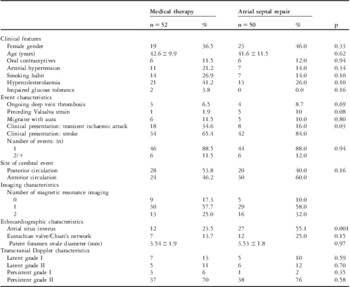
The remaining 52 patients were addressed to medical therapy. This consisted of anti-platelets in most cases, that is, 100 milligrams of aspirin in 45 cases; 250 milligrams of ticlopidine twice a day in two cases; and 75 milligrams of clopidogrel a day in two more cases, while oral anticoagulation was reserved for three cases. Epidemiological and clinical features of the two groups of patients – medical therapy and endovascular therapy – are shown in Table 2.
Clinical and epidemiological features of patients of the two groups.

There was no statistically significant difference between the two groups of patients, except for the fact that patients undergoing percutaneous treatment were less likely to have a transient ischaemic attack as the index event and were more likely to display atrial septal aneurism, as a consequence of the clinical algorithm (Fig 1; Table 2).
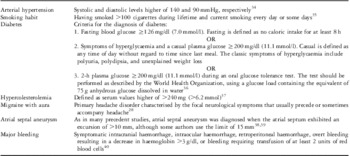
Glossary.

Follow-up
Approximately 89% of patients underwent clinical and instrumental follow-up as required by the study protocol; the mean follow-up was 27.5 months; standard deviation was 9.9 months; minimum length was 1 month; and maximum length was 72 months. Within the interventional treatment group, at the 6-month instrumental follow-up, 37% of patients displayed residual shunt as assessed by means of contrast-enhanced transcranial Doppler – that is, 29% showed latent I grade shunt, 4% latent II degree shunt, and 4% a persistent I degree shunt. At 12 months, only 25% of patients showed a latent I grade shunt, one patient a latent II degree shunt, and none had a persistent shunt.
All patients with residual shunt were advised to continue anti-platelet treatment with aspirin. None had device-related complications; one patient had peri-procedural femoral minor bleeding with no need for blood transfusion. With regard to the occurrence of primary endpoints, one patient suffered from a symptomatic traumatic intracerebral haemorrhage while he was taking aspirin in the post-procedural phase.
In the medical group, no patient reported long-term gastric intolerance to aspirin, blood dyscrasias, or minor bleeding. There was one patient who experienced a first stroke recurrence while receiving 100 milligrams of aspirin, and a second recurrence while on oral anticoagulation; he was hence switched to the interventional procedure with no further recurrence at the 6-month post-procedural follow-up.
Discussion
We hereby report on our experience on stroke of unknown origin in patients younger than 55 years with a patent foramen ovale. This is a challenging medical issue, given that the potential alternative explanation is unrelated to paradoxical embolism present in young patients with cryptogenic stroke and transient ischaemic attack. Moreover, there is a lack of robust evidence to guide clinicians in the choice of secondary prevention therapy. The perceived need for a pragmatic, standardised approach to these patients led our institution to set up a multi-disciplinary group that in the last 4 years has been systematically discussing and treating all the suitable cases according to a shared flow chart. Patients have been subjected to a clinical and instrumental follow-up in order to assess immediate and long-term outcomes. Nearly 50% of patients were addressed to medical therapy and 50% underwent endovascular procedures of atrial septal repair. This was the favoured choice in case of associated atrial septal abnormalities, or coagulation deficits, as shown in the flow chart (Fig 1). The two groups differ from each other accordingly, in terms of severity of clinical events and presence of aspirin.
Stroke in the young is a rare entity, given that ischaemic stroke is an age-dependent pathology. In young patients, a higher rate of diagnosis of “stroke of undetermined aetiology” is made as compared with other age groups, in up to 60% of the cases.Reference Sacco, Ellenberg and Mohr31 Our cohort has been extensively studied in order to rule out all ascertainable causes of stroke. Indeed, the 103 patients enrolled in 4 years represent a minority of the population admitted or referred to our institution, where an average number of 1200 stroke patients are admitted each year, according to complete administrative records (Mazzucco S. et al, unpublished data). Although not impressive from a numeric point of view, medical care to these patients bears high relevance because of their young age and the potentially highly invalidating nature of their illness. This has obvious implications in terms of economic impact, for the loss of productivity of highly active people and for the medical attention they could potentially require lifelong. Moreover, it clearly has social, familiar, emotional implications as well, in which clinicians in charge of the patients are involved. This is why particular care has to be undertaken with regard to the risk–benefit weighting of any therapeutic intervention. Indeed, endovascular procedures of atrial septal repair seem to warrant the most radical solution of the supposed cause of a stroke in a young patient. It avoids lifelong bleeding risk linked to antithrombotic therapy, compliance-related issues, social complaints, and likely costs owing to long-term therapy. However, clear evidence of the advantages of the interventional approach over optimal medical therapy in preventing stroke recurrences is missing, and the only available large study, the CLOSURE-I randomised controlled trial, did not confirm the expected benefits of atrial septal closure with the STARflex device.Reference Furlan17 Nevertheless, such conclusions could not be valid for all devices, and should be restricted to the specific device selected by the trial. Customised strategies based on tailoring the most suitable device to patients’ local anatomy should be warranted.Reference Rigatelli, Dell'Avvocata, Ronco, Giordan and Cardaioli30 Moreover, it is important to note that the risk of selection bias cannot be ruled out. Patients enrolled in this trial had an apparent high rate of stroke recurrences, which is unusual in such a group of young patients. Thorough diagnosis including rare causes of stroke, particularly in the younger age groups, should be routinely carried out. Post-procedural residual shunt assessment is another crucial issue; contrast-enhanced transcranial Doppler has proved to be more sensitive in detecting residual shunts,Reference Anzola, Morandi, Casilli and Onorato32 and should be proposed as the gold standard for residual leaking assessment instead of echocardiography.
When compared with the previous studies,Reference Anzola, Morandi, Casilli and Onorato32 our cohort displays a similar prevalence of post-procedural residual right-to-left shunt at contrast-enhanced transcranial Doppler. These findings correspond to latent shunts of small entity; none is persistent at 12 months and some appear to close by the 6th month after the procedure. Moreover, such residual shunts seem to have no prognostic implications.Reference Serena, Segura, Perez-Ayuso, Bassaganyas, Molins and Davalos10
The occurrence of minor procedure-related complications should be taken into account as these may occur even in expert hands, as disclosed by CLOSURE-I trial. Although rare, immediate or long-term major complications can be catastrophic and deserve accurate monitoring.Reference Amin, Hijazi, Bass, Cheatham, Hellenbrand and Kleinman33 Furthermore, there is still a substantial lack of long-term follow-up regarding the performance of the percutaneous devices, an aspect that bares particular importance considering the young age of this population. Nevertheless, even medical therapy cannot be considered completely safe.Reference Furlan17
We think that because of the essential uncertainty of long-term outcome of the two therapeutic strategies, counselling on this issue should be based on a thorough analysis and shared decisions by a multi-disciplinary working group such as the one described in our experience. This, until clear recommendations become available, as recommended by Scientific Societies for clinically challenging patients subsets.Reference Wijns, Kolh and Danchin26
In conclusion, we believe that our approach to this complex subject is a concrete example of implementation of the existing scientific evidence to pragmatic clinical decision. Sharing the burden of a difficult therapeutic choice among a group of dedicated specialists in the field – like the VEROSTROKE group – could be a useful model of group-based counselling, and could be applied to other conflicting medical fields.