Introduction
In June 2016, Canada passed legislation about assisted death, also known as medical assistance in dying (MAiD; Government of Canada, 2017). Bill C-14 established a legislative framework for both euthanasia and assisted suicide in all Canadian provinces and territories (Minister of Justice, 2016). Medical assistance in dying can be provided in two ways: voluntary active euthanasia or assisted suicide. Voluntary active euthanasia is the practice of administering medication(s), most commonly by a physician, to hasten a person's death at the explicit request to alleviate suffering (Dierckx de Casterlé et al., Reference Dierckx de Casterlé, Denier and De Bal2010). Assisted suicide, or physician-assisted suicide, is the practice in which a person receives a prescription for life-ending medications that are self-administered by the person (Gielen et al., Reference Gielen, van den Branden and Broeckaert2009). In Canada, nurse practitioners and physicians are legally authorized to both prescribe and administer medications that hasten death (Minister of Justice, 2016). Nurse practitioners are licensed advanced practice nurses whose scope is similar to a physician, with the authority to diagnose and manage disease/illness, prescribe medications, order/interpret laboratory/diagnostic tests, and initiate referrals to specialists (British Columbia College of Nurse Professionals, 2020). A small body of research demonstrates that nurses are often involved at various stages, and in various roles in the provision of MAiD in countries where MAiD is legal, and in some cases where it is not. Therefore, it is of utmost importance to understand the role of all caregivers (such as nurses, pharmacists, and social workers) who may be involved in the provision of MAiD including understanding the experiences of interprofessional teams and how experiences may vary between professions.
Understanding the professional experiences of healthcare providers (HCPs), especially of nurses and physicians providing end-of-life care, is of utmost importance as they are regularly faced with making sense of and coping with serious illness and death. Nurses who provide end-of-life care have described this work as demanding, and report being exposed to emotional pain, overload, and work-related stress (Ablett and Jones, Reference Ablett and Jones2007; Boroujeni et al., Reference Boroujeni, Mohammadi and Oskouie2009). Similarly, studies of palliative care practitioners have identified the emotional toll from being constantly exposed to death (Vachon and Sherwood, Reference Vachon, Sherwood, Berger, Shuster and Von Roenn2007; Kearney et al., Reference Kearney, Weininger and Vachon2009). The emotional and spiritual experiences associated with end-of-life care can include anxiety, powerlessness, uncertainty, distress, grief, and frustration (Browall et al., Reference Browall, Henoch and Melin-Johansson2014; Luxardo et al., Reference Luxardo, Padros and Tripodoro2014; Wilson, Reference Wilson2014). Alternatively, some HCPs viewed the experience of end-of-life care as a privilege, giving them insight and bringing meaning to their own lives (Kearney et al., Reference Kearney, Weininger and Vachon2009; Johansson and Lindahl, Reference Johansson and Lindahl2012; Browall et al., Reference Browall, Henoch and Melin-Johansson2014; Fosse et al., Reference Fosse, Ruths and Malterud2017).
The provision of MAiD can elicit a similar spectrum of emotions among HCPs (Fujioka et al., Reference Fujioka, Mirza and McDonald2018) as experienced during the provision of end-of-life care. However, in addition to emotional responses, several moral conflicts about MAiD have been noted. It has been argued that MAiD stands in direct conflict of the goals of Western medicine, which is committed to promoting health and to doing no harm (Hulkower, Reference Hulkower2010; Siden, Reference Siden2016). As such, some physicians felt that MAiD should not be considered a medical treatment, and that it is beyond the scope of acceptable practices (Boudreau and Somerville, Reference Boudreau and Somerville2013). However, others maintain that the goals of medicine are to uphold the patients’ personal wishes and values, wellbeing, and medical needs (Kaba and Sooriakumaran, Reference Kaba and Sooriakumaran2007), in which MAiD may be a legally and ethically acceptable medical treatment. What remains unclear is how HCPs manage this new scope of practice and navigate the ethical landscape surrounding MAiD. Fujioka et al. (Reference Fujioka, Mirza and McDonald2018) emphasize the paucity of research exploring the breadth of experiences of formal caregivers in the provision of MAiD across professions and around the world and recommended further research specifically focus on the experience of professional HCPs with MAiD. Therefore, it is timely to conduct this scoping review to examine and synthesize existing evidence about the professional experiences of formal caregivers in the provision of MAiD. This scoping review asks: what are the professional experiences of formal caregivers in the provision of MAiD?
Methods
Scoping review is a knowledge synthesis method, which can be used to bring meaning and significance to a diverse body of research. This is done through extraction of key information and description of key concepts, main sources and types of evidence available (Davis et al., Reference Davis, Drey and Gould2009). This scoping review is based on the framework proposed by Colquhoun et al. (Reference Colquhoun, Levac and O'Brien2014), which has five steps: (1) identify the research question, (2) identify relevant studies, (3) study selection, (4) chart the data, and (5) collate, summarize, and report the results.
The research question examined “professional experience” referring to the experiences of HCPs within their workplace, while partaking in duties within their scope of practice and experience in relation to MAiD. Formal HCPs included doctors, nurses, social workers, or other HCPs engaged in the care of patients within the healthcare system. The provision of MAiD referred to HCPs who were involved in the care of a patient from the time that a request for MAiD was made to the time that the procedure was undertaken (if the request was granted), and any aftercare following the procedure. Studies of opinions, attitudes, and views were excluded.
Seven electronic databases were searched in January 2019, including PubMed, Web of Science (ISI), CINAHL (Ebsco), PsychInfo (Ebsco), Social Work Abstracts (Ebsco), Academic Search Premier (Ebsco), and Embase (OVID). Search strategies included various combinations of the following key words and subject headings (when available) were used to capture literature relevant to this topic:
1) Formal Caregivers: physician, doctor, nurse, nurse practitioner, palliative care worker, clinician, care team, care aide, support worker, counselor, circle of care, management, hospice staff, care provider.
2) Experience: provision, engagement, attitude of health personnel, professional practice, experience.
3) Medical Assistance in Dying: euthanasia, physician-assisted death, medical dying, mercy killing, assisted suicide, continuous sedation until death, wish to die, euthanasia, active, euthanasia, active, voluntary, suicide, assisted, right to die, death with dignity.
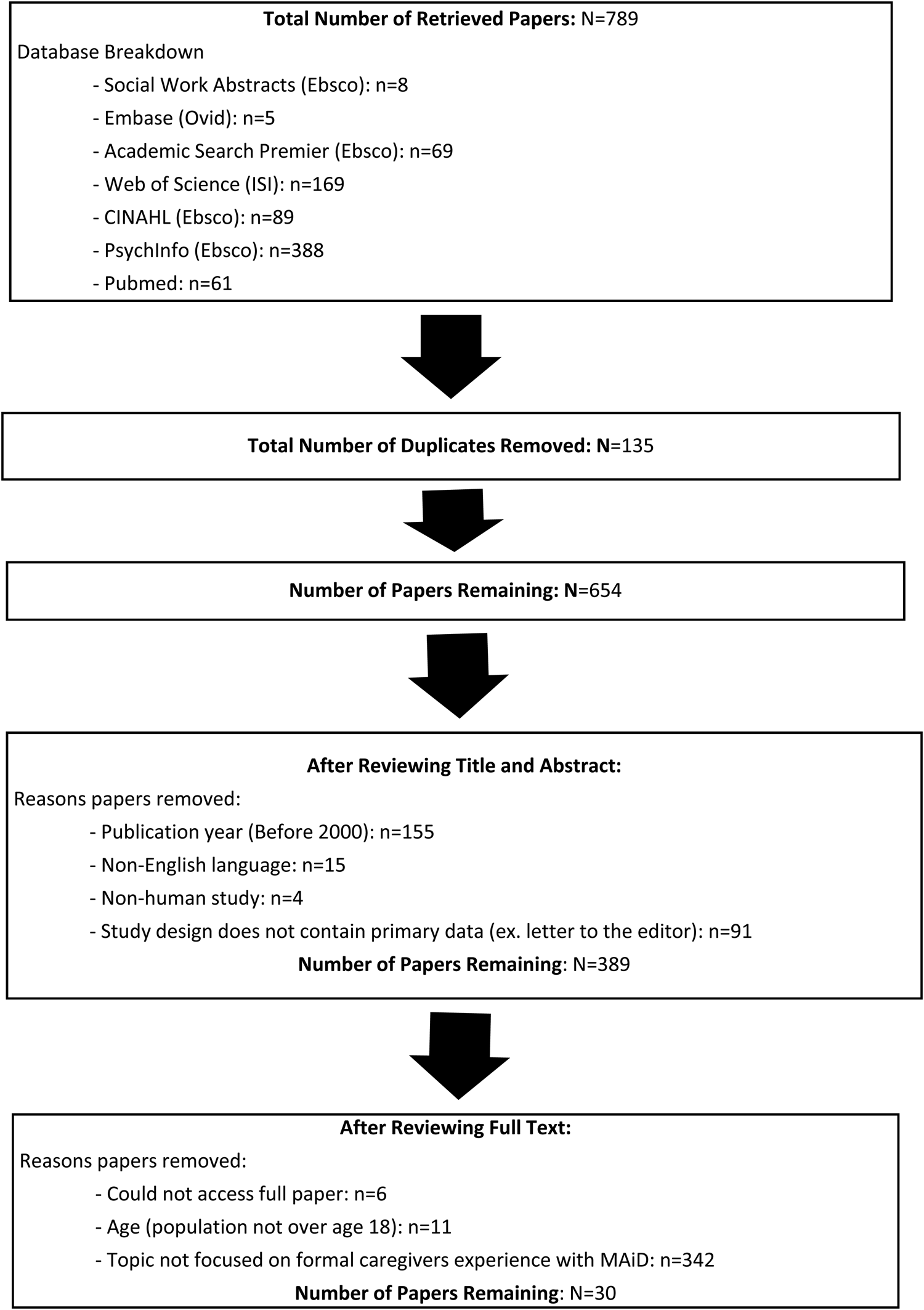
A detailed article search chart outlining inclusion and exclusion data can be found in Figure 1.
Flowchart detailing search strategy undertaken for scoping review.

Results
Study details
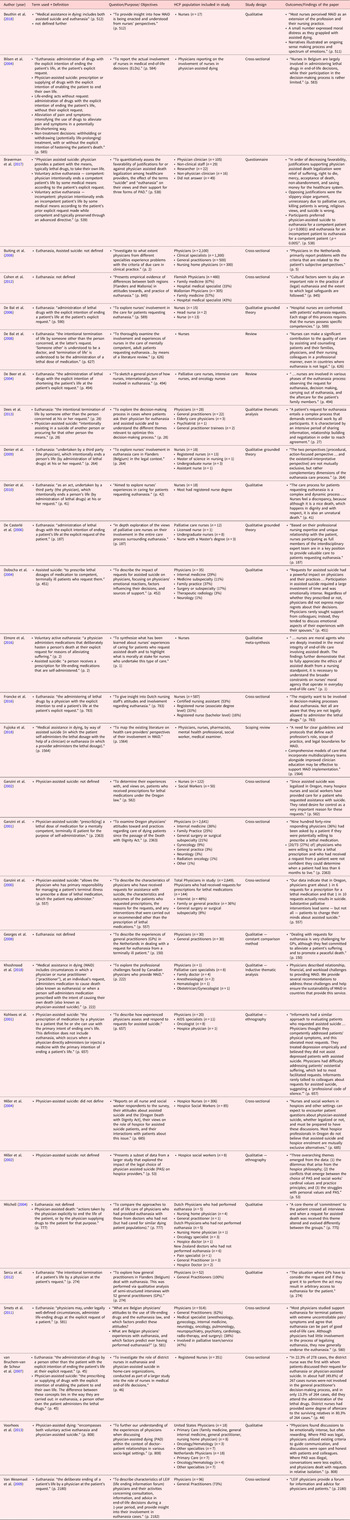
Fifty three percent of the 30 studies were from Europe (Belgium: n = 11/30; Netherlands: n = 5/30). Twenty seven percent of the studies were from the United States (Oregon: n = 6/30; Connecticut: n = 1/30; Seattle & San Francisco: n = 1/30), and 13% were from Canada (n = 4/30). Two studies were multi-country studies, comparing the Netherlands to New Zealand (Mitchell, Reference Mitchell2004) or the USA (Voorhees et al., Reference Voorhees, Rietjens and van der Heide2014). Sixty-three percent of studies stated that MAiD was legal (n = 19/30), whereas 17% of studies (n = 5/30) stated that MAiD was not legal at the time of data collection (Kohlwes et al., Reference Kohlwes, Koepsell and Rhodes2001; Bilsen et al., Reference Bilsen, Vander Stichele and Mortier2004; De Bal et al., Reference De Bal, Dierckx de Casterlé and De Beer2006; Braverman et al., Reference Braverman, Marcus and Wakim2017). One study did not state if MAiD was legal (Georges et al., Reference Georges, The and Onwuteaka-Philipsen2008) and five included countries with varying legal status (Miller et al., Reference Miller, Mesler and Eggman2002; De Beer et al., Reference De Beer, Gastmans and De Casterle2004; De Bal et al., Reference De Bal, Gastmans and Dierckx de Casterlè2008; Voorhees et al., Reference Voorhees, Rietjens and van der Heide2013; Elmore et al., Reference Elmore, Wright and Paradis2016). Thirty-three percent of studies (n = 10/30) were completed between 2000 and 2005, 30% between 2005 and 2010 (n = 9/30), and 37% of studies between 2010 and 2018 (n = 11/30). Sixty-three percent of the studies were done by academic institutions in one or more countries (n = 19/30). The remaining 33% (n = 10/30) of studies involved both academic and non-academic institutions with only one study being conducted by a non-academic center only (Georges et al., Reference Georges, The and Onwuteaka-Philipsen2008). Fifty-seven percent of studies were qualitative (n = 17/30) and 37% were non-experimental cross-sectional design (n = 11/30). The most commonly used term was euthanasia (n = 12/30) and physician-assisted suicide (n = 7/30). Seven studies used multiple terms, all of which used euthanasia plus additional terms (assisted suicide, physician-assisted suicide, voluntary active euthanasia, MAiD). When looking more in depth about terms used, 83% of studies defined their terms (n = 25/30) (see Table 1).
Summary of the research articles included in this study (N = 30)

Study participants
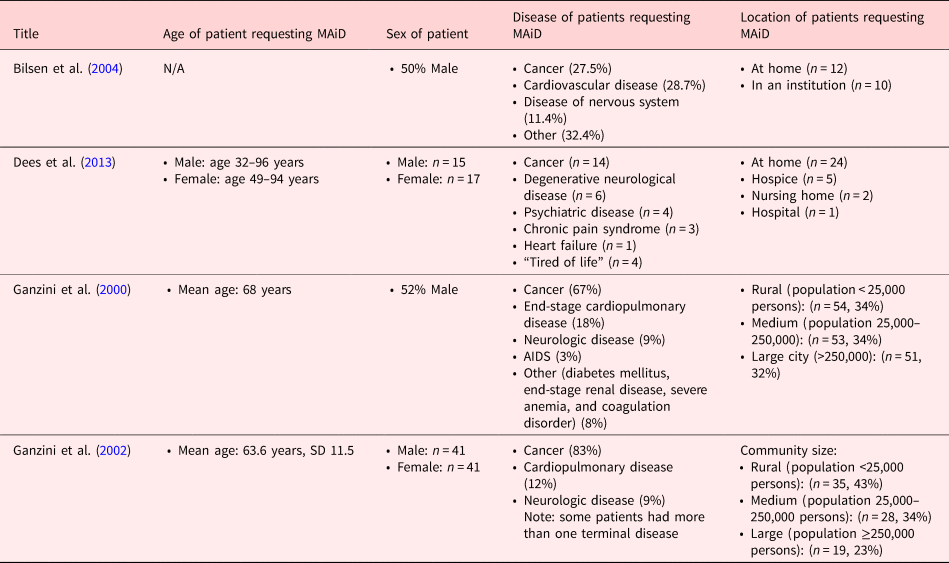
Fifty percent of studies involved physicians (n = 15/30), and 33% involved nurses (n = 10/30). One study examined social workers’ experiences (Miller et al., Reference Miller, Mesler and Eggman2002). Additionally, four studies compared more than one population: two studied both nurses and social workers (Ganzini et al., Reference Ganzini, Harvath and Jackson2002; Miller et al., Reference Miller, Harvath and Ganzini2004), one included physicians and other clinicians (Fujioka et al., Reference Fujioka, Mirza and McDonald2018), and one examined researchers, physician and non-physician clinicians, and other non-clinical staff (Braverman et al., Reference Braverman, Marcus and Wakim2017). Papers included a range of physician types: 30% included general practitioners (n = 9) and 20% involved family practitioners (n = 6). Other physician populations included AIDS specialists, hospice physicians, oncologists, internists, anesthesiologists, gynecologists, neurologists, pulmonologists, neuropsychiatrists, psychiatrists, cardiologists, radiotherapists, surgeons, elderly care physicians, nursing home physicians, pain specialists, hematologists, and palliative care specialists. Nurse populations included registered nurses, licensed nurses, certified nursing assistant, assistant nurse, master of nursing, undergraduate nurses, and nurse practitioners. Nurses were working in various units including palliative care, intensive care, oncology, and hospice. Social workers worked in hospices. The characteristics of patients requesting MAiD in addition to the professional experiences of professional caregivers with MAiD were reported in four studies (see Table 2).
Reported patient characteristics (n = 4)

Note: some patients had more than one terminal disease.
Receiving requests for MAiD
Physicians and nurses in Belgium, the Netherlands, USA, and Canada received requests for MAiD after legalization. Prior to legalization, physicians in New Zealand (Mitchell, Reference Mitchell2004) and the USA (Kohlwes et al., Reference Kohlwes, Koepsell and Rhodes2001; Voorhees et al., Reference Voorhees, Rietjens and van der Heide2013), and some Belgian nurses received requests for MAiD (De Bal et al., Reference De Bal, Dierckx de Casterlé and De Beer2006). Oregon social workers received requests for MAiD from their patients (Ganzini et al., Reference Ganzini, Harvath and Jackson2002; Miller et al., Reference Miller, Mesler and Eggman2002, Reference Miller, Harvath and Ganzini2004).
Physicians receiving requests for MAiD
The experiences of physicians receiving requests for MAiD varied considerably. Physicians, in countries where MAiD was and was not legal at the time of study, spoke about how patient–physician relationships influenced their experience (Kohlwes et al., Reference Kohlwes, Koepsell and Rhodes2001; Sercu et al., Reference Sercu, Pype and Christiaens2012; Dees et al., Reference Dees, Vernooij-Dassen and Dekkers2013). In a study of 28 Dutch physicians, some physicians felt that the request for MAiD put a strain on this relationship, by cutting across the “usual curative role” (Dees et al., Reference Dees, Vernooij-Dassen and Dekkers2013, p. 34). In a study of 35 physicians in Oregon, some physicians perceived requests for MAiD as a refusal of treatment (Dobscha et al., Reference Dobscha, Heintz and Press2004), while in another study of 52 Belgian physicians, having a long-standing relationship with a patient made some physicians feel unable to comply, whereas other physicians felt obliged to perform MAiD despite being ethically and emotionally unprepared (Sercu et al., Reference Sercu, Pype and Christiaens2012). Some physicians in Oregon felt surprised or unprepared, powerless to intervene, and frustrated (Dobscha et al., Reference Dobscha, Heintz and Press2004).
Patient requests for MAiD may provide opportunities for HCPs to discuss patient concerns and fears about death and dying, clarify information about symptom control, and reassure patients that they would not be abandoned (Dobscha et al., Reference Dobscha, Heintz and Press2004; Voorhees et al., Reference Voorhees, Rietjens and van der Heide2013). For example, Kohlwes et al. (Reference Kohlwes, Koepsell and Rhodes2001) reported that 25% of U.S. physicians in their study (n = 5/20) felt that discussing MAiD and existential suffering created an opportunity to strengthen patient and physician relationships. In Mitchell's (Reference Mitchell2004) study, the five physicians who had provided euthanasia at a time where it was an illegal but accepted practice, had expected patients exhaust all other options until euthanasia was the only alternative.
Nurses and social workers receiving requests for MAiD
Of the 13 studies discussing the experiences of nurses and social workers, 67% of these explored the experiences of nurses in receiving requests for MAiD. The percentage of nurses in the Netherlands that received a patients’ first request for MAiD ranged from 22% (n = 62/278) (van Bruchem-van de Scheur et al., Reference van Bruchem-van de Scheur, van der Arend and Spreeuwenberg2007) to 37% (n = 219/587) (Francke et al., Reference Francke, Albers and Bilsen2016). Francke et al. (Reference Francke, Albers and Bilsen2016) noted that 35% of nurses (n = 204/587) had informed a physician about a request for MAiD on at least one occasion. Ganzini et al. (Reference Ganzini, Harvath and Jackson2002) found that 98% of Belgian nurses had discussed the request for a MAiD prescription with coworkers, in the context of MAiD being legal.
When faced with a request for MAiD, regardless of its legal status, nurses in several countries (Belgium, the Netherlands, and Canada) emphasized the importance of taking the request seriously, determining the reasons behind the request for euthanasia, actively listening, and continuing to care for the patient compassionately (De Bal et al., Reference De Bal, Dierckx de Casterlé and De Beer2006). Two studies from Canada and the Netherlands reported that some nurses informed patients about palliative care alternatives as part of understanding the request for MAiD (De Casterlé et al., Reference De Bal, Dierckx de Casterlé and De Beer2006; Elmore et al., Reference Elmore, Wright and Paradis2016). Miller et al. (Reference Miller, Harvath and Ganzini2004) found that Oregonian hospice social workers were more comfortable than nurses in their study when it came to discussions of assisted suicide with patients. Of the Oregonian nurses and social workers who had cared for at least one patient who expressed an interest in pursuing MAiD in the last year (217/391), 81 (37.3%) attempted to facilitate a patient's access to a legal lethal prescription. Only two social workers (2%) would transfer care of a patient who received a lethal prescription to another hospice clinician [compared to 12% of nurses (n = 36) in this study] (Miller et al., Reference Miller, Harvath and Ganzini2004). Further, Miller et al., (2004) found there was no difference between nurses and social workers in their comfort in discussing assisted suicide with coworkers and supervisors or in seeking their consultation.
Decisions to grant requests for MAiD
Nurses and physicians can play an important role in the decision-making process with regards to MAiD. In Oregon, USA, and Belgium where legal guidelines exist, physicians reported challenges in assessing a patient's eligibility for MAiD such as having little confidence in determining when a patient has less than 6 months to live, assessing whether patient suffering is eligible for euthanasia, and knowing the patient well at time of assessment (Dobscha et al., Reference Dobscha, Heintz and Press2004). This was the case 3 years (Dobscha et al., Reference Dobscha, Heintz and Press2004), 4 years (Ganzini et al., Reference Ganzini, Nelson and Lee2001) and 5 years (Sercu et al., Reference Sercu, Pype and Christiaens2012) after legalization in their respective countries. In a study by Dees et al. (Reference Dees, Vernooij-Dassen and Dekkers2013), all Dutch physicians (n = 28) mentioned careful assessment of whether the patient's request was voluntary, well considered and durable, and whether the patient was competent to make this request. Despite the potential for challenges in the legal assessment process, most of the 28 physicians in this study decided on their course of action before the independent consultation, and consequently, the consultant's positive or negative assessment did not alter the physician's course of action (Dees et al., Reference Dees, Vernooij-Dassen and Dekkers2013). Interestingly, one study highlighted that 62% of HCPs were ethically more comfortable with MAiD for incompetent patients with advanced directives compared with 51.6% for competent patients (Braverman et al., Reference Braverman, Marcus and Wakim2017). As well, 68.1% of HCPs were more legally comfortable with MAiD for incompetent patients with advanced directives compared with 58.1% (Braverman et al., Reference Braverman, Marcus and Wakim2017). In the discussion, Braverman et al. (Reference Braverman, Marcus and Wakim2017) posit that this may have resulted from HCPs perceiving the presence of an advanced directive as a safeguard and emphasized that further research is warranted to better understand how the competency of the patient may affect the HCPs perspective on MAiD.
Of the 10 studies discussing the experiences of nurse involvement in decision making, 70% of studies reported that other healthcare professionals were frequently consulted. In countries where MAiD was legal and where it was not, physicians frequently consulted other physicians (Van Wesemael et al., Reference Van Wesemael, Cohen and Onwuteaka-Philipsen2009; Cohen et al., Reference Cohen, Van Wesemael and Smets2012), nurses (Bilsen et al., Reference Bilsen, Vander Stichele and Mortier2004; De Bal et al., Reference De Bal, Dierckx de Casterlé and De Beer2006; Francke et al., Reference Francke, Albers and Bilsen2016), or other HCPs such as a psychologist, psychiatrist, and mental health nurse practitioner (Ganzini et al., Reference Ganzini, Harvath and Jackson2002). At a time when MAiD was illegal, Bilsen et al. (Reference Bilsen, Vander Stichele and Mortier2004) found that Belgian nurses were consulted more often in institutional euthanasia cases (83.3%) than at home (20%). In a study by Francke et al. (Reference Francke, Albers and Bilsen2016) of 587 nurses, 69% reported they felt that the physician should discuss the request for MAiD with the nurse, while 83% agreed that the physician should discuss a decision for MAiD with the nurse. However, several studies found that nurses were not always included (De Beer et al., Reference De Beer, Gastmans and De Casterle2004; De Bal et al., Reference De Bal, Gastmans and Dierckx de Casterlè2008; Elmore et al., Reference Elmore, Wright and Paradis2016; Francke et al., Reference Francke, Albers and Bilsen2016). Many nurses felt that their knowledge of the patient through their continuous and daily follow-up gave them insight into a patient's experiences, making it important that they have a voice in the interdisciplinary decision-making process (De Bal et al., Reference De Bal, Gastmans and Dierckx de Casterlè2008) across countries where MAiD was and was not legal.
Other factors that influenced decision making included interpersonal factors, balancing the necessity to perform euthanasia and respect for their own values, alternate options to alleviate the patient's suffering, and respecting patient autonomy (Dobscha et al., Reference Dobscha, Heintz and Press2004; Georges et al., Reference Georges, The and Onwuteaka-Philipsen2008). For 53% of Dutch physicians (n = 16/30), the decision-making process also gave them time to emotionally prepare to perform euthanasia (Georges et al., Reference Georges, The and Onwuteaka-Philipsen2008). Other Dutch physicians described the process of planning a date and time of the procedure as an “unfamiliar emotional task,” which involved negotiation between patients and physicians and substantial preparatory work (Dees et al., Reference Dees, Vernooij-Dassen and Dekkers2013). Dobscha et al. (Reference Dobscha, Heintz and Press2004) found that 37% of Oregonian physicians (n = 13/35) who chose not to prescribe referred patients to other physicians who were more likely to prescribe, yet 20% of physicians (n = 7/35) felt pressure to not disappoint or abandon their patient, and that referring may be abandoning patients.
In the context of provision of MAiD where it was not legal, Kohlwes et al. (Reference Kohlwes, Koepsell and Rhodes2001) found 90% of physicians who had provided a prescription for physician-assisted suicide (n = 9/10) reported that they would only assist a patient they knew well. These physicians involved the family intensely and documented prescribing medication for sleep to protect themselves legally. Twenty-five percent of physicians (n = 5/20) arranged meetings with the patient's support network to ensure that everybody knew the plan and could be educated about what to expect (Kohlwes et al., Reference Kohlwes, Koepsell and Rhodes2001). These physicians felt that involving the family prior to administering MAiD could reduce the risk for “survivor guilt” among family members (Kohlwes et al., Reference Kohlwes, Koepsell and Rhodes2001). Survivor guilt has been defined as “a highly individualized, interpersonal process involving the status of being spared from harm that others incurred, which is adversely experienced as distressing, manifested by diverse responses, and is driven by the context(s) from which it emerges" (Hutson et al., Reference Hutson, Hall and Pack2015). This type of self-guilt can occur following a traumatic event. In the context of MAiD, this could include feelings of guilt among family members for reasons such as not providing enough support to the family member, symptoms not being managed well enough, or not being a good enough reason to live.
Being present at time of MAiD
In one study of Belgian physicians who were specifically trained in end-of-life care support including MAiD, 33% of physicians (n = 132) had been present at least once at the time of euthanasia, 38.5% had helped with preparing the required drugs, and 27% had administered the drugs (Van Wesemael et al., Reference Van Wesemael, Cohen and Onwuteaka-Philipsen2009). Some Oregonian physicians wanted to be present at patient deaths: they felt obliged to see things through, and being present was considered an extension of medical treatment, while others felt that it would be inappropriate to be present at a patient's death and that the medical part of things was over (Dobscha et al., Reference Dobscha, Heintz and Press2004). Factors associated with a higher likelihood of having performed euthanasia included specialists, older age, having had training in palliative care, and having cared for terminal patients in the last 12 months (Smets et al., Reference Smets, Cohen and Bilsen2011). After MAiD was performed, some Dutch physicians in this study debriefed with the surviving relatives (Dees et al., Reference Dees, Vernooij-Dassen and Dekkers2013).
Five studies reported that a small percentage (less than 25%) of Belgian and Dutch nurses were present when MAiD was administered (De Casterlé et al., Reference De Casterlé, Verpoort and De Bal2006; van Bruchem-van de Scheur et al., Reference van Bruchem-van de Scheur, van der Arend and Spreeuwenberg2007; De Bal et al., Reference De Bal, Gastmans and Dierckx de Casterlè2008; Denier et al., Reference Denier, Dierckx de Casterlé and De Bal2010; Francke et al., Reference Francke, Albers and Bilsen2016), at times when MAiD was legal and when it was not. When present, nurses were involved in a range of activities including: supporting the patient or the patient's relatives, involvement in the administration of MAiD including helping to prepare the lethal drugs, insertion of the IV used to deliver the lethal drug, and administration of the lethal medication (Bilsen et al., Reference Bilsen, Vander Stichele and Mortier2004; De Beer et al., Reference De Beer, Gastmans and De Casterle2004; van Bruchem-van de Scheur et al., Reference van Bruchem-van de Scheur, van der Arend and Spreeuwenberg2007; De Bal et al., Reference De Bal, Gastmans and Dierckx de Casterlè2008; Francke et al., Reference Francke, Albers and Bilsen2016; Beuthin et al., Reference Beuthin, Bruce and Scaia2018). This was seen in both countries where MAiD was and was not legal.
Emotional response to MAiD
Physicians and nurses may experience a wide array of emotional responses, to the process of providing MAiD. In a qualitative exploration of 35 Oregon physicians, Dobscha et al. (Reference Dobscha, Heintz and Press2004) describe a breadth of positive and negative emotions associated with MAiD. Positive emotions included the rewarding feeling of being there for someone, the relief of being able to talk openly with them, believing that their actions were the right thing to do, a feeling of becoming a better doctor, increased confidence in discussing end-of-life options, being emotionally moved, or growing on some personal level (Dobscha et al., Reference Dobscha, Heintz and Press2004). Negative emotions included fear, discomfort with the topic of physician-assisted death, the emotional exhaustion such an intense experience can bring, feeling that giving a lethal injection is “a harsh and harrowing way to end life,” feeling that MAiD is a rejection of treatment, struggling with the morality of MAiD, disrupting the sacred nature of dying, or a sense of obligation to carry out a request for MAiD (Dobscha et al., Reference Dobscha, Heintz and Press2004; Mitchell, Reference Mitchell2004; Sercu et al., Reference Sercu, Pype and Christiaens2012). In the six months following legalization of MAiD in Canada, some physicians felt that being involved in the provision of MAiD resulted in stronger collegial relationships, while other physicians felt that providing MAiD harmed collegial relationships (Khoshnood et al., Reference Khoshnood, Hopwood and Lokuge2018).
Beuthin et al. (Reference Beuthin, Bruce and Scaia2018) found that some nurses felt bullied to participate despite moral or conscientious objection to the provision of MAiD. Some of the 15 Belgian nurses studied by De Bal et al. (Reference De Bal, Dierckx de Casterlé and De Beer2006) used the word “intense” to describe their experiences sometimes pointing to MAiD as causing an “intense moral conflict”. There may also be feelings of discomfort with this “unnatural death” (De Beer et al., Reference De Beer, Gastmans and De Casterle2004; Denier et al., Reference Denier, Dierckx de Casterlé and De Bal2010. In their literature reviews, several authors described nurses experiences of carrying out euthanasia as demanding (De Beer et al., Reference De Beer, Gastmans and De Casterle2004; De Bal et al., Reference De Bal, Gastmans and Dierckx de Casterlè2008).
Self-care in the provision of MAiD
Self-care was noted as important for both nurses and physicians involved in the provision of MAiD. Voorhees et al. (Reference Voorhees, Rietjens and van der Heide2014) described extensive discussions with other practitioners including physicians, nurses, rehabilitation therapists, and chaplains were inherent to the process in the Netherlands, which most physicians found helpful, within a context of MAiD being legal. Meanwhile, in their study of 20 U.S. physicians operating where MAiD was illegal, Kohlwes et al. (Reference Kohlwes, Koepsell and Rhodes2001) found that 14 physicians did not talk to colleagues about MAiD, and 6 did so in an abstract way, contributing to a “professional code of silence” around MAiD. Several physicians stressed the importance of being supported by colleagues to empower the physician to decline participation in physician-assisted death (Voorhees et al., Reference Voorhees, Rietjens and van der Heide2014), especially when MAiD was not legal. Having the support of colleagues was helpful for some Belgian physicians when a request for MAiD was being processed and when engaging in provision of MAiD (Sercu et al., Reference Sercu, Pype and Christiaens2012). One fifth of Dutch physicians (n = 81) in a study by Georges et al. (Reference Georges, The and Onwuteaka-Philipsen2008) were concerned with their ability to cope with MAiD, and felt that having to face a request for euthanasia or physician-assisted suicide and to perform euthanasia might have an important emotional impact on the physician (Georges et al., Reference Georges, The and Onwuteaka-Philipsen2008).
Three studies discussed the nurses’ experience of self-care and caring for colleagues in the provision of MAiD (De Bal et al., Reference De Bal, Dierckx de Casterlé and De Beer2006; De Casterlé et al., Reference De Casterlé, Verpoort and De Bal2006; Beuthin et al., Reference Beuthin, Bruce and Scaia2018). Twelve Belgian nurses working in the context of MAiD being illegal, emphasized that emotional support was indispensable and stressed the importance of debriefing with team members after administering MAiD (De Casterlé et al., Reference De Casterlé, Verpoort and De Bal2006). Strategies included maintaining emotional distance, psychologically releasing the patient's request, being aware of their limits, admitting their limits, making the most of the short time with their patient, expressing their feelings to their colleagues, and professional debriefing (De Beer et al., Reference De Beer, Gastmans and De Casterle2004).
Discussion
Formal HCP experiences with MAiD are highly individualized; yet, there are commonalities both within and across professions. This review highlights the breadth of emotional experiences, both positive and negative, that can be experienced by physicians, nurses, and social workers involved in caring for a patient requesting and/or undergoing MAiD. This review highlights a need to develop and implement formal supports as well as to promote self-care activities for all health professionals involved in MAiD regardless of the degree of involvement.
This review explores the roles and process taken by physicians in the provision of MAiD. This is not surprising given their primary role of being legally able to prescribe and administer the lethal drugs. However, it is important to note the various roles and extent of involvement that some nurses play in the provision of MAiD. Some nursing organizations have developed guidelines for nurses outlining roles and responsibilities in the provision of MAiD, and in response to legalization of MAiD. There is a paucity of research examining the role of social workers in the provision of MAiD; notably only one study in this review focussed on social workers’ experiences. This highlights a gap, to better understand the experiences of social workers in the provision of MAiD and also how MAiD might impact other care providers such as mental health providers or pharmacists. No studies in this review focussed upon detailing the experiences of an interdisciplinary team providing care for a patient requesting MAiD. Research is needed to examine the influences of interdisciplinary team membership on HCP experiences in the provision of MAiD.
As well, it is interesting to note differences in the experiences of MAiD before and after legalization of MAiD. One observation seems to be that when MAiD was illegal, physicians were able to cite the legality of the procedure as cause for not pursuing MAiD if they did not feel comfortable with this procedure. Since legalization, some physicians have been faced with requests and have varying degrees of comfort with providing MAiD, however, it is now considered a patient right to have access to this form of treatment. As well, nurses report less support and more of a code of silence around the topic in contexts where it is not legal. Similarly, physicians report caution when documenting MAiD prior to legalization for legal protection of themselves. Generally speaking, in some countries, legalization has provided more opportunity to discuss and seek support from colleagues with regards to providing MAiD. However, this is not without its limitations, as sometimes this can create sources of tension between colleagues who may hold different views on MAiD. Worthy of note is that most physicians in countries before and after legalization took requests for MAiD seriously and were diligent in thoroughly assessing requests and pursuing all options prior to accepting a request. This study highlights that experiences in the provision of MAiD can change over time for both physicians and nurses. However, to our knowledge, there have been no longitudinal studies which follow a cohort of care providers over time and document their experiences in providing MAiD over time. This would be a meaningful area for further research.
Diversity in emotions experienced by HCPs when engaging with patients about MAiD ranged from positive feelings of personal or spiritual growth and reflection to negative emotions, such as powerlessness or anxiety. Emotional responses of stress and burden are common, with one in three U.S. physicians having reported emotional exhaustion from caring for dying patients (Yoon et al., Reference Yoon, Hunt and Ravella2017). In the context of MAiD, some HCPs may experience emotional distress over feeling obligated to participate in MAiD, despite their personal objections (Beuthin et al., Reference Beuthin, Bruce and Scaia2018). Further research may consider examining if and how the level of emotional burden experienced in situations involving MAiD is similar to, or different from, the level experienced when caring for those facing end of life, who do not request MAiD.
Self-care is an issue of great importance recognized by health professionals as an integral component in job retention and job satisfaction (Vahey et al., Reference Vahey, Aiken and Sloane2004; Corley et al., Reference Corley, Minick and Elswick2005; Kearney et al., Reference Kearney, Weininger and Vachon2009; Shanafelt et al., Reference Shanafelt, Raymond and Kosty2014); it is also important when working in a supportive team environment (Sanchez-Reilly et al., Reference Sanchez-Reilly, Morrison and Carey2013). Studies involving physicians, nurses, and social workers all stressed the importance of being supported by colleagues when processing a request for MAiD, and especially when performing the act (Sercu et al., Reference Sercu, Pype and Christiaens2012). Granek et al. (Reference Granek, Mazzotta and Tozer2013) found that some physicians use strategies of compartmentalization, and withdrawing from families at end of life in order to avoid dealing with the emotional strain of patient death (Granek et al., Reference Granek, Mazzotta and Tozer2013). Research examining strategies for self-care are limited, which highlights the opportunity for further research to examine which intrapersonal efforts such as maintaining emotional distance, being aware of their limits, and expressing their feelings to their colleagues, may be most beneficial to provide enhanced support for HCPs involved in MAiD. Formal training and education, such as the one described in Houck (Reference Houck2014), have also been shown to be effective for HCPs involved in end-of-life care. This educational program focused on cumulative grief and compassion, fatigue, holistic self-care, and spiritual self-care to help grieving nurses develop strategies to remain physically and emotionally healthy (Houck, Reference Houck2014).
Research involving persons nearing end of life and those who care for them can be a sensitive area. For many, discussion and study of MAiD evokes a range of emotions. Therefore, there is currently limited research available focussed on clinician's experiences of MAiD. No studies in this review focussed directly on interventions to support HCPs engaged in provision of MAiD and very few focussed on the influences of multidisciplinary teams. The provision of MAiD is expanding both in the nations where it is legally provided and by the professions which are tasked to provide it. As the locations and number of HCPs engaged in provision of MAiD increase, so will opportunities to explore this topic in further depth.
Acknowledgments
This research was supported by a University of British Columbia Summer Student Research Program Funding (May 2017).
Conflict of interest
The authors have no conflicts of interest to disclose.