Highlights
-
Deprived patients were more often women, alone at home and were referred later to a Community Stroke Rehabilitation Team (CSRT).
-
CSRTs led to modest improvements in deprived patients but failed to close the gap with non-deprived peers.
-
Findings emphasize the need for socially responsive and equity-oriented post-stroke rehabilitation policies.
Introduction
Individual social deprivation is defined by the French health authority, Haute Autorité de Santé (HAS) as the absence of one or more of the securities enabling individuals and families to assume their basic responsibilities and enjoy their fundamental rights. It is now well established that deprived patients have a higher risk of cardiovascular disease, particularly stroke. Reference Béjot, Guilloteau and Joux1 Stroke is the second leading cause of death in industrialized countries, and a leading cause of disability according to the World Health Organization (WHO). Every year, 5 million stroke survivors are left with severe disabilities (WHO). Impairments affect the physical, cognitive and social spheres, and can lead to dependency on carer. Reference Ozge, Ince and Somay2 Deprived patients are three times more likely to have a stroke, Reference Arrich, Lalouschek and Müllner3 often presenting severe forms Reference Béjot, Guilloteau and Joux1 and at an earlier age. Reference Chen, Crichton, McKevitt, Rudd, Sheldenkar and Wolfe4 Deprived patients have a higher risk of mortality, Reference Arrich, Lalouschek and Müllner3,Reference Brown, Liang and Vassar5 being three times more likely to die from stroke, while survivors experience higher morbidity, regardless of initial stroke severity. Reference Arrich, Lalouschek and Müllner3,Reference Chen, Crichton, McKevitt, Rudd, Sheldenkar and Wolfe4,Reference Béjot, Bourredjem and Mimeau6
Differences in survival vary according to the post-stroke phase. There is no difference in survival in the acute phase of stroke, but inequalities appear in the sub-acute phase and increase over time. Reference Béjot, Guilloteau and Joux1,Reference Crozes, Demeulemeester and Mounie7,Reference Lindmark, Glader, Asplund, Norrving and Eriksson8 Previous research showed that rehabilitation gains deteriorate over time Reference van de Port, Kwakkel, van Wijk and Lindeman9 and that the risk of post-stroke mortality varies according to the quality of care and social support provided in the post-acute phase. Reference Grimaud, Leray and Lalloué10 Following a stroke, patients are usually hospitalized in the initial phase. During this hospitalization, permanent stimulation and care provided by the healthcare team improve the functional abilities of the patients to allow them to return to their basic daily activities. Reference Cott, Wiles and Devitt11 However, patients tended to remain passive during hospitalization Reference Olofsson, Andersson and Carlberg12 and little attention would be paid to the social roles disrupted by the after-effects of the stroke. This results in a feeling of abandonment and isolation upon leaving hospital. Reference Cott, Wiles and Devitt11 In addition, 33% to 43% of patients retain impairments that require post-acute care upon hospital discharge. Reference Jørgensen, Nakayama, Raaschou and Olsen13 These two phenomena contribute to restrictions in participation caused not only by the stroke after-effects but also by environmental and social support inadequacies. Reference Ezekiel, Collett, Mayo, Pang, Field and Dawes14 Indeed, studies on the needs of post-stroke patients at home have shown that around three-quarters of survivors had at least one essential but unmet need and a median number of 2 to 5 unmet needs. The most common needs involved personal care, treatment, home support, information and transportation. Reference Chen, Zhang, Deng, Fan, Zhang and Song15 Returning home is all the more challenging in deprived patients who have limited access to care, less knowledge about the disease and reduced social support. Reference Lindmark, Glader, Asplund, Norrving and Eriksson8,Reference Wamala, Merlo, Bostrom, Hogstedt and Agren16 Indeed, studies have shown poorer functional recovery in deprived patients, regardless of risk factors and stroke severity, Reference Chen, Crichton, McKevitt, Rudd, Sheldenkar and Wolfe4,Reference Aslanyan, Weir, Lees, Reid and McInnes17 and higher rates of rehospitalization. Reference Aslanyan, Weir, Lees, Reid and McInnes17 This highlights the challenge of maintaining effective rehabilitation for deprived patients upon discharge and the need for specific strategies to reduce these inequalities.
In recent years, Community-based Stroke Rehabilitation Teams (CSRTs) have been developed, offering individualized, multidisciplinary home-based rehabilitation services. Several studies have demonstrated the effectiveness of these teams in improving short- and long-term functional independence (Barthel Index [BI], Reference Daviet, Compagnat, Bonne, Maud, Bernikier and Salle18 Functional Independence Measure Reference Allen, Richardson and McIntyre19 ), particularly through better transfer of skills to the living environment. These interventions are associated with higher levels of patient satisfaction, improved anxiety and depression scores, Reference Allen, Richardson and McIntyre19 quality of life (SF-36 Reference Markle-Reid, Orridge and Weir20 ; EQ5D Reference Daviet, Compagnat, Bonne, Maud, Bernikier and Salle18 ) and social participation. Reference Daviet, Compagnat, Bonne, Maud, Bernikier and Salle18,Reference Allen, Richardson and McIntyre19 They also provide public health benefits, such as reduced re-hospitalization rates and lower healthcare costs. Reference Anderson, Mhurchu, Rubenach, Clark, Spencer and Winsor21 We conducted a first retrospective study on our CSRT databases. Reference Daviet, Compagnat, Bonne, Maud, Bernikier and Salle18 Our findings are in accordance with the literature confirming improvements in functional independence (BI), quality of life (EuroQol), social participation (Frenchay Activity Index [FAI]) but also in caregivers burden (Mini-Zarit). Reference Daviet, Compagnat, Bonne, Maud, Bernikier and Salle18 These findings, along with poorer functional recovery in deprived patients, led us to a double questioning. Our first hypothesis was that CRST-provided home rehabilitation would benefit both deprived and non-deprived (ND) populations. The second hypothesis was that the CSRT could deliver specific rehabilitation to deprived patients, thereby highlighting possible specific needs. In order to review these hypotheses, this second retrospective study aimed to compare the effects of the rehabilitation delivered by CSRT on social participation and quality of life between deprived and ND patients, and analyze the content of the CSRT interventions.
Methods
Type of study
This retrospective cohort study was conducted under real-care conditions, without a control group, and received French official authorization, and was approved by the local ethics committee (CCTIRS No.14.395bis and CNIL No. 914581), in accordance with the Helsinki declaration. All patients provided informed consent to the use of their anonymized data for scientific research purposes. For this study, we analyzed the CSRT database from 2020 to 2023.
Population
Eligibility criteria for participating in the program included: history of stroke (regardless of type, nature and date), living at home, experiencing difficulties in daily life, residing in the region (Haute-Vienne department). Patients, their family, or home-based caregivers could contact the CSRT to enter the program. Inclusion occurred after approval by the family physician, who contributed to defining the objectives and validated the rehabilitation program.
CSRT program
The home-based rehabilitation took place under the guidance of the CSRT. The team includes a part-time physician, neuropsychologist, occupational therapist, social worker and physical activity teacher who served as full-time coordinator. The CSRT coordinated care with professionals in the community (physiotherapists, social workers, etc.) within a defined geographical area (department). One of the main objectives of this home-based rehabilitation team is to provide services to help post-stroke patients achieve social participation within their current living environments. Patients could be referred to the CSRT by health and social professionals or by caregivers. A first interview was conducted to define the home-based rehabilitation goals and the program was established. Several home visits were scheduled according to identified needs, as well as a weekly multidisciplinary meeting. Visits were based on an individualized task-specific approach in which patients identified their personal or physical barriers and the concrete tasks they wished to carry out with the professional.
The different interventions provided by the CSRT, tailored to individual needs, were categorized according to the domains of the International Classification of Functioning disability and health (ICF). Regarding social actions, we distinguished between “social follow-up” and “social assistance.” The former referred to the fact that a social monitoring process has been put in place, while the latter referred to social follow-up that had led to the implementation of concrete social actions.
If they agreed, patients and their families could also benefit from the care education program authorized by the Regional Health Agency (RHA) consisting of workshops focused on sequelae management (cognitive and communication disorders, mobility, physical activity, falls, pain and treatment). Depending on the needs expressed by the patient and family, the corresponding workshops (above) are proposed. These workshops are conducted at home, either individually or with family members, lasting around 30 minutes. Patients participated in two to three workshops. The workshops aimed to promote self-management. For the theoretical part, we used paper supports (iconographies and cards). For the practical part, patients could carry out paper-based exercises (cards, etc.) or practical situations in their own environment. For the physical activity workshop, role-playing was systematically used.
The interventions varied significantly according to the patient’s needs. Hence, the duration of the program varied accordingly.
We also compared rehabilitation duration, defined as the number of days between intake and the end of the intervention. We compared the average number of different stakeholders among the CSRT team (physician, neuropsychologist, occupational therapist, social worker or physical activity teacher) who intervened at home and the total duration of visits which resulted from the interventions of the different stakeholders during the rehabilitation.
Dataset
Demographic characteristics
Patients’ data were collected and entered into a database maintained directly by CSRT members. Demographic, socio-familial, socio-professional, contextual (caregiver, existing follow-up) and administrative data were collected at intake. Clinical informations were obtained from the patient and the medical files: stroke nature, date, symptoms and comorbidities (detailed in Annexe 1), current medications. Each patient was also questioned regarding four established stroke risk factors: sedentary behavior, (defined as the time spent awake in a sitting, reclining or lying position, characterized by an energy expenditure of less than 1.5 metabolic equivalents Reference Tremblay, Aubert and Barnes22 ), alcohol use, tobacco use and drugs use in the last 3 months. Functional independence was assessed at intake with the BI questionnaire.
Social participation (FAI) and quality of life (EuroQol-5D) were assessed twice: at intake and at the end of the program, to evaluate the effect of the CSRT intervention. These outcome measures are part of routine care.
Social deprivation measurement: EPICES score
Usually, individual deprivation is assessed with socio-administrative criteria such as “poverty” or “social disadvantage” both related to health phenomena and mortality. Reference Carstairs, Elliott, Wakefield, Best and Briggs23–Reference Morris and Carstairs25 These indices were constructed using geographical units. However, as individual deprivation is linked to many other factors, socio-administrative criteria were found to be insufficient for a comprehensive identification of populations in difficulty. Reference Sass, Guéguen and Moulin26,Reference Labbe, Blanquet and Gerbaud27 This is why we favored the EPICES score (Evaluation de la Précarité et des Inégalités de santé dans les Centres d’Examens de Santé, translated to Evaluation of Deprivation and Health Inequalities in Health Examination Centres), a reliable, individual, multidimensional questionnaire, broadly used in French literature, Reference Béjot, Bourredjem and Mimeau6,Reference Labbe, Blanquet and Gerbaud27 which measures the social and material dimensions of deprivation. This score was validated in a cohort of 197,389 individuals as part of a prospective study conducted between 2002 and 2009, involving all patients aged 16 and older who consulted at Health Care Examination Centers across the Nord-Pas-De-Calais region in France. Reference Labbe, Blanquet and Gerbaud27 The questionnaire comprises eleven questions assessing marital status, health insurance status, economic status, family support and leisure activities. For each positive answer, the corresponding coefficient is added. The final score ranges from 0 (not deprived) to 100 (highly deprived). Deprivation is then dichotomized as “Non-Deprived” (EPICES score < 30.17) and “Deprived” (EPICES score ≥ 30.17). Reference Labbe, Blanquet and Gerbaud27
Outcome measurements (effect of CSRT intervention)
Frenchay Activity Index (FAI) in its modified form Reference Holbrook and Skilbeck28 is a questionnaire recording the frequency of 15 different activities over the last three or six months. These activities require some initiative from the patient, which provides an indication of their social participation. Activities are divided into three categories: daily life, leisure/work and outdoor activities. Each item is scored between 0 (never) and 3 (frequently). A maximal score of 45 indicates great social participation.
EuroQol-5D (EQ) is a validated questionnaire among post-stroke population, used to assess quality of life. Reference Balestroni and Bertolotti29,Reference Pinto, Maso, Vilela, Santos and Oliveira-Filho30 It is based on five dimensions of health: mobility, self-care, usual activities, pain/discomfort and anxiety/depression. Each one was evaluated using the EuroQol visual analog scale. A maximal score of 100 indicates a high quality of life.
Statistical analysis
The normality of the variables was assessed using the Shapiro–Wilk test. Patients’ age was dichotomized according to social age categories. Reference Elder, Johnson and Crosnoe31 Categories “18–29y/o” and “30–44y/o” were combined for statistical power. Hence, the age of patients was compared both as a quantitative and ordinal variable. Regarding the program characteristics, both education and intervention were expressed as quantitative variables (number of workshops or actions) and ordinal variables (Yes = patients benefited; No = patients did not benefit). Univariate comparisons between deprived and ND populations were performed using chi-square tests for ordinal age, gender, lifestyle categories, ordinal education and interventions. To analyze the differences in rehabilitation between deprived and ND populations, Fisher’s exact tests were performed on the 10 education workshops and 24 intervention categories. To compare all other demographic and program characteristics and clinical outcomes, Mann–Whitney tests were conducted between the two populations. To evaluate the efficiency of the CRST’s intervention in both deprived and ND populations, repeated measures analyses were conducted with Wilcoxon tests between initial (“Pre”) and final (“Post”) assessments of FAI and EQ. For all statistical analyses, the alpha risk was 0.05. Statistical analyses were performed using JASP software.
Results
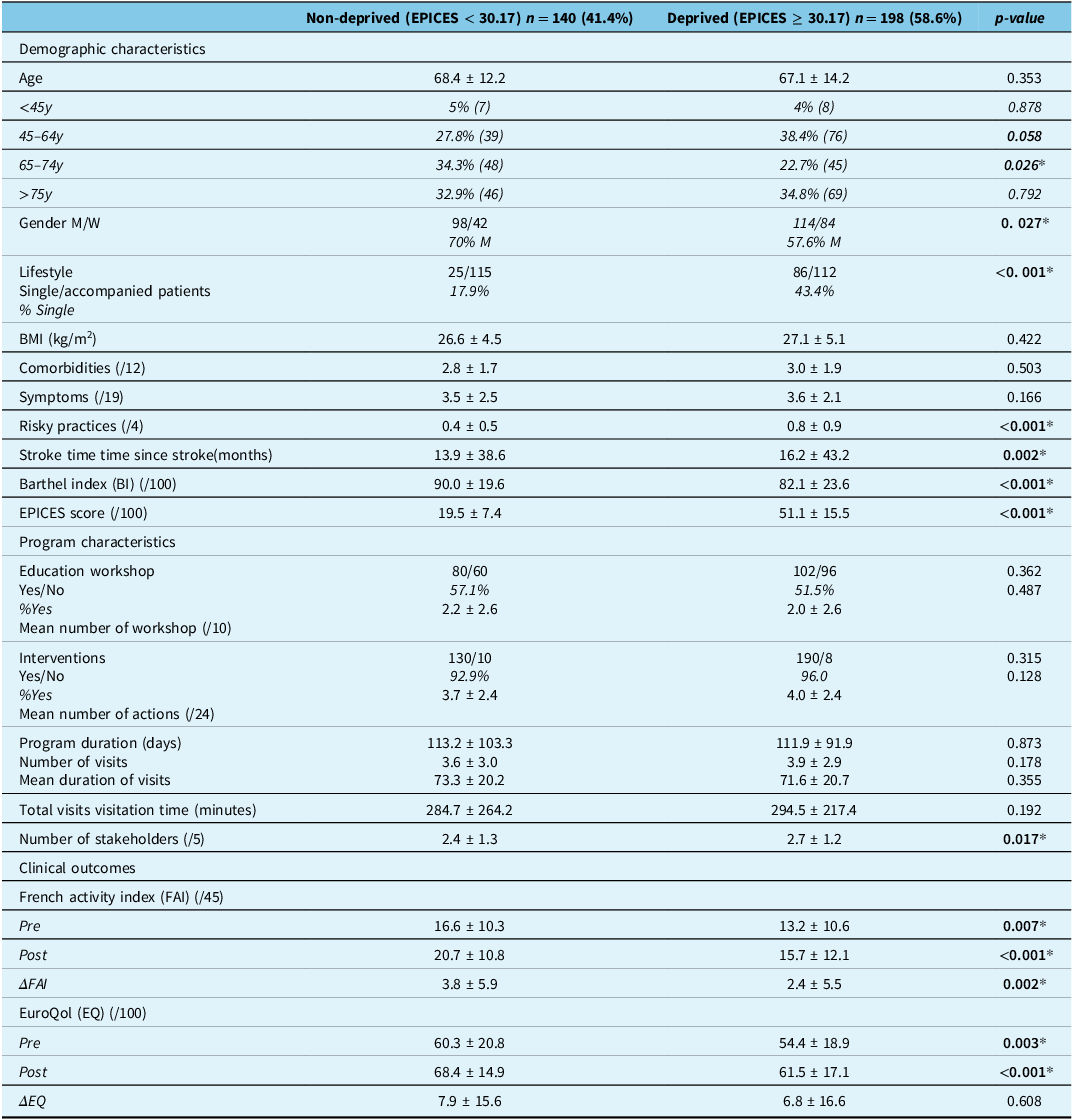
We analyzed data from 340 patients enrolled between 2020 and 2023. For the outcomes analysis, we excluded two patients with uncompleted data. The population characteristics of the remaining 338 patients are presented according to the deprivation status in Table 1. In total, 198 patients (58.6%) were deprived (D) according to their EPICE score, against 140 ND patients (41.4%). Overall, there was no significant age difference among patients (around 68 years old) but the “65–74y/o” category was significantly less represented (22.7% in D; 34.3% in ND; p = 0.026) and the “45–64y/o” category was marginally more represented (38.4% in D; 27.8% in ND; p = 0.058) in the deprived group. Deprived patients were more likely to live alone compared with ND patients (43.4% in D ;17.9% in ND; p = 0.027) and reported more risky behaviors (0.8 ± 0.9 in D; 0.4 ± 0.5 in ND; p < 0.001). The time since stroke was longer for deprived patients (16.2 ± 43.2 months in D; 13.9 ± 38.6 months in ND; p = 0.002). Regarding the rehabilitation program characteristics, the number of CRST members involved was the only variable significantly higher in the deprived population (2.7 ± 1.2 in D; 2.4 ± 1.3 in ND; p = 0.017). Indeed, the number of visits (3.6 ± 3.0 in ND; 3.9 ± 2.9 in D ; p = 0.178), the mean visit duration (73.2 ± 20.2 minutes in ND; 71.6 ± 20.7 minutes in D ; p = 0.355) and the overall program duration (113.2 ± 103.3 days in ND; 111.9 ± 91.9 days in D ; p = 0.873) were comparable between the two populations. At baseline, deprived patients were less independent in their activities of daily (BI: 82.1 ± 23.6 in D; 90.0 ± 19.6 in ND; p < 0.001), less engaged in social participation (FAI: 13.2 ± 10.6 in D; 16.6 ± 10.3 in ND; p = 0.007) and had a lower quality of life (EQ: 54.4 ± 18.9 in D; 60.3 ± 20.8 in ND; p = 0.003).
Comparative description of deprived and non-deprived populations

Note: Data are given as Mean ± Standard Deviation for quantitative variables or % (n) for qualitative variables. P-values are from Fisher tests for qualitative variables and from Mann–Whitney tests for quantitative variables. Significance label: *. Gender M: Men/W: Women. BMI = Body Mass Index. Stakeholders: medicine doctor, neuropsychologist, occupational therapist, social worker and physical activity teacher.
Comparisons of functional outcomes between and within populations, using Wilcoxon and Mann–Whitney tests, respectively, are presented in Figure 1. There was a significant improvement in FAI and EQ scores between the beginning and the end of the rehabilitation program in both deprived and ND populations. In the deprived population, the FAI score increased from 13.2 ± 10.6 to 15.7 ± 12.1 (p < 0.001) and the EQ score increased from 54.4 ± 18.9 to 61.5 ± 17.1 (p < 0.001). In the ND population, the FAI score increased from 16.6 ± 10.3 to 20.7 ± 10.8 (p < 0.001) and the EQ score increased from 60.3 ± 20.8 to 68.4 ± 14.9 (p < 0.001).
Evolution of outcomes before and after the home-based rehabilitation program provided by the CSRT. Note: FAI = Frenchay Activity Index; EQ = EuroQol; PRE = pre-intervention; POST = post-intervention. p-values are the significativity scores from Wilcoxon test (PRE vs POST) or Mann–Whitney (Deprived vs Non-Deprived).

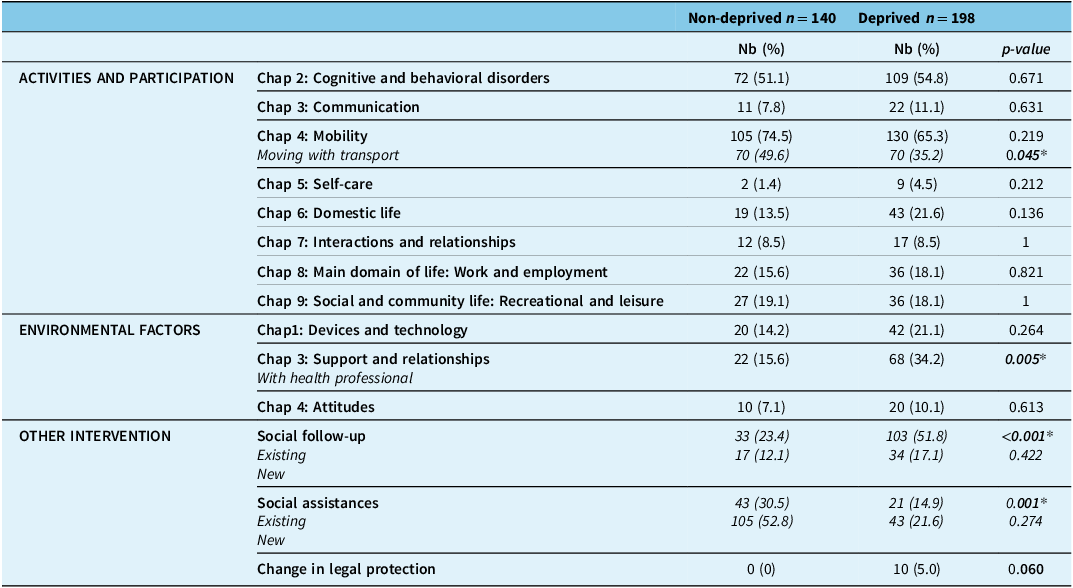
The overall number of interventions did not differ between the two populations. Both deprived and ND patients benefited from the same education workshops according to the results of Fisher tests. However, differences emerged in the types of interventions (Table 2). Deprived patients benefited more often from the intervention “Health professional relationship” (34.2% in D; 15.6% in ND; p = 0.005), whereas ND patients more frequently received the intervention “Mobility: transport” (49.6% in ND; 35.2% in D; p = 0.045). There were marginal differences for “Home layout” (9.5% in D; 2.8% in ND, p = 0.82) and “Change in legal protection” (5% in D; 0% in ND; p = 0.06) with a higher rate in the deprived group. At inclusion, deprived patients more frequently had existing social follow-up (51.8% in D; 23.4% in ND, p < 0.001), whereas a greater proportion of ND patients had existing social assistance (30.5% in ND; 14.9% in D, p = 0.001). However, these differences disappeared by the end of the rehabilitation.
Different categories of interventions delivered by CSRT according to the International Classification of Functioning disability and health

Note: Data are given as the number of patients who have benefited from the “Action” and the percentage of the population. P-values are from Fisher tests. Significance label: *. Marginal label: bold characters.
Discussion
Improving social participation is a major objective of home rehabilitation. Reference Daviet, Compagnat, Bonne, Maud, Bernikier and Salle18,Reference Allen, Richardson and McIntyre19 The aim of this study was to determine whether home rehabilitation delivered by CSRT could have beneficial effects and whether these effects differed between deprived and ND populations. In our pragmatic study, conducted in routine care, deprived patients initially had poorer social participation than ND patients. Rehabilitation delivered by CSRT led to statistically significant improvements in both FAI (13.2 ± 10.6 to 15.7 ± 12.1; p < 0.001) and EQ (54.4 ± 18.9 to 61.5 ± 17.1; p < 0.001) in deprived patients. However, these improvements were smaller than for ND patients, in particular for FAI, and did not close the gap in social participation between both populations. Although the improvement was statistically significant, the MDC for FAI is 6.7. Reference Lu, Chen, Huang and Hsieh32 Therefore, the difference might not be representative of meaningful change. At best, we can say that it’s a sign of minimal improvement over time in both groups, with ND patients performing better on average because they were better off to start with. While CSRT interventions might facilitate improvement, they did not achieve functional equity.
Regarding the different intervention topics, deprived patients received more interventions related to health professional relationship (34.2% in D; 15.6% in ND; p < 0.005). Non-deprived subjects, on the other hand, received more interventions in the mobility category (according to ICF), particularly regarding the use of transport (driving and using public transport). These patients, who had already had their health needs better addressed (unlike the deprived subjects), seemed to express greater needs for access to social participation and mobility in society, whereas deprived patients seemed to still require basic care access, even more than a year after stroke. We also observed differences in social follow-up. More social follow-ups had already been initiated in the deprived population prior to the CSRT intervention, whereas less social assistance was already in place. These differences disappeared with the CSRT intervention. This may suggest that, despite the initiation of social follow-up, deprived patients did not continue the process on their own to benefit from social assistance and that it was the CSRT social worker who enabled patients to resume the process. As highlighted in previous studies, deprivation is a process occurring over time and that generates heterogeneous situations of deprivation depending on the relationship that the patient has with their own situation. This relationship is based on the notion of temporal perspective. Reference Fieulaine and Apostolidis33 Indeed, deprived patients tend to focus on the present or the past, which explains their low demand for care Reference Fieulaine and Apostolidis33 and possibly for social actions, as highlighted by our findings. Another important point concerns the education of patients to improve their understanding of their disease and management of sequelae. In our study, deprived patients had the same level of participation in the education program (51.5% in D; 57.1% in ND; NS). We might have expected lower participation. This could also be explained by time perspective. On their own, the deprived patient may not anticipate the need for educational workshops (future-oriented projection). But once offered, patients agreed to participate. This temporality is also reflected by the time since stroke, as deprived patients began CSRT rehabilitation later than ND patients (16.2 ± 43.2 vs 13.9 ± 38.6 months; p = 0.002). Moreover, interventions for deprived patients appeared to be more complex. Indeed, they required a greater variety of professionals (2.7 ± 1.2 in D; 2.4 ± 1.3 in ND; p = 0.017), even though the total time spent visiting was similar, suggesting more diverse needs. These data showed that there were differences in the interventions that were carried out in each group. Ultimately, the group of deprived stroke survivors was in worse condition at time of enrollment, but the standard community rehabilitation methods (CSRT) led to smaller improvements. The program was not as effective as in ND patients. Despite having a higher number of interactions with health professionals, it did not work as well. It is likely that several needs were not taken into account in order to improve their situation, despite the desire to individualize interventions.
The characteristics of the included patients further highlighted the impact of social deprivation on stroke outcome. The patients taken care of by our CSRT were in the chronic phase (16.2 months ± 43.2). Among them, 58.6% were deprived according to the EPICE definition. In a French registry of 1,559 patients treated in the acute phase of stroke, Bejot et al. found a rate of 59% of deprived patients, Reference Béjot, Bourredjem and Mimeau6 assessed with the same score (EPICES). We obtained the same rate of deprived patients managed by our CSRT. We might have feared that this deprived population, which has difficulty accessing care, would be lost over time in the chronic phase rehabilitation and thus be under-represented in CSRT. However, the similar proportion between our chronic post-stroke population and the acute population found by Bejot et al. suggests that CSRT could be effective in keeping deprived patients within the care pathway. However, we noted that deprived patients were referred to CSRT later than ND patients (16 ± 43.2 months in D; 13.9 ± 38.6 months in ND; p < 0.001) while they had a poorer functional level at intake (BI 82.1 ± 23.6 in D; 90.0 ± 19.6 in ND; p < 0.001). Our results are in line with studies that have established that deprivation is associated with poorer functional recovery. Reference Chen, Crichton, McKevitt, Rudd, Sheldenkar and Wolfe4–Reference Béjot, Bourredjem and Mimeau6 We also observed that deprived patients had a poorer social participation at intake (FAI 13.2 ± 10.6 in D; 16.6 ± 10.3 in ND; p = 0.007). Even so, this could reflect potential difficulties in accessing health resources because of social isolation.
In our study, deprived patients were more often women (p = 0.027), living alone at home (p = 0.01), and had greater activity limitations (p < 0.001). Our results illustrate the intersectionality of stroke-related issues. Our findings align with a growing body of evidence highlighting persistent gender disparities in access to post-stroke rehabilitation services. Despite often presenting with more severe functional impairment and older age at stroke onset, women are less likely than men to receive a rehabilitation plan at hospital discharge and are less likely to attend rehabilitation programs. Reference Kruse, Worm and Olsen34,Reference Sibbritt, Bayes, Peng and Adams35 This lower uptake is partly attributable to adverse socioeconomic conditions, including lower income, higher rates of widowhood or social isolation and lower levels of education, all of which can negatively influence both referral and adherence to rehabilitation. Reference Kruse, Worm and Olsen34 In our cohort, women were indeed significantly older (p = 0.014) and tended to have a lower BI (p = 0.091). No significant differences were observed in terms of social participation or quality of life. Taken together, these findings support the notion of a “double burden” in which women, particularly those who are socioeconomically disadvantaged, not only face a higher risk of post-stroke disability but also encounter greater obstacles in accessing appropriate care.
Geographic barriers further exacerbate these disparities. The area in which CSRT interventions were implemented in our study was predominantly rural, which is noteworthy because women living in rural or semi-urban settings often face limited access to services and transportation challenges. Reference Sibbritt, Bayes, Peng and Adams35 However, another study showed that CSRTs were a promising approach to provide home rehabilitation for populations with difficulties in accessing care. Indeed, Allen et al. Reference Allen, McIntyre and Janzen36 showed that rehabilitation by CSRT was equally effective for patients living in rural and urban areas in Ontario, Canada. The intervention of a CSRT could therefore be a good way to address this difficulty in accessing care.
Our results highlight the need to develop more equitable post-stroke rehabilitation policies that are sensitive to gender and social determinants of health. Sociodemographic variables and gender should be systematically integrated into eligibility criteria for rehabilitation plans as early as the acute hospitalization phase. Reference Kruse, Worm and Olsen34 The implementation of home-based rehabilitation services could also enhance coverage in underserved areas. In parallel, future research should adopt an intersectional approach to explore barriers to rehabilitation adherence among women, taking into account age, income, educational level, marital status and geographic location. Such approaches would support the design of targeted interventions grounded in patients’ actual needs, with the potential to improve functional and social recovery trajectories for women following stroke.
However, without explicit demands formulated directly by patients, we cannot determine whether these differences were directly linked with different needs between deprived and ND patients, or if the same needs required different answers, in quality or quantity. Further studies are needed to better identify the specific needs of deprived patients and to develop more effective responses to improve their situation. Some aspects of the discussion suggest that the involvement of a CSRT could be beneficial in supporting these patients. Nevertheless, it remains necessary to clearly define both their specific needs and the appropriate scope of intervention.
One of our strengths is having assessed individual deprivation with a validated score, and having compared the effect of care in real-life condition between deprived and ND patients. Another strength of our study is that it was conducted in a pragmatic design, reflecting real-care situations about CSRT as proposed in the French healthcare system. This allowed us to evaluate the functioning and effectiveness of the CSRT in a real context and not in an experimental setting.
One limitation of our study was the use of a questionnaire to assess social deprivation. Social deprivation is a complex, multifactorial issue, and we acknowledge that capturing it through a single questionnaire represents a partial and limited approach. However, we used the EPICES score, a validated tool within the French healthcare system, for which we had available data. Despite its limitations, we believed it was valuable to share the findings related to this score. Our results provide relevant insights into the characteristics and outcomes of the population identified as socially deprived by this tool. Regarding the effectiveness of CSRTs, our findings highlight that there is still considerable work to be done to optimize care pathways and better identify the needs of deprived patients, in particular, the specific needs of subpopulations (gender, age). Another limitation of our study was its retrospective design, which led to some missing data, although the overall sample size remained substantial. Additionally, the rehabilitation program was not standardized, as it was tailored to each patient’s individual needs. This high variability in interventions made it challenging to clearly describe and categorize the actions undertaken, and thus difficult to generalize the results. Similarly, the duration of rehabilitation varied widely among patients. Finally, the study was not a randomized controlled trial, which limits the ability to attribute the observed changes solely to the intervention. Nonetheless, our findings reveal notable differences between the deprived and ND populations as identified by the EPICES score.
Conclusion
Although CSRT interventions differed for deprived patients, as they received a greater number of interactions with healthcare professionals, functional equity between deprived and ND patients was not achieved. Indeed, the outcomes for deprived patients remained lower at the end of the CSRT program. Deprived patients also exhibited more severe activity limitations and were more frequently women living alone at home. These findings reinforce the intersectionality of post-stroke challenges and highlight persistent gender disparities in access to rehabilitation services. These findings support the concept of a ‘double burden’, whereby women – particularly those who are socioeconomically disadvantaged – not only face a higher risk of post-stroke disability but also encounter more significant barriers in accessing appropriate rehabilitation services. Our findings highlight the need to develop more equitable post-stroke rehabilitation policies to enhance the effectiveness of CSRT among deprived populations. Rehabilitation planning and orientation should occur during the acute hospitalization phase to ensure timely access to appropriate services. Finally, CSRT should be tailored to the actual needs identified in our cohort. In particular, addressing the emotional and informational needs of female patients, along with providing adequate in-home support, may help reduce persistent disparities.
Supplementary material
The supplementary material for this article can be found at https://doi.org/10.1017/cjn.2025.10482.
Acknowledgments
The authors thank the Regional Health Agency (RHA), the departmental council (département de la Haute-Vienne) and IPSEN for their support for this project. We also thank the members of the CSRT HEMIPASS of the CHU de Limoges for their work with patients.
Author contributions
SV: data extraction, statistical analysis, writing and reviewing the paper; AP: data extraction and reviewing the paper; JYS: writing the protocol and reviewing the paper; SM: reviewing the paper; MC: building the database and reviewing the paper; JCD: writing the protocol, building the database, writing and reviewing the paper.
Funding statement
The CSRT was financed by the RHA, supplemented in part by the departmental council (département de la Haute Vienne). The IPSEN company participated in financing the database. They funded the project, but subsequently were not involved in the various tasks of the project. There was no conflict of interest with the funder, who is totally independent. The funder did not take part in the study design, data collection, analysis and interpretation of data and in writing the manuscript.
Competing interests
None.