Introduction
The increase in global asthma prevalence observed since the 1970s, especially among developed countries,Reference Lai, Beasley and Crane 1 , Reference Anandan, Nurmatov, van Schayck and Sheikh 2 , Reference To, Stanojevic and Moores 3 has given rise to the belief that industrialization and associated environmental exposures may play a role in asthma pathogenesis.Reference Holgate, Davies and Powel 4 Human exposure to synthetic xenoestrogens,Reference Dodson, Nishioka and Standley 5 a group of chemicals structurally similar to estrogen and known to interfere with estrogen receptor signaling, has been implicated in the pathogenesis of asthma.Reference Bornehag, Sundell and Weschler 6 , Reference Bornehag and Nanberg 7 , Reference Choi, Schmidbauer and Sundell 8 Furthermore, epidemiologic studies suggest that estrogen plays a role in asthma development and severity of symptomsReference Haggerty, Ness and Kelsey 9 , Reference Tam, Morrish and Wadsworth 10 , Reference Bonds and Midoro-Horiuti 11 as evidenced by the higher prevalence of asthma in adult females compared to adult males,Reference Vink, Postma, Schouten, Rosmalen and Boezen 12 , Reference Leynaert, Sunyer and Carcia-Esteban 13 worsened asthma symptoms corresponding to peaks in estrogen and progesterone corresponding to the ovulation cycle,Reference Vrieze and Postma 14 , Reference Thornton, Lewis, Lebrun and Licskai 15 and an increased risk of developing adult-onset asthma in patients undergoing hormone replacement therapy.Reference Barr, Wentowski and Grodstein 16 , Reference Dratva 17 Recently, human exposure to the ubiquitous xenoestrogen bisphenol A (BPA) has been associated with worsened asthma symptoms.Reference Spanier, Kahn and Kunselman 18 , Reference Vaidya and Kulkarni 19 , Reference Donohue, Miller and Perzanowski 20
BPA is a synthetic monomer produced in high quantities on a global scale,Reference Vandenberg, Maffini, Sonnenschein, Rubin and Soto 21 and it is a regular component of polycarbonate plastic and epoxide resin products such as baby bottles, water bottles, food storage containers and linings of metal cans.Reference Vandenberg, Hauser, Marcus, Olea and Welshons 22 BPA is also a component or precursor in thermal receipt paper,Reference Biedermann, Tschudin and Grob 23 dental sealantsReference Joskow, Barr and Barr 24 and flame retardants.Reference Meerts, Letcher and Hoving 25 Human exposure to BPA mainly occurs through ingestion of tainted food and drink, though exposure through inhalation and dermal absorption are possible exposure routes as well.Reference Vandenberg, Hauser, Marcus, Olea and Welshons 22 National Health and Nutrition Examination Survey data report detectable amounts of BPA and BPA metabolites in the urine of 95% of participants, indicating that BPA exposure is widespread.Reference Calafat, Kuklenyik and Reidy 26 , Reference Vandenberg, Chahoud and Heindel 27
Research on the developmental origins of asthmaReference Henderson and Warner 28 , Reference Duijts 29 has recently focused on in utero and early postnatal exposures to BPA.Reference Midoro-Horiuti, Tiwari, Watson and Goldblum 30 , Reference Nakajima, Goldblum and Midoro-Horiuti 31 , Reference Bauer, Roy and Emo 32 Studies conducted in mice indicate that perinatal BPA exposure promotes the development of asthma in juvenile animals,Reference Midoro-Horiuti, Tiwari, Watson and Goldblum 30 , Reference Nakajima, Goldblum and Midoro-Horiuti 31 though, asthma pathogenesis in adult animals remains unclear.Reference Bauer, Roy and Emo 32 This study seeks to build upon existing literature by examining the effect of perinatal BPA exposure at doses relevant to human exposure on allergen sensitization and allergen-induced pulmonary inflammation in adulthood. Through use of the ovalbumin (OVA) sensitization model in BALB/c mice, markers of inflammation and allergen sensitization including cellular recruitment, cytokine and chemokine production, lipid mediator production, lung histopathology scoring, serum anti-OVA immunoglobulin E (IgE) levels and splenocyte cytokine production were assessed. The current study reports that exposure to BPA, especially to 50 μg and 50 mg BPA/kg diet, enhanced OVA sensitization as indicated by elevated serum IgE and splenocyte cytokine production, but did not enhance pulmonary inflammation. These data suggest that early-life exposures to BPA in humans may contribute to enhanced allergen sensitization in adulthood.
Methods and materials
Animals
Eight-week-old virgin male and female BALB/c breeders were obtained from Charles River (Wilmington, MA). Dams were randomly assigned to one of four modified, BPA-supplemented phytoestrogen-free diets (AIN-93G with 7% corn oil substituted for 7% soybean oil; Harlan Teklad, Madison, WI): 50 ng (n=20 offspring, 4 litters), 50 µg (n=23 offspring, 4 litters) or 50 mg (n=18 offspring, 4 litters) BPA/kg diet (diets 09798, 09797 and 09518, respectively), or a BPA-free control diet (n=19 offspring, 4 litters, diet 95092). All diet ingredients were supplied by Harlan, except for BPA, which was provided by the National Toxicology Program (NTP; Durham, NC). The highest dose of BPA used in this study was designed to be an order of magnitude lower than the established maximum non-lethal threshold in rodents (200 mg/kg BW/day),Reference Takahashi and Oishi 33 though, all three BPA doses are considered relevant to human exposure.Reference Vandenberg, Hauser, Marcus, Olea and Welshons 22 , Reference Sieli, Jasarevic and Warzak 34 , Reference Anderson, Nahar and Faulk 35 For further discussion on BPA dosing and exposure in study animals, refer to O’Brien et al. Reference O’Brien, Dolinoy and Mancuso 36 Female breeders were maintained on the assigned diet for two weeks before being paired with a BALB/c sire. Dams and offspring remained on the assigned diet throughout gestation and maternal lactation until weaning at postnatal day (PND) 21. At weaning, offspring were group-housed with age-matched, exposure-matched and sex-matched cage mates. All weaned offspring were fed the BPA-free control diet for the duration of the study. Animals were housed in a University of Michigan animal facility under hygienic conditions with cage bedding changed once every week.
Induction of allergic asthma
Twelve-week-old male and female offspring from all of the dietary treatment groups were sensitized to OVA with a single 200-μl intraperitoneal injection of a PBS solution containing 20 μg OVA (Sigma, St. Louis, MO) with 2 mg of Al(OH)3 from Imject Alum® (Thermo Fisher Scientific, Waltham, MA) as an adjuvant. One week after sensitization, offspring were challenged twice, with 24 h in between, by exposure to an aerosol of 3% OVA in PBS for 20 min using an ultrasonic nebulizer (ICEL US-800) delivering particles of 0.5–10 nm in diameter at 0.75 ml/min. OVA solutions for sensitization and airway challenge were prepared in non-sterile conditions and likely contain low levels of lipopolysaccharides (LPS). Twenty-four hours after the second OVA challenge, lungs, sera and spleens were collected from euthanized animals. Due to experimental constraints, a limitation of this experimental design is that the estrus cycle in female offspring was not monitored at time of allergen challenge.
Lung leukocyte recovery by bronchoalveolar lavage (BAL) and enumeration
Lungs were removed en bloc from euthanized mice, cannulated through the trachea, and lavaged twice with 1 ml of ice cold HEPES buffer, as previously described.Reference Mancuso, Standiford, Marshall and Peters-Golden 37 The maximum amount of bronchoalveolar lavage fluid (BALF) retrievable was collected (1.6 ml on average). The total number of cells suspended in BALF was enumerated by counting on a hemocytometer under a light microscope. Differential counts were determined after cells had been cytospun onto glass slides using a StatSpin Cytofuge 2 Centrifuge (Iris Sample Processing, Westwood, MA) and stained using a modified Wright-Giemsa stain (Differential Quik Stain, Thermo Fisher Scientific). A total of 200 cells were counted in randomly chosen fields under a light microscope (×1000) by a single observer (E.O.). The total number of cells per ml of a particular leukocyte subset was determined by multiplying the percentage of the population by the total number of lung leukocytes per ml collected from the same mouse, as previously described.Reference Mancuso, Gottschalk and Phare 38
Splenocyte culture
Excised spleens were homogenized in 2 ml of cold PBS and passed through a 40-μm filter. Following lysis of red blood cells, suspended splenocytes were centrifuged at 1500 RPMs and 4°C for 5 min, then resuspended in 1 ml of RPMI (Life Technologies, Invitrogen, Carlsbad, CA) supplemented with 10% fetal calf serum (Invitrogen) and 1% penicillin/streptomycin (Invitrogen). Cells in suspension were enumerated on a hemocytometer under a light microscope and plated in 96-well culture plates at a concentration of 5.0×10⁵ cells/well. Cells were stimulated with or without 15 μg OVA/well for 72 h to elicit cytokine production, after which supernatants were collected and stored at −80°C until analysis. Due to small sample size (n=4), male and female splenocyte cytokine data were combined and analyzed controlling for sex as an effect modifier.
Serum IgE determination
Sera were collected at the time of dissection and stored at −80°C until analysis. The levels of anti-OVA IgE in serum were determined by a commercially available enzyme immunoassay (EIA) kit (Cayman Chemical, Ann Arbor, MI) according to the manufacturer’s instructions. The limit of detection for IgE measurements was 3.12 ng/ml.
Cytokine and chemokine determinations
Measurement of the cytokines and chemokines tumor necrosis factor (TNF)-α, interferon (IFN)-γ, interleukin (IL)-4, IL-5, IL-13, RANTES (CCL5), MCP-1 (CCL2), MIP-3 (CCL20) and eotaxin-1 (CCL11) in BALF, lung homogenates and/or splenocyte supernatants was conducted by the University of Michigan Cancer Center Immunology Core Facility using commercially available EIA kits (DuoSet, R&D Systems, Minneapolis, MN) according to the manufacturer’s instructions. The limit of detection for cytokine and chemokine measurements was 4.1 pg/ml. Cytokine and chemokine values in lung homogenates were normalized by total protein content of samples.
Cysteinyl leukotriene (CysLT) and prostaglandin D2 (PGD2) determinations
The levels of CysLTs in BALF and PGD2 after methoximation (PGD2-MOX) in lung homogenates were determined by commercially available EIA kits (Cayman Chemical) according to the manufacturer’s instructions. The limits of detection for CysLT and PGD2-MOX measurements were 34 and 3.1 pg/ml, respectively. PGD2-MOX values in lung homogenates were normalized by total protein content of samples.
Histology
Excised lungs were fixed in a solution of 60% ethanol (Thermo Fisher Scientific), 30% chloroform (Sigma), and 10% glacial acetic acid (Thermo Fisher Scientific). Samples were paraffin embedded, sectioned onto slides and stained with hematoxylin and eosin (H&E) by the University of Michigan Cancer Center Research Histology & Immunohistochemistry Core Facility. Light microscopic evaluation was performed by a board-certified veterinary pathologist (I.L.B.) from the University of Michigan Pathology Cores for Animal Research (PCAR), who was blinded to the experimental groups. Representative images were taken using an Olympus DP72 12.5-megapixel digital camera mounted to an Olympus BX45 light microscope (Olympus, Center Valley, PA). Images were acquired using the manufacturer’s software (Olympus). The scoring system was modified from previously published systems for the histological evaluation of asthma in murine models.Reference Mehlhop, van de Rijn and Goldberg 39 , Reference Wachtel, Shome, Sutherland and McGlone 40 In brief, one section per lung was individually assessed in three categories, specifically peribronchial/peribronchiolar inflammation, perivascular inflammation and alveolar inflammation. Peribronchial/peribronchiolar and perivascular inflammation were individually scored from 0 to 4 [0: none; 1: thin inflammatory infiltrate (<3 cell layers) confined to central lung; 2: dense inflammatory infiltrate (⩾3 cell layers) confined to central lung; 3: thin (<3 cell layers) to dense (⩾3 cell layers) inflammatory infiltrate extending to peripheral airways/vessels; 4: dense (⩾3 cell layers) inflammatory infiltrate extending to pleural surface]. Alveolar inflammation was scored from 0 to 2 (0: absent; 1: few foci present; 2: many foci present). Each lung section was given an overall score in the three scoring categories. The three category scores were then summed to give a total inflammatory score (maximum score of 10).
Statistical analyses
All data are expressed as mean±standard error of the mean (s.e.m.). Analyses for data in Table 1 were conducted using a one-way analysis of variance with a post-hoc Bonferroni test for separation of the means in Prism Graph Software. Each data point in Figs 1–5 represents a measurement from a single offspring. Data in Figs 1–5 that were normally distributed were analyzed using a linear mixed model with BPA dosage as a categorical predictor, to compare the BPA-exposed groups to the control group. Within-litter correlation was adjusted by including a random intercept for each litter. Data in Figs 1–5 with skewed distributions were analyzed using generalized estimating equations with Poisson distribution. Within-litter correlation was adjusted by using a compound symmetric covariance matrix. Except where otherwise noted, data from female and male offspring were analyzed separately due to the correlation between sex and prevalence and severity of asthma.Reference Vink, Postma, Schouten, Rosmalen and Boezen 12 , Reference Leynaert, Sunyer and Carcia-Esteban 13 Analyses for Figs 1–5 were conducted using SAS (Version 9.2; SAS Institute Inc., Cary, NC). In all cases, a two-sided P-value of <0.05 was considered statistically significant.
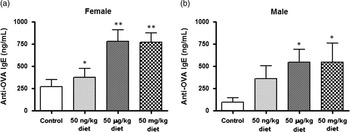
Anti-ovalbumin (OVA) immunoglobulin E (IgE) in sera of female (a) and male (b) offspring with perinatal exposure to bisphenol A (BPA) and subsequent adult OVA challenge. Note that the y-axes in a and b are the same to facilitate comparison between female and male offspring. Bars represent mean±s.e.m. *P<0.05 and **P<0.0001 compared with respective control (open bar). Females: n=6 (control), n=11 (50 ng), n=13 (50 μg), n=14 (50 mg). Males: n=8 (control), n=9 (50 ng), n=10 (50 μg), n=4 (50 mg).

Litter parameters

BPA, bisphenol A.
Offspring litter number, size, survival rate, and sex ratio across exposure groups.
*P<0.05 compared with control.
Results
Impact of BPA exposure on offspring
Consistent with previous reports,Reference Anderson, Nahar and Faulk 35 , Reference Anderson, Peterson and Sanchez 41 perinatal exposure to 50 ng BPA/kg (4 litters, 20 offspring), 50 μg BPA/kg (4 litters, 23 offspring) or 50 mg BPA/kg (4 litters, 18 offspring) did not significantly alter litter size (P=0.790) or offspring survival (P=0.603), compared with control offspring (4 litters, 19 offspring) (Table 1). Interestingly, the percentage of female offspring per litter born to dams fed the 50 mg BPA/kg diet was increased compared with control dams (P=0.036). There was no significant difference in the percentage of female offspring per litter in 50 ng BPA/kg diet (P=0.171) or 50 μg BPA/kg diet (P=0.402) exposure groups compared with controls.
Serum levels of anti-OVA IgE
To determine the impact of BPA exposure on systemic OVA sensitization, anti-OVA IgE levels in sera were measured (Fig. 1). A modest increase in sera anti-OVA IgE levels in female (P=0.016) and male (non-significant increase, P=0.096) offspring exposed to the 50 ng BPA/kg diet was observed, whereas mean IgE levels increased two-fold in sera obtained from both female and male offspring exposed to the 50 μg (female: P<0.0001, male: P=0.021) and 50 mg BPA/kg (female: P<0.0001, male: P=0.038) diets, compared with respective controls.
OVA-stimulated splenocyte cytokine production
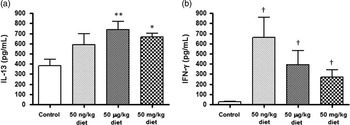
Since the balance of T helper cell type 1 (Th1) and Th2 cytokines plays an important role in driving the production of IgE, cytokine production in splenocytes obtained from sensitized mice was examined in order to determine if BPA exposure influences Th1-Th2 balance (Fig. 2). As shown in Fig. 2a, the Th2 cytokine IL-13, known to promote immunoglobulin class switching to IgE,Reference Poulsen and Hummelshoj 42 was increased in OVA-stimulated splenocytes obtained from mice exposed to the 50 μg (P=0.004) and 50 mg BPA/kg (P=0.028) diets, compared with controls. Interestingly, IFN-γ production was dramatically increased in OVA-stimulated splenocytes obtained from offspring exposed to the 50 ng (P<0.0001), 50 μg (P<0.0001) and 50 mg BPA/kg (P<0.0001) diets (Fig. 2b). There was no difference in IL-4, IL-5 or TNF-α production from OVA-stimulated splenocytes between any treatment groups (data not shown). Additionally, there was no difference in the production of any cytokine (IL-4, IL-5, IL-13, IFN-γ or TNF-α) from splenocytes that were not stimulated with OVA (data not shown).
Production of cytokines interleukin (IL)-13 (a) and interferon (IFN)-γ (b) from stimulated splenocytes of male and female offspring with perinatal exposure to bisphenol A (BPA) and subsequent adult ovalbumin (OVA) challenge. Bars represent mean±s.e.m. *P<0.05, **P<0.005, and † P<0.0001 compared with respective control (open bar). n=4 for all exposure groups.

Leukocyte recruitment following OVA challenge
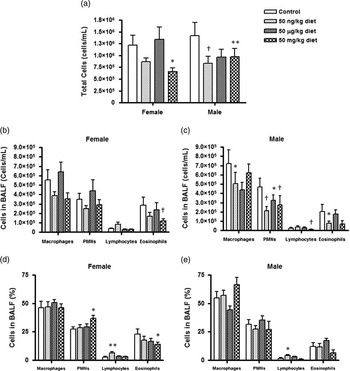
The influence of perinatal BPA exposure on leukocyte recruitment to the lungs following OVA challenge was examined as one endpoint indicative of altered pulmonary inflammation (Fig. 3). As shown in Fig. 3a, the total number of leukocytes obtained from BALF of females exposed to 50 mg BPA/kg diet was modestly decreased compared with female controls (P=0.047). Additionally, male offspring exposed to 50 ng (P<0.0001) or 50 mg BPA/kg (P<0.0003) diets displayed decreased total leukocytes counts compared with male controls. Leukocyte recruitment was further assessed by quantifying specific leukocyte types in BALF. In females, eosinophil counts were decreased among animals exposed to 50 mg BPA/kg diet (P<0.0001); however, total macrophage, polymorphonuclear neutrophil (PMN), and lymphocyte counts did not differ among exposure groups (Fig. 3b). In males, animals exposed to 50 ng BPA/kg diet displayed decreased macrophage (P=0.027), PMN (P<0.0001), and eosinophil (P=0.041) numbers, and animals exposed to 50 mg BPA/kg diet displayed decreased PMN (P<0.0001) and lymphocyte (P<0.0001) numbers (Fig. 3c) – responses that were similar to total leukocyte counts. Males exposed to 50 μg BPA/kg diet also displayed a decrease in PMN counts (P=0.018; Fig. 3c). Recruitment of each specific type of leukocyte was also expressed as a percentage of the composition of total leukocytes in BALF. The percentage of lymphocytes recovered from both female (P=0.001) and male (P=0.015) mice exposed to the 50 ng BPA/kg diet was increased, compared with respective control offspring (Fig. 3d and 3e). Additionally, female offspring exposed to 50 mg BPA/kg diet displayed a modest decrease in the percent of airway leukocytes that were eosinophils (P=0.045), which was accompanied by an increase in percentage of PMNs (P=0.019; Fig. 3d). The percent of airway leukocytes that were macrophages did not differ between exposure groups among males or females.
Airway influx of total leukocytes in bronchoalveolar lavage fluid (BALF) of female and male offspring (a), airway influx of macrophages, polymorphonuclear neutrophils (PMNs), lymphocytes and eosinophils as measured in BALF of female (b) and male (c) offspring, and percent composition of macrophages, PMNs, lymphocytes and eosinophils among total leukocytes in BALF from female (d) and male (e) offspring all with perinatal bisphenol A (BPA) exposure and subsequent adult ovalbumin (OVA) challenge. Bars represent mean±s.e.m. *P<0.05, **P<0.005 and † P<0.0001 compared with respective control (open bar). Females: n=8 (control), n=11 (50 ng), n=13 (50 μg), n=14 (50 mg). Males: n=11 (control), n=9 (50 ng), n=10 (50 μg), n=4 (50 mg).

Cytokines and CysLTs in BALF following OVA challenge
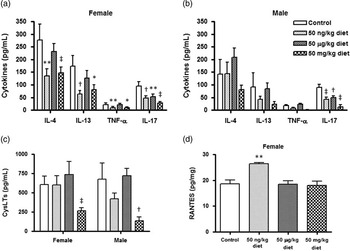
Cytokine and CysLT concentrations in BALF were measured as one way to determine if perinatal BPA exposure effects pulmonary inflammation following OVA challenge (Fig. 4). The concentrations of IL-4, IL-13 and TNF-α in BALF collected from female offspring were significantly lower among animals exposed to the 50 ng BPA/kg (IL-4: P=0.007, IL-13: P=0.002, TNF-α: P=0.007) and 50 mg BPA/kg (IL-4: P=0.001, IL-13: P=0.040, TNF-α: P=0.027) diets compared with female controls (Fig. 4a). Changes in BALF concentrations of IL-4, IL-13 and TNF-α among males did not differ between exposure groups (Fig. 4b). Compared with their respective controls, BALF levels of IL-17 were lower for both female and male mice in all BPA exposure groups: 50 ng BPA/kg (female: P=0.004, male: P<0.0001), 50 μg BPA/kg (female: P=0.006, male: P=0.001) and 50 mg BPA/kg (female: P=0.001, male: P<0.0001) diets (Fig. 4a and 4b). Additionally, CysLTs levels were decreased in BALF from females (P<0.0001) and males (P=0.003) exposed to the 50 mg BPA/kg diet (Fig. 4c). Perinatal BPA exposure had no effect on eotaxin-1 levels in BALF following OVA challenge (data not shown).
Lung homogenate cytokines, chemokines and PGD2 following OVA challenge
Lungs were homogenized following OVA challenge in order to measure production of cytokines, chemokines and the lipid mediator PGD2. An increase in RANTES production was observed in female offspring exposed to 50 ng BPA/kg diet, compared with controls (P=0.006; Fig. 4d). However, there was no difference in the levels of TNF-α, IFN-γ, IL-4, IL-5, IL-13, MCP-1, MIP-3, eotaxin-1 or PGD2 between any BPA exposure group and controls (data not shown).
Airway production of cytokines interleukin (IL)-4, IL-13, tumor necrosis factor (TNF)-α and IL-17 in bronchoalveolar lavage fluid (BALF) of female (a) and male (b) offspring, airway production of cysteinyl leukotrienes (CysLTs) (c) in BALF of female and male offspring, and lung concentration of RANTES (d) from female offspring all with perinatal exposure to bisphenol A (BPA) and subsequent adult ovalbumin (OVA) challenge. Note that the y-axes in a and b are the same to facilitate comparison between female and male offspring. Bars represent mean±s.e.m. *P<0.05, **P<0.01, † P<0.005 and ‡ P⩽0.001 compared with respective control (open bar). (a) n=6 (control), n=11 (50 ng), n=13 (50 μg), n=14 (50 mg). (b) n=8 (control), n=9 (50 ng), n=10 (50 μg), n=4 (50 mg). (c) Female: n=6 (control), n=11 (50 ng and 50 μg), n=14 (50 mg). Male: n=8 (control and 50 ng), n=9 (50 μg), n=4 (50 mg). (d) n=5 (control), n=4 (50 ng), n=9 (50 μg), n=8 (50 mg).

Lung histology
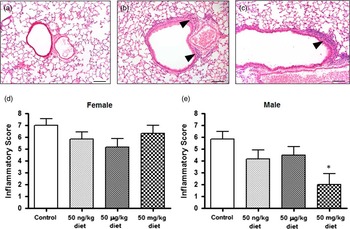
Lung sections were examined and scored as a means to directly quantify the severity of pulmonary inflammation. Examples of tissues and scoring are shown in Fig. 5a, 5b and 5c. There was no difference in total inflammatory score among females in any BPA exposure group compared with control offspring (Fig. 5d). Likewise, there were no differences in inflammation score between female offspring within individual parameters (i.e. peribronchiolar inflammation, perivascular inflammation and alveolar inflammation; data not shown). In contrast, the total inflammatory score was lower than the control for male offspring exposed to the 50 mg BPA/kg diet (P=0.003) (Fig. 5e). The lower total inflammation score among 50 mg BPA/kg diet males was not driven by any one individual parameter since this exposure group consistently exhibited a significantly lower score within each inflammatory parameter (data not shown).
Representative lung sections from ovalbumin (OVA)-challenged mice stained with hematoxylin and eosin (H&E) (a–c) depicting (a) no inflammation, (b) thin inflammatory infiltrate around the bronchiole and in the interbronchiolar–interarteriolar space (arrows) and (c) dense peribronchiolar inflammation (arrow). Bar=100 μm. Total inflammatory score of lung sections from female (d) and male (e) offspring with perinatal exposure to bisphenol A (BPA) and subsequent adult OVA challenge. Bars represent mean±s.e.m. *P<0.005 compared with male control (open bar). Females: n=3 (control), n=6 (50 ng, 50 μg and 50 mg). Males: n=6 (control, 50 ng and 50 μg), n=4 (50 mg/kg diet).

Discussion
The current study examined the effect of in utero and early-life BPA exposure on allergic airway inflammation in adult BALB/c mice through use of the conventional OVA sensitization-aerosol challenge model. This study was conducted using BALB/c mice since this strain is considered susceptible to allergen sensitization by virtue of a Th2-dominant immune response. Offspring exposure to BPA began 2 weeks before mating and ended on PND 21. All of embryogenesis was included in the exposure window due to the considerable amount of epigenetic reprogramming that occurs during in utero development, especially early on after fertilization,Reference Morgan, Santos, Green, Dean and Rejk 43 , Reference Jirtle and Skinner 44 and the potential for BPA to act as an epigenetic disruptor by altering DNA methylation.Reference Dolinoy, Huang and Jirtle 45 , Reference Doshi, Mehta, Dighe, Balasinor and Vanage 46 , Reference Zhang, Zhang and Feng 47 , Reference Susiarjo, Sasson, Mesaros and Bartolomei 48 BPA was administered to dams from preconception through weaning via dietary supplementation since this route of exposure best emulates human BPA exposure, avoids maternal stress and results in greater bioavailabilityReference Gayrard, Lacroix and Collet 49 and more consistent levelsReference Sieli, Jasarevic and Warzak 34 of BPA in a chronic exposure model than oral gavage. Previously, two studies using the OVA model examined the influence of in utero and early-life BPA exposure on allergic inflammation in neonate offspring,Reference Midoro-Horiuti, Tiwari, Watson and Goldblum 30 , Reference Nakajima, Goldblum and Midoro-Horiuti 31 and one study examined allergic inflammation in adult offspring.Reference Bauer, Roy and Emo 32 The current study is unique from previous studies in that it is the first to investigate allergic inflammation and allergen sensitization in adulthood when BPA exposure, via maternal diet in dams that have been normalized to BPA treatment, encompasses all of gestational development and maternal lactation.
A novel observation in this study is that perinatal BPA exposure enhanced allergic sensitization to OVA in adult mice, as evidenced by increased serum anti-OVA IgE levels. This result was similar to a report by Midoro-Horiuti et al.,Reference Midoro-Horiuti, Tiwari, Watson and Goldblum 30 which found elevated IgE levels in sera of juvenile BALB/c mice exposed to BPA perinatally through maternal drinking water at a concentration of 10 μg/ml and sensitized to a ‘suboptimal’ dose of OVA with alum (5 μg OVA, 1 mg alum) on PND 4. However, Bauer et al. Reference Bauer, Roy and Emo 32 reported that exposure to 0.5, 5 or 500 μg BPA/kg BW/day through maternal gavage in C57BL/6 mice from gestational day (GD) 6 through PND 21, followed by intraperitoneal OVA sensitization and subsequent challenge in adulthood, decreased anti-OVA IgE levels, compared with controls. The differences in IgE responses between the current study and the study by Midoro-Horiuti et al. Reference Midoro-Horiuti, Tiwari, Watson and Goldblum 30 compared with the study by Bauer et al. Reference Bauer, Roy and Emo 32 illustrate how important slight variation in BPA exposure timing can be on later-in-life health outcomes. In the current study and the report by Midoro-Horiuti et al.,Reference Midoro-Horiuti, Tiwari, Watson and Goldblum 30 BPA exposure occurred through maternal diet or drinking water prior to pregnancy, throughout gestation and throughout nursing until day 21 after birth. In contrast, Bauer et al. Reference Bauer, Roy and Emo 32 exposed dams to BPA beginning on GD 6 until PND 21. The differences in timing of offspring exposure to BPA is significant since BPA is capable of altering DNA methylation before implantation of the fertilized embryo and during early post-implantation development when the genome is most vulnerable to epigenetic reprogramming.Reference Cantone and Fisher 50 , Reference Chao, Zhang and Chen 51 In total, these studies pinpoint a small window of early gestation (from before fertilization to GD 6) during which BPA exposure can have a profound influence the development of enhanced allergic sensitization later in life – a concept supported by Nakajima et al. Reference Nakajima, Goldblum and Midoro-Horiuti 31 Yet, we also cannot rule out that differences in mouse strains or BPA exposure routesReference Sieli, Jasarevic and Warzak 34 , Reference Gayrard, Lacroix and Collet 49 may influence the levels of OVA-specific IgE, which have been demonstrated to be variable between different strains of miceReference Shinagawa and Kojima 52 and rats.Reference Pauwels, Bazin, Platteau and van der Straeten 53 Future work should examine changes in promoter DNA methylation and/or chromatin structure of relevant genes in order to confirm the epigenetic potential of BPA during early gestation on asthmatic inflammation outcomes.
Another novel finding of the current study is enhanced production of IL-13 and IFN-γ from OVA-stimulated splenocytes of mice exposed to BPA perinatally through the maternal diet and subsequently sensitized and challenged to OVA. IL-13 is a classical Th2 cytokine known to promote the growth and differentiation of allergen-specific B cells that elaborate IgE,Reference Ingram and Kraft 54 while IFN-γ is a classical Th1 cytokine that can inhibit eosinophilia and IgE production during asthma.Reference Chung and Barnes 55 , Reference Teixeira, Fonseca, Barboza and Viola 56 Enhanced splenocyte production of IL-13 and IFN-γ observed in the current study is similar to a report by Yoshino et al.,Reference Yoshino, Yamaki and Li 57 which observed that male mice exposed to 300 or 3000 μg BPA/kg BW/day through maternal drinking water prior to fertilization until GD 18 and sensitized to OVA as adults displayed increased IL-4 and IFN-γ production following OVA stimulation of cultured splenocytes. A similar response was observed by Yan et al. Reference Yan, Takamoto and Sugane 58 in male mice exposed to 10 or 100 nM BPA through maternal drinking water from fertilization until GD 7 and sensitized to Leishmania major at 10 weeks old. Combined, these results suggest that BPA exposure upregulates both Th1 and Th2 responses. Importantly, each of these three studies was conducted using a BPA exposure window that included early gestation, beginning at or before fertilization. Notably, Yan et al. Reference Yan, Takamoto and Sugane 58 observed a response from mice that were exposed to BPA during a narrow window from only GD 0 to GD 7. Enhanced splenocyte cytokine production reported in these three studies further support the important impact BPA exposure during early gestational development can have on allergen sensitization in adulthood.
Evidence from the current study does not support that perinatal BPA exposure results in worsened allergen-induced pulmonary inflammation in adulthood; pulmonary inflammation, as measured by leukocyte recruitment, BALF cytokines and CysLTs, lung homogenate cytokines, chemokines and PGD2 and histopathology scores, appeared to be unaffected or possibly dampened among BPA-exposed animals. The enhanced eosinophilia and airway hyperreactivity observed in animals exposed perinatally to BPA in studies by Midoro-Horiuti et al. Reference Midoro-Horiuti, Tiwari, Watson and Goldblum 30 and Nakajima et al. Reference Nakajima, Goldblum and Midoro-Horiuti 31 are likely complemented by the young age at which offspring were sensitized and challenged. Juvenile sensitivity to hormone dysregulation can influence airway inflammation outcomes.Reference Bauer, Roy and Emo 32 , Reference Regal, Regal, Meehan and Mohrman 59 , Reference Balzano, Fuschillo, Melillo and Bonini 60 Additionally, as neonates age into adulthood in the absence of the original BPA exposure, the body burden of BPA that is present at weaning will be gradually reduced as well. Thus, body burden of BPA at the time of sensitization and challenge could also affect pulmonary inflammation outcomes and needs further investigation.
BPA exposure has been shown to influence Th1 and Th2 cell populations in allergen-induced inflammation models.Reference Yoshino, Yamaki and Li 57 , Reference Yan, Takamoto and Sugane 58 In the current study, a very modest increase in lymphocyte recruitment among animals in the 50 ng BPA/kg diet exposure group was observed. This increase in lymphocyte recruitment was associated with the novel observation that lung homogenate levels of RANTES, a chemoattractant known to recruit T cells to the lung in response to allergen challenge,Reference Palmqvist, Wardlaw and Bradding 61 were increased in animals from the 50 ng BPA/kg diet group. Both responses typify the low-dose effect that is common for endocrine disruptors.Reference Vandenberg, Colborn and Hayes 62 In contrast, Bauer et al. Reference Bauer, Roy and Emo 32 observed a non-significant increase in lymphocyte recruitment to airways among adult female mice exposed to 500 μg BPA/kg BW/day and sensitized with OVA or OVA with LPS intratracheally. However, increased lymphocyte recruitment was not observed in females exposed to 0.5, 5 or 50 μg BPA/kg BW/day or among BPA-exposed males.Reference Bauer, Roy and Emo 32 Likewise, neither male nor female offspring exposed to BPA and sensitized to OVA intraperitoneally displayed changes in airway lymphocyte recruitment compared with controls.Reference Bauer, Roy and Emo 32 Collectively, these results suggest that increases in lymphocyte recruitment, and other inflammatory endpoints for that matter, could depend on a variety of factors including BPA dose, sex, age,Reference Pilegaard and Madsen 63 animal strain,Reference Gueders, Paulissen and Crahay 64 , Reference Zhu and Gilmour 65 OVA type,Reference Huntington and Stein 66 OVA sensitization routeReference Bauer, Roy and Emo 32 and OVA challenge quantity.Reference Stumm, Wettlaufer, Jancar and Peters-Golden 67 Future research should examine the influence of BPA exposure on lymphocyte recruitment and production of lymphocyte chemoattractants.
OVA sensitization in mice provokes the recruitment of eosinophils to the lung and is used as a model of atopic asthma. Using a ‘suboptimal’ model for OVA sensitization, Midoro-Horiuti et al. Reference Midoro-Horiuti, Tiwari, Watson and Goldblum 30 demonstrated increased eosinophil counts in the lungs of mice exposed to BPA during perinatal development. However, in the current study, mice exposed to BPA through the maternal diet displayed no difference or a decrease in eosinophil counts. This discrepancy was most likely due to the differences in OVA sensitization. In the current study, mice were challenged with enough OVA to induce a robust influx of eosinophils into the lung (100,000–300,000 eosinophils per ml of BALF). In contrast, the suboptimal OVA sensitization model used by Midoro-Horiuti et al. Reference Midoro-Horiuti, Tiwari, Watson and Goldblum 30 resulted in a very modest number of eosinophils in BALF (<2000 cells per ml of BALF). Therefore, if BPA exposure induces a subtle effect on eosinophil-mediated pulmonary inflammation, this may not be observed using a more robust OVA-sensitization model.
A limitation of this work is the exclusion of experimental investigation into physiologic alterations in lung function following perinatal BPA exposure and subsequent allergen challenge. Previously, it was reported that in utero Reference Nakajima, Goldblum and Midoro-Horiuti 31 and perinatalReference Midoro-Horiuti, Tiwari, Watson and Goldblum 30 , Reference Nakajima, Goldblum and Midoro-Horiuti 31 BPA exposure enhanced airway hyperresponsiveness after allergen challenge in juvenile mice as determined through whole-body barometric plethysmography and/or forced oscillation with methacholine challenge. However, perinatal BPA exposure did not influence airway hyperresponsiveness as measured by forced oscillation in offspring undergoing allergen challenge as adults.Reference Bauer, Roy and Emo 32 The unchanged or dampened measures of pulmonary inflammation in adult offspring with perinatal BPA exposure observed in the current study and the report by Bauer et al. Reference Bauer, Roy and Emo 32 suggest a low likelihood that there would be enhancement of airway hyperresponsiveness were it assessed in the current study.
In conclusion, the current study is the first to demonstrate that exposure to BPA before conception and throughout gestation and early postnatal development via the maternal diet enhances allergen sensitization in adulthood. Furthermore, the current report, in combination with previously published works,Reference Midoro-Horiuti, Tiwari, Watson and Goldblum 30 , Reference Nakajima, Goldblum and Midoro-Horiuti 31 , Reference Bauer, Roy and Emo 32 has identified a sensitive period early in gestation during which the presence or absence of BPA exposure can greatly impact the development of allergen sensitization in adulthood. Although BPA exposure was not observed to worsen pulmonary inflammation following allergen challenge, this study is the first to report on stimulated splenocyte cytokine production, cytokine levels in BALF, CysLT levels in BALF and cytokine; chemokine and PGD2 levels in lung homogenates as markers of inflammation after challenge. Several endpoints measured in this study produced nonmonotonic and/or nonlinear dose response curves, thus adding further support to nonmonotonicity and low-dose responses of BPA and other endocrine disruptors.Reference Vandenberg, Colborn and Hayes 62 This study suggests that BPA promotes hypersensitivity responses in adults that are exposed to this chemical continuously during all of early development. BPA-induced hypersensitivity could be mediated through endocrine-disruptive mechanisms or epigenetic modification of genes that regulate Th2 cytokines and IgE-mediated allergic responses, or a combination of both. Based on these findings, developmental BPA exposures may play a role in the asthma pathogenesis, although not directly worsening pulmonary inflammation in adulthood.
Acknowledgements
The authors thank Joel Whitfield from the University of Michigan Immunology Core Facility for technical assistance. They also thank Anya Abashian, Kristen A. Angel, Michael Carnegie, Jennifer Dolan and Marisa Mead for technical assistance.
Financial support
This work was supported by the NIH grants HL077417 (P.M.), ES017524 (D.C.D.) and HL058897 (M.P.G.); the Flight Attendant Medical Research Institute award CIA-103071 (P.M.) and the University of Michigan National Institutes of Environmental Health Sciences (NIEHS) Core Center (P30 ES017885). Support for E.O. was provided by Institutional Training Grant T32 ES007062, and support for Z.Z. was provided by Deutsche Forschungsgemeinschaft (German Research Foundation).
Conflicts of interest
None.
Ethical standards
The authors assert that all procedures contributing to this work comply with the ethical standards of the National Institutes of Health on the care and use of laboratory animals and have been approved by the University of Michigan Committee for the Use and Care of Animals.