“More power to him,” a Harlem waitress told an Ebony reporter in 1964, referring to Malcolm X. “I'm sick and tired of Martin Luther King's turn-the-other-cheek stuff. What has it gotten us? Malcolm X is a real man because he stands up for what he believes.” If favoring Malcolm over Martin would shock most readers of Ebony at the height of the civil rights movement, the next ten years saw ever wider embrace of Malcolm X as “real man.” The Autobiography of Malcolm X (1965) as told to Alex Haley chronicled his lifting of himself up from degradation, crime, and prison to achieve self-mastery, assert black dignity, and refine his searing elocution. In Malcolm X's self-portrayal, his moral rebirth was inseparable from race radicalism, personal responsibility being a predicate for dressing down white America and Uncle Tom “house Negroes.” When Ossie Davis eulogized Malcolm X as “our shining black prince” and defined “his meaning to his people” as “our manhood, our living black manhood,” his reputation was sealed as the epitome of blackness and masculinity.Footnote 1
The hyper-masculinity of black power spokesmen in the late 1960s owed much to a self-conception of picking up where Malcolm left off, their bravado in turn giving rise to a black feminism that challenged what Angela Davis, at the peak of 1990s hip-hop Malcolmania, would call “notions of male dominance in this contemporary iconization of Malcolm X.”Footnote 2 Some black feminists hypothesized that in the metamorphosis of his final year Malcolm moved toward inclusiveness of women on an equal basis, but attachment to Malcolm X as a supremely masculine role model – admired by figures as various as Clarence Thomas and Barack Obama – would endure as manufacturing's flight, budget cuts, and mass incarceration combined with the drug trade, low high-school graduation rates, gangsta culture, and “babies having babies” to create what many termed a crisis of black male youth. Malcolm X's urban edge, personal discipline, and “by-any-means-necessary” militancy made him, wrote the novelist David Bradley, “an African-American hero, when the demand for such is great and the supply of same short.”Footnote 3
Esteem for Malcolm X as an icon of masculinity, not only blackness or revolution, helps explain why such a storm of criticism met Manning Marable's Malcolm X: A Life of Reinvention (2011), with its claim that Malcolm Little, as he was named in his youth, was a “homosexual lover.”Footnote 4 Published days after his death, Marable's biography was praised by Ivy League stars from Henry Louis Gates to Cornel West and awarded the Pulitzer Prize even as other black scholars, radicals, and nationalists issued a torrent of objections to it. Special journal issues, edited collections, and dozens of reviews faulted the book, its claim of homosexuality eliciting perhaps the most voluble indignation.Footnote 5
That proposition actually dated back three decades, but it became a flashpoint with Marable's book because there for the first time it was advanced by a leading African American historian and disseminated by a major publishing house. The specific uproar over Marable's book having now abated, clarification might be facilitated by refocussing on the life of Malcolm Little in the Great Depression and Second World War. The question of same-sexuality in his experience deserves a dispassionate, thorough analysis given that it is germane to scholarly interest in race and sexuality, the contrapuntal relationship between the movements for black self-determination and same-sex equality, and the life of this black revolutionary of world-historical importance.
This article seeks to sift all evidence that has led some to conclude that Malcolm Little had same-sexual encounters. By necessity this procedure is detailed and explicit. The point is not to engage in voyeurism but to consolidate understanding and devise a viable interpretation. The evidence is arrayed comprehensively in the order of its surfacing, set within the unfolding secondary literature on Malcolm X, and subjected to scrutiny, with new findings conveyed. This process yields strong indication that Malcolm Little did take part in sex acts with male counterparts, if not photographic or confessional proof of the kind skeptics appear to demand. A new analysis of the meaning of these acts follows that draws on secondary literatures and primary sources on sexual identity, male sex work, and race and sexuality. It shows that in the context of the 1930s and 1940s the form of same-sex activity that Malcolm Little took part in, far from making him a “homosexual lover,” fit patterns consistent with heterosexuality, as counterintuitive as that may seem today. This status as “straight trade,” in turn, provides insight into the later masculinity of Malcolm X, revealing significant continuities in gender outlook between his adolescent and mature selves alongside the moral transformation so heavily underscored in The Autobiography of Malcolm X. The result is to affirm that sexuality has a history, one best understood by recourse to its historiography, while substantiating a point made recently by Sharon Marcus, namely that “the sexualities we consider normal and think we know best are consequently those we understand the least.”Footnote 6
All assertions of Malcolm's same-sexual involvement concern the years prior to his prison term, conversion to the Nation of Islam, and emergence as Malcolm X: the period when he was still named Malcolm Little. First to broach the subject was the writer Bruce Perry, initially in an obscure 1985 journal article and then, more controversially, in Malcolm: The Life of a Man Who Changed Black America.Footnote 7 Perry's findings came wrapped in a pejorative psychoanalytic framework that won little acclaim, but any full inventory of Malcolm's sexuality requires appraisal of his research, not least because Perry sought out as sources a great number of Malcolm's friends and acquaintances from his youth.
Malcolm Little was born in 1925 in Omaha, Nebraska, but the family moved soon afterward to Milwaukee, Wisconsin, and then in 1928 to Lansing, Michigan. There in 1931 when Malcolm was six, his father Earl Little, a Marcus Garvey admirer, died in a streetcar accident that the family conjectured was a murder by white supremacists, leaving them impoverished and struggling in a mostly white working-class neighborhood. Decades later, Perry contacted many of their surviving Lansing acquaintances. Bob Bebee – a friend of Malcolm's who was a “short, freckle-faced redhead” – told Perry that he and Malcolm had sex with a white neighbor girl outside the Nazarene church late one night. Malcolm, panicky, urged Bebee to withdraw before he made her pregnant. After Bebee finished, he coaxed the girl into having sex with Malcolm as well. On another occasion, Bebee and Malcolm encountered a boy they knew named Robert in the woods. Robert was “tall, broad-shouldered, and muscular,” writes Perry, “the very image of the all-American boy,” but “also effeminate and considered a sissy.” He was the rebellious son of “puritanical” parents, his brother “the apple of their eye.” Earlier, Malcolm came across Robert masturbating, and that day Malcolm directed him to do it again. “He wanted me to see Robert's huge phallus,” said Bebee. Then Malcolm “instructed him to masturbate him,” and Robert complied. Subsequently Malcolm told Bebee that “Robert had performed fellatio on him,” and “Bob had no reason to doubt his friend, for Robert had yielded similarly to him.”Footnote 8
If these accounts are true, then some of Malcolm's earliest adolescent sexual experiences included intercourse with a white girl and genital stimulation by a white boy. The positioning of the stories in Perry's narrative, combined with Malcolm's anxiety about impregnation, suggest a timing of around 1937 or 1938 in East Lansing, when Malcolm was thirteen or fourteen, between when his mother Louise Little became pregnant and was abandoned by her boyfriend and her institutionalization for madness in December 1938. A few months before, Malcolm was expelled from his Eastside school in the seventh grade and taken in by a white foster family in West Lansing at age thirteen so he could attend a new school. In the next three years, he would sometimes return home to the disintegrating Little household, headed momentarily by his nineteen-year-old brother; be placed by the state in a juvenile home in Mason ten miles to the south; and live briefly in two black foster homes in Lansing. A visit from his half-sister Ella Collins – who sensed his plight and impressed Malcolm as “the first really proud black woman I had ever seen in my life” – resulted in her sponsoring a summer 1940 visit to her home in Boston, Massachusetts, and gaining permanent custody of him, when he was fifteen, in February 1941. Living with her in Roxbury, Boston's African American district, and working in a drug store, on railways, and at an assortment of other jobs, Malcolm entered his storied zoot-suit phase.Footnote 9
In that period Malcolm had additional same-sex encounters, according to Perry, who also confirmed that Malcolm avidly pursued women and embarked on a series of hustles that included steering white male customers to female black prostitutes in Harlem, as is consistent with The Autobiography of Malcolm X. When Malcolm returned to Michigan at age seventeen to take up work at Christmas 1942 in an AC Sparkplug factory in Flint, a stint lasting only a few months, he stayed at the rooming house of Delia Williams, writes Perry:
One of Malcolm's roommates had jokingly suggested that he might be able to raise some rent money by striking a deal with a fellow boarder called “Miss Jones.” Shortly thereafter, the roommate began noticing that Malcolm wasn't sleeping in the room they had been sharing. Instead, he began stealing down the hallway to Miss Jones's room. But Miss Jones, who sported a bright yellow jumper with matching slacks and umbrella, was not a woman. He was a well-known transvestite named Willie Mae. Malcolm's roommate concluded that Willie Mae was sleeping with him.Footnote 10
Returning east in March 1943, Malcolm would spend most of the next three years, between ages seventeen and twenty, living in Harlem and Boston. In New York one night, writes Perry, Malcolm ran into two Michigan friends who had joined the merchant marine and were visiting New York at the YMCA. They asked what he was doing there. “Hell, with all these little ‘girls’ here, I'm going to make some money,” he replied. Malcolm later told them about two “queers” at the Harlem YMCA willing to pay. “It's not that bad,” he said. “They suck dick!” He then, writes Perry, “arranged a ‘party’ in the six-by-nine-foot YMCA cubicle of a man who called himself ‘Reverend Witherspoon.’ The arrangements were businesslike. Each man closeted himself with Witherspoon and emerged, minutes later, with an embarrassed grin on his face.” Witherspoon promised chicken dinners in return.Footnote 11
Boston police photo of Malcolm Little, with conked hair, after his arrest for theft in 1944, the year he began working for William Paul Lennon as “butler and occasional houseworker.” Credit: Time Life Pictures/Getty Images.

The return of Malcolm to Massachusetts in October 1944 led to the episode that would resonate most in scholarship subsequent to Perry. This concerned William Paul Lennon, “a wealthy Boston Brahmin whose living quarters overlooked the Boston Common,” for whom Malcolm worked in household tasks. Malcolm Jarvis, basis of the character “Shorty,” Malcolm's best friend in The Autobiography of Malcolm X, told Perry that Malcolm had said Lennon paid him and another man “to disrobe him, place him on his bed, sprinkle him with talcum powder, and massage him until he reached his climax.”Footnote 12 This echoes a homoerotic passage in the Autobiography referring to “Rudy,” a friend of Shorty and Malcolm's identified as being of black and Italian parentage:
Rudy worked regularly for an employment agency that sent him to wait on tables at exclusive parties. He had a side deal going, a hustle that took me right back to the old steering days in Harlem. Once a week, Rudy went to the home of this old, rich Boston blueblood, pillar-of-society aristocrat. He paid Rudy to undress them both, then pick up the old man like a baby, lay him on his bed, then stand over him and sprinkle him all over with talcum powder.
Rudy said the old man would actually reach his climax from that.Footnote 13
According to Jarvis, two men actually took part in these powderings. In a footnote, Perry supplied a letter from Jarvis, reproduced without correction:
People like Paul Lennerd, the queer, always liked to see a new face on the scene every now and then. After meeting Paul Lennerd and participating ina few of the parties, Malcolm confided in me about the affair. As I look back in the years, I believe today that Malcolm's idea in telling me all this was to get me to join the party as a new face on the scene, and make a few easy dollars on the side while doing so … It was the practice of Mr. – or Mrs. (smile) – Lennard to pay for your time if it was satisfying.Footnote 14
The final allusion to homosexuality in Perry comes after Malcolm's November 1944 arrest in Boston for theft of a fur coat, which prompted him to return to Lansing to wait tables and bus dishes. There, writes Perry, Malcolm lived with a “240-pound homosexual named Jimmy Williams, who supplied him with bed and board.” Malcolm turned on Williams, robbing him at gunpoint, but Williams stuck by him and gave him a job making mattresses at the Capitol Bedding Company where Williams was a supervisor, employment that Malcolm would quit in July 1945 to return to Boston.Footnote 15
To recapitulate, Perry's book attested primarily to Malcolm's sexual involvement with women but also suggested ties with five homosexual counterparts: Robert (Lansing), Willie Mae (Flint), Reverend Witherspoon (Harlem), William Paul Lennon (Boston), and Jimmy Williams (Lansing). These associations vary in intensity. One is merely a roommate (Jimmy Williams); another (Willie Mae) was sensed by a housemate to be Malcolm's sexual partner. More categorical are the earliest episode (the masturbation and fellatio with Robert), witnessed by a named source, and the remaining two (Reverend Witherspoon and William Paul Lennon), each of whom hired Malcolm for what Perry terms “income-producing homosexual activity.”Footnote 16
Yet in the Malcolm X renaissance of the 1990s, few took these claims seriously, largely because Perry was a white writer perceived to be maladroit at African American history. He graduated with a degree in economics from Bates College in Maine in 1958, enrolled in Harvard Law School in 1958–59 and again in 1961 without completing a degree, and finally obtained a PhD in international relations from the University of Pennsylvania in 1968 with a dissertation on Senator J. William Fulbright. The cover of Malcolm states that Perry taught political science at universities in Texas and Pennsylvania, but after the book's publication he vanished from public view.Footnote 17
Malcolm X's radicalism, Perry held, arose from mental instabilities generated by a fractured childhood. In conservative David Horowitz's Heterodoxy, he wrote that Malcolm was plagued by “doubts about his virility” across “a lifetime of self-destructiveness”; he “projected onto whites his own imperfections, real and imagined.” However Freudian, this portrait of Malcolm's mind focussed less on sexuality than on claims of a harsh parental upbringing and unresolved inner strife over racial identity, but insofar as same-sexuality figured in the mix, it signified aberration. Malcolm's “male-to-male encounters, which afforded him sexual gratification without the attendant risk of rejection by women,” wrote Perry, showed his “partial, vacillating flight from women” and “rebellion against his biologically appointed role,” being “purchased at a considerable cost in self-esteem.”Footnote 18
This psychobiography and its casting of Malcolm X's objection to white supremacy as irrational in origin met with a resounding repudiation from African American intellectuals. David Bradley called Perry's approach “a reductive, mechanistic, and ultimately behavioristic interpretation of Malcolm's career” that “cannot be divorced” from “liberal-racist attitudes.” A Baltimore Sun columnist called the book a “hatchet job,” while Amiri Baraka called it a “calumny.” Robin D. G. Kelley faulted Perry for “an incredible ignorance of black culture.” John Edgar Wideman proposed that the book be “read as a work of fiction whose every word is suspect,” saying Perry had actually written “an autobiography, the tale of his own life.” To Hazel Carby, it “could not be a more devastating attempt to undermine the political significance of the life of Malcolm X had it been written by the CIA as an exercise in disinformation.” Such fundamental distrust persists to the present. While admitting that the book was denounced in part out of “anger at the very thought of the icon of black manhood sleeping with men,” Ta-Nehisi Coates calls Perry's Malcolm X biography “pretty worthless”: “big on telepathy and small on skepticism,” with its “any claim” to be taken with “a grain of salt.”Footnote 19
A genuine quandary, therefore, exists over how to weigh Perry's evidence of Malcolm Little's same-sexual encounters. He said he interviewed 420 (or “nearly 500”) of Malcolm's teachers, friends, peers, and family.Footnote 20 Certainly no one else canvassed Malcolm's youthful acquaintances on anywhere near the same scale.Footnote 21 Because most of Perry's oral-history subjects are no longer alive, his book is the only medium affording access to their recollections about Malcolm's early sexual history. By embedding these memories within an overbearing psychoanalytic interpretation, Perry gave subsequent scholars the near-impossible task of determining whether his commitment to detail makes his accounts trustworthy or whether his evident antagonism toward Malcolm X caused him to inflate impressionistic evidence to achieve a portrait that he believed would be damning. Compounding these problems are irregularities in citation. Perry did not date his interviews, although by inference most were conducted in the early 1970s. Furthermore, anonymity veils many sources. The Flint boarding house tale, for example, is ascribed to “two confidential sources,” with a third verifying Willie Mae's homosexuality. The Reverend Witherspoon anecdote cites interviews with “Johnny Davis, Jr., and two confidential sources.” The Williams cohabitation story comes from “Vince” (without surname) and one additional, unnamed source.Footnote 22
If such obscurities leave the impression of an amateur sleuth contaminating a historical crime scene, it should be said that few factual errors have been exposed in Perry's work and that he provided named sources for three of his five main stories: Robert in the woods (Bob Bebee and Ray Bebee), Reverend Witherspoon (Johnny Davis Jr.), and William Paul Lennon (Malcolm Jarvis). A number of Perry's details are verifiable, moreover. Federal records exist for Michigan residents Robert M. Bebee (1924–93) and Ray C. Bebee (1927–89), their lifespans making them Malcolm's contemporaries at puberty and showing that Bob Bebee was alive when Perry's attributions to him were published. The story of sex with the white girl is reminiscent of a passage in The Autobiography of Malcolm X that white boys in Lansing would “push me to proposition certain white girls,” since if they broke “the terrible taboo by slipping off with me somewhere, they would have that hammer over the girls’ heads, to make them give in to them,” although there Malcolm says he declined to do so. The Flint boarding-house story is substantiated by the 1940 census, which shows Delia Williams, forty, wife of Willie Williams, thirty-one, both Negroes from Arkansas, living at 1614½ Clifford Street, Flint, Michigan, with two lodgers, also Negro. Willie Williams is a striking match for Willie Mae, the alleged “Miss Jones,” and his landlord status would square with paying the rent (although it is inconsistent with Willie Mae's description as “another boarder”). That Malcolm Little did work for Paul Lennon, 5 Arlington Street, Boston, as “butler and occ. house-worker,” and for the Capitol Bedding Company in Lansing from April to June 1945, are confirmed by his Masachusetts prison file. The Autobiography, finally, refers to “table-waiting” at the “exclusive parties” of a “sensitive old man” and observes that Boston's rich whites “had their private specialty desires catered to by Negroes who come to their homes camouflaged as chauffeurs, maids, waiters, or some other accepted image.”Footnote 23
In 1991, Perry donated floppy disks related to his book to the Houghton Library at Harvard University, where they are sealed in a vault for fifty years, until 2041. His book states that the disks will divulge his confidential sources’ identities. One hopes that a quarter-century from now the computer disks will not have deteriorated and technology still exists by which they can be read – or, better yet, that the Houghton Library converts the digital files in the interim. What they contain besides the promised list of names is unclear. No other records of Perry's have been donated to any repository. If he or his heirs were to place all his oral-history recordings, original notes, and correspondence in a secure archive, it would enable reproducibility of results and foster wider acceptance of his claims of Malcolm's adolescent same-sex experiences. Until that occurs, some will continue to dismiss Perry's research, even if it is perfectly possible to imagine differentiating its factual claims from his interpretations.Footnote 24
As Malcolm X passed from iconoclast to icon, scaling new symbolic and commercial heights in the 1990s through rap music, a Hollywood movie, and X baseball caps, most scholars ignored the question of same-sexuality in his life, just as it was absent from the foundational works of the 1960s and 1970s. Malcolm X: Make It Plain (1994), The Malcolm X Encyclopedia (2002), and The Cambridge Companion to Malcolm X (2010) did not mention it, a sign of antipathy to Perry's work and, undoubtedly, of fear of “seeing another black icon torn down, another black hero tarnished.”Footnote 25
A few writers were prepared to concede the possibility that Malcolm was sexually involved with other men, albeit guardedly, as when Michael Eric Dyson expressed openness to the idea that Malcolm had “homosexual relations” but called Perry's handling of the issue “a rhetorical low blow” that reinforced “a line of attack against an already sexually demonized black leadership culture.”Footnote 26 Only one black author – Karl Evanzz of the Washington Post research department, in his book on Malcolm X's assassination The Judas Factor (1992) – stated categorically that Malcolm participated in same-sex acts:
On occasion, when he needed money desperately, Malcolm allowed the men he called “punks” or “fags” to perform fellatio on him. It was easy money, and while homosexuals in the African American community have always been treated like lepers, exploiting them as a source of income was viewed as a sign of masculinity.Footnote 27
Evanzz's perception of a uniformly homophobic black community is contradicted by scholarship on the 1930s and 1940s suggesting that poor and working-class blacks were more tolerant of homosexuality than white society even as the black middle class, seeking respectability, sought its suppression.Footnote 28 Nevertheless, Evanzz's view that Malcolm's same-sex encounters might be reconcilable with masculinity – indeed, with homophobic utterances – stood out as distinctive. (Evanzz, it should be acknowledged, has since retracted the position that Malcolm had sex with other men and became perhaps the fiercest critic of Marable on this very point.)Footnote 29
Another exception to the silence was Malcolm X: In Our Own Image (1992), edited by the talented Joe Wood.Footnote 30 A nuanced statement of “our own” – that is, African American – voices, the collection paid homage to Malcolm X but exuded a sophisticated ambivalence about blackness as an organizing principle. While many of its contributors abjured Perry's psychoanalysis, giving the volume the quality of a rejoinder to him, they acknowledged that Malcolm's legacy could be marshaled for many subjective purposes, opening onto discussion of whether, among other topics, Malcolm was claimable as gay. Arnold Rampersad noted the “potent revelation” of possible “homosexual relations on Malcolm's part” and cautioned that “homophobia undoubtedly lies behind much of the general supposition that Malcolm could not possibly have had homosexual experiences.”Footnote 31 In a sign of abounding uncertainty about Perry and his methods, however, even two openly gay contributors equivocated, calling Malcolm's sexual identity “enigmatic.”Footnote 32
Malcolm X: In Our Own Image contained the most influential essay ever written on Malcolm's adolescence: Robin D. G. Kelley's “The Riddle of the Zoot.” Kelley's luminous analysis was that Little's cultural rebellion in the 1940s was progenitor, not antithesis, of his later race radicalism, turning The Autobiography of Malcolm X upside-down with obvious implications for the hip-hop generation's own politics of style. In a single sentence and footnote, Kelley addressed same-sexuality, calling Perry's evidence “slim, to say the least.” This criticism was not entirely evenhanded. Kelley said that Perry claimed that “Malcolm pimped gay men,” apparently in reference to the Reverend Witherspoon story, but there Perry had merely stated that Malcolm encouraged friends (not said to be gay) to participate. Kelley also faulted the “hearsay Perry's informant passed on,” presumably a reference to Jarvis, although Perry's informants were plural and included Bebee, an eyewitness. Louis A. De Caro Jr. wrote similarly of “shabby, self-serving attempts to homosexualize Malcolm” reliant on “only one source of alleged proof.” Both he and Kelley faulted Perry for quoting late-life Malcolm X speeches to make judgments about Malcolm Little's mind in the 1940s, although Perry did that kind of thing only in a footnote – and there more as suggestive traces than as proof. In retrospect, the derision of Kelley and De Caro primarily illustrates how the best Malcolm X scholars of the 1990s, put off by Perry's psychobiography, dismissed his evidence.Footnote 33
Shortly thereafter, however, powerful new corroboration of Malcolm's youthful same-sexual activity appeared, particularly in regard to William Paul Lennon. In 1998, Rodnell Collins, son of Malcolm X's half-sister Ella Collins, published a book billed as a memoir that featured quotations from his mother's papers and conversations before her death in 1996. A credited assistant on the project was Peter Bailey, who belonged to the Organization of African American Unity (OAAU) under Malcolm X and edited its newsletter Blacklash. The book quotes Ella Collins as saying that she admired Malcolm's “rebelling against the hypocrisy and racial oppression so prevalent in the United States in the 1940s and 1950s” but
didn't admire his using that rebellious streak against himself by using drugs and throwing away his money on zoot suits and conked hair and against his own people by selling them drugs and directing thrill-seeking whites to places where they could indulge in their kinky sexual fantasies with weak, money-mad black folks.Footnote 34
Most strikingly, the book introduced a letter Malcolm wrote from prison to Ella Collins on 10 September 1946:
The person that you said called me is a very good friend of mine. He's only worth some fourteen million dollars. If you read the society pages you'd know who he is. He knows where I am now because I've written and told him, but I didn't say what for. He may call and ask you. Whatever answer you give him will have to do with my entire future but I still depend on you …
She assumed that Malcolm was seeking to facilitate parole by manipulating “one of those decadent whites whom he had been hustling.” When she visited him in prison, her son writes, Malcolm told her about “a business deal he and Malcolm Jarvis had with an elderly, wealthy white millionaire named Paul Lennon, who would pay them to rub powder over his body” and said that “Lennon's current powderer was Frank Cooper, who had sometimes visited him with … Malcolm and Jarvis.” However, this “friend” – Lennon – “never called again.”Footnote 35
Although few apart from ardent Malcolm X aficionados read the Collins book, its contribution of a previously unknown letter of Malcolm's was significant, as was its placement of family members (Ella Collins and her son) on record for the first time in favor of Jarvis's memory that Malcolm was involved in the Lennon powdering. One of its details, moreover, is verifiable: the existence of Frank Cooper, a Roxbury resident sentenced at age twenty-three in May 1946 to nine to twelve years in prison for assault. (That incarceration means he could no longer have been Lennon's powderer when Malcolm wrote to Collins, but Malcolm, imprisoned, might very well not have heard that news.)Footnote 36
A Malcolm Jarvis memoir appeared posthumously in 2001, following his 1998 death. In it he did not mention Paul Lennon but alluded to “many things Malcolm never told Alex Haley,” saying, “I feel those things Malcolm never intended to become public news. I too shall respect Malcolm's wishes in this manner.” Jarvis regretted collaborating with an author (Perry, evidently) whose book brought scorn on him in the black community after a false promise of monetary compensation.Footnote 37 Burnt by that experience, Jarvis seems not to have discussed Lennon on the record with anyone else, but he never denied anything Perry attributed to him.Footnote 38
In 2005, the question of Malcolm and same-sexuality was catapulted into the Internet age in a Guardian article by Peter Tatchell claiming Malcolm as gay icon. A longtime British gay rights campaigner, Tatchell drew solely on Bruce Perry's biography to hold that Malcolm had “sex for money” and “at least one sustained sexual liaison with a man” and to suggest that “some degree of queer desire” must have enabled “Malcolm to sustain his sexual experiences with men over a period of ten years.” Given Malcolm's age of twenty when incarcerated, this dated his first same-sexual experience before he was ten, which no one else had suggested. In that and two other pieces, Tatchell cast the Nation of Islam as custodian of Malcolm's legacy when in actuality the two ended as bitter rivals, and depicted Perry, inexplicably, as “a great admirer and defender of Malcolm X.” Tatchell proposed to refashion Malcolm as a gay hero for Black History Month since “Elton John has no black equivalent.” His last article, for The Independent, called Malcolm “bisexual, out, and proud.” These interventions, although obviously not scholarly, influenced subsequent black studies discussions and helped to seal a perception that the issue was primarily one of sexual orientation. Inevitably, a “bi-any-means-necessary” meme spread across the Internet, propelled by Tatchell's indubitable flare: “Malcolm X was bisexual. Get over it.”Footnote 39
Meanwhile, Manning Marable, at work on his own Malcolm X biography, was unearthing new shards. Papers once kept in the family home of Malcolm X's widow, Betty Shabazz, were acquired by the New York Public Library's Schomburg Center for Research in Black Culture in 2002. Contained in the trove was correspondence between the imprisoned Malcolm and his brother Philbert Little in Michigan, including a salient 1951 letter which Marable cited for the first time in his 2011 book:
A very wealthy man, for whom I once worked, visited me today and is going to try and get me a reconsideration from the parole board (Insha Allah). The will of Allah will be done. By the way, he's not an original. However, he can give me a home and a job, which is something I lacked when I saw them before.
This letter, remarkably similar to that Malcolm wrote in 1946 to Ella Collins, was taken by Marable, plausibly, to also refer to Lennon. (“Not an original” meant not black in Nation of Islam idiom.)Footnote 40
In Marable's book, indeed, the question of same-sexuality contracts wholly to Lennon, all other possibilities going unmentioned. This concentration was understandable given density of evidence, but other leads merited pursuit. Malcolm Little's draft evasion, for example, is according to legend a moment of race resistance when he threatened to turn his gun on white “crackers” if inducted.Footnote 41 His FBI file, though, ascribed the draft board's “psychiatric rejection” of Malcolm Little on 25 October 1943 to “sexual perversion” and “psychopathic personality,” with no mention of race or threatened violence.Footnote 42 His full psychological evaluation does not survive, but Selective Service records not cited elsewhere in Malcolm X scholarship confirm that he registered for the draft in New York City in 1943 when residing at 2460 Seventh Avenue, Apt. 31, in Harlem as an employee of Jimmie's Chicken Shack, and was classified 4 F – rejection for physical, mental, or moral reasons – early in 1944 following “psychiatric investigation.”Footnote 43 Khary Polk has rightly condemned the silence of Malcolm X scholars about homosexuality's pertinence in the determination of his draft status.Footnote 44 Neither interracial sex nor prostitution steering, factors that Evanzz suggests may account for the phrase “sexual perversion,” were among the military's indicators of “pathological personality types.”Footnote 45 War Department guidelines stated:
Sexual perversions. – Persons habitually or occasionally engaged in homosexual or other perverse sexual practices are unsuitable for military service and should be excluded. Feminine bodily characteristics, effeminacy in dress or manner, or a patulous rectum are not consistently found in such persons, but where present should lead to careful psychiatric examination. If the individual admits or claims homosexuality or other sexual perversion, he should be referred to his local board for further psychiatric and social investigation. If an individual has a record as a pervert he should be rejected.Footnote 46
Revealingly, all the medical terminology and stereotypes mustered in this definition focus on homosexuality, despite the passing nod to “other perverse sexual practices.” That, historians have found, is precisely how it functioned.Footnote 47 The phrase “sexual perversion” in Malcolm Little's FBI file, thus, almost surely indicates declaration of same-sex encounters in order to evade conscription.
Had Marable not overlooked such leads, he might have persuaded more readers, but he and his research assistants did uncover more on William Paul Lennon than ever before. They determined that Lennon was born in 1888 (meaning he would have been in his late fifties when he began interacting with Malcolm Little), was the eldest of eight children of a successful merchant and newspaper publisher in Pawtucket, Rhode Island, attended Brown University for several years, was a naval officer in the First World War, and served as a hotel manager. These were valuable details, but a great deal more about Paul Lennon awaited discovery.Footnote 48
Passport photo of William Paul Lennon, 1921, in his early thirties. This is the first photograph of the wealthy Bostonian to be published in the secondary literature on Malcolm X. No photographs of him from the 1940s are known to survive. Credit: National Archives and Records Administration/Ancestry.com.

Lennon was wealthy, for example, a fact Marable was unable to verify.Footnote 49 His prosperity came from his marriage to a socialite, born Jeanne Marie Scott, daughter of a Wall Street banker who in 1915 left her the bulk of an estate valued at $584,225 ($13.7 million today). In her debutante days in New York, Newport, and Palm Beach, she was known as Mimi Scott. During the First World War she volunteered as a Red Cross nurse in France, where she had a well-publicized romance with Hobey Baker, a Princeton star athlete turned fighter pilot. When she broke off their engagement and Baker crashed his plane at war's end, it prompted speculation that he committed suicide out of heartbreak. This has not endeared her to his admirers and biographers, who describe her as “a good-looking girl in a flashy sort of way” but “hard” and “vacuous” with “no sweetness” and “no charm at all.” She instead married Philander Lathrop Cable, a US embassy official in Paris, divorcing him a decade later in 1929 on “grounds of indifference and his formal refusal to live with her.” In 1937, she married Paul Lennon in Palm Beach to become Jeanne Marie Lennon. According to their wedding notices, Lennon – once manager of hotels in Rhode Island, Florida, and New York, where he resided in Greenwich Village – was by then in “the commission business” in Paris. “The wedding of the couple came as a complete surprise to friends as no engagement was announced,” one news account observed. They called themselves “Mr. and Mrs. Paul Lennon of Boston and Paris” until the Nazi conquest of France led to building a “permanent residence” at Cape Cod in Sandwich, Massachusetts. They continued to winter in Florida, she arriving early some years while he was “detained in the North on business.” Their childless union appears to have dissolved in 1948, shortly after Malcolm Little's incarceration.Footnote 50
That Paul Lennon is the name by which Malcolm Jarvis and Ella Collins remembered him is significant, because he went by that rather than his full name. The apartment he kept at 5 Arlington Street on the Boston Common was supplemental to the primary residences he and his wife maintained in Palm Beach and Cape Cod, where they lived a life of leisure and charity, to judge by the society pages. Significantly, Lennon had a proclivity for hiring servants drawn from a rougher demographic to work for him at 5 Arlington Street. In 1943 – the year prior to his hiring of eighteen-year-old Malcolm Little – a thirty-two-year-old houseman he discharged was arrested for stealing five of his suits and a topcoat worth $530 ($5,900 today) and charging another suit to his department store account.Footnote 51
A subsequent incident involving the rougher sort has also escaped the attention of scholars. In 1955, Lennon was rescued by police who found him gagged and tied in bed at his Sandwich home in the middle of the day, with two naked male domestic employees bound and lying on the floor in the same room. Lennon told the press he was sixty-four, a few years younger than his actual age, and he was identified in the front-page Boston Globe coverage as a “wealthy Florida businessman,” not a Bostonian. (He last made use of 5 Arlington Street in 1948, to gauge by city directories.) It was reported that he was reading in bed when four gunmen in their twenties and thirties overpowered John I. Grant, his butler and chauffer, who had just “returned from the village post office with the morning mail,” and Paul E. Chamberlain, his gardener, both twenty-five, and “marched them into the bedroom, forced them to disrobe and lie on the floor and bound them.” A later report stated, “After the gunmen left, Chamberlain knocked over a phone and called police.” Preoccupied with the sensational theft of valuables worth $10,000 ($88,000 today), the newspapers did not explain how a band of young Boston ex-convicts knew to target Lennon's Cape Cod home or why the criminals had made him and his young male household workers strip naked.Footnote 52
Barring some yet-undiscovered revelation, two camps of understanding are likely to persist among scholars. One will continue to talk of Malcolm Little's same-sex acts as “speculation,” “conjecture,” “rumor,” and “hearsay,” seeing the evidence as “not credible enough to really be able to measure it one way or the other.”Footnote 53 The other will find the convergence of evidence more than hearsay and sufficient to indicate that Malcolm Little did at the very least participate in the talcum-powder rubdowns of Paul Lennon: The Autobiography of Malcolm X passage about the “blueblood, pillar-of-society aristocrat” who climaxed if a naked young man undressed him and sprinkled him with talcum powder; Malcolm Jarvis's attestation that Malcolm said he powdered and rubbed down “the queer” Paul Lennon; Ella Collins's statement that Malcolm told her of a “business deal” involving Lennon, “one of those decadent whites whom he had been hustling”; the two handwritten letters from Malcolm in prison, one to Collins in 1946, the other to his brother in 1951, indicating a “very wealthy man, for whom I once worked,” whose name is in “the society pages” and who might support his parole; the prison file stating Malcolm's employment by Lennon as butler and household worker; and authentication here of Lennon's wealth and recurrent association with young male toughs. Those in this camp might credit, as well, the fellatio story of Bob Bebee, Perry's additional episodes from the Harlem YMCA to the Flint boarding house, or the Selective Service “sexual perversion” designation. If the first view seems to insist on a photograph or direct statement by Malcolm as proof, the second will observe that the amassed evidence is very difficult to explain in any other way, that history often entails probability, and that historians of sexuality in particular often rely on inference given the lacunae left by discretion and erasure compelled by social stigma. There is no purity of method in these respective approaches, though, for, as the historian Clarence Lang has observed, many who insist on categorical proof in regard to Malcolm's sexuality are perfectly open to inference and probability when it comes to whether government agencies were involved in his assassination.Footnote 54
For those who find the evidence of same-sexuality sufficient, what remains to be determined is its meaning. This requires sensitivity to acts, roles, and context. Virtually all who have written about the question presume that if Malcolm Little participated in same-sex acts it automatically determines his emotional involvement, sexual orientation, or sexual identity.Footnote 55 When Lennon hired him, writes Marable, “soon something deeper than an employer–employee relationship developed,” an “intimate relationship” that made Malcolm a “homosexual lover,” even if not one “actively homosexual” in later years. Such phrases are precisely what most riled others, such as Patricia Reid-Merritt, who called them “direct attacks on Malcolm's manhood.”Footnote 56 Quite apart from their moral tonality, each of these positions is profoundly anachronistic, for neither shows awareness that in the 1930s and 1940s it was possible for a man to engage in sex with another and yet be considered heterosexual and manly, particularly in poor and working-class culture and in the hustler world.
The importance of two works to understanding this lost world of sexual consciousness cannot be overstated: George Chauncey's Gay New York (1994) and Barry Reay's New York Hustlers (2010). Chauncey charted a varied and gendered Depression-era sexual culture of effeminate “fairies” and “pansies,” predatory “wolves” seeking young “punks,” middle-class “queers,” and – crucially – “trade,” heterosexual men who neither identified nor were perceived as homosexuals but were open to same-sex invitations. A “phallocentric economy of sexual pleasure,” he explained, put male gratification above sexual object-choice, although by 1940 a modern gay male identity, patterned on that of discreet middle-class queers, coalesced to eclipse the earlier ways of being. Reay's study extends this timeline past the Second World War, proving with copious pictorial–textual detail that trade persisted throughout the 1940s and beyond.Footnote 57
References to straight trade abound in reminiscences of the 1930s and 1940s. One man recalled Hearst newspaper columnist Maury Paul's kept boy in Manhattan: “The handsomest man I had ever seen … It was trade Maury had picked up, polished up, dressed up. Straight.” Chuck Rowland, a Mattachine Society founder, said of a good friend in the army during the Second World War, “He wasn't gay although we had sex a couple times.” Likewise, Samuel Steward recalled sexual encounters in Chicago from the 1930s to the 1950s with hundreds of heterosexual men:
It was more natural to them just to get their rocks off any way they could. And it didn't matter a whole hell of a lot whether it was male or female. A man enjoyed a good blow job just as much as he did a good screw. The only kind of censure that there was seemed to be connected with anal screwing. If a man let himself be screwed, then it was a step downward and he was subject to a lot of razzing or insult. But, when the mouth was used, it didn't seem to be important at all.
Bathhouse patrons, Steward said, included “a lot of straight guys” open to mutual masturbation and the 1940s’ “language of love”: “How'd you like to have your cock sucked, Buddy?”Footnote 58
The concept of straight trade – sometimes called “rough trade” if the partner was a working-class tough – makes intelligible the otherwise baffling utterances of those interviewed by medical doctor George W. Henry for Sex Variants: A Study of Homosexual Patterns (1941). One said, “Sometimes I have relations with heterosexual men, but the homosexuals are better.” Another, with opposite tastes, described his “ideal sexual object”: “He must have no suggestion of homosexuality about him … A person defiant of convention, ruggedly individualistic, independent, frank, slightly coarse, even slightly brutal, outspoken, strong minded, virile in every way is preferred.” One man interviewed by Chauncey struggled to explain the 1930s and 1940s:
A lot of straight boys let us have sex with them. People don't believe it now. People say they must have been gay. But they weren't. They were straight. They wouldn't look for or suck a guy's thing, but they'd let you suck theirs. If you want to say they were gay because they had sex with a man, go ahead, but I say only a man who wants to have sex with a man is gay.
As late as 1965, The Guild Dictionary of Homosexual Terms defined trade as “the male of masculine body type and build, usually heterosexual, who takes the positive, leading, inserter role in sexual relations with the homosexual.” The pioneering gay historian Allan Bérubé acknowledged straight trade, writing that in the first half of the twentieth century, “Many men who came out … had learned to prefer ‘servicing’ straight men in semipublic places.”Footnote 59
Trade helps make sense of the sexuality of Malcolm Little, who had none of the characteristics of the “fairy,” “pansy” or “queer.” Attraction to the opposite sex suffuses The Autobiography of Malcolm X and all other evidence. In Lansing, he recalled, “I really went for some of the white girls, and some of them went for me, too.” In his zoot suit and conk years in Boston, he went lindy-hopping at the Roseland, “whirling girls so fast their skirts were snapping,” boosting them “over my hips, my shoulders, into the air.” He was involved with black women such as “Laura” (Gloria Strother) and white women such as his girlfriend and accomplice in crime “Sophia” (Beatrice Caragulian), and pursued by women less often remembered, such as the shapely Jaci Massey, who brought him home-cooked food in prison. “I met chicks who were as fine as May wine,” he recounted, “and cats who were hip to all happenings.” His scrawled youthful letters, written in a juvenile script, abound in sly flirtations, invariably with women. “Listen, will you send me a picture of you,” he wrote one in Michigan in 1941 after asking whether she was still seeing someone else. “I want to show the fellas out here that we have some fine girls in Michigan too & I want pictures of only the finest ‘no jive.’”Footnote 60
That such a connoisseur of “only the finest” women could also have had same-sex encounters is perfectly credible. An initial analytical distinction must be made between the masturbation and fellatio with Robert in the Lansing woods relayed by Bebee and the subsequent episodes, for that occurred in early adolescence, its exhibitionism and group activity consistent with Alfred Kinsey's contemporaneous finding in Sexual Behavior in the Human Male that “many a boy exhibits his masturbatory techniques to lone companions or to whole groups of boys,” almost half taking part in “mutual manipulation of genitalia.”Footnote 61 Boys’ greater access to one another in adolescence explained this, Kinsey wrote; such experimental sex play did not determine adult sexual orientation.
A gender analysis is essential to comprehension of both that and the four later cases: Willie Mae (Flint), Reverend Witherspoon (Harlem), Jimmy Williams (Lansing), and Paul Lennon (Boston). In each instance, Malcolm occupied a masculine position, whether in contrast to the “effeminate” and “sissy” Robert, Willie Mae with his bright yellow jumper, the theatrically self-named Reverend Witherspoon and other YMCA “queers,” the 240-pound “homosexual” Jimmy Williams, or the wealthy Paul Lennon, whom Jarvis called “the queer.” Not only were these sexual partners or queer acquaintances less masculine, they were female. Willie Mae is “Miss Jones,” Malcolm paid visits to “little girls” at the YMCA, and Jarvis referred to “Mrs.” Paul Lennon. Insofar as specific acts are described, Malcolm is fellated rather than fellator, masturbated rather than masturbator, and powderer rather than powdered, correlating to a sexual ideology of dominance and submission, penetrator and penetrated, trade and queer, male and female – with Malcolm on the “manly” side of every antinomy.
The four later encounters all took place from 1943 onward, when Malcolm Little was drifting restlessly between homes and states; edging ever more deeply into hustling; dealing marijuana; and using cocaine, amphetamines, and opium. These were his hustler years as “Big Red” (or “Detroit Red” in the Autobiography), spent mostly in Harlem in 1943–45 and Boston in 1945–46. “Almost everyone in Harlem needed some kind of hustle to survive,” he states in the Autobiography, “and needed to stay high in some way to forget what they had to do to survive.” All of the encounters entailed material reward, whether rent (Willie Mae), a chicken dinner (Reverend Witherspoon), housing (Jimmy Williams), or money (Paul Lennon). His hustler masculinity, as Douglas Taylor has perceptively argued, deserves to be distinguished from his zoot-suit frenzy of 1941–43, for the hustler pose was “cool,” the dress style more conservative (when moving a brick of weed, an attention-getting zoot was a liability), and the mindset more callous in which women, particularly white women, were commodities and manhood was defended in “showdowns” against any who might threaten it. Bill Fletcher finds the possibility that Malcolm “engaged in a same-sex encounter for pay” useful to explain “the criminal, parasitic life that Malcolm Little lived prior to prison,” yet few others have been willing to entertain the idea that Malcolm's urbane hustler masculinity not only governed him as reefer pusher, prostitution steerer, and numbers runner but also in sexuality with men – that being seen as merely of “salacious interest.”Footnote 62
The chapter of The Autobiography of Malcolm X entitled “Hustler” has always seemed to refer to his life as a thief and dope dealer, but as a homonym the word can mean a go-getter, a con artist, a criminal – or a male prostitute. In this last sense, hustling was coextensive with trade. One interviewee in George Henry's Sex Variants spoke of trade that “is heterosexual and prefers women but will sell his body to anyone for money,” and Henry in an earlier article described the “hoodlum” hustler who has “a rough, aggressive, ‘hard-boiled’ exterior,” boasts “a little of the ‘fags’ he has beaten and robbed,” and often supplements his earnings “by assault and robbery of the clients or possible benefactors.” Malcolm derogated “queers,” held up Jimmy Williams at gunpoint, and robbed Lennon's apartment with his Boston burglary ring. Lennon himself was to type, for according to Steward those most likely to use hustlers were “well-heeled older persons,” especially closeted gay men. One such patron said, “Two years ago I met a male prostitute in Times Square. He was just what I wanted – big, athletic … about twenty-five years old. I detest homosexual boys.”Footnote 63
It is far more economical to see Malcolm as rough trade hustling Lennon, including when seeking parole, than as a “homosexual lover” in an “intimate relationship.” In the history of sexuality, it is an axiom that sex acts and sexual identity are distinct. The erotic proclivities of a client – say, an older closeted white man's fetish for soft white powder sprinkled on him by naked black bodies, inverting class and race norms with a stereotype-fueled frisson of danger – in no way indicates the paid performer's romantic–emotional involvement or sexual desire.Footnote 64 Trade had leverage, for, as James Baldwin wrote, the hustler was “a good deal less frightened than the men who roamed the streets to buy them, whose careers, positions, aspirations, could never have survived such notoriety.” The mid-century social science on hustlers found them to be, just as Malcolm Little was, between fifteen and twenty-three years of age and from “broken homes.” They did not see themselves as queer or effeminate if brought to orgasm by another man so long as they were the inserter: “only a few will admit any pleasure from homosexual relations and most say that they find them repulsive”; “among male hustlers … one who has the reputation of being mainly heterosexual is more desired”; “he regarded ‘what happened’ as a form of masturbation: he would close his eyes and think about ‘girls and things’”; “the boy develops no self-conception as a homosexual person”; “hustlers are not necessarily homosexual, and many of them will characterize themselves as heterosexual.” One in-depth sociological study found most male prostitutes to be trade, not bisexuals who “recognize their homosexual activity as indicative of their own psychosexual orientations.”Footnote 65
Evidence abounds that in the 1930s and 1940s young heterosexual men often serviced homosexual clients, just as female prostitutes could be lesbians servicing men.Footnote 66 One aficionado of trade in New York and Washington was Henry Gerber, credited with establishing the first American gay rights organization. “Boys and men who prostitute themselves to homosexuals for money,” he wrote in 1946, “are almost always heterosexual[s] who care nothing for the homosexual except his money.”Footnote 67 In Tom Kramer's 1935 proletarian roman-à-clef Waiting for Nothing, the protagonist accepts the advances of a “rouged” and “perfumed” man, “Mrs. Carter,” because “a stiff has got to live”: “These pansies give me the willies, but I have got to get myself a feed.”Footnote 68 This phenomenon was transatlantic. A Danish study of three hundred adolescent prostitutes found 85 percent to be heterosexual, 12·7 percent bisexual, and 2·3 percent homosexual, while in London male prostitutes were “primarily heterosexual” and “likely to spend their best energies, as well as their immoral earnings, upon girlfriends.”Footnote 69
Malcolm Little showed no trace of homosexual or bisexual orientation. No morals charge appears on his otherwise extensive rap sheet. His same-sex hustling appears to have been an opportunistic sideline, and an entirely unsurprising one given the informal economies of Harlem and Roxbury, where race and sexuality converged as redlining, vice enforcement, and white middle-class “slumming” fads shaped urban space in the first half of the twentieth century, with racism accentuating forbidden desire.Footnote 70 Malcolm's same-sex transactions, like his other illicit hustles, supplemented low-wage proletarian drudgery (jobs were “slaves”), enabled evasion of military racism, and underwrote a life of highs and jazz in the clubs. “I was a true hustler – uneducated, unskilled at anything honorable,” he told Alex Haley, “and I considered myself nervy and cunning enough to live by my wits, exploiting any prey that presented itself.”Footnote 71 A friend from Harlem days, Clarence Atkins, said, “He was just wild, man. He didn't give a shit about nothing … Whatever he thought was the thing for him to do at a particular time, that's what he would do.”Footnote 72
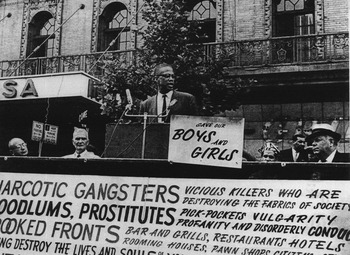
Malcolm X speaks as a Nation of Islam minister in the early 1960s at a public rally at which he stated, “Dope, prostitution, and numbers could not flourish here in Harlem without the knowledge of the police!” Credit: Robert Haggins and Schomburg Center for Research in Black Culture, New York Public Library.

When Malcolm Little became Malcolm X, the transformation was born of the perception that his hustler self-image was delusory, that the criminal life made him prey, that he had sunk into “more and more, worse and worse, illegality and immorality.”Footnote 73 His religious conversion in prison coincided with the postwar shift in American sexual consciousness toward “normality” and defining one's sexual orientation by the biological sex of one's partner.Footnote 74 As he excoriated “white devils” in the Nation of Islam, Malcolm X embraced normative 1950s sexuality – marital, reproductive, heterosexual – and turned those norms against white society, decrying the history of white male lust and violence, especially rape of black women. The hustling life, he said, had given him insight into “the cesspool morals of the white man” and “the sick things he wanted.”Footnote 75
To refute racist assumptions of black depravity, the Nation cultivated a puritanical–patriarchal moral code that preached respect toward women in the context of their subordination to men. Women were segregated at meetings, enjoined to dress modestly, and forbidden from dancing except with their husband. Nation adherents abstained from pork, alcohol, tobacco, drugs, gambling, profanity, and “fornication,” including extramarital sexuality and homosexuality. If this mandated a sharp behavioral turnaround for Malcolm, its gender conservatism was continuous with his past sexism, its heterosexism with his statements of contempt for the homosexuals he hustled. Malcolm X's forceful rhetoric and advocacy of armed self-defense, which so excited white journalistic sensationalism, bear comparison with the performative “potential for violence” and “possibility of sudden death” in rough trade, which one New York hustler recalled provided patrons with “intensity” and “excitement” to “animate the eroticism.”Footnote 76 The transgressive antiracist politics of Malcolm X, this is to say, owed something tacitly to the transgressive interracial sexuality of Malcolm Little.
Malcolm X's first act of protest as a Nation of Islam member occurred in prison, when he wrote the commissioner of the Massachusetts Department of Corrections to object to religious persecution of black Muslims. “Yet,” he objected, “the homosexual perverts in here can get job-changes whenever they work to change or acquire new ‘husbands.’”Footnote 77 That sentence, with its distinction of homosexuals from their husbands, took for granted a gendered male world in which same-sexuality did not automatically make one homosexual; simultaneously, it equated homosexuality with perversion. Nobody – including Jarvis, who entered prison with him in 1946 – would claim that Malcolm X ever engaged further in homosexual acts as he forged new identities as believer, minister, husband, and father. None are noted in his prison file, and his daughter Ilyasah Shabazz and follower Peter Bailey have posited that as Malcolm X he was under surveillance so heavy that such activity would hardly have escaped the government's notice.Footnote 78
In Malcolm X's simultaneous adoption of sexual conservatism and black militancy lies the line of continuity to the black power outlook that hailed him for “reclamation of the black man's masculinity.”Footnote 79 Malcolm was the archetype of the 1960s opposition to the “castration” of a white world that called black men “boy,” depriving them of “manhood.” By the time Malcolm X worked on his autobiography with Alex Haley, to acknowledge same-sex encounters would have destroyed a credibility fashioned for that era's heteronormativity even as the toughness that made him alluring as trade was central to his radical charisma. His street appeal, as Sonia Sanchez expressed it so well, was gendered: “He said it in a very strong fashion, a very manly fashion, one that says, ‘I am not afraid to say what you've been thinking all these years.’ That's why we loved him so very much. He took on America for us.”Footnote 80
Reticence today about discussing Malcolm's sexuality traces in part to emulation of this strategy of respectability, street credibility, and manliness. Even at his nationalist apex, however, Malcolm X had more than one side to him when it came to gender and sexuality. When FBI agents visited his home in 1964, he taped the ensuing conversation, including his casual slur against Bayard Rustin as a “homo,” but in their public debates Malcolm respected Rustin – and he outright admired James Baldwin.Footnote 81 The extraordinary transformations of his final year from 1964 to 1965 included dropping objection to interracial relationships and hints of a proto-feminism, but when Malcolm X was gunned down at age thirty-nine, the world was only on the cusp of the late 1960s’ profusion of sexual, gender, and political radicalisms, including the gay and women's liberation movements.Footnote 82
Care must therefore be taken to guard against anachronism, but the reminder that not all same-sexuality correlates with gay identity should be understood to complement, not deny, the growing black gay male historiography.Footnote 83 To locate Malcolm's same-sexual encounters of the 1930s and 1940s within a culture that understood them as masculine and therefore heterosexual is not to “normalize” them but to historicize them. Rough trade was neither gay nor normative; interracial sexuality contravened propriety; hustling abrogated the law. Straight trade bears comparison with today's African American “down-low” – ostensibly straight men having secretive sex with other men – but differs from the down-low's associations with bisexuality and the closet.Footnote 84 Likewise, the queer, trans, and non-binary valences of millennials share little with the rigidly gendered culture that produced straight trade, but it is intriguing that there are survivals (or even signs of a revival) of disaggregation of identity from sexual activity, as in an oral history of steelworkers in which gay men report with some regularity having had workplace sex with working-class heterosexual men, or a poll that 10 percent of young American heterosexuals have had a sexual encounter with someone of the same sex.Footnote 85 If Malcolm Little's experiences must be understood in the categories of the 1930s and 1940s, this suggests that they are not entirely remote from our own. As Irene Monroe has astutely observed, “If we, as LGBTs, use this era of Malcolm's life to claim him as gay, we misunderstand the art and survival of street-hustling culture … If we, as African Americans, use this era of Malcolm's life to dismiss that he engaged in same-sex relationships, many will miss the opportunity to purge ourselves of homophobic attitudes.”Footnote 86