INTRODUCTION
In 2010, a proposal to put a mosque in Murfreesboro, Tennessee, stirred up national controversy and raised many normative questions regarding Islam and its influence in the United States (US). Despite significant opposition going as far as denouncing Islam as a legitimate religion, the mosque was eventually completed in 2012 (Smietana Reference Smietana2014). Elsewhere, an attempt to build an Islamic Community Center in New York was unsuccessful, in part, due to critics who were concerned about the Islamic center being built close to the site of the Former World Trade Center that was subject to the September 11, 2001, attacks (Otterman Reference Otterman2014).
The aforesaid along with other salient incidents likely exacerbated religious polarization and provided a catalyst for several states to place anti-international initiatives on their agenda. The scope of these initiatives varies across states, but the majority of the anti-international laws target the Islamic faith. While the specific reasons why some states have chosen to adopt or attempt to adopt these laws is uncertain, it is likely due to the perceived threat of Islamic practice in the United States.
While dozens of states have placed anti-Sharia initiatives on their agenda, only a small number have passed these measures to date, raising many questions, including: the specific reasons why some states have been successful in adopting these policies and not others, the exact mechanisms driving states to place these controversial initiatives on their agendas, and the causal pathways linking these initiatives among states. Applying a policy diffusion framework, this article attempts to unravel these questions. In the next section, the background of Sharia law and the development of anti-Sharia laws in US states are discussed.
SHARIA LAW BACKGROUND
Sharia is an Islamic legal system that has been instituted in multiple locations around the world (Nmehielle Reference Nmehielle2004). Sharia law includes tenants from the Quran (the Islamic holy book), traditions from Muhammad, as well as other supplementary sources (Mashhour Reference Mashhour2005). Sharia law is often controversial due to the nature of some of its tenants in areas such as rules over marriage and gender roles. Therefore, the subject of Sharia law is often driven by politics (Mashhour Reference Mashhour2005) and ideological presuppositions.
A number of US states in recent years have instituted laws that oppose the use of Sharia law in their court systems. In many states, Sharia law itself is not banned, but foreign or international laws are, partially due to the difficulty of passing initiatives specifically targeting Islam. For example, an Oklahoma law specifically mentioning Sharia law was struck down by the courts (Gershman Reference Gershman2013), making those who seek to introduce these laws to pursue an alternative route that would be more likely to be upheld by the courts (Farmer Reference Farmer2014).
The implementation and legal proceeding regarding these laws has led to questions about what specifically international law is and how it is enforced in the American court system. Many of these bans are inspired and pushed by other agencies or organizations that provide model legislation written by think tanks. For example, agencies such as the Center for Security Policy, an organization that focuses on what they see as national security threats for the US (Patel, Toh, and Duss Reference Patel, Toh and Duss2013) and national groups such as the American Legislative Exchange Council (ALEC), may likely have a role in pushing anti-Sharia initiatives. These organizations have been successful on other issues such as gun rights, voter ID, and labor law (McIntire Reference McIntire2012).
Laws to ban foreign/international law in the US according to the Brennan Center for Justice (a group that opposes these laws) have been introduced in over 30 states (Patel, Toh, and Duss Reference Patel, Toh and Duss2013). Figure 1 shows those states that have attempted to adopt anti-Sharia laws.
Number of anti-Sharia bill introductions.

Supporters of these state efforts feel that these laws are necessary due to their belief that Islamic legal traditions can disrupt and supersede the American legal system and the American way of life (Gaffney Reference Gaffney2010). These supporters argue that the implementation or acceptance of Sharia law by the courts is inherently anti-Western. These individuals often support Samuel Huntingdon's controversial Clash of Civilization thesis, which argues that the Western world and Islam are on a collision course (Otto Reference Otto2010).
Critics of these state efforts worry that anti-Sharia laws could disrupt the American legal system in a number of different legal fields including family and tort law (Volokoh Reference Volokoh2014); and some are concerned that these laws have negative ramifications beyond the legal system itself, including the violation of the constitutional system of separation of powers (Patel, Toh, and Duss Reference Patel, Toh and Duss2013). Many critics believe that lawmakers should focus on other issues that are more pressing to the general population such as the economy (Schlachtenhaufen Reference Schlachtenhaufen2010).
Despite an individual's political position on this issue, the Islamic population is expanding greatly in Western Europe and demographically the Islamic population is younger, meaning that the percentage of Muslims in the western world including the US will likely increase in the years ahead (Tyler Reference Tyler2008). Thus, this issue will likely be exacerbated in the future, highlighting the importance of the study of this policy. In the next section, policy diffusion is discussed.
POLICY DIFFUSION AND AGENDA SETTING
Diffusion is “the process by which an innovation is communicated through certain channels over time among the members of a social system” (Rogers Reference Rogers1995, 5). More specifically, policy diffusion refers to the process by which policies spread among jurisdictions. Scholars have long examined state policy diffusion (Berry and Berry Reference Berry and Berry1994; Reference Berry and Berry1990; Berry and Baybeck Reference Berry and Baybeck2005; Karch Reference Karch2007; Boushey Reference Boushey2010; Savage Reference Savage1985; Nicholson-Crotty Reference Nicholson-Crotty2009; Makse and Volden Reference Makse and Volden2011; Boushey Reference Boushey2012) and have relied on multiple theories that help explain interstate adoption, including policy entrepreneurs (Mintrom and Sandra 1998), imitation (Shipan and Volden Reference Shipan and Volden2006; Volden Reference Volden2006; Mitchchell and Stewart Reference Mitchell and Stewart2014), social learning (Butz, Fix, and Mitchell Reference Butz, Fix and Mitchell2015, Mooney Reference Mooney2001), coercion (Sabatier and Jenkins-Smith Reference Sabatier, Jenkins-Smith and Sabatier1999; Jensen Reference Jensen2004; DiMaggio Reference DiMaggio1991), and economic competition (Berry and Baybeck Reference Berry and Baybeck2005; Boehmke and Witmer Reference Boehmke and Witmer2004). These theories generally include both internal characteristics taking place within a state that increase its likelihood of adopting a policy, and external factors occurring outside of states (Berry and Berry Reference Berry and Berry1990), which are known as the mechanisms of diffusion (Shipan and Volden, Reference Shipan and Volden2006). These usually encompass a regional dimension or an increased likelihood of a state adopting a policy if its neighbors have previously adopted the policy.
To answer questions related to agenda-setting, it is important to understand the emergence of policy ideas and the policy process (Gray and Lowery Reference Gray and Lowery2000), or specifically the agenda-setting stage of policy adoption (Cobb and Elder Reference Cobb and Elder1975). Agenda setting has a long theoretical and empirical tradition (e.g., Schattschneider Reference Schattschneider1960; Bachrach and Baratz Reference Bachrach and Baratz1962; Cobb and Elder Reference Cobb and Elder1975; Kingdon Reference Kingdon1995; Baumgartner and Jones Reference Baumgartner and Jones1993). Kingdon (Reference Kingdon1995, 3) defines an agenda as “a list of subjects or problems to which government officials and people outside of government closely associated with those officials, are paying some serious attention to at any given time.” Furthermore, Kingdon (Reference Kingdon1995) explains that the process of agenda setting winnows down the array of conceivable ideas to a more specific set that becomes the subject of attention. Cobb and Elder (Reference Cobb and Elder1975) state that citizens voice their concerns to government while citizens that are against the legislation campaign against it.
One study examines how policy ideas form; in particular, it finds that policy ideas come from a legislator's own experiences as well as from their constituents (Gray and Lowery Reference Gray and Lowery2000). In addition, Kingdon (Reference Kingdon1989) examines how legislators make decisions and determines that they consider their constituency as well. Furthermore, Karch (Reference Karch2007) notes that usually the process of agenda setting is only a marginal consideration of scholars in diffusion studies, therefore, examining the agenda setting process is important. To examine agenda setting, we posit that if a state's neighbors adopt a policy, the policymakers in the state will be more likely to be cognizant of these experiences, and ultimately more likely to place this policy on the agenda.
Additionally, we examine the factors driving the adoption of these policies. While policy diffusion has been conceptualized in multiple ways and multiple mechanisms have been developed to explain diffusion among states, scholars posit that policy diffusion and its respective theories are driven by a regional or neighbor effect (e.g., Berry and Berry Reference Berry and Berry1990). For example, one theory behind diffusion is that policymakers learn from one another about policy ideas (Berry and Baybeck Reference Berry and Baybeck2005; Mooney Reference Mooney2001; Valente Reference Valente1996); and in turn, this makes policy adoption more probable. Put differently, jurisdictions observe the consequences of the policy in other states and choose to adopt or ignore policy successes or failures. Diffusion has also been conceptualized as more of a haphazard process. Instead of carefully examining neighboring policies, governments adopt policies on the basis of copying neighboring governments without particular regard for consequences or policy successes (Shipan and Volden Reference Shipan and Volden2008). Put another way, governments adopt policy in hopes that it “will raise their profile and make them more attractive places to live, like their wealthier and more cosmopolitan neighbors” (Shipan and Volden Reference Shipan and Volden2008, 187). In this conceptualization, policymakers look more toward governments that are considered leaders (Walker Reference Walker1969) or governments that are larger (Shipan and Volden Reference Shipan and Volden2008). Due to the fact that anti-Sharia law is a highly-salient politically-driven policy with no tangible benefits, we rely on multiple ways to capture the concept of diffusion, which will be discussed in the next section.
METHODOLOGY
Internal Determinants
Though we theorize that the external diffusion discussed previously will explain the adoption of anti-Sharia laws across states and the placement of the policy on the agenda, we must also account for internal factors within a state. These internal determinants include both policy-specific variables in addition to more established determinants of policy diffusion.
Political Determinants
One likely determinant of an anti-Sharia law is the partisan makeup of a state's constituency. Public policy researchers often theorize that politics, ideology, or electoral composition can predict which policy a government adopts (Grossback, Nicholson-Crotty, and Peterson Reference Grossback, Nicholson-Crotty and Peterson2004; Berry and Berry Reference Berry and Berry1990; Mooney Reference Mooney2001). For example, Morgan and Wilson (Reference Morgan and Wilson1990) indicate that political variables such as ideology can have an impact on policy outputs. As previous research has found, legislatures push the agendas and policies wanted by their constituencies (e.g., Mayhew Reference Mayhew1974).
Our belief is that the higher the vote percentage for a Republican presidential candidate the more likely that a state is to adopt an anti-Sharia law because those states are more likely to be politically conservative and therefore distrustful of what they consider being outside legal/religious systems. This can be evidenced by the fact that Mitt Romney received some of his highest vote totals from the most conservative states in the US. In fact, Romney won the 10 most politically-conservative states while President Obama won the 10 most politically-liberal ones (Swift Reference Swift2014). Furthermore, according to a Pew Research Center Poll (2010), nearly 30% of Republicans believe that US President Barack Obama is of Muslim faith, indicating that there may be an association between a state's presidential vote share and a state's public opinion toward Islam.Footnote 1 For these reasons, electoral returns would likely be a predictor of a state's propensity to produce politically-driven policies such as anti-Sharia laws.Footnote 2
To gather information on presidential elections, we collected information from Dave Leip's Political Atlas. This website has collected exhaustive vote total information on presidential and mid-term elections going back many years.Footnote 3 The presidential vote share variable is coded as the percentage of the vote share for the Republican Party from the most recent US presidential election in each state. Given the years of this study, we used data from the 2008 and 2012 presidential elections.
Furthermore, government officials that are oriented toward a certain ideology (liberal or conservative) will adopt certain policies and not others (Grossback, Nicholson-Crotty, and Peterson Reference Grossback, Nicholson-Crotty and Peterson2004). In the case of anti-Sharia law adoption, we theorize that adoption will be more likely for conservatives. It has been found that partisan control of state governments can lead to certain policy outcomes (Erikson, Wright, and McIver Reference Erikson, Wright and McIver1989); therefore it is important to examine the partisan legislative composition of states. Additionally, it can also be seen that states with more Republican state legislators will be more open to the influence of groups such as ALEC that provide templates for legislation on a number of conservative issues throughout the US. This is especially true considering that ALEC has targeted Republican state senators on other issues such as healthcare (Jones, Bradley, and Oberlander Reference Jones, Bradley and Oberlander2014).
The information on the partisan structure of states was collected from the National Conference of State Legislators, a bipartisan organization intended to support state legislatures in developing policy initiatives and, generally speaking, strengthen the quality and efficacy of state legislatures. In addition, the National Conference of State Legislators keeps information on the partisan composition of every legislature except for Nebraska which is nonpartisan.Footnote 4 Using these data, we develop a Republican control variable that is coded as 1 if the Republicans control both the state legislators and governorship and 0 otherwise.
We also consider geography by including a variable that measures regionalism, such as states in the South. Inglehart (1988, 1203) explained that the “incompleteness of models that ignore cultural factors is becoming increasingly evident.” This is also evident in diffusion research, which often excludes measures of political culture. We feel that the political culture may be an important predictor of adoption of anti-Sharia laws. For example, it is possible that there is a greater propensity for specific geographic regions such as southern states to be more likely push for anti-Sharia laws. This could be because the South tends to be more politically conservative on social and cultural issues than the rest of the US (Black and Black Reference Black and Black2002; Hayes and McKee Reference Hayes and McKee2008). In addition, Tatalovich (Reference Tatalovich1995) discusses how southern states were more likely to adopt “English-Only” laws against Spanish speakers in the 1980s. To measure being in the South, we include a dichotomous variable coded as 0 if a state is outside of the South and 1 if a state is in the South.
Religious Factors
The percentage of a state's population that belongs to the Islamic faith might also have an impact on the likelihood of anti-Sharia law adoption in multiple ways. For instance, if a state has a higher Islamic population, it could be argued that a state would be less likely to pass an anti-Sharia law since state legislators would not want to upset their constituents. Additionally, V.O Key and others examined the racial threat hypothesis, which states that in the South, the dominant class may feel threatened by large numbers of African-Americans even though they are not the majority; therefore, the southern white elites would pass laws more hostile toward the minority interests (Key Reference Key1949; Liu Reference Liu2001). As it relates to this work, it might be argued, then, that a higher percentage of Muslims in a state would lead to a greater likelihood of the state adopting anti-Sharia or anti-international laws. This is becoming increasingly important to consider as Islam is poised to be the second largest religion in the US following Christianity (Leonard Reference Leonard2003).
On the other hand, if a state has a very small Islamic population, this likely would not be a pressing issue for state policymakers, which would lessen the likelihood that anti-Sharia laws would be a policy priority. For this study, Islamic population data were gathered from the 2010 Association of Religion Data Archives.Footnote 5 This variable is coded as the number of Muslim congregations by state.
Presumably, the total number of evangelical Christians in a state might influence a state's propensity to adopt an anti-Sharia measure. For example, an above average evangelical population may make it easier for anti-Sharia laws to be passed. While there has not been work on evangelical populations and anti-Sharia law specifically, there has been much evidence that the evangelical movement has been greatly supportive of other politically-conservative causes especially on issues such as opposition to abortion (Wald and Calhoun-Brown Reference Wald and Calhoun-Brown2014; Brint and Abrutyn Reference Brint and Abrutyn2008). Furthermore, diffusion studies have relied on variables that measure religion (e.g., Berry and Berry Reference Berry and Berry1990), especially when the policy is morally driven. For the evangelical population variable, we used the total number of adherents to evangelical Christianity per 1000 individuals within each state. These data were obtained from the US Religion Census: Religious Congregations and Membership Study (2010).
Demographic Factors
The population or population density of a state may also impact its policy adoption behavior (Boehmke and Witmer Reference Boehmke and Witmer2004; Berry and Berry Reference Berry and Berry1990; 1992; Mooney Reference Mooney2001; Bouche and Volden Reference Bouche and Volden2011). For anti-Sharia policies, arguably the less densely populated areas or those lower in population might represent a more rural area that is prone to anti-Sharia policy, especially considering many of these areas are not religiously diverse. On the contrary, larger states might have a greater propensity to produce anti-Sharia laws. For example, a larger population might reflect negative externalities produced by urbanized areas (e.g., crime, densely populated areas, and pollution, among others). These factors could make population a factor in a state's decision to create anti-Sharia legislation. Therefore, in this study, we include a measure of population and population density by state. Each of these was used to test diffusion in separate models. Population includes the total number of residents (in thousands) residing in each state each year, while population density measures the total number of individuals in a square mile of land. These figures are adjusted for years. These data were obtained from the US Census Bureau.
We control for three additional factors that may be linked to anti-Sharia law adoption: poverty, income, and the percentage of whites in a state. These variables are more specific to diffusion, and the theories linking these variables to anti-Sharia adoption are considerably weaker than the factors mentioned above. For the former, states that are higher in poverty may have a populace either more unaware or more cognizant of Islam. Additionally, higher poverty areas could potentially be correlated with other predictors of anti-Sharia laws, or people in higher poverty may view similar news content that raises awareness of Islam. Therefore, we include a measure of poverty in individual states. Poverty includes the percentage of the residents within a state below the poverty level. These data were obtained by the US Census Bureau.
Similar to poverty, the income of the residents within a state could shape a government's policy adoption patterns (Boehmke and Witmer Reference Boehmke and Witmer2004; Berry and Berry Reference Berry and Berry1990; 1992; Godwin and Schroedel Reference Godwin and Schroedel2000; Bouche and Volden Reference Bouche and Volden2011). Income levels are often linked to education and are associated with more urban areas; therefore, income could be linked to anti-Sharia laws. Income includes the total median income by state adjusted for years. These data were obtained from the US Census Bureau, Current Population Survey, and the Annual Social and Economic Supplements.
We also feel that the percentage of the population that is Caucasian in each state for each year evaluated may also have an impact on anti-Sharia law adoption. These data were obtained from the US Census Bureau. Presumably, it could be argued anti-Sharia laws may be more likely to pass in states that lack racial diversity. Lack of exposure to people of other religious backgrounds may make states more likely to fear non-evangelical religions. Arguably, as was discussed in the last section, Key (Reference Key1949) might argue the opposite: the higher a non-white or non-Christian population, the greater the likelihood that there would be a backlash against those minority groups, even if they are a substantial minority. Therefore, to settle this question we include a variable to capture the white population in states.
External Diffusion Determinants
As mentioned previously, one element of policy diffusion theory is based on the existence of a regional dimension, or the tendency of policymakers to more readily learn from those states closer in proximity (Mooney Reference Mooney2001); the more a policy is present in geographically contiguous states, the greater likelihood that this policy is adopted in the policymaker's respective state. The regional effect has been conceptualized and operationalized in many ways.
While it seems plausible that states are looking to neighboring adoptions when considering their own anti-Sharia measures, it is unclear what specific mechanism linking these states. For policies with more tangible benefits and with more direct spillover effects (such as smoking bans, lotteries, taxes), diffusion may occur more directly. However, with policies such as anti-Sharia laws, it is less obvious how these policies are diffusing. Therefore, we rely on multiple measures to model the regional effect of diffusion. First, we rely on the total number of neighbors that had adopted an anti-Sharia law in the previous year. Second, we also use the percentage of a state's neighbors that had adopted to control for the effects of some states having more neighbors than others. For example, if a state had four neighbors and one had adopted, this would be coded as 25%.
Next, we rely on an interaction variable between population and the total number of neighbors a state has that adopted an anti-Sharia law. Presumably, states will attempt to imitate those policies initiated by leader-states, or those states that are larger in population. This interaction variable will tease out how a state's adoption of anti-Sharia laws varies at different levels of population. Therefore, this will show how the adoption behavior varies between larger and smaller states; and presumably smaller states will be more likely to adopt the policies of larger states.
Dependent Variable and Modeling Diffusion
To collect information on what states have passed anti-Sharia laws, information was gathered from the Pew Research Center's examination of Religion and Public Life Project. This project takes polls and gauges public opinion on a number of issues where religion intersects with politics. This website provides information that shows which states have passed anti-Sharia laws, which states were thinking about passing these laws, and which states had yet to consider these policies.
In this study, we use a logit regression analysis to model the diffusion of anti-Sharia laws across US states. Since the Berry and Berry (Reference Berry and Berry1990) study, scholars have relied on this type of analysis (also called event history) to model policy diffusion (e.g., Mintrom Reference Mintrom1997; Mooney Reference Mooney1995). In event history models (both event history Cox/Weibull and Logistic), the dependent variable is a binary sequence of 0 each year prior to the adoption until 1, the year the policy is adopted. Since these constitute an event, the unit of analysis, or states in this case, drops out of the sample. We clustered our standard errors by states to account for the potential for non-independent observations (Buckley and Westerland Reference Buckley and Westerland2004). Additionally, we included annual dummy variables to examine adoption behavior over time. We reported all the years except 2013, the reference year used in our analysis.
RESULTS
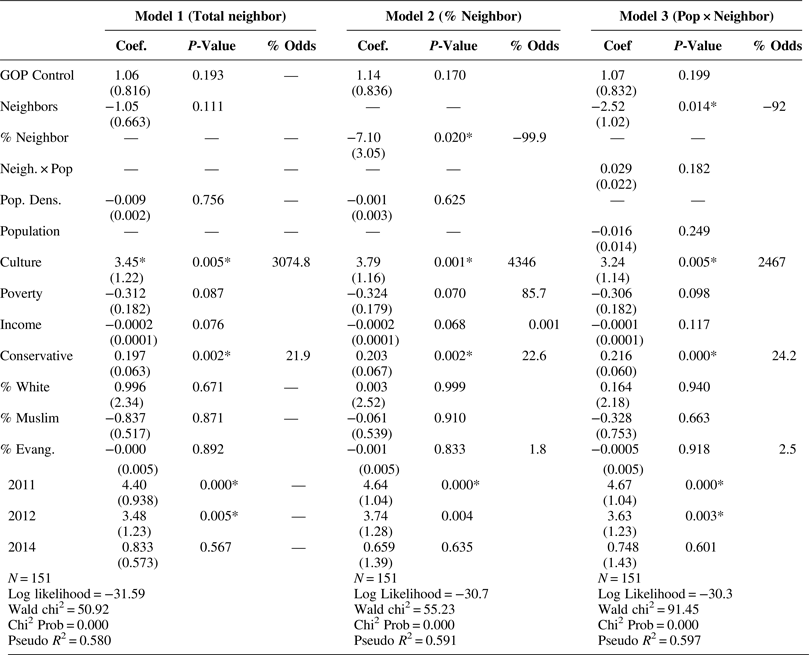
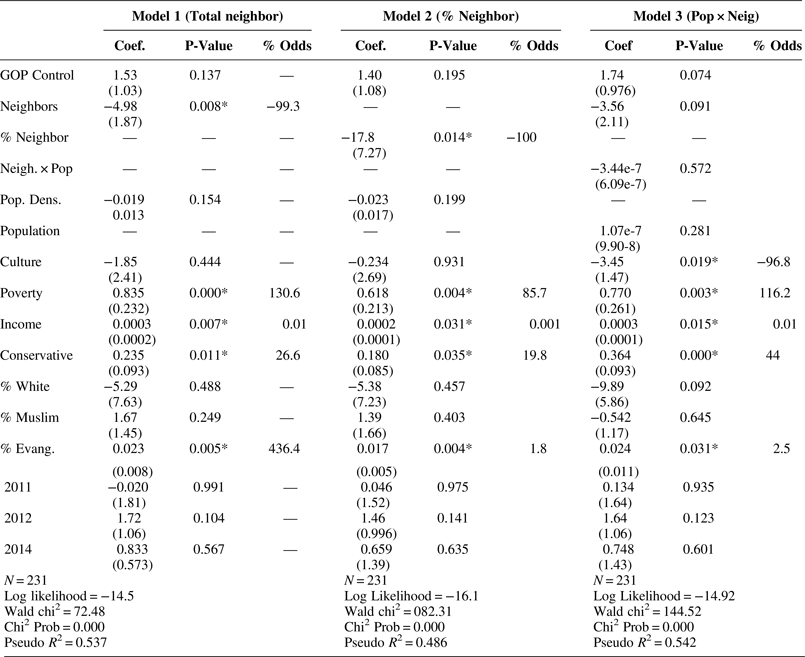
Figure 1 shows the total number of Anti-International laws introduced in each state. Tables 1 and 2 show the results of the logit model that tests whether diffusion is occurring in both the agenda setting and adoption of these policies.Footnote 6 In each table, the beta coefficient, standard error, and p-value are reported. For the significant variables, the percentage increase or decrease in odds are reported for interpretation purposes. The first section of Table 1 and Table 2 is our Total Neighbor Model, which models diffusion as the total number of neighbors that had previously adopted an anti-Sharia law. The % Neighbor Model shows diffusion as the percentage of a state's neighbors that had adopted an anti-Sharia law. The third section shows the results of our final model of diffusion: Population × Neighbor. Additionally, we reported the correlation coefficients of each variable along with lagged models in our online appendix.
Logit model for agenda setting

Logit model for diffusion and adoption

For the agenda-setting model in Table 1, our neighbor variable in the Total Neighbor Model is not significant. However, the culture and conservative variables are. For the South variable, being a Southern state increases your odds of placing an anti-Sharia initiative on the agenda by 3074%. Additionally, the conservative variable is significant as a 1% increase in a vote for the Republican Party corresponds to a 21.9% increase in odds for adopting an anti-Sharia initiative. For the % Neighbors Model, our neighbor variable is significant. For each 1% increase in the proportion of neighbors that adopt, there is almost a 100% decrease in odds. Being in a Southern state increases the odds by 4346%. This seems quite high, but upon examining Figures 1 shows that there were a large number of anti-Sharia bills introduced in the South relative to the US as a whole.
According to Table 1, for each increase in poverty, there is an 85.7% increase in odds. For income, there is a fraction of a percentage increase while the conservative variable corresponds to a 23% increase and evangelical adherents per 1000 individuals nearly a 2% increase. For the interaction model, the neighbors’ variable is not significant. Being in the south corresponds to a 3718% increase in odds, Conservative a 22% increase, and evangelical a 2.5% increase. The annual dummy variables also show significance, meaning that there were many initial adopters but the diffusion slowed down as time progressed. For the interaction model population × neighbor, there was no significant interaction effect.
Turning to the Diffusion adopt model in Table 2, for the Total Neighbors Model, neighbors, poverty, income, conservative and the evangelical adherents per 1000 within a state are found to be significant. For each additional neighbor bordering the state in question that had adopted an anti-Sharia law in the previous year, there is roughly a 99% decrease in the odds of the state adopting an anti-Sharia law. For poverty and income, each percentage increase in individuals living in poverty increases the odds of adoption by 130% and with income, an increase corresponds to a fraction of a percent. Turning to conservative, an increase in a conservative vote increases the odds of adopting by 27%. For each additional evangelical adherents per 1000, the risk of adopting an anti-Sharia law increases by roughly 436%. For Model 2 that measures neighbors as a proportion, the results are similar. For each additional increase in the proportion of neighbors having adopted an anti-Sharia law, there is a 100% decrease in the odds of adoption. Poverty exhibits an 86% increase in odds, incomes exhibits a fraction of a percent increase in odds, conservative a 20%, and evangelical a 2% increase. Finally, for our interaction model, we find no evidence of a diffusion effect; but the poverty, income, conservative, South, and evangelical variables remain significant.
According to our lagged models in the online appendix, the neighbor variables are not significant with the exception of the interaction model, but many of the same internal determinants are significant, including the GOP (a nickname for the Republican Party) control variable. This means that when neighbors adopt, the respective state acts quickly and adopts their own anti-Sharia initiative. However, the effects of internal determinants persist over time. Given the addition of the GOP control variable, it appears that the right political climate and GOP dominance makes these initiatives more likely.
DISCUSSION AND CONCLUSION
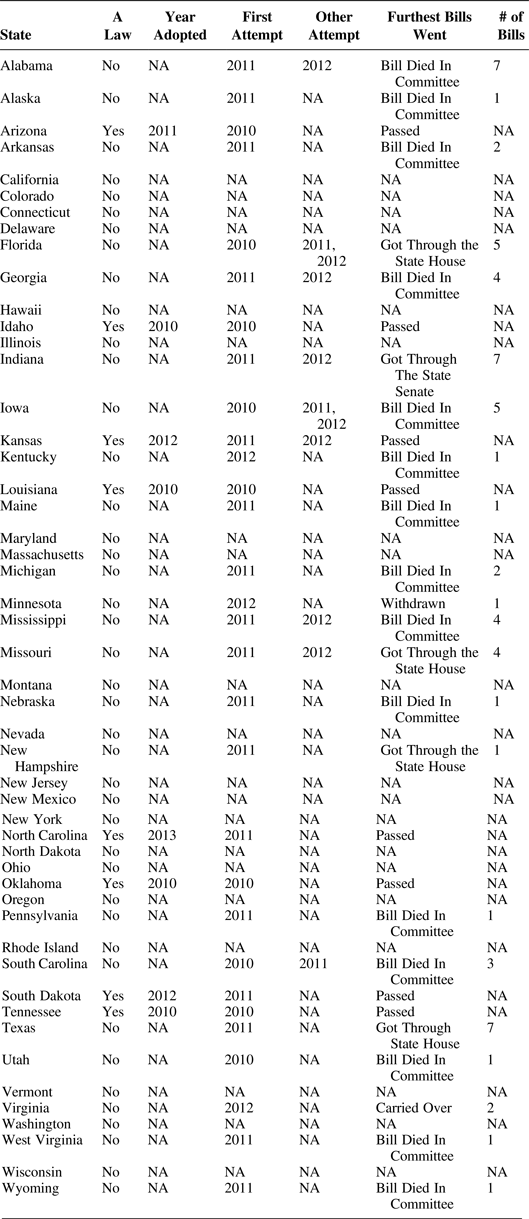
During recent years, more states have moved toward banning international law in state courts. Table 3 shows more specific information regarding the status of anti-Sharia initiatives in each state. However, uncertainty remains as to why states are adopting these laws and why they are being placed on the agenda. Therefore, in this study we applied a diffusion framework to better understand these underlying processes.
Anti-Sharia law information for US states

We examined the diffusion of anti-sharia laws across US states. Diffusion appears to be occurring but the effect is quite complex given the various measures we employ. For agenda setting, the proportion model is significant but the total neighbors or interaction model is not. For the adoption, the total neighbors and proportion variables are both significant. However, there is a negative effect, meaning that surrounding states are less likely to adopt or place the policy on the agenda if their neighbor had previously done so. This is likely because states, particularly those states that are not innovators, may be waiting until the policy matures so they can ascertain the effects of the policy.Footnote 7 Additionally, it could be that the mass media attention regarding this policy is negative, making other states reluctant to adopt their own initiatives. Finally, this effect could be positive in certain regions of the country (such as the South) and negative in others, contributing to an overall negative diffusion finding. This negative diffusion finding is similar to the Butz, Fix, and Mitchell (Reference Butz, Fix and Mitchell2015) study that examined the diffusion of Stand Your Ground Laws. For morality policies, there is likely a complex dynamic involved in diffusion, much more so than more simplistic economic policies.
For our agenda-setting models, two internal determinants were statistically significant for each model we employed, including the South and conservative variables. Those states located in the South are many times more likely to place anti-Sharia policies on the agenda. Those states that have higher vote shares for conservatives are more likely to adopt these policies, likely due to anti-Sharia law being more favorable to conservative ideology.
Additionally, we find that several internal determinants had an effect for the adoption model. The evangelical Christians, poverty, income, and conservative variables had an impact. For the evangelical variable, this effect is probably because policymakers are more likely to push these policies as Islam may be of greater concern to Christian constituencies. For poverty and income, those states that have greater poverty and have less income may have a less educated populace, or less exposure to ideas such as Islam, or the higher poverty and lower income may be more reflective of the Southern states which tend to be more conservative. Conservative was also significant, meaning that conservative states are more likely to adopt these policies. This is due to the position of the Republican Party relative to anti-Sharia law. For the interaction model, we also found that the South variable was significant; meaning that being in the South is likely interacting with population or demographic variables.
Despite the importance of our findings, this study has several limitations. First and most, is the short time span of this policy. The first adoption of this policy came in 2010, allowing us only four years to assess the diffusion of this policy. It is plausible that additional states will adopt this policy in the future, which would allow for a greater sample and additional years to examine how this policy diffuses over time. If additional adoptions are made, future studies should examine the additional data to allow a more temporally in-depth analysis. However, given the nature of these policies, it is important to initially assess factors that are causing multiple adoptions among states. Second, the variables used in this study are by no means exhaustive. Scholars may consider exploring different covariates. Furthermore, qualitative studies should examine in more detail specific contextual state features that may make states more or less likely to adopt these policies.
In the future, there is still some uncertainty as to how this anti-Sharia movement will evolve. On one hand, the movement may be picking up steam as evidenced by the Republican Party's (the voters or the establishment) support of this initiative as evidenced in exit polls throughout the United States, Donald Trump's call to ban all Islamic immigrants to the US, or in Ted Cruz's proposal to monitor Muslim neighborhoods. This could in turn lead to more state legislatures especially those controlled by Republicans to adopt anti-Sharia type laws. Furthermore, the recent terrorist attacks by Islamic State of Iraq and the Levant in Europe may exacerbate these measures, but this remains to be seen.
On the other hand, there could be a backlash to this anti-Sharia movement namely from those in the country who are opposed to Trump and his policy positions. For example, individuals on the Democratic side of the political spectrum may be motivated to oppose anything that even remotely relates to what they see as religious discrimination. Despite the results of the 2016 elections, the argument over anti-Sharia law is likely to remain an issue.
Supplementary materials and methods
To view supplementary material for this article, please visit http://dx.doi.org/10.1017/S1755048316000419