Introduction
Recently, increasing attention has been paid to the development of multifunctional materials consisting of layered aluminosilicates for use in biotechnology, medicine, and ecology (Alekseeva et al. Reference Alekseeva, Rodionova, Bagrovskaya, Agafonov and Noskov2017, Reference Alekseeva, Rodionova, Bagrovskaya, Agafonov and Noskov2019; Lin et al. Reference Lin, Zhou and Yin2017; Martinez-Costa et al. Reference Martinez-Costa, Leyva-Ramos and Padilla-Ortega2018; Sahnoun et al. Reference Sahnoun, Boutahala, Tiar and Kahoul2018; Abidi et al. Reference Abidi, Duplay, Jada, Errais, Ghazi, Semhi and Trabelsi-Ayadi2019). Of the entire variety of aluminosilicates, bentonite clay minerals occur widely in nature and are most promising for the production of composites (Gil et al. Reference Gil, Korili and Vicente2008; Bee et al. Reference Bee, Abdullah, Bee, Sin and Rahmat2018).
Bentonite consists primarily (near 80%) of montmorillonite (Mnt), which is a natural 2:1 type сlay mineral. Other components of bentonite are illite, calcite, plagioclase, muscovite, etc. This clay mineral exhibits anisotropy, a regular distribution of meso- and micropores, thermal stability, and the presence of various reactive centers. As a low-cost and readily available mineral with many excellent properties, bentonite has been applied in the fields of catalysis, separation, biology, medicine, adsorption, sensor environmental control, etc. (Park et al. Reference Park, Jung, Kim, Kim and Kwon2009; Ruiz-Hitzky et al. Reference Ruiz-Hitzky, Aranda, Dardera and Rytwo2010; Lee et al. Reference Lee, Kato and Usuki2011; Zhou et al. Reference Zhou, Shen, Liu and Liu2011; Datta Reference Datta2013; Yu et al. Reference Yu, Li, Tong, Zhou, Lin and Xu2013; Deng et al. Reference Deng, Yuan, Liu, Annabi-Bergaya, Zhou, Chen and Liu2017; Gamba et al. Reference Gamba, Kovář, Pospíšil and Sánchez2017).
Clay minerals are natural adsorbents and are known for their hydrophilic nature. Due to the presence of exchangeable cations in their structure, large specific surface area, swelling properties, as well as their wide availability, some of the most common types of clay minerals such as kaolinite and montmorillonite (the most prevalent clay mineral in bentonite) have already been tested for the removal of a variety of organic pollutants (Jaynes & Boyd Reference Jaynes and Boyd1991; Zhang et al. Reference Zhang, Ding, Boyd, Teppen and Li2010; Dordio et al. Reference Dordio, Miranda, Ramalho and Carvalho2017).
Bentonite can be modified to improve its sorption ability. One modification is coating with metal particles (Golubeva Reference Golubeva2016). The introduction of such nanoparticles promotes destruction of the hierarchical structure formed because of the coalescence of individual crystallites and can cause changes in the texture and physicochemical properties of the resulting composite. Of the metal compounds used, iron oxides, e.g. magnetite Fe3O4, which is characterized by a positive magnetic susceptibility, are of interest (Barraqué et al. Reference Barraqué, Montes, Fernández, Mercader, Candal and Sánchez2018). This property is used to make magnetically controlled adsorbents, which results in intensification of the solid–liquid separation process (Pastukhov et al. Reference Pastukhov, Davankov, Lubentsova, Kosandrovich and Soldatov2013). The use of magnetic clay as an adsorbent to remove hazardous and toxic substances from aqueous media is extremely important. Among different sources of water contamination, pollution by different types of drugs has become a major concern. Moreover, even residual amounts of such substances in pharmaceutical wastewater have a negative impact on human health and the ecological balance of the environment.
Many pharmaceutical wastewaters contain nitrofurans, i.e. antibacterial drugs used widely in medicine (Biosic et al. Reference Biosic, Skoric, Beganovic and Babic2017; Grenni et al. Reference Grenni, Ancona and Caracciolo2018). Nitrofurans are synthetic therapeutic drugs with a broad antiseptic effect against bacteria, mold, yeast, and viruses. One of the representatives of the nitrofuran group is nitrofurazone which is used widely in surgical practice in the form of ointments and water and alcohol solutions.
Few studies of nitrofuran sorption are found in the literature and certain aspects of adsorption phenomena on the surface of clay minerals have not been studied sufficiently well. Further research of this process is needed to enhance its effectiveness.
The aim of the present study was, therefore, to make a bentonite/magnetite composite; to investigate its structure, morphology, and physicochemical properties; and to explore the possibility of using the composite for the removal of nitrofurazone from water solutions.
Materials and Methods
Materials
Bentonite, ferric chloride hexahydrate (FeCl3·6H2O), ferrous sulfate heptahydrate (FeSO4·7H2O), and aqueous ammonia (NH4OH) were supplied by Sigma Aldrich, St. Louis, Missouri, USA. The materials listed were used for synthesis of a bentonite/magnetite powder. Nitrofurazone (furacilin, 5-nitro-2-furfural semicarbazone) was used to study adsorption activity of the bentonite/magnetite composite.
All reagents were of analytical reagent grade; doubly distilled water was used for the preparation of solutions.
Synthesis of Bentonite/magnetite Composites
Bentonite/magnetite powder was produced by co-precipitation of iron salts into clay. For this purpose 11.8 g of FeCl3⋅6H2O and 6.25 g of FeSO4⋅7H2O were dissolved in water (250 mL). Then dried bentonite (15 g) was dispersed in this solution by intensive stirring and ultrasonic vibration at 60°С for 10 min. For this, a Grad 13-35 (Grad-Technology, Moscow, Russia) ultrasonic bath was used at 205 W. The resultant suspension was stirred using a magnetic stirrer (600 rpm) at 80°C for 1 h.
For the precipitation of magnetite particles onto the surface and in pores of the bentonite, aqueous ammonia (25%) was added dropwise to the mixture to raise the pH to 11.0 while maintaining vigorous stirring. The reaction proceeded according to the following scheme:

The resulting suspension turned black, indicating the formation of magnetite. The resulting suspension was left for 24 h. The final product was then washed thoroughly with distilled water until a pH of ~7 was reached. Then it was centrifuged (CM-6M centrifuge (ELMI, Riga, Latvia), 2300 ×g) and dried at 60°C.
Pure magnetite was also obtained by mixing the corresponding reagents and following the same procedure described previously without the clay mineral.
Characterization
Granulometric analysis of the bentonite/magnetite powder was performed using an Analysette 22 COMPACT (Idar-Oberstein, Germany) particle size analyzer.
The surface morphology and composition of magnetized clay samples were investigated using a Tescan Vega 3 SBH (Brno, Czech Republic) scanning electron microscope equipped with an energy-dispersive X-ray spectroscopy (EDS) detector.
The porosity parameters were determined using the method of low-temperature (77 K) nitrogen vapor adsorption-desorption with the use of a NOVAtouch NT LX-1 (Quantachrome, Boynton Beach, Florida, USA) surface area analyzer. Before the adsorption measurements, the sample powders were kept in a vacuum drying oven at a temperature of 100°C for 7 h. Analysis of isotherms was performed using the Brunauer-Emmett-Teller (BET) and Barrett-Joyner-Halenda (BJH) models.
The structure of the powders was investigated by means of X-ray diffraction (XRD) in the angle range of 2–70°2θ using a DRON-UM1 (St. Petersburg, Russia) diffractometer (CuKα radiation, λ = 0.154 nm), operating at a voltage of 40 kV and a current of 40 mA.
Infrared (IR) transmission spectra of bentonite/magnetite powders were registered using an Avatar 360 FT-IR ESP Fourier-transform spectrometer (Thermo Nicolet, Woodland, California, USA) within a wavenumber range of ~4000–400 cm–1 with 16 scans at a resolution of 0.9 cm–1. For measurements, the samples were pressed into KBr pellets at a mass ratio of 1:100.
The magnetic property was measured using a vibrating sample magnetometer at room temperature up to a maximum magnetic field of 4000 Oe.
Adsorption Experiments
The adsorption behavior of the bentonite/magnetite powder was studied at ambient temperature to measure the distribution of nitrofurazone in the heterogeneous adsorbent/(aqueous nitrofurazone) system. For this purpose, aqueous solutions of nitrofurazone at various concentrations were prepared by dissolving nitrofurazone in 0.9% sodium chloride solution (pH = 5.5). The choice of pH was due to poor solubility of nitrofurazone in water and its good solubility in an acidic medium.
Then, a weighed portion of the adsorbent (m = 0.005 g) was placed into 25 mL glass tubes, mixed with 5 mL (V) of aqueous nitrofurazone, stirred for a certain time interval (from 4 to 362 min), and then the phases were separated using a centrifuge for 2 min.
In kinetics experiments, the initial nitrofurazone concentration in solution (C 0) was 6.813·10–2 mmol/L. The concentration of nitrofurazone in solution after adsorption (C t) was determined using a UV-Vis spectrophotometer (T70+UV/Vis, PG Instrument Co Ltd., Lutterworth, UK) at 374 nm (Fig. 1). For this purpose, the pre-calibration dependence of absorbance on the concentration of nitrofurazone solution was plotted in the concentration range of (~0–7)×10–2 mmol/L. The calibration curve was highly reproducible and linear (Fig. 2).
UV/Vis spectrum of nitrofurazone and its chemical structure

Calibration dependence ‘absorbance versus concentration’ for nitrofurazone solution

All the experimental data reported from the batch adsorption experiments were the average values of three tests (error <±5%).
The amount of adsorbed drug (А t) was calculated as follows:

Then the A t value was plotted against time (t).
The adsorption kinetics data for the adsorbent/nitrofurazone system were analyzed by non-linear fitting of two models: pseudo-first-order (model I) and pseudo-second-order (model II) (Ho Reference Ho2004; Cazetta et al. Reference Cazetta, Vargas, Nogami, Kunita, Guilherme, Martins, Silva, Moraes and Almeida2011), according to Eqs. 2 and 3:


where A eq is the equilibrium concentration of adsorbed nitrofurazone; k1 and k2 are the rate constants.
The A eq, k1, and k2 values were determined on the basis of the experimental data using non-linear curve fitting (OriginPro7.0 software package). The adequacy of the model was evaluated by the coefficient of determination (R 2) and the reduced adequacy parameter (χ2red) determined as follows:

where y i represents the A t values found experimentally; f(x i , p 1, p 2) is the fitting function; n is the total number of experimental points used in the fitting; and p i values are the fitting parameters.
The adsorption isotherms of nitrofurazone on bentonite/magnetite were determined when the initial concentration of adsorbate in solution was in the range ((~0.512–5.09) 0.512~5.09)×10–2 mmol/L. The equilibrium amount of nitrofurazone in the adsorbent phase (A eq) was plotted against the equilibrium drug concentration in solution (C eq) and fitted using the Langmuir, Freundlich, and Temkin isotherms as mathematical fitting models, given by Eqs. 5, 6, and 7, respectively:


where A m is the theoretical maximum monolayer adsorption capacity; KL is the Langmuir constant; KF is the Freundlich constant; 1/n is a heterogeneity factor which ranges from 0 to 1; and BT and KT are the Temkin isotherm constants.
The Langmuir model is based on the supposition of monolayer adsorption on a structurally homogenous adsorbent, where all sorption sites are identical and energy equivalent. The Freundlich equation is applicable to adsorption on heterogeneous surfaces with a non-uniform distribution of heat of adsorption. The Temkin isotherm model assumes that adsorption is characterized by the uniform distribution of binding energies.
Results and Discussion
Granulometric Composition
Granulometric analysis of bentonite and bentonite/magnetite powders revealed that these materials contained particles which were predominantly <50 μm in diameter (Fig. 3(a,b)). The average particle size, the peak in the particle-size distribution (mode), and the sizes corresponding to 10%, 50%, and 90% of the overall particle population were determined (Table 1). For both bentonite and bentonite/magnetite powders, the particle-size distributions were mono-modal with peaks at 5.6 and 3.2 μm, respectively.
Cumulative and differential particle-size distributions for (a) bentonite and (b) magnetic bentonite/magnetite composite

Particle-size distributions for the bentonite and bentonite/magnetite composite

Porous Structure
To estimate the structural and adsorption parameters for bentonite and the synthesized magnetic clay, the nitrogen adsorption–desorption method was used. The measured N2 adsorption-desorption isotherms (Fig. 4a,b) belong to type IV according to the IUPAC classification (ALOthman Reference ALOthman2012). When the relative pressure р/р 0 was low, adsorption was limited only by formation of the thin layer on pore walls. The р/р 0 value of 0.5 was attributed to the beginning of capillary condensation in the thinnest pores. When the relative pressure was close to 1, an abrupt rise was observed in the adsorption isotherm which indicated the presence of large pores in the material.
Isotherms of low-temperature nitrogen adsorption-desorption and BJH pore-size distribution for (a) bentonite and (b) magnetic bentonite/magnetite composite

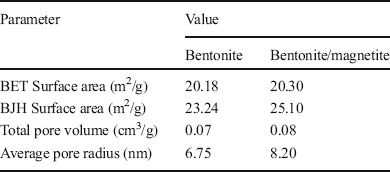
Analysis of the isotherms revealed the quantitative indices of pore structure for both bentonite and bentonite/magnetite powders, and that the total pore volumes were 0.07 and 0.08 cm3/g, respectively. The specific surface areas were calculated using both the BET (S BET) and BJH (S BJH) models. The specific surface area from both models was greater for bentonite/magnetite than for bentonite alone (Table 2), giving S BET and S BJH values of 20.30 and 25.10 m2/g, respectively, for bentonite/magnetite and 20.18 and 23.24 m2/g, respectively, for bentonite. The differences between S BET and S BJH values are probably due to different assumptions inherent in the BET and BJH models. For example, unlike the BET model, the BJH model is based on the Kelvin theory of cylindrical pore filling.
Specific surface areas and porosities of materials investigated

The pore-size distribution was plotted using the BJH model (inserts in Fig. 4a,b). The pore sizes in both bentonite and bentonite/magnetite composite were <45 nm. The pore-size distribution of bentonite/magnetite, however, was wider (with peaks near 4 and 9 nm) and the average pore radius was larger (8.20 nm vs 6.75 nm for bentonite).
Crystal Structure
The crystal structures of bentonite, magnetite, and bentonite/magnetite powders were evaluated by XRD measurements (Fig. 5). The XRD pattern of bentonite (Fig. 5a) contains a pronounced reflection at 7.76°2θ. This characteristic peak is assigned to the (001) plane, which agrees well with the reference pattern for montmorillonite (Joint Committee on Powder Diffraction Standards (JCPDS) card no. 13-0135).
XRD patterns for (a) bentonite, (b) bentonite/magnetite, and (c) magnetite (insert)

In the XRD pattern of magnetite (Fig. 5c), the diffraction peaks at 30.20, 35.62, 43.24, 57.32, and 62.71°2θ confirmed the existence of the Fe3O4 pure phase (JCPDS card no. 65-3107). The listed peaks can be indexed (as face-centered cubic Fe3O4 with lattice constant a = 0.84 nm) to the crystal planes (220), (311), (400), (511), and (440), respectively.
In the XRD pattern of bentonite/magnetite (Fig. 5b), the most intense diffraction peak at 7.30°2θ was assigned to the (001) crystal plane in bentonite. The characteristic peaks corresponding to planes (220), (311), and (400) in magnetite remained and were not obviously shifted. So, the Fe3O4 phase was not changed in the bentonite/magnetite composite.
On the basis of the patterns obtained, the interlayer distances, d, and crystallites sizes, L, in bentonite/magnetite were calculated. For this, Bragg’s law (Eq. 8) and the Scherrer equation (Eq. 9) were applied to the (001) peak:


where λ is the X-ray wavelength (λ = 0.154 nm), n is the order of reflection, β is the full width at half maximum (radian), and θ0 is the Bragg angle.
An experimental summary for the bentonite and bentonite/magnetite powders (Table 3) demonstrated that, with the introduction of magnetite, the basal spacing increased slightly from 1.14 to 1.21 nm. Apparently, this increase was caused by the attachment of magnetite to the edges of the clay particles. The crystallite size increased also (Table 3).
Crystal parameters for bentonite and bentonite/magnetite powders

Magnetic Behavior
Magnetic materials are of scientific interest due to their adsorbent ability under external magnetic fields. The possible uses of the magnetic material depend on the size of the hysteresis loop and coercivity. Substances with a wide hysteresis loop and high coercivity are used to produce permanent magnets, while materials with a narrow hysteresis loop and low coercivity are required for the manufacture of transformer and generator cores.
The plot of magnetization (M) vs magnetic field (H) recorded for synthesized bentonite/magnetite powder showed a strong hysteresis, indicating that the resultant bentonite/magnetite particles were ferromagnetic (Fig. 6). The inset photograph shows that the composite powder dispersed in water could be separated easily, within several minutes, by an external magnetic field.
Magnetization curves for bentonite/magnetite composite

On the basis of the plot of M vs H and its enlargement near the origin (other insertion in Fig. 6), the remanent magnetization (M r), saturation magnetization (M s), coercivity (H c), and squareness (M r/M s) were determined (Table 4).
Magnetic properties of bentonite/magnetite powder and pure magnetite

*Values for magnetite were obtained from Liao & Chen (Reference Liao and Chen2002).
The magnetic properties of magnetite (pure) synthesized by the same chemical co-precipitation of iron salts, as bentonite/magnetite powders used in the current study, were reported by Liao & Chen (Reference Liao and Chen2002) (Table 4). For composite powders, the saturation magnetization was >10 times less than for pure magnetite. Apparently, the reason for this is the smaller content of the magnetic component in the composite powder. The decrease in the M s value for composites compared to pure magnetite is consistent with the results from other studies (Liao & Chen Reference Liao and Chen2002; Barraqué et al. Reference Barraqué, Montes, Fernández, Mercader, Candal and Sánchez2018; Sebayang et al. Reference Sebayang, Kurniawan, Aryanto, Setiadi, Tamba, Djuhana and Sudiro2018).
The value of H c for magnetite is significantly less than that measured for the bentonite/magnetite powder in the present study. Apparently, the increase in H c in the composite is a consequence of the change in the magnetic dipole interaction after the precipitation of the magnetite particles in the pores and among clay layers.
Adsorption of Nitrofurazone by Bentonite/Magnetite from Aqueous Media
To assess the value of bentonite/magnetite powder in environmental protection, its performance in the removal of nitrofurazone was studied.
Surface Morphology and Composition
SEM-EDX analysis was carried out to evaluate the surface morphology and composition of the bentonite/magnetite powder and to confirm the adsorption of nitrofurazone on it (Figs. 7 and 8). The bentonite/magnetite particles were aggregated with various morphologies and sizes <50 μm (Fig. 7). This result agreed well with the granulometric analysis (Fig. 3b). Elemental analysis for O, Si, Al, and Mg estimated their contents to be 28.9, 20.3, 7.5, and 1.0 wt.%, respectively. Iron from magnetite accounted for 23.3 wt.% of the total composition of the composite. The analysis also identified chlorine and sulfur in the sample, which may have originated from the use of a solution containing FeCl3 and FeSO4.
EDX analysis (a) and SEM image (b) of the bentonite/magnetite composite

EDX analysis (a) and SEM image (b) of the bentonite/magnetite composite after nitrofurazone adsorption

The SEM image of the bentonite/magnetite surface after nitrofurazone adsorption (Fig. 8) showed changes during adsorption: namely, nitrofurazone was located on the surfaces of swollen clay particles. The presence of C and N was attributed to the nitrofurazone.
IR Spectroscopy
Interactions between nitrofurazone and bentonite/magnetite were followed by FTIR spectroscopy. Peaks in the range 3700–3000 cm–1 from the composite were due to stretching bands for structural O–H and H–O–H from adsorbed water (Fig. 9, spectrum a). The band at 1635 cm–1 belongs to the deformation vibration of adsorbed H2O molecules. The absorption band at 1400 cm–1 is assigned to the deformation vibrations of the OH groups at the edges of the Si–O tetrahedra. The band with a peak at 1042 cm–1 corresponds to the Si–O–Si valence vibrations of the SiO4 tetrahedra in the Mnt. Fluctuations of the Si–O–Si rings in the SiO4 tetrahedra and lattice vibration of Fe–O bonds in magnetite manifest themselves in the range 700–450 cm–1 (Ma et al. Reference Ma, Zhang, Yu, Shen, Zhang and Gu2003; Khashirova et al. Reference Khashirova, Musaev, Mikitaev, Malkanduev and Ligidov2009; Lou et al. Reference Lou, Zhou, Zhang, Zhang, Hu, Liu and Zhang2015).
IR spectra of (a) bentonite/magnetite composite, (b) nitrofurazone, and (c) bentonite/magnetite composite after nitrofurazone adsorption

In the nitrofurazone spectrum (Fig. 9, spectrum b), a broad absorption band was observed in the region of 3700–3000 cm–1. A maximum at 3415 cm–1 corresponds to the N–H stretching vibrations in the amide group. The absorption band at 2924 cm–1 is assigned to the stretching vibrations of the CH3 group. The absorption bands in the region 1700–1500 cm–1 correspond to the stretching vibrations of the C=O, C=C, C–NO2 groups, and to deformation vibrations of the NH group. The absorption band at 1463 cm–1 is assigned to the deformation vibrations of the CH group in the furfural ring. The intense absorption band with a maximum at 1038 cm–1 corresponds to the deformation vibrations of the C–O–C group.
In the spectrum of bentonite/magnetite composite after adsorption of nitrofurazone (Fig. 9, spectrum c), a significant change in the contour of the absorption band in the region 3700–2900 cm–1 and an increase in its half width were observed. These changes are believed to be caused by rearrangements in the hydrogen bond system of the adsorbent. The absorption band at 1046 cm–1 shifted by 4 cm–1 toward a higher wavenumber. The presence of nitrofurazone in the sorbent was confirmed by the low-intensity absorption band at 1463 cm–1.
The totality of changes identified in the spectrum of bentonite/magnetite after nitrofurazone adsorption suggests that nitrofurazone adsorption was accompanied by the formation of hydrogen bonds between the NH groups in nitrofurazone and oxygen-containing groups in bentonite.
Kinetics
The kinetics curve characterizing the accumulation of the drug in the adsorbent phase shows that the A t value increased very quickly and reached the limit (Fig. 10). This was caused by the strong driving force of the concentration gradient at the beginning of the process due to the numerous adsorption sites available. The adsorption level reached 65% after 6 h.
Effect of contact time with regard to nitrofurazone adsorption onto bentonite/magnetite composite (pH = 5.5; adsorbent dosage = 1 g/L; C 0 = 6.813×10⁻² mmol/L)

The adsorption kinetics for the adsorbent/nitrofurazone system were analyzed using the models of both pseudo-first-order (Eq. 2, model I) and pseudo-second-order (Eq. 3, model II).
The greater R 2 value and the smaller χ 2 red for model II compared to model I (Table 5) led to the conclusion that nitrofurazone adsorption by bentonite/magnetite powder is better described by kinetics model II. The goodness of fit of the pseudo-second order kinetics indicates that chemical rather than physical adsorption controls the rate of nitrofurazone adsorption.
Kinetics parameters of nitrofurazone adsorption by the magnetized bentonite/magnetite composite

The nitrofurazone adsorption was also modeled according to the Langmuir, Freundlich, and Temkin isotherms, given by Eqs. 5, 6, and 7, respectively. In the equilibrium solution concentration range of 0 to ~0.05 mmol/L, the amount of nitrofurazone in the sorbed phase increased almost linearly (Fig. 11), indicating that adsorption depended only on the amount of drug transported to the adsorbent surface and the number of adsorption sites was not limiting. However, at higher equilibrium solution concentrations, the isotherm became curvilinear due to a limited number of available adsorption sites.
Adsorption isotherm of nitrofurazone onto bentonite/magnetite composite (pH = 5.5; adsorbent dosage = 1 g/L)

Comparing the constants derived from these models, as well as comparing values for R2 and χ 2 red (Table 6), revealed that the adsorption of nitrofurazone on bentonite/magnetite was described less well by the Temkin isotherm (lower R2 and greater χ 2 red) and best by the Langmuir and Freundlich models, which differed little in their ability to predict the experimental results.
Constants and the adequacy indicators derived from adsorption models of nitrofurazone on the bentonite/magnetite composite

Apparently, with a further increase in nitrofurazone concentration in solution, the A eq value increased and reached the limiting magnitude due to the deficiency of adsorption sites on the adsorbent surface. However, this cannot be tested experimentally because greater concentrations are beyond the range of the calibration curve and, thus, the accuracy of the method is compromised (Fig. 2).
The magnetic character of the bentonite/magnetite system (see above) was undiminished by nitrofurazone adsorption, so this is an effective system for removing the drug from the liquid medium under an external magnetic field (Fig. 12).
Photographs illustrating the removal of nitrofurazone using a magnetic field

Conclusions
In the present study, bentonite/magnetite powder was produced by co-precipitation of iron salts onto or into the clay layers and was characterized using a variety of methods. Based on the data of both laser diffraction and scanning electron microscopy, the particle size produced was <50 μm. X-ray diffraction analysis showed that the Fe3O4 phases were unchanged upon incorporation into the bentonite/magnetite composite; magnetization curves confirmed that the bentonite/magnetite particles were ferromagnetic. The bentonite/magnetite composite had a significant adsorption capacity for nitrofurazone, giving a value of 3.2×10⁻² mmol/g of composite. The adsorption level reached 65% after 6 h. The adsorption kinetics were well described by a pseudo-second-order mechanism. These findings suggest that bentonite/magnetite materials can serve as magnetic adsorbents for removing pharmaceutical compounds from contaminated water bodies.
Acknowledgments
The work was supported by the Russia Foundation for Basic Research (Grant N 18-43-370015-a). Measurements were performed in the centre for joint use of scientific equipment “The Upper Volga Region Centre of Physicochemical Research.”
Compliance with Ethical Standards
Conflicts of Interest
On behalf of all authors, the corresponding author states that there is no conflict of interest.