Introduction
Many studies have reported associations between stressful events and child/adolescent behavioural and emotional problems (e.g. Swearingen & Cohen, Reference Swearingen and Cohen1985; Berden et al. Reference Berden, Althaus and Verhulst1990; Williamson et al. Reference Williamson, Birmaher, Anderson, Alshabbout and Ryan1995; Patton et al. Reference Patton, Coffey, Posterino, Carlin and Bowes2003; Grant et al. Reference Grant, Compas, Thurm, McMahon and Gipson2004; Morales & Guerra, Reference Morales and Guerra2006). However, there is still debate about the true role of stressful events in the development of psychopathology. Previously researchers argued that life stress truly influences the development of psychopathology (Berden et al. Reference Berden, Althaus and Verhulst1990; Grant et al. Reference Grant, Compas, Thurm, McMahon and Gipson2004). In contrast, others regarded experiences of stressful events as the consequence of already existing psychopathology, and stressful events to not influence the development of psychopathology (Swearingen & Cohen, Reference Swearingen and Cohen1985; Williamson et al. Reference Williamson, Birmaher, Anderson, Alshabbout and Ryan1995). There is now a growing consensus that stressful events and psychopathology mutually influence each other over time (Sandler et al. Reference Sandler, Tein and West1994; Kim et al. Reference Kim, Conger, Elder and Lorenz2003; Patton et al. Reference Patton, Coffey, Posterino, Carlin and Bowes2003). That is, experiences of stressful events are indeed more observed among those who already had elevated levels of psychopathology. However, once such stressful events are experienced, this does add uniquely to the development of psychopathology. In support of this, Kim et al. (Reference Kim, Conger, Elder and Lorenz2003) showed in a five-wave longitudinal study (age 12 to 18 years) that externalizing and internalizing symptoms predicted future experiences of stressful events. In turn, these experiences of stressful events predicted future increases in behavioural and emotional problems.
Despite the growing evidence that experiences of stressful life events – in part – account for the development of both emotional and behavioural problems, several important issues are yet unsolved. The first concerns the question whether stressful events influence the continuity of both externalizing and internalizing problems. Note that studies that explored the influence of stressful events on the development of behavioural and emotional problems addressed those outcomes separately. However, emotional and behavioural adjustment problems are not separate problems, but, rather, are likely to co-occur (Angold & Costello, Reference Angold and Costello1993; Keenan et al. Reference Keenan, Loeber and Green1999; Lavigne et al. Reference Lavigne, Cicchetti, Gibbons, Binns, Larsen and DeVito2001; Lahey et al. Reference Lahey, Loeber, Burke, Rathouz and McBurnett2002; Beyers & Loeber, Reference Beyers and Loeber2003; Wiesner & Kim, Reference Wiesner and Kim2006). To illustrate, co-morbidity rates of oppositional defiant disorder and conduct disorder in children and adolescents with major depressive disorder range from 21% to 83% in clinical and community samples (Angold & Costello, Reference Angold and Costello1993). Thus, when studying what the role of life events is in the development of both externalizing and internalizing problems, the co-occurrence between them should not be ignored. However, this is often the case. For instance, in the study by Kim et al. (Reference Kim, Conger, Elder and Lorenz2003) the role of stressful life events was tested for internalizing and externalizing problems separately, which may have led to the unwarranted conclusion that stressful events are of importance in the continuation of both internalizing and externalizing problems.
Second, apart from influencing the development of externalizing and internalizing problems themselves, stressful events may also play a role in the cross-influence between externalizing and internalizing problems. For instance, we know that externalizing and internalizing problems are linked across time, in that externalizing problems may lead to the onset of internalizing problems (Mesman et al. Reference Mesman, Bongers and Koot2001; Lahey et al. Reference Lahey, Loeber, Burke, Rathouz and McBurnett2002; Gilliom & Shaw, Reference Gilliom and Shaw2004) and that internalizing problems influence the development of externalizing behaviours (Beyers & Loeber, Reference Beyers and Loeber2003). The so-called failure model, developed by Capaldi and Patterson (Capaldi, Reference Capaldi1991, Reference Capaldi1992; Patterson et al. Reference Patterson, Reid and Dishion1992; Capaldi & Stoolmiller, Reference Capaldi and Stoolmiller1999) suggests that stressful events may partly account for the cross-influence between externalizing and internalizing problems. These authors suggested that the cross-influence from externalizing problems to the onset of internalizing problems occurs through failure experiences. Specifically, behavioural problems are expected to lead to stressful experiences such as interpersonal conflicts or lack of support and social rejection, which subsequently trigger feelings of failure, ultimately leading to symptoms of depression. Results from a study by Rowe et al. (Reference Rowe, Maughan and Eley2006) indeed showed that stressful life events stood in between the link of delinquency and oppositional behaviour to depressed mood. Note that the model delineated by Capaldi and Patterson particularly refers to failure experiences that are evoked directly by externalizing behaviours, such as stressful experiences due to conflicts with teachers or rejection by peers. In addition to this, maladjusted youths are found to be unproportionately exposed to other, less direct stressful circumstances such as multiple caretaker changes, father's history of conviction, and a negative parent–child relationship (Jaffee et al. Reference Jaffee, Caspi, Moffitt, Belsky and Silva2001). Moreover, the failure model further posits that as children progress to later stages of development, depressive feelings which were initially triggered by externalizing problems and stress may in turn start to predict elevated levels of antisocial behaviours. Although this proposition has not been clearly demonstrated yet, Wiesner & Kim (Reference Wiesner and Kim2006) showed in their longitudinal study that stressful life events were correlated to co-occurring pathways of delinquent behaviours and depressive symptoms in mid-adolescence. Thus, it seems clear from the previous that in order to study the role of stressful events on externalizing and internalizing problems, both should be considered simultaneously, as stressful events are expected to play a role in both the continuity within, and the cross-influence between, behavioural and emotional problems. This study's first aim is therefore to test the contribution of stressful events in both the continuity and cross-influence between internalizing and externalizing problems in a general population sample.
A third issue that needs clarification is the role of stressful events in the development of emotional and behavioural problems during the childhood period. From the longitudinal study by Kim et al. (Reference Kim, Conger, Elder and Lorenz2003), we know that experiences of stressful events explained part of the continuity of behavioural and emotional problems during adolescence. However, findings of effects of stressful events on psychopathology during childhood are limited. One study that focused on childhood did report a predictive association from stressful life events to elevated symptoms of overall psychopathology 2 years later (e.g. Berden et al. Reference Berden, Althaus and Verhulst1990). However, to our knowledge no studies examined the true role of stressful events on both internalizing and externalizing problems covering both the childhood as well as the adolescent years. Thus, our second aim is to add to this previous work by testing the role of stressful events in the continuity of, and cross-influence between, externalizing and internalizing problems from the age of 3 years to 18 years. Finally, although previous research has indicated that responses to stressful events are very similar in both sexes (Gore et al. Reference Gore, Aseltine and Colton1992; Kim et al. Reference Kim, Conger, Elder and Lorenz2003; Wiesner & Kim, Reference Wiesner and Kim2006), we aim to test sex differences in the role of stressful events in psychopathology development, as in childhood boys tend to show higher levels of externalizing problems, whereas in adolescence girls show more rapid increases in internalizing symptomatology (e.g. Bongers et al. Reference Bongers, Koot, van der Ende and Verhulst2003).
To summarize, our objective was to investigate the role of stressful events in the continuity of, and cross-influence between, emotional and behavioural problems in a general population sample of males and females followed from early childhood to late adolescence. Based on the findings by Kim et al. (Reference Kim, Conger, Elder and Lorenz2003) in adolescence, we expected to find transactional links between stressful events and externalizing and internalizing problems. That is, experiences of stressful events are predicted by prior externalizing and internalizing problems, but, once experienced, stressful events explain – in part – why individuals continue in having externalizing or internalizing problems. We also hypothesized that in accordance with the failure model (Capaldi, Reference Capaldi1991, Reference Capaldi1992; Patterson et al. Reference Patterson, Reid and Dishion1992; Capaldi & Stoolmiller, Reference Capaldi and Stoolmiller1999) the cross-influence between externalizing and internalizing occurs through the experience of stressful events. Finally, we expected that stressful events play a role in the development of, and cross-influence between, emotional and behavioural problems from childhood onwards, in addition to that effects of stressful events were expected to be equal in both sexes.
Method
Sample
The sample is described in detail elsewhere (Mesman & Koot, Reference Mesman and Koot2000; Timmermans et al. Reference Timmermans, van Lier and Koot2008). In short, the original sample of 420 children was taken randomly from the Dutch province of Zuid-Holland, using inoculation registers and the municipal population register of Rotterdam in 1989 (Koot & Verhulst, Reference Koot and Verhulst1991). Data were collected using multiple informants when children were aged 3 years (in 1989), 5 years (in 1991), 10 years (in 1997) and 18 years (in 2005). Written informed consent was obtained from parents at age 3, 5, 10 and 18 years assessments and from adolescents at age 18 years assessment. Parent data were available for 420 children out of 469 approached families (90%) at the first assessment (mean age=2.58 years, s.d.=7.3 months), for 396 children (95%) at the second assessment (mean age=4.83 years, s.d.=8.4 months), for 358 children (85%) at the third assessment (mean age=10.46 years, s.d.=7.2 months) and for 324 adolescents (77%) at the fourth assessment (mean age=18.19 years, s.d.=8.4 months). At the latter assessment, adolescent interviews were available for 247 participants.
Instruments
Stressful life events
At ages 5 and 10 years parents completed the Life Events Questionnaire (LEQ; Berden et al. Reference Berden, Althaus and Verhulst1990), which assesses 32 potentially stressful events, such as parental divorce, death of a family member, and long-term hospitalization. At the age of 10 years a short-form of the LEQ was used including 12 items. The items have a yes/no response format to indicate whether an event had occurred during the period between ages 3 and 5 years, and ages 5 and 10 years assessments. The item scores (0, 1) are summed into a total stressful life events score.
At age of 18 years, adolescents were interviewed using an adapted version of the Stressful Life Events Schedule (SLES; Williamson et al. Reference Williamson, Birmaher, Ryan, Shiffrin, Lusky, Protopapa, Dahl and Brent2003). This interview originally included 96 items concerning the participant him or herself, his or her close family members (first-degree relative and/or member of the household), or his or her best friends on various topics such as health (e.g. hospitalized or had surgery, family member or friend had serious injury or accident), school/work (e.g. failed major exams), death (e.g. family member or friend died) and relationships (e.g. major problems with family member or friend, parents divorced). Of the events, 31 were excluded because these events were considered normative (e.g. started menstrual cycle; four items) or irrelevant to this age period (e.g. problems with your child's conduct; 11 items), or applied to second- or third-degree relatives not living in participant's household (six items). In some cases events were possibly confounders of the results through effects of hereditary (e.g. mental illness of close relative; two items), were not applicable to the Netherlands (e.g. failed to get accepted to sports team, club or organization; five items), or the events were already covered elsewhere (e.g. unexpected bad news; three items). Experiences of the remaining 65 items over the period between age 10 years (third data wave) and age 18 years were assessed through interviewers with the adolescent. The total number of stressful events (including multiple occurrences of the same event) was used for the current analyses. The SLES has been found to have a good reliability and validity (Williamson et al. Reference Williamson, Birmaher, Ryan, Shiffrin, Lusky, Protopapa, Dahl and Brent2003).
Emotional and behaviour problems
Parent-reported externalizing and internalizing behaviours were assessed through the Dutch version of the Child Behavior Checklist for ages 2 and 3 years (CBCL/2–3; Achenbach, Reference Achenbach1992) at the first assessment, the Child Behavior Checklist for ages 4–18 years at the 5- and 10-year assessments (CBCL/4–18; Achenbach, Reference Achenbach1991) and the updated version for ages 6–18 years at the final assessment (CBCL/6-18; Achenbach & Rescorla, Reference Achenbach and Rescorla2001). For all instruments the response format is a three-point Likert scale (0=not true, 1=somewhat true or sometimes true, 2=very true or often true). Cronbach's α was 0.90, 0.86, 0.91 and 0.93 for the externalizing scales at ages 3, 5, 10 and 18 years, respectively, and 0.80, 0.72, 0.85 and 0.88, respectively, at those ages for the internalizing scales at these ages.
Procedure
The study was approved by the Erasmus Medical Center Ethical Committee. At the first assessment in 1989 (age 3 years), parents received a letter inviting them to participate in the study. Interviewers made an appointment for an interview at home. Parents were again approached in 1991 (age 5 years). After obtaining consent by phone, parents again were interviewed at home. In 1997 (age 10 years), all parents in the original sample were invited by mail to participate in the third assessment, regardless of participation at the second assessment. Respondents were contacted by phone to obtain consent to send them a package of questionnaires by mail as well as to send a number of questionnaires to the child and its teacher. In 2005 (age 18 years), all traceable adolescents and parents in the original sample were approached by mail for the fourth assessment. Parents were only invited after consent from the target adolescent. Parents could fill out questionnaires through mail (49.5%) or by the Internet. Adolescents were interviewed by phone.
Analyses
The analyses were conducted in two phases. In the first phase we aimed to confirm previous findings on the role of stressful events in psychopathology development, as this serves as the starting point to coming to our (final) model, testing all hypothesized effects at once. First, to test for the role of stressful events in the continuity of externalizing and internalizing problems, without the conditionality between both outcomes, externalizing and internalizing problems were analysed separately (two models). Then, to confirm our expectations of cross-influences between externalizing and internalizing problems, a model for externalizing and internalizing only was fitted. These three models were tested by fitting autoregressive cross-lagged models (Jöreskog, Reference Jöreskog1970). For example, for externalizing problems in the autoregressive part of the model, externalizing scores and stressful events were regressed on their immediate prior values. To test for the transactional relationship between externalizing behaviour and stressful events, cross-lagged paths were included.
Then, in the second phase of the analyses externalizing and internalizing were combined in an autoregressive cross-lagged model together with stressful events. To test for sex differences, a multiple group model was fitted (one for males, one for females). To test for model fit, the comparative fit index (CFI; Hu & Bentler, Reference Hu, Bentler and Hoyle1995) and the Tucker–Lewis index (TLI; Hu & Bentler, Reference Hu, Bentler and Hoyle1995) with critical values of ⩾90 and the root mean squared error of approximation (RMSEA) with a critical value ⩽0.08 (Browne & Cudeck, Reference Browne and Cudeck1992) were used. The structural models were fitted in MPlus version 4.21 (Muthén & Muthén, 1998–Reference Muthén and Muthén2007; Muthén & Muthén, USA).
Results
Preliminary analyses
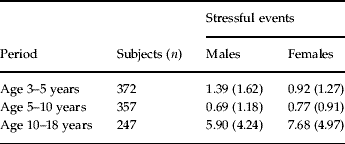
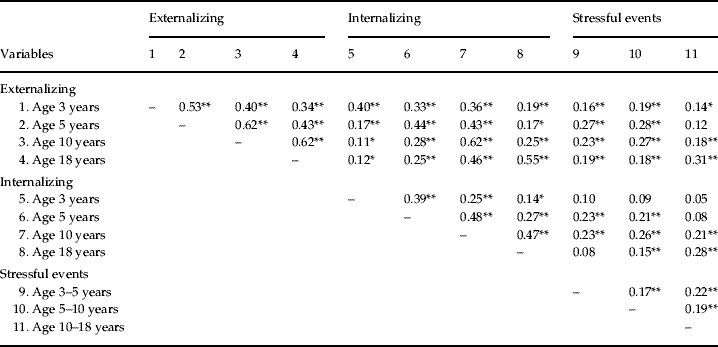
Cases with available data on stressful events on any assessment were included in the analyses (n=396). Mean levels of stressful events on each of the assessments are presented in Table 1. Table 2 shows correlations between all study variables.
Mean levels of stressful events between each assessment

Values are given as mean (standard deviation).
Correlations between repeatedly assessed study variables

* p<0.05, ** p<0.01.
We then fitted the three separated structural models. The model of externalizing and stressful events (see Fig. 1 a) had a good fit to the data (CFI=0.98, TLI=0.94, RMSEA=0.06). Only significant paths at p<0.05 are presented (estimates represent β). It showed that from age 3 years to age 18 years, externalizing problems predicted later stressful events, which in turn predicted subsequent externalizing problems. Fig. 1 b shows the results for internalizing problems and stressful events (CFI=0.97, TLI=0.92, RMSEA=0.05). Similar findings as for externalizing were found, apart that no significant link was found between internalizing symptoms at age 3 years leading to stressful events. The third model (see Fig. 1 c, CFI=1.00, TLI=0.99, RMSEA=0.03) showed that in addition to continuity within both externalizing and internalizing problems, cross-effects are found from ages 3 and 5 years externalizing problems to ages 5 and 10 years internalizing problems, respectively, and from age 10 years internalizing problems to age 18 years externalizing problems. To sum up, these results confirm the role of stressful events in externalizing and internalizing development when considered separately, as well as the cross-influence between externalizing and internalizing problems over time.
Results of autoregressive cross-lagged models on the role of stressful events in externalizing (EX) problems (a) and internalizing (IN) problems (b). Autoregressive cross-lagged model on the co-occurrence between externalizing and internalizing problems (c). LEQ, Life Events Questionnaire; SLES, Stressful Life Events Schedule. * p<0.05, ** p<0.01.

Role of stressful events on the continuity of, and cross-influence between, externalizing and internalizing problems
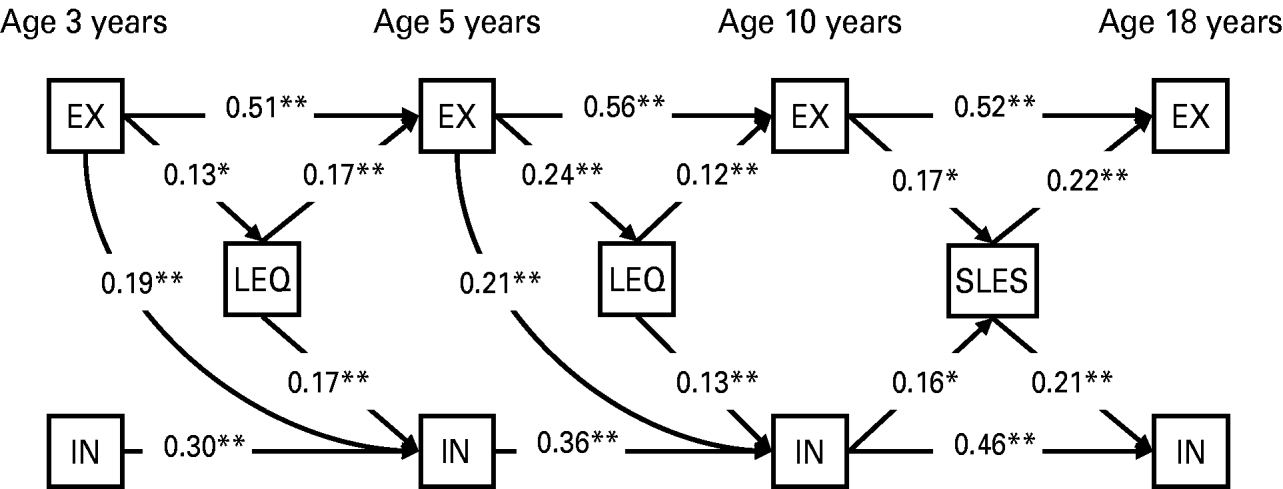
We then fitted the model containing both externalizing and internalizing problems in addition to stressful events. Results can be seen in Fig. 2. Only path estimates (β) significant at p<0.05 are shown. The model fitted the data well (CFI=1.00, TLI=0.99, RMSEA=0.03). This model showed continuity within externalizing and internalizing problems. No direct paths between experiences of stressful event were found.
Full autoregressive cross-lagged model on the role of stressful events on the continuity within, and the cross-influence between, internalizing (IN) and externalizing (EX) problems. LEQ, Life Events Questionnaire; SLES, Stressful Life Events Schedule. * p<0.05, ** p<0.01.

With respect to the continuity of externalizing problems, this model also showed that across the entire time span, externalizing problems predicted subsequent stressful events, which in turn predicted subsequent externalizing problems. To examine whether the continuity of externalizing problems were – in part – explained by experiences of stressful events we tested for the significance of the indirect paths from externalizing problems to subsequent externalizing problems via stressful events (MacKinnon et al. Reference MacKinnon, Lockwood, Hoffman, West and Sheets2002). The results showed that the indirect path from age 3 years externalizing problems to subsequent stressful events to age 5 years externalizing problems (B=0.02, s.e.=0.01, β=0.02, p<0.05), and from age 5 years externalizing problems to subsequent stressful events to age 10 years externalizing problems (B=0.03, s.e.=0.01, β=0.03, p<0.05) were significant. Although not significant at the 0.05 level, the results indicate a trend toward significance for the path of externalizing problems at age 10 years to externalizing problems at age 18 years via intermediate stressful events (B=0.04, s.e.=0.02, β=0.04, p=0.08).
In contrast to externalizing problems, over the childhood years, internalizing problems did not predict subsequent experiences of stressful events. Hence, the previously significant path from internalizing problems at age 5 years to stressful events was no longer significant, once externalizing problems were accounted for. However, internalizing problems at age 10 years predicted stressful events during adolescence, which in turn predicted internalizing problems at age 18 years. Again, this indirect path was tested. It showed a trend towards significance (B=0.04, s.e.=0.02, β=0.03, p=0.09).
In the childhood years, only cross-influence from externalizing to internalizing was found. Specifically, two direct paths, one from age 3 years externalizing problems to age 5 years internalizing problems and one from age 5 years externalizing problems to age 10 years internalizing problems were found. In addition to these direct paths, two indirect paths via intermediate stressful events at the same time interval were found (see Fig. 2). To test whether the direct effects of externalizing to internalizing were – in part – accounted for by experiences of stressful events, we tested for the significance of the indirect paths. The results showed that both indirect paths via stressful events were significant: age 3 years externalizing to age 5 years internalizing (B=0.01, s.e.=0.01, β=0.02, p<0.05); age 5 years externalizing to age 10 years internalizing (B=0.03, s.e.=0.01, β=0.03, p<0.05).
Finally, indirect paths from age 10 years externalizing problems to age 18 years internalizing via stressful events, and vice versa, were tested. Both these indirect paths were marginally significant: externalizing age 10 years to internalizing age 18 years (B=0.02, s.e.=0.04, β=0.03, p=0.08); internalizing to externalizing (B=0.03, s.e.=0.04, β=0.05, p=0.09).
Sex differences
To test whether the findings applied to both males and females, we compared the final model in which paths were constrained to be equal between both sexes to a sex-specific model in which estimates were allowed to vary. The χ2 difference test was not significant (Δχ2=47.74, df=37, p>0.05), indicating that the paths were not significantly different for males and females.
Missing data
As stated, for 37% of the cases data on stressful events were missing at one or two of the assessments. No differences were shown by t tests and χ2 tests between cases with complete data or cases with missing data with respect to sex (χ2=2.34, df=1, n=396, p>0.05), age (t=0.05, p>0.05), internalizing (t=−1.73, p>0.05) and externalizing problems (t=0.57, p>0.05) at age 2–3 years; however, cases with missing data were more often of lower socio-economic status (χ2=9.40, df=2, n=365, p=0.01). To test whether missing data influenced the model estimates we refitted the final model using only the restricted sample with no missing data (n=247). All except two paths found in our full sample remained significant; the paths from stressful events to age 5 years internalizing problems and from age 10 years internalizing problems to subsequent stressful events failed to reach conventional levels of significance. To test whether this was due to truly different estimates, or because of lack of statistical power due to the smaller sample, we fixed the parameter estimates of these two paths in the full sample to the estimates found in the smaller sample. The χ2 difference test showed no significant difference (Δχ2=1.57, df=2, p>0.05), indicating that estimates of the now insignificant paths were not different from the estimates found in the full sample, but became insignificant due to lack of power.
Discussion
This study found new evidence that stressful events influence the continuity as well as the cross-influence between internalizing and externalizing problems from early childhood to late adolescence, while being influenced by externalizing problems themselves. Specifically, these are our findings:
(1) Throughout childhood and adolescence, stressful events account – in part – for the continuity of externalizing problems.
(2) Stressful events also account for the continuity of internalizing problems, but only during adolescence.
(3) In childhood, stressful events partially account for the cross-influence of externalizing to internalizing problems.
(4) During the adolescent years, internalizing to externalizing cross-influences, and vice versa, run through the experiences of stressful events. These findings apply to both males and females.
With respect to externalizing problems, our results corroborate the proposition that, indeed, experience of stressful events and behaviour problems work together in a cycle of ongoing adjustment problems and experience of life stress, and in this way help explain why externalizing problems persist (Steinberg & Avenevoli, Reference Steinberg and Avenevoli2000; Kim et al. Reference Kim, Conger, Elder and Lorenz2003) from as early as age 3 years on. However, it should be noted that the indirect paths via life stress contributing to continuation in externalizing problems in adolescence were just below the adopted level of significance. Nevertheless, given the consistency of the results reaching significance at p<0.10 level in adolescence (also for continuation in internalizing problems and cross-influence between externalizing and internalizing problems between ages of 10 and 18 years), the hypotheses of stressful events contributing to the development of psychopathology in adolescence could not be rejected with any certainty.
This study also showed the importance of accounting for the co-occurrence between internalizing and externalizing problems when studying the influence of stressful events on psychopathology. Specifically, it showed that when considered separately, life stress and internalizing problems were mutually related to each other in both childhood and adolescence. However, during the childhood years, the paths of internalizing problems to stressful events were accounted for by co-occurring externalizing problems. Thus, in accordance with prior studies (Kim et al. Reference Kim, Conger, Elder and Lorenz2003; Patton et al. Reference Patton, Coffey, Posterino, Carlin and Bowes2003), experiences of life stress are important in explaining the continuity of internalizing problems during adolescence. During childhood, co-occurring externalizing problems seem to account for the influence of stressful events in the course of internalizing problems. Perhaps because the manifestation of depression and anxiety symptoms becomes more profound in adolescence (e.g. Bongers et al. Reference Bongers, Koot, van der Ende and Verhulst2003), this may lead to increasing negative social consequences of internalizing behaviours such as social rejection.
Experience of stressful events also contributed to the cross-influence between externalizing and internalizing problems. As outlined by Caron & Rutter (Reference Caron and Rutter1991), two of a number of possible explanations of true co-morbidity are (1) shared risk factors and (2) one disorder creating an increased risk for the other. Our results seem to support the first explanation for the adolescent years and the latter for the childhood years. In fact, our findings almost fully supported Capaldi's and Patterson's failure model (Capaldi, Reference Capaldi1991, Reference Capaldi1992; Patterson et al. Reference Patterson, Reid and Dishion1992; Capaldi & Stoolmiller, Reference Capaldi and Stoolmiller1999). Indeed, our results clearly indicate that from early childhood onwards, externalizing problems add to increases in internalizing problems over time. Stressful events were always in between this relationship. In adolescence, internalizing problems indeed also predicted increasing externalizing problems, again via experiences of stressful events. Our findings are also consistent with earlier findings in adolescence suggesting that the association between delinquency and depressed mood was mediated by negative stressful events (Rowe et al. Reference Rowe, Maughan and Eley2006), and in addition with findings by Wiesner & Kim (Reference Wiesner and Kim2006) showing that stressful life events correlated with co-occurring pathways of delinquency and depressive mood.
Finally, our results showed that there is no continuity in life stress scores once externalizing and internalizing symptoms were taken into account. That is, with either externalizing or internalizing alone, continuity paths in event scores were found, but these disappeared when both internalizing and externalizing problems were accounted for. This suggests that children's behaviour accounts for the continuity between events scores rather than continuity in adverse experiences contributing to continuity in behaviour problems.
The current results should be viewed against a number of limitations. The first limitation regards the relatively small sample size. Although it was a general population sample, followed up for 15 years, we lacked power to assess the specific role of stressful events in the development of clinically elevated levels of psychopathology. In this regard, it is also important to note that some of the (indirect) paths via stressful events during the adolescent years just failed to reach conventional significance levels of 0.05. This could well be due to lack of power, especially considering the large interval (ages 10–18 years), and the use of multiple informants (parents and adolescents). Although these paths were in accordance with the theoretical framework and our hypotheses, these particular results in adolescence should be interpreted with caution. We would therefore like to see these results replicated in larger samples.
Second, the interval between the subsequent assessments was quite large, especially in the adolescence period (between ages of 10 and 18 years). We could not control for the interval between the experience of life stress, and the assessment of behavioural and emotional problems. This raises an issue of the potential difference in impact of distant versus recent stressors on psychological symptoms, with distant events being less intrusive than recent ones. However, a study by Ensel et al. (Reference Ensel, Peek, Lin and Lai1996) showed that of stressors occurring in a 15-year period, early stressors had a significant impact on current depressive symptoms above and beyond the effect of recent stressors. Also, particularly the large time span between ages 10 and 18 years may have caused a recall bias in adolescents, as recent events are more likely to be recalled than early events. However, the extensive list of possible stressful events provided in the SLES (Williamson et al. Reference Williamson, Birmaher, Ryan, Shiffrin, Lusky, Protopapa, Dahl and Brent2003) may have minimized the chance of missing out on events that had occurred in the earlier years of the adolescent period. Another consequence of the gap between ages 10 and 18 years is that we could not study the possible direct effect of stressful events on increases in externalizing and internalizing problems in adolescence. That is, adolescence is pre-eminently the period in which individuals experience high levels of stressful events as well as in which both externalizing and internalizing problems tend to increase (Farrington, Reference Farrington1986; Moffitt, Reference Moffitt1993; Arnett, Reference Arnett1999; Ge et al. Reference Ge, Conger and Elder2001). Third, during the childhood years, parent-reported symptoms and stressful events as well as parent-rated childhood psychopathology were used. Although over the childhood years, parents may be the best informant on both children's behaviour and experienced life events, this may have produced informant bias. However, during the adolescent years, adolescent-reported stressful events and parent-reported child psychopathology was used. The use of adolescent-reported life events may be of particular importance in this period when youths are becoming independent of their parents. Apart from different informants, we also used different measures of life stress. This may reduce comparability of the results over time. However, at each time of data collection the authors thought of methods which were most appropriate for each age period. Although the LEQ is found to appropriately assess life stress in childhood, it is not sensitive in adolescence. In contrast, the SLES is found to be sound for the adolescent (and adult) years, but highly inappropriate in childhood. Fourth, we did not distinguish between life events in specific domains (school, interpersonal conflict, family). In the life events questionnaire used in the childhood years (LEQ) such domain-specific distinctions cannot be made. Given the results of this study, future studies should focus on differential effects of various types of stress on psychological symptoms. A final remark has to be made with respect to the possible existence of confounding factors. Stressful events may be associated with other time-varying or enduring adversities that were not measured by the study. Most importantly, regardless of single or multiple informants, and the use of different, albeit developmental phase-specific, measures of life events, our results confirmed our hypotheses.
Despite these limitations, our findings may have important implications for both research and practice. This study clearly underlines the necessity to account for stressful events when trying to understand the continuity of, and co-occurrence between, emotional and behavioural problems. With regard to prevention practices, the findings underscore the importance of the assessment of stressful events from childhood onwards. Specifically, practitioners should be aware of young children's behavioural responses to stressful experiences, because these put them at risk for increasing life stress, and subsequent emotional and behavioural problems, resulting in an ongoing cycle of increasing life stress and behavioural and emotional maladjustment.
Declaration of Interest
None.