1. Introduction
The study of Ordovician trilobites in Baltoscandia goes back at least to the days of Carolus Linnaeus (Carl von Linné). The agnostids, now understood to be distinct from trilobites, were included in earlier studies and are also included here. A modern taxonomic standard with short descriptions, binominal names and figures was introduced in a monographic study by Göran Wahlenberg (Reference Wahlenberg1818, Reference Wahlenberg1821a , Reference Wahlenberg b ), who described eleven new species. By the end of the 1820s Wilhelm Dalman (Reference Dalman1827) had described or listed 30 species of Swedish trilobite and listed all reported trilobites (22 species) from the rest of the world (Bergström, Reference Bergström, Mikulic, Landing and Kluessendorf2007). Sars (Reference Sars1835) and Boeck (Reference Boeck and Keilhau1838) are other early contributors to our knowledge of Scandinavian trilobites. Nils Petter Angelin (Reference Angelin1851, Reference Angelin1854, Reference Angelin and Lindström1878) provided a comprehensive volume on primarily Swedish trilobites. Simultaneously trilobite study started on the eastern side of the Baltic Sea, where Eduard Eichwald described 25 new species (Reference Eichwald1825, Reference Eichwald1840, Reference Eichwald1843, Reference Eichwald1857, Reference Eichwald1860, Reference Eichwald1861). A few more were established by Pander (Reference Pander1830), Leuchtenberg (Reference Leuchtenberg1843) and Volborth (Reference Volborth1863), and 17 new species by Nieszkowski (Reference Nieszkowski1857, Reference Nieszkowski1859). Around the turn of the century, the eastern Baltic trilobites were treated in a series of contributions by Friedrich Schmidt (Reference Schmidt1881, Reference Schmidt1885, Reference Schmidt1894, Reference Schmidt1898, Reference Schmidt1901, Reference Schmidt1904, Reference Schmidt1906, Reference Schmidt1907). In the 20th century, trilobites were studied by many specialists, but not according to any general plan, and not aiming at any comprehensive overview. Therefore our knowledge is uneven, with some intervals, faunas and groups being treated fairly recently, others more or less forgotten for the last century.
One of the first biostratigraphical attempts at a comprehensive correlation of the entire Ordovician succession (known as the Lower Silurian at that time) in the eastern Baltic, and its comparison with that in Sweden was made by Friedrich Schmidt (Reference Schmidt1858). It was based mainly on trilobites. Since then, stratigraphic division and nomenclature as well as stratigraphic precision have evolved continuously. The whole of the sequence that we are concerned with below is summarized as the Öland Series. This concept was introduced by Kaljo, Rõõmusoks and Männil (Reference Kaljo, Rõõmusoks and Männil1958) in the process of unifying stratigraphical charts in the eastern Baltic and Baltoscandia. The three-fold division of the Ordovician included the Öland, Viru and Harju Series. In general, it follows the stratigraphical chart of Öpik (Reference Öpik1930) that was based on trilobites, except that the lowermost division is devoid of trilobites (Öpik's divisions from the bottom are the Obolus, Asaphus, Chasmops and Isotelus series). Luha (Reference Luha1940) gave geographical names (Iru, Tallinn, Viru and Harju) to these series; the two lowermost were later merged into one, the Iru Series (Kaljo, Rõõmusoks & Männil, Reference Kaljo, Rõõmusoks and Männil1958). As the Lower Ordovician succession in Estonia is too fragmentary, the isle of Öland was accepted as the more appropriate area for the stratotype of this unit. Nowadays, the Öland Series includes the Pakerort, Varangu, Hunneberg, Billingen, Volkhov and Kunda regional stages and covers the British stages from the Tremadoc to the middle Llanvirn, or the global stages Tremadocian, Floian, Dapingian and part of the Darriwilian (Nõlvak et al. Reference Nõlvak, Hints, Männik and Pärnaste2007). What keeps this series as a more or less natural unit is the dominance of limestone facies with numerous asaphid trilobites through much of it, with the Tremadocian alum shale and later graptolite shale facies in marginal environments excepted.
The aim of this paper is: (1) to review the nomenclature of all published Baltoscandian trilobites; (2) to review the occurrences of all taxa through 13 areas over the basin; (3) to correlate trilobite biozones with recently revised graptolite and conodont biozones as well as with global stage slices; (4) to map the development of trilobite faunas through the Öland Series in particular for a planned comparison with the evolution in similar sedimentary environments in the Yangtze Block of China (cf. Zhou et al. Reference Zhou, Bergström, Zhou, Yuan and Zhang2011; Bergström et al. in press).
2. Material and methods
The trilobite data in this paper were carefully collected from the literature, with additional information from specimens examined at the institutions listed below (see online Appendix for a list of all data sources, http://journals.cambridge.org/geo). The unevenness of the publications have made necessary a thorough revision including the updating of generic names, consideration of synonyms on genus and species levels, and reconsideration of vertical and horizontal distributions. For many old descriptions, we still do not know the levels well enough to place them in the detailed regional biozonal system that is in use today. The overview, which is presented in the online Supplementary Material (available at http://journals.cambridge.org/geo) therefore shows data with variable precision. Letters ‘a, b, c’ are used for levels in the tables wherever the exact trilobite zone is known. When the exact zone within the interval of a table is unknown, the presence is marked with an ‘x’ in all columns. If the taxon occurs only in the lower or upper portion of the zone, it is marked with addition of 1 (i.e. a1) or 2 (i.e. b2) accordingly. A question mark ahead of such a letter indicates a doubtful assignment, whereas such a mark alone means that the stratigraphical level is uncertain. When a taxon has been recently revised (e.g. by Nielsen, Reference Nielsen1995; Bruton et al. Reference Bruton, Hoel, Beyene and Ivantsov1997; Ebbestad, Reference Ebbestad1999; Hoel, Reference Hoel1999a , Reference Hoel b ; Pämaste, Reference Pärnaste2003, Reference Pärnaste2006a , Reference Pärnaste b ; Ivantsov, Reference Ivantsov2004; Hansen, Reference Hansen2009; Pärnaste et al. Reference Pärnaste, Popp and Owens2009) we generally follow the suggested synonymy. When not (and we have not newly assigned a name), we prefer to employ the latest published name. The sediments without preserved trilobites (some shales or sandstones) are marked with ‘–’ and gaps with ‘o’.
There are also a number of superfluous genus and subgenus names, not least in Russian literature, which do not have any obvious phylogenetic meaning and may rather be misleading. We have therefore had to revert to the use of Megistaspis, Asaphus and Ptychopyge in broader and supposedly, more ‘natural’ senses. On the other hand, we keep Niobe and Niobella apart since these genera seem to define conservative lineages that go back to the Cambrian. The studied material includes unpublished specimens deposited at different institutions.
Institutional abbreviations. LO – Division of Geology, Department of Earth and Ecosystem Sciences, Lund University; MGUH – Geological Museum, Copenhagen University; SGU – Geological Survey of Sweden, Uppsala; PMU – Museum of Evolution, Uppsala University; NRM – Swedish Museum of Natural History, Stockholm; PMO – The Natural History Museum (Geology), University of Oslo; GIT – Institute of Geology, Tallinn University of Technology; TUG – Geological Museum of the University of Tartu; LDM – Latvian Museum of Natural History, Riga; CNI – All-Union Scientific Research Institute of Geology, St. Petersburg; PSM – Museum of Paleontology and Stratigraphy, University of St. Petersburg; PIN – Paleontological Institute of the Russian Academy of Sciences in Moscow.
3. Geological setting
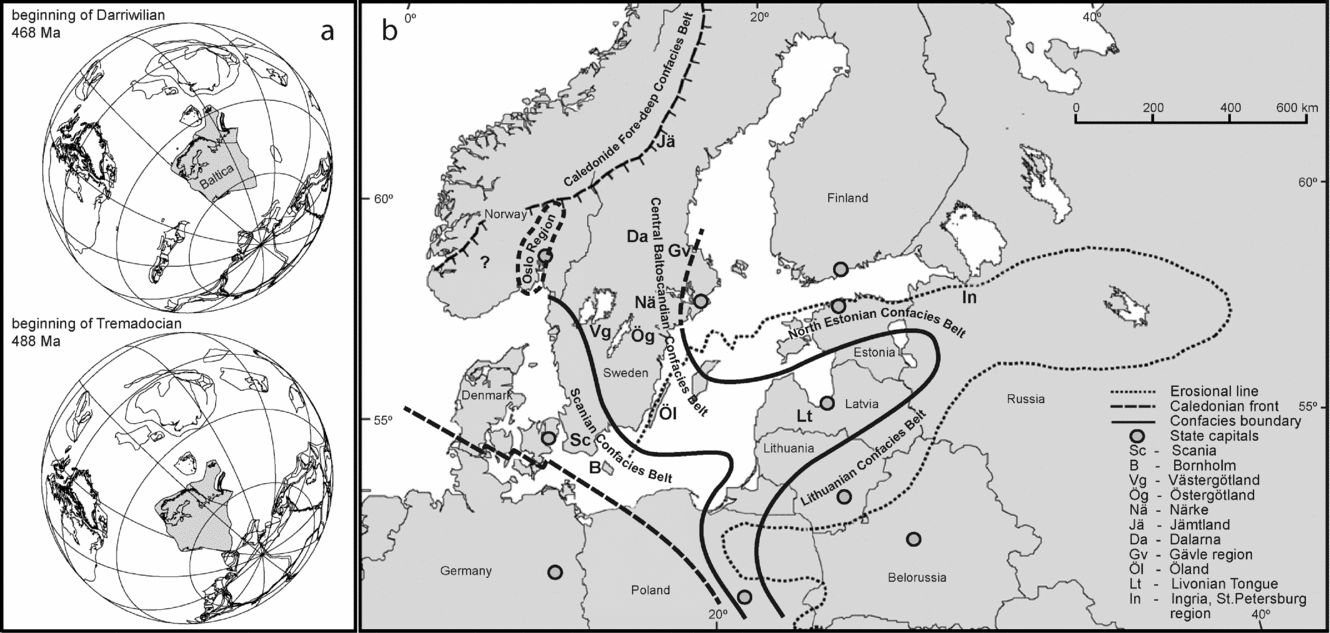
During Early Ordovician time, the terrane of Baltica drifted steadily northwards from South Pole rotating slightly counter-clockwise (Fig. 1a). Being situated in median latitudes and surrounded by fairly wide oceans, Baltica had a benthic fauna that developed in a relatively endemic direction (Cocks & Torsvik, Reference Cocks and Torsvik2005). Sediments of the Öland Series of Baltoscandia indicate a shallow extensive epicontinental sea, reaching at least two thousand kilometres further than most off shore deposits preserved today (e.g. Bornholm, Scania) at the northern German – Polish Caledonian front. Faunally and lithologically, the deposits outline an out-stretched area of facies belts (Männil, Reference Männil1966; Jaanusson, Reference Jaanusson and Bassett1976, Reference Jaanusson, Bruton and Williams1982). The Baltoscandian palaeobasin is generally subdivided into four confacies belts from offshore to onshore: the Scanian, Oslo, Central Baltoscandian and North Estonian with its counterpart, the Lithuanian (Fig. 1b). This division of confacies belts does not hold for lower and middle Tremadocian strata. The dominant lithofacies for this interval is bituminous alum shale that contains a fauna with graptolites and a few olenid trilobites. In Estonia this level, except for its upper part, has alum shale seams and sandstone that is rich in inarticulate brachiopods. On the whole, the alum shale facies with olenids ranges from Middle Cambrian to Upper Tremadocian strata. It has been suggested that the black facies was caused by ‘global hyperwarming’ in a very shallow sea with dysoxic (to anoxic) chemical conditions (Landing, Reference Landing2011). Shallow marine conditions would explain the patchy Tremadocian distribution of thin alum shale; otherwise, there would be conglomeratic or sandy sediments over much of Baltoscandia.
(a) Palaeogeographical position of Baltica (shaded in grey) during Ölandian time. (Map generated using the T. H. Torsvik's GIS-oriented software, BugPlates: linking biogeography and palaeogeography, 2009). (b) The confacies (bio-lithofacies) belts of Baltoscandia. The conventional Oslo Confacies Belt is here considered to be a tectonically delimited region of unusual relief rather than an extended belt with intermediate low relief. The Jämtland autochthon has central Scandinavian type limestone from the upper Tremadocian to the top of the Darriwillian Stage and clastic sediments occur only in allochthonous rocks transported from the Caledonian area in the west (Jaanusson & Karis, Reference Jaanusson, Karis, Bruton and Williams1982, p. 44). The Caledonide Fore-deep Confacies Belt is introduced.

The Oslo Confacies Belt differs from the others in having strongly varying lithologies and faunas, indicating marked bottom topography as compared with the generally leveled bottoms of the other belts. We conclude in Section 5 that it is not comparable to the others but rather constitutes a limited, tectonically influenced region. We therefore use the geographical term Oslo Region. The western boundary of the Central Baltoscandian Confacies Belt is generally extended to the north from the Oslo area. This implies that the whole of Norway belonged to the Scanian Confacies Belt. This appears to be an over-simplification. In early Ordovician times, before Caledonian movements had started, the shallow shelf appears to have extended far to the west (perhaps around 100 km) of where we now see the Caledonian front, with only a gentle dip to the west (Greiling et al. Reference Greiling, Jensen and Smith1999). With the growth of the Caledonides in the west, clastic sediments were deposited in a fore-deep to the east of the rising land. With tectonic nappes proceeding eastwards the fore-deep probably also shifted eastwards with time. This zone should have formed an additional Caledonide Fore-deep Confacies Belt, but for Ölandian strata there is little information about the faunas in this belt. Later on it was characterized by species of the asaphid genus Ogygiocaris. It is probably the fore-deep sediments that suggested to Hansen (Reference Hansen2009, figs. 3–4) and Hansen, Nielsen & Bruton (Reference Hansen, Nielsen and Bruton2011, fig. 2) a deep trough extending from Oslo to the Östersund area.
4. Stratigraphy and trilobite zonation
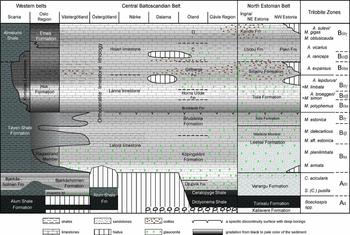
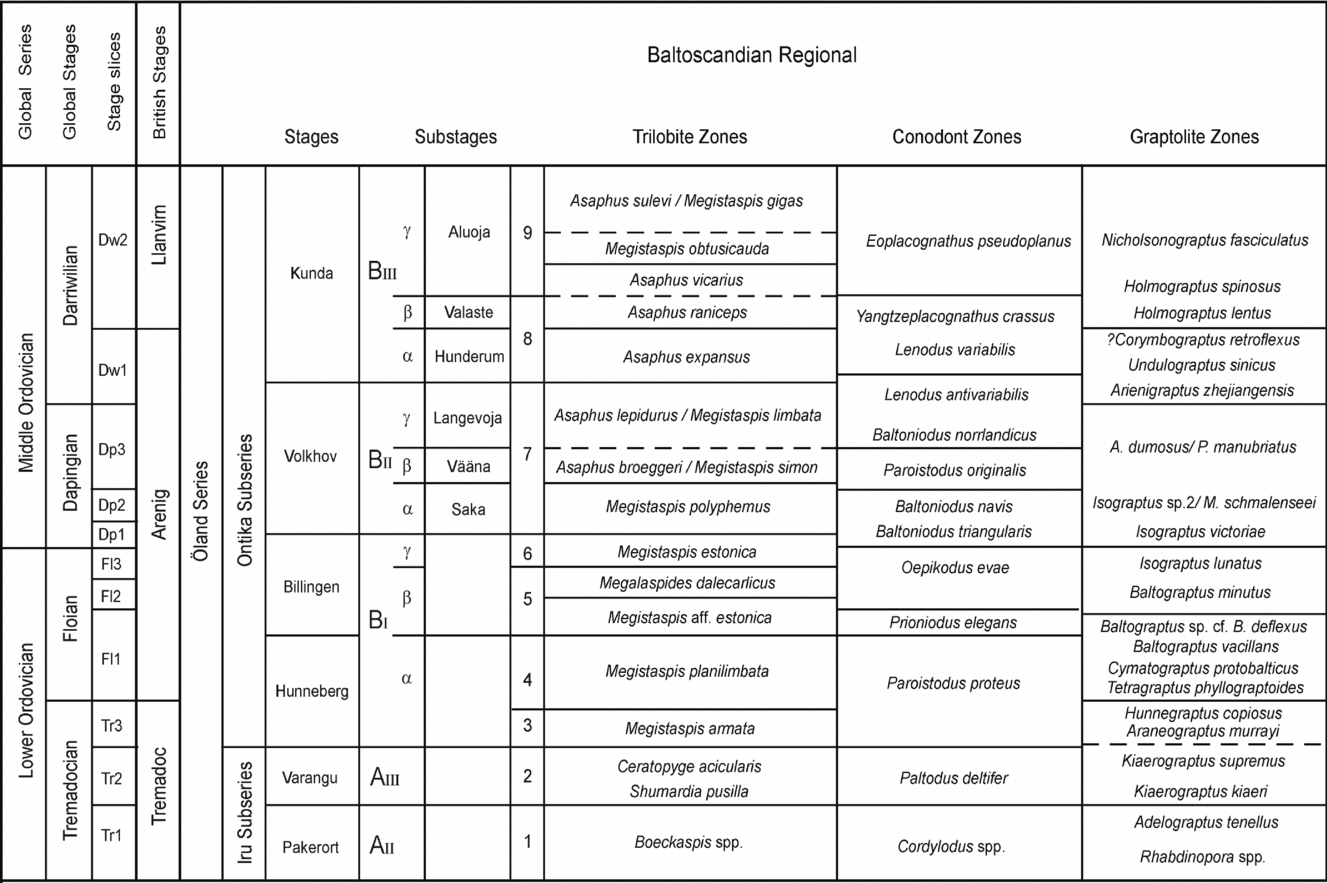
Traditionally, quite different classification systems for stratigraphy have been used in the various regions of Baltoscandia. Often, lithostratigraphic units are rather limited geographically. However, the distribution of faunas is less restricted (Fig. 2). A formal zonation has long been used (except for Norway) with symbols (BIα to BIIIγ for the intervals treated herein) for sets of biozones described by Lamansky (Reference Lamansky1905). These biozones are now standardized into regional substages. Different stratigraphic symbols have been used in the Oslo Region, where there was a system of stages (etasje) with subdivisions. The Norwegian units were not really defined by biostratigraphic boundaries and are now ‘replaced’ by formal lithostratigraphic units (Owen et al. Reference Owen, Bruton, Bockelie and Bockelie1990). However, there is neither official formal chronostratigraphic subdivision replacing the old Norwegian bio-lithological divisions, nor alternative zonation. Fortunately, as far as trilobite zones are concerned, this deficiency has been partly addressed in the Ölandian through contributions by Nielsen (Reference Nielsen1995), Ebbestad (Reference Ebbestad1999) and Hoel (Reference Hoel1999a , Reference Hoel b ). On the whole correlation of the trilobite faunas across Baltoscandia is not difficult, except for the upper Kunda Regional Stage, in which each of the belts has its own set of trilobite species. The correlation and division that we use for that level are therefore of a preliminary character. To give wider perspective to this overview, the Baltoscandian trilobite zones are correlated with recently reviewed conodont (Löfgren, Reference Löfgren2000; Viira et al. Reference Viira, Löfgren, Mägi and Wikström2001; Pärnaste, Reference Pärnaste2006a ; Bergström & Löfgren, Reference Bergström and Löfgren2009) and graptolite zonation (Maletz, Löfgren & Bergström Reference Maletz, Löfgren and Bergström1996; Maletz & Ahlberg, Reference Maletz and Ahlberg2011) and via those also with global stages and stage slices (Nõlvak et al. Reference Nõlvak, Hints, Männik and Pärnaste2007; Bergström et al. Reference Bergström, Chen, Guiterrez-Marco and Dronov2009) (Fig. 3).
Regional stratigraphic units and correlation.

Stratigraphic classification with biostratigraphical subdivision of the Öland Series in Baltoscandia modified from Pärnaste (Reference Pärnaste2006a ; see discussion and references therein), with refreshed graptolite data by Maletz and Ahlberg (Reference Maletz and Ahlberg2011), and following the revised global standard (Bergström et al. Reference Bergström, Chen, Guiterrez-Marco and Dronov2009). The graptolites in the Lower Tremadoc (Tr1) represent ‘superzones’; for a finer zonation, see Egenhoff et al. (Reference Egenhoff, Cassle, Maletz, Frisk, Ebbestad and Stübner2010). The numbering of our study intervals presented in Tables S1–7 (online Supplementary Material available at http://journals.cambridge.org/geo) is shown to the left of the trilobite zonation.

4.a. Pakerort Stage: Boeckaspis spp. Zone
At the base of the Öland Series is a black, organic rich, alum shale (previously known as the Dictyonema Shale, the nominal genus of which is now known as Rhabdinopora) over most of the basin. In its lower part, the fauna is dominated by dendroid graptolites, but there are also a few, mostly olenid, trilobites (Table S1, http://journals.cambridge.org/geo). The base of the shale becomes younger shorewards, i.e. in the North Estonian Confacies Belt (Türisalu Formation; Fig. 2), and is replaced in the lower part by sandstones rich in inarticulate brachiopods (Kallavere Formation). Unfortunately, they are devoid of trilobites. The divisions in the much of the Tremadocian section are problematical. Boeckaspis spp. and Hysterolenus toernquisti have been used as zonal indicators in Norway and Sweden, respectively. We do not know the exact level for their first appearance. According to Henningsmoen (Reference Henningsmoen1957, pp. 41–42), Boeckaspis hirsuta is found in the second subzone (R. flabelliforme sociale Subzone) of the Rhabdinopora flabelliforme Biozone, Boeckaspis mobergi in the third subzone (R. f. flabelliforme Subzone). Neither of them is thus known from the very base of the Tremadocian in Scandinavia, and a zone with any of the names would have to be provisional. Hysterolenus toernquisti is said to be from the Dictyonema beds, but the exact level is unknown. The restricted geographical distribution of all these species also makes a formal zone questionable. However, species of Boeckaspis are fairly widely distributed in the R. flabelliforme Biozone, and we therefore accept the Boeckaspis spp. Zone as a provisional unit corresponding to this graptolite biozone and the successive Adelograptus tenellus Biozone, the latter being almost devoid of trilobites (see also Bruton, Erdtmann & Koch, Reference Bruton, Erdtmann, Koch, Bassett and Dean1982; Bruton, Koch & Repetski, Reference Bruton, Koch and Repetski1988).
4.b. Varangu Stage: (a) Shumardia (Conophrys) pusilla and (b) Ceratopyge acicularis Biozones
In the upper part, the alum shale grades into black to grey shale and limestone with the so-called Ceratopyge trilobite fauna (Table S2, http://journals.cambridge.org/geo), covering the old Shumardia (Conophrys) pusilla and Apatokephalus serratus Biozones. The Ceratopyge beds (corresponding to a now obsolete Ceratopyge forficula Biozone) have been subdivided into a lower Shumardia (C.) pusilla Biozone (corresponding to the Ceratopyge shale, now included to the Alum Shale Formation; Owen et al. Reference Owen, Bruton, Bockelie and Bockelie1990), and an upper Apatokephalus serratus Biozone (Moberg & Segerberg, Reference Moberg and Segerberg1906; corresponding to the Ceratopyge limestone, now the Bjørkåsholmen Formation). In addition, there is the Platypeltoides incipiens Biozone in the Oslo Region, which is now considered to be correlated to an stratigraphic interval in the very base of the S. (C.) pusilla Zone and that of the Ceratopyge shale (3aα; Brøgger, Reference Brøgger1882, Reference Brøgger1896; Henningsmoen, Reference Henningsmoen1973; Owen et al. Reference Owen, Bruton, Bockelie and Bockelie1990, p. 7, fig. 2). The shale above the ‘Platypeltoides incipiens Limestone’ contains Kiaerograptus kiaeri, which is a graptolite biozone underlying the K. supremus Biozone. However, co-occurring trilobites (e.g. Peltocare norvegicum, Parabolinella limitis, Orometopus primigenius, S. (C.) pusilla?, A. serratus?, C. forficula?) indicate that it would better be interpreted as a limestone facies aspect of the Shumardia (C.) pusilla Biozone.
The two nominal species of the S. (C.) pusilla and A. serratus Zones range through both zones (Ebbestad, Reference Ebbestad1999; Frisk & Ebbestad, Reference Frisk and Ebbestad2008). A. serratus cannot therefore be used as an indicator of the latter zone. Some differences have recently been identified between specimens of S. (C.) pusilla in the lower and upper zones (Ebbestad, Reference Ebbestad1999, p. 31), but the younger form cannot be used to distinguish a separate zone until the taxonomic separation is formally published.
Even apart from the zonal species, the species composition in the two zones is in fact so similar that there is reason to question the separation. However, we keep the division for historical and practical reasons but rename the upper zone as the Ceratopyge acicularis Zone. The nominal species used to be known as C. forficula, but Ebbestad (Reference Ebbestad1999) and Frisk & Ebbestad (Reference Frisk and Ebbestad2008) revealed that this species is restricted to the Shumardia (C.) pusilla Zone, whereas the species found in the upper zone is in fact C. acicularis (see Ebbestad (Reference Ebbestad1999) for a synonymy list). The base of the C. acicularis Zone is defined by the first appearance of the zonal species at Prestenga, Slemmestad, Norway (Frisk & Ebbestad, Reference Frisk and Ebbestad2008, fig. 2) where it coincides with the base of the Bjørkåsholmen Formation.
4.c. Hunneberg Stage: (a) Megistaspis armata and (b) M. planilimbata Biozones
Intervals 3 and 4 (Table S3, http://journals.cambridge.org/geo) correspond to the Hunneberg Stage (previously a substage of the Latorp Stage), that was formerly thought to be basal Arenig in age (Tjernvik, Reference Tjernvik1956). The basal Megistaspis armata Zone is now considered to belong to the Tremadocian, whereas the M. planilimbata Zone falls within the Floian according to graptolite and conodont evidence. In the Diabasbrottet section, Västergötland, where the Floian is defined by the FAD of Tetragraptus phyllograptoides and Megistaspis planilimbata occurs in a limestone bed immediately underlying shales with T. phyllograptoides (Maletz, Löfgren & Bergström, Reference Maletz, Löfgren and Bergström1996; Bergström, Löfgren & Maletz, Reference Bergström, Löfgren and Maletz2004; Bergström et al. Reference Bergström, Chen, Guiterrez-Marco and Dronov2009; Pärnaste & Viira, Reference Pärnaste and Viira2012). In some other sections, such as Storeklev, the FAD of T. phyllograptoides has been recorded in the shale about 3.5 m above the limestone with M. planilimbata, which may indicate a late Tremadocian origin of M. planilimbata.
4.d. Billingen Stage: (a) Megistaspis aff. estonica and Megalaspides dalecarlicus Biozones, and (b) Megistaspis estonica Biozone
When establishing the Hunneberg and Billingen groups, Tjernvik (Reference Tjernvik1956) first considered the transition zone as the upper part of the former. Later on (Tjernvik in Tjernvik & Johansson, Reference Tjernvik and Johansson1980) he considered the Megistaspis aff. estonica Zone to be the lowest biozone in the Billingenian. Therefore, several species that were earlier considered as belonging to the upper part of the M. planilimbata Biozone, i.e. the Hunnebergian, but coming from the transition zone, are here reconsidered to represent the Billingen Stage and are marked with a1 (Table S4, http://journals.cambridge.org/geo).
The use of a non-asaphid trilobite (Evropeites lamanskii) between the asaphids as the zonal index taxon for uppermost Tremadocian strata in the eastern Baltic was proposed by Balashova (Reference Balashova1966). The correlation with the Apatokephalus serratus zone by her was based on a mistaken determination of poorly preserved specimens (Pärnaste, Reference Pärnaste2003, Reference Pärnaste2006a ). Evropeites lamanskii is one of the commonest species in the lowermost beds of the calcareous succession (Mäeküla Member, the uppermost Leetse Formation; Fig. 2), but is restricted to the North Estonian Belt. From Billingen to Volkhov time, faunas are fairly similar all over Baltoscandia.
4.e. Volkhov Stage: (a) Megistaspis polyphemus Biozone, (b) Asaphus broeggeri and Megistaspis simon Biozones, and (c) Asaphus lepidurus and Megistaspis limbata Biozones
Traditionally the boundary between the Billingen and Volkhov stages coincides with the disappearance of the Megistaspis estonica group and appearance of the M. polyphemus and M. limbata group. In the eastern Baltic, it coincides with the remarkable discontinuity surface traceable over the entire region, and reaching even to Öland (Fig. 2). Close to that boundary the conodont Baltoniodus triangularis also appears, marking the beginning of the global Dapingian Stage (Fig. 3). The exact appearance of this conodont has been set to either slightly below or above that boundary (see discussion in Pärnaste, Reference Pärnaste2006a ; Bergström & Löfgren, Reference Bergström and Löfgren2009). It is interesting that, in the St. Petersburg region (Ingria), B. triangularis is often associated with the lowest beds of mud-mounds (Tolmacheva, Fedorov & Egerquist, Reference Tolmacheva, Fedorov and Egerquist2003). Some smaller build-ups have also been found in Estonia (Pärnaste, unpublished data).
The lower boundary of the Darriwilian Stage also falls within the Volkhov Regional Stage. It is defined by the FAD of Undulograptus austrodentatus, which in Baltoscandia is correlated by Maletz & Ahlberg (Reference Maletz and Ahlberg2011) with the lower boundary of the Arienigraptus zhejiangensis Biozone in the Tøyen Formation. Outside of Scania it falls in the upper part of the Megistaspis limbata Biozone.
The zonation in the Hunneberg, Billingen and Volkhov stages is uniform in Scandinavia (cf. Fig. 3). The lower part of this sequence is devoid of trilobites in the North Estonian Confacies Belt. In this belt, the Megistaspis simon and lower part of the M. limbata Zones is replaced by the Asaphus broeggeri Zone, whereas the upper part of the M. limbata Zone is replaced by the A. lepidurus Zone (Table S5, http://journals.cambridge.org/geo).
4.f. Kunda Stage: (a) Asaphus expansus Biozone, (b) Asaphus raniceps and A. vicarius Biozones, (c) Asaphus sulevi and Megistaspis obtusicauda – M. gigas Biozones
The Kunda Stage has long been divided into the Asaphus expansus, A. ‘raniceps’, Megistaspis obtusicauda and M. gigas Zones, on which substages are based. The lower boundary of the regional stage and the expansus Zone falls in the middle of the Dw1 global stage slice, and is slightly below the base of the conodont Lenodus variabilis Zone (Löfgren, Reference Löfgren2003, Bergström et al. Reference Bergström, Chen, Guiterrez-Marco and Dronov2009). Since Lamansky (Reference Lamansky1905), who could not trace A. expansus in Estonia, a statement on the missing A. expansus Zone is repeated in most stratigraphical schemes. However, Mägi (Reference Mägi1984, Reference Mägi, Kaljo and Nestor1990) employed this zone in several localities in Estonia, mainly based on conodont data in spite of the absence of the zonal trilobite indicator. The trilobite collections of her student Helje Pärnaste proved the occurrence of A. expansus and other species common to this zone (H. Pärnaste, unpub. thesis, Tartu University, 1984; Kaljo, Reference Kaljo1987, scheme 1; Table S6, http://journals.cambridge.org/geo). Later the A. expansus Zone was recognized in Estonia also by Nielsen (Rasmussen, Nielsen & Harper, Reference Rasmussen, Nielsen and Harper2009). In Norway, the Asaphus expansus Zone is well attested by Nielsen (Reference Nielsen1995). The A. expansus Zone is now well confirmed throughout Baltoscandia.
Asaphus ‘raniceps’ sensu Tjernvik and Johansson (Reference Tjernvik and Johansson1980) was recently revised (Stein & Bergström, Reference Stein and Bergström2010). It was found that the true A. raniceps is a good marker for the base of the zone, but that A. vicarius occurs for much of the ‘A. raniceps Zone’. We recognize the subzones of A. raniceps and A. vicarius (as suggested by Stein & Bergström, Reference Stein and Bergström2010) as separate zones and draw the boundary between our intervals 8 and 9 (Tables S6, S7, http://journals.cambridge.org/geo) at the base of the A. vicarius Zone in the Swedish sequence since this is an approximate boundary between the rich and well-known association of A. expansus and the associations with only a few species in the higher parts of the Kunda Stage. Nielsen (Reference Nielsen1995) reported the presence of the Asaphus ‘raniceps’ Zone (Svartodden Member of the Huk Formation) in the Oslo Region. The illustrated specimen of A. ‘raniceps’ is in fact A. vicarius, and there is no sure evidence for the presence of the A. raniceps Subzone there.
In Sweden, fossils are extremely rare in the M. obtusicauda and M. gigas Zones; the zonal indicators are unknown in the Oslo Region and are very rare in the North Estonian Confacies Belt. In the western part of the North Estonian Confacies Belt these two zones and perhaps a part of the A. vicarius Zone may more or less correspond to the A. sulevi Zone. Kundan type trilobites continue into the Helskjer Member of the Elnes Formation and end at the upper boundary of the graptolite Nicholsonograptus fasciculatus Zone (Hansen, Reference Hansen2009). It seems most likely that the Helskjer level corresponds to the Megistaspis obtusicauda – M. gigas Zone interval in the Central Baltoscandian Confacies Belt.
In conclusion, the lower part of the Kunda Stage (the Asaphus expansus Zone) can be correlated all over Baltoscandia. For the successive parts, there is an increasing isolation between the confacies belts, resulting in three different faunas. Those of the Oslo Region and the North Estonian Confacies Belt are rich in species and dominated by species of Megistaspis. In the Central Scandinavian Confacies Belt there is typically only a single trilobite species at this time, again representing the genus Megistaspis.
5. Remarks on Ölandian faunas
Agnostid larvae have a strikingly advanced tagmosis in their larval limbs (Müller & Walossek, Reference Müller and Walossek1987; Bergström & Hou, Reference Bergström, Hou, Koenemann and Jenner2005, Stein, Waloszek & Maas, Reference Stein, Waloszek, Maas, Koenemann and Jenner2005). This is in sharp contrast to the lack of tagmosis even in adult trilobites and does not support the idea that agnostids were even related to trilobites. However, it is still convenient to deal with the two groups together. Since agnostids are usually preserved and dealt together with trilobites, they are included in the overview. They are always few in number and species and play no role in Baltoscandian Ordovician stratigraphy. Our knowledge of them is updated through a number of contributions by Ahlberg (e.g. Reference Ahlberg1988, Reference Ahlberg1989, Reference Ahlberg1990, Reference Ahlberg1992).
The Olenid Fauna is a remnant from the Cambrian Alum Shale faunas and includes only olenids and one or two ceratopygids. This is totally replaced by a new immigrant fauna during the Varangu Age.
The Varanguan Ceratopyge Fauna includes some olenids, particularly in dark shale facies, but there is a total of 12 families or superfamilies in more or less shaley limestone facies. Olenids dominate over others, with ten species, followed by asaphids with seven species, and then come with decreasing numbers nileids, shumardiids, ceratopygids, trinucleoids, cheirurans, harpoids, illaenoids plus families with a single species: Dikelokephalinidae, Eulomidae, Leiostegiidae and Cyclopygidae.
The Asaphid Fauna (i.e. the sum of individual faunas in this general type) has a total of 422 trilobite (170 of which are asaphids) and 34 agnostid species. Some of them do not have formal names. With time, species of Asaphus (Asaphus) and Megistaspis became particularly common. Other particularly important groups are cheirurines with 53 species, illaenoids with 48 species, nileids with 28 species and trinucleids with 27 species. Other groups are small in number; Dikelokephalids and ceratopygids did not make it into the Asaphid Fauna, while shumardiids lingered on for some time before leaving the scene. New groups immigrated successively, but none of them became rich in species during this interval: odontopleurids, lichids, telephinids, raymondinids, calymenoids and phacopoids.
Thus, the Asaphid Fauna is far from uniform. We can recognize a number of successive associations that more or less are fragmentary remains of benthic communities, of which the non-trilobite constituents are virtually unknown. The oldest associations are fairly uniform over much of the area although, as Nielsen (Reference Nielsen1995) has pointed out, there are ‘sub-associations’ (called biofacies), which differ mostly in the abundance of certain genera or species, reflecting different sedimentological and depth aspects. With time, there are increasing differences between the main confacies belts so that we can recognize a few contemporary associations in each level.
When we compare this situation with that in the overlying lower Viru Series (Aseri to Uhaku Stages, Platyurus to Crassicauda beds), there may still be many asaphids, but generally of different lineages. In the lower Viruan of Scania (Scanian Confacies Belt) there is a sparse shale fauna of some 12 trilobite species, four of which are trinucleoids and only one asaphid. In the upper Darriwilian beds of the Oslo-Asker district (Oslo Region) 13 out of 33 species are asaphids, but none of them represent the important older lineages (Hansen, Reference Hansen2009, fig. 30). Shales in western Jämtland (the Caledonide Fore-deep Confacies Belt) have several species of the trilobite genus Ogygiocaris (also represented in the Oslo Region). This bio-lithofacies area is associated with early Caledonian movements and is not intermediate between the Scanian and Central Baltoscandian confacies belts. In the Central Baltoscandian Confacies Belt, there are at least some 50 species, roughly 15 of which are asaphids. Six of these belong to Asaphus other than the type subgenus that dominates completely in the older strata. There also include 11 illaenoids and 6 phacopines. In the upper Viruan (upper Middle Ordovician) sediments, there are only two asaphid species in a fauna with some 50 trilobite species. In the North Estonian Confacies Belt the Viruan deposits have a large number of asaphids (mostly species of Asaphus (Neoasaphus)), illaenids, cheirurans and lichids in addition to smaller groups such as phacopoids. It is thus evident that the rather uniform Asaphid Fauna had become replaced by a series of new faunas, and that there is a major break in the faunal continuity at the top of the Kunda Stage, even if individual genera and species continued through this barrier.
6. Conclusions
(1) More than 500 trilobite and agnostid species of some 120 genera are included in the Öland Series (for alphabetical index, see Table S8, http://journals.cambridge.org/geo).
(2) The vertical and horizontal distribution of known trilobites and agnostids are shown for 15 successive trilobite zones and 13 regions. Data has been retrieved from a large number of publications as well as from a number of museum and university collections and unpublished studies. Old determinations have been revised.
(3) Some trilobite zones are modified: a zone with Boeckaspis spp. is taken to correspond to interval 1, the Dictyonema shale; Ceratopyge forficula, ranging from the base of the Shumardia (Conophrys) pusilla Zone, is replaced by Ceratopyge acicularis as indicator of the zone corresponding to the former Ceratopyge limestone (upper part of interval 2).
(4) The correlation between trilobite, graptolite and conodont zones is updated.
(5) A modified version of the confacies belts is presented. The former Oslo Confacies Belt is interpreted as a confined tectonically influenced Oslo Region, and a Caledonide Fore-deep Confacies Belt is added east of the accumulating Caledonide nappes.
Acknowledgements
This study was supported by the Estonian Ministry of Education and Research (H.P., project No SF0140020s08), and the Estonian Science Foundation (H.P., grant number ETF8054). This paper is a contribution to IGCP 591 ‘The Early to Middle Paleozoic Revolution’. We are grateful also for support from Stefan Bengtson and the Department of Palaeozology, Swedish Museum of Natural History. David L. Bruton and an anonymous referee reviewed the manuscript and made helpful suggestions for its improvement.