Introduction
Alzheimer's disease and related forms of dementia are highly prevalent, incurable conditions marked by prolonged and progressive cognitive, functional, and behavioral impairments. The majority (80%) of persons with dementia (PWD) in the United States are cared for in the community by approximately 15 million unpaid, informal caregivers (CGs; Alzheimer's Association, 2012), usually spouses, other family members, or friends. Informal caregivers assume a critical role in the provision of dementia care. Dementia caregivers often initiate formal dementia evaluations, manage patient symptoms, provide emotional and financial support, and monitor the effects of care management strategies (Rabins, Reference Rabins1998). The economic value of caregiving and the amount of time dedicated to providing informal care are particularly high, given that 50–70% of dementia care costs are covered by individuals and families (Stommel et al., Reference Stommel, Collins and Given1994; Hurd et. al., Reference Hurd, Martorell, Delavande, Mullen and Langa2013). As a result, informal caregiving can be associated with considerable stress. There are few systematic supports that assist caregivers in meeting their individual needs and alleviate burden.
Not surprisingly, dementia caregivers are at an increased risk for developing: medical and psychiatric comorbidities, dementia, higher rates of mortality, social isolation, and financial loss (Alzheimer's Association, 2012; Thies and Bleiler, Reference Thies and Bleiler2013). The degree of caregiver burden experienced is a key mediator in a complex relationship between patient risk factors (e.g. demographics, behavioral, cognitive, functional impairment, and social support), caregiver risk factors (e.g. demographics, health, duration of caregiving), the care situation (patient–caregiver) relationship, social support network, medical community care resources, and caregiver and PWD outcomes (Gaugler et al., Reference Gaugler2011; Alzheimer's Association, 2012). Important aspects of burden are subjective burden (e.g. subjective assessment of the caregiving role, extent to which it impacts or disrupts the individual's caregiving role, and the emotional reaction to objective burden; Matsuda, Reference Matsuda1999), and objective burden (i.e., the tangible observable costs of caregiving such as time spent providing care and time lost at work due to caregiving responsibilities; Wolfs et al., Reference Wolfs, Kessels, Severens, Brouwer, de Vugt, Verhey and Dirksen2012). Subjective and objective burden are loosely correlated; however, reducing or ameliorating one or both of these will likely lessen adverse caregiver and PWD outcomes, including costly institutionalization.
A relationship between patient, caregiver, and contextual risk factors with subjective burden has been well described. Reviews show that duration of patient illness, patient symptoms, such as behavioral disturbances or activities of daily living (ADL) dependency, caregiver's relationship with patient, and caregiver's age and gender are related to higher subjective burden (Etters et al., Reference Etters, Goodall and Harrison2008; Pinquart and Sorensen, Reference Pinquart and Sorensen2011). A few studies that examined correlates of objective burden suggest that behavioral problems and patient physical and cognitive impairment are significant predictors (Wolfs et al., Reference Wolfs, Kessels, Severens, Brouwer, de Vugt, Verhey and Dirksen2012).
While the relationship between burden and global disease severity indicators (such as dementia duration, ADL dependency, and behavioral disturbances) is well established, a more in-depth understanding of specific and potentially modifiable unmet care and resource needs for patients and caregivers is warranted. The Johns Hopkins Dementia Care Needs Assessment (JHDCNA; Black et al., Reference Black2008) represents a tool that could be used to assist this goal and provide information critical to the provision of effective, targeted, and cost-efficient dementia care.
Here we seek to identify the potentially modifiable risk factors for both subjective and objective burden among informal caregivers of community-residing PWD, paying particular attention to the role of PWD and caregiver unmet care and resource needs. By using the JHDCNA, we consider the contribution of unmet care needs for both patients and caregivers and examine their relationship with caregiver subjective and objective burden. Specifically, this study addresses two questions: (1) What are the correlates, including unmet PWD and caregiver care needs, of subjective and objective caregiver burden?; and (2) what are the factors, if any, that influence both aspects of caregiver burden? We hypothesized that subjective and objective caregiver burden would be related to PWD and caregiver risk factors (such as duration of care provision, patient age, and level of functional capacity) and that unmet care and support resource needs would be major contributors to measures of burden after adjustment for other significant factors. These data are from the Maximizing Independence at Home (MIND at Home) trial and include the baseline characteristics of community-living PWD and their caregivers who were enrolled in this dementia care coordination intervention trial. By estimating the impact of specific types of unmet care needs on different aspects of burden we will provide a more complete assessment of factors critical to caregiver burden that may inform the way in which support needs should be assessed, prioritized, and targeted.
Methods
Study Design
Participants were enrolled in a community-based randomized controlled trial of individuals with dementia and their caregivers. The data presented here were collected at baseline (BL) prior to randomization into a single-blind controlled trial to test a home-based care coordination intervention for older adults with dementia (i.e. the MIND at Home study). The study was approved by a Johns Hopkins Medicine Institutional Review Board. Oral consent was obtained during an initial telephone screening. Written consent from all study participants was obtained in person during an in-home assessment. For participants who were too impaired to provide informed consent, proxy consent was obtained from a legally authorized representative in accordance with the Maryland Health Care Decisions Act, with assent obtained from the participant.
Participants
Participants were recruited from an ethnically and economically diverse area of Baltimore, Maryland. Recruitment methods included: referrals from 16 community-based service providers (e.g. senior centers, local social service agencies, senior day programs, clinics, and senior housing facilities), letters sent from service providers to their clients about the study, and general study promotion in the community (e.g. health fairs, media advertisements). Primary participants met the following inclusion criteria: (1) age 70 years or older, (2) resident in a 28 postal code area in North/Northwest Baltimore, (3) English-speaking, (4) dementia or Cognitive Disorder not Otherwise Specified by the Diagnostic and Statistical Manual of Mental Disorders, Fourth Edition, Text Revision (DSM-IV-TR) criteria (American Psychiatric Association, 2000), and (5) a study partner available (not necessarily a caregiver).
Study methods and procedures
Participants were initially screened to determine eligibility utilizing the Telephone Interview for Cognitive Status (TICS; Brandt et al., Reference Brandt, Spencer and Folstein1988), a validated assessment for cognitive impairment with scores ranging from 0 to 41. Demographic eligibility was determined by participant or informant reports. Identified study partners were administered the Informant Questionnaire for Cognitive Disorders in the Elderly (IQCODE; Jorm, Reference Jorm2004), a proxy-rated questionnaire used to determine an individual's current level of cognitive functioning with scores ranging from 16 to 80. The IQCODE is based on the perception of a relative or friend who can assess whether there has been a change in the individual's level of cognition based on their familiarity with the individual before the onset of cognitive decline. Based on previously established cut-off scores (Brandt et al., Reference Brandt, Spencer and Folstein1988; Jorm, Reference Jorm2004), participants who met eligibility requirements and received a TICS score of <31 and an IQCODE score of >52 were asked to participate in an in-home assessment. The in-home assessment was conducted by a licensed clinician (registered nurse or geriatric psychiatrist) to confirm a DSM-IV-TR rating of dementia or cognitive disorders not otherwise specified, and to establish the presence of dementia-related needs (both met and unmet). Data collected included family medical and mental health history, review of medications, medical and psychiatric diagnoses, a brief mental status and neurological exam, information on function, behavior, cognition, and physical health, formal and informal support networks, service use, and visual inspection of the PWD's home environment. Eligible participants received a BL study visit that included standardized measures for the PWD's function and neuropsychiatric symptoms (NPS), and caregiver burden measures.
A total of 1,275 individuals were referred to the study. Of these, 664 were eligible and agreed to telephone screening, of which 371 screened positive for study participation. Of these individuals, 360 completed the in-home assessment, and 303 enrolled. Of those enrolled, 265 met the DSM-IV-TR criteria for dementia (85%), and 38 (13%) had mild cognitive impairment, after having met the DSM-IV-TR criteria for Cognitive Disorder Not Otherwise Specified. The analyses presented are limited to participants with dementia (n = 254) with a caregiver (defined as a relative or friend who interacted with the participant on a regular basis and who provided unpaid informal assistance in day-to-day activities). Eight caregivers provided assistance to two PWD (i.e. mother and father), thus there were a total of 246 individual caregivers; however, their burden ratings were independent and individualized to each of the primary participants they cared for in the study.
Measures
Characteristics of PWD assessed included demographics (gender, race, age, and education) and care support (number of others available to assist excluding the identified caregiver). Participants were evaluated on the Mini-Mental State Examination (MMSE), a global measure of cognitive impairment (Folstein et al., Reference Folstein, Folstein and McHugh1975); the Psychogeriatric Dependency Rating Scale (PGDRS) assessing basic ADL (Wilkinson and Graham-White, Reference Wilkinson and Graham-White1980); the 12-item Neuropsychiatric Interview-Questionnaire (NPI-Q), an informant-based measure of NPS (Cummings et al., Reference Cummings, Mega, Gray, Rosenberg-Thompson, Carusi and Gornbein1994); and the Cornell Scale for Depression in Dementia (CSDD) to assess depressive symptoms (Alexopoulos et al., Reference Alexopoulos, Abrams, Young and Shamoian1988). Number of routine medications taken daily were recorded, and the General Medical Health Rating (GHMR) was used as an indicator of physical health (Lyketsos et al., Reference Lyketsos, Galik, Steele, Steinberg, Rosenblatt, Warren, Sheppard, Baker and Brandt1999). Caregiver characteristics assessed included demographics (i.e. gender, race, age, and education) and care context variables (i.e. months spent in caregiving role for participant, active employment status [1, 0]; spousal caregiver [1, 0]; and caring for at least one other dependent over 65 or under 18 [1, 0]).
Persons with dementia and caregiver dementia-related care and support resource needs were identified using the JHDCNA (Black et al., Reference Black2008), a multidimensional, clinician-rated assessment tool developed by a multidisciplinary group of clinical dementia care experts and based on the best practices in dementia care. Clinicians rated items as being needed or not, and if needed, whether the need was “met” or “unmet” based on interviews with the PWD and caregiver(s), visual assessment of the PWD's home, and consideration of the individual's perspectives of their needs. A “met” need was one being addressed with potential benefits of interventions having been achieved to the extent possible for the individual. A need was considered “unmet” if (1) it had not been addressed such that potentially beneficial interventions were available, or (2) it was being addressed but potential benefits had not yet been achieved. Unmet PWD care needs were calculated by summing the counts of unmet care needs in six areas: evaluation/treatment of memory symptoms (e.g. dementia work-up; referral to neurologist/other specialist for ruling out other diagnoses; seven items); NPS management (e.g. behavior management for daily care and/or sleep, use of psychotropic medications; eight items); patient home and personal safety (e.g. medication administration assistance and/or supervision, fall risk, wander risk; 11 items); general medical and allied health care (e.g. primary care, medical specialist care, pain management, PT or OT referrals; three items); daily and meaningful activities (e.g. instrumental and basic activities of daily living support, in-home stimulating activities, adult day care, spiritual activities; 16 items); legal advice/advanced directives (e.g. power of attorney, will, advance care planning; six items).
Unmet caregiver needs derived from the JHDCNA included: dementia education (1, 0), skills counseling (1, 0), community resource availability (1, 0), emotional support (1, 0), respite support (1, 0), mental health counseling/psychiatric care (1, 0), primary medical care (1, 0), specialist medical care (1, 0), and other professional medical care (1, 0). Unmet caregiver need for Community Resource Referrals services included: the Alzheimer's Association, eldercare attorney, Office on Aging/social services, geriatric care management, and adult protective services. The total count of unmet needs was the sum of the five JHDCNA items.
The 12-item Zarit Burden Inventory (ZBI; Zarit et al., Reference Zarit, Reever and Bach-Peterson1980) was used to measure caregiver subjective perceptions of burden. This widely used measure is psychometrically valid in ethnically diverse populations. Items are assessed on a 5-point Likert scale with scores ranging from 0–48, with higher scores being indicative of greater burden (Zarit et al., Reference Zarit, Reever and Bach-Peterson1980).
We measured objective caregiver burden in the form of caregiver time by asking caregivers to estimate the number of hours in the past week they spent providing care for the PWD (such as paying bills, picking up supplies, taking them to medical appointments, coordinating services) as well as hours spent face-to-face with the PWD (i.e. in-person contact, including supervision and ADL assistance). Actively employed caregivers (n = 119) were asked to estimate the number of hours in the past month they missed work because of their helping or assisting the PWD with various tasks. Due to positive skew, this outcome variable was dichotomized to represent loss of work time greater than 8 h or less (1, 0).
Data analyses
Descriptive statistics (i.e. frequencies, means, and standard deviations) were calculated and the distribution of continuous variables were plotted and examined with histograms to check for normality. Collinearity of independent variables was assessed with a correlation matrix. Simple linear regression models were first estimated to assess bivariable relationships (p ≤ 0.10 were considered significant) between each of the hypothesized correlates and the continuous measures of caregiver burden (i.e. ZBI and total caregiving hours in past week). A series of multivariable linear regression models were estimated. In Model 1, all independent variables significant in the bivariable analyses were entered into a stepwise multivariate regression model to estimate the independent contribution of each variable. Entry parameters were set at p < 0.05 for variable entry and p < 0.10 for exit. In Model 2, all significant demographic and contextual covariate variables were entered in Step 1 of a regression model using the ENTER procedure followed by the stepwise entry of the significant dementia-related unmet care needs in Step 2. This model was constructed so that the association between burden and potentially modifiable unmet care items could be isolated after accounting for the influences of significant demographic and contextual variables that are intractable. Variance inflation factor was used to assess for multicollinearity. In sub-analysis examining correlates of loss of work time ≥ 8h, univariable logistic models were used to estimate bivariable relationships and multivariable logistic models as described for the linear regression models. SPSS 20.0 was used for all analyses; α was set at <0.05 in the final multivariate models.
Results
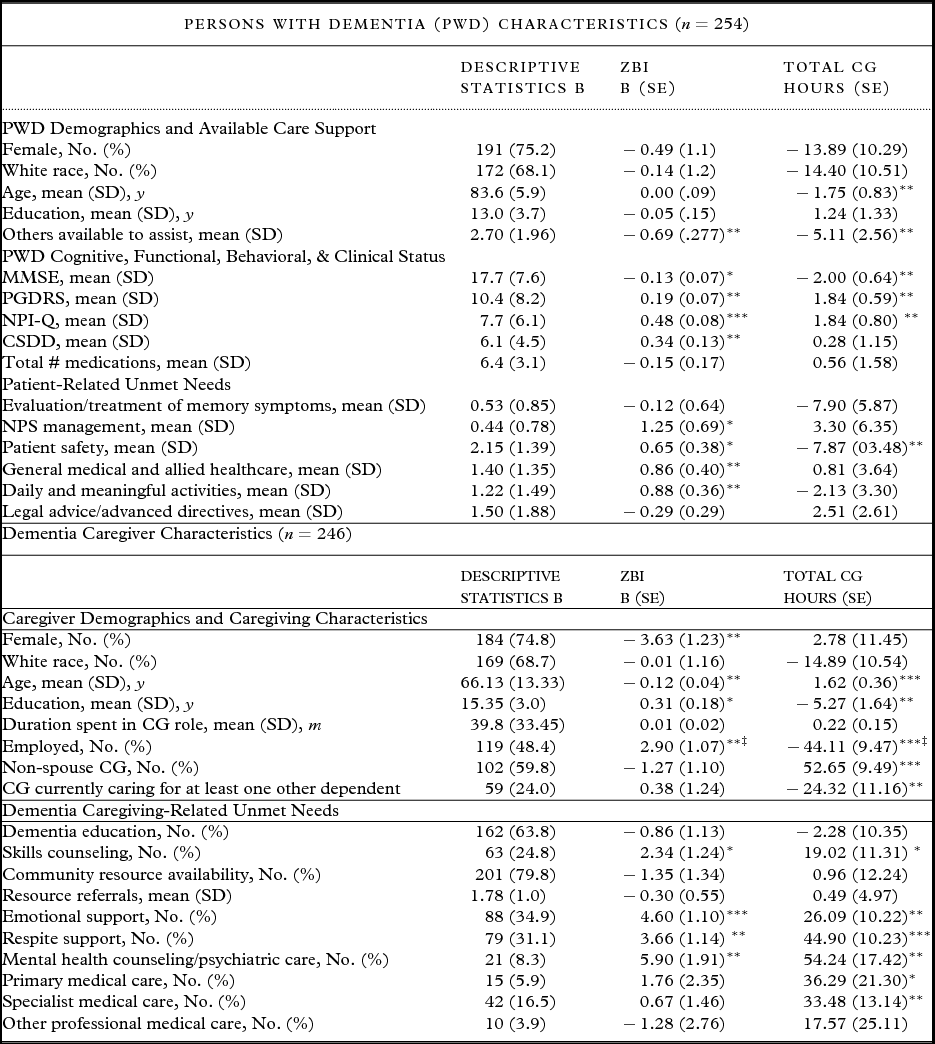
Table 1 presents descriptive statistics for PWD and caregivers characteristics and the bivariable relationships of these with caregiver burden measures. The majority of PWD were women (75%), white (68%), with a mean age of 84 years, and averaged 13 years of education. PWD had an average of 2.7 people, other than the caregiver identified in this study, who were available to assist them if needed. They averaged taking 6.4 medications daily and had an average MMSE score of 17.7. The most common unmet dementia care need categories to emerge from participants were home and personal safety (91.7%), general medical and allied health care (67.7%), daily and meaningful activities (61.4%), and legal and advanced care planning assistance (48%).
Persons with dementia and caregiver characteristics and bivariate correlates of objective and subjective caregiver burden measures

Notes: CG = caregiver, NPS = neuropsychiatric symptoms, NPI-Q = Neuropsychiatric Inventory-Questionnaire, PGDRS = Psychogeriatric Dependency Rating Scale, MMSE = Mini-Mental State Examination, ZBI = Zarit Burden Inventory, CSDD = Cornell Scale for Depression in Dementia.
*p ≤ 0.10; ** p < 0.05; ***p < 0.001.
‡Results limited to subsample whose study CG was actively employed (n = 125 primary participants, 119 individual CGs).
Eight CGs provided care to two care recipients with dementia and duplicated CG demographic data were removed from descriptive statistics.
The majority of caregivers were women (74.8%), white (68.7%), with an average age of 66 years, and 15 years of education. Caregivers had been in that role for an average of over three years (40 months), nearly half (48.4%) maintained paid employment outside their home. The majority were married (69.5%), although 59.8% provided care in a non-spousal capacity. The most prevalent dementia-related unmet care needs among caregivers were: community resource availability (79.8%), dementia education (64.3%), emotional support (34.9%), respite support (31.3%), skills counseling (24.8%), and unmet specialty medical care (16.5%). Almost 90% had at least one unmet care need in the resource referral category. The average ZBI score was 15.1 (SD: 8.5), and the total mean hours caregiver spent for and with participants in the past week was 91.1 (SD: 77.5).
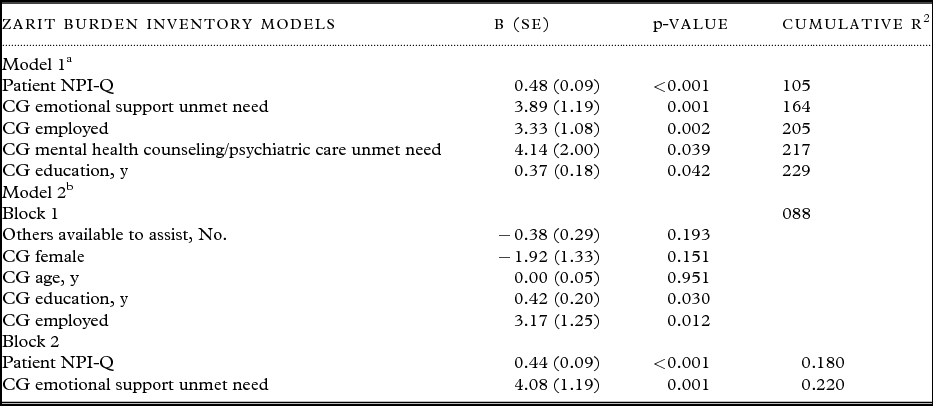
The results of the multivariable linear regression analyses for the ZBI are given in Table 2. In Model 1, approximately 23% of the variance was explained by the following five variables: patient NPS, caregiver unmet need for emotional support, caregiver employment status, caregiver unmet need for professional mental health care, and caregiver education. In Model 2, after adjusting for the demographic and contextual variables (Block 1), patient NPS and caregiver unmet need for emotional support were significant correlates and accounted for an additional 13.2% of the variance. The fully adjusted Model 2 accounted for 22% of the variance in the ZBI.
Multivariate linear regression models for Zarit Burden Inventory (subjective burden)

Notes: CG = caregiver; NPI-Q = Neuropsychiatric Inventory-Questionnaire, PGDRS = Psychogeriatric Dependency Rating Scale, MMSE = Mini-Mental State Examination.
aAll significant univariate variables entered using step-wise methods. MMSE, PGDRS, CSDD, number of people available to assist, number of unmet neuropsychiatric symptom needs, number of unmet safety needs, number of unmet healthcare needs, number of unmet needs for daily and meaningful activities, CG sex, age, skills counseling unmet need, and CG respite support unmet care need did not meet the model inclusion parameters.
bAll significant univariate demographic and context variables entered into Block 1. Significant hypothesis-driven predictor variables entered using stepwise methods into Block 2.
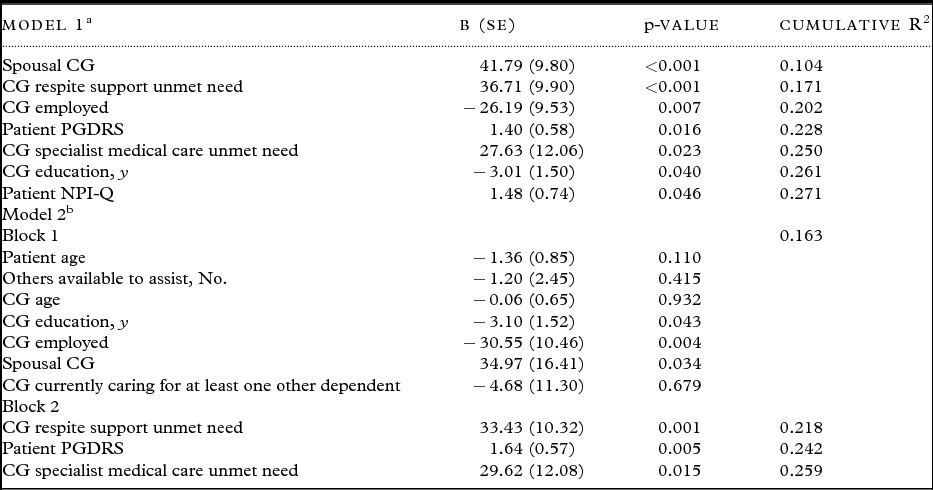
Results of the multivariable linear regression analyses for total caregiving time are shown in Table 3. In Model 1, of the total hours that caregiver spent for and with participant per week, approximately 27% of the variance was explained by the following variables: spousal caregiver (vs. non-spousal), caregiver respite unmet need, caregiver actively employed, patient functional dependency, caregiver's unmet needs for specialist medical care, caregiver education, and patient NPS. In Model 2, after entry of covariates related to demographics and contextual variables (Block 1), caregiver's needs for respite, patient functional dependency, and caregiver's need for specialist medical care were significant in Block 2 and accounted for an additional 9.6% of the variance. The fully adjusted Model 2 accounted for 26% of the variance.
Multivariate linear regression models for correlates of total hours that caregivers spent for and with participant per week

Notes: CG = caregiver; NPI-Q = Neuropsychiatric Inventory-Questionnaire, PGDRS = Psychogeriatric Dependency Rating Scale, MMSE = Mini-Mental State Examination.
aAll significant univariate variables entered using stepwise methods. Patient age, MMSE, Number of other people available to assist PWD, number of unmet safety needs, CG age, CG caring for another dependent, CG skills counseling unmet need, CG emotional support unmet need, CG mental health counseling/psychiatric care unmet need, and CG primary medical care unmet need did not meet the model inclusion parameters.
bAll significant univariate demographic and context variables entered into Block 1. Significant hypothesis-driven predictor variables entered using stepwise methods into Block 2. MMSE, number of unmet safety needs, CG skills counseling unmet need, CG emotional support unmet need, CG mental health counseling/psychiatric care unmet need, and CG primary medical care unmet need did not meet the model inclusion parameters into Block 2.
In a sub-analysis looking at the correlates of loss of work time of greater than 8 h (1, 0) in the past month among caregivers who were currently working (data not shown in tables), the only bivariate correlates were functional dependency (PGDRS score; OR = 1.09, 95% CI 1.03–1.15, p = 0.002), and the caregiver being female (OR = 0.31 95% Confidence Interval (CI) = 0.10–0.98, p = 0.046). Patient functional dependency was the only significant correlate in a multivariable forward stepwise method logistic regression model, and these estimates suggest that a 5-point increase in PGDRS score would correspond to a 54% (OR = 1.095 = 1.54, 95% CI = 1.03–1.15, p = 0.002) increase in the odds of missing eight or more hours of work per month due to caregiving.
Discussion
These analyses provide important new information on specific predictors of subjective and objective caregiver burden in dementia, with a particular focus on the contribution of PWD and caregiver unmet dementia-related care needs. The correlates of subjective and objective caregiver burden differed; however, specific types of potentially modifiable caregiver-related unmet needs contributed significantly to both aspects of burden. Therein lies the strength of our study, by utilizing the JHDCNA, we were able to concurrently identify specific unmet patient and caregiver care needs that have been underestimated or overlooked in prior studies, and illustrate the impact of these unmet needs on both subjective and objective burden among caregivers. Consistent with prior findings (Sink et al., Reference Sink, Covinsky, Barnes, Newcomer and Yaffe2006; Mohamed et al., Reference Mohamed, Rosenbeck, Lyketsos and Schneider2010), patient severity of behavioral problems and functional dependency (PGDRS) contributed significantly to subjective and objective burden measures respectively. Caregiver education (used as a proxy measure for socio-economic status (SES) was associated with higher subjective burden but fewer caregiver hours. This might be explained by SES group differences in coping strategies and perceptions of burden on subjective caregiver burden measures such as the ZBI, as reported previously (Etters et al., Reference Etters, Goodall and Harrison2008). Further, these caregivers may also have been in a financial position to afford additional patient care assistance and services, thus reducing the amount of time they themselves spent in caregiving activities. We also report that unmet dementia-related caregiver needs for emotional support, respite, and specialist medical care, such as gynecological, cardiac, or gastroenterologist services, are correlated with both subjective and objective caregiver burden, and this has not, to our knowledge, been previously reported. Although we used caregiver education as a contextual factor, the primary focus of our study was on modifiable patient and caregiver unmet needs.
These findings are consistent with prior findings revealing that lack of time to devote to personal needs (e.g. maintaining their own health) contributes to negative caregiver physical and mental health outcomes (Richardson et al., Reference Richardson, Lee, Berg-Weger and Grossberg2013). This lack of time among caregivers has been shown to be related to a number of factors that include: patient level of functional and cognitive dependence, a lack of social support and other available caregivers to provide assistance (Pinquart and Sorensen, Reference Pinquart and Sorensen2004), caregiver working status, caregiver income and resource availability (Wolfs et al., Reference Wolfs, Kessels, Severens, Brouwer, de Vugt, Verhey and Dirksen2012). To date, few studies have examined the association of multidimensional unmet dementia-related need domains on objective and subjective measures of caregiver burden or simultaneously used both patient and CG characteristics to predict caregiver burden.
These findings indicate that dementia caregivers are at an increased risk for both mental and physical health problems as stress levels and the demand for care escalate. Future interventions should consider the unique differences and unmet needs that exist among caregivers. Targeted intervention programs will aid in the identification of caregivers at the greatest risk for debilitating levels of caregiver burden. For example, caregivers and families who report high levels of burden may benefit from interventions that incorporate positive coping mechanism.
Limitations of this study were the lack of random selection and recruitment from urban settings, both of which limit the generalizability of findings. Second, because study data were cross-sectional, causal relationships between variables could not be established. Third, participants’ and caregivers’ unmet needs were based on the JHDCNA that uses a clinical rater to determine unmet needs and not the caregiver's own perception. It is possible that unmet care needs not rated by the clinician may have been unmet from the caregiver's perspective and influential in their subjective and objective experience of caregiving. Finally, it is important to note that a substantial amount of the variance in both subjective and objective caregiver burden measures remains unexplained. This suggests that other factors beyond those that were directly assessed in the study (i.e. psychosocial, cultural, or personal preferences) may play an important role in the subjective and objective burden experienced by caregivers of PWD.
This is the first study, to our knowledge, to examine how potentially modifiable unmet dementia-related care needs in both patients and caregivers contribute to caregiver subjective and objective burden. These results suggest that in order to alleviate caregiver burden, a wide range of dementia intervention services should be provided that not only target improving behavior and functional impairment in the person with dementia but also provide support that is comparable to the patient's level of functional dependency, and the caregiver's mental and physical health care needs.
Conflict of Interest
None
Description of Authors’ Roles
Drs. Black, Lyketsos, and Samus participated in developing the concept and design of the study, the acquisition and analysis of data, and writing the manuscript. Drs. Albert and Hughes participated in the analysis of data and writing of the manuscript. Drs. Gitlin and Johnston contributed to the editing of the manuscript.