Clinical Implications
• Schizophrenic patients show higher comorbidity rate of obsessive-compulsive disorder and hypochondriasis than the general population.
• These comorbidities seem to be more frequent in schizophrenic patients treated with clozapine versus patients treated with other atypical antipsychotics.
• There is an inverse correlation between the diagnosis of hypochondriasis, the severity of its symptoms, and the global level of functioning. The assessment and treatment of this condition in schizophrenic patients treated with atypical antipsychotics could have clinical and functional implications.
Introduction
Obsessive compulsive disorder and symptoms in schizophrenia
Anxiety disorders are highly prevalent in schizophrenia spectrum disorders, and their prevalence rates are higher than those reported for the general population, despite there being a great variation in rates between studies.Reference Achim, Maziade and Raymond1 Recently, the interest on the co-occurrence of obsessive-compulsive disorder (OCD) and schizophrenia has increased considerably. Underlying this interest is probably the attempt to understand the basis of the recognition of higher-than-expected comorbidity rates and the observations of emergence or exacerbation of obsessive-compulsive (OC) symptoms during treatment of psychosis with atypical antipsychotics (AAPs).Reference Tranulis, Potvin and Gourgue2, Reference Schirmbeck and Zink3 In fact, despite the inconsistence of the results of different epidemiological studies [largely due to the alternative inclusion of schizophrenic patients with obsessive-compulsive symptoms (OCS), OCD, or both] a great body of clinical literature shows that schizophrenic patients tend to have a higher prevalence of OCS and OCD (ranging from 20–30%) than the general population.Reference Schirmbeck and Zink3 A recent meta-analyses showed a mean OCD prevalence rate of 12.1% across systematic studies.Reference Achim, Maziade and Raymond1 Furthermore, the presence of OCS in schizophrenic patients has a negative impact on the prognosis. Indeed, the presence of OCS or OCD is associated with more positive and negative symptoms, lower level of social functioning, higher treatment costs, worse social rehabilitation, and greater motoric impairment.Reference Schirmbeck and Zink3–Reference Mukhopadhaya, Krishnaiah and Taye5
Even if the causes of this high rate of comorbidity are still unknown, several studies suggest that this fact is largely due to atypical antipsychotics treatment. In fact, the prevalence of OCS during first-onset psychosis is considerably lower than during other phases of the disease, suggesting that a significant proportion of schizophrenic patients develop OCS during or even as a consequence of antipsychotic treatments.Reference Schirmbeck and Zink3, Reference Sterk, Lankreijer, Linszen and de Haan6–Reference Hwang, Kim, Yum and Opler10
Since the introduction of atypical antipsychotics, both case reportsReference Lykouras, Alevizos, Michalopoulou and Rabavilas11–Reference Stamouli and Lykouras15 and clinical studiesReference Baker, Chengappa and Baird16–Reference Mahendra, Liew and Subramaniam19 have described de novo onset of OCS during treatment with these drugs. Only a few case reports showed a high rate of OCS comorbidity in schizophrenic patients treated with first-generation antipsychotics (FGAs), and recent studies directly comparing FGAs and AAPs showed that AAP-treated patients have higher prevalence of OCS than FGA-treated patients.Reference Sa, Hounie and Sampaio20 These different effects are probably due to the antiserotonergic properties of the AAPs.
Between the AAPs, clozapine (CLZ) seems to be associated to the higher rates of OCS or OCD comorbidities.Reference Tranulis, Potvin and Gourgue2, Reference deHaan, Oekeneva, Van Amelsvoort and Linszen21 Two main pharmacodynamic hypotheses may account for this observation. The first hypothesis is based on the fact that CLZ has lower D2-blocking and stronger 5-HT2A and 5-HT2C blocking effect than other AAPs. Data showing that agents with high D2-blocking potency, such as haloperidol, aripiprazole, and amisulpride, have a lower rate of induced OCS support this hypothesis.Reference Poyurovsky, Weizman and Weizman22–Reference Schirmbeck, Rausch and Englisch24 The second hypothesis is based on the putative pro-glutamatergic effect of clozapine. In fact, CLZ seems to have a stronger glutamate transmission enhancing capacity than other antipsychotics.Reference Tanahashi, Yamamura, Nakagawa, Motomura and Okada25 As supported by recent data, the excitatory neurotransmitter glutamate seems to play a role in the pathophysiology of OCD, suggesting the existence of a hyperglutamatergic state.Reference Pallanti, Grassi and Cantisani26 Furthermore, data from a genetic association study suggested glutamate involvement in APP-induced OC symptoms, although other authors failed to replicate this result.Reference Kwon, Joo and Nam27, Reference Schirmbeck, Nieratschker and Frank28 In this study, the authors found an association between a sequence variation in the glutamate transporter gene SLC1A1 and the susceptibility to APP-induced OC symptoms in schizophrenic patients. Recently, a genetic study found that SLC1A1 and GRIN2B (a gene encoding the NR2B subunit of the NMDA receptors), and their interactions, may potentially confer susceptibility to OC symptoms in schizophrenia patients receiving clozapine.Reference Cai, Zhang and Yi29 Thus, CLZ may be associated with higher rates of OCS than other AAPs because of both its serotonergic and glutamatergic effects.
OCD-spectrum disorders and schizophrenia
To date, only one studyReference Poyurovsky, Fuchs and Faragian30 investigated the prevalence of OCD-spectrum disorders in schizophrenic patients with and without OCD comorbidity. This study found a higher rate of OCD-spectrum disorders in schizo-obsessive patients versus schizophrenic patients and a comparable rate of OCD-spectrum conditions between schizo-obsessive patients and OCD patients.Reference Poyurovsky, Fuchs and Faragian30 In particular, the authors found in the schizo-obsessive group a higher rate of body dysmorphic disorder and tic disorders.
Several studies and, in particular, a large family study found a familial aggregation between OCD and several anxiety disorders such as hypochondriasis, suggesting that this disorder could be part of a putative obsessive-compulsive spectrum.Reference Bienvenu, Samuels and Wuliek31 Indeed, despite several studies that investigated the co-occurrence of OCD and schizophrenia, there is a lack of studies addressing the co-occurrence of OCD spectrum disorders, such as hypochondriasis, and schizophrenia. However, clinical experience shows that several schizophrenic patients suffer from hypochondriac symptoms.
Purpose of the study
The aim of the study was to investigate the prevalence rates of OCD and hypochondriasis in schizophrenic patients treated with atypical antipsychotics and to investigate the different comorbidity rates of OCD and hypochondriasis between clozapine-treated patients and patients treated with other atypical antipsychotics. Our main hypotheses were as follows:
1. Schizophrenic patients will show higher rates of co-occurring OCD and hypochondriasis when compared to known prevalence rates from the general population.
2. Patients treated with clozapine will show higher rates of OCD and hypochondriasis when compared to those patients taking other AAPs.
Methods
Subjects
The sample was composed of schizophrenic patients treated with clozapine or other atypical antipsychotics (olanzapine, quetiapine, risperidone, aripiprazole, amisulpride, and paliperidone) who met diagnostic criteria for schizophrenia according to the Diagnostic and Statistical Manual of Mental Disorders, 4th edition (DSM-IV)32 and who agreed to participate in the study. Clozapine-treated patients were recruited from the Clozapine Clinic of the University of Florence between January 2011 and May 2013. Schizophrenic patients treated with other atypical antipsychotics were recruited from the outpatient clinic of the University of Florence between January 2011 and May 2013. Patients had to be stable on their clozapine or other atypical antipsychotic dose for 6 months before entry into the study. All patients had to be in treatment with an antipsychotic (clozapine or atypical antipsychotic) monotherapy to be included in the study. Exclusion criteria were as follows: presence of organic brain disease, psychoses other than schizophrenia, inability to give informed consent, and active alcohol or drug abuse in the last 6 months before study participation.
Assessment tools
We used the Structured Clinical Interview for DSM-IV Axis I DisordersReference First, Spritzer, Gibbon and Willians33 to make the diagnosis of schizophrenia, OCD, and hypochondriasis. The severity of schizophrenia symptoms was assessed by the Positive and Negative Syndrome Scale (PANSS).Reference Kay, Fiszbein and Opler34 The depressive symptoms were assessed with the Montgomery–Asberg Depression Rating Scale (MADRS),Reference Montogomery and Asberg35 and anxiety symptoms were assessed with the Hamilton Anxiety Rating Scale (HAM-A).Reference Hamilton36 We also assessed the presence of OC symptoms and hypochondriac symptoms by the Yale–Brown Obsessive-Compulsive Scale (Y-BOCS)Reference Goodman, Price and Rasmussen37, Reference Goodman, Price and Rasmussen38 and the Hypochondriasis Yale–Brown Obsessive-Compulsive Scale (HY-BOCS).Reference Greeven, Spinhoven and van Balkom39 Finally we assessed the patients functioning by the Global Assessment of Functioning (GAF).Reference Hall40 A clinical interview was performed in order to determine the social and demographic characteristics, the duration of illness, duration of antipsychotic treatment, and other clinical features.
Statistical analysis
In order to compare the 2 groups on socio-demographic and clinical variables, the χ2 test and Fisher's exact test were used for categorical variables; the t-test was used to compare continuous or interval variables; and analysis of covariance (ANCOVA) was used to compare continuous or interval clinical variables controlling for the effects of a covariate variable.
Pearson's correlation coefficient was calculated to measure the linear relationship between variables. Logistic regression analysis was used to estimate the influence of an independent variable on a dependent Boolean variable, adjusting for potential confounders. To assess the influence of an independent variable on a dependent continuous variable, adjusting for potential confounders, regression analysis was used.
A p value less than .05 was considered to indicate a statistically significant difference.
All analyses were carried out using STATA statistical software V.12.1 (StataCorp, College Station, TX, USA).
Results
The final sample was formed of 60 patients (34 men and 26 women), 30 of them in treatment with clozapine and 30 of them with another atypical antipsychotic (11 patients were taking olanzapine, 7 risperidone, 6 aripiprazole, 2 amisulpride, 3 quetiapine, and 1 paliperidone). A total of 12 patients was taking an antidepressant (AD) at the moment of the interview; 6 of them were in the clozapine group (2 patients were taking escitalopram, 2 fluoxetine, 1 fluvoxamine, and 1 paroxetine) and 6 in the other group (1 patient was taking mirtazapine, 1 sertraline, 1 fluvoxamine, 1 citalopram, 1 venlafaxine, 1 clomipramine). The daily dosage of all the ADs was within the therapeutic range.
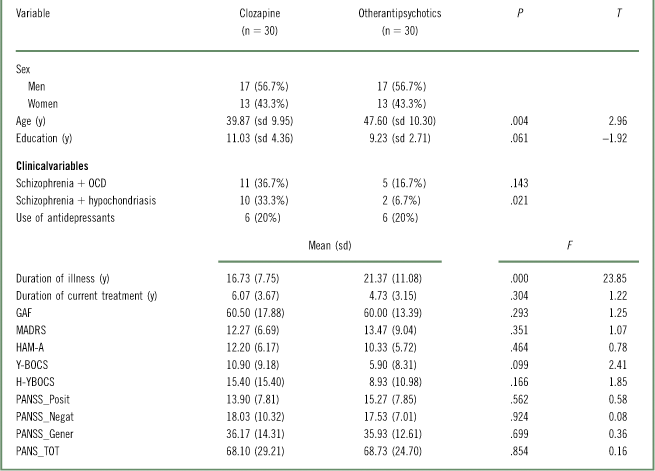
Demographic and clinical characteristics of the 2 groups are displayed in Table 1
Clinical and demographic characteristics of patients taking clozapine or other antipsychotics

There were no statistically significant differences with respect to gender and educational attainment between the two samples. Nevertheless, there was a statistically significant difference in mean age (39.87 vs 47.60 p = .004) (see Table 1). To control the effect of the age variable, ANCOVA was calculated to compare groups on duration of illness; duration of current treatment; and PANSS, HAM-A, MADRS, and GAF scores. We found a statistically significant difference only in duration of illness (16.73 vs 21.37 p = .000).
In the whole sample, 16 patients were diagnosed with OCD (26.6%) and 12 patients were diagnosed with hypochondriasis (20%).
Patients treated with clozapine showed a higher comorbidity with OCD (n = 11/30, 36.7%) and hypochondriasis (n = 10/30, 33.3%) than patients using other antipsychotics (respectively, n = 5/30, 16.7%; n = 2/30, 6.7%), even if this difference reached statistical significance only for the latter condition (respectively, p = .143 and p = .021) (see Table 1).
Y-BOCS and H-YBOCS mean scores were higher in the clozapine-treated group, even if the differences did not reach statistical significance (YBOCS: 10.90 vs 5.90, p = .099; H-YBOCS: 15.40 vs 8.93, p = .067) (see Table 1).
A statistically significant correlation was found between the Y-BOCS and HY-BOCS scores of the whole group (r = .378, p = 0.03).
Moreover a statistically significant inverse correlation was found among the whole group of patients between the GAF scores and the presence of comorbid hypochondriasis (simple logistic regression coefficient = –.045, p = .048) and the severity of its symptoms (Pearson's correlation coefficient r = –.257, p = .047).
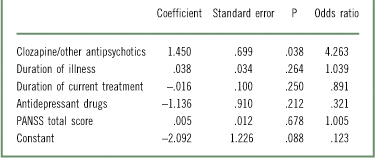
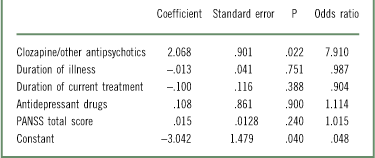
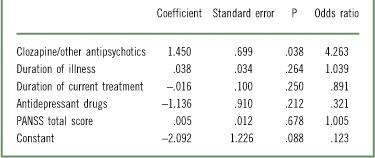
Two multiple logistic regressions were performed with presence or absence of OCD or hypochondriasis as dependent variables and duration of illness, duration of antipsychotic treatment, use of antidepressant medication, PANSS total score, use of clozapine, or other atypical antipsychotics as independent variables. The results showed that the patients in treatment with clozapine were significantly more likely to have OCD or hypochondriasis (see Tables 2 and 3).
Predictors of presence of OCD in patients with schizophrenia taking clozapine or other antipsychotics
Predictors of presence of hypochondriasis in patients with schizophrenia taking clozapine or other antipsychotics
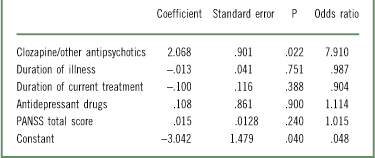
In addition, we performed 2 multiple regressions where Y-BOCS and HY-BOCS scores were the dependent variables, and duration of illness, duration of antipsychotic treatment, use of antidepressant medication, PANSS total score, and use of clozapine or other atypical antipsychotics were used as independent variables. The results showed that patients in treatment with clozapine were significantly more likely to present OC symptoms (coefficient = 6.35, p = .010) but not symptoms of hypochondriasis (coefficient = 6.38, p = .092).
Discussion
This is the first study that has directly assessed the presence of hypochondriasis in schizophrenic patients treated with clozapine or other atypical antipsychotics. The main result of our study is the finding of a higher rate of hypochondriasis in schizophrenic patients treated with atypical antipsychotics than in the general population (20% vs 1%).Reference Starcevic41 Furthermore, clozapine-treated patients had a statistically significant higher rate of hypochondriasis comorbidity and a higher prevalence of hypochondriac symptoms with respect to schizophrenic patients treated with other atypical antipsychotics. Moreover, we found a significant correlation between hypochondriasis, the severity of its symptoms, and a low level of global functioning.
With regard to the presence of OCD or OC symptoms, we found a higher rate of OCD in schizophrenic patients treated with atypical antipsychotics than in the general population (26.6% vs 1–3%).Reference Schirmbeck and Zink3 Clozapine-treated patients had a higher rate of OCD comorbidity and a higher prevalence of OC symptoms than schizophrenic patients treated with other atypical antipsychotics. These latter results confirm up-to-date evidence, showing a higher rate of OCD and OCS in schizophrenic patients versus the general population and a higher rate of OCD/OCS in clozapine-treated patients versus patients treated with other atypical or typical antipsychotics.Reference Schirmbeck and Zink3
Another important result of our study is that we found a correlation between the Y-BOCS and HY-BOCS scores of the whole group. These data seem to corroborate the idea that hypochondriasis represents an obsessive-compulsive spectrum condition also in schizophrenic patients treated with atypical antipsychotics. However, another possible explanation for this result could be that this correlation is due to the content overlap between the Y-BOCS and the HY-BOCS. In fact, the probes and anchors of the HY-BOCS are similar to those of the original Y-BOCS, because of the phenomenological resemblances between OCD and hypochondriasis (such as inability to inhibit repetitive thoughts and anxiety-reducing behaviors). However, the HY-BOCS rating was performed only for health concerns and when these symptoms were clearly unrelated to obsessive-compulsive symptoms, in order to avoid an over estimation of the presence of hypochondriac symptoms.
Our results highlight the importance of assessing obsessive-compulsive spectrum symptoms in schizophrenic patients who are treated with atypical antipsychotics. In fact, our finding of a correlation between the presence of hypochondriac symptoms and a low level of functioning has clinical and functional implications. Furthermore, several studies showed that the cost of patients suffering from hypochondriasis may have an economic impact on the health system due to a high utilization of health system services.Reference Hiller and Fichter42 Thus, it would be important to investigate the use of health system services by schizophrenic patients with hypochondriac symptoms.
The main hypothesis to explain the higher rates of OCD and hypochondriasis in schizophrenic patients is the AAP-induced de-novo onset of OC and/or hypochondriac symptoms or the AAP-induced worsening of existing subthreshold OC and/or hypochondriac symptoms.
Moreover, clozapine-treated patients tend to have higher rates of OCD and hypochondriasis, probably due to lower D2-blocking, stronger 5-HT2A and 5-HT2C blocking effects, and stronger glutamate-transmission enhancing properties than other atypical antipsychotics.Reference Schirmbeck and Zink3 However, due to our study design, we cannot rule out the hypothesis that hypochondriasis and OC symptoms were pre-existing in a sub-population of our sample. Otherwise, we can hypothesize a genetic influence on the presence of hypochondriac and OC symptoms in a subgroup of schizophrenic patients. In this perspective it would be interesting to investigate the presence of a polymorphism of the NMDA receptor genes SLC1A1 and GRIN2B in the subgroup of patients with hypochondriac and OC symptoms.
Finally, several studies suggested that also olanzapine, due to its quite strong antiserotonergic properties, could be associated with higher rates of OCD/OCS than other atypical antipsychotics (such as risperidone, aripiprazole, and amisupride).Reference Schirmbeck, Rausch and Englisch24, Reference deHaan, Beuk, Hoogenboom, Dingemans and Linszen43 Our results could be weakened by the fact that 11 patients were taking olanzapine in our sample (36.6% of the other AAPs group). To analyze possible effects of olanzapine, we performed 2 Fisher's exact test to compare patients taking olanzapine and patients taking other atypical antipsychotics, different from olanzapine and clozapine, on OCD diagnosis and hypochondriasis diagnosis. The differences were not statistically significant (OCD, p = .259; hypochondriasis, p = .520).
Our results are limited by the small sample size and by the fact that we found a significant difference in the main age and in the duration of illness of the 2 groups of patients. Thus, larger prospective studies are needed to confirm our hypotheses.
Conclusion
Our study shows that schizophrenic patients had a higher comorbidity rate of OCD and hypochondriasis with respect to the general population. These comorbidities seem to be more frequent in schizophrenic patients treated with clozapine versus patients treated with other atypical antipsychotics. Furthermore, the presence of hypochondriac symptoms has important clinical implications. In fact, we found an inverse correlation between the severity of hypochondriac symptoms and the global level of functioning.
Disclosures
The authors do not have anything to disclose.