Introduction
In most developing countries, natural grasslands provide the majority of feed in ruminant grazing systems (Suttie et al., Reference Suttie, Reynolds and Batello2005). The relatively low quality and poor digestibility of natural forage, together with low intake by animals, contribute to the low productivity of ruminants in these regions. Cultivated pastures have increasingly been introduced into the grazing systems of developing countries, but studies on animal grazing behaviour and forage response are still rare in these cultivated pastures. Goats were generally considered to be damaging to the environment (Chen et al., Reference Chen, Hou, Matthew and He2010) due to behaviour including root disturbance of grasses and trees. However, in countries such as South Africa, Argentina (Mills et al., Reference Mills, Cowling, Fey, Kerley, Donaldson, Lechmere-Oertel, Sigwela, Skowno and Rundel2005), the southern United States (Roundy and Ruyle, Reference Roundy and Ruyle1989) and many regions of south-western China (Wan et al., Reference Wan, Li, Su and Bai2000), goats are the primary or at least an important livestock species in grazing systems. Therefore, understanding the grazing behaviour of goats on cultivated pastures is very important for preserving the environment and maintaining pasture sustainability.
One important management decision in grazing systems is stocking rate (SR). SR influences forage mass (Liu et al., Reference Liu, Sollenberger, Newman, Vendramini, Interrante and White-Leech2011), herbage cover (Chen et al., Reference Chen, Hou, Matthew and He2010), nutritive value of forage (Askar et al., Reference Askar, Gipson, Puchala, Tesfai, Detweiler, Asmare, Keli, Sahlu and Goetsch2013), animal grazing behaviour (Sharp et al., Reference Sharp, Edwards and Jeger2012; Pittarello et al., Reference Pittarello, Gorlier, Lombardi and Lonati2017) and animal performance (Sollenberger and Vanzant, Reference Sollenberger and Vanzant2011). Grazing behaviour is also affected by grazing season (Tolu et al., Reference Tolu, Alaturk, Parlak and Gokkus2017) and plant characteristics (Sollenberger and Burns, Reference Sollenberger, Burns, Gomide, Mattos and Da Silva2001; Basha et al., Reference Basha, Scogings, Dziba and Nsahlai2012; Manousidis et al., Reference Manousidis, Kyriazopoulos, Parissi, Abraham, Korakis and Abas2016). Sanon et al. (Reference Sanon, Kabore-Zoungrana and Ledin2007) observed that sward canopy conditions affected animal grazing behaviour significantly, including bite mass and rate of biting (Alvarez-Rodriguez et al., Reference Alvarez-Rodriguez, Sanz, Delfa, Revilla and Joy2007; Pontes et al., Reference Pontes, Agreil, Magda, Gleizes and Fritz2010). Therefore, clarifying the relationship between SR and grazing behaviour is important for the formulation of strategies for pasture management and understanding how animals graze.
Different animals have different dietary habits and preferences. Goats are said to possess some degree of nutritional wisdom which enables them to select foods that meet their nutritional needs (Ngwa et al., Reference Ngwa, Pone and Mafeni2000). On natural grasslands, goats are found to browse more shrub species than sheep and cattle (Ouedraogo-Kone et al., Reference Ouedraogo-Kone, Kabore-Zoungrana and Ledin2006; Sanon et al., Reference Sanon, Kabore-Zoungrana and Ledin2007). Some researchers have reported factors affecting grazing behaviour of sheep (Raeside et al., Reference Raeside, Robertson, Nie, Partington, Jacobs and Behrendt2017) or cattle (Liu et al., Reference Liu, Sollenberger, Newman, Vendramini, Interrante and White-Leech2011) on cultivated pastures; however, little attention has been paid to grazing behaviour of goats on cultivated pastures where grasses and herbaceous legumes play an important role in feeding systems. An understanding of diet selection and behaviour of goats in response to varying SR on cultivated pasture is a prerequisite for the development of sustainable grazing systems and profitable animal production. However, adequate research to support decision making with goats has not been conducted thoroughly. Therefore, the objectives of the current experiment were to (1) observe goat grazing behaviour on cultivated pastures under different SRs and grazing seasons, and (2) quantify the patterns and mechanisms of goat grazing behaviour.
Materials and methods
Study site
The experiment was conducted on a cultivated pasture in a goat farm in Xundian county (25°40′N, 103°11′E, 2100 m a.s.l.), Yunnan province, China. Average annual precipitation is 965 mm and 0.82 of total rainfall occurs from July to October. The annual mean temperature is 13.4 °C, and ⩾10 °C active annual accumulated temperature is 4357 °C. Annual frost-free days are around 230. Field studies did not involve endangered or protected species. The experimental cultivated pasture was dominated by perennial ryegrass (Lolium perenne L.), cocksfoot (Dactylis glomerata L.) and white clover (Trifolium repens L.). Other plant species accounted for a lower proportion in this cultivated pasture, which included cruciform crabgrass (Digitaria cruciat a) and creeping wood sorrel (Oxalis corniculata L.). The soil is laterite (National Soil Survey Office, 1998) with a pH of 5.0.
Experimental design and management
Treatments consisted of two SRs (low and high) imposed on rotationally stocked pasture in 2010, where low and high SR were 5 and 15 goats/ha, respectively. In this rotational stocking management, the grazing cycle (6 days grazing time + 24 days rest period) was 30 days for all treatments and there was a total of four cycles during experimental periods (from July to October). The two SR treatments were arranged in a randomized complete block design with two replicates (blocks), and each SR treatment in one block consisted of five 0.2-ha grazing paddocks. The grazing season was from July to October. The grazing pastures used for the low and high SRs were in similar condition before the experiment began.
Forty 2-year-old healthy local Yunling black goats were assigned to the two treatments: ten goats with 46 ± 0.5 kg average initial weight for low SR treatment (five goats/block); and 30 goats with 46 ± 0.7 kg average initial weight for high SR treatment (15 goats/block). Four grazing groups were formed and used in the current study. At the beginning of the grazing experiment, sward canopy conditions were similar between the two treatments and sward height was around 20 cm. Grazing was initiated on 1 July 2010. Subsequent grazing events occurred according to the established grazing cycle. After 6 days of grazing on a given paddock, goats were moved to the next grazing paddock of the same block and SR. One water tank was placed in every paddock during the grazing period. All goats remained in the paddocks from 08.00 h to 18.00 h daily during the experimental period. After grazing, they were moved back to the separated roofed building based on treatment and housed without extra feed until 08.00 h the next day.
Disappearance of forage species
Disappearance of forage species was calculated based on herbage mass of forage species measured before and after each grazing event. Before goats entered the paddock, three 0.5 m × 0.5 m quadrats were selected randomly in the paddock to measure the herbage mass of each forage species. Herbage within the 0.25-m2 quadrats was clipped to a stubble height of 5 cm, bagged by species, dried at 60 °C to constant weight and weighed. After the end of the 6-day grazing period, the same procedure was used in grazed paddocks to measure the post-grazing herbage mass of each forage species. Herbage disappearance of forage species at each grazing cycle was calculated by subtracting the post-grazing herbage mass at the end of a given grazing event from the pre-grazing herbage mass at the beginning of that particular grazing event.
Goat grazing behaviour
Goat grazing behaviour included activities and eating behaviour. Activities included walking, eating, resting (without ruminating) and ruminating. These activities were monitored using binoculars from 15 m away during the grazing period. This distance was tested previously and found not to disturb goat grazing behaviour. One monitoring goat for each grazing group was chosen and marked from the beginning of grazing, and there were four marked goats in total used through the whole grazing period. Assigned and marked goats always grazed the same treatment. As observations began, a group of three people was assigned to observe one marked goat with different responsibilities: one observed the goat's activities and recorded the time, one observed eating behaviour and one recorded data. Observations started after the marked goat entered an experimental paddock and began eating. A stopwatch and counter were used to measure the time and frequency. Each observation lasted 5 min, and the next observation began after 15 min. Generally, 20 observation times for each marked goat were obtained every grazing observation day, which covered a large part of the grazing time. In one grazing cycle, a no-rain grazing day was selected as the observation day.
Walking time was determined as the time a goat spent walking without including time spent eating and ruminating; eating time was the time goats spent eating within the observation; resting time was time goats spent resting without including the times of rumination within the observation; ruminating time was total time between goats starting and ending one ruminating activity within the observation. The relative time (proportion) of each activity was calculated using the following formula:
 $$\displaystyle{{{\rm The\;} \,{\rm duration\;} {\rm of}\,{\rm activity}} \over {{\rm Total\;} \,{\rm observation}\,{\rm time}}}\; $$
The relative eating time (proportion) for each species within the observed period was calculated using the following formula:
 $$\displaystyle{{{\rm The\;} \,{\rm duration}\,{\rm of} \,{\rm eating\;} \,{\rm a\;} \,{\rm given\;} \,{\rm species}} \over {{\rm Total\;} \,{\rm eating\;} \,{\rm time}}}\; $$
Eating behaviour included bites/step, bite rate, bite weight and daily intake. Bites/step and bite rate were recorded with a counter at each observation. Before goats entered the paddock, three 0.5 m × 0.5 m quadrats were sampled to measure pre-grazing herbage mass of each species and total pre-grazing herbage mass (the sum of pre-grazing herbage mass of each species). After 1 day of grazing ended, the same procedure was used in each grazed paddock to measure individual and total species post-grazing herbage mass (the sum of post-grazing herbage mass of each species). The same procedures were repeated before and after grazing in subsequent grazing days. Bite weight for each forage species was calculated as (pre-grazing forage species biomass − post-grazing forage species biomass)/recorded number of bites per day. Goat daily intake was calculated as (pre-grazing total forage biomass − post-grazing total forage biomass).
Statistical analysis
All monitoring activities within a given sampling period were pooled and expressed as the proportion of total monitoring time. The eating time of each species was expressed as the proportion of total eating time. These proportions were analysed by analysis of variance using the general linear model procedure of SAS (1989), with SR, months and their interaction in the model. In order to compare the differences between months within the same SR or between SR with the same grazing month, the data were combined for analysis. Pair-wise comparisons were performed using the Tukey test. Effects were considered to be significant if P ⩽ 0.05.
Results
Herbage disappearance of forage species
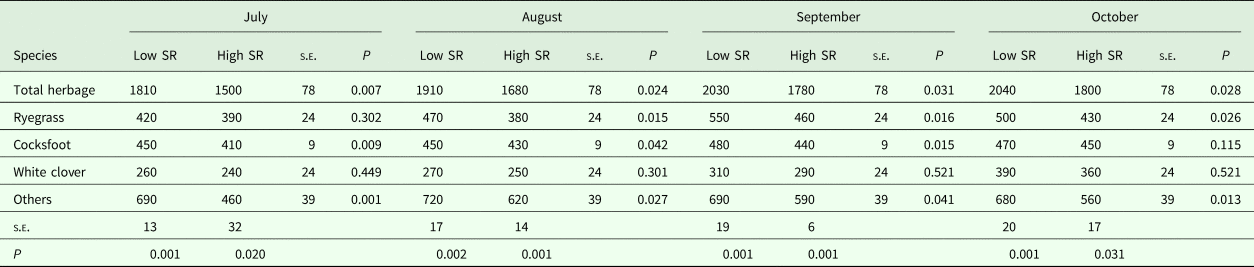
Although measuring herbage disappearance was not a primary objective of the current study, it is an important characteristic of grassland systems that impacts responses of grazing behaviour. SR and grazing month affected herbage disappearance of forage species (P < 0.001, Table 1). Between the low and high SRs, herbage disappearance of forage species in the low SR was generally greater in any grazing month (Table 1). Total herbage disappearance in the low SR was 20, 14, 13 and 13 greater in July, August, September and October, respectively, than that in the high SR. Herbage disappearance of ryegrass was not significantly different between the low and high SRs in July, however in other grazing months it was greater in the low SR than that in the high SR. Compared with the high SR, herbage disappearance of cocksfoot in the low SR was greater in the previous three grazing months and was not significantly different in October. Herbage disappearance of white clover was not significantly different between the low and high SRs in any grazing month. Under the low SR, herbage disappearance of ryegrass and cocksfoot was not significantly different in most grazing months, but both were greater than the herbage disappearance of white clover. Under the high SR, herbage disappearance of ryegrass and cocksfoot was greater from July to September than the herbage disappearance of white clover, but herbage disappearance of these three main forage species was generally lower than herbage disappearance of others in any grazing month.
The herbage disappearance (kg/ha) of forage species in low and high SRs from July to October

s.e., standard error; P, P value.
Goats’ activities
Goats had a similar distribution of grazing activities under low and high SRs. The greatest amount of time was spent eating, followed by ruminating, walking and resting in July through September. In October, the proportion of time spent eating reached >0.80, but time spent ruminating decreased to some extent compared with the prior three grazing months and time spent walking increased within both SRs, especially under high SR. These changes were probably associated with herbage mass of preferred forage. As autumn approached, preferred forage mass decreased, so animals needed to walk more and spent more time eating to meet their requirements. Within an observation period, goats spent more time eating and walking and less time ruminating and resting under high than under low SR during July, August and September, but there were no significant differences in October (Table 2). This difference was particularly large in August and September. Eating time was 2–11% greater for the high SR than the low SR. Using August as an example, for the high and low SRs, respectively, goats spent 0.69 v. 0.59 proportion of the time eating, 0.06 v. 0.03 walking, 0.24 v. 0.35 ruminating and 0.01 v. 0.03 resting.
Proportion of time allocated to different activities at low and high SRs from July to October

s.e., standard error; P, P value.
Goats had a similar diet preference in all months, regardless of SR. Compared with other forage species, goats spent more time eating the three dominant species, which occupied nearly 0.80 of their entire eating time (Table 3). Among these three dominant species, goats preferred ryegrass and cocksfoot over white clover. From July to September, goats spent more time eating ryegrass and cocksfoot, less on white clover, and even less on other plant species. However, time spent eating white clover increased in October such that it was almost equal to the time spent eating the other two dominant species. As for other species, goats’ eating time also increased slightly in September. Compared with the low SR, the distribution of eating time on each forage species was more uniform under the high SR. Furthermore, goats spent relatively more time on other species under the high SR than under the low SR (Table 3). During the whole grazing season, the distribution proportion of eating time was around 0.29, 0.27, 0.25 and 0.19 for ryegrass, cocksfoot, white clover and other species, respectively, under low SR, and around 0.27, 0.26, 0.24 and 0.23 for ryegrass, cocksfoot, white clover and other species under high SR, respectively.
The proportion of eating time for different forage species at low and high SRs from July to October

s.e., standard error; P, P value.
Goat eating behaviour
There were differences between low and high SRs in bites/step, bite rate, bite weight and daily intake (Table 4). Generally, values of bites/step, bite rate, bite weight and daily intake were greater within any grazing month under low than high SR. Under low SR, bites/step, bite weight and daily intake increased from July to September, and then decreased in October. There was no difference in bite rate among grazing months; it averaged 70 bites/min. As for bite weight, it increased slightly during three grazing months prior to October, but decreased significantly (P < 0.001) to 58.3 mg/bite in October. Under high SR, the changes in bites/step, bite rate, bite weight and daily intake among grazing months were similar to the low SR. Bites/step increased from seven in July to nine in September and then decreased again to seven in October. Bite rate was not significantly different among the four grazing months and averaged around 64 bites/min. Bite weight was similar for the first three months, around 59 mg/bite, but in October it decreased significantly (P = 0.017) to 42 mg/bite. Daily intake increased from 1.88 kg dry matter (DM)/day in July to 2.02 kg DM/day in September and then decreased to 1.21 kg DM/day in October.
Bites/step (bite), bite rate (bite/minute), bite weight (mg/bite) and daily intake (kg DM/day) of goat at low and high SRs from July to October

s.e., standard error; P, P value; DM, dry matter.
Goat bite weight for ryegrass and cocksfoot was greater in most grazing months under low SR than under high SR, however, bite weight for white clover and other plants was not significantly different in any month for either of the two SRs (Table 5). Goats had different bite weights for different forage species under the low SR in all grazing months; however, bite weight was similar among forage species under the high SR (Table 5). This is probably associated with goat preference and with forage mass (Tables 1 and 3). Under low SR, bite weight for cocksfoot was generally greater in any grazing month than for ryegrass, white clover and others. Goat bite weight was not significantly different for ryegrass and white clover in August, September and October, and was greater in these months than in others. For any given forage, bite weight varied among grazing months under the low SR. Bite weight for ryegrass and other species was not significantly different in the first three grazing months and then gradually decreased in the last grazing month; however, bite weight for cocksfoot and white clover increased slightly during the first three grazing months and then decreased in the following month. Under high SR, bite weight for all forage species was similar in the first three months but decreased in the last month. Between the two SRs, bite weight for ryegrass and cocksfoot was greater in all grazing months under low than under high SR.
Goat's bite weight (mg/bite) for different forage species at low and high SRs from July to October

s.e., standard error; P, P value.
Discussion
Goat grazing activities
As the grazing season progressed, goat grazing activities changed. Eating time increased in the last month, regardless of SR. This is likely related to the reduction of pasture mass in October, so goats had to spend more time eating to meet their nutritional needs. On a natural pasture, Sanon et al. (Reference Sanon, Kabore-Zoungrana and Ledin2007) found that goats made a shift in their feeding activities from grazing to browsing when the herbaceous biomass decreased. On the contrary, ruminating time decreased significantly after September. In the current study, goats under low SR used more time to ruminate compared with high SR. This was probably because forage mass was much greater and was much easier to access under low SR. In grass-forb pasture, Animut et al. (Reference Animut, Goetsch, Aiken, Puchala, Detweiler, Krehbiel, Merkel, Sahlu, Dawson, Johnson and Gipson2005) observed that post-grazing forage mass decreased linearly as grazing intensity increased. Goats tended to decrease their ruminating and resting time under high SR conditions in order to maintain their eating time when daylength became shorter and forage mass decreased (Lin et al., Reference Lin, Dickhoefer, Müller, Wurina and Susenbeth2011). Increasing grazing intensity generally decreases herbage mass on offer and reduces bite weight (Sollenberger et al., Reference Sollenberger, Agouridis, Vanzant, Franzluebbers, Owens and Nelson2012). As a consequence, goats at high SR increased eating and walking time and decreased ruminating time to compensate for the decrease in forage mass (Animut et al., Reference Animut, Goetsch, Aiken, Puchala, Detweiler, Krehbiel, Merkel, Sahlu, Dawson, Johnson and Gipson2005). In contrast, pastures stocked at the low SR regrew quickly and had greater herbage mass, which could be accessed easily. Animut et al. (Reference Animut, Goetsch, Aiken, Puchala, Detweiler, Krehbiel, Merkel, Sahlu, Dawson, Johnson and Gipson2005) found that goats in heavily grazed pasture increased eating time 8.3% above that in lightly grazed pasture during summer. In Tanzania (Panicum maximum cv. Tanzânia) pastures, Fernandes et al. (Reference Fernandes, Fernandes Junior, de Resende, Bonfa, Reis, Ruggieri, Fernandes and Santos2016) also reported that goats spent 0.70–0.74 of the time grazing and spent more time grazing when post-grazing residue was low (high-grazing intensity) than when it was high (low-grazing intensity). In the current study, results were similar to previous research findings. Time spent eating was found to be the largest proportion of time consumption and was 2–11% greater for the high SR than low SR.
Goat eating behaviour
Goats had similar diet preferences under low and high SRs. This was in agreement with the finding of Yiakoulaki et al. (Reference Yiakoulaki, Goetsch, Detweiler and Sahlu2014), who found that there were no significant effects of SR on botanical composition of the diet selected. As for ryegrass and cocksfoot in the current study, goats spent similar time eating them in all months under both SRs. Schiborra et al. (Reference Schiborra, Gierus, Wan, Glindemann, Wang, Susenbeth and Taube2010) reported that animals did not select their feed differently across grazing intensities because there was a homogeneous nutritional composition of herbage on offer. In the current study, ryegrass and cocksfoot, both grasses, probably had a similar nutritive value. Among the forage species present, goats spent more time eating the grasses (ryegrass and cocksfoot) than legumes (white clover) during July to September; however, the time spent eating white clover increased in October to a level that was almost equal to the time spent eating ryegrass and cocksfoot. Seasonal dietary preferences for specific forage species were probably related to the phenological stage and herbage mass of the species present. Iussig et al. (Reference Iussig, Lonati, Probo, Hodge and Lombardi2015) reported that the selection by goats seemed to be more species-dependent rather than functional group-dependent: they found that the most selected species belonged to graminoids (88.2%) and followed by forbs (11.0%). In the current study, the pasture was dominated by ryegrass and cocksfoot from July to October, whereas white clover proportion increased during the latter part of the grazing season. The increase in time spent eating white clover was probably due to the increase of its visibility, accessibility and biomass. The change of forage nutritional value also seemed to be responsible for the time spent feeding on particular species. Grass herbage increased in NDF (Neutral Detergent Fiber); ADF (Acid Detergent Fiber) (Decandia et al., Reference Decandia, Sitzia, Cabiddu, Kababya and Molle2000) and decreased in digestibility at the end of grazing season due to the presence of more dry and standing-dead material (Gutman et al., Reference Gutman, Henkin, Holzer, Noy-Meir and Seligman2000), which has lower nutritional value (Kababya et al., Reference Kababya, Perevolotsky, Bruckental and Landau1998). On the whole, goats adjusted their diet and preferences depending on the habitat in which they were foraging.
Bite rate and bite weight are important factors in the evaluation of eating behaviour (Perevolotsky et al., Reference Perevolotsky, Landau, Kababia and Ungar1998). A negative relationship between bite weight and SR was found in the present study. Bite weights were lower under high than under low SR in all months. A similar finding was reported by Meuret (Reference Meuret1997) for Mediterranean goats and by Dziba et al. (Reference Dziba, Scogings, Gordon and Raats2003) for Boer goats. The decline in bite rate with increasing SR in the current study might be related to the fact that goats under high SR need more time to seek forage. Bite rate across grazing seasons was around 70 and 64 bites/min under low and high SRs, respectively, which is close to the observation of 65 bites/min by Chen et al. (Reference Chen, Hou, Matthew and He2010). It indicated that goat bite rate and bite weight were affected significantly by grazing intensity. According to the change of pasture conditions due to grazing intensity, goats changed the nature of their eating behaviour in an attempt to meet their intake requirements. A decline in bite weight was proportional to a decrease in forage mass. In September, forage grew rapidly and there was a sufficient quantity of edible forage for goats. At this time, bite weight and bites/step reached their maximum levels and thus the daily intake also reached a peak in this month. In October, rainfall and daylength decreased significantly, and forage growth declined. Meanwhile, some plant species elongated reproductive stems and goat preference for these species decreased. In order to consume enough forage to meet maintenance and activity demand when forage mass was limiting, goats extended their eating time and increased the number of walking steps to allow access to more forage and to sustain forage intake. Both bite weight and bites/step decreased significantly as a result. However, the increase in walking steps could not compensate for low bite weight and bites per step, thus daily intake of goats decreased. Goats could adjust eating time, bites/step and bite rate to obtain the require intake after the reduction in bite weight. Rodrigues et al. (Reference Rodrigues, de Oliveira, Leal, de Moura, Araujo, dos Santos, Rodrigues and Rodrigues2016) reported that bite rate exhibited a linear and positive correlation with intake. However, the increase of eating time and number of bites could not compensate completely. Therefore, it finally led to a reduction in intake at higher SR which affected animal performance. Burns and Sollenberger (Reference Burns and Sollenberger2002) reported that the magnitude of adverse effects of high SR and low vegetation mass could increase with increasing nutrient requirement because of a lower threshold of vegetation mass at which increases in eating time are not fully compensatory for reduced bite weight. Also, increasing SR decreased opportunity for selection and intake/bite.
Conclusions
Goat grazing activity and eating behaviour were affected by a complex variety of factors and their interactions, such as SR, grazing season and plant species. Generally, goats spent more time eating and walking and less time ruminating and resting under high SR than under low SR. Goats spent more time eating ryegrass and cocksfoot than white clover. Bites/step, bite rate, bite weight and daily intake were greater under low than under high SR. Bite weight was similar among forage species under high SR; however, bite weight for ryegrass and cocksfoot under low SR was greater compared with bite weight for white clover. These results confirmed that SR affected goat grazing behaviour on cultivated pasture and indicated that grazing management (i.e. implementation of different SRs) is an important tool in modifying diet selection, promoting the consumption of particular plant species and thus managing the dynamics of plant communities on cultivated pasture.
Acknowledgements
The authors want to thank collaborating people at Yunnan Sheep & Goat Breeding Farm, the Yunnan Academy of Grassland and Animal Sciences, and Qingdao Agricultural University in China.
Financial support
The work was supported by the National Key Research and Development program (2016YFC0501902), the National Natural Science Foundation of China (31372370), the Science and Technology Program of CAAS (ASTIP-PS -IAS14), the China Forage Research System (CARS-35-12) and Chinese Universities Scientific Fund (2016DK001).
Conflict of interest
None.
Ethical standards
Not applicable.