Introduction
This article reports on an experimental study which was part of a five-phase research project. This study argues that music media is a contributing, and potentially highly significant influence in shaping children's gender role and self-identity.
Defining Gender Role
Gender role refers to expectations designated by society relating to behaviours, interests, presentation and activities pertinent to one's sex (Berk, Reference Berk2012; Cahill & Adams, Reference Cahill and Adams1997). Berk (Reference Berk2012) claims that gender-role identity begins in toddlerhood and is influenced environmentally through family, peers, teachers and the broader social environment, such as the media. In early childhood, children are aware of gender-stereotyped conventions and strive to imitate same-gender role-models. During middle childhood, children are under pressure to conform to socially valued gender-stereotyped roles of boys engaging in masculine activities and girls engaging in feminine activities. Peer interaction is commonly sex-segregated, strengthening stereotyped gender-role expectations (Berk, Reference Berk2012). Gender-role identity therefore plays a large role in self-identity development.
Defining Self-identity
Terminology used in literature around the development of self-identity commonly refers to the development of self-concept or self-understanding when discussing infants through to middle childhood (Berk, Reference Berk2012; Boyd & Bee, Reference Boyd and Bee2010). The term ‘self-identity’ is usually only introduced in literature relating to adolescents, although the foundations of self-identity begin in early childhood (Berk, Reference Berk2012).
This article uses the term self-identity across all ages, defined as children's understanding of self. Self-identity develops from infancy as the infant learns about his/her existence as a separate person (Boyd & Bee, Reference Boyd and Bee2010). By 2 years of age, the toddler is able to identify as a girl or boy (Boyd & Bee, Reference Boyd and Bee2010). With the increase of children's cognitive abilities during early childhood (3–8 years) children's self-identity becomes more refined. Initially they identify and describe personal characteristics, such as physical appearance and gender, discuss who and what activities they like and relate gender-specific characteristics to themselves. Such descriptions become more complex with age (Boyd & Bee, Reference Boyd and Bee2010). In middle childhood (9–12 years), children's self-identity becomes more multifaceted. They evaluate their self-identity by comparing themselves to others (Boyd & Bee, Reference Boyd and Bee2010). Like gender role, self-identity is shaped by biological and external influences (Berk, Reference Berk2012).
Music Media's Influence on Shaping Identity
It is widely accepted that children learn from, and are influenced by, media (Australian Communications and Media Authority, 2007; Newton, Reference Newton2009; Strasburger, Reference Strasburger2005). Many commentators argue that music media is a factor shaping identity (Australian Communications and Media Authority, 2007; Bosacki, Francis-Murray, Pollon, & Elliott, Reference Bosacki, Francis-Murray, Pollon and Elliott2006; Gonzalez de Rivas et al., Reference Gonzalez de Rivas, Fuld, Mulligan, Altmann, Brown, Christakis and Wilocox2009; Hanna, Reference Hanna1988; Hogan et al., Reference Hogan, Bar-on, Beard, Corrigan, Holroyd, Sherry and Strasburger1996; Middleton, Reference Middleton, Frith, Straw and Street2001; Russell, Reference Russell, Hargreaves and North1997; Shuker, Reference Shuker2005; Timmerman et al., Reference Timmerman, Allen, Jorgensen, Herrett-Skjellum, Kramer and Ryan2008; Wall, Reference Wall2003). Wall (Reference Wall2003) suggests that ‘music is not a separate phenomenon of identity but an integral part of the process of identity making’ (p. 161). Music affects how children begin to understand and articulate who they are, and it helps them define social and subcultural boundaries (Hogan et al., Reference Hogan, Bar-on, Beard, Corrigan, Holroyd, Sherry and Strasburger1996; Wall, Reference Wall2003). Studies reported by Russell (Reference Russell, Hargreaves and North1997) argue that music impacts on social identity in dress, self-presentation, attitudes and the emulation of behaviours exhibited by idols. For example, popular music and accompanying music video clips reflect gender issues through gender-stereotyped themes, prime perceptions and influence the mimicry of behaviours and attitudes viewed through the recall of schema (Russell, Reference Russell, Hargreaves and North1997). Thus, music culture plays a role in shaping social attitudes and behaviour (Russell, Reference Russell, Hargreaves and North1997).
Children's Engagement with Music Media
In Australia, children as young as 5 years engage with contemporary music media (Australian Bureau of Statistics, 2009; Australian Communications and Media Authority, 2010). Internationally, children from 8 years regularly engage with music media and are using a diversity of media tools to access it (Australian Communications and Media Authority, 2010; Christenson & Peterson, Reference Christenson and Peterson1988; Gonzalez de Rivas et al., Reference Gonzalez de Rivas, Fuld, Mulligan, Altmann, Brown, Christakis and Wilocox2009; Kaestle, Halpern, & Brown, Reference Brown2007). Given the evidence that music media contributes to identity formation, it is necessary to explore music media content.
Sexually Signified Content in Music Media
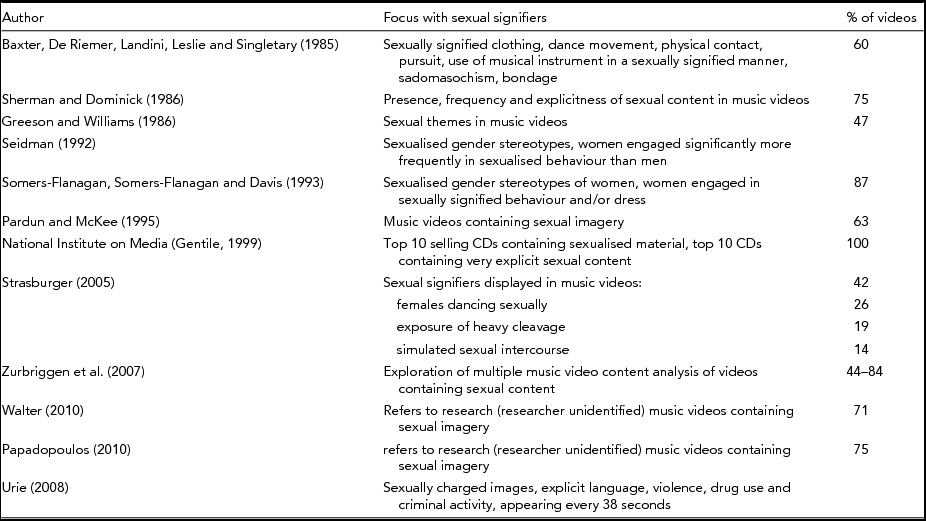
Music media is widely documented as containing high levels of overtly sexualised images and lyrics (Andsager & Roe, Reference Andsager and Roe2003; Arnett, Reference Arnett, Brown, Steele and Walsh-Childers2004; Bosacki et al., Reference Bosacki, Francis-Murray, Pollon and Elliott2006; Gale, Reference Gale2010; Greeson & Williams, Reference Greeson and Williams1986; Hamilton, Reference Hamilton2009; Hogan et al., Reference Hogan, Bar-on, Beard, Corrigan, Holroyd, Sherry and Strasburger1996; Kelton, Reference Kelton2010; Papadopoulos, Reference Papadopoulos2010; Rush & La Nauze, Reference Rush and Nauze2006a, Reference Rush and La Nauze2006b; Villani, Reference Villani2001; Walter, Reference Walter2010). The results of research conducted on sexually signified content in music media are shown in Table 1.
Sexually signified content in music media.

Concerns around the Impact of Sexually Signified Media on Children's Development
Numerous authors have shown that sexually signified media adversely impacts on the social attitudes, behaviours, psychological wellbeing and physical health of adults and adolescents (Burke, Gridley, & Pham, Reference Burke, Gridley and Pham2008; Ewing, Reference Ewing and Tankard-Reist2009; Ezzel, Reference Ezzel and Olfman2009; Gill, Reference Gill and Attwood2009; Kalof, Reference Kalof1999; Maine, Reference Maine and Olfman2009; Papadopoulos, Reference Papadopoulos2010; Urie, Reference Urie2008; Zurbriggen et al., Reference Zurbriggen, Collins, Lamb, Roberts, Tolman, Ward and Blake2007). The pervasive presence of sexually signified media is at the forefront of sexualised culture. Dines (Reference Dines2010) and Hamilton (Reference Hamilton2010) argue that children developing within this culture are affected because the mainstreaming of pornography-inspired media is encoded into their gender and sexual identities. Alongside Papadopoulos (Reference Papadopoulos2010), they claim that attitudes towards females are particularly affected because many images degrade and debase them, thus reinforcing and perpetuating inequality.
Concerns for pre-pubescent children proposed by commentators include:
• children adopting adverse gender stereotypical attitudes from media;
• gender inequality;
• hyper-masculine ideals;
• hyper-sexual ideals; and
• dysfunctional attitudes toward females
(Biddulph, Reference Biddulph and Tankard-Reist2009; Browne, Reference Browne1998; Buckingham, Willett, Bragg, & Russell, Reference Buckingham, Willett, Bragg and Russell2010; Burke et al., Reference Burke, Gridley and Pham2008; Carr-Greg, Reference Carr-Greg2010; Coy, Reference Coy2009; Department for Children Schools and Families, 2009; Dines, Reference Dines2010; Dittmar, Bell, & Lawton, Reference Dittmar, Bell and Lawton2007; Ewing, Reference Ewing and Tankard-Reist2009; Flood, Reference Flood2009; Gale, Reference Gale and Tankard-Reist2009; Hall, West, & Hill, Reference Hall, West and Hill2011; Hamilton, Reference Hamilton2010; Jung & Peterson, Reference Jung and Peterson2007; Levin & Kilbourne, Reference Levin and Kilbourne2008; Maine, Reference Maine and Olfman2009; Martino, Collins, Kanouse, Elliott, & Berry, Reference Martino, Collins, Kanouse, Elliott and Berry2005; Papadopoulos, Reference Papadopoulos2010; Princi, Reference Princi2010; Rissel, Richters, & Grulich, Reference Rissel, Richters and Grulich2003; Rush, Reference Rush and Tankard-Reist2009; Rush & La Nauze, Reference Rush and Nauze2006a, Reference Rush and La Nauze2006b; Sharpe, Reference Sharpe1998; Silmalis, Reference Silmalis2010; Tankard-Reist, Reference Tankard-Reist and Tankard-Reist2009; Walter, Reference Walter2010; Zurbriggen et al., Reference Zurbriggen, Collins, Lamb, Roberts, Tolman, Ward and Blake2007).
Concerns are usually based on research with adolescents and tertiary students, which has demonstrated that engagement with overtly sexualised music media adversely impacts attitudes (Gonzalez de Rivas et al., Reference Gonzalez de Rivas, Fuld, Mulligan, Altmann, Brown, Christakis and Wilocox2009; Kalof, Reference Kalof1999; Papadopoulos, Reference Papadopoulos2010; West, Reference West and Olfman2009; Zurbriggen et al., Reference Zurbriggen, Collins, Lamb, Roberts, Tolman, Ward and Blake2007). Tertiary students exposed to sexually objectifying music videos expressed adverse gender stereotypical attitudes, such as the acceptance of rape myths, sexual harassment, sex-role stereotyping, interpersonal violence, date rape and adversarial sexual beliefs about relationships (Gonzalez de Rivas et al., Reference Gonzalez de Rivas, Fuld, Mulligan, Altmann, Brown, Christakis and Wilocox2009; Kalof, Reference Kalof1999; Zurbriggen et al., Reference Zurbriggen, Collins, Lamb, Roberts, Tolman, Ward and Blake2007). Research conducted with boys aged 13–15 years found that media influenced their critical aesthetic expectations of girls; boys emphasised slimness and beauty as ‘important’ when choosing a partner (Papadopoulos, Reference Papadopoulos2010). Such attitudes position girls as vulnerable to sexual objectification and gender inequality.
Research continues to build a case that the foundations of such attitudes are evident in younger children, but contributing influences are yet to be established. Hamilton (Reference Hamilton2010) states that primary-school-aged boys view girlfriends as mere accessories. Coy (Reference Coy2009) claims that children are beginning to adopt sexualised ambitions above other aspirations. Starr and Ferguson (Reference Starr and Ferguson2012) found that girls aged 6–9 years sought sexy clothing and anticipated social advantages generated from looking sexy. They suggest that girls may fear social rejection as a result of non-compliance with the sexy ideal (Starr & Ferguson, Reference Starr and Ferguson2012).
Given the lack of research in this area, a research study with children aged 6 years explored whether music media influences their attitudes. Ten-year-old children's responses were compared to identify whether there were any emerging patterns.
Methodology
Ethical Considerations
This study was approved by the University of South Australia Human Research Ethics Committee, an allocated ethics officer from the Department for Education and Child Development and the independent school. Written consent was then sought from the individual schools, parents or guardians, and the children themselves. This research placed importance on the children's decision to participate. Children were fully informed ‘about the aims and scope of the research, asked consent at the beginning of the research’(Mahon & Glendinning, Reference Mahon and Glendinning1996, p. 150), and informed of their right to withdraw (Mahon & Glendinning, Reference Mahon and Glendinning1996) with no consequence (Curtin, Reference Curtin2000).
Participants
A convenience sample of 72 children – 34 Grade 1 children (median age 6.8 years), and 38 Grade 4 children (median age 9.7 years) were recruited from five government schools and an independent primary school in the metropolitan area of a Southern Australian state, to participate in the experimental study.
Apparatus
Laminated paper dolls with clothing pieces were used to collect data about children's clothing preferences and their perceptions of singers’ attire. The male figure had 10 pieces of clothing. Four pieces represented sexualised attire and included outfits such as baggy long pants with underpants showing above the waistline; an open red shirt (Rapper's outfit) and individual pieces such as, tight jeans and a tight shirt revealing muscles. Six pieces represented non-sexualised attire and consisted of outfits such as, jeans, T-shirt and a dress shirt and individual pieces such as T-shirts and board shorts.
The female figure had 14 pieces of clothing. Nine pieces represented sexualised attire and included outfits such as, a mid-thigh dress with a gaping neckline and a high-cut over thigh body-suit with a gaping neckline. Separate pieces included micro-mini shorts and a bustier top. Four pieces of non-sexualised attire included a knee-length dress and knee-length shorts. There were also six unisex pieces, which were non-sexualised. These consisted of tracksuit pants, loose jeans, a baseball cap, a beanie, flat black shoes and sneakers. The study thus allowed children access to 20 pieces of clothing for female dolls (9 sexualised items and 11 non-sexualised items) and 16 pieces for males (4 sexualised and 12 non-sexualised). The gender disproportion of clothing for these dolls is addressed in the data analysis section.
An interview proforma for the doll-dressing activity listed four directive questions and two opinion questions that were used to obtain children's clothing preferences and their perceptions of how female and male music artists dress. A further 17 open and closed questions, 14 to elicit children's perceptions of gender behaviour and three to obtain children's views around self-presentation, were asked (see the Appendix).
Two mildly sexualised and two non-sexualised contemporary music videos were selected. These selections were based on children's favourite music artists, which were revealed in an earlier phase of this research. The two music videos representing minimal frequency and duration of sexualised content were Justin Bieber's ‘Baby’ (Bieber, Reference Bieber2010), with a frequency score of 4, and Katy Perry's ‘Hot ‘n’ Cold’ (Perry, Reference Perry2008), which had a frequency score of 10 in an unpublished content analysis study conducted alongside this study. The frequency score reflects the number of incidents of sexually signified content displayed in the music video. For example, Katy Perry's ‘Hot ‘n’ Cold’ video showed Katy Perry in a wedding dress which had a gaping neckline and then wearing excessively tight shiny vinyl shorts and top with a gaping neckline. Her back-up dancers/characters were seen in skimpy bridal wear including suspenders and then in micro-shorts and a top which had a gaping neckline and an excessively tight, skimpy bodysuit. All female characters, including Katy Perry wore heavy make-up. These images accounted for six incidents. The dance and movement included all females pulsating their crotches, stroking their neck and thighs seductively and squatting seductively. These movements accounted for four incidents. The frequency score of 10 was identified as the largest number of incidents that could be categorised as mildly sexualised because videos viewed above this calibre were commonly more overt in the sexualised depictions. The two songs representing non-sexualised videos were Chris Brown's ‘With You’ (Brown, Reference Brown2007) and Miley Cyrus’ ‘The Climb’ (Cyrus, Reference Cyrus2009), both scoring 0. Videos were shown to children on a 16-inch-screen laptop computer. Children's activity and small group interviews were recorded on a HDR UX1/UX1E digital video recorder.
Procedure
On the first visit, children were interviewed in groups of 2–6 within their own age groups in a quiet room in their school. Children were invited to dress their dolls in: (1) clothes they liked wearing; (2) clothes they usually wore: (3) as a female and a male singer; and (4) in their favourite attire for boys and girls. On completion of the interactive activity, children were seated in a circle on the floor to engage in the semi-structured group interview. Children answered questions relating to each gender. The first six related to children's perceptions of girls’ activities and behaviours. For example, what girls like doing on weekends; how they act when they go out and how they play in gender-specific groups. The next six questions were identical but related to boys. Two questions related to gender power: “When boys and girls play together, who is usually in charge of the game?”, and “Who do you think should be in charge of the game?” The final questions related to whether children dress for the purpose of what they are doing or to “look good” (see the Appendix). Children's responses were hand-noted by the researcher and video recorded by a research assistant. The presence of the camera was not intrusive and did not appear to interfere with the natural progression of play or interviews (Flewitt, Reference Flewitt2005).
On the second visit, children were assigned randomly either to the experimental group or the comparison group. Children in the experimental groups were shown the two videos containing mild sexual connotations within their individual groups. Children in the comparison groups were shown the two videos with no sexual connotations. An alternating assignment method was employed. This means that the first group of grade 1 children, who participated in this study, were shown the two mildly sexualised videos. The second group of grade 1 children were shown the two non-sexualised videos. The third group, sexualised, the fourth group, non-sexualised and so-on. Thus, if the previous grade 1 group was exposed to mildly sexualised music videos, the next grade 1 group, regardless of whether it was the same school or not, was exposed to non-sexualised music videos. This method was used with both year levels to ensure that the same number of groups was exposed to the sexualised music videos as were exposed to the non-sexualised music videos, for the sake of comparison. When children finished watching the music videos, the post-test procedure with paper dolls and interviews was repeated as in the pre-test.
Data Analysis
Data were analysed for children's clothing choices, gender-role beliefs and self-presentation values. Responses were analysed for themes, created post-hoc from responses and tabulated. ‘Post-hoc’ is the process of creating categories based on themes that become apparent at the time of analysis (National Institute for Health Research, 2014). Brief explanations of indistinct categories are defined with the respective tables (see Tables 3, 7, 8, 9, 10, 11, 12, 13 and 14). Types of language, frequency of descriptive words used and preferred doll attire post-exposure to the sexualised or neutral videos were compared to pre-exposure responses. Comparisons were made in relation to differences in age, gender and exposure to different music videos. Data were tallied based on children's responses. Given that most children gave multiple responses to questions, the numbers presented in the tables vary from the number of participants. This is outlined under each table.
There was a higher proportion of sexualised clothing (45 per cent) to choose from for the female dolls than the male dolls (25 per cent). Attire was considered sexualised if it drew attention to secondary sexual characteristics, such as breast or crotch, or it exposed large areas of the skin.
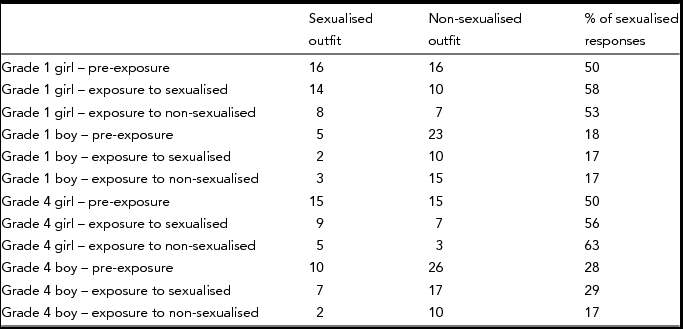
Responses to “Dress a doll in clothes that you would like to wear” and “Dress a doll in clothes that you and your friends usually wear on weekends” were tabulated together because there were minimal differences in children's choice of sexualised or non-sexualised attire between the questions. Responses were totalled and presented in a single table. Pre-test and post-test data for the sample of 72 children have only been presented in Table 2, to demonstrate the inconsistencies in the patterns of children's responses. Pre-test data have been presented thereafter. These data were taken from Visit 1 which enlisted 63 children – 16 Grade 1 girls, 14 Grade 4 girls, 15 Grade 1 boys and 18 Grade 4 boys. Children's comments have been written verbatim unless otherwise indicated with square brackets.
Children's sexualised and non-sexualised clothing preferences for themselves, in response to the directives: “Dress a doll in clothes that you would like to wear” and “Dress a doll in clothes that you and your friends usually wear on weekends”.
n = 72
Responses are double participant numbers because the data presented in the table combine two questions.
Number of responses varies between pre-exposure and post-exposure groups because of child absences. Numbers are as follows: Grade 1 girls Visit 1 (16), Visit 2 (19); Grade 1 boys Visit 1 (14), Visit 2 (15); Grade 4 girls Visit 1 (15), Visit 2 (12); Grade 4 boys Visit 1 (18), Visit 2 (18); and one Grade 1 girl answered one question twice on the second visit.
Limitations
The small sample of children who participated in this research means that the results cannot be tested for statistical significance or generalised. The consistency and significance of the results across participating school sites and across participants, however, warrants further investigation on a broader scale.
Because there were differences in the number of clothing items and sexualised and non-sexualised pieces of clothing for the female and male dolls, the clothing choices for each doll could not be significantly compared. This study could be replicated using the same number of sexualised and non-sexualised pieces of clothing for the male and female dolls.
Due to the ethical sensitivities of exposing children to sexualised music media, music videos that contained sexualised material were very mild. The ethical implications of such exposure were considered to be minimal given the assumption that all children would have already been exposed to sexually signified media, given the ubiquity of sexualised media in Western culture. Parallel studies with college-age or adult samples are able to use more strongly sexualised material. It is very unlikely that such material would ever be approved in a child study. The level of material allowed to be used in a child study is never going to be able to produce the kinds of effects that stronger material does with older age groups.
Results
Children's Self-presentation Values
This study found inconsistency in children's responses in the pre- and post-test procedure. Table 2 contains the only data presenting results from both the pre-exposure and post-exposure experimental and comparison groups, to demonstrate the variability of children's responses.
Table 2 shows that exactly half the girls showed a preference for sexualised clothing prior to exposure to music videos. There was a small increase in their choice of sexualised clothing after exposure to sexualised and non-sexualised videos in both grades. Only five of the 28 Grade 1 boys (18%) showed a preference for sexualised clothing pre- and post-exposure to music videos. Just over a third of Grade 4 boys (38%) preferred sexualised clothing before exposure to music videos, which mildly declined after exposure to sexualised videos. Only two of the 12 Grade 4 boys (17%) exposed to non-sexualised videos chose sexualised attire (see Table 2).
To demonstrate the inconsistency in children's clothing choices, pre- and post-exposure to music videos, individual examples of children's clothing choices are as follows:
• Mid-thigh dress with a gaping neckline and high-heels – recorded as sexualised (Grade 1 girl pre-exposure). Red micro-mini dress and knee-length heeled boots – recorded as sexualised (same child exposure to non-sexualised videos);
• Rapper outfit and sneakers – recorded as sexualised (Grade 1 boy pre-exposure); board shorts and T-shirt – recorded as non-sexualised (same child, exposure to sexualised videos);
• Jeans, T-shirt and sneakers – recorded as non-sexualised (Grade 4 girl, pre-exposure); micro-shorts and T-shirt – recorded as sexualised (same child, exposure to non-sexualised videos);
• T-shirt, board shorts, cap and black flat shoes – recorded as non-sexualised (Grade 4 boy, pre-exposure); T-shirt, jeans, green shirt and sneakers – recorded as non-sexualised (same child, exposure to sexualised videos).
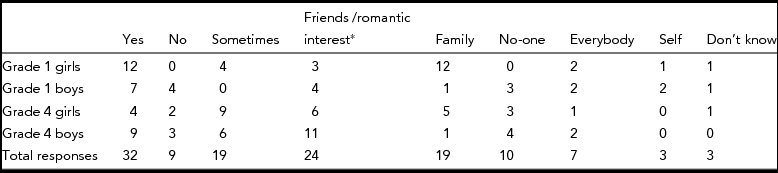
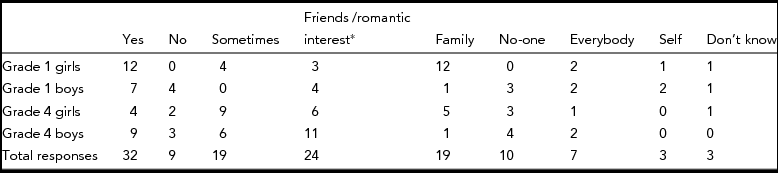
Fifty-two of the 63 children (83%) said they choose their own clothing based on the context of what they are doing. Many children supported their answer, explaining what they would wear to the playground or dressing for the temperature. Of the 60 responses to the question, “Do you choose clothes to look good and if so who do you hope notices?” 51 per cent of respondents said they choose clothes to look good and 30 per cent said they do “sometimes”. Grade 1 children focused more on wanting to look good, but Grade 4 children had a higher focus on being noticed by friends or romantic interests. Only 13 responses, compartmentalised into “no-one” (10) and “self” (3), were not focused on other people noticing (Table 3).
Children's responses to the question “Do you choose clothes to look good and if so, who do you hope notices?”
n = 63
Responses varied from the number of participants because three children did not answer this question and some children gave multiple responses as to whom they hope notices.
*Romantic interests referred to responses which specifically said boyfriend or girlfriend.
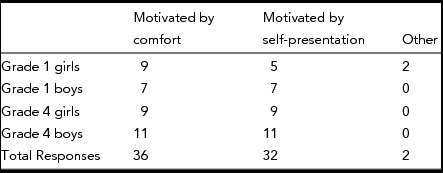
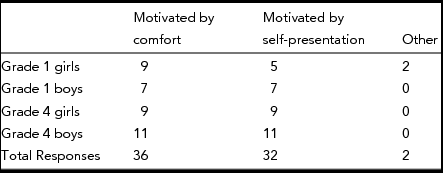
Children were asked if there was any particular clothing they did not like wearing. Their responses were relatively even between not liking particular clothes because of what they looked like or because they were uncomfortable. There were no notable differences between ages or genders (Table 4).
Children's motivation for what clothes they do not like wearing.
n = 63
Responses are higher than participants because some children gave multiple responses.
Responses from children who were motivated by presentation included:
• “jeans that aren't my style – green stuff” (Grade 4 girl);
• “overalls – nerdy” (Grade 4 boy);
• “ones that look boring – grey shorts” (Grade 1 boy);
• “pants; ’cos they look like boys and they don't look sexy” (Grade 1 girl).
Children's Clothing Preferences for Girls
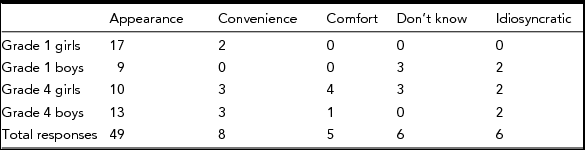
Fifty-one per cent of children (18 of 31 girls and 14 of 32 boys) dressed their female doll in sexually signified clothing. Micro-shorts were the most preferred attire. Grade 4 children (59 %) showed a slightly greater preference for sexualised clothing compared to Grade 1 children (41%).
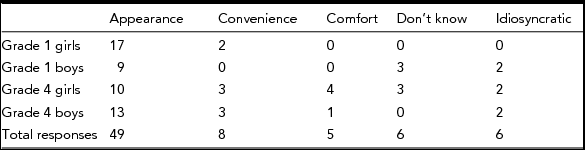
The majority of explanations given by children for their choices of female clothes were based on appearance. Other categories scored much lower (Table 5).
Children's reasons for their choice of favourite female clothes.
n = 63
Responses are higher than participants because some children provided multiple answers.
Children's Clothing Preferences for Boys
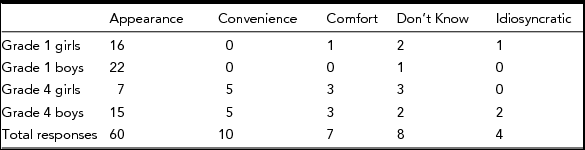
Thirty-seven per cent of children (8 of 31 girls and 15 of 32 boys) dressed their dolls in sexualised clothing when asked to dress a doll in clothing they liked best for a male. The most popular item of clothing for boys was jeans, followed by the rapper's outfit. Boys (47%) showed a greater preference for sexualised male attire than did girls (26%).
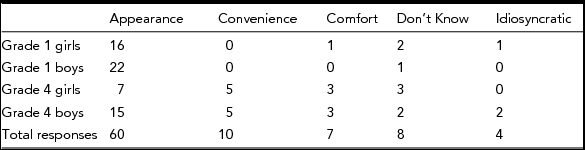
Most of the children's reasons for their choices of male clothes were based around appearance (Table 6).
Children's reasons for their choice of favourite male clothes.
n = 63
Responses are higher than participants because some children gave multiple answers.
Children's Perceptions of How Female and Male Music Artists Dress
Seventy-eight per cent of children dressed their female doll sexually when asked to dress the doll like a female singer: 12 Grade 1 girls, 11 Grade 1 boys, 14 Grade 4 girls, and 13 Grade 4 boys. One Grade 1 girl stated, “I’ve seen girl singers, they dress sexy”.
Thirty per cent of children dressed their male doll sexually when asked to dress the doll like a male singer: 3 Grade 1 girls, 8 Grade 1 boys, 2 Grade 4 girls and 6 Grade 4 boys. Remarks made by children when dressing their male doll as a singer included: “I’m gonna make mine look handsome” (Grade 1 girl) and “Buff shoulders” (Grade 4 girl).
Children's Perceptions of their Own and Opposite Gender
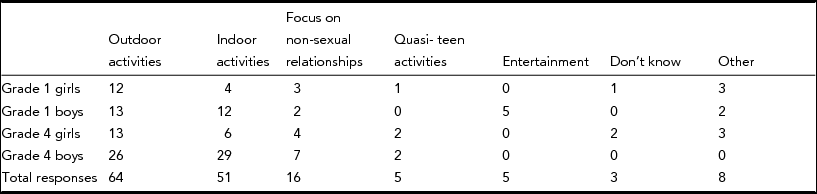
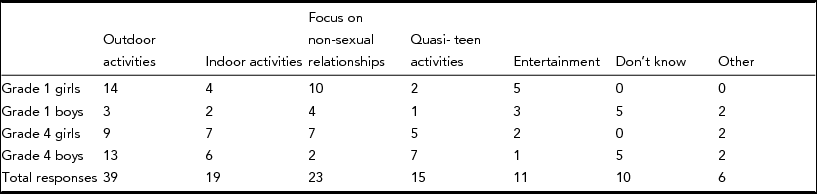
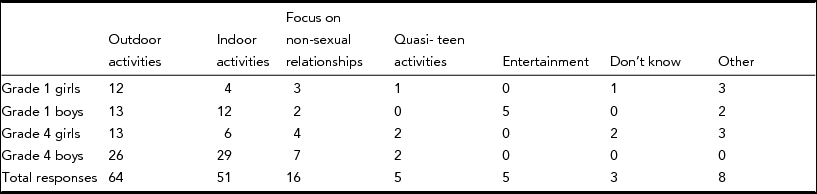
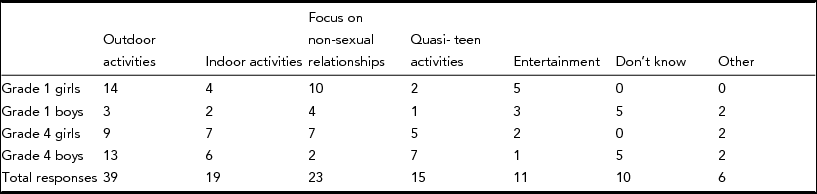
When children discussed what they think boys and girls like doing at weekends, most identified play activities. Boys were perceived as more likely to participate in activities (115) than girls (58). Boys made 80 references to their own gender participating in indoor and outdoor activities. Girls focused more on peer relationships, such as playing, hanging out, going out with a boyfriend or “going to the mall”(Tables 7 and 8).
What Grade 1 and Grade 4 children perceive boys their age like doing on weekends.
n = 63
Outdoor activities: sports, playing outside, swimming; Indoor activities: Lego, digital technology, hand-held games, drawing, reading; Focus on non-sexual relationships: playing with friends; Quasi-teen behaviours: leisure activities or behaviours usually associated with teenagers, such as hanging out at the mall, shoe shopping and catching up with their girlfriend or boyfriend; Entertainment: going out with parents for lunch, the movies or ‘plaster house’ (a shop in which children make trinkets from plaster); Other: idiosyncratic responses that do not fit into any other category.
What Grade 1 and Grade 4 children perceive girls their age like doing on weekends.
n = 63
Responses are higher than participants because some children gave multiple responses.
Outdoor activities: sports, playing outside, swimming; Indoor activities: Lego, digital technology, hand-held games, drawing, reading; Focus on non-sexual relationships: playing with friends; Quasi-teen behaviours: leisure activities or behaviours usually associated with teenagers, such as hanging out at the mall, shoe shopping and catching up with their girlfriend or boyfriend; Entertainment: going out with parents for lunch, the movies or ‘plaster house’ (a shop in which children make trinkets from plaster); Other: idiosyncratic responses that do not fit into any other category.
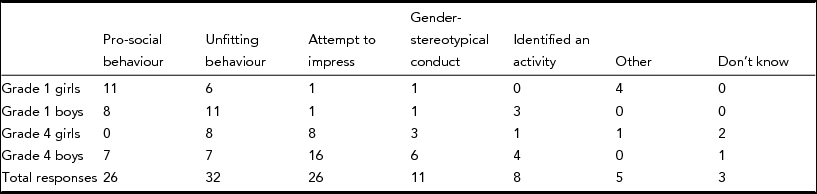
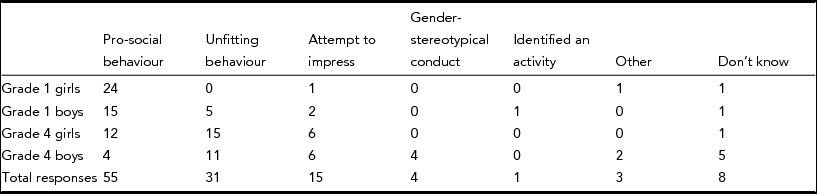
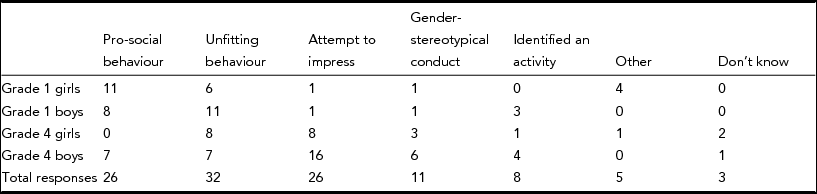
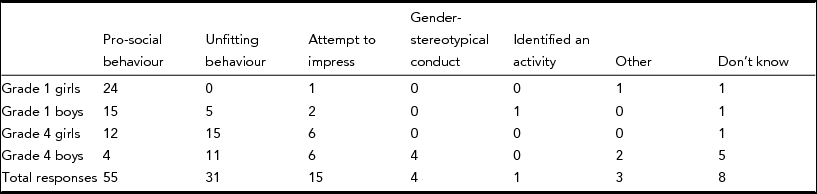
When children were asked about how boys and girls act when they go out, girls were seen to display more pro-social behaviour than boys. Boys were seen as attempting to impress more than girls, particularly by Grade 4 (Tables 9 and 10).
Children's perceptions of how boys act when they go out.
n = 63
Pro-social behaviour: showing manners, sitting nicely, sitting quietly, being ‘good’; Unfitting behaviour: acting naughty, being loud or acting silly; Attempts to impress: responses that suggest boys or girls tried to gain attention from the opposite sex, such as boys trying to walk into girls to get their attention; Gender-stereotypical conduct: boys shaking hands or acting rough and girls talking or giggling a lot; Identified an activity: such as playing digital games or iPods, swapping cards, colouring in; Other: idiosyncratic responses such as being funny or cheeky (not in a naughty way).
Children's perceptions of how girls act when they go out.
n = 63
Responses are higher than participants because some children gave multiple responses.
Pro-social behaviour: showing manners, sitting nicely, sitting quietly, being ‘good’; Unfitting behaviour: acting naughty, being loud or acting silly; Attempts to impress: responses that suggest boys or girls tried to gain attention from the opposite sex, such as boys trying to walk into girls to get their attention; Gender-stereotypical conduct: boys shaking hands or acting rough and girls talking or giggling a lot; Identified an activity: such as playing digital games or iPods, swapping cards, colouring in; Other: idiosyncratic responses such as being funny or cheeky (not in a naughty way).
When children were asked how each gender played with same-sex companions they regularly referred to neutral behaviours such as “nicely”, “friendly” or “fairly” for both genders. Activities such as football, chasey and skipping were more prominent when discussing boys (41) than girls (22). Boys (35) made the greatest number of reference to boys participating in physical activities. Stereotypical behaviours such a socio-dramatic play for girls and wrestling for boys were referenced more in the responses about boys (35) than girls (26).
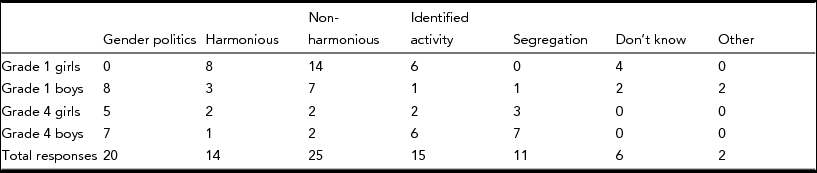
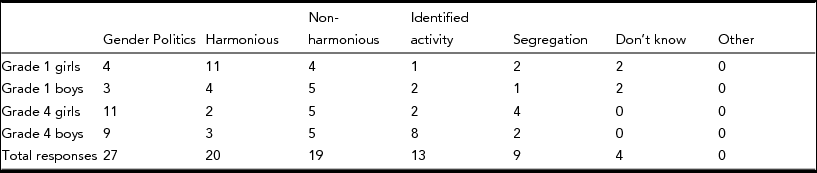
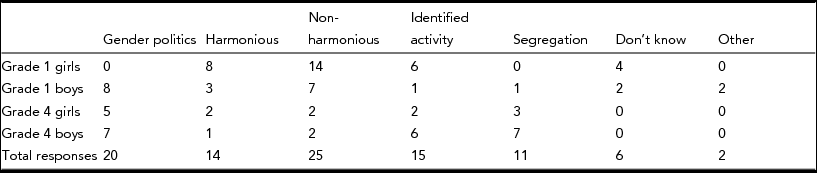
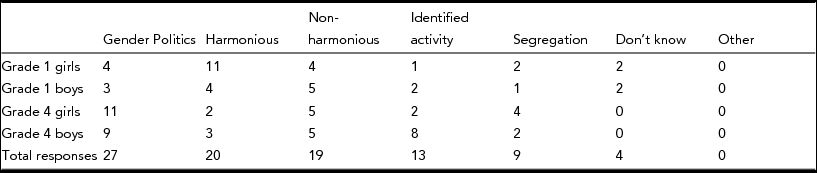
When discussing mixed-gender play, boys were perceived as playing more non-harmoniously than girls. Girls were mildly perceived as playing more harmoniously than boys. Gender politics (47) was prevalent across both age and gender responses and dominated responses when children were discussing how girls play when playing with boys. Gender segregation was more prominent in Grade 4 responses when discussing both boys’ and girls’ behaviour (Tables 11 and 12).
Children's responses to the question “How do boys play when playing with the opposite gender?”
n = 63
Gender politics: included statements such as girls try to make boys do things for them by putting on a baby voice, or boys trying to impress the girls; Harmonious: friendly, inclusive or kind to one another; Non-harmonious: physically rough or mean to one another; Identified activity or game: such as playing chasey, football, mums and dads, ‘Pokémon Wars’; Segregation of opposite gender: ignored or would not play with the opposite sex; Other: idiosyncratic responses such as “boys say silly things like go to the light of death” and “they’re shy”.
Children's responses to the question “How do girls play when playing with the opposite gender?”
n = 63
Responses are higher than participants because some children gave multiple responses.
Gender politics: included statements such as girls try to make boys do things for them by putting on a baby voice, or boys trying to impress the girls; Harmonious: friendly, inclusive or kind to one another; Non-harmonious: physically rough or mean to one another; Identified activity or game: such as playing chasey, football, mums and dads, ‘Pokémon Wars’; Segregation of opposite gender: ignored or would not play with the opposite sex; Other: idiosyncratic responses such as “boys say silly things like go to the light of death” and “they’re shy”.
The number of references to non-harmonious play and gender politics in mixed-gender play was unexpected. Some of the children's comments are presented below to further understand children's perceptions of non-harmonious play and the prevalence of gender politics.
Samples of mixed-gender play included the following (names have been changed to protect the privacy of children):
• “Boys will just go up to a girl and push her in the mud” (Grade 4 boy);
• “Boys are bossy” (Grade 4 girl);
• “They [girls] go crazy because they don't really get along” (Grade 4 girl);
• “They [boys] tease them [girls]” (Grade 4 boy);
• “Badly, boys and girls don't like each other, so they argue” (Grade 4 boy);
• [Boys are] “Mean, not fair, bossy, they start the war, hit us, kick, hit us with skipping ropes” (Grade 1 girl);
• “They [boys] wrestle them [girls]” (Grade 1 boy);
• “Sam throws sand at girls without saying sorry, plus he makes booby traps. He made a big hole and tried to trap Suzie and Nicki” (told by two Grade 1 boys);
• “They [boys] play games really nicely, suddenly they wrestle them [girls], surprise them, girls feel bad” (Grade 1 boy).
Children's responses to gender politics (47) in mixed-gender play (Tables 11 and 12) found that girls’ flirty behaviours (i.e., behaviour identified as seeking the attention of the opposite sex; 30) were the most evident interaction in both age and gender groups. Some children identified girls’ and boys’ interest in different types of games (i.e., stereotypical games that the opposite gender is not interested in) as leading to gender politics. A minority of children displayed non-stereotypical behaviours (i.e., responses such as girls being tomboys and boys engaging in socio-play, for example playing dad) during mixed-gender play, which created gender contention amongst children who did not approve of peers engaging in non-stereotypical play.
Children's Perceptions of Boys’ and Girls’ Roles in Mixed Play
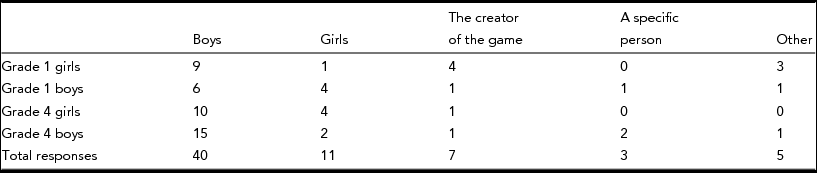
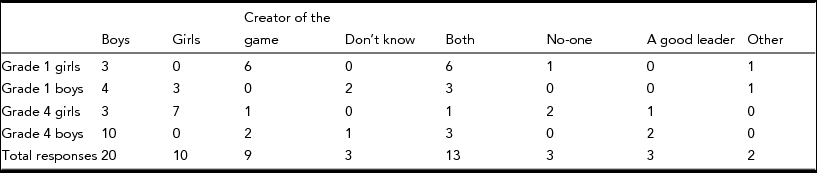
Table 13 shows that boys were most commonly seen as being in charge of play. Although children shared multiple views of who should be in charge of mixed-gender play, many children, predominantly boys, stated that boys should be in charge. Democratic responses such as “both genders”, “creator of the game” and “a good leader” were given by approximately one-third of children (Table 14).
Children's responses to “Who is usually in charge of mixed-gender play?”
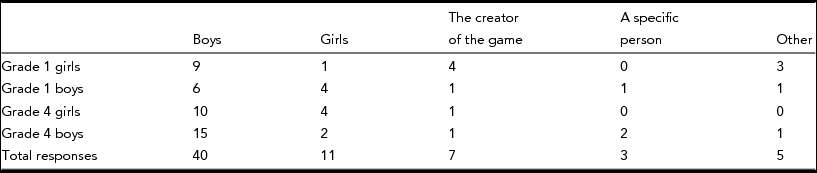
n = 63
Responses are higher than participants because some children gave multiple responses.
A specific person: children identified a peer by name; Other: included negotiation by voting (1), first one there (1), everyone (1), teacher (1) and both genders (1).
Children's responses to who they think should be in charge of mixed-gender play.
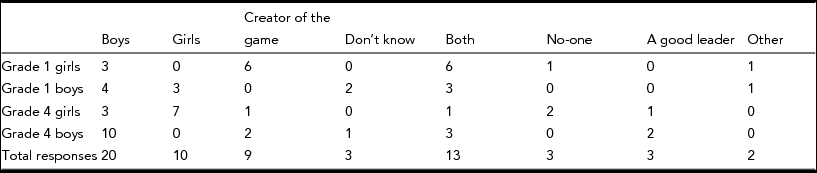
n = 63
Responses are higher than participants because some children gave multiple responses.
Don't know: verbatim; A good leader: children identified a peer who had leadership traits;
Other: a popular peer who is always in charge although they don't possess good leadership skills, and older people.
Comments made by children who chose boys (highest category) in relation to who should be in charge of the game included:
• “Boys, because they always are” (Grade 1 boy);
• “Boys want to be in charge and don't really care about anything else” (Grade 1 girl);
• “Boys – that's the way it should be” (Grade 4 boy);
• “Boys are better at sport” (Grade 4 girl);
• “Boys are a lot stronger than girls; they can pick up bigger sticks” (Grade 4 girl);
• “Men are usually in charge; boys do most of the work and have a stronger brain” (Grade 4 boy).
Discussion
This study showed that a single experimental exposure to two music videos containing mild sexually signified content did not demonstrate a direct impact on children's attitudes towards self-presentation or towards their own or their opposite gender. Children's attitudes relating to gender roles and preferences for sexualised clothing were present, as evident in the pre-test data, but this finding could not be linked to music media.
Findings revealed that some children's attitudes reflected gender-stereotypical attitudes portrayed in music media. This research also identified emerging patterns in children's attitudes, consistent with those found in research with adolescents and tertiary students, but to a much lesser degree. Given that research with adolescents and tertiary students demonstrates adverse impacts on social-sexual attitudes, and childhood is the foundation of children's gender-role and self-identity development, the findings from this study indicate a need for early intervention.
The majority of children dressed female singers in sexually signified attire, indicating that children are discerning of female singers’ sexual presentation. That a significantly smaller number of children dressed their male doll sexually suggests that children are aware that female singers present more sexually than males. This was not unexpected given that children as young as 5 years engage with music media (Australian Bureau of Statistics, 2009; Australian Communications and Media Authority, 2010), increasing with age (Australian Communications and Media Authority, 2010; Christenson & Peterson, Reference Christenson and Peterson1988; Gonzalez de Rivas et al., Reference Gonzalez de Rivas, Fuld, Mulligan, Altmann, Brown, Christakis and Wilocox2009; Kaestle et al., Reference Kaestle, Halpern and Brown2007). Since music media is considered influential in shaping gender role and self-identity (Australian Communications and Media Authority, 2007; Berk, Reference Berk2012; Hogan et al., Reference Hogan, Bar-on, Beard, Corrigan, Holroyd, Sherry and Strasburger1996; Newton, Reference Newton2009; Russell, Reference Russell, Hargreaves and North1997; Strasburger, Reference Strasburger2005; Wall, Reference Wall2003), the overt sexual presentation of female singers is likely to contribute to children developing adverse stereotypical attitudes towards girls. Such attitudes were evidenced in this study.
This research also found that most girls showed a preference for sexually signified clothing for themselves and their own gender. Preferences for sexually signified clothing for girls were similarly reflected in boys’ responses, with the majority of children focusing on appearance. This suggests that, from an early age, children expect girls to focus on appearance and sexual presentation. Music videos are likely to be a contributing influence, as they portray females as sex objects, thus normalising female sexual presentation. Such media lay the foundations for boys having critical aesthetic expectations of girls (Papadopoulos, Reference Papadopoulos2010). These findings also suggest that girls are embracing the value that sexual-appeal is important to social acceptance, reinforcing Starr and Ferguson's research (Reference Starr and Ferguson2012).
Boys’ preference for sexually signified clothing for themselves and their own gender was far less than that for girls, and only a minority of girls showed a preference for sexually signified clothing for boys. Despite the disparity in clothing choices, it is anticipated that if children were predisposed to view boys sexually, their clothing choices would have reflected this. This suggests that sexualised presentation is not woven into societal gender role expectations for boys. As such, boys are not under the same pressure as girls to present sexually, and are less likely to incorporate sexual appeal into their self-identity.
That the majority of children in this study already focused on appearance indicates that they may be vulnerable to self-objectifying behaviours, which have been identified as a risk factor for children exposed to sexually signified media (Burke et al., Reference Burke, Gridley and Pham2008; Department for Children Schools and Families, 2009; Gale, Reference Gale and Tankard-Reist2009; Levin & Kilbourne, Reference Levin and Kilbourne2008; Maine, Reference Maine and Olfman2009; Papadopoulos, Reference Papadopoulos2010; Starr & Ferguson, Reference Starr and Ferguson2012). Appearance-based values are likely to impact adversely on children's self-identity, particularly children who cannot achieve the beauty ideal.
Gender-stereotypical attitudes were evidenced throughout this study, commonly relating to boys being perceived as active and mischievous and girls perceived as displaying pro-social behaviour. There is a wealth of literature showing that children construct knowledge about gender from an early age based on environmental influences and cultural expectations (Levin & Kilbourne, Reference Levin and Kilbourne2008; Simon & Gagnon, Reference Simon and Gagnon1998). In Western society, boys are represented as more active and girls as more compliant through socially constructed gender-role expectations conveyed by sources such as parental and media modelling and portrayals of gender roles (Peterson, Reference Peterson2010; Sanson et al., Reference Sanson, Duck, Cupit, Ungerer, Scuderi and Sutton2000). Therefore, this finding was not unexpected.
Children in this study predominantly viewed boys as the dominant gender. Comments indicated that boys dominate mixed-gender play and exert power over girls, and such power-relations are expected and accepted by these age groups. Gender power-inequality is portrayed in music media (Seidman, Reference Seidman1992; Somers-Flanagan, Somers-Flanagan, & Davis, Reference Somers-Flanagan, Somers-Flanagan and Davis1993) which, according to Hogan et al. (Reference Hogan, Bar-on, Beard, Corrigan, Holroyd, Sherry and Strasburger1996) and Wall (Reference Wall2003), contributes to shaping children's gender-role and self-identity through defining social and subcultural boundaries. Children's attitudes reflected in this study not only validate commentators’ concerns about sexually signified media influencing children's adoption of adverse gender-stereotypical and hyper-masculine attitudes, leading to gender inequality (Browne, Reference Browne1998; Buckingham et al., Reference Buckingham, Willett, Bragg and Russell2010; Burke et al., Reference Burke, Gridley and Pham2008; Department for Children Schools and Families, 2009; Dines, Reference Dines2010; Dittmar et al., Reference Dittmar, Bell and Lawton2007; Ewing, Reference Ewing and Tankard-Reist2009; Hall et al., Reference Hall, West and Hill2011; Hamilton, Reference Hamilton2010; Jung & Peterson, Reference Jung and Peterson2007; Levin & Kilbourne, Reference Levin and Kilbourne2008; Maine, Reference Maine and Olfman2009; Martino et al., Reference Martino, Collins, Kanouse, Elliott and Berry2005; Papadopoulos, Reference Papadopoulos2010; Rissel et al., Reference Rissel, Richters and Grulich2003; Rush, Reference Rush and Tankard-Reist2009; Rush & La Nauze, Reference Rush and Nauze2006a, Reference Rush and La Nauze2006b; Sharpe, Reference Sharpe1998; Silmalis, Reference Silmalis2010; Walter, Reference Walter2010; Zurbriggen et al., Reference Zurbriggen, Collins, Lamb, Roberts, Tolman, Ward and Blake2007), but also identify that the foundations of such attitudes are being laid early in childhood. That boys’ and girls’ attitudes demonstrated a right of male power is particularly problematic for girls and may lead to negative outcomes for them, especially in light of research conducted with adolescents and tertiary students (Gonzalez de Rivas et al., Reference Gonzalez de Rivas, Fuld, Mulligan, Altmann, Brown, Christakis and Wilocox2009; Kalof, Reference Kalof1999; Papadopoulos, Reference Papadopoulos2010; West, Reference West and Olfman2009; Zurbriggen et al., Reference Zurbriggen, Collins, Lamb, Roberts, Tolman, Ward and Blake2007).
The findings of this study indicate that children's current attitudes and behaviours are at the early stages of those found in adolescents, which suggests that there is an urgent need for early intervention. The most effective means to lessen adverse effects on children's healthy development would be a collaborative societal approach which places children's development at the forefront. While this approach would be optimal, it is unlikely, as it would necessitate generating change to music industry productions, media law and classifications, and other influential societal variables. Since it is impossible to shield children from media, early education may be a useful strategy to protect children from its effects. A collaborative approach between teachers and parents can support a healthy psychological foundation and support children and their families to become proficient in critically analysing sexualised media. This will empower children to develop their own identities based on their own and their family's values and may reduce the further implications identified in the research with adolescents.
Appendix Interview proforma
Visit 1 – dressing doll activity and group interview only.
Visit 2 – exposure to music videos which had mild sexual connotation or no sexual connotation (Experimental group - 2 videos with mild sexual connotations, less than 10 events. Comparison group – exposure to 2 videos with no sexualised content).
Children were invited to participate in the interview and choose dolls to support their answers.
Pre- and Post-exposure Questions for Children
Instructional questions:
1. Dress a doll in the clothes that you most like to wear.
2. Dress a doll in clothes that you and your friends usually wear on weekends.
3. Dress a doll like a girl singer.
4. Dress a doll like a boy singer.
Opinion questions based on clothing preferences:
5. Which girl outfit did you like the best? What did you like about it?
6. Which boy outfit did you like the best? What did you like about it?
Questions based on gender:
7. What do you think girls your age like doing on weekends?
8. How do girls your age act when they go out?
9. Do you think they should act like this? If not, how do you think they should act?
10. How do girls dance? Why do you think they dance like that?
11. How do girls play when they play with other girls?
12. How do girls play when they play with boys?
13. What do you think boys like doing on weekends?
14. How do boys your age act when they go out?
15. Do you think they should act like this? If not, how do you think they should act?
16. How do boys dance? Why do you think they dance like that?
17. How do boys play when they play with other boys?
18. How do boys play when they play with girls?
19. When girls and boys play together who is usually in charge of the game?
20. Who do you think should be in charge of the game?
Questions based on self-presentation:
21. When you choose your own clothes to wear, do you choose clothes that are best for what you are doing (e.g., playing outside)?
22. Do you choose clothes to look good? If yes, who do you hope notices?
23. What clothes don't you like wearing? Why?