INTRODUCTION
This review considers factors influencing survival of the two extant species of cockle, Cerastoderma edule (L.) and C. glaucum (Bruguière, 1789) in European waters. Parasites, pathogens and commensals are treated separately by Longshaw & Malham (in press). The edible cockle C. edule is extensively exploited throughout its range and has a high economic value; its counterpart, the lagoon cockle C. glaucum is not commercially fished. Cockles are a bivalve occurring intertidally and subtidally around the coastline of Europe. Cerastoderma glaucum tends to occur in non-tidal areas such as lagoons and salt marshes whilst C. edule is more likely to be found on open coasts and in estuaries (Reise, Reference Reise2003). They occur from Norway to Morocco and through the Baltic, Mediterranean and Black Seas. Although an overlap in distribution occurs at a large geographical scale for both species, C. glaucum is more common in the Mediterranean Sea and southern Europe and has been recorded from the coasts of Egypt, Tunisia, Turkey, Sardinia, Italy, Greece, Portugal, Spain, France (Atlantic and Mediterranean coasts), The Netherlands, the British Isles, Denmark, Finland, Norway and in the Wadden Sea, Baltic Sea, Mediterranean Sea, Black Sea, Adriatic Sea, Red Sea, Aegean Sea and Caspian Sea (Boyden, Reference Boyden1970; Ivell, Reference Ivell1979; Abdel-Malek & Ishak, Reference Abdel-Malek and Ishak1980; Baudin, Reference Baudin1980; Labourg & Lasserre, Reference Labourg and Lasserre1980; Latypov et al., Reference Latypov, Gulbin and Yakovlev1995; Belofastova, Reference Belofastova1996; Kevrekidis et al., Reference Kevrekidis, Gouvis and Koukouras1996; Amaral & Costa, Reference Amaral and Costa1999; Breber et al., Reference Breber, Scirocco and Cilenti2000; Carlsson, Reference Carlsson2002; Erkan et al., Reference Erkan, Sousa and Baldala2002; Reise, Reference Reise2003; Arroyo et al., Reference Arroyo, Aarnio and Bonsdorff2006; Culurgioni et al., Reference Culurgioni, D'Amico, De Murtas, Trotti and Figus2006; Riisgård et al., Reference Riisgård, Lassen, Kortegaard, Möller, Friedrichs, Jensen and Larsen2007; Derbali et al., Reference Derbali, Jarboui, Ghorbel and Zamouri-Langar2009b; Leontarakis et al., Reference Leontarakis, Xatzianastasiou and Theodorou2009). On the other hand, C. edule is distributed along the north-eastern coastline of the Atlantic Ocean and into the Barents and Wadden Seas along the coasts of Norway, Sweden, Denmark, The Netherlands, Germany, the British Isles, France, Spain, Portugal and Morocco (Barnes, Reference Barnes1973; Seed & Brown, Reference Seed and Brown1977; Wilson, Reference Wilson1980; Ivell, Reference Ivell1981; Armonies, Reference Armonies1992; Bachelet & Dauvin, Reference Bachelet and Dauvin1993; Machado & Costa, Reference Machado and Costa1994; Atkinson et al., Reference Atkinson, Clark, Bell, Dare, Clark and Ireland2003; Flach, Reference Flach2003; Bazairi et al., Reference Bazairi, Bayed and Hily2005; Anajjar et al., Reference Anajjar, Chiffoleau, Bergayou, Moukrim, Burgeot and Cheggour2008; Cacabelos et al., Reference Cacabelos, Quintas and Troncoso2008; de Montaudouin et al., Reference de Montaudouin, Thieltges, Gam, Krakau, Pina, Bazairi, Dabouineau, Russell-Pinto and Jensen2009; Ponsero et al., Reference Ponsero, Dabouineau and Allain2009; Andersen et al., Reference Andersen, Lanuru, van Bernem, Pejrup and Riethmueller2010; Genelt-Yanovskiy et al., Reference Genelt-Yanovskiy, Poloskin, Granovitch, Nazarova and Strelkov2010). Longevity has been estimated to be in excess of 6 years for some populations, although with mortality events and poor growth, this can often be reduced to 2–3 years maximum (Jelesias & Navarro, Reference Jelesias and Navarro1990; Jensen, Reference Jensen1992; Lindegarth et al., Reference Lindegarth, André and Jonsson1995). Population success can be negatively influenced by inter- and intra-specific competition, particularly in relation to growth and density (Jensen, Reference Jensen1992, Reference Jensen1993; de Montaudouin & Bachelet, Reference de Montaudouin and Bachelet1996; Ramón, Reference Ramón1996)
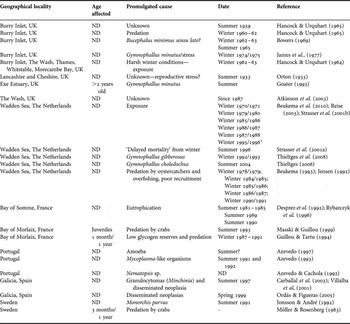
Mortalities of cockles and catastrophic declines in cockle populations have been reported for many years with predation, disease, climatic events, pollution, failed recruitment and over-fishing being suggested as important factors (Ducrotoy et al., Reference Ducrotoy, Rybarczyk, Souprayen, Bachelet, Beukema, Desprez, Dörjes, Essink, Guillou, Michaelis, Sylvand, Wilson, Elkaïm and Ibanez1989). A list of some mortality events in cockles and promulgated causes are listed in Table 1. Ducrotoy et al. (Reference Ducrotoy, Rybarczyk, Souprayen, Bachelet, Beukema, Desprez, Dörjes, Essink, Guillou, Michaelis, Sylvand, Wilson, Elkaïm and Ibanez1989) developed a simple model of population parameters. These included populations undergoing ‘crisis' situations characterized by a few age-classes which undertake successive spawning-periods or uninterrupted spawnings leading to numerous cohorts. This is considered a strategy for restoration by the cockle. A single and strong recruitment leading to a high density of the first cohort then occurs in the ‘recovery’ phase with the possibility of synchronization of spawning between breeding stocks. The most ideal population is one defined as ‘upholding' by Ducrotoy et al. (Reference Ducrotoy, Rybarczyk, Souprayen, Bachelet, Beukema, Desprez, Dörjes, Essink, Guillou, Michaelis, Sylvand, Wilson, Elkaïm and Ibanez1989) in which there are several age-classes and a higher density of older age-classes with spawning following the expected pattern. Any subsequent collapse in abundance may be due to loss of older animals and/or unsuccessful recruitment. Any increase in population growth rate at this stage should be considered as a sign of instability which may lead to a population crash.
Published ‘mass' mortality events reported for Cerastoderma edule. No mass mortality events have been noted for Cerastoderma glaucum. ND, no data.

1, includes mortality of C. glaucum in winter 1995/1996.
GENETICS
Controversy has existed regarding the genetic relationship between Cerastoderma glaucum and C. edule with a number of molecular and morphological techniques (including shell and sperm morphology) being used to discriminate the species from each other (Rygg, Reference Rygg1970; Urk, Reference Urk1973; Brock, Reference Brock1987; Chao, Reference Chao2000). These techniques and others have subsequently been applied to discriminate larvae and adults as well as to demonstrate the phylogeny and phylogeography of cockle populations. Isozyme and allozyme electrophoresis studies with C. edule and C. glaucum are readily able to discriminate the two species (Jelnes et al., Reference Jelnes, Petersen and Russell1971; Brock, Reference Brock1987; Machado & Costa, Reference Machado and Costa1994) and discriminate subpopulations of both species throughout their range (Hummel et al., Reference Hummel, Wolowicz and Bogaards1994; Mariani et al., Reference Mariani, Ketmaier and De Matthaeis2002; Nikula & Väinölä, Reference Nikula and Väinölä2003). Electrophoretic methods provide limited evidence for genetically isolated populations of C. edule. However, Beaumont & Pether (Reference Beaumont and Pether1996) suggested that cockles from the Burry Inlet (Wales) appeared to be distinct from seven other cockle populations around the UK sampled for nine polymorphic allozyme loci. It should be noted that allozymes may be subject to selection, and therefore differences in allele frequencies between populations could be selectively induced, rather than representing true genetic differences. Lagoon cockles collected from the infralittoral zone of the Romanian Black Sea were mainly shown to be similar, with over 80% of the animals sharing similar haplotypes (David & Tigan, Reference David and Tigan2011).
Studies using microsatellite data have further shown that the allele frequency of cockles indicated low but significant genetic differentiation of populations of cockles around the estuaries of UK coasts but that localized samples showed no significant difference (e.g. Burry Inlet). This suggests that the Burry Inlet at the time of study was thought of as a single population even though the presence of a pelagic larval phase would suggest the potential for extensive dispersal. Molecular methods have shown that at least two dominant haplotypes of C. edule occur—a homogeneous south-western population from Africa to the British Isles and a second haplotype of a heterogeneous northern group predominately in the Arctic (Krakau et al., Reference Krakau, Jacobsen, Jensen and Reise2012). A more complex population structure of C. glaucum, formed as a result of its fragmented distribution has been shown through mtDNA data (Tarnowska et al., Reference Tarnowska, Chenuil, Nikula, Féral and Wolowicz2010). As a result of that study, Tarnowska et al. (Reference Tarnowska, Chenuil, Nikula, Féral and Wolowicz2010) suggested that the taxonomy of the genus required revision.
Chromosome patterns have some utility for discriminating subpopulations of C. glaucum. Both edible and lagoon cockles have a diploid chromosome complement of 2n = 38 (Wolowicz & Thiriot-Quievreux, Reference Wolowicz and Thiriot-Quievreux1997; Leitão et al., Reference Leitão, Chaves, Joaquim, Matias, Ruano and Guedes-Pinto2008). The karyotype of lagoon cockles from the southern Baltic Sea includes 11 metacentric, 2 submetacentric and 6 subtelocentric chromosomes (Wolowicz & Thiriot-Quievreux, Reference Wolowicz and Thiriot-Quievreux1997) whilst those from Gdansk Bay have 3 metacentric, 10 submetacentric and 6 subtelocentric chromosome pairs (Thiriot-Quievreux & Wolowicz, Reference Thiriot-Quievreux and Wolowicz1996). In contrast, those from Thau Lagoon in the Mediterranean have a karyotype of 4 metacentric, 9 submetacentric and 6 subtelocentric pairs (Thiriot-Quievreux & Wolowicz, Reference Thiriot-Quievreux and Wolowicz1996). In general C. edule has a karyotype of 12 submetacentric, 3 telocentric and 4 subtelocentric chromosomal pairs or 7 submetacentric, 5 telocentric and 7 subtelocentric depending on geographical origin (Insua & Thiriot, Reference Insua and Thiriot1992). However, in the presence of environmental pollutants the number of chromosomes can dramatically increase as a result of chromosomal fission and may thus have some utility as a biomarker for contaminant exposure (Insua & Thiriot, Reference Insua and Thiriot1992; Leitão et al., Reference Leitão, Chaves, Joaquim, Matias, Ruano and Guedes-Pinto2008).
Cockle species have been discriminated from each other and from other bivalve species through the use of molecular methods such as random amplified polymorphic DNA (RAPD-DNA) (André et al., Reference André, Lindegarth, Jonsson and Sundberg1999), polymerase chain reaction (PCR) and sequencing of 18S rRNA, 5S rDNA/RNA, ITS1 and ITS2 (Insua et al., Reference Insua, Freire and Méndez1999; Hare et al., Reference Hare, Palumbi and Butman2000; Freire et al., Reference Freire, Insua and Méndez2005, Reference Freire, Arias, Mendez and Insua2009, Reference Freire, Arias, Méndez and Insua2011; Larsen et al., Reference Larsen, Frischer, Rasmussen and Hansen2005, Reference Larsen, Frischer, Ockelmann, Rasmussen and Hansen2007; Espineira et al., Reference Espineira, González-Lavín, Juan and Santaclara2009), PCR-restriction fragment length polymorphism (PCR-RFLP) (Freire et al., Reference Freire, Insua and Méndez2005) and single-strand conformation polymorphism-PCR (SSCP-PCR) (Nikula & Väinölä, Reference Nikula and Väinölä2003). All methods are equally valid in discriminating species.
REPRODUCTION AND DEVELOPMENT
As with most bivalves, cockles are dioecious with no external morphological differences between the sexes. In general, there is a 1:1 sex-ratio in any given population (Boyden, Reference Boyden1971; Bowmer et al., Reference Bowmer, Jenner, Foekema and Van der Meer1994). Discrepancies in these ratios may provide evidence of a sex-specific mortality. Reproductive cycles for Cerastoderma edule and C. glaucum are similar with rapid gametogenesis occurring in spring. Subsequent maturation of C. edule occurs at a quicker rate compared with C. glaucum, which may reduce the risk of cross-fertilization in sympatric populations of these species (Boyden, Reference Boyden1971). However, Brock (Reference Brock1982) considered that synchronous spawning occurred in sympatric species although hybrids were not produced as a result. Some limited evidence of hybridization has however been provided (Kingston, Reference Kingston1973).
Cerastoderma species undergo gametogenesis in February/March followed by rapid gonad development in April and May and spawn around May to July/August with gonads accounting for up to 20% of the animal's body mass at the height of sexual maturity (Lebour, Reference Lebour1938; Boyden, Reference Boyden1971; Newell & Bayne, Reference Newell and Bayne1980; Brock, Reference Brock1982; Guillou et al., Reference Guillou, Bachelet, Desprez, Ducrotoy, Madani, Rybarczyk, Sauriau, Sylvand, Elkaim and Glermarec1990; Cardoso et al., Reference Cardoso, Witte and van der Veer2009). Some populations of C. glaucum undergo two to three synchronized spawning events (spring and autumn) (Zaouali, Reference Zaouali1980; Derbali et al., Reference Derbali, Jarboui and Ghorbel2009a); C. edule either undergoes a single spawning event in a short space of time (Kingston, Reference Kingston1974a) or can undertake ‘polycyclic' spawning without a resting period (Yankson, Reference Yankson1986b). Gonadal resting takes place usually between October and March. Egg production and egg size is larger after a harsh winter compared with mild winter temperatures (Honkoop et al., Reference Honkoop, Beukema and Kwast1995) and although recruitment is generally earlier after a mild winter (Strasser et al., Reference Strasser, Hertlein and Reise2001a), survival of progeny may be lower (Beukema et al., Reference Beukema, Essink, Michaelis and Zwarts1993). Exposure to various pollutants such as pulverized fuel ash, polyaromatic hydrocarbons, polychlorinated biphenyls or oestrogenic compounds can delay the onset of oocyte maturation and reduce fecundity (Bowmer et al., Reference Bowmer, Jenner, Foekema and Van der Meer1994; Timmermans et al., Reference Timmermans, Hummel and Bogaards1996; Matozzo & Marin, Reference Matozzo and Marin2007). In addition, certain parasites such as digeneans have been shown to castrate both males and female cockles reducing reproductive output of a population (Boyden, Reference Boyden1970; Derbali et al., Reference Derbali, Jarboui and Ghorbel2009a).
Various schemes to categorize the development stages of the gonad have been proposed including by Boyden (Reference Boyden1971) for Cerastoderma spp. who listed grades I to IV representing resting (or spent), developing, ripe and very ripe respectively. A similar, but somewhat extended scheme for female C. edule was suggested by Seed & Brown (Reference Seed and Brown1977) with 0 being rested or spent, 1 and 2 developing and spawning, 3 being ripe. For male cockles the scheme proposed by Boyden (Reference Boyden1971) was grade 0 (indeterminate), grade II (developing), grade III (ripe) and IV (very ripe/spawning); the scheme for male cockles proposed by Seed & Brown (Reference Seed and Brown1977) mirrored that proposed for female cockles. The scheme of Kingston (Reference Kingston1974a) consisted of stage 1 (initiation of gametogenesis), stage 2 (development), stage 3 (ripe), stage 4 (recently spawned) and stage 5 (post-spawning recovery).
Minimum size at first maturity in C. glaucum is normally around 12 mm shell length (SL) for males and 14 mm SL for females (Derbali et al., Reference Derbali, Jarboui, Ghorbel and Zamouri-Langar2009b); similar sizes have been reported for C. edule (Hancock & Franklin, Reference Hancock and Franklin1972; Seed & Brown, Reference Seed and Brown1977). Maturation of 7 weeks old C. glaucum (4 mm SL) laboratory reared spat has been reported and although no fertilization experiments were conducted, gamete morphology was comparable to those of adults from natural populations (Yankson, Reference Yankson1986a). Edible cockles produce many, small pelagic eggs whilst lagoon cockles produce a smaller number of larger benthic eggs (Reise, Reference Reise2003). Eggs become non-viable if not fertilized within 4–8 hours post-release from the females (André & Lindegarth, Reference André and Lindegarth1995). Following fertilization, eggs are pelagic with larval development in the pelagic phase taking around 31/2 to 5 weeks; the veliger stage accounts for around 2 to 3 weeks of this (Lebour, Reference Lebour1938; Creek, Reference Creek1960).
Although many bivalves typically undergo a lifecycle that includes a planktonic dispersal phase followed by a sessile juvenile stage (a plantigrade) with metamorphosis into an adult, cockles have been shown to undergo a secondary, planktonic postlarval stage (Baker & Mann, Reference Baker and Mann1997). Secondary dispersal of edible cockle larvae is restricted to the summer months in northern Europe and is correlated with a semilunar rhythm of 15 days (Armonies, Reference Armonies1992). In contrast, planktonic C. edule larvae occur throughout most of the year in southern Portugal (Chicharo & Chicharo, Reference Chicharo and Chicharo2000). This planktonic postlarval dispersal is an active process occurring in cockles up to 6 mm in length (de Montaudouin, Reference de Montaudouin1997; de Montaudouin et al., Reference de Montaudouin, Bachelet and Sauriau2003). Survival and subsequent recruitment of cockles into the adult population can be influenced by a number of factors including predation, climate, larviphagy and sediment dynamics (Jensen & Jensen, Reference Jensen and Jensen1985; André & Rosenberg, Reference André and Rosenberg1991; Young et al., Reference Young, Bigg, Grant, Walker and Brown1998; Bouma et al., Reference Bouma, Duiker, De Vries, Herman and Wolff2001; Flach, Reference Flach2003; Beukema & Dekker, Reference Beukema and Dekker2005).
FOOD, FEEDING, ENERGY AND GROWTH
Cockles are generalist, opportunistic filter feeders (Rueda & Smaal, Reference Rueda and Smaal2002), with food captured by the gills, enclosed in a mucus secretion derived from the cockle and transported to the mouth (Foster-Smith, Reference Foster-Smith1975). This opportunism is beneficial as it limits inter-specific competition for food (Lefebvre et al., Reference Lefebvre, Marín Leal, Dubois, Orvain, Blin, Bataillé, Ourry and Galois2009). Cockles are able to preselect particles for ingestion via the gills and show a strong preference for organic material (Iglesias, Reference Iglesias1992). Production of pseudofaeces as a result of this process limits the amount of energy expended in digesting poor quality food (Urrutia et al., Reference Urrutia, Navarro, Ibarrola and Iglesias2001). Cockles are able to adjust the different digestive enzymes depending on food quality and quantity, particularly with respect to amylases and cellulases (Ibarrola et al., Reference Ibarrola, Iglesias and Navarro1996, Reference Ibarrola, Navarro and Iglesias1998a). In addition, seasonal changes in these digestive enzymes occur, with increased amounts being available during spring and summer in response to increased food availability (Ibarrola et al., Reference Ibarrola, Larretxea, Iglesias, Urrutia and Navarro1998b). The maximum peak of activity appears to be linked to maximum activity in growth therefore maximizing energy balance from improved nutritional conditions (Ibarrola et al., Reference Ibarrola, Larretxea, Iglesias, Urrutia and Navarro1998b). As a predominately suspension feeding organism, it is not surprising to find that algal species found in the stomach of cockles correlates well with the species composition in the water column (Kamermans, Reference Kamermans1994). During the tidal cycle when the tidal flats are drained, minimal levels of algae are found in the stomachs of cockles, supporting the view that food intake is extremely limited during this period (Kamermans, Reference Kamermans1994), which in turn affects growth (Jensen, Reference Jensen1992). Age related differences in food choices are noted with juveniles and spat reliant on the microphytobenthos (algae) whilst adults feed on a combination of both suspended particulate organic matter (Kang et al., Reference Kang, Sauriau, Richard and Blanchard1999; Karlsson et al., Reference Karlsson, Jonsson and Larsson2003; Rossi et al., Reference Rossi, Herman and Middelburg2004) derived from marine plants such as the sea rush Juncus maritimus Lamm., small cordgrass Spartina maritima (Curtis) and the green macroalgae Ulva (=Enteromorpha) sp. (Sarà, Reference Sarà2007; Arambalza et al., Reference Arambalza, Ibarrola and Urrutia2009, Reference Arambalza, Urrutia, Navarro and Ibarrola2010) and feeding on phytoplankton (Navarro et al., Reference Navarro, Méndez, Ibarrola and Urrutia2009). Data on feeding habits of planktonic larval stages of cockles are lacking although Bos et al. (Reference Bos, Hendriks, Strasser, Dolmer and Kamermans2006) implies that pelagic larval stages of C. edule, like other marine bivalves, feed predominately on small phytoplankton, including dinoflagellates, diatoms, ciliates and bacteria. This lack of data requires further investigation. Using an in vitro preparation of the gills, Bamford & McCrea (Reference Bamford and McCrea1975) were able to show that Cerastoderma edule absorbed L-alanine and L-lysine via a carrier mediated process and via a saturable system respectively. Absorption of these environmentally derived amino acids is considered to be an important source of nutritional supplements in other bivalves (Wright, Reference Wright1982).
Bivalves exposed to chronic disturbance by fisheries or other forms of disturbance, such as disease or contaminants, incur greater energetic costs related to physical damage and stress which affects body condition and gonad development (Kaiser et al., Reference Kaiser, Blyth-Skryme, Hart, Edwards-Jones and Palmer2007), in addition to more subtle short-term effects on their immunocompetence. It is known that cockle growth is strongly influenced by seasonality. A seasonal change in soft body weight occurs, which is dependent on food supplies, metabolic rate and maintenance requirements (Navarro et al., Reference Navarro, Iglesias and Larrañaga1989). Seasonal changes in dry weight are as expected and reflect the reproductive cycle with weight loss during spawning and over winter. Weight loss is proportionally larger in older cockles compared with younger individuals (Beukema & Dekker, Reference Beukema and Dekker2006).
Honkoop & Beukema (Reference Honkoop and Beukema1997) suggested that cockles lose body mass in autumn and winter due to low food supply and high temperatures causing high energy demands. Zwarts (Reference Zwarts1991) found a relationship between temperature and changes in body mass index, with lower temperatures causing lower body mass loss at the end of winter and greater reproductive output than at higher temperatures where more energy is utilized for maintenance and growth. Carbohydrate and glycogen tend to show an interannual variation with a maximum in December followed by a decline as the gonad developed in young cockles (Navarro et al., Reference Navarro, Iglesias and Larrañaga1989). Navarro et al. (Reference Navarro, Iglesias and Larrañaga1989) demonstrated that after spawning there is a period of recovery of the carbohydrate and glycogen levels in the cockle until July followed by a decline through to February of the following year. Although the lipid content of the tissues did not alter over the study period of about 19 months, the protein content was negatively correlated to the carbohydrate levels with maximum carbohydrate occurring at the same time as protein minima. Glycogen accumulation occurred in early summer in the Navarro et al. (Reference Navarro, Iglesias and Larrañaga1989) study whereas Boyden (Reference Boyden1971) demonstrated that it occurred in the summer and early autumn. Differences in glycogen uptake could be due to environmental factors such as the availability of food and different experimental sites as well as the experimental method. Bivalve digestion appears to be biphasic and involves extracellular digestion of ingested food particles mediated by the action of the crystalline style and subsequent intracellular digestion within the digestive gland (Ibarrola et al., Reference Ibarrola, Larretxea, Iglesias, Urrutia and Navarro1998b). These authors showed that cockles are able to increase their cellulose activities in the digestive gland, ten times more than in the style, when there is more food around by increasing the size of the digestive gland including its specific cellulose activity.
PREDATORS
Cockles are an important component of the ecosystem and are a major food source for a number of species, in particular for birds that actively forage for cockles during low tide. Cockles, in particular Cerastoderma edule are commercially fished by man. Invertebrates such as the brown shrimp Crangon crangon (Linnaeus, 1758) predate on small postlarvae (newly settled spat) (Beukema & Dekker, Reference Beukema and Dekker2005) whilst the common shore crab Carcinus maenas (Linnaeus, 1758) feeds on a wider size-range of cockles, consuming approximately 40 C. edule per individual per day (Sanchez-Salazar et al., Reference Sanchez-Salazar, Griffiths and Seed1987). In a field caging experiment in Sweden, Flach (Reference Flach2003) showed that allowing crabs access to cockles in selected plots led to reduction in cockle recruitment success by nearly 90% and suggested that a combination of high predation rates and the presence of high densities of adult macrofauna led to recruitment failures of C. edule. Similar results were obtained for cockles smaller than 11 mm in length in Brittany (Masski & Guillou, Reference Masski and Guillou1999). However, whilst acknowledging that predation by juvenile crabs on young cockles was an important factor in determining survival in the Wadden Sea, Jensen & Jensen (Reference Jensen and Jensen1985) only considered that about 6% of the total cockle production was compromised by predation by crabs. Size-selective feeding by C. maenas on cockles occurs with large crabs (carapace length 55–70 mm) selecting cockles 10–20 mm long compared with medium sized crabs (carapace length 40–55 mm) having a preference for cockles with a shell length of 5–10 mm (Mascaró & Seed, Reference Mascaró and Seed2000a, Reference Mascaró and Seedb). Differences in predation rates of crabs on Macoma balthica (Linnaeus, 1758) and C. edule have been noted (Richards et al., Reference Richards, Huxham and Bryant1999) and this may be due to the response of M. balthica to crab-derived chemical cues. When cockles and M. balthica were exposed to chemical cues emitted from shore crabs, M. balthica responded by doubling their burial depth; cockles failed to respond to these cues making them 15 times more likely to be predated on compared with M. balthica (Griffiths & Richardson, Reference Griffiths and Richardson2006). The identity of the chemical cue remains unknown.
Gastropods such as Nucella lapillus (Linnaeus, 1758), Hexaplex (Trunculariopsis) trunculus (Linnaeus, 1758), Euspira (=Polinices) pulchella (Risso, 1826) and Buccinum undatum Linnaeus, 1758 predate on C. edule by either drilling through or by prising open the shell but they are not considered to dramatically influence cockle population dynamics (Morgan, Reference Morgan1972; Kingsley-Smith et al., Reference Kingsley-Smith, Richardson and Seed2003; Morton et al., Reference Morton, Peharda and Harper2007; Scolding et al., Reference Scolding, Richardson and Luckenbach2007). The polychaete Halla parthenopeia (Delle Chiaje, 1828), whilst having a preference for C. glaucum under experimental conditions, only consume around 1 cockle each per day (Osman et al., Reference Osman, Gabr and El-Etreby2010). Larviphagy, the feeding on bivalve larvae by adult bivalve filter feeders, has been reported for a number of species, including Crassostrea gigas (Thunberg, 1793) and Mytilus edulis Linnaeus, 1758 (Troost et al., Reference Troost, Kamermans and Wolff2008). Adult C. edule can reduce settlement of C. edule larvae by up to 40% through this route (André & Rosenberg, Reference André and Rosenberg1991) although they can ingest up to 75% of larvae drifting over the sediment populated by adult cockles (André et al., Reference André, Jonsson and Lindegarth1993).
Predation by Pomatoschistus microps (Krøyer, 1838) on post-settlement C. glaucum can account for 50–70% of the mortalities encountered for this life stage (McArthur, Reference McArthur1998) whilst C. glaucum account for up to 60% of the diet of Rutilus frisii (Nordmann, 1840) (Afraeibandpei et al., Reference Afraeibandpei, Mashhor, Abdolmalaki and El-Sayed2009) and they can be a component of the diet of Rutilus rutilus (Linnaeus, 1758) in the Baltic Sea (Rask, Reference Rask1989). Larger sized C. edule (5–10 mm in size) can be the dominant food item for flounder and plaice, particularly in late summer and early autumn and for older fish (De Vlas, Reference De Vlas1979; Pihl, Reference Pihl1982). As well as feeding on whole cockles, plaice and flounder have a high predation rate on the foot tips and siphons of C. edule (De Vlas, Reference De Vlas1979). The impact of this sublethal predation on cockle survival and increased susceptibility to additional predation is unknown. However, New Zealand cockles (Austrovenus stutchburyi (Wood, 1828)) with cropped feet are unable to bury before the foot has regenerated and are thus more susceptible to thermal and desiccation stress as well as being subjected to a substantially higher predation risk (Mouritsen & Poulin, Reference Mouritsen and Poulin2003).
Oystercatchers (Haematopus ostralegus Linnaeus, 1758) and knot (Calidris canutus (Linnaeus, 1758)) are major avian predators of cockles with sanderling (Calidris alba Pallas, 1764), grey plover (Pluvialis squatarola (Linnaeus, 1758)), redshank (Tringa tetanus (Linnaeus, 1758)), eider (Somateria mollissima (Linnaeus, 1758)), common gull (Larus canus Linnaeus, 1758) and long tailed duck (Clangula hyemalis Leach, 1819) predating on this host to a lesser extent (Drinan, Reference Drinan1957; Bryant, Reference Bryant1979; Sutherland, Reference Sutherland1982; Dekinga & Piersma, Reference Dekinga and Piersma1993; Cadee, Reference Cadee1994; Triplet, Reference Triplet1994; Stempniewicz, Reference Stempniewicz1995; Perez-Hurtado et al., Reference Perez-Hurtado, Goss-Custard and Garcia1997; Beukema & Dekker, Reference Beukema and Dekker2006). Individual birds are estimated to take up to 300 cockles per day. Oystercatchers preferentially feed on second winter and larger cockles (>15 mm) when numbers of cockles are high but switch to feeding on smaller cockles (<15 mm) when numbers of cockles are depleted (O'Connor & Brown, Reference O'Connor and Brown1977; Johnstone & Norris, Reference Johnstone and Norris2000). Larger, older cockles tend to have the highest helminth intensity but are also energetically the most profitable prey (Norris, Reference Norris1999). In addition, parasites such as digeneans may alter burrowing behaviour leading to increased predation. Thus feeding on larger cockles can increase the risk of exposure of birds to parasites, particularly as oystercatchers do not selectively feed on non-parasitized cockles (Norris, Reference Norris1999). Ultimately, several thousand digeneans can occur in individual oystercatchers with a concomitant impact on bird survival (Borgsteede et al., Reference Borgsteede, Van Den Broek and Swennen1988).
IMMUNOLOGY
The ability of animals or plants to defend themselves against disease can be linked directly to the ‘quality of the surrounding environment’ (Oliver & Fisher, Reference Oliver and Fisher1999). Animals and plants protect themselves from infection mainly via the detection of pathogens and the capacity of the immune system to mount a response. In invertebrates, haemocytes are capable of recognition, migration and phagocytosis of foreign micro-organisms and possible internal or external microbicidal superoxide generation (Millar & Ratcliffe, Reference Millar, Ratcliffe and Turner1994). The haemolymph contains lectins and opsonins which coat the foreign organisms and enable faster recognition by the haemocytes (Millar & Ratcliffe, Reference Millar, Ratcliffe and Turner1994). The haemocytes of Cerastoderma edule and C. glaucum have been shown to be similar to the haemocytes of other bivalves containing both agranular (hyaline) cells and both eosinophilic and basophilic granular haemocytes. However there is a third type of cell that has been described as Type III eosinophil cell (Russell-Pinto et al., Reference Russell-Pinto, Reimão and de Sousa1994; Wootton et al., Reference Wootton, Dyrynda and Ratcliffe2003b; Matozzo et al., Reference Matozzo, Rova and Marin2007) which contains a large vacuole potentially used for nutrient or enzyme storage. The granular cells of C. edule stain positively for the enzymes non-specific esterase, acid phosphotase (Russell-Pinto et al., Reference Russell-Pinto, Reimão and de Sousa1994), arylsulphatase and peroxidase (Wootton et al., Reference Wootton, Dyrynda and Ratcliffe2003b). Wootton et al. (Reference Wootton, Dyrynda and Ratcliffe2003b) also demonstrated that lectin-binding in C. edule was similar to other bivalves such as Mytilus edulis. Interestingly in C. glaucum, unlike other bivalves, it appears that hyalinocytes are also able to phagocytose (Matozzo et al., Reference Matozzo, Rova and Marin2007).
Functional differences in immunocompetence were also detected between C. edule, C. glaucum and M. edulis haemocytes where the cockle haemocytes were less phagocytically active, had lower superoxide generation and fewer lysosomal enzymes (Wootton et al., Reference Wootton, Dyrynda and Ratcliffe2003b; Matozzo et al., Reference Matozzo, Rova and Marin2007). These findings potentially suggest that cockles are more sensitive to environmental stress compared to mussels; however, the results may be a matter of the more restricted lifecycle of the more infaunal burrowing cockle. Stress responses and reduced immunocompetence have been shown in a number of molluscs after exposure to environmental stresses including temperature, inorganic nutrients and their interaction (Malham et al., unpublished data), salinity (Gagnaire et al., Reference Gagnaire, Frouin, Moreau, Thomas-Guyon and Renault2006) bacteria and physical stress (Lacoste et al., Reference Lacoste, Malham, Cueff and Poulet2001; Malham et al., Reference Malham, Lacoste, Gélébart, Cueff and Poulet2003).
EXTRINSIC ENVIRONMENTAL DRIVERS
Marine bivalve molluscs, including cockles, are well known to be sensitive to a wide variety of chemical contaminants found in coastal environments. Depending on the physico-chemical properties of the contaminants of interest, chemicals may accumulate in marine sediments (in general these are more hydrophobic organic chemicals with a log P of >3) or may tend to remain in the water column. Hence it is important to take into account both the water and sediment exposure aspects for chemicals of concern for the environmental quality and the health of shellfish populations, as well as bearing in mind the life cycle of cockles or other organisms of relevance. In general, early developmental stages are often the most vulnerable to chemical toxicants and often represent a critical period in the lifecycle of marine invertebrate. For example, it is known that copper, mercury and zinc are toxic to oysters and other marine invertebrate larvae at levels 14 to 1000 times lower than to adults (Connors, Reference Connors1972). With this rationale, mussel and oyster embryo development toxicity tests are widely used in Europe as highly sensitive monitoring tools for the presence of toxic chemical contaminants (for example, see Thain, Reference Thain1991; His et al., Reference His, Beiras and Seaman1999; Beiras & Bellas, Reference Beiras and Bellas2008).
There is a lack of data on the overall health, and in particular negative effects, of individuals and populations of cockles as a result of exposure to radioactivity, shellfish poisoning (including diuretic, paralytic, amnesic and azasparacid shellfish poisoning), nutrient enrichment or sewage in spite of their apparent importance and known impacts in other bivalve species (Svensson et al., Reference Svensson, André, Rehnstam-Holm and Hansson2000; Vale & De, Reference Vale and De2002; Furey et al., Reference Furey, Moroney, Braña Magdalena, Fidalgo Saez, Lehane and James2003; Miles et al., Reference Miles, Wilkins, Samdal, Sandvik, Petersen, Quilliam, Naustvoll, Rundberget, Torgersen, Hovgaard, Jensen and Cooney2004; Vale, Reference Vale2004; Stobo et al., Reference Stobo, Lacaze, Scott, Gallacher, Smith and Quilliam2005; Scotter & Roberts, Reference Scotter and Roberts2007; Gunsen et al., Reference Gunsen, Aydin and Ozcan2008; Vale et al., Reference Vale, Bire and Hess2008; Vale, Reference Vale2010). Numerous papers have, however, dealt with the uptake, sequestration, bioaccumulation, and tissue localization of these compounds (Jaime et al., Reference Jaime, Gerdts and Luckas2007). For example, cockles will readily take up radioactive particles from sediment and water, although there is evidence of preferential uptake for different elements and indeed that uptake from contaminated sediment is almost negligible compared with uptake from water (Miramand & Germain, Reference Miramand and Germain1985; Germain et al., Reference Germain, Gandon, Masson and Guegueniat1987). Cockles preferentially accumulate plutonium (239Pu) at a rate 8 times higher compared to americium (241Am) and reach equilibrium more quickly (Miramand & Germain, Reference Miramand and Germain1985). In addition, differences in target organs were noted with plutonium being fixed in the flesh, pallial organ and shells whilst americium is fixed mainly in the viscera and digestive tract. Similar results have been obtained for exposure of cockles to curium (244Cm), lead (210Pb) and polonium (210Po) (Miramand et al., Reference Miramand, Germain and Arzur1987; Jia et al., Reference Jia, Belli, Sansone, Rosamilia and Blasi2003).
In contrast, the impact of hydrocarbons, including polyaromatic hydrocarbons (PAHs) has been extensively studied in cockles (Porte et al., Reference Porte, Biosca, Pastor, Solé and Albaigés2000; Carro et al., Reference Carro, Cobas and Maneiro2006; Fernandes et al., Reference Fernandes, Mortimer, Gem, Dicks, Smith, White and Rose2009). Typically, DNA damage, measured by the comet assay has been shown to occur (Fernández-Tajes et al., Reference Fernández-Tajes, Flõrez, Pereira, Rábade, Laffon and Méndez2011; Pereira et al., Reference Pereira, Fernandez-Tajes, Rabade, Florez-Barros, Laffon and Mendez2011), as well as alterations to immune function (Wootton et al., Reference Wootton, Dyrynda, Pipe and Ratcliffe2003a) and gonadal development (Timmermans et al., Reference Timmermans, Hummel and Bogaards1996). Barite, used to lubricate and cool drill bits as well as control well pressures in the offshore oil industry, can damage gill architecture of C. edule including destruction of the cilia and ultimately complete loss of gill function and death (Barlow & Kingston, Reference Barlow and Kingston2001). Pulverized fuel ash (PFA) or fly-ash, a by-product of coal burning for production of electricity typically contains high levels of metals and has commonly been dumped at sea (Bowmer et al., Reference Bowmer, Jenner, Foekema and Van der Meer1994). Cockles exposed to PFA show high mortality rates and reductions in and delays to reproductive output; histological changes in the digestive gland have also been recorded (Jenner & Bowmer, Reference Jenner and Bowmer1990; Bowmer et al., Reference Bowmer, Jenner, Foekema and Van der Meer1994). Metal contamination of sediment has been shown to reduce burrowing behaviour (Amiard & Amiard-Triquet, Reference Amiard and Amiard-Triquet1986) whilst parasitism can lead to increased vulnerability to metal contamination (Baudrimont et al., Reference Baudrimont, de Montaudouin and Palvadeau2003, Reference Baudrimont, de Montaudouin and Palvadeau2006; Baudrimont & de Montaudouin, Reference Baudrimont and de Montaudouin2007; Desclaux-Marchand et al., Reference Desclaux-Marchand, Paul-Pont, Gonzalez, Baudrimont and de Montaudouin2007; Paul-Pont et al., Reference Paul-Pont, Gonzalez, Baudrimont, Jude, Raymond, Bourrasseau, Le Goïc, Haynes, Legeay, Paillard and de Montaudouin2010). High levels of metals may be accumulated at different rates in different tissues of cockles, and indeed sequestered at a higher rate compared with environmental levels, thus any surveys conducted to assess metal contamination must consider this (Cheggour et al., Reference Cheggour, Chafik, Langston, Burt, Benbrahim and Texier2001; Baudrimont et al., Reference Baudrimont, Schäfer, Marie, Maury-Brachet, Bossy, Boudou and Blanc2005).
Cockles from highly polluted areas can be exposed to a number of contaminants, including endocrine disruptors. Matozzo & Marin (Reference Matozzo and Marin2007) examined cockles at the very early stage of gametogenesis (January) and in the pre-spawning period (June) from Venice lagoon. Animals from the more contaminated sites had higher vitellogenin-like protein levels compared with other sites. The authors consider that endocrine disrupters have the capacity to lead to fertility reductions, alterations in sex-ratios and reductions in reproductive rates. In a further refinement, Matozzo et al. (Reference Matozzo, Rova, Ricciardi and Marin2008) reported on the effects of the xenoestrogen 4-nonylphenol (NP) on functional responses of haemocytes from the cockle Cerastoderma glaucum. Adult cockles were exposed to sublethal NP concentrations for seven days, after which aspects of the haematology of the animals were assessed. Total haemocyte count, lysozyme-like activity and acid phosphatase activity were generally significantly increased in animals exposed to NP. Subsequently, Marin et al. (Reference Marin, Rigato, Ricciardi and Matozzo2008) conducted experimental work to define the lethal and sublethal effects of 4-nonylphenol in the cockle Cerastoderma glaucum. In a 96-h lethality test, the LC50 value was 0.3 mg NP/l with no mortalities being observed at 0.1 mg NP/l. Furthermore, the authors were able to show that NP induces vitellogenin synthesis in C. glaucum and that males were more responsive to NP compared with females. Whilst the study was able to demonstrate similar effects between sexually undifferentiated (resting phase) and differentiated (pre-spawning phase) cockles, to date no experimental studies have been found on the effects of chemicals on the early life stages of cockles. Importantly, the combination of chemical contaminants and pathogens could have a serious impact on the health of mollusc populations. For a recent review of the importance of understanding the role of environmental stressors such as chemical contaminants on disease resistance in molluscs see Morley (Reference Morley2010).
Salinity has an impact on the distribution and survival of cockles. Cerastoderma glaucum tends to occur in lagoons and salt marshes and thus would naturally be exposed to higher salinities compared with C. edule which occur on more open coasts and in estuaries where salinities may show a greater diurnal variation. Kater et al. (Reference Kater, Geurts van Kessel and Baars2006) suggest that salinity has less of an influence on cockle distribution compared with flow velocity and emersion time. However, they do acknowledge that low salinity will ultimately limit distributions. Cerastoderma edule has a preference for salinities of between 12.5 and 38.5 (ppt) (Russell & Petersen, Reference Russell and Petersen1973), whilst C. glaucum can tolerate salinities of between 15 and 35 (Boyden & Russell, Reference Boyden and Russell1972). Optimal salinity for both species is between 30 and 35 (Kingston, Reference Kingston1974b). If exposed to sudden reductions in salinity i.e. influx of freshwater, C. glaucum will undergo complete closure of the valves whilst C. edule will partially close its valves and undergoes periodic gaping movements (Nossier, Reference Nossier1986). Nossier (Reference Nossier1986) demonstrated that both species of cockles respond to rhythmic changes to the tidal flows and suggested that C. edule is more able to respond on a daily basis to fluctuating environmental conditions whilst C. glaucum were likely to respond more positively to seasonal changes in environmental conditions. However, any dramatic alterations in salinity can only really be tolerated for short periods before mortalities are induced. Salinity tolerances of cockle larvae are lower compared with adults as they are only able to tolerate salinities as low as 20–25, and can frequently be deformed if reared at salinities of 20. Furthermore, whilst they are able to grow at salinities of 40, at salinities of 45 they are unable to undergo metamorphosis (Kingston, Reference Kingston1974b).
Tolerances to thermal stress can vary depending on the season and physiological state of animals. In addition, age can influence tolerance with young C. glaucum being more resistant to short exposures to high temperatures compared to adults (Ansell et al., Reference Ansell, Barnett, Bodoy and Massé1981). Compton et al. (Reference Compton, Rijkenberg, Drent and Piersma2007) showed that C. edule were able to tolerate temperatures of between +4°C and +38°C. Geographical and seasonal differences in upper thermal tolerance which may reflect historical exposures to temperature extremes are noted with upper thermal tolerances of up to 45°C noted for C. glaucum from France and Ireland collected in summer compared with an upper limit of 40°C for C. glaucum collected in winter from Ireland (Wilson & Elkaim, Reference Wilson and Elkaim1997). Extreme low winter temperatures have been implicated in population mortalities of cockles, particularly C. edule throughout their range (see Table 1). Temperature can also influence egg production, with higher temperatures leading to smaller sized and fewer numbers of eggs being produced in C. edule (Honkoop & van der Meer, Reference Honkoop and van der Meer1998). However, fertilization does not occur below 5°C and viable offspring are not produced at temperatures above 25°C (Kingston, Reference Kingston1974b). In contrast, further development of larvae can occur at higher temperatures of 25–30°C for C. edule and 30–35°C for C. glaucum whilst growth is retarded at 10°C or lower (Kingston, Reference Kingston1974b).
Cockles are able to consume oxygen from the air if removed from the water, albeit at a lower rate compared with oxygen consumption when immersed (Widdows et al., Reference Widdows, Bayne, Livingstone, Newell and Donkin1979). Gaping of bivalves during aerial exposure allows for oxygen diffusion into the mantle water and for C. edule aerial uptake rate of oxygen is between 28 and 78% of the aquatic rate; for C. glaucum aerial uptake rate is much lower at 8% of the aquatic rate (Widdows et al., Reference Widdows, Bayne, Livingstone, Newell and Donkin1979). Anaerobic metabolism does occur in cockles, but at a lower rate compared with other bivalves such as Macoma balthica and Mytilus edulis which tend to show less of a gape response on exposure to air (Ahmad & Chaplin, Reference Ahmad and Chaplin1984). Anaerobic bacteria and digenean parasites can greatly reduce survival time of C. edule under anoxic or air-exposed conditions (Wegeberg & Jensen, Reference Wegeberg and Jensen1999; Javanshir, Reference Javanshir2001; Barbarro & de Zwaan, Reference Babarro and de Zwaan2008). It is possible that some perceived mortalities of C. edule, reported as gaping, may reflect the normal aerial breathing behaviour of the species. Thus caution should be exercised in the interpretation of reports of mortalities described in this fashion in the absence of empirical evidence to support such a view.
CONCLUSIONS AND FUTURE DIRECTIONS
This review has covered the major aspects of the biology and health of cockles and considered those factors that influence their individual and population health. It became clear throughout that a number of issues and priority knowledge gaps need to be addressed. In particular, there is a lack of information on basic biology of cockle larvae including dispersal mechanisms and the influence of environment on cockle lifecycles. This includes the alternation between benthic and pelagic phases. The different approaches taken by different researchers to measure life spans and age of cockles have created issues when comparing the literature. Research should be directed towards clarifying the growth rates of cockles, including measuring daily growth as well as annual growth. Understanding the diet choices and the types of predators appears to be well mapped out although it is unclear about the overall impact of predators on population health and this should be assessed as a matter of priority. There is a lack of data on the food habits of pelagic cockle stages. In addition, the effect of food quality on host fitness and disease resistance needs to be considered.
Future climate change scenarios broadly predict that temperatures will generally increase and that precipitation will decrease in the summer months and increase during winter months (Johnson et al., Reference Johnson, Acreman, Dunbar, Feist, Giacomello, Gozlan, Hinsley, Ibbotson, Jarvie, Jones, Longshaw, Maberly, Marsh, Neal, Newman, Nunn, Pickup, Reynard, Sullivan, Sumpter and Williams2009). In coastal zones, particularly in vulnerable estuarine areas, this is likely to manifest as a decrease in salinity during winter months due to increased freshwater inundation and higher temperatures during summer months. Furthermore, increases in storm and flooding events may affect the overall stability of these ecosystems with a fundamental shift in the types of organisms present. It is not clear how estuaries will be affected by perceived changes in ocean acidification. Bivalve recruitment, in particular of cockles, is likely to be detrimentally impacted by increased winter temperatures (Beukema, Reference Beukema1992; Beukema & Dekker, Reference Beukema and Dekker2005; Cardoso et al., Reference Cardoso, Witte and van der Veer2009) although the predicted decrease in the frequency and severity of cold winters under future climate change scenarios may lead to fewer mortalities of adult populations (e.g. Hancock & Urquhart, Reference Hancock and Urquhart1964; Beukema et al., Reference Beukema, Dekker and Philippart2010). Flooding events in estuaries that are already environmentally stressed are likely to be more detrimental to cockles than other species in these systems (Cardoso et al., Reference Cardoso, Raffaelli, Lillebø, Verdelhos and Pardal2008) whilst genetically homogeneous cockle populations may be less able to cope with environmental changes in general.
An integrated approach should be used in all future studies of cockles (Jung et al., Reference Jung, Stelzenmüller and Zauke2006; de Montaudouin et al., Reference de Montaudouin, Paul-Pont, Lambert, Gonzalez, Raymond, Jude, Legeay, Baudrimont, Dang, Le Grand, Le Goic, Bourasseau and Paillard2010). This should include ensuring that contemporaneous samples are examined (or at least collected) for a range of studies at the same time. The lack of phenotypic anchoring as a result of failure to collect such samples can lead to erroneous interpretations of the results obtained. It is clear from studies of mortality events that it is difficult to unequivocally assign a cause to the host deaths due mainly to the lack of all relevant biological and ecological data being collected. As a guide, during routine cockle studies the following data should be obtained: length, age and growth; molecular samples to confirm species identity as well as population genetic stock and the health and reproductive status should be assessed. Other measures such as density, estimates of mortality rates, associated fauna, sediment type, salinity, temperature and water quality should also be collected.
There is a need to better understand exposure risks associated with the particular life stage of the cockle comparing benthic and pelagic habitats and ensuring that ecological quality standards that have been derived for other species are appropriate for cockles. In addition, it is important to collate the available chemical monitoring data for metals and organic contaminants monitored by responsible bodies in areas of cockle fisheries and to identify key data gaps for chemical classes of interest (including emerging chemical contaminants such as endocrine disrupters). Finally, it will be important to develop methods to assess immune function in adult and early life stages of cockles for use in field and laboratory studies to assess disease resistance opposite environmental stressors (e.g. chemicals, hypoxia, temperature, etc).
ACKNOWLEDGEMENT
This work was supported by the Welsh Government.