INTRODUCTION
Sub-Saharan Africa (henceforth simply Africa) is dramatically more secure than it was just a decade ago, according to a recent report from the Human Security Centre (HSC 2008). While Africa remains one of the world's most turbulent regions, the number of armed conflicts is down sharply and total fatalities have dropped even more steeply. Yet, the same report observes an apparent contradiction. Africa has simultaneously undergone a major shift in governance, away from dictatorial rule and towards institutionalised autocratic–democratic systems. The inconsistency is that this type of regime is widely expected to step up the threat to regional security and raise prospects for domestic political violence. If hybrid political regimes endanger peace, as the HSC (2008: 5) asserts, why did Africa grow noticeably less violent at a time when many hybrid regimes were established?
The scholarly background to this question is the international relations theory of democratic peace, and the broadly held revisionist view that the relationship between democracy and strife is not a descending straight line but a parabola or inverted-U: regimes at either end of the democratic spectrum are peaceful, whereas mid-range regimes have trouble accommodating political discontent non-violently or subduing it efficiently. According to Collier (Reference Collier2009), partial adoption of democracy may be ushering in a brave new world of entrenched civil war.
The purpose of this article is to explore the seeming incongruity of Africa's growing number of new partial democracies and the fall off in political violence. My argument proceeds in four steps. The next sections discuss the on-going wave of democratisation in Africa and the rise of regimes blending open and closed patterns of authority. After that is a brief review of the quantitative literature on the relationship between partial democracy and political violence globally. The following section presents measures of political violence in Africa, and estimates its level and frequency for three basic types of political regime over the past half-century. Finally, I perform confirmatory data analysis, finding no compelling evidence that partial democracy itself is associated with increased exposure to political violence.
MIXED POLITICAL SYSTEMS AND PARTIAL DEMOCRATIC TRANSITIONS
Democracy is a disputed concept in scholarly practice, with some convergence around a definition first articulated by Schumpeter (Reference Schumpeter1947) and later refined by Dahl (Reference Dahl1971) that emphasises free, fair, periodic and competitive elections with widespread participation. Democratisation is a bumpy process that leads towards the creation of such lawfully contested political systems. Rose and Chin (Reference Rose and Shin2001: 331) suggest three broad pathways of political development: ‘completing democratization; repudiating free elections and turning to an undemocratic alternative; or falling into a low-level equilibrium trap in which the inadequacies of elites are matched by low popular demands and expectations’. The latter is typical when contested elections are introduced in a society that lacks facilitating socio-economic or cultural foundations for democracy – a description that applies to numerous African countries over the past two decades.Footnote 1
In Angola, for example, a multiparty vote was held in 1992 as part of a peace deal ending decades of civil war. The main opposition group, however, rejected the results and returned to arms. Fighting subsided by 2002, but subsequent elections have been repeatedly delayed and opposition groups accuse the ruling party of stalling for political advantage. A negotiated settlement with separatists in the oil-rich Cabinda region was also showing strains by 2009. Nigeria is another case of an emerging ‘low-level’ democracy, to use Rose and Chin's designation. It had a competitive national ballot following years of military dictatorship in 1999, but contests in 2003 and 2007 were marred by violence and charges of fraud and other voting irregularities. Ethnic militia groups in the Niger Delta oil region operate openly and frequently target the oil industry for kidnapping and extortion. Political conditions like those in Angola and Nigeria can persist for years, despite their apparent institutional inconsistencies and ‘unfinished’ character.
According to Ottaway (Reference Ottaway2003), countries that mingle elements of democratic rule and authoritarianism should be called ‘semi-authoritarian’. Following Mainwaring et al. (Reference Mainwaring, Brinks and Perez-Linan2001), I instead favour the term ‘semi-democratic’ to identify regimes in which flawed democratic practices impair but do not wholly undo electoral institutions. Additional overlapping designations for such regimes include ‘competitive authoritarianism’ (Levitsky & Way Reference Levitsky and Way2002) and ‘defective democracy’ (Merkel Reference Merkel2004). Whatever designation we give these mixed systems, they are often trapped by a balance of forces, as Rose and Chin say. While they may take on the trappings and some of the substance of constitutional and pluralistic rule, many seem unlikely to adopt far-reaching institutional restraints, countervailing powers, protection of civil liberties, and respect for legitimate political opposition. Regime change is not teleological; there is no internal logic or directive principle that necessitates the eventual unfolding of full democracy in mixed regimes (Carothers Reference Carothers2002), or the collapse back to non-competitive despotism. Thus semi-democratic polities can be stable and persist for long periods (Case Reference Case1996). Many of those in Africa appear to be settling in to an extended phase of regular, yet questionable, elections that fail to reinvigorate national leadership or to earn citizens' legitimacy.Footnote 2
Before going further, I want to make my scope clear. This article explores how a country's political regime (as measured in numerous prior studies) correlates with political violence, based on the assumption that different forms of government have differing capacity to respond to internal and external challenges, manage societal tension and avoid overt conflict. In addition, change from one type of regime to another may also influence political violence. Major disruptions in state authority create opportunities for political action and raise the prospect of escalating conflict and a collapse in social order. Towards the end of this article, I briefly consider the onset of conflict during regime transitions. But my main question is whether, once formed, any of three broad types of regimes are particularly conflict-prone, and I am less interested here in how much the process of forming regimes affects the prospect of conflict. For either question, however, it is important to separate the transition period, and fix the starting and ending date for every given regime.
To this end, I turn to the Polity data series, a source for national regime typologies used widely in political science research. The latest version, Polity iv, contains coded annual information on political system characteristics for most independent states and covers the years 1800–2008.Footnote 3 Forty-five countries in the Polity iv database are African: Cape Verde, São Tomé and Príncipe, and Seychelles are excluded due to low population.
To categorise individual nations, I employ the polity2 variable, a continuous index for regime type measured on a 21-point scale, ranging from −10 to +10. The maximum score is for countries in which the executive is chosen in free and fair elections with widespread participation and where substantial checks and balances constrain the chief executive's power. Lower scores reflect lessening degrees of competitiveness and political participation and diminishing constraints on executive powers. From 1960 to 2008, African countries' mean polity2 score rose some 6 points, indicating a substantial process of democratisation. But only some countries crossed the line to become institutionally consistent democratic systems represented at the high end of the polity2 scale; many others became less autocratic, but not dependably democratic with rule-based electoral competition and constitutional protections for the opposition to organise and vie for power. Countries in the mid-range of scores mix elements of authoritarianism and democratic practice, as in the examples of Angola and Nigeria cited above.
To determine the number of mixed regimes versus more uniform democratic or authoritarian political systems, I follow the coding system that Polity iv suggests for separating nations into three groups: a country is classified as fully democratic if its polity2 score is +6 or greater, and autocratic if polity2 is −6 or less. Countries with in-between scores are categorised as ‘anocratic’ by Polity iv (implying an uninstitutionalised and temporary condition), or semi-democratic (with no implication of impermanence) using my preferred terminology. As of 2008, the latest year in the Polity iv time-series, Africa contained fourteen full democracies, two autocracies and twenty-one semi-democratic systems, using these cut-off points. That is a major change from twenty years earlier when most countries fell squarely in the autocratic category. There are an additional eight countries that currently appear to be in a prenatal or transitional phase between regimes (most of them trending democratic), a concept I discuss in more detail below.
Whether these are the proper lines between political systems is controversial. One paper identifies twenty different ways in which scholars have used Polity scores to separate regime types (Bogaards Reference Bogaards2007). Researchers associated with the US Political Instability Task Force (Epstein et al. Reference Epstein, Bates, Goldstone, Kristensen and O'Halloran2006), for example, employ a more restrictive typology that classifies countries as semi-democratic from +1 to +7 on the polity2 scale. Setting the bar at that level reduces the number of semi-democratic systems in Africa to fifteen in 2008 and raises the number of autocracies to twenty-two. There are currently only five full democracies in Africa under this revised classification scheme, plus three regimes that may be in transition.
Obviously, any three-way categorisation of regimes (or four including unconsolidated systems) leaves out many salient differences between political systems. Diamond (Reference Diamond2002), for example, suggests a six-way typology of closed, hegemonic electoral, competitive electoral, ambiguous, electoral democratic, and liberal democratic systems. Hadenius and Teorell (Reference Hadenius and Teorell2007) offer seven regime types. For exploring the inverted-U curve, however, I opt for parsimony and emphasise the tripartite typology as initially defined by Polity iv.Footnote 4 While further parsing of political systems is useful for some research questions, additional categories are not needed to explore whether generic mixed regimes are prone to violence, which is the enquiry motivating this article.
A few years under any form of rule obviously does not mean that a country's political system is consolidated; one recent study estimates that about half of transitional democracies will revert to dictatorship by their thirteenth year (Svolik Reference Svolik2008).Footnote 5 To exclude aborted transitions and systems in flux, and try to get a more precise bearing on the distribution of consolidated regimes in Africa, I reanalyse the Polity iv dataset. My approach is to isolate the founding of regimes, which I define as a shift in regime category (with semi-democracy coded as polity2 >−5 and <+6) that lasts five years and puts the country in a different classification in year six than it was in during the nearest previous episode that also lasted a minimum of five years. The five-year cut-off is based on the assumption that the national leadership will usually be replaced or renewed within five years, giving some assurance that a regime lasting that long has established itself and made provisions for continuing existence. Prospects for regime persistence are still speculative at that point, but five years is a reasonable compromise on time given the practical problem that many of Africa's contemporary regimes are still quite young. The in-between years I call a prenatal or transitional regime. If the interlude lasts less than five years, I code the country as unchanged from the initial regime type.Footnote 6
Because the Polity iv database extends to 2008, the most recent successful emergence of a regime that can be recorded using this methodology started in 2003. To gain historical perspective and gain a reasonable sample of cases, I go back to the ‘winds of change’ year of 1960 to start grouping African political systems using the five-year survival rule. That makes 1965 the base year for tabulating regime type.
During these decades, nearly one hundred regimes formed in Africa by my reckoning – many fewer than appears from looking at the raw polity2 scores which do not distinguish transitions from consolidated political systems in the way I have. Obviously, somewhat over half the regimes I count were superseded after their quinquennial gestation periods. The 1960s was a time of upheaval and adjustment. Decolonisation set off a surge in the founding of autocratic states, either immediately or after the overthrow of fragile post-colonial successor regimes.Footnote 7 There was a lull in transitions during the 1980s and a brief era of apparent regime stability or entrenchment. The calm was cut short by a large new wave of regime transitions in the 1990s, most of which produced semi-democratic states with a smaller number of democratic states also being founded. These latter transitions lack any simple causal mechanism but are driven by a complex interplay of conditions and actors (Brown & Kaiser Reference Brown and Kaiser2007).
Counting from the first year following each regime's quinquennial prenatal phase, the median age of Africa's surviving semi-democracies and democracies was nearly the same in 2008: eleven and twelve years, respectively. While it is premature to say which of these systems will prove more robust over the long haul, there seems little reason from this comparison of polity2 scores to conclude that semi-democracy is an especially fragile or fleeting form of government in the sub-Saharan context. As I suggested earlier, many of the systems are probably in equilibrium and will not be completing the transition to full democracy any time soon.
THE INVERTED-U CURVE THESIS
Given the emerging distribution of regimes, my principal question is how much bloodshed and aggression can be expected. As noted, numerous scholars find that the relationship between regime type and conflict resembles an upside-down U, with strife rising in the changeover zone from autocracy to democracy. They argue that mixed autocratic–democratic states are ‘stuck in the middle’, powerless either to minimise violent behaviour by co-opting dissident opinion as a successful democracy does, or to buy off or stifle dissent before it gets out of hand in the way that an efficient dictatorship can. Mixed regimes may launch international wars as a diversion from their internal divisions, or inadvertently invite attacks from neighbouring states wanting to capitalise on their lack of cohesion. Many case studies in Africa can be cited to illustrate aspects of the inverted-U curve, such as Kenya and South Africa (Klopp & Zuern Reference Klopp and Zuern2007). Do these individual cases add up to a regional pattern?
Traditional democratic peace theory is about external conflicts. Strictly defined, external conflicts are rare in Africa. International war and violence, as coded by the Center for Systemic Peace, account for less than 10% of conflicts over the past five decades. The largest number of conflicts is classified as ethnic in origin, followed closely by civil strife (Marshall Reference Marshall2009). But these are often distinctions without much difference in Africa because so much intrastate conflict in Africa flows across international boundaries.
The sub-national Darfur conflict that broke out in 2003 is an epitome. Irregular forces from Sudan soon began to attack villages across the frontier with Chad, where Sudanese civilians and resistance fighters had fled. These events escalated into coup attempts in Chad, which were alleged to have been coordinated by the Sudanese government operating through local proxy groups. The Central African Republic has also been pulled into the turmoil, with rebel militias from its territory taking refuge in Sudan. It is a judgement call whether the trouble in Darfur should be called an internal or an external conflict. Ostensibly interstate violence can be similarly difficult to separate from internal disorder in the region, as in the 1978–9 Uganda–Tanzania war, where Tanzania's invasion of its neighbour was triggered by a rebellion against the Ugandan government that spilled over the border between the two countries.
With indigenous conflict so prevalent in Africa, the most relevant strand in the democratic peace literature concerns domestic or civil peace.Footnote 8 Mid-level democracies around the world are widely described as more prone to civil war than either democracies or autocracies (Craft & Smaldone Reference Craft and Smaldone2002; Krause & Suzuki Reference Krause and Suzuki2005; Reynal-Querol Reference Reynal-Querol2002). Such antagonism runs the risk of spatial contagion, which partially democratic conditions may both facilitate and tend to exacerbate (Raleigh Reference Raleigh2007). In addition to a high rate of civil war, countries at a mid-range of democracy are reportedly more liable than authoritarian or democratic countries to experience terrorism (Kurrild-Klitgaard et al. Reference Kurrild-Klitgaard, Justesen and Klemmensen2006), and also to export that terrorism (Krueger & Laitin Reference Krueger, Laitin, Keefer and Loayza2008). Political repression and human rights violations are said to be more prevalent in semi-democratic states, compared with full democracies and autocracies (Kreutz Reference Kreutz and Harbom2006; Regan & Henderson Reference Regan and Henderson2002). Mass killing of civilians also is purported to be most common at intermediate levels of democracy (Easterly et al. Reference Easterly, Gatti and Kurlat2006).
While the international relations literature tends to disaggregate these forms of collective violence to identify their separate causes, a plausible general explanation for internal and external conflict in semi-democracies is that it derives from social mobilisation and expanded political participation in the absence of restraining governing institutions. According to Huntington's (Reference Huntington1968) classic formulation, this combination is a formula for disorder in developing societies. Elections and mass political activity exacerbate rather than accommodate cleavages if institutions are unable to mediate and channel political differences. Regimes at the partially democratic phase may be the most likely to generate excessive or irreconcilable political demands that end in open conflict whether at home or abroad.
For all the evidence of a correlation between mid-range democracy and political violence, however, the inverted-U curve thesis has come under scrutiny as a possible statistical artifice or misreading of data. Treier and Jackman (Reference Treier and Jackman2008), for example, find no significant relationship between the level of democracy and civil war onset. They obtain this nil result after trying to adjust for measurement error in the polity2 measure of regime type. Vreeland (Reference Vreeland2008) also questions the relationship between semi-democracy and civil war.Footnote 9 He suggests that there is circularity in the data; the standard curvilinear finding may be spurious and actually due to embryonic social conflicts reflected in polity2. Nor are partial democracy and genocide related, according to Harff (Reference Harff2003).Footnote 10 In addition, Wade and Reiter (Reference Wade and Reiter2007) challenge claims of a measurable relationship between regime type and terrorism as inaccurate.
Focusing on Africa specifically, Straus and Taylor (Reference Straus and Taylor2009) try to quantify the level of violence surrounding elections, and find that the measurable amount, while substantial, is probably less than generally assumed. Serious incidents of political violence did occur in about one fifth of African elections after 1990, but two fifths of the elections experienced no reported violent episodes.
Huntington's (Reference Huntington1968) ideas about institutionalisation also offer a credible explanation for these contrary findings about the inverted-U curve. As he suggests, administrative deficiencies could bring about higher incidence of political violence regardless of the degree of democratisation. Governments lacking capacity in resource mobilisation and programme implementation may find themselves powerless to placate potential domestic adversaries with public services, or to nip burgeoning rebellion in peripheral areas by mobilising the military. Political system variables such as transparency, representation or accountability may be less salient in keeping the peace. Conflict studies that focus on regime type without taking full account of state capacity may thus be getting spurious results, if partially democratic regimes happen to have fewer effective institutions and implementing capabilities on average. In any event, we should not take it as given that semi-democratic regimes necessarily bear any particular relationship to political violence.
TESTING THE INVERTED-U CURVE THESIS
The empirical issue, therefore, is to what extent political tension and violent confrontation in Africa are associated with (not necessarily caused by) the level of democracy in various countries. To explore the answers, I use t-tests to assess whether the mean level of political violence is statistically different in semi-democratic regimes. For that end, I need measurable variables that capture the frequency and severity of conflict across Africa over time. I turn again to the Center for Systemic Peace's comprehensive inventory of major episodes of political violence (Marshall Reference Marshall2009).Footnote 11 These are incidents that involve 500 or more directly related fatalities and reach a level of intensity in which armed conflict is both systematic and sustained – a base rate of 100 directly related deaths per year. Included are international, civil, ethnic, communal, and genocidal violence and warfare. For purposes of this article I group these conflicts together as a family of similarly unwelcome and injurious events.
The Center for Systemic Peace reports close to one hundred identifiable episodes of major violence in thirty-five different African nations from 1960 to 2008. Four of these conflicts had carried over from before that period; eleven were on-going at the end of it. The centre has assigned each violent event a score between 1 (for sporadic or expressive political violence) and 7 (for pervasive warfare).Footnote 12 I use these ratings to generate an annual magnitude of violence value for each country in the sample. In 2000, for example, Ethiopia was undergoing a category 6 international war with Eritrea and a category 1 internal ethnic war with Oromo separatists, for a total of 7 violence points in Ethiopia that year. When both those armed struggles ended in 2001, Ethiopia's violence rating dropped to 0. The magnitude of violence rating in Ethiopia went back to 1 in 2007, when fighting broke out again with Oromo militants. For all African countries, the average year's major political conflict rating was just under 0·95 over the review period.
My first question is whether a pacifying effect of new consolidated democracies cancelled out a destabilising impact of new partial democracies, leading to the recent overall decline in African violence. That is not the case. If we take these two groups of countries in 2008 and look backwards ten years (ignoring any regime changes), the average severity of conflict rating has remained roughly constant in today's democracies, but has dropped in half in what are now partial democracies. The factor pulling down regional average political violence is the fall in violence in semi-democratic regimes, not the jump in the number of peaceful democracies.
My next question is whether that favourable pattern in semi-democracies holds going back to 1965. When comparing population means of two samples that are correlated, the appropriate technique is a paired sample t-test. This method can be used to determine whether a significant increase exists in the severity of violence in partially democratic regimes (polity2 >−5 and <+6) following the quinquennial prenatal regime phase. The null hypothesis is:
H0: d=μ1−μ2=0 There is no difference between the mean annual magnitude of violence rating in African countries at time  and at
 , where t is a five-year interlude preceding consolidation of a partial democracy.
I test this null hypothesis against the following alternative hypotheses:
H1: d=μ1−μ2<0 The difference between the mean violence rating in African countries at  compared to
 is less than 0.
The result conflicts with the alternative hypothesis (and the inverted-U thesis) suggesting there is no systematic before-and-after change, let alone a rise in major armed conflict subsequent to the consolidation of a semi-democratic regime.
To see if this result is robust, I run the t-test again with the alternative specification of partial democracy (polity2>0 and <8) employed by Epstein et al. (Reference Epstein, Bates, Goldstone, Kristensen and O'Halloran2006). Looking at this smaller sample of transitions suggests that there may be a drop in political violence in new partial democracies thus defined, although the difference is not statistically significant at the 5% confidence level and several of the regimes are very recent, giving few observations on post-transition peace and conflict. The important point is that even with the substitute specification of regime type, no demonstrable rise in political violence occurs during the first decade for consolidated African semi-democracies.
A difficulty exists with this line of analysis, however. The Center for Systemic Peace's data on war magnitudes are insensitive to changes in the dimension of violence over the course of a particular episode: each episode has a single magnitude rating of ‘total societal effect’ assigned annually for the duration of that episode. Some of these conflicts may start off small and explode, while others may burn down but smoulder for years regardless of regime formation if rebels operate in the periphery and can deny the government victory. The data do not capture these possibly important temporal variations.
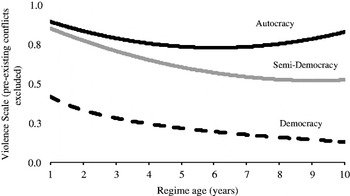
Rather than the average level of violence, therefore, a more meaningful metric may be the relationship between regime type and flare-ups of fresh episodes of major violence. To get another perspective, it also may be useful to take a cross-sectional approach, as opposed to looking longitudinally at partial democracies only. I show the relevant data in Figure 1, which reports the seriousness of fresh violence in all three types of consolidated regimes (using the initial specification), excluding any conflict that carried over from the prior political system.
Average intensity of new political violence in consolidated African regimes, 1965–2008. Note. Regime age starts on the first year after a regime transition – a five-year period estimated using the Polity iv Project's composite index for regime type. The violence scale reflects the magnitude of each major armed conflict in a given year on a 7 point scale, ranging from sporadic or expressive political violence to pervasive warfare. Fitted trend lines are displayed. Source: Author's calculations based on Polity iv Project (2009) and Marshall (Reference Marshall2009).

Looking at the first ten years following a successful transition, democracies performed the best by far. Newly constituted authoritarian systems have somewhat higher levels of new political violence over the initial ten-year window compared with the equivalent partial democracies, although the difference is not statistically significant in most years. This finding is obviously counter to the inverted-U curve thesis, and also challenges the related claim that there is an ‘authoritarian advantage’ in defusing or delimiting political violence.
Observe, as well, that in democracies and semi-democracies the level of new violence appears to decline over time. This downward trend is consistent with a possible consolidation effect: as a regime becomes institutionalised, it faces fewer challenges to its authority, and becomes better at asserting authority when it is challenged. No such effect is seen in autocracies, where violence tends to level out or turn up after falling for several years, perhaps because this sort of regime finds it harder and harder to defuse violent opposition or avoid antagonising neutral groups.
Figure 1 still has the problem that it only shows the average level of violence, so I also examine the simple frequency of violent event initiation and cessation, without regard to magnitude. Is the rate at which episodes start and stop distinguishable across the three categories of states? The inverted-U thesis implies that semi-democracies are more likely to find themselves involved in new outbreaks of internal and external fighting, and that they are less likely to see violent events come to an end. To test this claim, it is helpful to include lesser forms of unrest, the inception/termination of which may have been important even if bloodshed failed to reach the level required for them to be registered as major conflicts by the Center for Systemic Peace. Ten African countries experienced no armed violence with over 500 fatalities, but some still had serious confrontations. For these secondary data, I consult the centre's inventory of ‘additional violent crises’ that fall short of the 500-death benchmark (Marshall Reference Marshall2005).
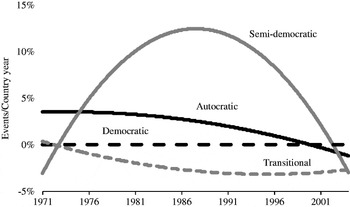
Combining the major and secondary incidents, ninety violent events started between 1971 and 2004, the years for which data are available. Nearly one third occurred in just five countries: the Democratic Republic of Congo, Ethiopia, Nigeria, Sudan and Uganda. The termination rates for violent events follow a similar pattern. A total of sixty-nine major and minor conflicts ended during the 1971–2004 period, concentrated in the same five countries. Figure 2 reports the net annual rate of new violent incidents for each regime type, defined as event onsets minus event endings, normalised by the number of countries in each political system category per year.
Net onset of violent episodes by regime type 1971–2004. Note: The fitted trend lines show the per cent of country years when identifiable incidents of violence began, less cessation of violent incidents, according to regime type. Source: Author's calculations based on Polityiv Project (2009) and Marshall (Reference Marshall2005; Reference Marshall2009).

The partially democratic systems (indicated by the solid grey line) do have the highest net commencement rate for violent events. There is an inverted U-shaped distribution but it is determined by time, with a bulge in onsets in the 1980s even after adjusting for the violent event endings. This temporal bulge may be the source of some of the evidence that mid-range regimes are conflict-prone. A t-test, however, suggests that the overall difference in the net commencement of violent events under semi-democracy is indistinguishable from what happens under autocracy (represented by the black line in Figure 2). Both types of regimes, moreover, are significantly different at the 5% level compared with the democratic group (the dotted black line).Footnote 13 In other words, the correlation between tri-part regime type and conflict onset in Africa may more closely resemble a single step curve than either a downhill line or an inverted U: the net rate of violent outbreaks is comparable in semi-democracies and autocracies, but drops down in democracies. That is consistent with the threshold effect of democracy on violence identified by Davenport and Armstrong (Reference Davenport and Armstrong2004).
Another way to look at these data is to recall that all contemporary African semi-democracies except Gambia are also former autocracies according to the Polity iv coding. Regardless of their political system, several of those countries have a past punctuated by civil wars and other violent episodes. The reason for the lack of measurable difference between the two categories of regime may be due to country characteristics other than the form of government, which nourish old grievances and recreate earlier conflicts in an on-going cycle regardless of what sort of regime is in place. I will look at some additional explanatory factors for political violence in the next section.
Any bi-variate analysis raises questions of reverse causality and of bias due to omitted variables. With respect to the direction of causality, empirical studies indicate that war often has the effect of creating opportunities for democratic regime change (Bermeo Reference Bermeo2003; Reiter Reference Reiter2001). That implies that the causal arrow between regime type and political violence runs two ways, and it is not entirely clear which relationship is strongest. Of the semi-democratic regimes I identify for Africa, however, three in four were not undergoing a major violent episode at the start of the five-year gestation period, about the same proportion as for democratic systems, so the link from active conflict to any particular variant of rule seems fairly weak in this region.
Turning to omitted variables, some of the same factors found to explain political violence are also associated with regime type, suggesting that both could be the result of common underlying social and economic processes. For example ethnic homogeneity and certain types of natural resource endowments have both been independently linked to democracy (Fish & Brooks Reference Fish and Brooks2004; Jensen & Wantchekon Reference Jensen and Wantchekon2004) and to domestic peace, as addressed in the following section.
The other striking thing in Figure 2 is how much the overall frequency of fresh violent outbreaks has dropped since the 1980s. Both autocracies and semi-democracies average fewer net violent outbreaks recently than in the earlier period. In democracies such destructive events have been and remain rare. That means that even strife-prone countries have grown more peaceful. To understand the positive trend we must look beyond relatively constant variables like ethnicity or resource endowments.
How do transition periods fare? As observed earlier, many researchers associate increased repression and violence with temporary interludes when an established political system is being challenged. Transitional polities shift power balances, create new insecurities, and potentially breed violence. Conversely, these transition periods can also be times when elites resolve older conflicts, work out new political arrangements, and gain approval from the population. If so, some prenatal regimes may hold the promise of lower violence during their five-year life spans. Straus and Taylor (Reference Straus and Taylor2009) report, for example, that the probability of electoral violence is comparable for African states in or out of civil war, but declines for states that hold their first elections after a civil war termination.
While regime transitions are a lesser concern in this article, I do look at them in Figure 2. Contrary to the pessimistic view, regime changeovers as I measure them are not especially susceptible to new incidents of violence in Africa.Footnote 14 The net annual rate of violent outbreaks during five-year prenatal episodes is even lower than under democracy, due in part to the high rate of conflict cessation that happens during the changeovers. This finding is consistent with the theory that the resolution of conflict provides the opening for regime consolidation, as opposed to the contrary view that consolidated regimes are in a better position to find ways to avoid new tensions or to put an end to on-going struggles.
ALTERNATIVE EXPLANATIONS FOR THE PATTERN OF VIOLENCE
The profile of African political violence is uneven over time. Besides the region's predominant regime type, what else changed in the period under review that could account for the rise and recent dip in political conflict in Africa? Research has identified many factors beyond the political system that add to the general level of violence in society – factors that include cultural diversity, the presence of natural resources, and a history of prior conflict. Do these explain the changes in Figure 2?
African nations are diverse and apt to be fractured along racial, ethnic, linguistic or religious lines. Diversity is associated in some studies with internal conflict (e.g. Ellingsen Reference Ellingsen2000,) although according to Fearon and Laitin (Reference Fearon and Laitin2003), ethnically or religiously diverse countries are no more likely than others to experience significant civil violence. African nations are also frequently dependent on extractive industries. The ‘resource curse’ literature proposes a strong relationship between ‘lootable’ commodities, such as diamonds or narcotics, and the onset and continuation of civil war (e.g. Lujala et al. Reference Lujala, Gleditsch and Gilmore2005; Ross Reference Ross2004). Other studies (e.g. Brunnschweiler & Bulte Reference Brunnschweiler and Bulte2009) come to the opposite conclusion about resource abundance and the probability of the inception of war. While these controversies in the international relations literature have not been resolved, neither ethnic diversity nor the availability of natural resources seems likely to change quickly enough to be precipitating events for a particular conflict or reconciliation in most cases for Africa, barring large refugee movements or major discoveries of mineral deposits in some countries.
Past violence is similar. It does contribute to renewal of fighting: Quinn et al. (Reference Quinn, Mason and Gurses2007) report that over half of civil wars since World War II were followed by additional episodes of civil war. A number of African nations are subject to oscillating outbreaks of bloodshed, as noted above. Still, a broad legacy of domestic political strife cannot easily be said to trigger any given outbreak of fighting, any more than it would explain some specific initiative for peace. We need to look elsewhere to understand the drop in violence currently witnessed across Africa.
An obvious consideration is international assistance and pressure. The fact that many African conflicts ended with or shortly after the Cold War strongly implies an international component in the incidence of fighting. The East–West stand-off helped fuel some conflicts in the first place, as the major powers armed client states to gain influence in the sub-Saharan region. Later, reduced international tension led to fewer proxy wars and greater peacekeeping effort by third parties such as the United Nations. After 1990, empirical studies show that conflict management has increased, and that it can lead to de-escalation and reduced violence (Beardsley et al. Reference Beardsley2006; Bercovitch & DeRouen Reference Bercovitch and DeRouen2004).
A second possibility is a beneficial effect of economic growth, which studies such as Miguel et al. (Reference Miguel, Satyanath and Sergenti2004) link to reduced likelihood of internal conflict in Africa. Around the world, countries that improve the economic well-being of their citizenry are in the best position to break an established cycle of violence, according to Walter's (Reference Walter2004) calculations. While Africa's overall development record is disappointing, real economic improvements are observed in some countries over the past few decades that could be limiting the chance of civil strife.
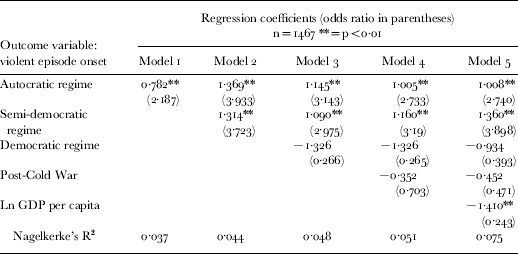
These two independent variables (the international environment and economic development) plus regime type are explored using logit analysis, with the results shown in Table 1. To capture the international setting, I introduce a dummy variable that breaks the time frame into the pre- and post-Cold War periods. Economic development is operationalised as the logarithm of gross domestic product per capita. Both of these explanatory variables are negatively associated with the onset of violent incidents, as expected. The coefficient for gross domestic product is statistically significant.
Logit regressions for the onset of political violence, 1971–2004
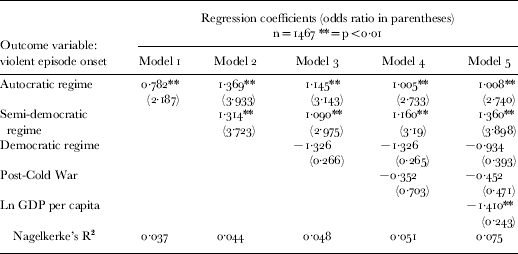
Note: The outcome variable is a dummy set to ‘1’ in any country year with inception of one or more violent events. The regime types are dummies set to ‘0’ in the absence of the particular form of government. Post-Cold War is a dummy variable that takes a value of ‘1’ for years after 1989. The logarithm of GDP per capita is in constant 2000 prices, based on Heston et al. (Reference Heston, Summers and Aten2006).
Source: Author's calculations based on Polityiv Project (2009) and Marshall (Reference Marshall2005; Reference Marshall2009).
Being either a consolidated autocratic or semi-democratic regime is positively and significantly associated with event initiation in these empirical models. That pattern is consistent both with a discrete or single-step democratic domestic peace thesis, and with the argument that, no matter what their regime, a sub-group of African countries is always prone to violence. The odds are two to four times greater that autocracies and semi-democracies (as initially specified by Polity iv) will experience a new violent incident, compared with other political systems in these models. Consolidated democratic systems are negatively correlated with onsets of violence, although the relationship is outside the bounds of statistical significance.
We can use the complete model on the right-hand column in Table 1 to predict the probability that a country of a given regime type will experience the start of a new violent event. For semi-democratic countries there is a 91% chance of such an event taking place at some point in time, about the same as the 88% chance for an autocracy. For a democratic regime, however, the chance of experiencing a new violent event is just 50% over time. The explanatory power of all the models, however, is low, which reinforces the suggestion that the decline in African political violence has many important historical features that differ from country to country, and which are not captured in a simple regime typology.
I started this article with a paradox: why is the rate of national political violence dipping in twenty-first century Africa, when revised democratic peace theory leads us to expect the opposite? My results, though far from definitive, bear on both academic and policy debates. Academically, my findings raise questions about the inverted-U curve thesis. Looking at the data several different ways, it is hard to see any evidence of an upsurge in civil strife or warfare accompanying the shift to semi-democratic hybrid regimes in Africa. While we must be cautious about drawing solid conclusions, regime type's effect on political violence may be less consistent than often assumed.
My findings also contribute to contemporary public policy debates concerning the promotion of democracy as a peacemaking and development strategy. The African Union, the United Nations and many other international agencies support democratic reform in Africa, as do numerous domestic organisations and social movements within African countries. The inverted-U curve casts a shadow on democratisation because it may have the unintended effect of irritating latent social disorder if reforms stop short of institutionalised consent-based systems. Yet there is not much reason in these data for special apprehension about partial democracy per se. Conflict during the Cold War period in Africa took place almost exclusively under autocratic regimes, and during the post-Cold War period mainly under mixed regimes, often governing the same societies. As a rule, these countries are probably no less secure for partly opening their political systems, even if they are not much more secure either. That may be a tepid endorsement of incremental democratic reform, but it is perhaps sufficient to quiet generalised concerns about creating a brave new world of violence in Africa.