Introduction
The Cyclophyllidea van Beneden in Braun, 1900 is the most species rich order of tapeworms (Cestoda) (Schmidt, Reference Schmidt1986; Caira and Jensen, Reference Caira and Jensen2017). Adult cyclophyllideans are parasites of both aquatic and terrestrial vertebrate hosts (except teleosteans and chondrichthyans) and are the dominant group of parasites occurring in mammalian and avian hosts (Hoberg et al., Reference Hoberg, Jones and Bray1999b; Mariaux et al., Reference Mariaux, Caira and Jensen2017). This group of tapeworms has been classified based on morphological and ecological characters, and 16 families are now included in the Cyclophyllidea (Khalil et al., Reference Khalil, Jones and Bray1994; Hoberg et al., Reference Hoberg, Jones and Bray1999b; Mariaux et al., Reference Mariaux, Caira and Jensen2017). The first phylogenetic studies of cyclophyllideans were mainly based on morphological, ultrastructural and ontogenetic data (Brooks et al., Reference Brooks, Hoberg and Weekes1991; Brooks & McLennan, Reference Brooks and MacLennan1993; Hoberg et al., Reference Hoberg1997, Reference Hoberg, Gardner and Campbell1999a). However, in recent years molecular characters have been used to resolve difficulties regarding relationships among tapeworms (Mariaux, Reference Mariaux1996; Hoberg et al., Reference Hoberg, Gardner and Campbell1999a; Mariaux and Olson, Reference Mariaux, Olson, Littlewood and Bray2001; Littlewood, Reference Littlewood, Maule and Marks2006; Mariaux et al., Reference Mariaux, Caira and Jensen2017).
Spassky and Spasskaya (Reference Spassky and Spasskaya1973) erected the family Gryporhynchidae to include all the species previously placed in the family Dilepididae that exhibit a three-host life cycle, with crustaceans as the first intermediate host, freshwater fishes as the second, and fish-eating birds such as Pelecaniformes, Anseriformes, Gruiformes, Suliformes and Accipitriformes as the definitive hosts (Mariaux et al., Reference Mariaux, Caira and Jensen2017). For a long time, gryporhynchids have been classified as members of the Dilepididae based on the similarity of their scolex and strobilar morphology (Baer and Bona, Reference Baer and Bona1960; Bona, Reference Bona1975). Nevertheless, molecular studies suggest that this taxon represents an independent group not closely related to dilepidids (Mariaux, Reference Mariaux1998; Hoberg et al., Reference Hoberg, Jones and Bray1999b; Mariaux et al., Reference Mariaux, Caira and Jensen2017).
The taxonomy of the Gryporhynchidae has been mainly based on the strobilar morphology (distribution of gonads, position of gonopore, structure of terminal genitalia) and on the morphology of the rostellum, rostellar apparatus and its sheath, and hooks (Bona, Reference Bona1975; Mariaux et al., Reference Mariaux, Caira and Jensen2017). Identification of larvae (metacestodes) in fish intermediate hosts is based almost exclusively on the morphology of rostellar hooks: their number, shape and size (Scholz, Reference Scholz2001; Scholz and Salgado-Maldonado, Reference Scholz and Salgado-Maldonado2001; Scholz et al., Reference Scholz, Kuchta and Salgado-Maldonado2002, Reference Scholz2004, Reference Scholz2018).
The family currently contains 76 species of 16 genera (Mariaux et al., Reference Mariaux, Caira and Jensen2017): Amirthalingamia Bray, 1974; Ascodilepis Guildal, 1960; Baerbonaia Deblock, 1966; Bancroftiella Johnston, 1911; Clelandia Johnston, 1909; Cyclorchida Fuhrmann, 1907; Cyclustera Fuhrmann, 1901; Dendrouterina Fuhrmann, 1912; Glossocercus Chandler, 1935; Mashonalepis Beverley-Burton, 1960; Neogryporhynchus Baer & Bona, 1960; Paradilepis Hsü, 1935; Parvitaenia Burt, 1940; Proochida Fuhrmann, 1908; Proparadilepis Kornyushin & Greben, 2014; and Valipora Linton, 1927. In Mexico, 24 species of seven genera (Cyclustera, Dendrouterina, Glossocercus, Neovalipora, Paradilepis, Parvitaenia and Valipora) have been recorded (Ortega-Olivares et al., Reference Ortega-Olivares2008, Reference Ortega-Olivares, García-Prieto and García-Varela2014), which represent almost one-third (32%) of all biodiversity of this group of tapeworms.
Although some members of the family Gryporhynchidae have been included in recent phylogenetic studies, the relationships between the genera of this family are still unknown. Scholz et al. (Reference Scholz2018) provided the first insight into the internal phylogenetic relationships within the family based on partial sequences from LSU rDNA of nine species of five genera of gryporhynchid larvae (metacestodes) from African fishes. The main objective of the present study was to establish the relationships between the genera of this family by conducting a phylogenetic analysis based on comparative analysis of sequences of the 18S (SSU) and 28S (LSU) from rDNA of tapeworms of 20 species and nine genera.
Materials and methods
Parasite samples
Between June 2006 and April 2011, samples of 14 species of gryporhynchids (adult specimens) and three species of hymenolepidids were collected from naturally infected birds from several localities along the Pacific coast of Mexico and Gulf of Mexico (table 1). Following capture, the intestine was removed from the body of each bird and examined under stereoscopic microscope. Tapeworms found were washed in 0.75% saline solution; the final proglottids of each specimen were preserved in absolute ethanol, and stored at 4°C for molecular work. The entire tapeworms were stained with Schuberg's hydrochloric carmine or Mayer's paracarmine, and mounted as permanent preparations in Canada balsam. Scoleces of some specimens were squashed and fixed with a mixture of glycerine and ammonium picrate (see Scholz et al., Reference Scholz2004) for observation and measurement of rostellar hooks. Tapeworms were identified according to Bona (Reference Bona1975). Hologenophores (sensu Pleijel et al., Reference Pleijel2008) were deposited in the Colección Nacional de Helmintos (CNHE), Instituto de Biología, Universidad Nacional Autónoma de México (UNAM), Mexico City (accession numbers in table 1).
Species name, host, sampling localities, voucher number deposited at the Colección Nacional de Helmintos (CNHE), and GenBank access numbers. Nd = not determined; (A) = adult; (M) = merocercoid.

* Sequences of the species obtained in the current study
† Hologenophore
DNA extraction, amplification and sequencing
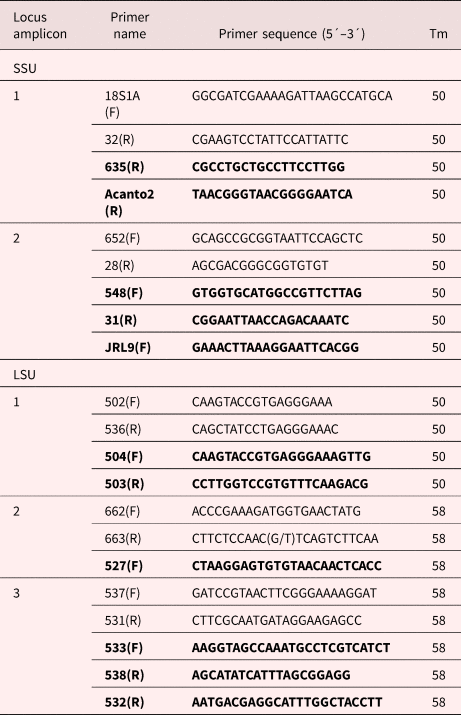
For molecular analyses, 29 specimens of 14 species of eight genera were analysed. The proglottids of each specimen were digested overnight at 56°C in a solution containing 10 mm Tris-base HCl (pH 7.6), 20 mm NaCl, 100 mm Na2 EDTA (pH 8.0), 1% Sarkosyl, and 0.1 mg/ml proteinase K. Genomic DNA was extracted from the supernatant using the DNAzol reagent (Molecular Research Center, Cincinnati, OH, USA) according to the manufacturer's instructions. Two regions of the nuclear ribosomal DNA (rDNA) were amplified using polymerase chain reaction (PCR). The SSU rDNA (c. 2200 bp) was amplified in two fragments, and LSU rDNA (c. 4500 bp) in three overlapping fragments (table 2).
Details of amplification and sequencing primers. Internal primers are in bold. (F) = Forward, (R) = Reverse, Tm = Annealing temperature of primer.

PCR (final volume 25 μl) consisted of 2.5 μl 10× PCR buffer, 1.5 μl MgCl2, 0.5 μl of dNTPs, 1 μl of each primer (10 pmol), 1–2 μl of genomic DNA, 0.125 μl of Taq DNA polymerase, and 16.375 μl sterile-distilled water. PCR cycling parameters included denaturation at 94°C for 3 minutes, followed by 35 cycles of 94°C for 1 minute, annealing at 50–58°C (optimized for each rDNA region) for 1 minute, and extension at 72°C for 1 minute, followed by a post-amplification incubation at 72°C for 7 minutes. All PCR reactions were visualized on 1% agarose gels and the products were prepared for direct sequencing using Millipore columns (Amicon, Billerica, MA, USA). When direct sequencing of PCR products yielded poor results (e.g. due to repeated sequences motifs or misreading), products were cloned by ligation into pGEM-T vector (Promega, Madison, WI, USA) and used to transform competent Escherichia coli (JM109). Positive clones were identified by blue/white selection, and target insert of white colonies was confirmed by PCR of bacterial DNA extracts. Liquid cultures for minipreps were grown in Luria broth containing 50 μg/ml of ampicillin. Plasmids for DNA sequencing were prepared using commercial miniprep kits (Qiaprep, QIAGEN, Hilden, Germany). At least two plasmids obtained from each isolate and species were sequenced in both DNA strands using universal (vector) and internal primers (see table 2). Sequencing reactions were performed using ABI Big Dye (Applied Biosystems, Boston, MA, USA) terminator sequencing chemistry, and reaction products were separated and detected using an ABI 3730 capillary DNA sequencer. Contigs were assembled and base-calling differences resolved using Codoncode Aligner version 5.1.5 (Codoncode Corporation, Dedham, MA, USA). Sequences were deposited in the GenBank database under numbers MH699780–MH699794 for 28S (LSU) and MH699795–MH699822 for 18S (SSU).
Phylogenetic analyses
We used the software Clustal W (Thompson et al., Reference Thompson1997) for the alignment of the sequences of species of adult gryporhynchid tapeworms and for the species Paradilepis cf. minima (SSU; larva from fish – see Presswell et al., Reference Presswell, Poulin and Randhawa2012); Amirthalingamia macracantha (Joyeux & Baer, 1975); Neogryporhynchus lasiopeius Baer & Bona, 1960; Paradilepis maleki Khalil, 1961; Paradilepis scolecina (Rudolphi, 1819); Paradilepis sp.; Parvitaenia sp. 1; Parvitaenia sp. 3; and Valipora minuta (Coil, 1950) (LSU; all larvae from fish – see Scholz et al., Reference Scholz2018). Additionally, sequences of Fimbriaria sp.; Hymenolepis diminuta (Rudolphi, 1819); Hymenolepis hibernia Montgomery, Montgomery & Dunn, 1987 (Hymenolepididae); Choanotaenia infundibulum (Bloch, 1779); Dilepis undula (Schrank, 1788) (Dilepididae); Raillietina mitchelli O'Callaghan, Davis & Andrews, 2000; Skrjabinia cesticillus (Molin, 1858) (Davaineidae); Taenia solium Linnaeus, 1758 (Taeniidae); and Mesocestoides sp. (Mesocestoididae) were used as outgroups (table 1).
The nucleotide substitution model was selected for each molecular marker using jModelTest (Posada, Reference Posada2008) and applying the Akaike criterion; for the SSU dataset, the selected model was TIM1 + I + G, and for the LSU was TIM3 + I + G. Phylogenetic trees were constructed using maximum-likelihood (ML) with the program RaxML v7.0.4 (Stamatakis, Reference Stamatakis2006). A GTRGAMMAI substitution model was used, and 10,000 bootstrap replicates were run to assess nodal support. We also estimated gene trees using MrBayes v3.2.2 (Ronquist et al., Reference Ronquist2012), with two runs of the Markov chain (MCMC) for 10 million generations, sampled every 1000 generations, a heating parameter value of 0.2 and burn-in (25%). Trees were drawn using FigTree v1.4.3 (http://tree.bio.ed.ac.uk/software/figtree/). The genetic divergences among taxa for each gene were estimated using p-distances with the program MEGA v.6 (Tamura et al., Reference Tamura2013).
Results
LSU dataset
Near complete sequences of LSU from 15 adults and one metacestode of gryporhynchids were generated in this study and were aligned with partial sequences of LSU of metacestodes of the species A. macracantha, N. lasiopeius, P. maleki, P. scolecina, Paradilepis sp., Parvitaenia sp. 1, Parvitaenia sp. 3, and V. minuta, which were downloaded from GenBank. In addition, sequences of three species representing the families Hymenolepididae, Dilepididae and Mesocestoididae were used as outgroups. The final alignment consisted of 40 sequences and was 3623 bp long. The genetic divergence among genera of Gryporhynchidae (Amirthalingamia, Cyclustera, Dendrouterina, Glossocercus, Gryporhynchidae gen. sp., Neogryporhynchus, Neovalipora, Paradilepis, Parvitaenia and Valipora) ranged from 3.1 to 11.6%, whereas the divergence among three species of Dendrouterina (D. pilherodiae, D. papillifera and Dendrouterina sp.) ranged from 1.7 to 3.1%, between G. caribaensis and G. cyprinodontis was 0.9%, for the three species of Paradilepis (P. scolecina, P. maleki and Paradilepis sp.) ranged from 1.3 to 6.1%, for the two species of Parvitaenia (P. cochlearii and Parvitaenia sp.) ranged from 2.7 to 2.9%, and finally among the three species of Valipora (V. campylancristrota, V. minuta and V. mutabilis) ranged from 1.1 to 3.9%. The ML and Bayesian trees showed that the family Gryporhynchidae is monophyletic with strong bootstrap support (90%) and Bayesian posterior probabilities (0.99). Both trees yielded similar topologies with two major clades. The first contained five genera: Amirthalingamia, Cyclustera, Glossocercus, Gryporhynchidae gen. sp. and Neogryporhynchus. However, the genus Parvitaenia was paraphyletic because four isolates of Parvitaenia spp. recovered from two species of freshwater fishes from South Africa (Scholz et al., Reference Scholz2018) were sister to N. lasiopeius, whereas P. cochlearii was placed in the base of the ML and Bayesian trees (fig. 1). The second clade was subdivided in two subclades; the first contained two species of the genus Paradilepis (P. maleki and P. scolecina) from South Africa plus two undescribed species, one from South Africa and the other from Mexico. The genus Paradilepis is a monophyletic lineage with strong support of bootstrap and Bayesian inference (100/1). The second subclade included species of the genera Neovalipora, Dendrouterina and Valipora; the latter two were revealed to be paraphyletic (fig. 1).
Maximum likelihood tree of the family Gryporhynchidae (Cestoda: Cyclophyllidea) inferred with the LSU rDNA dataset; numbers near internal nodes show ML bootstrap clade frequencies and posterior probabilities (BI). Sequences of the specimens in bold were generated in this study.

SSU dataset
Near complete sequences of SSU from 24 adult and one metacestode of gryporhynchids were generated in this study, and were aligned with three partial sequences of metacestodes of Paradilepis cf. minima downloaded from GenBank. An additional three sequences of adult hymenolepidids were generated plus sequences of five species of cyclophyllideans of the families Davaineidae, Dilepididae, Hymenolepididae, Mesocestoididae and Taeniidae that were used as outgroups. The final alignment consisted of 39 sequences and was 1786 bp long. The genetic divergence among genera of Gryporhynchidae (Cyclustera, Dendrouterina, Glossocercus, Gryporhynchidae gen. sp., Neovalipora, Paradilepis, Parvitaenia and Valipora) ranged from 1.8 to 6.1%. The divergence among the three species of Dendrouterina (D. pilherodiae, D. papillifera and Dendrouterina sp.) ranged from 0.3 to 0.8%, among the eight isolates representing two species of Glossocercus (G. caribaensis and G. cyprinodontis) from 2.9 to 3.0%, among three species of Paradilepis (P. caballeroi, Paradilepis cf. minima and Paradilepis sp.) from 1.1 to 3.9%, and among the three species of Valipora (V. campylancristrota, V. minuta and V. mutabilis) from 0.2 to 1.2%. The ML and Bayesian trees also confirmed the monophyly of the family, with strong bootstrap support and Bayesian posterior probability values (100/0.95) (fig. 2). Both trees yielded two major clades, as those generated by LSU dataset. The first contained the genera Cyclustera, Glossocercus, Gryporhynchidae gen. sp. and Parvitaenia. The second contained the genera Dendrouterina, Neovalipora, Paradilepis and Valipora (fig. 2). As in LSU analysis, Dendrouterina and Valipora were revealed as paraphyletic (fig. 1).
Maximum likelihood tree of the family Gryporhynchidae (Cestoda: Cyclophyllidea) inferred with the SSU rDNA dataset; numbers near internal nodes show ML bootstrap clade frequencies and posterior probabilities (BI). Sequences of the specimens in bold were generated in this study.

The trees obtained with LSU and SSU datasets in both analyses (ML and BI) are composed of clades that include species that mature in birds of different families. The first clade includes Amirthalingamia macracantha, which occurs in cormorants (Phalacrocoracidae), Cyclustera ibisae occurs in ibis (Threskiornithidae), and Glosocercus caribaensis, G. cyprinodontis, Gryporhynchidae gen. sp., Neogryporhynchus lasiopeius and Parvitaenia cochlearii all occur in Ardeidae (herons). The second clade includes species of Paradilepis associated with Threskiornithidae, Phalacrocoracidae and Pelecanidae (pelicans), and Dendrouterina spp. and Valipora spp. all found in Ardeidae.
Discussion
As adults, gryporhynchids parasitize the intestines of fish-eating birds across the globe. Recently, molecular and morphological phylogenetic hypotheses showed that the family Gryporhynchidae is a monophyletic group nested within the Cyclophyllidea (Mariaux, Reference Mariaux1998; Hoberg et al., Reference Hoberg, Gardner and Campbell1999a; Presswell et al., Reference Presswell, Poulin and Randhawa2012; Mariaux et al., Reference Mariaux, Caira and Jensen2017), but these studies were based on a few species. The phylogeny inferred in the present study includes a much greater diversity of gryporhynchids (20 species representing 9 of 16 described genera). It thus provides the most comprehensive phylogenetic hypothesis about internal relationships of these cestodes.
The trees derived from SSU showed similar topologies with the LSU trees, although they include a larger number of terminal taxa (36 compared with 28). Phylogenetic analyses inferred with the LSU dataset support the monophyly of the genera Glossocercus (two species included) and Paradilepis (four species). In contrast, the genera Dendrouterina, Parvitaenia and Valipora were revealed not to be monophyletic (see Baer and Bona, Reference Baer and Bona1960 and Bona, Reference Bona1975 for review of taxonomic history). It is obvious that classification and species composition of these cestodes are pending revision. Unfortunately, molecular data on type species of these genera, i.e. D. herodiae Fuhrmann, 1912, P. ardeolae Burt, 1940 and V. mutabilis Linton, 1927, are not available, which makes it difficult (morphological characters may be homoplastic) to redefine the species composition of these genera.
In addition, our phylogenetic analyses in combination with the high genetic divergence (2.3–2.9% for LSU and 1.7–6.3% for SSU) on both molecular markers revealed that tapeworms from the yellow-crowned night heron (Nyctanassa violacea) identified as Glossocercus sp. by Ortega-Olivares et al. (Reference Ortega-Olivares, García-Prieto and García-Varela2014) probably represent a new species for which a new genus should be erected. Isolates from two species of night herons, the black-crowned night heron (Nycticorax nycticorax) and the yellow-crowned night heron (Nyctanassa violacea), found in two localities in the Gulf of Mexico (Ortega-Olivares et al., Reference Ortega-Olivares, García-Prieto and García-Varela2014) appeared as a sister lineage to the clade composed from two unidentified species of Parvitaenia and N. lasiopeius, all from fishes in Africa, i.e. markedly distant from species of Glossocercus in the LSU dataset (fig. 1) and a sister lineage to the clade consisting of species of Cyclustera (C. ibisae) and Glossocercus (G. caribaensis and G. cyprindontis) in SSU analyses (fig. 2). These tapeworms are somewhat similar in their morphology to species of Glossocercus, but their rostellar hooks are less robust and smaller than those of Neotropical species of Glossocercus (length of distal hooks 77–95 μm and of proximal hooks 44–46 μm).
One of the morphological traits that is most important for the taxonomy of the Gryporhynchidae, especially for metacestodes that do not have internal organs developed, is the morphology (shape and size) and number of rostellar hooks (Baer and Bona, Reference Baer and Bona1960; Bona, Reference Bona1975; Scholz et al., Reference Scholz2004, Reference Scholz2018). However, the hooks of some genera may be similar, which makes identification of some larvae difficult (Scholz et al., Reference Scholz2018). In contrast, identification of adults and their generic placement are facilitated by difference in strobilar morphology, especially distribution of gonads, position of osmoregulatory canals and gonopores, and structure of terminal genitalia (Bona, Reference Bona, Khalil, Jones and Bray1994).
The phylogenetic hypothesis proposed in this study provides the information on interrelations of gryporhynchids (adults) from the Neotropical region and metacestodes of five genera from Africa. Apparently, some genera, such as Dendrouterina, Neovalipora and Valipora, should be re-examined based on new morphological criteria in combination with information derived from nuclear and mitochondrial data. The genetic divergence among Dendrouterina papillifera, Neovalipora sp. and Valipora minuta, which nested in the same clade (figs 1 and 2) was low (0.2–0.3% for LSU and 0.0–0.2% for SSU), suggesting that these taxa belong to the same species. In contrast, Dendrouterina sp., Valipora minuta (from Africa) and V. mutabilis could be different species belonging to the same genera, given that the genetic divergence (1.7–1.9% for LSU and 0.3–0.5% for SSU) is not sufficient for them to be considered different genera. In contrast, the high level of genetic divergence (3.2–3.9% for LSU and 0.9–1.2% for SSU) among the three species of Dendrouterina and three species of Valipora, plus their systematic position in the phylogenetic trees clearly suggest that they belong to different genera. However, it is crucial to obtain molecular data for type species of these genera to newly circumscribe individual genera and their species composition. Scholz et al. (Reference Scholz2018) mentioned that the identification of the species of gryporhynchids could be verified by comparison of adults from fish-eating birds with metacestodes from fishes, in addition to the coincidence of data on nuclear and mitochondrial genes, which provide undeniable evidence of the correspondence between the species. In the present study, identification of metacestodes of V. minuta from African fish is questioned because their sequences do not match with that of adult V. minuta from Mexico (and the species was described from the USA).
The phylogenetic hypothesis inferred from SSU and LSU gene sequences from both adults and metacestodes of the family Gryporhynchidae represents the most complete study until now and may serve as a starting point to better understand relationships among the members of this family. The present study provides a robust phylogenetic framework to start describing some aspects of the evolutionary history of these host–parasite associations. The present study has also revealed congruence of molecular data with the spectrum of definitive hosts (fish-eating birds) because cestodes from the same groups of birds form distinct clades. In contrast, these clades contain genera of markedly distinct morphology, especially of the rostellar hooks. Future research should be focused on obtaining molecular data on the other gryporhynchid genera, namely Ascodilepis, Baerbonaia, Bancroftiella, Clelandia, Cyclorchida, Mashonalepis, Proorchida and Proparadilepis, and type species of those genera that were revealed as paraphyletic in the present study.
Acknowledgments
We thank two anonymous reviewers for suggestions that helped improve the quality of the manuscript. We are grateful to Miriam Reyna, Andrés Martínez, Rogelio Rosas, David Hernández and Carlos Pinacho for their invaluable help with collection and dissection of birds, and Laura Márquez for her technical assistance with sequencing.
Financial support
This research was supported by Programa de Apoyo a Proyectos de Investigación e Inovación Tecnológica (PAPIIT-UNAM) IN206716. MPOO thanks the Programa de Posgrado en Ciencias Biológicas, Universidad Nacional Autónoma de México (UNAM) and Consejo Nacional de Ciencia y Tecnología (CONACyT) for the scholarships to complete her PhD degree.
Conflict of interest
None.
Ethical standards
Hosts were collected in Mexico under the Cartilla Nacional de Colector Científico (FAUT 0202) issued by the Secretaría del Medio Ambiente y Recursos Naturales (SEMARNAT) to MGV.