INTRODUCTION
Palliative care nurses strive to provide an environment in which individuals at the end of life can experience a peaceful death (International Council of Nurses, 1997). Their personal attitudes toward death and end-of-life care should be consistent with that aim. In the personal interaction with the dying, a perception that a humanistic relationship exists with the nurses and is recognized and valued at a personal level is important (Richardson, Reference Richardson2002). The success of nurses in palliative care relies on their relationship with each patient and it is related to her/his interest and willingness to care for people at the end of life (Olthuis et al., Reference Olthuis, Dekkers and Leget2006). This personal motivation, which is the reflection of nurses' attitudes toward giving care to the people who are dying (Olthuis & Dekker, 2003), might be affected by not only their beliefs and practices (Holloway, Reference Holloway2006) but also by their personal and professional experiences related to death and dying (Dunn et al., Reference Dunn, Otten and Stephens2005). For instance, there are some research studies that found the effect of death education on nurses' attitudes toward care of people who are dying (Hainsworth, Reference Hainsworth1996; Wessel & Rutledge, Reference Wessel and Rutledge2005). Others revealed the relationships between professional nurses' experiences and their attitude toward caring for persons at the end of life (Rooda et al., Reference Rooda, Clements and Jordan1999; Dunn et al., Reference Dunn, Otten and Stephens2005).
Some studies found a close relation between personal experiences related to death and dying with attitude toward care of people who are dying (Franke & Durlak, Reference Franke and Durlak1990; Waltman & Zimmerman, Reference Waltman and Zimmerman1992). Besides personal/professional experiences, nurses' sociocultural heritage also may translate into different ways of interacting with people at the end of life (Kao & Lusk, Reference Kao and Lusk1997). Therefore, the American Association of Colleges of Nursing (AACN) asserted that one of the competencies necessary for nurses to provide high-quality care at the end of life is recognizing one's own attitudes, feelings, and values about death and dying (Ferrell, Reference Ferrell2001). So, this descriptive study aimed to examine the attitude toward death and caring for people at the end of life among Iranian nurses (oncology and nononcology) in the capital of Iran, Tehran.
Context
The sample of nurses in this study was selected from the Cancer Institute and Valiasr Hospital, which are under the supervision of the Tehran University of Medical Science. Assuming both that the Iranian nursing profession is strongly influenced by sociocultural context (Adib Hajbaghery & Salsali, Reference Adib Hajbaghery and Salsali2005) and death as a foundation on which culture is built (Bauman, Reference Bauman and Featherstone1992), it seems necessary to mentioned the context in this study. According to the Leininger (Reference Leininger1985), sociocultural factors may influence attitudes toward death and dying, including values and beliefs, kinship relationship, political and economical factors, and educational and technological situations.
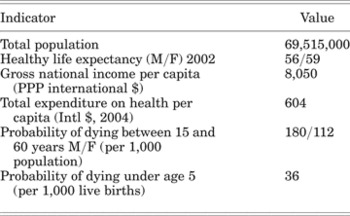
Iran, as one of the most ancient world civilizations, is part of Middle East culture. The population is about 67 million, and, of this, 51% are younger than 20 years and 6.5% constitute the older people (World Health Organization, 2005). The Health demographic indicators are indicated in Table 1. Most religions are represented in this country, but the preponderance is Islam. The country is ruled by theocrats. The majority (99.4%) of the people in Iran consider themselves to be religious (European Values Study Group and World Values Surveys Association, 2000), and religious beliefs are strong and explicit in dealing with the fact of death (Ghavamzadeh & Bahar, 1997).
WHO Health and Welfare Indicators in Iran

Source: World Health Organization, 2005.
Iranians are familiar with death. Besides the Iran–Iraq war and natural disasters, which led to the considerable collective death in recent years, the major causes (65%) of death among Iranian are heart disease, cancer, and accidents (Budget & Planning Organization, 1988). So apart from chronic disease, accidents seem to be a significant cause of death or at least life-threatening situations among Iranian people.
Iranian families are nuclear and in some areas extended. Familial relations and sentiments are so strong that, for instance, incurable disease strikes not only the patient but the family as well (Ghavamzadeh & Bahar, Reference Ghavamzadeh and Bahar1997). The eldest family members are regarded as a source of spiritual blessing, wisdom, and love, and they often prefer to die at home with their family members (Cheraghi et al., Reference Cheraghi, Payne and Salsali2005). End-of-life care is still a new topic in Iran, and palliative care education is neither included as specific clinical education for nurses who are involved with end-of-life care nor as a specific academic course in the nurse educational curriculum. In addition, there is not any specific hospice care centers like in Western countries (Cheraghi et al., Reference Cheraghi, Payne and Salsali2005), but the health care system has already started to provide palliative care for people at the end of life.
METHODS
Design
There was approval from the heads of the Cancer Institute and Valieasr Hospital prior to the collection of data. The study employed a descriptive design and was conducted in those two hospitals.
Background Information
First, a questionnaire was designed to obtain background information that was assumed to influence attitudes toward death and dying. It was developed based on the experiences of a pretest among nurses and included four categories: (1) personal characteristics like gender, age, and marital status, (2) professional characteristicss like previous education about caring for dying patients, years of nursing experience, and years of working with people who are dying, (3) previous experiences related to death within the last 6 months such as experience of caring for a dying member in the family, experience of death of someone close, and experience of life-threatening situations, and (4) religiosity index consisting of intrinsic (belief in God) and extrinsic (attendance at religious services and activities) religiosity.
The Instruments
To measure the nurses' attitudes toward caring for people at the end of life, a translated version of Frommelt's Attitude towards Care of the Dying (FATCOD; Frommelt, Reference Frommelt1991) was used. This scale has 30 items designed to measure participants' attitude toward providing care to people at the end of life. Fifteen of the items were worded positively and 15 were worded negatively. The questions are scored from 1 to 5 (1 = strongly disagree to 5 = strongly agree).
The nurses' attitude toward death was measured with a translated version of the Death Attitude Profile–Revised (DAP-R; Wong et al., Reference Wong, Reker, Gesser and Neimeyer1994). This is a multidimensional measure using a 7-point Likert-type scale. It is composed of 32 questions that describe attitude toward death. A factor analysis made by Wong et al. (Reference Wong, Reker, Gesser and Neimeyer1994) on research made in an American setting revealed that the questions could be divided into five components, including fear of death (7 items), death avoidance (5 items), neutral acceptance (5 items), approach acceptance (10 items), and escape acceptance (5 items). The questions are scored from 1 to 7 (1 = strongly disagree to 7 = strongly agree).
For translation of both questionnaires from English into Farsi, the standard forward–backward procedure was applied. Translation of the items and the response categories was independently performed by two professional translators and then temporary versions were provided. Afterward they were back-translated into English, and, after a careful cultural adaptation, the final versions were provided. Translated questionnaires went through pilot testing. Suggestions by nurses were combined into the final questionnaires versions.
Reliability and Validity
The two translated scales were originally developed and tested in an American cultural context, which is different from the research contexts, so the validity and reliability of both scales was rechecked. A factor analysis (Rotated Component Matrix) on the results was done in order to examine the context validity of the five identified components of the DAP-R scale. The load of the items was similar to the American results. The validity of both scales was assessed through a content validity discussion. Scholars of statistics and nursing care have reviewed the content of the scales from religious and cultural aspects of death and dying and agreed on a reasonable content validity. To reassess the reliability of both translated scales, alpha coefficients of internal consistency and three-week test–retest coefficients (n = 50) of stability were computed. The alpha coefficient for FATCOD was .68 and for DAP-R varied from a low of .59 in natural acceptance of death to a high of .77 in approach acceptance. The three–week test–retest coefficients of stability for FATCOD was .63 and for DAP-R varied from a low of .65 in fear of death to a high of .79 in approach acceptance. So both translated scales presented acceptable reliability.
Data Collection and Analysis
Accompanied by a letter including some information about the aim of the study, the questionnaires were handed out by the third author to 120 nurses who were introduced by the head of each ward at work during two months (May and June 2007) at the Cancer Institute and Valiasr Hospital in Tehran. Some oral information about the study was also given by the third author. Participation in the study was voluntary and anonymous. One hundred twenty sets of questionnaires were distributed, with a dropout of six. In all collected data, 98% of all questions were answered. Data from the questionnaires were analyzed using the Statistical Package for Social Scientists. A Kolmogorov–Smirnov test indicated that the data were sampled from a population with a normal distribution. Descriptive statistics of the sample and measures that were computed included frequencies, means, and reliability. A Pearson correlation was used to examine relationships among the measured factors (DAP-R scores and demographic variables) and scores on the FATCOD.
RESULTS
Participants
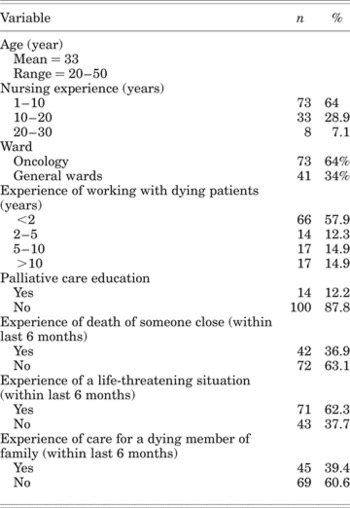
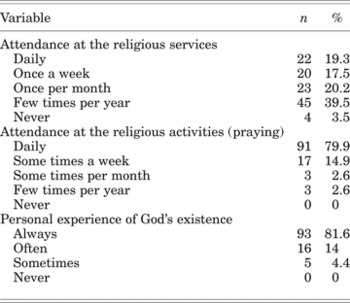
A descriptive analysis of the background information (Table 2) revealed that the participants belonged to the age group of 20–50 years with a mean age of 33 years and were mainly female (81%). About 68% were married and the majority had a Bachelor of Science degree in nursing (91%) with 1–10 years experience of working in hospitals (73%). Whereas 64% of participants were oncology nurses, only 12.2% claimed that they were educated in caring for people who are dying. Almost 58% of respondents stated that they had less than 2 years of experience of caring for people at the end of life. Regarding previous experience of death and dying, 36.9% had the experience of death of someone close, 39.4% had the experience of care for a dying member in the family, and 62.3% had experienced a life-threatening situation within the last 6 months. Considering religiosity (Table 3), 81.6% of respondents reported that they always experience God's existence in their daily life, and 19.3% claimed that they attended religious services daily. Of the participants, 79.9% stated that they performed religious activities like praying daily.
Background Characteristics of the Sample

Religious Variables among the Participants

Descriptive Findings
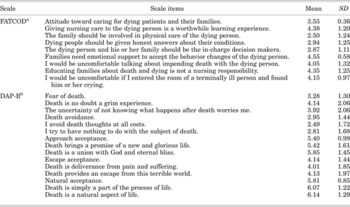
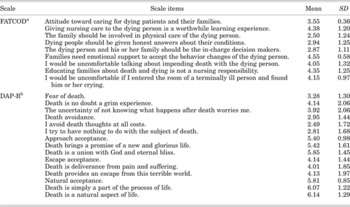
Descriptive analysis (Table 4) indicated a neutral to a moderately positive attitude toward giving care to people who are dying among the participants (mean = 3.55). Most of the nurses in this study were likely to give care and emotional support to persons at the end of life and their families as well. They acknowledge care of people at the end of life as a worthwhile experience. But most of the participants did not tend to involve persons who are dying and their families in the care and accept them as in-charge decision makers. They also reported themselves unlikely to talk about death with persons at the end of life and even educate them about death and dying. Furthermore, they stated that they are not likely to give honest answers to the dying persons about their conditions. In DAP-R subscales, on average, nurses reported that they have a low fear of death and death avoidance, but most of them viewed death as a natural phenomenon in life and also as a gateway to the afterlife.
Frommelt Attitude towards Care of the Dying Patients (FATCOD) and Death Attitude Profile–Revised (DAP-R) Scores
aThe item range for FATCOD = 1–5.
bThe item range for DAP-R = 1–7.
Correlation Analysis
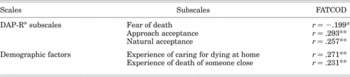
Pearson correlation analysis (Table 5) indicated a significant correlation of natural (r = .257) and approach (r = .293) acceptance with attitude toward giving care to persons who are dying. It means that those who viewed death as a natural part of life or/and as a gateway to the afterlife were more likely to give care to persons who are dying than those who did not share these views. But fear of death was negatively (r = −.199) correlated with attitude toward giving care to persons who are dying. Among demographic characteristics, the experience of death of someone close (r = .231) and also care for a family member who is dying (r = .271) was positively correlated with attitude toward giving care to people at the end of life.
Correlation between Measured Factors and Frommelt Attitude towards Care of the Dying Patients (FATCOD) Scores

aDAP-R: Death Attitude Profile-Revised.
* Correlation is significant at the level of p < .05.
** Correlation is significant at the level of p < .001.
DISCUSSION
The results of this study indicated a significant relationship between nurses' views on death and their attitudes toward giving care to people at the end of life. According to the results, approach and natural acceptance of death was positively correlated to the attitudes toward giving care to people at the end of life, but fear of death was negatively correlated. This result supported other research that found nurses who had less fear of death and accepted death as a gateway to the afterlife (Wessel & Rutledge, Reference Wessel and Rutledge2005) or as a natural part of life (Rooda et al., Reference Rooda, Clements and Jordan1999) tend to have a more positive attitude toward giving care to people who are dying than nurses who did not have these views. It could be explained by the fact that caregivers view death as a natural part of life are more likely to interact positively with the terminally ill and to talk honestly about death with them (Rooda et al., 1999). The other findings indicated that nurses who had previous experience of death of significant others or/and experience of care for a dying member in the family are more likely to give care to people at the end of life than those who did not have such experiences. According to Franke and Durlak (Reference Franke and Durlak1990), death of a significant other could be the highest life experience to decrease death anxiety. These findings can be supported by previous studies that found the experience of a close family member's death to be a positive influential factor not only on the attitude toward giving care to people at the end of life among nurse students (Brent et al., Reference Brent, Speece and Gates1991) but also on the attitude toward providing continuing care for bereaved family members among caregivers (Waltman & Zimmerman, Reference Waltman and Zimmerman1992).
The majority of nurses in this study reported that they accepted death as a natural part of life and also as a gateway to the afterlife. An attitude of acceptance toward death seems to be associated with familiarity with death (Ghavamzadeh & Bahar, Reference Ghavamzadeh and Bahar1997) and stronger religious beliefs (Neimeyer et al., Reference Neimeyer, Moser and Wittkowski2004). Apart from the reported mortality rate and religious beliefs among Iranian people, the demographic characteristics in this study also revealed that more than half (62.3%) of participants had experienced a life-threatening situation within the last 6 months, and the majority (81.6%) claimed that they always experience God's existence in their daily life.
On average, the majority of nurses in this study claimed that they are likely to provide care and emotional support for people who are dying and their families and acknowledge it as a worthwhile experience. But they did not have a positive attitude toward most aspects of the care for them. It could be related to the lack of education and clinical experiences related to death and dying among the participants. More experience (Dunn et al., Reference Dunn, Otten and Stephens2005) or/and more education (Wessel & Rutledge, Reference Wessel and Rutledge2005) leads to less anxiety about death and consequently a more positive attitude toward care of people who are dying. But in this study, more than half of the participants (about 58%) had less than 2 years of experience in working with people at the end of life, and the majority of them (87.8%) had not received any education on how to care for them and their families. In addition, Iranian nurses are overworked due to the nursing shortage in the health care system (Nikbakht & Emami, Reference Nikbakht Nasrabadi and Emami2006). So they may have limited time to spend with patients and their families in order to talk with them or even educate them about death and dying. Another possibility, as was mentioned before, is related to cultural limitations. For instance, the relations and sentiments among Iranian families are so strong that, apart from the patient, the family members will be severely struck if they are informed that their loved one is near death (Ghavamzadeh & Bahar, Reference Ghavamzadeh and Bahar1997). These reactions, which make the patient worse or disrupt the family, may lead nurses to be likely, on one hand, to give them care and support them emotionally, but be unlikely, on the other hand, to talk with them about death, to give them honest answers about the patient's condition, and even to involve them in the care.
Limitations
The convenience sample of nurses, which is not representative of all Iranian nurses, including oncology or nononcology nurses, could limit the generalization of the findings. Furthermore, use of the self-report questionnaires may have led to an overestimation of some of the findings due to variance that is common in different methods. Another limitation is related to the article's focus on the psychological aspects of attitude, as “attitude” is a very complex term with the broad meanings (Olthuis & Dekkers, Reference Olthuis and Dekkers2003).
Implications
The findings of this study suggest that how nurses view death together with personal experiences affect on how they felt about care of people who are dying. Besides the findings, the lack of education and experience as well as some cultural and professional limitations may have contributed to the negative attitude toward some aspects of the care for people who are dying among most of the nurses. So creating a reflective narrative environment in which nurses can express their own feelings about death and dying (Wessel & Garon, Reference Wessel and Garon2005) seems to be as an effective approach to identifing the influential factors on their interaction with people at the end of life. Furthermore, continuing education may need to be added to the palliative care in order to improve the quality of care at the end of life.
ACKNOWLEDGMENT
The authors wish to acknowledge Tehran University of Medical Science for enabling data collection. Special thanks due to Professor Karin Axelsson, Dr. Terttu Häggström, and Dr. Stefan Sävenstedt for sharing their scientific knowledge.