

Introduction
The relevance of the research lies in the fact that, in the context of globalization and active interaction of states in the legal sphere, international norms and principles of criminal justice play a key role in ensuring justice, protecting human rights and the rule of law. The Kyrgyz Republic and the Republic of Kazakhstan, as states parties to international legal treaties, are obliged to implement generally accepted norms in their national legal systems. However, in practice, their application faces many difficulties related to differences in law enforcement, legal culture and institutional barriers.
Sayapin (Reference Sayapin2020) and Zhiyengaliyeva, Bimoldanov, and Seraliyeva (Reference Zhiyengaliyeva, Bimoldanov and Seraliyeva2024) argued that the criminal legislation of the Kyrgyz Republic and the Republic of Kazakhstan generally complies with international standards such as the right to a fair trial, the presumption of innocence and the right to a defence. However, according to the researchers, in practice, there are several obstacles to full compliance, including insufficient harmonization of national norms with international standards and limited mechanisms for protecting the rights of defendants and victims, which require further work to improve law enforcement practices and legislation.
Utanov et al. (Reference Utanov, Aueshova, Bugibay, Sautbaeva and Ablaeva2024) and Nurkhan (Reference Nurkhan2018) focused on the serious problems associated with the application of international norms in judicial practice. They emphasized that, in theory, the legislation of these countries complies with international standards; in practice, the judicial system faces significant problems related to pressure from government agencies. This leads to a decrease in the independence of judges and the creation of conditions for corruption. In particular, they point to cases where court decisions are made not based on an impartial analysis of the case, but under the influence of external pressure, which calls into question the implementation of the principle of fairness.
Mitskaya, Sarykulov, and Utarov (Reference Mitskaya, Sarykulov and Utarov2025) investigated the principle of competition in criminal proceedings, which is the basis of fair judicial proceedings. In the framework of the above studies, it was concluded that despite the guarantees of equality of the parties in the legislation of both countries, in practice, the prosecution often has a clear advantage conditioned by several factors, including the strong influence of the prosecutor’s office and the lack of preparation of defenders. Mitskaya et al. (Reference Mitskaya, Sarykulov and Utarov2025) identified the low qualifications of lawyers and limited access to defence as key problems that also contribute to the inequality of the parties in court.
The influence of international organizations on the reform of judicial systems in Kyrgyzstan and Kazakhstan was considered by Mahaseth and Bansal (Reference Mahaseth and Bansal2021) and Khovpun et al. (Reference Khovpun, Zavydniak, Kovtun and Zhuravel2019). They emphasized that the recommendations of organizations such as the United Nations and the Organization for Security and Cooperation in Europe significantly contribute to improving legal procedures and standards. However, according to Mahaseth and Bansal (Reference Mahaseth and Bansal2021), the implementation of these recommendations faces bureaucratic barriers that hinder the reform processes. In turn, Khovpun et al. (Reference Khovpun, Zavydniak, Kovtun and Zhuravel2019) have suggested that the main obstacles are not only bureaucracy, but also the low level of legal culture in society and the lack of effective mechanisms for monitoring the implementation of international standards at the national level.
Kotecha (Reference Kotecha2020) and Lostal (Reference Lostal2021) examined the issues of protecting the rights of victims in criminal proceedings and concluded that, despite existing international standards, guarantees for victims in criminal proceedings in Kyrgyzstan and Kazakhstan remain insufficient. Kotecha (Reference Kotecha2020) attributed this to the fact that the legislation of these countries does not fully regulate the participation of victims in the process, which limits their opportunities at all stages of legal proceedings. In contrast, the study by Lostal (Reference Lostal2021) focused on the lack of specialized institutions, such as bar associations, that could fully protect the interests of victims and guarantee their active participation in the process.
Thus, an analysis of existing research showed that, despite the legislative consolidation of international standards of criminal justice, their actual application faces serious problems. The main disagreements among researchers relate to the causes of these difficulties: some see them in institutional and bureaucratic barriers, others in the lack of judicial independence and law enforcement practice. However, most researchers agree that the implementation of international standards requires an integrated approach, including the reform of the judicial system, professional development of the legal community and the development of public control mechanisms.
The purpose of the study was a comprehensive investigation of the implementation of international norms and principles of criminal justice in Kyrgyzstan and Kazakhstan. To achieve this goal, the following tasks were set within the framework of the study: to identify key international norms affecting criminal proceedings; to conduct a comparative analysis of the consolidation and application of these norms in the national legal systems of the Kyrgyz Republic and the Republic of Kazakhstan; and to develop recommendations for improving the criminal justice system.
Materials and Methods
A set of special legal methods was used to conduct the study, which helped to comprehensively analyse the process of implementing international standards of criminal justice in the national legal systems of the Kyrgyz Republic and the Republic of Kazakhstan.
The main research method was comparative legal analysis. Within the framework of this method, the key norms of national legislation were compared with the provisions of international treaties and standards governing criminal proceedings. The most important international documents were selected for analysis, such as the Rome Statute of the International Criminal Court (1998), Universal Declaration of Human Rights (United Nations 1948), International Covenant on Civil and Political Rights (United Nations Human Rights 1966), Convention against Torture and Other Cruel, Inhuman or Degrading Treatment or Punishment (1984), Convention on the Non-Applicability of Statutory Limitations to War Crimes and Crimes Against Humanity (1968), Protocol Additional to the Geneva Conventions of 12 August 1949, and relating to the Protection of Victims of International Armed Conflicts (Protocol 1) (1977), Protocol Additional to the Geneva Conventions of 12 August 1949, and Relating to the Protection of Victims of Non-International Armed Conflicts (Protocol II) (1977) and Principles of International Law recognized by the Charter of the Nuremberg Tribunal (1945) and expressed in its decision. These documents are the basis of international standards in the field of criminal justice, and their provisions serve as a starting point for analysing the compliance of national norms with international obligations.
The study analysed the Criminal Procedure Code of the Republic of Kazakhstan (2014), the Criminal Procedure Code of the Kyrgyz Republic (2021), the Constitution of the Republic of Kazakhstan (1995) and the Constitution of the Kyrgyz Republic (2021), which define the basic principles of criminal justice in both countries. Particular attention was paid to the provisions concerning the principle of legality, the independence of the courts, procedural guarantees of the rights of the accused and mechanisms to ensure a fair trial. An analysis of the judicial case of journalist Duman Mukhammedkarim was also carried out, which helped to trace the relevance of the application of international criminal law norms in national judicial practice (Human Rights Watch 2024).
To analyse the compliance of individual norms of national legislation with international standards, the method of formal legal analysis was used, which helped to identify existing inconsistencies and assess their potential impact on law enforcement practice. An assessment was also made of how ambiguities in the interpretation of these norms and their selective application can create obstacles to the effective administration of justice. In addition, the formal legal analysis established the relationship between certain provisions of national codes and international legal standards, which is an important aspect for developing practical recommendations for improving criminal proceedings.
A systematic approach was applied to investigate the structural features of national criminal justice systems. It helped to determine how various elements of the legal system (for example, the judiciary, the prosecutor’s office and the defence) interact and influence the perception and integration of international norms. In particular, institutional barriers and procedural features that may slow down or hinder the integration of international standards were investigated.
The method of legal interpretation was also used, which considered how international legal norms were incorporated into national legal systems, and analysed ways to consolidate them in criminal and criminal procedure legislation. This method examined in more detail the forms of legal transformation of international obligations in legislative acts, and identified what practical steps are being taken to ensure their implementation.
Together, the applied methods allowed a comprehensive analysis of the process of implementing international norms into the national legal systems of the Kyrgyz Republic and Kazakhstan, identifying key problems and proposing recommendations for their elimination.
Results
International Norms and Principles of Criminal Procedure
Modern international criminal law is largely based on the principles laid down during the work of the Nuremberg Tribunal. Its activities contributed to the codification of norms related to crimes against humanity, war crimes and crimes against peace. These principles were officially recognized in the Charter of the Nuremberg Tribunal (1945).
The Rome Statute of the International Criminal Court (1998) established the basic principles of criminal law, typical of most national legal systems. It became the first international act in which the principles of international criminal law were systematized and explained in detail. In addition, these principles are reflected in numerous other international documents, such as the United Nations International Standards for the Protection of Human Rights and Freedoms, acts of the Council of Europe and other sources. The principles of law occupy a central place in the system of international legal regulation, acting as one of its fundamental sources. According to Article 38 of the Rome Statute of the International Criminal Court (1998), the main sources of international law include international conventions that establish norms recognized by states, international customs reflecting established law enforcement practices and general principles of law recognized by civilized nations. Judicial decisions and doctrines of leading experts in the field of international law play a supporting role in determining the content of legal norms, which underlines their importance in the development of law enforcement practice and the development of a uniform approach to the interpretation of norms (Mihr Reference Mihr, Khan and Mihr2023).
International criminal law, being an independent branch of public international law, has close interrelations with other branches of international law and with national systems of criminal law and criminal procedure legislation. This necessitates an integrated approach to the analysis of its principles, which play a key role in regulating international criminal proceedings. The system of such principles is based on their universal nature, providing a normative framework for bringing international crimes to justice.
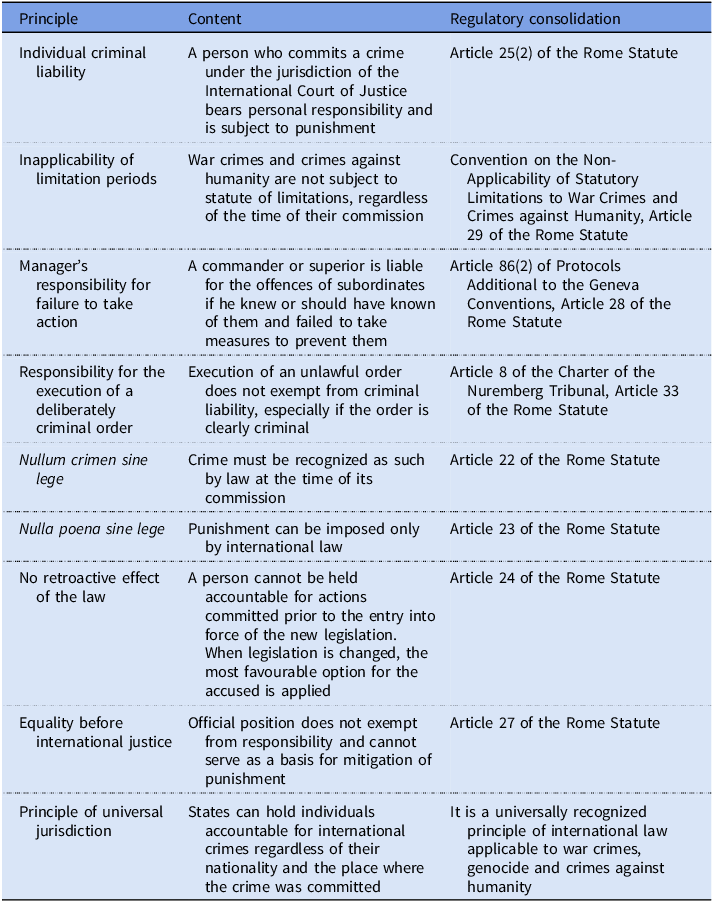
Scientific discussions regarding the content and scope of international criminal law indicate the difficulties associated with its enforcement. Different approaches to the classification and interpretation of the principles of this industry emphasize their dynamic nature and the need to consider law enforcement practice when defining them. Table 1 is presented to systematize the basic principles of international criminal law.
Basic principles of international criminal law

Source: compiled by the authors based on the Charter of the Nuremberg Tribunal (1945), International Covenant on Civil and Political Rights (United Nations Human Rights 1966), Rome Statute of the International Criminal Court (1998), Convention on the Non-Applicability of Statutory Limitations to War Crimes and Crimes against Humanity (1968), Protocol Additional to the Geneva Conventions of 12 August 1949, and relating to the Protection of Victims of International Armed Conflicts (Protocol 1) (1977), Protocol Additional to the Geneva Conventions of 12 August 1949, and Relating to the Protection of Victims of Non-International Armed Conflicts (Protocol II) (1977) and Friedrichs and Panke (Reference Friedrichs and Panke2024).
The set of key provisions of international criminal law forms the basis of its regulation, ensuring the binding nature of legal regulations. One of the most important elements of this system is individual criminal liability, which is consolidated in international regulations and law enforcement practice. According to Article 25(2) of the Rome Statute of the International Criminal Court (1998), a person who commits a crime within the jurisdiction of the court is personally responsible and is subject to punishment by the established provisions. This provision reflects a fundamental principle that excludes the possibility of collective or state responsibility for crimes of an international nature.
Equally important is the establishment of the inapplicability of the statute of limitations to war crimes and crimes against humanity. This approach was first documented in the Convention on the Non-Applicability of Statutory Limitations to War Crimes and Crimes Against Humanity (1968), and subsequently developed in Article 29 of the Rome Statute of the International Criminal Court (1998). According to this principle, crimes classified as war crimes and crimes against humanity are not subject to time limits for prosecution, which is due to their special public danger and the need to ensure the inevitability of punishment.
Special attention in international criminal law is paid to the responsibility of leaders and commanders for failure to take measures to prevent crimes. By Article 86(2) of the Protocols Additional to the Geneva Conventions, and Article 28 of the Rome Statute of the International Criminal Court (1998), military leaders, commanders and other officials are criminally liable for crimes committed by their subordinates if they knew or should have known about the upcoming or committed illegal actions, but did not take all possible measures to prevent them. This approach forms an important mechanism of international criminal responsibility aimed at combatting crimes committed in military conflicts.
Another key provision of international criminal law is the prohibition of exemption from liability for the execution of a deliberately criminal order. This principle was first consolidated in Article 8 of the Charter of the Nuremberg Tribunal (1945), and later developed in international conventions and statutes of the International Tribunals for the former Yugoslavia, Rwanda and the International Criminal Court. According to Article 33 of the Rome Statute of the International Criminal Court (1998), the execution of an order from a superior does not exempt a person from criminal liability, except in cases where execution was mandatory, the executor did not realize its illegality and the order itself was not criminal. Crimes against humanity and genocide are prohibited from justifying actions by executing an order.
One of the fundamental principles of criminal law on an international scale is the principle of legality (“nullum crimen sine lege”), which is reflected in Article 22 of the Rome Statute of the International Criminal Court (1998). This principle establishes that a person cannot be held accountable for an act that was not recognized as criminal at the time of its commission. The related principle of the fairness of punishment (“nulla poena sine lege”), fixed in Article 23 of the Rome Statute of the International Criminal Court (1998), states that punishment can be imposed only by established legal norms and cannot be applied arbitrarily.
The absence of the retroactive effect of criminal law in international criminal law is also an important aspect ensuring the observance of justice in the application of punishment. According to Article 24 of the Rome Statute of the International Criminal Court (1998), a person cannot be held criminally liable for acts committed before the entry into force of the relevant norms of international criminal law. Moreover, if the criminal law changes in the future, the most favourable option for the accused will be applied.
The principle of equality before international justice, consolidated in Article 27 of the Rome Statute of the International Criminal Court (1998), excludes the possibility of exemption from liability based on a person’s official position. According to this provision, heads of state, ministers, deputies and other high-ranking officials cannot enjoy immunity or count on mitigation of punishment solely by their official status. This principle ensures the universality of international criminal justice and excludes abuse of power without legal consequences.
Of additional importance is the concept of universal jurisdiction, according to which states can prosecute persons who have committed crimes recognized by international law, regardless of their nationality and the territory where the crime was committed. This rule applies to the most serious crimes, including genocide, war crimes and crimes against humanity. Universal jurisdiction is consolidated in numerous international conventions and is used in the practice of individual states, which contributes to strengthening the global fight against crime and preventing impunity. For example, Belgium was one of the first countries to adopt the Universal Jurisdiction Act (1993), which allowed national courts to prosecute persons accused of crimes against humanity, regardless of where they were committed. However, due to diplomatic pressure, the legislation was partially limited. Spain has widely applied the principle of universal jurisdiction, including in the case against Chilean dictator Augusto Pinochet in 1998 (see Pinochet Case Study 2009). Later, the legislation was changed, but the principle is still valid within a limited framework. The principles of international criminal law form the basis of law enforcement practice and ensure compliance with uniform criminal justice standards at the international level.
Legal Regulation of Criminal Proceedings in the Kyrgyz Republic and the Republic of Kazakhstan
Criminal proceedings in the Kyrgyz Republic and the Republic of Kazakhstan are regulated by national codes of criminal procedure, constitutions and international treaties to which both countries have acceded. According to the Criminal Procedure Code of the Kyrgyz Republic (2021), criminal proceedings cover pre-trial and judicial proceedings. In turn, the Criminal Procedure Code of the Republic of Kazakhstan (2014) interprets criminal proceedings through the identical concept of criminal procedure, including judicial proceedings. Thus, in both countries, criminal proceedings are a complex activity of authorized bodies, starting from a preliminary investigation and ending with the execution of a court decision.
International treaties, which are part of the criminal procedure law of Kyrgyzstan and Kazakhstan, are of great importance in regulating criminal proceedings. In Kyrgyzstan, generally recognized norms and principles of international law are integrated into national legislation, which is reflected in the Constitution of the Kyrgyz Republic (2021) and the Criminal Procedure Code of the Kyrgyz Republic (2021). In Kazakhstan, the Constitution of the Republic of Kazakhstan (1995) regulates the application of international law in the case of conflict with national norms. According to Article 4, ratified international treaties have priority over national laws and are subject to direct application, unless the treaty explicitly provides otherwise or requires the adoption of domestic legislation for its implementation. In addition, Article 8 of the Constitution establishes the principle of conscientious fulfilment of international obligations and the Constitutional Court may verify the conformity of international treaties with the Constitution before their ratification.
However, unlike in Kazakhstan, where the Constitution establishes the priority of ratified international treaties over national laws, in Kyrgyzstan, such priority is not explicitly established. This creates certain legal conflicts, since Kazakhstan limits the influence of international law to the framework of ratified treaties, while Kyrgyzstan includes all generally recognized norms in national legislation, regardless of their ratification. In the context of criminal proceedings, such a difference in approaches can have an impact on law enforcement practice and interpretation of norms (Kenzhaliyev Reference Kenzhaliyev2024).
It is worth noting that despite international obligations in the field of human rights, their implementation in the national legislation of both states has its specifics. Kazakhstan, being a member of the International Covenant on Civil and Political Rights, has implemented its norms into national legislation, adapting them to consider domestic legal and social realities. One of the key aspects of the implementation of the Covenant’s provisions in the Kazakh legal system is the regulation of the right to freedom of assembly. This right is formally guaranteed by the Constitution of the Republic of Kazakhstan (1995), but its implementation is subject to special legislative acts that establish several restrictions and procedural requirements (Nursaliyeva et al. Reference Nursaliyeva, Baikenzhina, Kalmaganbetova, Balgimbekova, Seitzhanova and Kussainova2023).
In particular, the Law of the Republic of Kazakhstan No. 333-VI ZRK “On the Procedure for Organizing and Holding Peaceful Assemblies in the Republic of Kazakhstan” (2020) defines the mechanism for the implementation of this right in the country. According to its provisions, organizers of public events are required to notify local authorities in advance and obtain their permission. State bodies have the authority to refuse to approve the holding of an assembly in cases where it may pose a threat to public safety, violate the rights and freedoms of others, or take place in places not provided for such events.
There are two main models for regulating freedom of assembly: notification and permissive. In most democratic states, a notification model is used, which assumes that the organizers of the actions are only required to inform the authorities about the event, but do not need prior approval. The Kazakh approach, on the contrary, involves obtaining an official permit, which creates additional administrative barriers to the exercise of the right to freedom of peaceful assembly. In contrast, Kyrgyzstan has a notification procedure established by the Law of the Kyrgyz Republic No. 64 “On Peaceful Assemblies” (2012), according to which no special permit is required to hold an assembly, but the authorities can change its place or time for several reasons, such as a threat to public safety or the closure of transport routes. Such differences in regulation can have an impact on criminal proceedings, as strict legal restrictions on civil liberties in Kazakhstan can lead to criminal prosecution for participation in protest actions.
Another important problem is the spatial application of the norms of criminal proceedings, which defines the territorial scope of their operation. In general, national legislation is applied within a single country, while interstate agreements regulate international norms. However, conflicts of legal systems and differences in legislation can lead to difficulties in extradition, taxation and financial crimes. According to the Criminal Procedure Codes of the Kyrgyz Republic and the Republic of Kazakhstan, national criminal proceedings are conducted by the laws of each country, unless otherwise provided by international treaties. However, the constitutions of both countries have the highest legal force, which limits the application of international norms.
There is a monistic approach in the legal systems of Kazakhstan and Kyrgyzstan, according to which international law is part of national legislation. However, elements of a dualistic approach are also present, as the adoption of certain laws or amendments is required for the implementation of some international treaties. For example, a separate regulatory framework is being created in both countries to implement international environmental and anti-corruption standards. In Kazakhstan and Kyrgyzstan, the established priority of international treaties does not mean their unconditional supremacy: if a treaty contradicts the Constitution or affects state interests, its ratification may be blocked or it may be interpreted with reservations. This leads to a situation where the formal consolidation of international norms does not always correspond to their actual application.
Implementation of International Criminal Law Standards in the National Legal Systems of Kazakhstan and Kyrgyzstan
By international legal standards consolidated in the Universal Declaration of Human Rights (United Nations 1948) and the International Covenant on Civil and Political Rights (United Nations Human Rights 1966), a person cannot be held accountable for an act if it was not criminally punishable at the time of its commission. In the national criminal codes of Kazakhstan and Kyrgyzstan, this provision is reflected in legislation prohibiting the retroactive application of criminal law, except in cases where the new law mitigates liability or decriminalizes the act (Sorokina and Koichukulova Reference Sorokina and Koichukulova2021).
An important aspect of the criminal legislation of both countries is the consolidation of personal responsibility for criminal acts. In particular, the norms on the inapplicability of criminal penalties to legal entities emphasize the personal nature of responsibility, which corresponds to international practice. This approach is aimed at ensuring fair justice and preventing a situation in which collective entities, such as corporations, could be criminalized along with individuals. Kazakhstan and Kyrgyzstan have mechanisms for holding legal entities liable for other types of liability, including administrative and civil penalties. However, within the framework of anti-corruption legislation and the fight against economic crimes, both countries have introduced mechanisms for bringing legal entities to administrative responsibility for corruption and other offences (Mitskaya Reference Mitskaya2024).
According to the norms of international criminal law, the establishment of a minimum age of criminal responsibility is an important element of protecting the rights of minors. In particular, Article 26 of the Rome Statute of the International Criminal Court (1998) stipulates that the jurisdiction of this court does not apply to persons under the age of 18 years at the time of the alleged commission of a crime.
This approach is consistent with the provisions of the Convention on the Rights of the Child (1989), which emphasizes the need for special protection of minors in the justice system. The criminal laws of most countries provide for special procedures for dealing with juvenile cases, including Kazakhstan and Kyrgyzstan. In these states, legislation defines a lower age of criminal responsibility for certain crimes, but at the same time provides for the use of educational and rehabilitative measures instead of conventional criminal penalties. Thus, by Article 15 of the Criminal Code of the Republic of Kazakhstan, the general age of criminal responsibility is 16 years, but for certain crimes against the peace and security of mankind, criminal responsibility begins at the age of 14 years. In particular, this applies to crimes provided for in Article 173 of the Criminal Code of the Republic of Kazakhstan (attacks on internationally protected persons or organizations). Thus, the national criminal legislation of Kazakhstan expands the range of persons criminalized for crimes related to international law compared to the provisions of the Rome Statute of the International Criminal Court (1998).
A similar situation is observed in the Kyrgyz Republic. By Article 18 of the Criminal Code of the Republic of Kazakhstan, the general age of criminal responsibility is 16 years. However, for a certain category of particularly serious crimes, responsibility begins at the age of 14 years. These include crimes that pose a serious threat to public and international security (Sheranova Reference Sheranova and Mihr2020).
In this context, the criminal legislation of Kyrgyzstan is aimed at balancing the protection of public safety and respect for the principles of humanism. An important aspect is the possibility of applying alternative punishments, including educational measures and rehabilitation programmes, which comply with international standards in the field of juvenile justice.
The issue of lowering the age of criminal responsibility for certain crimes against peace and security remains controversial. On the one hand, given the seriousness of such crimes and their consequences, lowering the age of responsibility can help improve the effectiveness of criminal justice. On the other hand, such measures require careful assessment in terms of respect for the rights of minors and the principle of proportionality of punishment (Zhanuzakova Reference Zhanuzakova2022).
The inevitability of punishment for international crimes is one of the key elements of the criminal policies of Kazakhstan and Kyrgyzstan. The legislation of both countries provides for harsh sanctions for crimes such as terrorism, genocide, war crimes and crimes against humanity. These provisions are based on international obligations consolidated in several international treaties, including the Convention against Torture and Other Cruel, Inhuman or Degrading Treatment or Punishment (1984) and the Convention on the Prevention and Punishment of the Crime of Genocide (1948). However, there remains a gap in Kyrgyzstan’s legal system related to the lack of a clear legislative definition of crimes against humanity, which complicates law enforcement and requires further regulatory specification (Sayapin Reference Sayapin2019).
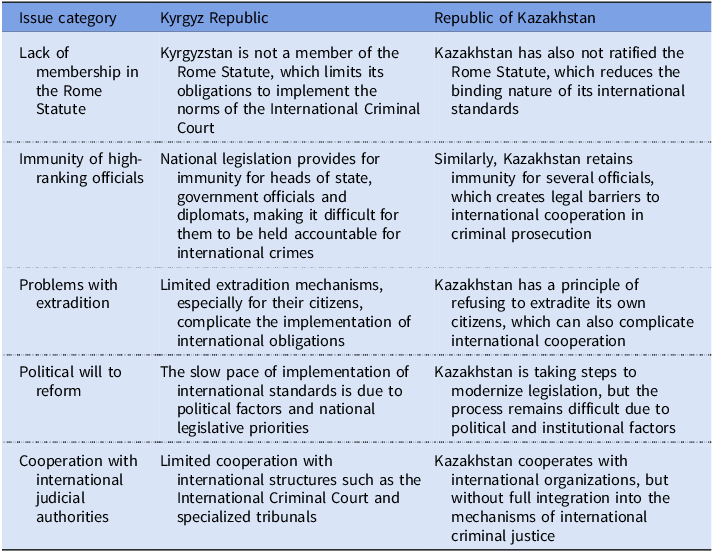
Issues of international cooperation in the field of criminal prosecution are also reflected in national legislation. The Criminal Codes of Kazakhstan and Kyrgyzstan contain rules governing extradition and cooperation with international judicial authorities. Kazakhstan adheres to the principle of refusing to extradite its citizens, but provides for the possibility of their criminal prosecution for crimes committed outside the country. Kyrgyzstan has a similar approach, but the country is demonstrating more active cooperation with international structures, including Interpol, especially in the context of countering transnational organized crime (Kabalskyi and Shevchyk Reference Kabalskyi and Shevchyk2021).
An additional aspect of international criminal law concerns the legal status of officials. According to Article 27 of the Rome Statute of the International Criminal Court (1998), the official position of the accused, including the status of the head of state or government, cannot serve as a basis for exemption from criminal liability. This approach is based on the fact that immunities are intended to protect state functions, and not to exclude responsibility for crimes contrary to the fundamental norms of international law. Thus, bringing to justice for international crimes goes beyond the domestic jurisdiction of individual states and becomes universal.
Member states of The Rome Statute of the International Criminal Court (1998) are making appropriate changes to national legislation, lifting the immunities for presidents, prime ministers, members of governments, judges, diplomats and other officials, which simplifies their criminal prosecution within the framework of national justice systems. However, the presence of immunity does not prevent such persons from being held accountable by international courts, even if the state that granted immunity is not a party to the Rome Statute.
Kazakhstan and Kyrgyzstan are not parties to the Rome Statute of the International Criminal Court (1998); therefore, issues of immunity from criminal prosecution in these countries are regulated based on customary international law and international treaties. International law recognizes personal immunity (for diplomatic agents, heads of state, government and foreign ministers) and functional immunity (for officials of states and international organizations if their actions were carried out in the performance of official duties).
In Kazakhstan, issues of immunity are regulated by several national laws and international agreements to which the state is a party. For example, by the Vienna Convention on Diplomatic Relations (1961), Kazakhstan recognizes diplomatic immunity, but provides for the possibility of its cancellation in the case of serious crimes or with the consent of the state that sent a representative. Kyrgyz legislation also establishes similar rules governing the granting and lifting of immunity, in particular, for diplomatic representatives and senior government officials.
In the context of combatting international crimes, Kazakhstan and Kyrgyzstan cooperate with international structures such as Interpol, the United Nations and the Shanghai Cooperation Organization. Both countries participate in regional initiatives on the extradition of persons suspected of committing serious crimes, including corruption and terrorist acts.
The implementation of international standards in the field of combatting corruption also occupies an important place in the criminal reforms of Kazakhstan and Kyrgyzstan. In the Republic of Kazakhstan, specific reforms have been carried out aimed at strengthening the fight against the financing of terrorism and organized crime. As part of these reforms, the legislative framework in the field of combatting money laundering has been improved, new standards of financial supervision and cash flow control have been introduced, and specialized law enforcement units responsible for conducting financial investigations have been created. Special attention is paid to the mandatory monitoring of suspicious transactions in the banking system, the introduction of modern electronic control systems and information exchange with international partners, which helps to identify and stop money-laundering schemes quickly. These measures contribute to the harmonization of Kazakhstan’s legislation with international standards and increase the effectiveness of the fight against transnational criminal organizations.
In the period from 2014 to 2024, there were cases in the Republic of Kazakhstan demonstrating the application of international norms in criminal proceedings, which underlines the relevance of integrating international standards into national legislation. For example, using the case of journalist Duman Mukhammedkarim, one can trace how issues of the application of international criminal law norms are becoming relevant in national judicial practice (Human Rights Watch 2024). In this case, the closed-door trial drew criticism from human rights defenders for violating the guarantees of a fair trial provided for by international standards, such as the presumption of innocence and the right to a public trial. This incident demonstrates that, despite the formal recognition of generally accepted norms, there are problems in the criminal justice system of Kazakhstan related to their actual application, which confirms the need to harmonize national legislation with international obligations.
This example shows that even in the absence of membership in the Rome Statute of the International Criminal Court (1998), both in Kazakhstan and Kyrgyzstan, national courts are beginning to focus on international norms, thereby ensuring more transparent and fair criminal proceedings. However, the identified practices also indicate the need for further improvement of legislation to eliminate legal gaps and unify terminology with international standards.
Recommendations for Improving the Legal and Institutional Mechanisms of Criminal Proceedings
Based on the analysis, it is possible to identify key problems and barriers that hinder the effective implementation of international standards in the national legislation of the Kyrgyz Republic and the Republic of Kazakhstan. Table 2 systematizes the main obstacles that require further improvement of legal mechanisms and adaptation of national legislation to international obligations.
Barriers to the effective implementation of international standards in the national legislation of Kyrgyzstan and Kazakhstan

Source: compiled by the authors based on the Rome Statute of the International Criminal Court (1998), Criminal Procedure Code of the Republic of Kazakhstan (2014), Criminal Procedure Code of the Kyrgyz Republic (2021), Constitution of the Republic of Kazakhstan (1995) and Constitution of the Kyrgyz Republic (2021).
In order to develop effective and fair criminal proceedings in Kazakhstan and the Kyrgyz Republic based on international standards, it is necessary to introduce several legal and institutional changes based on the best practices of other countries. In particular, it is necessary to identify and eliminate legal gaps that allow for excessive variability in the interpretation of generally accepted norms and principles of international law. One of the key steps is to review the norms of national criminal and criminal procedure codes to clarify the composition of crimes against the peace and security of humanity, and to eliminate discrepancies in the definition of terms. This will help to bring legislation in line with the requirements of international legal acts.
In addition, an important area is the integration of international human rights standards into the criminal process. In this regard, it is necessary to develop and adopt regulations governing the rights of the accused and defendants, in particular, ensuring guarantees of protection from torture, the right to qualified legal assistance, the presumption of innocence and the right to a fair trial. In this context, it is advisable to integrate into national legislation the recommendations of the European Committee for the Prevention of Torture and Ill-Treatment and the recommendations of the United Nations (2025), which provide valuable tools for improving the protection of human rights in criminal proceedings.
It is necessary to strengthen civil institutions and legal awareness of the population. Educational programmes for the general public to improve legal literacy should be developed and implemented. The reform of the training and certification system for judges and prosecutors, with an emphasis on international legal standards, should also be considered. In addition, the integration of informal justice into the unified judicial system is required, including the training of representatives of the Aksakal courts in the basics of international law and the principles of human rights protection.
It is proposed to introduce modern information technologies and artificial intelligence algorithms into criminal proceedings. This will increase the transparency of procedural actions, minimize corruption risks and reduce the subjectivity of court decisions. It is recommended to develop a unified digital platform for trials with the possibility of monitoring by independent international organizations and civil society.
In general, the strategy of reforming criminal justice in Kazakhstan and Kyrgyzstan should be aimed at ensuring transparency and objectivity of justice, minimizing corruption and pressure from authorities, and creating conditions for effective interaction with international institutions. It is necessary to develop specific mechanisms for independent oversight of judicial authorities, including the invitation of international experts to monitor respect for human rights and the rule of law in criminal proceedings.
Discussion
The results of this study confirmed the complexity and multidimensional nature of the problems associated with the adaptation of international standards of criminal justice into the national legislation of post-Soviet countries, in particular, Kazakhstan and the Kyrgyz Republic. Shaffer and Sandholtz (Reference Shaffer and Sandholtz2024) demonstrated that one of the significant problems in Kazakhstan was the lack of development of mechanisms for the implementation of international standards, which leads to their selective application in judicial practice. Similar conclusions were confirmed in the study by Sterio (Reference Sterio2020), which focused on the weakness of the institutional framework and the lack of systemic law enforcement in the Kyrgyz Republic, which significantly limits the effectiveness of the integration of international norms into the national judicial system.
Analysis of studies by Oster (Reference Oster2021) and Cocq (Reference Cocq and Cocq2024) indicates that corruption and the lack of judicial independence are the main obstacles to the effective application of international standards. This study revealed a high level of corruption in the judicial and law enforcement agencies of both Kazakhstan and the Kyrgyz Republic, which was also confirmed by the findings of García (Reference García2023), highlighting systemic corruption risks in Central Asian countries. Such risks negatively affect the quality of justice and require comprehensive reforms aimed at enhancing the transparency and independence of judicial processes.
In addition, Friedrichs and Panke (Reference Friedrichs and Panke2024) argued that political influence and insufficient institutional autonomy significantly limit the possibility of applying international legal norms in national practice. In addition to this, Villamarín López (Reference Villamarín López2021) pointed to the need to transform the legal culture in the region, which is especially important in light of the lack of qualified personnel and modern approaches to training specialists in the field of criminal law. These factors contribute to the fact that the implementation of international standards is fragmented and not systematic, which creates serious legal conflicts.
Thus, a comparison of the results obtained with the data of other researchers highlights that despite the existence of formally established international norms, their practical implementation in Kazakhstan and the Kyrgyz Republic faces several serious obstacles. These problems include not only legal gaps and discrepancies in national legislation, but also institutional barriers such as corruption, political pressure and lack of judicial independence. To overcome these problems, it is necessary to develop and implement a set of measures, including the unification of international and national norms, the improvement of law enforcement practice and active international cooperation and exchange of experience with other countries.
The results of the study indicate that there are significant legal gaps in legislative practice that hinder the effective application of international standards, which was confirmed by Habernal et al. (Reference Habernal, Faber, Recchia, Bretthauer, Gurevych, Döhmann and Burchard2024). However, the analysis showed that the problem goes beyond the lack of clearly formulated norms and is associated with a variable interpretation and selective application of existing provisions depending on the political context. Regulations are applied ambiguously, which leads to differences in the implementation of international standards in judicial practice.
Important attention is paid to the influence of international actors on the process of reforming criminal justice in the Republic of Kazakhstan and the Kyrgyz Republic. The study by Negi (Reference Negi2024) pointed to the significant influence of international organizations such as the United Nations and the European Court of Human Rights through the provision of recommendations, monitoring compliance with standards and the organization of technical assistance programmes. However, their impact is limited by the lack of internal political will, which makes it difficult to implement international norms, even with external pressure and support.
The study by France (Reference France2019) emphasized the importance of addressing legislative deficiencies to achieve harmonization of national legislation with international standards. However, it has been revealed that legislative problems represent only one side of the problem, while the key factor is political circumstances affecting the interpretation and application of norms. In a volatile political climate, judicial decisions can be made based on considerations of maintaining political stability, which leads to a selective interpretation of norms and undermines citizens’ ability to defend their rights.
Thus, it has been established that the effective implementation of international standards in national criminal legislation requires not only the elimination of obvious legal gaps, but also the creation of conditions for the consistent and transparent application of norms. To achieve this goal, it is necessary to improve legislation and carry out institutional reforms aimed at strengthening the independence of the judicial system and minimizing the influence of political factors on law enforcement. In this context, an important measure is the development of clear criteria for the interpretation of international norms and the introduction of monitoring mechanisms for their application, which will ensure the stable and fair functioning of the judicial system.
Additionally, it has been established that cooperation with international organizations can serve as an additional incentive for necessary reforms, but it cannot compensate for the lack of internal political will. Negi (Reference Negi2024) argued that a set of measures, including both legislative changes and institutional reforms, is a prerequisite for achieving significant improvements in the field of criminal justice. The final analysis of the data indicates the need for further research aimed at developing specific mechanisms for unifying the interpretation of norms and developing a law enforcement monitoring system capable of ensuring compliance with international standards, regardless of the political context.
The results of the study confirmed the need for further improvement of legal mechanisms aimed at more accurate and consistent implementation of international norms in judicial practice. The analysis revealed that the lack of clear mechanisms for the implementation of international standards and their selective application creates obstacles to the effective functioning of the judicial system. An important area of development is the development of a system of legal instruments that ensures the unification of national and international standards, which will eliminate discrepancies in law enforcement practice and increase the level of legal certainty.
One of the key aspects in this process is the harmonization of the regulatory framework, which requires the adoption of changes in national legislation aimed at adapting international standards, considering the specifics of national legal systems. The development of judicial precedent and the introduction of mechanisms for monitoring compliance with international norms in judicial decisions contribute to strengthening the rule of law and ensuring human rights in Central Asian countries. Additionally, the formation of institutional guarantees for the independence of the judiciary plays an important role, which minimizes the influence of political factors on law enforcement practice.
An analysis of law enforcement practice shows that without comprehensive reforms aimed at eliminating legislative gaps and improving the skills of the judiciary, the implementation of international standards will be fragmented. In this context, it is important to strengthen cooperation with international legal institutions such as the European Court of Human Rights, the International Criminal Court, the United Nations and other specialized organizations dealing with the rule of law. The integration of their recommendations into national legislation will create more transparent and predictable law enforcement mechanisms, which will positively affect the quality of judicial decisions and citizens’ trust in justice.
Gillett and Fan (Reference Gillett and Fan2023) confirmed that the selective application of international standards significantly limits the equality of the parties in the judicial process, reducing guarantees of respect for human rights in the judicial practice of Central Asian countries. This conclusion correlates with the results of this study, according to which the lack of uniform standards and the varying degree of their implementation in national judicial systems leads to significant discrepancies in the interpretation of international norms and their application.
Thus, the conducted research revealed additional aspects of the problem that require further study. In particular, it was found that the key factors influencing the success of judicial system reform are the presence of political will and the active participation of international actors in implementing international standards. It is important to consider that the effectiveness of such reforms largely depends on the level of internal training of judicial and law enforcement agencies to accept new legal mechanisms. This requires not only regulatory changes, but also the implementation of training programmes for judges, prosecutors and lawyers to improve their skills in the field of international law.
Conclusions
In the course of the study, key international norms influencing criminal proceedings were identified, and the specifics of their consolidation in the national legislation of the Kyrgyz Republic and the Republic of Kazakhstan were examined. A comparative analysis of law enforcement practice has revealed the main problems and barriers hindering the effective implementation of international standards in these countries.
The results of the analysis showed that, despite the formal recognition of the fundamental principles of international criminal law, their practical implementation faces several legal, institutional and sociopolitical obstacles. The study identified significant legal gaps that allow for significant variability in the interpretation of international law in national criminal proceedings. This creates conditions for the subjective interpretation of individual provisions and their selective application, which, in turn, leads to inconsistencies with international standards and principles of justice.
One of the main problems is the lack of harmonization of criminal legislation with international obligations, which is especially noticeable in areas such as extradition, immunity of officials, protection of the rights of the accused and ensuring procedural guarantees. This inconsistency in legal approaches leads to significant discrepancies in law enforcement practice and hinders effective cooperation with international judicial and human rights bodies. Systemic changes are required to address these shortcomings and improve the interaction of the national judicial system with international legal structures. In addition, the study revealed the weakness of the institutional framework, expressed in the lack of independence of the judicial system, high levels of corruption in law enforcement and judicial authorities, and limited opportunities for international cooperation in the field of criminal justice. This factor significantly reduces the effectiveness of law enforcement, since subjective and external political influences often turn out to be more significant than the norms of law. The current situation is aggravated by the insufficient level of legal awareness of the population, which leads to low access to justice, limited human rights protection mechanisms, and a high level of distrust of the judicial system.
Based on the identified problems, recommendations were developed to improve the legal and institutional mechanisms of criminal proceedings. The study proposed several measures aimed at strengthening the institutional independence of the judicial system. This includes the need to refine criminal legislation to address legal gaps related to the interpretation of international norms. An important step is the harmonization of national legislation with international obligations, which requires a revision of the rules on jurisdiction in the context of international crimes and the strengthening of the legal framework for extradition.
The study also revealed certain limitations. In particular, the analysis focused mainly on formal legal regulation and institutional mechanisms, while the influence of political and sociocultural factors requires further study. The prospects for further research include a detailed study of the effectiveness of the proposed reforms, an analysis of the impact of international human rights organizations on national criminal systems and the development of new methods for assessing the compliance of national legal proceedings with international standards.
Competing interests
None of the authors has a conflict of interest.
Zulfiia Mamyrbaeva is an Associate Professor at the Department of Theory and History of State and Law, Kyrgyz National University named after Jusup Balasagyn.
Kanatbek Suranbaev is a PhD, and a researcher at the Faculty of Law, Kyrgyz National University named after Jusup Balasagyn.
Ashir Aitkaliyev is a doctoral student at the Faculty of Law, Kyrgyz National University named after Jusup Balasagyn.
Meerim Rysalieva is a PhD, and Associate Professor at the Department of Theory and History of State and Law, Kyrgyz National University named after Jusup Balasagyn.