Arrhythmogenic right ventricular cardiomyopathy is a cardiomyopathy of an unknown cause that predominantly affects right ventricular structure and function.The prognosis is poor in patients with progressive arrhythmias and heart failure.Reference Corrado, Basso and Thiene 1 The incidence is unknown as it can be completely asymptomatic in the young, with sudden death as the initial manifestation.Reference Kanadasi, Tasal, Akpinar, Tercan and Acartürk 2 The association of arrythmogenic right ventricular cardiomyopathy with atrial septal defect is very rare, which may make the diagnosis, treatment, and prognosis difficult. We present a case with this association, and review the literature regarding arrhythmogenic right ventricular cardiomyopathy and atrial septal defect or patent foramen ovale.
Case presentation
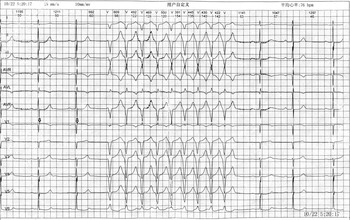
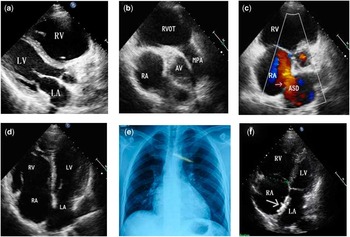
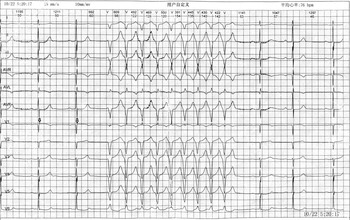
A 35-year-old male patient was admitted as an emergency because of palpitation and chest tightness. Electrocardiogram on admission showed sustained ventricular tachycardia with left bundle branch block morphology. A first attempt to terminate the tachycardia by intravenous amiodarone was unsuccessful, and therefore he underwent successful electrical cardioversion. His father had a sudden cardiac death at the age of 33, and his daughter had a patent ductus arteriosus. Laboratory findings were all within normal range. Holter monitoring showed non-sustained ventricular tachycardias and epsilon waves (V1 lead) during sinus rhythm (Fig 1). A transthoracic echocardiogram showed enlarged right atrial and right ventricular dimensions with diffuse akinetic and hypokinetic areas, and a thin right ventricular wall, an aneurysmatic right ventricular infundibulum – right ventricle end-diastolic diameter 4.4 cm, right ventricular wall thickness 0.2 cm, and right ventricular outflow diameter 4.1 cm – and the left ventricle and valves were normal (Figs 2a, b and d). Right ventricular fractional area change was 28% – lower reference value for normal right ventricular systolic function of 35% – evaluated by two-dimensional method in apical four-chamber view. The systolic pulmonary artery pressure was estimated at 35 mmHg. There was a secundum atrial septal defect, with a diameter of 1.8 cm, with a left-to-right interatrial shunt (Fig 2c). The chest X-ray showed midly dilated right heart (Fig 2e). According to the modification of the task force criteria of arrhythmogenic right ventricular cardiomyopathy, proposed by Marcus et al,Reference Marcus, McKenna and Sherrill 3 the present case had two major criteria, structural abnormalities in the right ventricle and sustained ventricular tachycardia, and one minor criterion, family history, and thus fulfilled the diagnostic criteria.
Holter monitoring showing non-sustained ventricular tachycardias and epsilon wave ( ) in V1 lead during sinus rhythm.
( a ) Transthoracic echocardiogram showing right ventricular dilatation. ( b ) Bulging of the right ventricular outflow tract. ( c ) Colour-flow Doppler showing left-to-right shunt across an atrial septal defect (arrow). ( d ) Diastolic frame from apical view demonstrating right atrial and right ventricular enlargement. ( e ) Chest X-ray showing mild right ventricular enlargement. ( f ) Atrial septal occluder after transcatheter closure of defect (arrow). ASD=atrial septal defect; AV=aortic valve; LA=left atrium; LV=left ventricle; MPA=main pulmonary artery; RA=right atrium; RV=right ventricle; RVOT=right ventricular outflow tract.
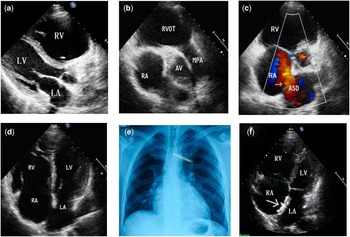
Taking into account that the severe clinical symptoms and gradually increasing load of the right heart resulting from interatrial left-to-right shunt might cause further right heart dilatation and heart failure, transcatheter closure of atrial septal defect and implantation of a cardioverter defibrillator were offered. Our patient only accepted percutaneous device closure of atrial septal defect and refused an implantable cardioverter defibrillator. The interventional procedure was guided by transthoracic echocardiography, and a 24 mm Amplatzer septal occluder was implanted (Fig 2f), with abolition of the shunt. Amiodarone (100 mg qd) and angiotensin-converting enzyme inhibitor perindopril (2 mg qd) were prescribed after intervention. During a 3-year follow-up, the patient remained clinically stable with a right ventricular fractional area change of 26%, and rare episode of ventricular tachycardia, which converted spontaneously. This patient gave written informed consent and the study was approved by our institutional ethical committee.
Discussion
Arrhythmogenic right ventricular cardiomyopathy is a cardiomyopathy of an unknown cause that predominantly affects right ventricular structure and function. There may be a genetic predisposition in 30–50% of those patients.Reference Franz, Mullerb and Katusb 4 , Reference Thiene, Basso, Calabreses, Angelini and Valente 5 Although it has a low incidence, in some series it is the most common cause of sudden cardiac death in individuals under the age of 35 years.Reference Gerrit, Stefan and Stavros 6
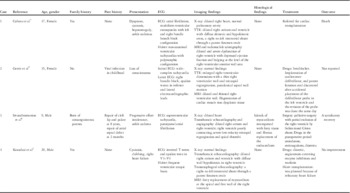
We report the case of a young patient with both arrhythmogenic right ventricular cardiomyopathy and atrial septal defect. Although there have been several reports of arrhythmogenic right ventricular cardiomyopathy associated with atrial septal defect or patent foramen ovale,Reference Kanadasi, Tasal, Akpinar, Tercan and Acartürk 2 , Reference Gerrit, Stefan and Stavros 6 – Reference Cubero, Gallego and Pavon Reference Sivasubramonian, Alphonso, Qureshi and Anderson 8 this is the first reported case of interventional treatment of atrial septal defect associated with arrhythmogenic right ventricular cardiomyopathy (see Table 1).
Current reported cases of arrhythmogenic right ventricular cardiomyopathy and atrial septal defect or patent foramen ovale.
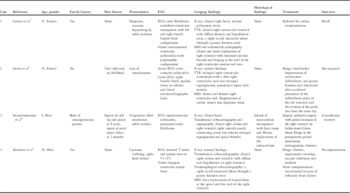
ECG=electrocardiogram; TTE=transthoracic echocardiogram.
In a Task Force on arrhythmogenic right ventricular cardiomyopathy, Marcus et alReference Marcus, McKenna and Sherrill 3 defined modified diagnostic criteria for right ventricular cardiomyopathy/dysplasia in 2010, including family history, structural, functional, histological, electrocardiographic, and echocardiographic findings. The electrocardiogram abnormalities include ventricular arrhythmias, T-wave inversion in the precordial leads, right bundle branch block, prolongation of right precordial QRS duration, and epsilon waves, particularly in V1. Severe dilatation of the right ventricle and impairment of right ventricular function observed by imaging examinations and/or histological evidence of fibrofatty replacement of the myocardium are two major criteria for the diagnosis of arrhythmogenic right ventricular cardiomyopathy.Reference Marcus, McKenna and Sherrill 3 , Reference Kayser, van der Wall, Sivananthan, Plein, Bloomer and de Roos 9 , Reference Khairy, Landzberg and Gatzoulis 10
It is well known that isolated atrial septal defect can also cause dilated right ventricle because of interatrial left-to-right shunt, and therefore arrhythmogenic right ventricular cardiomyopathy may be missed in cases associated with atrial septal defect. How to distinguish this association from isolated atrial septal defect? One of the clues is that right ventricular dysfunction is very unusual in patients with isolated atrial septal defect, except in rare patients over 40 years of age who have a comorbid factor, such as left ventricular failure, or right ventricular dysfunction secondary-to-pulmonary hypertension, or other complications.Reference Attie, Rosas, Granados, Zabal, Buendía and Calderón 11 , Reference Bartel and Muller 12 Other clues include a thin right ventricular wall and an aneurysmatic and bulging infundibulum, without a corresponding dilatation of the pulmonary artery. Electrocardiogram, MRI, family history, and other findings must be considered comprehensively. In addition, follow-up of patients who underwent correction of isolated atrial septal defect will reveal rapid recovery of right heart function in 3–6 months. In patients with associated arrhythmogenic right ventricular cardiomyopathy, right ventricular function will not usually recover completely after correction of defect. The progression of arrhythmogenic right ventricular cardiomyopathy associated with atrial septal defect may be quite variable. Sivasubramonian et alReference Sivasubramonian, Alphonso, Qureshi and Anderson 8 reported a 9-year-old patient with rapidly developing diffuse right ventricular cardiomyopathy presenting with right heart failure within 2 months after surgical closure of a secundum atrial septal defect. There are reports in the literature of arrhythmogenic right ventricular cardiomyopathy associated with atrial septal defect or patent foramen ovale progress at a slow pace after effective treatment. Our patient, who underwent percutaneous occlusion of atrial septal defect and drug treatment, has been relatively stable for 3 years.
Arrhythmogenic right ventricular cardiomyopathy is a progressive heart muscle disease. Therapeutic options include drugs, catheter ablation, implantable cardioverter defibrillator, and cardiac transplantation. Antiarrhythmic drugs, diuretics, angiotensin-converting enzyme inhibitors, and warfarin can be used for medical treatment. So far, the effect of ablation techniques is controversial.Reference Khalil, Kamal and Ahmad 13 No doubt that implantable cardioverter defibrillator is the most effective therapy against arrhythmic sudden death.Reference Corrado, Basso and Thiene 1
Because the combination of an atrial septal defect and arrhythmogenic right ventricular cardiomyopathy is rarely reported, the impact of this association on disease progression, right ventricular performance, and risk of arrhythmias is not clear. It is certainly reasonable to assume that closure of a significant atrial septal defect may be beneficial by decreasing right ventricular volume loading, reducing the risk of development of pulmonary hypertension, which is not likely to be well tolerated in these patients, and reducing the risk of developing atrial arrhythmias in the future. It is advised that closure of atrial septal defect should be performed before implantation of a cardioverter defibrillator, as there might be an increased risk of thromboembolic events in patients who have a transvenous implantable cardioverter defibrillator in the presence of an intracardiac shunt.Reference Sivasubramonian, Alphonso, Qureshi and Anderson 8 In addition, the ventricular pacemaker electrode may pass through the atrial septal defect into the left heart, and the atrial septal defect occlusion procedure may lead to electrode dislocation if this has been implanted beforehand.Reference Thiene, Basso, Calabreses, Angelini and Valente 5 In patients with high right ventricular and pulmonary artery pressures, closure of atrial septal defect requires careful assessment of risks and benefits. For those patients whose episodes of ventricular tachycardia cannot be prevented by a variety of methods and who have progressive biventricular failure, heart transplantation may be the only option.
In summary, arrhythmogenic right ventricular cardiomyopathy is a progressive hereditary malignant cardiac disease. Patients with ventricular tachycardia, right ventricular, or biventricular pump failure have poor prognosis.Reference Corrado, Basso and Thiene 1 Associated atrial septal defect or patent foramen oval may have an important impact on the arrhythmogenic right ventricular cardiomyopathy, clinicians need to raise awareness of the disease, and establish an individualised diagnostic and treatment plan for each patient. There are many issues requiring further investigation, particularly on the aetiology, disease progression, and treatment options.
Financial Suppo rt
This research received no specific grant from any funding agency, commercial, or not-for-profit sectors.
Conflicts of Interest
None.
Ethical Standards
This patient gave written informed consent and the study was approved by our institutional ethical committee.