Introduction
Anastrepha Schiner (Diptera, Tephritidae) is the most economically important genus of Tephritidae in the Americas. Simultaneously, Anastrepha species have revealed remarkable ecological and behavioral characteristics (Aluja, Reference Aluja1994). Currently, there are 213 valid species endemic to the New World, these being restricted to both tropical and subtropical environments. A high number of host plants have already been recorded for Anastrepha species (143 genera in 54 families) (Norrbom, Reference Norrbom, Norrbom and Thompson2004). Nevertheless, this number greatly decreases on excluding pest-species and exotic plants. There are few records of native host plants, since collections have been concentrated on commercial fruits, most of which are introduced (Norrbom & Kim, Reference Norrbom and Kim1988). These authors highlighted the importance of extensive collections of native plants, since the unknown hosts of many Anastrepha species are native, thus, contributing towards a better understanding of their biology. Fruit flies have been extensively studied in the tropics as pests in agricultural areas, but have rarely been assayed in forests with native vegetation. Little attention has been attributed to the natural history and behavior of fruit flies in nature, therefore underestimating the complexity of fruit fly biology and ecology (Aluja, Reference Aluja1999). Much of the information required for a better understanding of fruit fly biology, ecology and evolution is obtainable from areas with undisturbed native vegetation. Thus, finding these few remaining areas has become a notable challenge (Aluja et al., Reference Aluja, Rull, Sivinski, Norrbom, Wharton, Macías-Ordóñez, Díaz-Fleischer and López2003). Consequently, studies on native host plants in forest reserves have recently been intensified, with the result that these host plant/fruit fly associations have assumed importance for comprehending host plant use patterns, as well as the ecological and evolutionary processes of these insects. Aluja et al. (Reference Aluja, Rull, Sivinski, Norrbom, Wharton, Macías-Ordóñez, Díaz-Fleischer and López2003) pointed out that the food habits of primitive species, such as A. cordata, revealed through studies conducted in a preserved area of a tropical forest in Veracruz, Mexico (Hernández-Ortiz & Pérez-Alonso, Reference Hernández-Ortiz and Pérez-Alonso1993) gave rise to hypotheses on the evolution of oviposition behavior in Anastrepha species (Aluja et al., Reference Aluja, Piñero, Jacome, Díaz-Fleischer, Sivinski, Aluja and Norrbom1999; Díaz-Fleischer et al., Reference Díaz-Fleischer, Papaj, Prokopy, Norrbom, Aluja, Aluja and Norrbom1999). Furthermore, associations of Anastrepha species with host plants and the interactions between species were defined in the tropical rainforest biosphere reserve of Montes Azules, Mexico. This information provided support for inferences on the ecological and evolutionary processes of these insects and on pest management in the tropics (Aluja et al., Reference Aluja, Rull, Sivinski, Norrbom, Wharton, Macías-Ordóñez, Díaz-Fleischer and López2003). In locations undergoing different stages of environmental conservation in Argentina, the status of native and exotic fruits as hosts of A. fraterculus and Ceratitis capitata was verified. Thus, resource-use patterns, infestation and population distribution could be determined (Ovruski et al., Reference Ovruski, Schliserman and Aluja2003; Ovruski et al., Reference Ovruski, Wharton, Schliserman and Aluja2005; Segura et al., Reference Segura, Vera, Cagnotti, Vaccaro, De Coll, Ovruski and Cladera2006) there. In northeastern Argentina, A. fraterculus was predominant on native plant species, whereas C. capitata was so on those introduced, demonstrating that it is well-adapted to these disturbed environments (Ovruski et al., Reference Ovruski, Schliserman and Aluja2003). In a host plant survey undertaken in the ‘cerrado’ of the state of Mato Grosso do Sul, Brazil, C. capitata denoted higher infestation in guava samples, collected in urban areas, than did A. fraterculus and A. sororcula (Uchôa-Fernandes et al., Reference Uchôa-Fernandes, Oliveira, Molina and Zucchi2002). In areas where the pest-insect is an invasive species, this has frequently occurred in association with exotic plants (Selivon, Reference Selivon, Malavasi and Zucchi2000).
Among tephritids, C. capitata, the Mediterranean fruit fly (medfly) is considered to be the most polyphagous species with the highest adaptation capacity, since it infests 374 plant species (Liquido et al., Reference Liquido, Barr, Cunningham and Thompson1998) of which 33% are exotic (Copeland et al., Reference Copeland, Wharton, Luke and De Meyer2002). In several regions of Kenya, fruits were sampled to study the relationship of C. capitata to native plant hosts in its original home range. Medflies were predominantly reared from fruits of indigenous plant species, of which approximately 80% were new host records (Copeland et al., Reference Copeland, Wharton, Luke and De Meyer2002). These authors also pointed out the need for studying the medfly's natural history within its original home-range.
In a tropical forest of Papua New Guinea, the associations between frugivorous Dacinae species and host plants, their abundance and the number infesting several plant species were defined (Novotny et al., Reference Novotny, Clarke, Drew, Balagawi and Clifford2005).
Atlantic Rainforest fragments can be found in the State of Espírito Santo, Brazil. These, with a high rate of endemism and diversity, constitute a priority biome for biological conservation due to its highly endangered flora and fauna, which places it fourth in rank among 25 biodiversity hotspots world-wide (Myers et al., Reference Myers, Mittermeier, Mittermeier, da Fonseca and Kent2000). Therefore, it has become highly interesting to undertake a study so as to check the associations between fruit fly species and native host plants and to more specifically observe whether there is a pattern-relationship with plant-species groups, further comparing this with already published information as well as with behavior in relation to phytophagy in remnant Atlantic Rain Forest areas such as the Vale do Rio Doce Natural Reserve.
Materials and methods
Study area: location and characterization
Fruit collections were accomplished in the Vale do Rio Doce Natural Reserve (VRDNR), a fragment of the Atlantic Rain Forest located between geographic coordinates 19°06'–19°18' south and 39°45'–40°19' west in the county of Linhares, Espírito Santo State. The vegetation in VRDNR corresponds to secondary Dense Ombrophilous Forest (Souza et al., Reference Souza, Schettino, Jesus and do Vale2002) located on the surface of Tertiary mesas in the Barreira formation (lowland forest – mata de tabuleiro), which is characterized by a series of low elevation hills (28–65 m high) and flat-bottom valleys (Vicens et al., Reference Vicens, Cruz and Rizzini1998). The altitude of the fruit sampling area ranged from 48 to 60 m above sea level. According to Köppen's classification, the climate is Aw, humid tropical, with a mean annual rainfall of 1403 mm, a mean maximum temperature of 25.2°C, a mean minimum temperature of 19.1°C and a mean relative humidity of 84.3% (Souza et al., Reference Souza, Schettino, Jesus and do Vale2002).
Collection of fruit
Fruits from native plants (recently fallen or picked from trees) were collected weekly, according to the fruiting season of each species, during the period from February 2003 to July 2006. Sampled fruits were washed and counted, and the total mass of the sample was defined. Fruits were then placed in plastic pots containing a layer of autoclaved and sifted sand, so as to provide a pupation substratum. Puparia were kept in cages to allow adults to emerge.
Identification of insects and plants
K. Uramoto and R.A. Zucchi identified the Anastrepha species based on females. Nevertheless, in samples where only one species occurred, or where male characteristics permitted specific identification, males were also identified. As the fraterculus complex is formed by several cryptic species (Hernández-Ortiz et al., Reference Hernández-Ortiz, Gómez-Anaya, Sánchez, McPheron and Aluja2004; Selivon et al., Reference Selivon, Perondini and Morgante2005), the name A. fraterculus is being used herein in its sensu lato. Voucher specimens were deposited in the collection of Escola Superior de Agricultura Luiz de Queiroz (Entomologia), Universidade de São Paulo, São Paulo, Brazil.
Plants were identified by VRDNR botanists; and, in samples from which fruit flies were reared, those parts of the plant important for identification at the species level were dried and deposited in the VRDNR herbarium. Non-scientific plant names were referred to as vernacular names, since only names by which the plants were locally known were used (Frank, Reference Frank2001).
Data analysis
Infestation indices were calculated in two different ways: (i) by dividing the total number of puparia obtained in a given sample by the number of fruits in the sample (puparia.fruit−1); or (ii) by dividing the total number of puparia by the total mass (g) of fruits in the sample (puparia.g−1).
Results
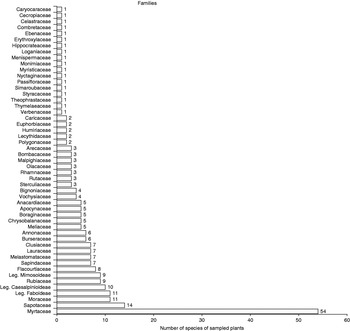
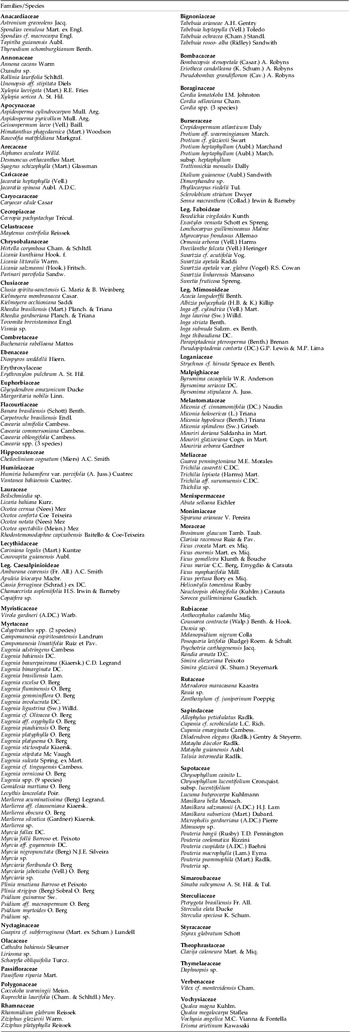
From 330 samples, 11,479 individual fruits were collected (39,810 g), representing 248 species in 51 plant families (table 1). The number of sampled species varied in the diverse families. Approximately 40% of the families sampled were represented by one or two species. Myrtaceae was the most diversified, with 54 species sampled (fig. 1). Emergence of fruit flies was detected in only 33 samples (10% of the total collected). The sampling and rearing of endophytic larvae is very laborious, since such sampling includes indiscriminate collecting of both infested and non-infested plant parts, as herbivore infestation cannot be easily recognized (Novotny et al., Reference Novotny, Clarke, Drew, Balagawi and Clifford2005).
Number of species of each plant family sampled in the Vale do Rio Doce Natural Reserve, Linhares, ES, February 2003–July 2006.

Plant family and species collected in the Vale do Rio Doce Natural Reserve, Linhares, ES, February 2003–July 2006.

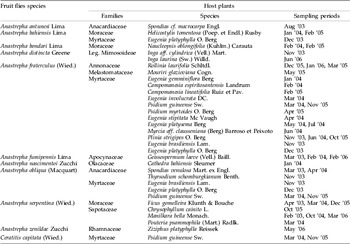
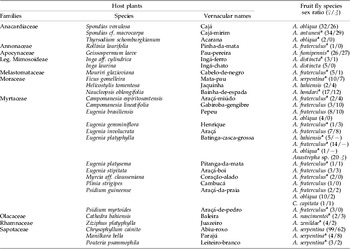
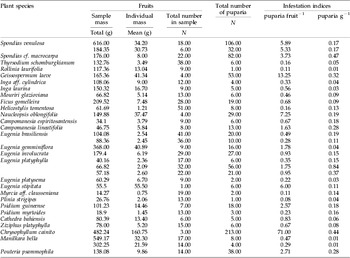
In ten plant families, 28 species were established as being natural hosts of ten Anastrepha species (A. antunesi Lima (one species), A. bahiensis Lima (two species), A. bondari Lima (one species), A. distincta Greene (two species), A. fraterculus (Wiedemann) (14 species), A. fumipennis Lima (one species), A. nascimentoi Zucchi (one species), A. obliqua (Macquart) (five species), A. serpentina (Wiedemann) (four species) and A. zenildae Zucchi (one species)) and of Ceratitis capitata (Wiedemann) (one species) (tables 2 and 3). Twenty of the 33 associations were recorded for the first time (table 3). New associations with host plants were detected for the following fruit fly species: A. antunesi, A. bahiensis, A. bondari, A. distincta, A. fumipennis, A. nascimentoi and A. zenildae (one record each), A. obliqua (two records), A. serpentina (three records) and A. fraterculus (eight records) (table 3). In the 33 samples where fruit fly emergence occurred, the individual mass of the fruit was generally low. Fruit from 20 samples weighed, on average, less than 10 g (only one weighed more than 100 g). Infestation indices were lower than 0.5 puparia.g−1, except for one sample of Eugenia platyphylla (table 4).
Fruit fly species obtained from native fruit and their collecting periods in the Vale do Rio Doce Natural Reserve, Linhares, ES, February 2003–July 2006.

Total number and sex ratio of fruit fly specimens obtained from native fruit in the Vale do Rio Doce Natural Reserve, Linhares, ES, February 2003–July 2006.

a, new associations with host plants; −, unidentified.
Infestation indices in fruit species collected in the Vale do Rio Doce Natural Reserve, Linhares, ES, February 2003–July 2006.

Discussion
Records of new hosts were obtained from several studies conducted in areas containing preserved native vegetation (Hernández-Ortiz & Pérez-Alonso, Reference Hernández-Ortiz and Pérez-Alonso1993; Copeland et al., Reference Copeland, Wharton, Luke and De Meyer2002; Aluja et al., Reference Aluja, Rull, Sivinski, Norrbom, Wharton, Macías-Ordóñez, Díaz-Fleischer and López2003). In this study and among the new hosts, the host-plant records were acquired for A. fumipennis on Geissospermum laeve (Vell.) Ball. (Apocynaceae) and A. nascimentoi on Cathedra bahiensis Sleumer (Olacaceae). Although A. nascimentoi is not classified in any species group, it may belong in the spatulata group, which is mainly associated with Euphorbiaceae and Olacaceae (Norrbom et al., Reference Norrbom, Zucchi, Hernández-Ortiz, Aluja and Norrbom1999). Therefore, this finding has contributed to reinforcing the idea that host-plant associations of Anastrepha appear to be correlated with phylogenetic relationships within the genus (Norrbom et al., Reference Norrbom, Zucchi, Hernández-Ortiz, Aluja and Norrbom1999). Furthermore, host information can be useful for studies on the biology and ecology of these insects. Nevertheless, the hosts of over 50% of the 213 Anastrepha species remain unknown.
The fraterculus species group, which is considered to be the most derived group (Norrbom et al., Reference Norrbom, Zucchi, Hernández-Ortiz, Aluja and Norrbom1999), was represented by six species (A. antunesi, A. bahiensis, A. distincta, A. fraterculus, A. obliqua and A. zenildae) all of which were associated with plant families belonging to the plant group Rosids, namely Leguminosae (Mimosoidea), Moraceae, Rhamnaceae, Melastomataceae, Myrtaceae and Anacardiaceae, except A. fraterculus, which also infested a species of Annonaceae, one of the primitive families of Angiosperm (Judd et al., Reference Judd, Campbell, Kellog, Stevens and Donoghue2002).
A. fraterculus is the most polyphagous species of Anastrepha, infesting species of 37 plant families (Norrbom, Reference Norrbom, Norrbom and Thompson2004). In this study, it was noted that fruits of Mouriri glazioviana Cogn. (Melastomataceae) were infested by A. fraterculus. Melastomataceae species had never before been recorded as A. fraterculus hosts, thus, revealing that the host range for this species, even as regards host family, could possibly expand as further host plant surveys proceed, especially in forest areas. As Anastrepha fraterculus is being considered herein in its sensu lato, this finding could be one more indication in clarifying the species of this complex. In Angiosperm phylogeny, Melastomataceae is a close family to Myrtaceae (Judd et al., Reference Judd, Campbell, Kellog, Stevens and Donoghue2002), whereby it is possible that the fruit of both plant families possess similar characteristics, which can attract this fruit fly species. Fourteen species of three plant families (Annonaceae, Melastomataceae and Myrtaceae) were observed to be attacked by A. fraterculus, including 12 Myrtaceae species of which six belong to the genus Eugenia. Therefore, A. fraterculus infested the highest diversity of plants, confirming its polyphagous nature (table 2). Nevertheless, care is needed when referring to A. fraterculus in this context, as it is formed by a complex of cryptic species, some of which may be monophagous or oligophagous. According to fruiting phenology when infested by the A. fraterculus complex, it may be inferred that host succession occurred since this fly infested fruits from different plant species throughout the year (table 2).
Five associations were defined between A. obliqua and plant species, two from the Anacardiaceae species and three from the Myrtaceae. This indicates a more oligophagous than poliphagous behavior, as has already been observed in disturbed environments.
A. bahiensis infested fruit of both the Moraceae and the Myrtaceae. Although these two plant families have already been registered as host, in the present study a new association with Eugenia platyphylla O. Berg (Myrtaceae) was detected.
A. distincta was associated with two Inga species (Leguminosae – Mimosoidea), this plant family probably being its primary host.
A new host record was obtained for A. antunesi on Spondias cf. macrocarpa Engl. (Anacardiaceae).
There are records of Rhamnaceae species being infested by only A. fraterculus and A. zenildae (see Norrbom, Reference Norrbom, Norrbom and Thompson2004), suggesting specificity of Rhamnaceae species with A. zenildae and possibly being its primitive host. Probably the record of A. fraterculus on Rhamnaceae species is a misidentification, seeing as the two species of flies are morphologically close to one another.
Three associations were determined between A. serpentina and Sapotaceae species (Ziziphus platyphylla Reissek, Chrysophyllum cainito L. and Manilkara bella Monach.) in addition to one Moraceae species (Ficus gomelleira Klunth & Bouche), constituting the first record with this plant family. Both plant families are latex-bearing, thus it appears that A. serpentina mainly associates with latex-bearing plant species.
A. bondari was obtained from the fruits of Naucleopsis oblongifolia (Kuhlm.) Carauta (Moraceae). Until now, only one species of Helicostylis has been cited as a host for A. bondari among the Moraceae genera. Therefore, Naucleopsis represents the second genus in this family with a species thus attacked.
C. capitata was only associated with Psidium guineense Sw. (Myrtaceae). Possibly this fly infests fruits of plants grown in commercial orchards located near the reserve, only using native fruits by accident. In a trap survey conducted in VRDNR (Uramoto, unpublished data), no C. capitata specimen was captured during a period of five years. Furthermore, in a study conducted in northeastern Argentina, C. capitata was predominant in introduced fruits, the population of adults being more abundant in disturbed environments, such as urban or rural zones and commercial orchards (Ovruski et al., Reference Ovruski, Schliserman and Aluja2003). In Brazil, it has been encountered in urban zones on Terminalia catappa L. (Malavasi et al., Reference Malavasi, Zucchi, Sugayama, Malavasi and Zucchi2000).
Simultaneous infestations of the same host in VRDNR were observed in only three samples among 33; Eugenia platyphylla was simultaneously infested by A. bahiensis, A. fraterculus, and A. obliqua, Psidium guineense by A. fraterculus, A. obliqua and C. capitata, and Eugenia brasiliensis by A. fraterculus and A. obliqua. Nevertheless, monophagous and oligophagous species were predominant in the reserve. In preserved tropical forests, this tendency has been noted to be common, as observed in studies undertaken in forest remnants in Mexico (Hernández-Ortiz & Pérez-Alonso, Reference Hernández-Ortiz and Pérez-Alonso1993; Aluja et al., Reference Aluja, Rull, Sivinski, Norrbom, Wharton, Macías-Ordóñez, Díaz-Fleischer and López2003).
The individual mass of most infested fruit was low, confirming that the association between fruit flies and their native hosts is extremely important, and even those apparently insignificant in size must be evaluated (Aluja, Reference Aluja1999).
The results obtained in this study, such as new associations between host plants and fruit flies, as well as the discovery of host plants for A. fumipennis Lima and A. nascimentoi Zucchi, prove how important it is to undertake research in areas with preserved native vegetation. Thus, it is highly desirable to continue the fruit plant survey in this reserve, as well as in other fragments of the Atlantic Rain Forest, since the present area represents only 7.5% of its original extent (Myers et al., Reference Myers, Mittermeier, Mittermeier, da Fonseca and Kent2000). Therefore, the preservation of these areas is of inestimable value, mainly for the conservation of specialist fruit fly species and their host plants. Furthermore, their detection may represent an indicator of environmental quality. Terrestrial invertebrate richness and abundance can provide information contributing to biodiversity conservation and management and conservation planning programs for forestry reserves (Pyle et al., Reference Pyle, Bentzien and Opler1981).
Acknowledgements
The authors are grateful to Dr Renato Moraes de Jesus, manager of the Vale do Rio Doce Natural Reserve, for permitting the collection of material for study and to Dr Marcos Sobral (Universidade Federal de Minas Gerais) and Dr Lucia Rossi (Instituto de Botânica, Secretaria do Meio Ambiente de São Paulo) for the identification of Psidium myrtoides O. Berg and Cathedra bahiensis Sleumer, respectively. The authors would also like to thank Dr Martin Aluja and Dr Allen L. Norrbom for reviewing the submitted version.