





Extended abstract
Project description and rationale
Nonhuman communications systems have long been a muse for conservation efforts. Arguably the most passionate part of the early conservation movement was inspired by Roger and Katy Payne’s Songs of the Humpback Whale. This was one of the earliest examples of field recordings being released as an album, and certainly the first example to go platinum and be circulated by National Geographic. Decades later, we better understand how fundamental these communication systems are to the organisms that use them. Songbirds use their sounds in courtship, to enhance pair bonds, or to settle territorial disputes. Whales vocalize to convey individual or group identity, to coordinate hunting or foraging, or to navigate the deep ocean. Additionally, we know that, in many cases, these communication systems are learned – which means that they evolve culturally, changing over space and time as individuals introduce small changes that are adopted and modified by others (Whiten Reference Whiten2021). This is a system that has led to the beauty and complexity of many species’ vocalizations, but it also makes them extremely susceptible to loss.
In a recent, field-defining article in Science, leading conservationists declared that “Animal cultures matter for conservation” (Brakes et al. Reference Brakes, Dall, Aplin, Bearhop, Carroll, Ciucci, Fishlock, Ford, Garland, Keith, McGregor, Mesnick, Noad, Di Sciara, Robbins, Simmonds, Spina, Thornton, Wade, Whiting, Williams, Rendell, Whitehead, Whiten and Rutz2019). This statement marks a paradigm shift in ecological thought, recognizing that for many species, survival depends not just on genetic diversity but on the transmission of learned behaviors – tool use, migration routes, and, most poignantly, song. Today, we are in the midst of a silent crisis of nonhuman cultural extinction. Climate-driven biodiversity loss threatens not only species but also their unique cultural traditions. Songbirds are particularly vulnerable. As populations decline, their complex, learned songs degrade and simplify (Crates et al. Reference Crates, Langmore, Ranjard, Stojanovic, Rayner, Ingwersen and Heinsohn2021), through a process that is eerily similar to language extinction in our own species (Amano et al. Reference Amano, Sandel, Eager, Bulteau, Svenning, Dalsgaard, Rahbek, Davies and Sutherland2014). In songbirds, this has the potential to create a devastating feedback loop where the remaining males are less successful in attracting mates (Appleby et al. Reference Appleby, Tripovich, Langmore, Heinsohn, Pitcher and Crates2023), accelerating their decline.
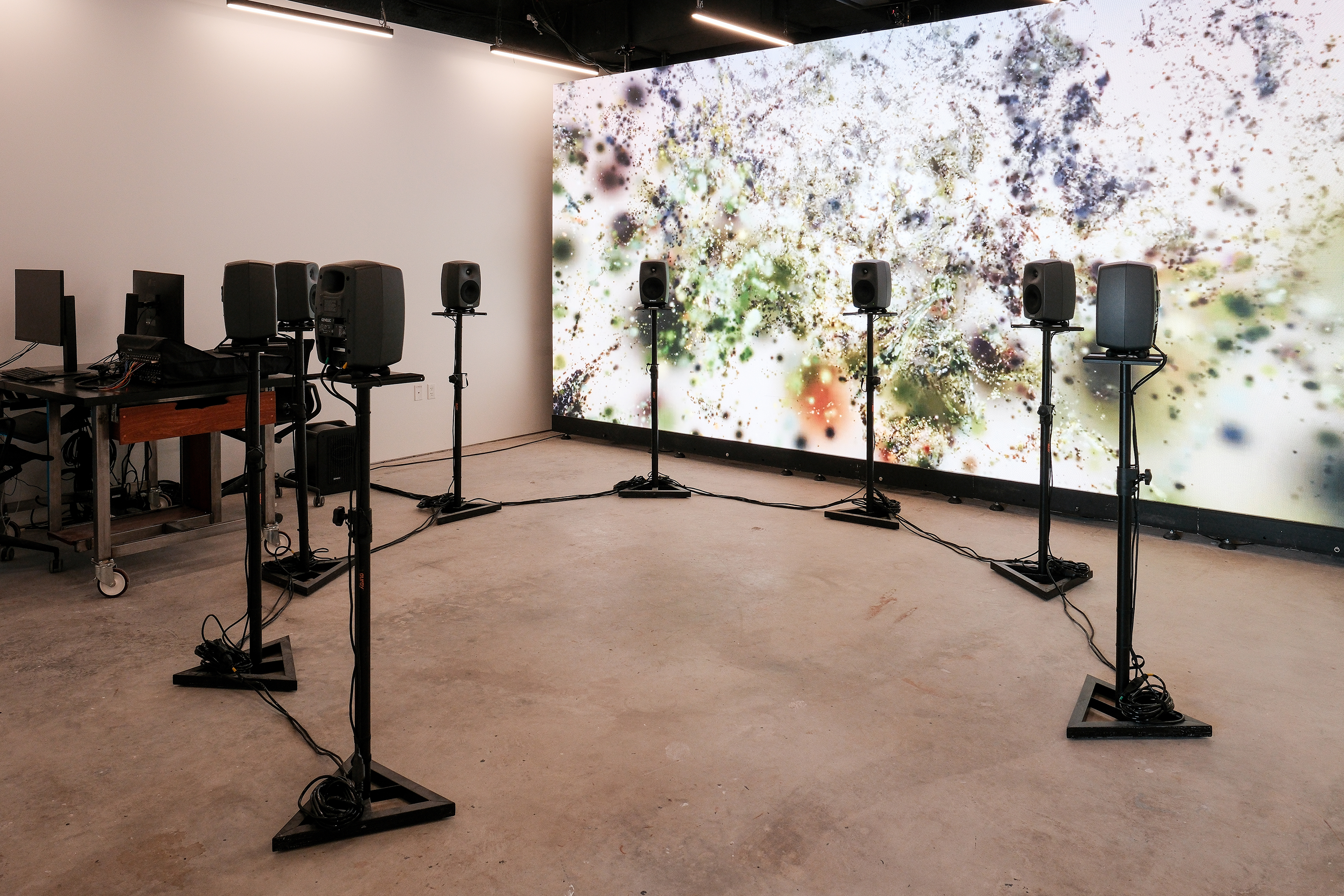
Alakaʻi 1777 is an immersive audiovisual installation that aims to make these extinctions tangible and audible (Figure 1). The protagonist, the Kauaʻi ʻōʻō, is a potent symbol of the nonhuman cultural extinction crisis. Its song was last heard in 1987, when biologist David Boynton recorded the song of a solitary male. That haunting recording is the last remnant of a once-vibrant acoustic tradition. The project’s title references this loss. 1777 marks the last time the Alakaʻi swamp, the bird’s ancestral habitat, remained untouched by European contact. This historical moment serves as a poignant reference point for imagining the bird’s cultural and ecological world before its decline, underscoring the devastating impact of colonization on both biodiversity and nonhuman cultural traditions. The project asks: can we use technology not just to record loss, but to cultivate memory and empathy?
Alakaʻi 1777 at the reopening of the New Museum in March 2026, with 8.1-channel audio and a 19′ × 10′ LED wall. Photographed by Russell Low.

At the heart of the installation is a novel, scientifically-grounded process designed to artistically reconstruct this lost sonic world:
-
1. The process begins with a mathematical model of the avian vocal organ (the syrinx) (Gardner et al. Reference Gardner, Cecchi, Magnasco, Laje and Mindlin2001), which is trained on the few surviving recordings. This model doesn’t just imitate the sounds; it learns the physical constraints of the ʻōʻō’s voice, allowing it to map out the full acoustic range the bird was physically capable of producing.
-
2. Using this physiological model, I generate thousands of novel, speculative sounds. Machine learning algorithms then cluster and categorize these sounds, identifying the foundational “syllable types” that likely formed the building blocks of the birds’ complex songs before their culture was eroded.
-
3. Finally, these syllables are assembled into full, complex songs using a model adapted from linguistics. These songs are then given to a flock of interacting artificial agents. Drawing on models from my scientific research, I’ve implemented social dynamics – call-and-response patterns, pitch and timing adaptation, etc. – to create an organic, lifelike soundscape. The result is a real-time, agent-based simulation where a virtual flock of Kauaʻi ʻōʻō can duet and interact, creating an emergent dawn chorus that is never the same twice.
These simulated Kauaʻi ʻōʻō are nestled within a digital twin of their native habitat, the Alakaʻi swamp in Kauaʻi, Hawaiʻi. The twin includes an ambisonic recording of the dawn chorus and an abstract 3D representation of the surrounding vegetation – both collected during field work in Kauaʻi early this year.
Outcomes and future perspectives
Alakaʻi 1777 has been shown in a variety of different contexts: museums, galleries, concert halls, planetariums, and public parks. Most recently, it was featured during the reopening weekend of the New Museum in New York City. Based on my interactions with audience members across these venues, it appears to be effective in creating a visceral, emotional connection to cultural extinction. As I continue to show Alakaʻi 1777 in the coming months, I plan on collecting survey data to assess its effectiveness more directly. Beyond the installation itself, the underlying pipeline – physiological modeling, speculative sound generation, and agent-based simulation – is designed to be generalizable, and I hope to apply it to other species facing extinction in the future. In a world saturated with abstract statistics and data about climate change and biodiversity loss, I believe that projects like Alakaʻi 1777 can foster the emotional engagement necessary to inspire conservation action.
Creative science reflection
In my experience, science is a deeply creative pursuit. The process of science – exploring others’ work to find new questions, designing methods to explore those questions, crafting ways to effectively convey findings – feels very much like the process of making art. Despite this unity, hybrid science-art practices remain fairly rare, in part because of structural barriers to combining the two. Alakaʻi 1777 is my attempt to dissolve that barrier in my own work. The installation doesn’t translate science into art or illustrate art with science – it treats them as a single practice. Published science can reveal important patterns, and compelling art can elicit deep emotions. Both matter, and I personally think they’re stronger together, particularly in the context of mission-driven work. My goal going forward is to keep developing work where the science and the art are genuinely inseparable – where the rigor of the research is what makes the experience powerful, and the emotional response of the audience is what makes the research matter.
Data availability statement
Data availability is not applicable to this article as no new data were created or analyzed in this study.
Author contributions
The author is solely responsible for all aspects of this work.
Financial support
This work was made possible by the Augustine Foundation, Cultural Evolution Society, Diverse Intelligences Summer Institute, Cornell’s Macaulay Library, and NEW INC.
Competing interests
The author has no conflicts of interest to declare for this publication.
Ethical standards
This research did not involve human or animal subjects requiring ethical approval.

 Open access

