Introduction
The National Health Service (Servizio Sanitario Nazionale, SSN) in Italy was established in 1978 to replace the earlier system of social health insurance. The SSN, which is financed mainly through general tax revenues, is committed to guaranteeing to all citizens a broad range of health services, provided on a free (or almost free) basis. During the last two decades, Italy, along with many other European countries, has been experiencing a progressive shift of jurisdiction in the health domain from centre to regions. Since the early 90s, regional governments have been granted broad discretion in planning and organising health care services in their own territory. The autonomy enjoyed today by Italian regions is such that it has led to the existence no longer of a single national health service, but rather of 20 different regional systems (Mapelli, Reference Mapelli2012). This engenders tensions between the more and the less-developed regions and worries the central government, which is committed to guaranteeing uniform levels of care over the entire national territory.
The article focuses on one of the most serious problems affecting Italy, namely the gap between the northern and southern regions. More specifically, the article’s purpose is to establish whether the gap between the health care systems of the regions of the North and of the South has decreased, increased, or remained unchanged during the 1999–2009 decade.
Three indicators are utilised in an attempt to answer this question: (1) the level of satisfaction expressed by the citizens towards their regional hospital system; (2) the mobility of the patients among regions; (3) the health care deficit accumulated by the individual regions. It is already possible to anticipate that, on the basis of these three indicators, there is evidence to state that the gap between the North and the South increased during the decade under study.
The work is organised as follows. To start, the second section provides a brief literature review: the concept of health care decentralisation is brought into focus, highlighting its possible advantages and disadvantages. The following section provides the background information required to put the Italian case into context: the history, regulatory framework and expectations that accompanied the process of health care regionalisation in Italy are briefly reconstructed. The differences between the health care systems of the northern and southern Italian regions are the subject of the fourth section. The fifth section addresses the methodological aspects concerning the indicators utilised (patient’s satisfaction, inter-regional mobility and health care deficit). The data are reported and analysed in the following section. The effects of regionalisation on the gap between the health care systems of the North and South are further discussed in the conclusions’ section.
Health care decentralisation: advantages and disadvantages
The Italian situation needs to be placed in the broader international context in order to be sharply defined. Starting in the 1970s, various European countries have transferred important responsibilities in the health care field from the central to the regional or local level (Saltman et al., Reference Saltman, Bankauskaite and Vrangbaek2007; Adolph et al., Reference Adolph, Greer and Fonseca2012; Costa-i-Font and Greer, Reference Costa-i-Font and Greer2012).
Health care decentralisation is indeed a controversial and slippery concept, which may refer to widely different processes (Rondinelli, Reference Rondinelli, Nellis and Cheema1983; Mills, Reference Mills1994; Levaggi and Smith, Reference Levaggi and Smith2005; Saltman and Bankauskaite, Reference Saltman and Bankauskaite2006; Peckham et al., Reference Peckham, Exworthy, Powell and Greener2008).
The first distinction to be made is between political and administrative decentralisation (Treisman, Reference Treisman2007). The first process concerns the transfer of competencies to democratically elected lower-level organs of government, whereas administrative decentralisation refers to decentralised organs appointed by the central government. As an example, in countries such as France and Portugal, important competencies in the health care sector are delegated to regional agencies whose heads are appointed by the central government. In northern countries, as well as in Spain and Great Britain, health care decentralisation has instead involved levels of government with their own electoral accountability (Costa-i-Font and Greer, Reference Costa-i-Font and Greer2012).
A second discriminating aspect regards the functions and autonomy of choice transferred to peripheral organs. As concerns the allocation of competencies among the different levels of government, the classification proposed by Adolph et al. (Reference Adolph, Greer and Fonseca2012) may prove useful. These authors indeed subdivide authority in health policy into five basic competencies: (1) framework legislation; (2) implementation legislation; (3) finance; (4) provision; (5) regulation. Depending on the country, these five functions may be diversely allocated at national, regional and local level.
Finally, a third distinction refers to the level of government involved in the transfer of competencies. In some countries, health care decentralisation has involved a transfer of responsibilities from central to regional level (as in the case of the autonomous communities in Spain); in other cases, health care competencies have been attributed to the local government (such as the municipalities in Finland).
Clearly, the concept of ‘health care decentralisation’ involves significantly diverse processes that differ in terms of ‘which’ competencies are transferred and ‘who’ is the recipient of such prerogatives. I should thus point out that the Italian health care system represents a case of political decentralisation. In particular, the last two decades have witnessed the strengthening of the regional level, whose organs of government are elected democratically, holding separate elections from national elections. Using the categories proposed by Adolph et al. (Reference Adolph, Greer and Fonseca2012), we can affirm that in Italy the national government has maintained its competency on ‘framework legislation’, whereas ‘implementation legislation’ has been entrusted to the regions (Helderman et al., Reference Helderman, Bevan and France2012). The latter enjoy great autonomy in organising the supply of services and regulating private suppliers, whereas strategic decisions on the financing of the system are partly the responsibility of the central government, and partly of the regions.
Different authors have attempted to bring into focus the possible advantages and disadvantages of decentralisation in the health care sector.
Supporters of health care decentralisation are convinced that it can deliver a variety of benefits. First and foremost, decentralisation should guarantee a better satisfaction of local demands (Oates, Reference Oates1999; Alesina and Spolaore, Reference Alesina and Spolaore2003); services can indeed be ‘tailored’ on the needs and wants of each single constituency (Oates, Reference Oates1972). Decentralisation also promises greater efficiency in providing services (DeVries, Reference DeVries2000; Saltman and Bankauskaite, Reference Saltman and Bankauskaite2006): proximity to the level of service provision will make it easier for decentralised governments to identify, and thus resolve any causes of inefficiency (Levaggi and Smith, Reference Levaggi and Smith2005). Decentralising is claimed to stimulate local innovation and policy experimentation (Mosca, Reference Mosca2006; Costa-i-Font and Greer, Reference Costa-i-Font and Greer2012), creating competition between the various local governments in order to attracts the citizens (Tiebout, Reference Tiebout1956; Levaggi and Smith, Reference Levaggi and Smith2005). Moreover, a decentralised set-up favours the accountability of office-holders, bringing the government ‘closer to the people’ (Treisman, Reference Treisman2007). Finally, a last benefit attributed to decentralisation is the greater responsibilisation of local governments and the consequent encouragement of fiscal discipline (Mosca, Reference Mosca2006; Costa-i-Font and Greer, Reference Costa-i-Font and Greer2012).
If the foregoing are the advantages linked with decentralisation processes, identifying a series of possible malfunctions is no hard task (Prud’homme, Reference Prud’homme1995; Treisman, Reference Treisman2007). According to its opponents, the main limitation of decentralisation lies in the fact that it tolerates disparities of treatment between constituencies. It is blamed to undermine the equity of the system (DeVries, Reference DeVries2000), allowing – and even favouring – territorial inequalities (Prud’homme, Reference Prud’homme1995; Saltman et al., Reference Saltman, Bankauskaite and Vrangbaek2007). Furthermore, decentralisation can easily generate tension between central and peripheral governments (Saltman and Bankauskaite, Reference Saltman and Bankauskaite2006). The different levels of government can attribute responsibility to one another with respect to inadequate financing or ineffective management of services: it is the typical ‘buck passing’ method, which may end up deresponsibilising local administrators both on a political and a financial level. Decentralisation processes may thus result in a less stringent fiscal discipline by local governments and a consequent rise in costs (Treisman, Reference Treisman2007). Finally, a decentralised management may operate less efficiently than a centralised system for another reason, that being the absence of economies of scale (Oates, Reference Oates1972; Alesina and Spolaore, Reference Alesina and Spolaore2003). It is interesting to note how, depending on the case, efficiency and fiscal discipline are used both as arguments in favour of and against decentralisation.
As stated by Treisman (Reference Treisman2007), each single devolution process is a ‘leap in the dark’: the effects are not predictable a priori, but need to be examined and appraised case by case. The positive or negative outcomes of a decentralisation process largely depend on how it is promoted on a practical basis, on the cultural and political context, on the competencies transferred, and on the administrative capabilities of the actors involved (Prud’homme, Reference Prud’homme1995; DeVries, Reference DeVries2000). The Italian experience thus gives the opportunity to test the diverse argumentations on decentralisation, with the aim of contributing to the debate with a practical case.
The regionalisation of health care in Italy
Italy is subdivided into 20 regions. The 1948 Constitution recognises to five of them (Friuli-Venezia Giulia, Sardegna, Sicilia, Trentino-Alto Adige and Valle d’Aosta) the status of ‘special statute region’. Compared with other regions, the five special statute regions receive larger financial transfers from the central government and enjoy a broader legislative autonomy.
Despite the previous legislation already provided for a decentralised management of the SSN, the process of health care regionalisation actually started with the coming into effect of the 1992–1993 reform. This reform granted broad discretion to the regions in planning, organising and financing health care services in their own territory. The individual regions have thus been able to choose among various organisation models, differing from each other in a variety of aspects: the size of the local health care authorities, the level of integration between local authorities and autonomous hospital facilities, the involvement of private providers (Fiorentini et al., Reference Fiorentini, Lippi Bruni and Ugolini2008; Mapelli, Reference Mapelli2012). The strengthening of the regional level was achieved by transferring powers from the national government and by subtracting the management of the local health care units from the municipal governments. This meant that the municipal administrations were relegated to a marginal role in terms of health care planning. The local health care units were transformed into public agencies, headed by a general manager appointed by the regional council. Before this, the directors of the local health care units were appointed by the municipal councils, on a mainly political basis. The idea was to place the management of the health care agencies in the hands of public managers who were to be responsible for the results achieved by their agency.
A further step forward in the process of regionalisation was represented by legislative decree no. 56 of 2000. The decree established that financing of the regional health care systems would no longer depend, as in the past, exclusively on transfers from the central government (Tediosi et al., Reference Tediosi, Gabriele and Longo2009). As from 2000, the regions can rely on a blend of their own resources and central government transfers (Mapelli, Reference Mapelli2012).
The process of regionalisation was further strengthened by a constitutional amendment passed in 2001. On the basis of this amendment, health care has become the object of concurrent legislation between State and regions: this means that the regions have large autonomy in organising and managing health care services on their own territory, whereas the State must confine itself to formulating the general rules of the system. The central government has jurisdiction for determining the ‘essential levels of care’ that must be guaranteed over the entire national territory. The national government must guarantee to the regions the financial resources required to provide the essential levels of care, transferring funds from the wealthier regions to the poorer ones. In the event that a region incurs an operating deficit, it must make it up with its own resources. This financing process was only partly modified by law no. 42 of 2009 on fiscal federalism. Starting from 2013, transfers to regions will be calculated on the basis of the so-called ‘standard costs’ (Mapelli, Reference Mapelli2012). In essence, the standard cost method provides for the identification of some benchmark regions, which stand out against others for their efficiency and adequacy in providing health services. The standard cost will correspond to the cost per capita borne by the said benchmark regions to guarantee the essential levels of care to their beneficiaries. The financial resources transferred by the central government to the single regions will be calculated on the basis of the said standard costs. The introduction of standard costs has the clear intent of driving the less efficient regions towards filling the gap that separates them from the benchmark regions.
After having followed its main phases, it is useful to dwell briefly on the factors that may have favoured the regionalisation process in Italy. The demands of the regional governments were certainly to play a critical role. The greater fiscal autonomy had been demanded especially by the economically more advanced regions, tired of having to shoulder the deficits of the less disciplined regions and depend on the central government to determine the health care budget (Tediosi et al., Reference Tediosi, Gabriele and Longo2009; Ferrario and Zanardi, Reference Ferrario and Zanardi2011).
The central government, on the other hand, saw devolution as a strategy to assign further responsibilities, especially financial, to the regional governments, burdening them with traditionally unpopular decisions like those inherent to the reorganisation of the hospital network (with the ensuing reduction in the number of beds and the closure of some hospitals) or the introduction of forms of cost-sharing by the patients (Tediosi et al., Reference Tediosi, Gabriele and Longo2009; Helderman et al., Reference Helderman, Bevan and France2012).
The thrust towards regionalisation was also based on the conviction that assigning most of the health care responsibilities to the regions would meet two objectives. First of all, the regions would be free to experiment with new organisational and management solutions and adopt those that best fitted their own needs and territories (Mosca, Reference Mosca2006). As a second objective, the devolution process was expected to trigger a blend of emulation and competition among Italian regions: in so doing, it was hoped to stimulate the more backward regions to close the gap with the more developed and efficient ones.
The differences between the health care systems of the North and South regions
The Italian regions have always been different in terms of size, geographical character, economic development, civic culture and institutional performance, with a sharp cleavage between the North and the South of the countryFootnote 1 (Putnam, Reference Putnam1993; Cotta and Verzichelli, Reference Cotta and Verzichelli2007; Pavolini and Vicarelli, Reference Pavolini and Vicarelli2012).
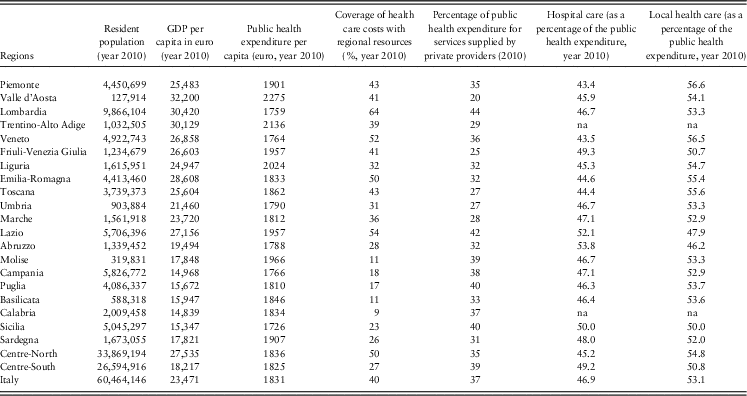
From an economic point of view, the northern regions are traditionally more developed than the southern ones, and, still today, have a higher per capita income: it exceeds 27,500 euro in the northern regions, while it is 18,200 euro in the southern regions (see Table 1). Such a disparity at the economic level is not reflected in the public health spending of the Italian regions. In fact, an equalisation fund at the central level aims at guaranteeing roughly the same resources per capita to all regions. During recent years, the health care budget has been allocated among the regions utilising a per capita share, partially adjusted on the basis of the age distribution of the population. With the exception of the special statute regions (which finance their health care services – at least in part – with resources from their own budget), the differences found among regions in terms of per capita health care spending (Table 1 fourth column) are therefore due to the differing demographics of the resident population. Because of the effects of the interregional equalisation transfer, the per capita public health care expenditure is 1836 euro in the North, compared with 1825 euro in the South: not a big difference. However, if we consider the differences in income levels, this means that the southern regions spend on average 10% of their GDP in health care, whereas the northern regions spend 6.7%.
It goes without saying that the more economically developed regions achieve a higher level of self-financing than the poorer regions (see Table 1, fifth column). On average, the regions in Northern Italy thus manage to cover 50% of health care costs with their own resources (the remaining 50% coming from central government transfers); conversely, the southern regions’ internal resources cover only 27% of their health care budget.
In the area of services offered, the regional health care systems differ among themselves with regard to the involvement of private sector providers. In fact, each region can freely decide whether to provide specific services directly or whether to purchase them from accredited private suppliers. The southern regions are more open to the private sector (see Table 1, sixth column): they outsource to private entities a volume of service corresponding to about 39% of the public regional health care spending. On the other hand, in the northern regions, the private sector receives <35% of the health care spending. Of the total of hospital beds, the private facilities accredited with the SSN provide 15% of the beds in the northern regions, and 24% in the southern ones (Ministero della Salute, 2011).
Looking at the strategies adopted by the various regional governments from the early 1990s to today, the main differences are seen in the hospital policies. The northern regions have undergone 20 years of radical changes, the principal being the progressive ‘de-hospitalisation’ of the health care system. This means that many services that were formerly provided in a hospital setting have been shifted to outpatient clinics. The number of hospital beds was greatly reduced as a result, and many hospitals were closed or transformed in long-term care facilities, rehabilitation centres and terminal patients hospices. These changes took place mostly in the northern regions. The reorganisation plans for the hospital network have been decidedly less bold and innovative in the southern regions (Tediosi et al., Reference Tediosi, Gabriele and Longo2009). A larger number of hospital facilities, often small, is therefore found in these regions: on average, there is one public hospital for 76,000 residents in the southern regions, whereas the ratio is one for 112,000 residents in the northern regions. Between 1999 and 2009, the northern regions have cut over 50,000 acute care hospital beds overall (−30%.) Over the same period, the southern regions have reduced their hospital offer by about 28,000 beds (−23%.) The differences are also significant in what concerns the number of beds in the health care facilities that complement the conventional hospital: the regions of the North have 0.7 non-acute care beds per 1000 residents; those of the South have 0.5 beds per 1000 residents (Ministero della Salute, 2011).
The number of hospital beds is a rather rough indicator of the health care services offered. A different indicator is more appropriate to assess the differing mix of hospital and local care: it is possible to establish, for each region, what percentage of the public health spending is devoted to hospital care and what percentage is instead devoted to local and preventive care. An inspection of the data (Table 1, last two columns) reveals that the northern regions spend more for local care (54.8% of the regional spending) than the southern regions do (50.8%). On the other hand, the southern regions allot a greater portion of their budget to hospital care (49.2% vs 45.2%).
The choice to adopt or not rigorous hospital reorganisation plans has caused a ripple effect. Most of the northern regions have achieved substantial operating savings thanks to the rationalisation plans: these regions have then had more resources available and have invested them in the territorial services, the modernisation of the facilities and the construction of new hospitals. On the contrary, most of the southern regions, having failed to rationalise the hospital network, have continued to register heavy operating deficits: consequently, they have fewer resources to invest in the modernisation of the facilities. The gap between the North and the South of the country in terms of health care facilities has therefore been increasing steadily.
Methods
To evaluate whether the gap between northern and southern Italian regions has increased or decreased over the last two decades, we shall refer to three indicators. The time period will be limited to the 1999–2009 decade, essentially due to the lack of uniform data for the years before 1999. Yet, there is another reason: as already anticipated, regional autonomy has been significantly enhanced both by legislative decree no. 56 of 2000, and by the 2001 constitutional reform: with 1999 as the starting year, it will be possible to assess the effects of the said significant reforms.
The first indicator under examination is the level of satisfaction expressed by patients with respect to hospital care provided in their region of residence. As the issue here is an inter-temporal comparison between 1999 and 2009, the results of the sample survey ‘Aspetti della vita quotidiana’ [‘Aspects of daily life’], conducted each year by the Italian Statistics Institute (Istat, 2010), will be utilised. This survey, based on a statistically representative sample of the resident population, measures, among other things, the degree of satisfaction with some public services.Footnote 2 Among the questions included in the survey, one addresses explicitly the citizens’ satisfaction with the hospital services. This question is addressed only to those who have experienced a hospital stay during the three months before the interview.Footnote 3 It is only fair to inform readers that the indicator used, focusing on the medical assistance received during hospital stays, looks at just one aspect of the overall quality of the services disbursed in every region.
The second indicator utilised concerns the mobility among regions. As several authors have argued, health care mobility can be considered an indicator of the perceived quality and responsiveness of the regional health care system (Messina et al., Reference Messina, Vigiani, Lispi and Nante2008; Glinos et al., Reference Glinos, Baeten, Helble and Maarse2010). If we exclude emergency admissions during business or travel, one presumably opts for medical treatment outside oneʼs region of residence essentially for two reasons: because one expects to receive a better service and/or because waiting times to obtain medical service are longer (France, Reference France1997; Messina et al., Reference Messina, Vigiani, Lispi and Nante2008). Moving from one region to the other, patients reveal which regional system they consider to be more effective: patients – as the saying goes – ‘vote with their feet’ (Tiebout, Reference Tiebout1956).
With the aim of operationalising the phenomenon of interregional health care mobility, I would propose to use the ‘synthetic mobility index’ (Pica and Villani, Reference Pica and Villani2010). This index is given by the ratio of the attraction index to the escape index: the attraction index is the percentage of non-residents hospitalised in a given region as compared with the total number of hospital admissions in regional hospitals; on the contrary, the escape index corresponds to the percentage of residents hospitalised in other regions as compared with the total number of residents in a given region who have been admitted to hospital during the year (both in and out of the region). The health care mobility index was calculated on the basis of the data of the ‘Annual report on hospital activity’ of the Italian Ministry of Health (Ministero della Salute, 2010). The data refer to ordinary hospitalisations for acute medical illnesses, and therefore exclude one-day hospitalisations and hospitalisations in rehabilitation or long-term care facilities.
The third indicator is the health care deficit accumulated by the various regions. As mentioned earlier, the national health care budget is allocated in such a way as to make available to the regional governments the resources required to provide the essential levels of care in their territory (independently of the taxing capacity of the individual regions). The results of the management of the health care budget can thus be considered as an indicator of the financial responsibility of the individual regional health care systems. The operating results of the regional health care systems are reported in the ‘General report of the country’s economic situation’, which the government tables each year in parliament (Ministero dell’Economia e delle Finanze, 2012).
Data
The level of patient satisfaction
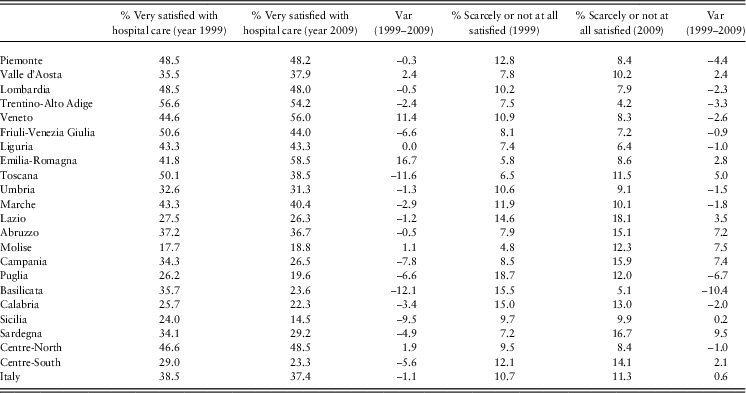
Table 2 reports – region by region, and for the years 1999 and 2009 – the percentage of respondents who indicated that they were ‘very satisfied’ with the medical assistance received in the hospital facilities in their region. The table also reports the percentage of respondents who were ‘scarcely or not at all satisfied’ with the assistance receivedFootnote 4.
It appears evident that both in 1999 and in 2009, the level of satisfaction expressed by the citizens of the northern regions is markedly higher than that reported in southern regions. The already wide gap registered in 1999 between the regions of Northern Italy and Southern Italy (46.6% vs 29%) increased even further during the 1999–2009 decade: while in the northern regions the level of satisfaction increased from 46.6% to 48.5% (+1.9%), the southern regions suffered a drop from 29% to 23.3% (−5.6%).
The trend is also confirmed by the percentage of respondents who affirmed to be ‘scarcely or not at all satisfied’ with hospital care. Over the decade at issue, the percentage of unsatisfied patients decreased in the Centre-North (from 9.5% to 8.4%), whereas it increased in the Centre-South (from 12.1% to 14.1%). From a general viewpoint, patients’ satisfaction has therefore grown in the North and dropped in the South, but it is important to point out that during the decade under examination not all northern regions registered an improvement.Footnote 5
Data regarding citizens’ satisfaction usually raise some scepticism, as the perception of the end users may be distorted. We cannot expect all citizens to be capable of exercising objective judgement on the intrinsic quality of the hospital care received. Depending on the region, patients could be more or less demanding, and this could result in different ratings for services that are substantially similar. Given the foregoing, it becomes opportune to complement the data on the ‘quality perceived’ by the end users with some more objective indicators of the outcome of the health services. One of the most widely used indicators for this purpose is infant mortality rate.
A look into the data unveils that, in 1999, the infant mortality rate in the regions of the Centre-North was equal to 4.0 (per 1000 live births). During the same year, in the Centre-South regions, the infant mortality rate reached 5.8, as compared with the mean national rate of 4.9. A decade later, the infant mortality rate dropped appreciably in both northern and southern regions. Nonetheless, there still exists a marked difference between North and South: in 2009, the infant mortality rate was 2.9 in the Centre-North and 4.1 in the Centre-South.
Besides the infant mortality indicator, other indicators that could be used to assess the outcomes of the single regional systems regard the so-called ‘appropriateness’ of health care treatmentsFootnote 6 (Lavis and Anderson, Reference Lavis and Anderson1996). An indicator of clinical appropriateness selected by the Italian Ministry of Health and also used at international level is the percentage of Caesarean sections. Despite the attention focused on the problem in the past, the percentage of Caesarean sections performed in Italy (calculated against the total number of births) continues to be very high. The average Italian rate is 38.4%. However, there are also considerable differences in this figure between the north and south of the country. In the northern regions, Caesarean sections account for 29.4% of all births, rising to 49.8% in the south (these figures refer to 2009). In recent years, the difference between the northern and southern regions has increased. In the decade between 1999 and 2009, the percentage of Caesarean sections rose by 13% in the Centre-North and by over 25% in the Centre-South.
Another indicator of appropriateness is the percentage of patients released from surgical wards with a medical DRG (and this is an indicator of organisational appropriateness, relating to the correct use of the beds on the surgical wards). In recent years, the value of this indicator has recorded a significant drop. At national level, the 43.4% recorded in 1999 had fallen to 34.2% by 2009. However, analysing the situation at regional level, we see a considerable variability. Higher values are found in the southern regions (40.8%), particularly in Calabria (where 51% of the patients released from surgical wards did not have surgery during their stay in hospital). Lower values are recorded in the northern regions (29.1%).
Interregional mobility
The phenomenon of interregional health care mobility has long attracted the interest of scholars of the Italian SSN (France, Reference France1997; Messina et al., Reference Messina, Vigiani, Lispi and Nante2008; Ferrario and Zanardi, Reference Ferrario and Zanardi2011). Before further discussion, we should indeed recall that in Italy, after having obtained a referral from their family doctor, patients can freely choose to obtain medical treatment – from public facilities or private ones accredited with the National Health Service – even outside their region of residence. To understand the import of this phenomenon, we should point out that in 2009, 168,000 patients residing in Southern Italy chose to be treated in the North. Only 31,000 did the opposite, choosing to be hospitalised in a southern region despite their northern residence (Ministero della Salute, 2010).
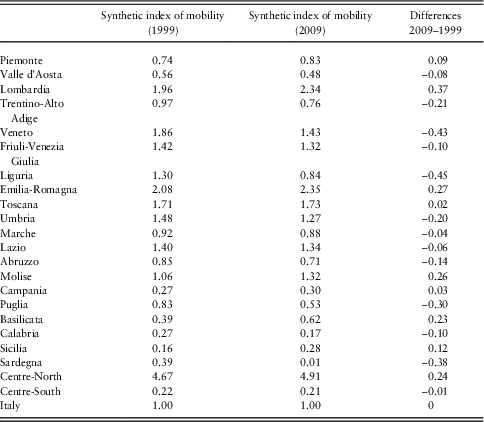
The synthetic mobility index referred to ordinary hospital admissions was calculated for each region. The values refer to the years 1999 and 2009, and are shown in Table 3.
Interregional health care mobility (years 1999, 2009)

Source: Ministero della Salute (various years).
To assess whether the balance of health care mobility between North and South has increased or decreased during the 1999–2009 decade, we should consider the third to last and second to last rows of Table 3: northern regions on the one side and southern regions on the other are considered like two macro-areas that exchange patients between them. We see that from 1999 to 2009 the mobility index increased for the regions in Northern Italy (from 4.67 to 4.91), whereas it slightly decreased for Southern Italian regions (from 0.22 to 0.21). This means that over the past decade, the flow of Southern residents who seek medical treatment in the North has further increased as compared with the flow of patients in the opposite directions (i.e. northern residents who get treatment in the South).
However, a high variability is found within the two macro-areas. In fact, it is noted that some southern regions (Molise and Basilicata) have improved their mobility balance. There are also some regions in the North, especially Veneto and Liguria whose balance has deteriorated over the decade. An inspection of the individual values of the escape and attraction indexes reveals that Molise and Basilicata have greatly increased their capacity to attract patients from outside the region; while an increase of the escape index caused the deterioration of the balance of Veneto and Liguria.
The deficit of regional health care systems
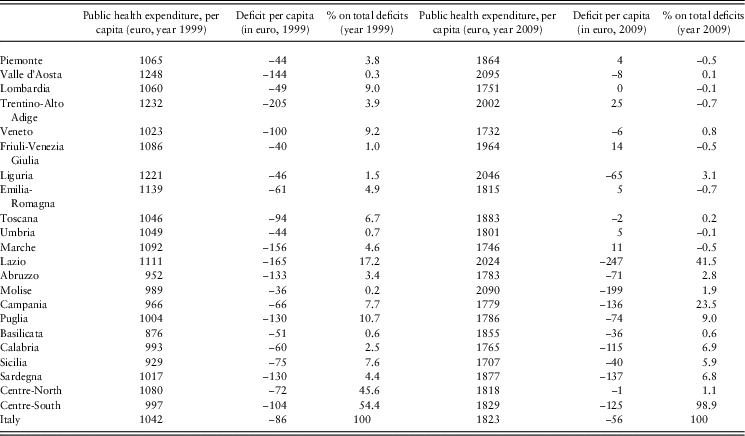
The data reported in Table 4 shows that regional governments have difficulty in staying within the budget allocated to them, and have generated repeated management losses over the last few years. We should bear in mind that, in absolute values, the deficit accrued in 2009 by all 20 regional health care systems was equal to 3260 million euro; in 1999 it totalled 4899 million euro. This means that over a period of 10 years many regional governments – but not all – have reduced their management deficit. This was made possible by acting both on a reduction of spending (cutting back on beds, closing small hospitals, reorganising local services, limiting the use of private suppliers) and on an increase of the region’s revenues (increasing the tax burden and/or introducing patient co-payments).
The health care deficits of the Italian regions (years 1999, 2009)
Source: Ministero dell’Economia e delle Finanze (various years).
In any event, regions in both the North and the South have contributed to the reduction of the overall deficit to a different extent.
From 1999 to 2009, the average per capita deficit dropped from €72 to €1 in northern regions. It was therefore reduced by 98.6%, almost achieving break-even.
Over the decade under study, all northern regions improved their economic accounts, with the sole exception of Liguria. The state of affairs in the Centre-South was quite the opposite. Many southern regions suffered an increase (even a substantial one) in their health care deficit: this was the case for Lazio, Molise, Campania, Calabria and Sardegna. We should add that all southern regions still register losses. Overall, in the Centre-South, instead of decreasing, the per capita deficit has increased further, going from €104 (in 1999) to €125 (in 2009).
The growing gap between North and South emerges even more clearly if we assess how each single region affects the overall deficit. If we consider the deficit accrued by all regional systems in the year 1999 on a percentage basis, Northern Italian regions were responsible for 45.6% of the total deficit, and Southern regions of the remaining 54.4%. Ten years later, northern regions account for only 1.1% of the total deficit, 98.9% of which is produced by southern regions. Also from this viewpoint, the gap between North and South appears to be on the increase. The reasons of this state of affairs are attributable, to a large extent, to the difficulties faced by two regions in particular, that is, Lazio and Campania, which alone are responsible for 65% of the total health care deficit.
Conclusions
This work has aimed at bringing into focus the main change that the Italian National Health Service has been undergoing over the past two decades, namely the gradual transfer of jurisdiction from the central government to the regions. The theoretical debate on the advantages and disadvantages of health care decentralisation processes has been reconstructed earlier: at this point, what lessons can we learn from the Italian experience? Given that each practical decentralisation experience involves a wide range of contingent aspects (DeVries, Reference DeVries2000; Treisman, Reference Treisman2007) that discourage venturing into generalisations, there is certainly something to be learned from the health care regionalisation process, which is currently ongoing in Italy.
Disparities among regions are due to the individual regional governments that are free to adopt strategies and organisation models differing from one other. The decentralisation process has taken place in a context, the Italian one, characterised by huge disparities between one region and the other in terms of economic conditions, culture, politics and efficiency of administrative bodies (Putnam, Reference Putnam1993). It was therefore to be expected that the single regional systems would have produced rather dissimilar strategies and outcomes. For example, the regions of the North have thus far been able to bring about a greater reduction of the acute care hospital bed availability, while enhancing the local care. By contrast, the regions of the south lag far behind on the path to de-hospitalisation.
In this work, we focused especially on the gap between the health care systems in the regions of the North and of the South. Those who hoped that regionalisation would lead the more backward regions to fill the gap separating them from the more efficient ones have been largely disappointed: as discussed in the preceding sections, from the year 1999 to 2009, the gap between northern and southern regions has not been filled, but has rather increased.
The residents of the northern regions generally pronounce themselves more satisfied than in the past with the hospital care received; by contrast, in the South, the level of satisfaction expressed by the patients decreased over the 1999–2009 decade in almost all regions. Over the same time span, the flow of patients from the South who seek medical treatment in the North has increased relative to the flow in the opposite direction. At the financial level, the northern regions (except Liguria) have balanced their budgets; the progress of the southern regions in this area has been more limited, and some of them continue to close their budget with a heavy deficit.
During recent years, the Italian government has adopted a strategy different from the past specifically in order to contain the health care deficit. On the basis of an agreement between the central government and the regions signed in 2006, the regions with serious deficits would have to arrange a ‘budget balance plan’ with the Ministry of Health and with that of Economy. These regions are kept under close scrutiny and, if they do not respect the budget balance plans arranged with the government, they are compelled to increase the taxation level in their territory and also risk being placed under trustee administration (this measure has already been adopted towards five regions). A few years are still required to assess whether this strategy of enhanced financial rigour adopted by the national government will bear fruits. Thus far, the constraint of the budget balance plan has yielded encouraging results in some regions (such as Sicilia, Abruzzo and Campania), but it does not appear to have worked in others (Lazio, Liguria, Molise).
There is also the concern that the strategy of the balanced budget plan is limited to the financial aspect. However, as discussed, the North–South gap concerns also the quality of the services provided. In other words, additional measures, besides the budget constraints, will be required to bridge the gap between the North and the South.
Acknowledgments
The author wishes to thank the anonymous reviewers for their helpful comments.