Introduction
Rice is the staple food of half of the world's population and people of several Asian countries fully depend on rice for their daily calorie intake. The introduction of high-yielding semi-dwarf varieties has heralded the green revolution. But, with yield levels stagnating, exploitation of hybrid vigour is considered to be a viable option to break the yield barrier in rice and the potential of hybrid rice was successfully demonstrated in China. But, the spread of hybrid rice in other Asian countries is low as indica hybrids could show only ~15–20% yield advantage over inbreds, mainly due to the narrow genetic diversity present in indica source material (Hossain et al., Reference Hossain, Singh and Zaman2010) while hybrids from indica/japonica parents were reported to show ~30–40% yield advantage over indica/indica hybrids (Yuan, Reference Yuan and Virmani1994).
Cytoplasmic male sterility (CMS), a maternally inherited trait, which causes the production of non-functional pollen, is the key component of the three line hybrid rice programme (Kaul, Reference Kaul1988) and the wild-abortive (WA), is the most extensively used CMS type in hybrid rice (Yuan, Reference Yuan1977; Lin and Yuan, Reference Lin, Yuan, Argosino, Durvasula and Smith1980). The WA type has been extensively investigated and investigations suggest that two nuclear genes, Rf3 and Rf4, can restore fertility of the WA type (Zhang et al., Reference Zhang, Bharaj, Lu, Virmani and Huang1997, Reference Zhang, Liu and Mei2002; Tan and Trangoonrang, Reference Tan and Trangoonrang1998; Kazama and Toriyama, Reference Kazama and Toriyama2014; Tang et al., Reference Tang, Luo, Zhou, Zhang, Tian, Zheng, Chen and Liu2014).
Searching for restorer genes/novel alleles of the restorer genes in native landraces, the major source of genetic diversity (Brar and Khush, Reference Brar, Khush, Nanda and Sharma2003; Sun et al., Reference Sun, Wang-Pruski, Mayich and De Jong2003), is ideal as many desirable alleles may still be floating in the native land races which can be exploited (Tanksley and McCouch, Reference Tanksley and McCouch1997) further. As heterosis is known to be more in crosses from diverse materials, native land races from different geographic regions could be the ideal base materials. In addition, the wild forms, Oryza rufipogon, a perennial and Oryza nivara, an annual, the progenitors of cultivated rice (Oryza sativa L.) (Oka and Chang, Reference Oka and Chang1962; Sampath, Reference Sampath1962; Sharma and Shastry, Reference Sharma and Shastry1965; Wang et al., Reference Wang, Second and Tanksley1992), are known to be gene reservoirs in rice. As gene flow is common between the cultivated and wild forms without any genetic barriers, a continuous array of intergrades were recorded and were considered to be the bridge between wild and cultivated forms (Oka and Chang, Reference Oka and Chang1962). The variation reported in indica rice across a wide geographical area might be the result of free gene flow or can be due to the large number of seed dispersal routes on land to highly diverse geographic locations. Studies on the presence of the Rf genes in native populations at different geographic locations can provide us the evolutionary trends at different locations and also can help us to understand the origin and evolution of Rf genes. The present study reports the distribution of Rf genes in native land race accessions collected from two distinct geographic regions of India and collections of wild relatives of rice and molecular markers were employed for the study.
Materials and methods
The rice accessions used in the study are 184 collections from Assam, a geographic location in North Eastern India, reported to be associated with the primary centre of origin of rice (Richharia and Govindaswami, Reference Richharia and Govindaswami1990) and 236 collections from Jeypore–Koraput tract of Eastern India, a region recognized as the secondary centre of origin of rice (Ramiah and Ghose, Reference Ramiah and Ghose1951; Ramiah and Rao, Reference Ramiah and Rao1953). One hundred and sixty-three accessions of O. rufipogon and 157 accessions of O. nivara, collected for different geographic locations in India were also included in the study (online Supplementary Table 1).
Total genomic DNA was extracted from fresh young leaves employing the cetyl trimethyn ammonium bromide method (Doyle and Doyle, Reference Doyle and Doyle1987) and PCR assays were carried out using the markers that are closely linked with Rf3 (RM10305- Balaji et al., Reference Balaji, Srikanth, Hemanth, Subhakara, Vemireddy, Dharika, Sundaram, Ramesha, Sambasiva Rao, Viraktamath and Neeraja2012) and Rf4 (RM6100- Singh et al., Reference Singh, Mahapatra, Prabhu, Singh, Zaman, Mishra, Nandakumar, Joseph, Gopalakrishnan, Aparajita, Tyagi, Prakash, Sharma, Shab and Singh2005) genes. The primer sequences employed are: RM10305- F: (5′-CAGGAACCAACCTTCTTCTTGACC-3′), R: (5′-GTCAGACTCCGATCTGGGATGG-3′) RM6100-F: (5′-TCCTCTACCAGTACCGCACC-3′), R: (5′- GCTGGATCACAGAT CATTGC -3′).
The PCR mix consists of 1 unit of Taq DNA polymerase, 5 pmol of each primer, 10× PCR buffer with 20 mM MgCl2, 2.5 mM dNTPs in a final volume of 10 µl. The PCR reactions were performed using the same profile for both the markers (initial denaturation at 94°C for 4 min, followed by 94°C for 30 s; 55°C for 45 s and 72°C for 1 min for 35 cycles with a final extension of 7 min at 72°C) on a thermal cycler (PTC-200 Thermo cycler; Bio-Rad, Germany). The amplified products were fractionated on 3% agarose gels at 75 V for 1.5 h and stained with ethidium bromide and the gel images were recorded with Multi Image system (Alpha Innotech, USA).
Results
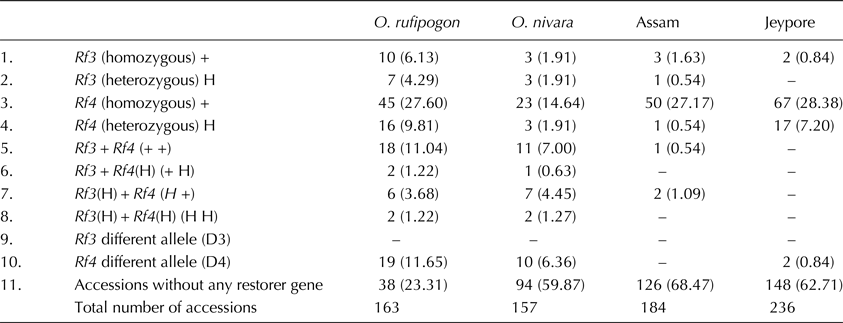
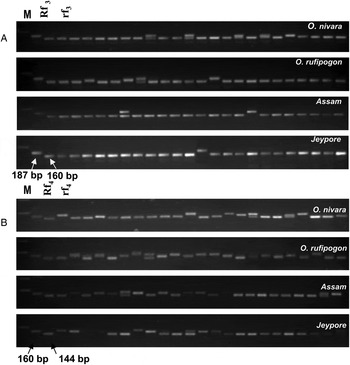
The results suggest that in O. rufipogon, the wild progenitor, majority (76.69%) of the accessions possess at least one of the fertility restorer genes while the value in the accessions of O. nivara is 59.87% (Table 1, Fig. 1). In the accessions of Assam and Jeypore, the presence of these genes was around 30–35% of the accessions suggesting their presence is low in the cultivated rice.
Distribution of fertility restoration genes in different populations

Figures in parenthesis indicate the frequency (%) in the population.
PCR analysis for identification of fertility restoration genes in different populations. A – for Rf3 gene. B – for Rf4 gene. M – Mol. Wt. Marker; Rf 3 – IR42266-29-3R; rf 3 – CRMS 31B; Rf 4 – IR42266-29-3R; rf 4 – CRMS 31B.

Of the two genes assayed, the occurrence of Rf4 was significantly higher than Rf3 in all the populations and the presence of Rf3 is very low in both Assam (3.8%) and Jeypore (0.85%) collections. The frequencies of Rf4 (single gene) were 57.55, 49.06, 87.93 and 97.67(%), while the values for Rf3 were 16.04, 11.32, 6.9 and 2.33 in O. rufipogon, O. nivara, Assam and Jeypore collections, respectively. While in most of the accessions, the genes are in homozygous state accessions with these two genes in a heterozygous state was also higher in the wild forms (17.19%) compared with cultivated forms (4.52%).
In the cultivated forms, the presence of both the genes in the same accession was very low. The frequency was 1.09% in Assam collections while none of the accessions collected from Jeypore contain both the genes in the same accession. In the wild relatives, the frequency of accessions having both the genes was 17.18 and 13.38(%) respectively for O. rufipogon and O. nivara.
The presence of a different kind of allele (the alleles having a different size than the expected sizes with the markers used) was observed only for the Rf4 gene and in cultivated forms, such alleles are also very low frequency with only two alleles of a different size being recorded in the Jeypore collections. In the wild relatives, the frequency of a different allele was 11.65 and 6.36% of the accessions of O. rufipogon and O. nivara, respectively.
Discussion
The results suggest that the Rf genes were well distributed in the wild relatives while their distribution was low in the cultivated species thus supporting the view of Wang et al. (Reference Wang, Second and Tanksley1992), who suggested that greater part of genetic variation in the genus Oryza remained intact in the wild relatives. Of the two wild relatives, the high frequency observed for both Rf genes in O. rufipogon suggest that the genetic wealth is intact in this wild progenitor, where out pollination rates are higher. The presence of new alleles in O. rufipogon suggest that this wild progenitor is a reservoir of allelic diversity that remained intact even in the absence of any selection pressure. It is also interesting to observe that the genes in heterozygous state are present in higher frequency in the wild forms (O. rufipogon – 22.08%; O. nivara – 12.1%) while in cultivated forms, the frequency of heterozygote's was very low, an observation that is in general agreement with previous studies on out-crossing rates (Morishima et al., Reference Morishima, Sano and Oka1984; Barbier, Reference Barbier1989) of the species and might be related to their survival in the ever-changing environments. The low level of heterozygosity in the cultivated forms might be the result of self-fertilization and though selection was not practiced in the land races, the loss of these genes can be attributed to the self-pollination mechanisms evolved in the cultivated rice and non-requirement of an pollination mechanism in a self-pollinated crop.
One of the interesting observations of the study was the wide dissimilarity for the presence of two genes at the two centres of diversity. In both, though Rf4 is more predominant, its proportion in the population varied. In Assam collections, the proportion of was around 85% while it was 97% in Jeypore collections. While the occurrence of both genes in the same accession was not observed in the Jeypore accessions, their combined presence was recorded in very few accessions of Assam, known to be the primary centre of origin of rice.
For the WA system, the effect of Rf4 appeared to be slightly larger than that of Rf3 (Jian and Zhang, Reference Jian and Zhang2012; Jian et al., Reference Jian, Liao, Dai, Zhu, Zeng, Zhang and Zhang2013) while the strong dominant gene Rf3 alone could restore the fertility of WA type (Hossain et al., Reference Hossain, Singh and Zaman2010). From the reports, it can be assumed that different alleles of these genes show varying degrees of restoration depending upon the genotypes employed. Jian et al. (Reference Jian, Liao, Dai, Zhu, Zeng, Zhang and Zhang2013) had demonstrated varying levels of fertility restoration of WA type in rice by different Rf alleles (for Rf3 and Rf4) from different genotypes using SSSLs (single segment substitution lines) suggesting the utility of the alleles from different genetic backgrounds in the improvement of hybrid rice. In this context, the new alleles observed for Rf4 might be invaluable and though no new alleles were found for Rf3, the utility of the alleles available in the population can be examined further for their utility.
The modern varieties are likely to share a higher proportion of alleles with landraces than with wild relatives as most of the elite cultivars are the result of either through selection or hybridization of landraces. Use of new alleles from the wild germplasm may show better response than from the crosses involving landraces as the wild species, with an out pollination mechanism, could possess many favourable characters which can be exploited fully through further studies. As crossing barriers do not exist between O. rufipogon, O. nivara and O. sativa, the utilization of the Rf genes from the wild relatives is feasible and improvement of cultivated rice through introgression of valuable genes from wild germplasm was well documented. In addition, if the genes are introgressed from genetically divergent, low-performing wild or weedy donors, the alleles of interest are likely to be associated with positive transgressive variation in elite genetic backgrounds and can help in development of superior hybrid rice cultivars. Some of these land races that possess japonica traits can help in development of hybrids with better performance. The new alleles found in these populations will be great interest for hybrid rice breeding programmes in generation of new parental lines and hybrids.
The utilization of such a diverse gene pool that can provide a wide array of genotypes with Rf genes can save the breeders a lot of time as breeding for restorers is one of major activities of the hybrid rice programme. A systematic assessment of the expression levels of the Rf alleles in the promising accessions is an essential first step for identification of potential donors. It can be followed by sequencing and analysis to detect the functional aspects of the variation, if any, which can provide additional inputs for the development of superior hybrids. These accessions can also be the ideal experimental material for studies to understand the adaptation mechanisms to different stresses.
Supplementary material
The supplementary material for this article can be found at https://doi.org/10.1017/S1479262117000090.
Acknowledgements
The authors are thankful to Director, National Rice Research Institute, Cuttack for providing all the necessary facilities and encouragement.