INTRODUCTION
Both ‘science for policy’ and more scholarly academic endeavours are increasingly pursuing interdisciplinary research. Scientific synthesis efforts such as the Intergovernmental Panel on Climate Change and the Millennium Ecosystem Assessment, and academic programmes, centres and institutes that are subject or problem based, are purposefully drawing together scholars and resources from a wide range of disciplinary backgrounds to address key areas at the frontier of inquiry and pressing problems in the real world. Interdisciplinary research offers the exciting promise of conceptual and practical advances resulting from the synergy of different perspectives and contributions.
However, in practice, interdisciplinary collaborations can be stifled by communication or conceptual difficulties that can result in mistaking different research approaches and competencies for faulty or unintelligible scholarship. Our purpose is to propose a conceptual framework that will facilitate more effective communication among scholars and assist in the selection, design, implementation and evaluation of rigorous interdisciplinary research projects and programmes.
We define interdisciplinary research to mean work that achieves a significant transformation of knowledge through the integration of ideas or tools typically used by two or more traditional research programmes or projects. There is a continuum of combinations of crossing and combining ideas and tools. For our purposes, cross-disciplinary research involves the application of ideas of one research programme to the traditional content of another research programme. Multi-disciplinary research entails using ideas from more than one research programme side-by-side to shed light on a common subject, question or problem, but with little integration. The notion of transdisciplinary research has emerged more recently, often either denoting a complete denial of extant disciplinary norms, or the full integration of two or more disciplines into a new one (Nicolescu Reference Nicolescu2008). Here we focus on interdisciplinary research, which involves a greater integration of both ideas and tools than cross- or multi-disciplinary work, but less so than transdisciplinarity.
It may be assumed that interdisciplinary scholarship requires that research be conducted across two or more disciplines. We believe disciplines are often historical artefacts that may be institutionally organized as departments, educational or training programmes, and academic professions. As a result of their institutionalization, and often bureaucratization, disciplines are more often and more likely to be driven by logics other than the generation and communication of knowledge. The vast literature in science studies offers ample evidence of these different and often perverse logics of disciplines (Biagioli Reference Biagioli1999).
Moreover, most disciplines understood in this way involve multiple research programmes as defined below. For these and numerous other reasons, we propose that research programmes, which may or may not be discipline based, are the appropriate building blocks for interdisciplinary research. Drawing on and extending the heuristic framework of Lakatos (Reference Lakatos, Lakatos and Musgrave1970), we propose that interdisciplinary scholarship consists of integration across knowledge structures in the form of research programmes, with research projects as their operational units.
Research projects may be interdisciplinary, but typically they address a specific question or set of questions, in a discrete manner such as in a paper or dissertation, and tend to be firmly temporally bounded. Research projects may be carried out by one or more researchers, and involve an iterative process between research design, inquiry, analysis and output. The iterative processes of research projects are informed by and fed back into a larger research programme.
Research programmes are the larger conceptual and methodological frameworks into which many individual research projects can fit, and generally persist for more extended periods of time than projects (though they need not become institutionalized into disciplines). A research programme is a more or less explicitly ongoing, community-wide engagement with a set of questions, ideas and tools by scholars committed to working with one another. Examples of research programmes are quantum mechanics, evolutionary biology, sociological institutionalism and post-colonialism.
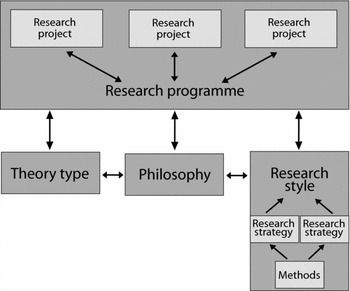
We specifically define a research programme as a self-identified community of scholars who share research questions or problems and are working on an interlinked set of research projects. Furthermore, members of a research programme share a set of understandings about three elements: an overarching understanding of theory types, or the conceptual structures into which knowledge should be assembled; an underlying philosophy or philosophies of knowledge and its attendant assumptions about the nature of the focus of study and what constitutes valid knowledge; and a predominant research style or styles that frames and guides inquiry and analysis (Fig. 1). We suggest that these three elements comprise the crucial ‘hard core’ of a knowledge-generating research programme, again extending and operationalizing Lakatos (Reference Lakatos, Lakatos and Musgrave1970).
Schematic diagram to represent the proposed relationship between knowledge-based structures (research programmes and projects) and the three conceptual elements that comprise research programmes: theory type, philosophy and style. A research programme may consist of many discrete projects addressing specific questions, while the overall research programme represents a broader conceptual and methodological framework shared by scholars in the programme. Members of a research programme share a set of understandings about theory type (the ways in which knowledge generated by the research programme is organized), philosophy or philosophies of knowledge (describing the nature and validity of the knowledge the programme seeks to generate), and research style or styles. The research style guides the practical gathering and organization of knowledge generated by the research programme, and may consist of one or a hierarchy of research strategies. Individual methods are not inherent to any one strategy or style, and may be used across multiple strategies.

The three elements comprising research programmes may not be explicitly articulated in professional training or practice, yet they are essential building blocks for knowledge generation. Thus, we aim to describe some of these critical but less visible aspects of knowledge production, so they may be better understood, examined and debated, to catalyse and improve interdisciplinary research. A research programme can have a combination of theory types, philosophies and research styles; it is the making of these explicit and the conscious attempts to integrate them by a community of scholars that is critical to interdisciplinary research programmes.
We propose that by reflecting on their own research projects and involvement in research programmes, and especially considering how theory types, philosophies and research styles are understood and practised, scholars can better understand their own assumptions and approaches, and those of other scholars. As researchers evaluate their own assumptions, we anticipate that perceived misunderstandings and conflicts arising from crossing boundaries of research programmes, and their attendant theory types, philosophies and research styles, will become respected differences offering the constructive foundations for reflection and opportunity for new interdisciplinary intellectual directions. We describe these three elements of research programmes, and provide examples applying this framework to the research programmes of sustainability science, and environment and security.
THEORIES OF KNOWLEDGE
The primary goal of research is the generation and communication of knowledge. While scholars may generate different kinds of knowledge about different kinds of phenomena for different purposes, all research shares an implicit, if not explicit, effort to use and produce theory to organize this knowledge. In contrast to the colloquial use of the word ‘theory’ to describe a prediction or explanation for phenomenon, we mean theory in the sense of the generalizations that specialists develop to make sense or use of complex data (Glaser & Strauss Reference Glaser and Strauss1967), a body of systematically related hypotheses (Hempel Reference Hempel1965), or a way of perceiving facts (Friedman Reference Friedman1953). We consider a theory to be an organized collection of conceptual assumptions and propositions, which serves as a system to logically connect abstract ideas that are applied across or within contexts. Because theory is so central to knowledge generation, scholars often most easily recognize their or their discipline's notion of theory and theorizing.
We propose three major ideal-types of theory: those focused on prediction, understanding and explanation. These classes of theory are meant as starting points for reflection and dialogue and are by no means exhaustive. Research programmes might also share combinations. We describe each theory type below using one well-known example of authors who have written explicitly about them, which is meant to serve as an example rather than a final definition of the theory type.
Predictive theory
Predictive theory, as championed by Milton Friedman (Reference Friedman1953), aims to provide an internally consistent logic of the relationships between data, in the form of laws to the extent possible, which yield ‘valid and meaningful predictions about phenomena not yet observed’ (Friedman Reference Friedman1953). Such theories often operate in a reductionist fashion; they distil complexity into a few crucial elements, and emphasize the individual components in a system rather than their synergies or interactions. Generalizations may be made across cases using the laws derived from predictive theories.
Friedman (Reference Friedman1953) proposed two criteria for judging the value of a theory: simplicity and fruitfulness. Simplicity prioritizes theories that involve fewer rather than more laws, and their underlying assumptions, to predict outcomes. A theory is more fruitful when it produces a more precise prediction, can yield predictions within a wider area, and suggests additional lines of further research. Friedman also states that ‘theory has no substantive content; it is a set of tautologies. Its function is to serve as a filing system for organizing empirical material and facilitating our understanding of it’ (Friedman Reference Friedman1953). Thus, mathematical models are particularly useful forms to assemble predictive theories.
Understanding theory
In contrast to theories that prioritize prediction, Clifford Geertz promoted a type of theory that aims to generate rich meaningful understandings within and of a particular context. While Geertz (Reference Geertz1973) also considered theory a systematic way to organize ideas, he proposed that defining social concepts contextually was inherently problematic. The function of theory, according to Geertz (Reference Geertz1973), is thus explication or understanding, to generalize within cases like the clinical inference of medicine and depth psychology. This amounts to creating a common vocabulary of concepts, arranged in a hierarchy of meaning and relation, to produce contextual situation-embedded understandings.
The form that theory as understanding takes is often ‘thick description’, an analytically detailed, context-specific narrative. Theoretical formulations and their applications are closely linked in this view, although theory applied to one particular context can offer guidance for theorizing in another setting, if they are applied critically and revised creatively to the context and inquiry at hand.
Explanatory theory
Finally, explanatory theory is exemplified by the grounded theory notions of Glaser and Strauss (Reference Glaser and Strauss1967). It is primarily focused neither on top-down simple predictive models nor bottom-up rich understandings of meanings; rather, it aims to construct mid-level conceptual categories and uncover interlinked causal mechanisms. Such theories are judged by their usefulness, which implies explanation through causal pathways and relationships. While other types of theory also entail causal explanations, grounded theorists see the elaboration of these mechanisms as crucial in and of themselves, even if they do not necessarily generate more simple predictive models or more rich meaningful understandings.
Grounded theories may be developed through an initial, systematic discovery of the theory in the form of linked conceptual categories and causal explanations from the data generated by inductive research. The integration of concepts and causal explanations into more coherent theories is interactively applied and refined based either on the initial data, additionally collected data, or both (Glaser & Strauss Reference Glaser and Strauss1967). Such theories aim to generalize both within and across cases, and commonly take the form of conceptual models.
Theory development involves a process of defining concepts and investigating relations between them that shed light on empirical reality. Thus, a theory, in simplest form, is an ordered collection of definitions and relationships. But there might be a trade-off between breadth and scope on the one hand versus depth and specificity on the other. For some, theoretical ideas and concepts are in danger of being made useless if they are ‘stretched’ further than it makes sense to do so; for others, conceptual stretching is the hallmark of generalizability.
Predictive theory types tend to be associated with research styles that prioritize experimental and statistical research strategies, understanding theory has tended to be linked with research styles that use ethnographic and single case-based research strategies, and explanatory types of theory have tended to rely most heavily on comparative-case and statistical research strategies. But all theory types allow for the use of multiple research strategies, albeit ordered in different hierarchies of usefulness and with different views on what type of knowledge they generate. This offers much room for creative mixing and matching in the construction of interdisciplinary research programmes.
PHILOSOPHIES OF KNOWLEDGE
While theories seek to organize knowledge into coherent conceptual frameworks, the underlying philosophy of knowledge more fundamentally defines the nature of the phenomena being considered (epistemology), as well as what constitutes valid knowledge about these phenomena (ontology). Because these philosophies deeply condition research norms and practices, they are often not explicitly considered, and can be the source of much misunderstanding in interdisciplinary research. While there is a continuum of philosophies of knowledge with many areas of overlap and ambiguity, we summarize several key assumptions and propositions of three major meta-philosophies: positivism, interpretivism and constructivism.
Positivism
In the positivist tradition, an actual external material reality exists independently of human perception, and is governed by law-like systems. This external reality can be objectively observed through direct or assisted (as with a microscope) sensory perception, and such observation is the only legitimate manner to collect information. Positivists believe that true objective knowledge that validly corresponds to this independent reality can be formulated as universal laws or law-like predictive theories. The disciplines of Newtonian physics and neoclassical economics tend to follow a positivist philosophy of knowledge.
There is a long-standing debate between corroboration and falsification philosophies of positivism. The initial empirical positivist tradition used inductive logic to determine laws. Hume (Reference Hume, Green and Grose1964) pointed out the contradiction that all knowledge is derived from experience while universal propositions (including scientific laws) are only verifiable by reference to experience. This formed the basis for post-positivism, where falsification, not confirmation, of deductively generated hypotheses is the only valid form of knowledge understood as objective true laws (Popper Reference Popper, Curd and Cover1963). Oreskes et al. (Reference Oreskes, Shrader-Frechette and Belitz1994) provided more recent support for the argument that theoretical propositions can never be conclusively verified. In post-positivism, a good theory can be refuted by a single event or piece of data, and the discovery of one genuine counter-example can falsify the entire theory, but the lack of such a counter-example is not verification of the theory. Kuhn (Reference Kuhn1962, Reference Kuhn, Lakatos and Musgrave1970) agreed with Popper's falsification view for periods of ‘normal science’ under one dominant paradigm, but believed that more exceptional periods of scientific progress involving ‘paradigm conversion’ are more like religious conversions, which do not and cannot follow deductive falsification.
An experimental strategy is often preferred by positivists, as experiments can offer critical tests of a hypothesis or theory (naïve falsification) or adjudication between competing research programmes (sophisticated falsification). Statistical and triangulation strategies are also often used by positivists, particularly when experiments cannot be reliably conducted or to further test theories. Corresponding research methods may include quasi-experiments, multiple regression, simulations and sensitivity analyses that are mathematical forms of counterfactuals, among others. Narrative or mathematical counterfactuals are particularly useful when little observed data is available.
Interpretivism
Interpretivists aim to uncover the contextual meaning of the social world (Dallmayr & McCarthy Reference Dallmayr and McCarthy1977), where knowledge is gained from interpretation of layer upon layer of meaning in context (Rabinow & Sullivan Reference Rabinow, Sullivan, Rabinow and Sullivan1987). A primary goal of interpretivist research is to understand the subjective views of individual actors, and the inter-subjective shared views of communities of actors. Many interdisciplinary research programmes, such as cultural studies, draw from the interpretivist tradition.
The setting for interpretivist research is important. Interpretivists believe that social phenomena cannot be understood in a controlled environment, because researchers are constantly interpreting layer upon layer of meanings (an act sometimes called the ‘hermeneutic circle’). The research strategy of ethnography is often primary within the interpretivist tradition, because it allows the lived experience of people in natural settings to be examined, deciphered and explicated. Intensive enmeshment through fieldwork in a context is critical to understanding the subjective and intersubjective meanings that constitute and shape reality.
A prominent version of interpretivism is subsumed under the rubric of ‘critical theory’ or what we call ‘critical philosophy’. This philosophy of knowledge can be understood in a three-step framework: problematization, contestation and destabilization. A widely accepted category, understanding or ‘myth’ is approached as a research puzzle in and of itself; in other words, a norm of thought or practice is turned into a ‘problem’ or analytical puzzle. Critical theory examines how the construct was produced and its corresponding impacts and influences on cultural and intellectual frameworks and, more broadly, social and natural phenomena. The goal is not necessarily to generate objective truths, but to revisit and critique existing interpretations, often to conceptually emancipate people or ideas that are oppressed or manipulated. Fields with strong critical philosophy components include feminism, post-colonial studies and queer theory.
Constructivism
Constructivism seeks to explain and understand how reality is constructed through social and natural processes. Knowledge reflects reality to different degrees, but is at least partly contingent upon convention, perception and social experience. In an early constructivist text, Weber (Reference Weber, Shils and Finch1949) described reality as causal relationships that are culturally significant in particular historical contexts, and stated that identifying and tracing as far back as possible the causal genesis of significant historical processes and events were critical tasks for scholars. Today this constructivist philosophy of knowledge is exemplified in the interdisciplinary research programme of science and technology studies.
While there is no accepted taxonomy of constructivism, Demeritt (Reference Demeritt, Braun and Castree1998, Reference Demeritt2002) offered one classification. At one pole is ‘common-sense realism’ (for example Gross & Levitt Reference Gross and Levitt1994), which accepts the objects of human perception as fundamental. At the other extreme, the independent existence of physical reality is questioned (Woolgar Reference Woolgar1988). In other words, by virtue of perception, conceptualization and description, material reality is created by, and inseparable from, ongoing social processes. Constructivism often straddles a middle ground between positivism and interpretivism, with approaches tending towards one perspective or another, or attempting to forge a unifying approach, depending upon the purposes of the research (see also Pedynowski Reference Pedynowski2003).
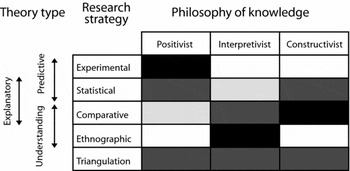
There are correlations between the three types of theory and the three meta-philosophies of knowledge described above (namely predictive and positivist, understanding and interpretivist, and explanatory and constructivist; see Fig. 2), but these are not necessary associations. There are also elective affinities between meta-philosophies and the subjects of study, but the particular research subjects do not determine the philosophical approach. Furthermore, the validity of the acquired knowledge is not measured by a universal standard; it is inherently tied to the theory form and philosophy of knowledge guiding the research. Of course, the execution of a research strategy or method can affect validity. The next section of this paper thus examines and explicates research styles and strategies in greater detail.
Matrix of generalized relationships between theories, philosophies and research strategies. While there is no necessary correspondence between any particular elements, increasing affinities between philosophies and research strategies are indicated by progressively darker shading. The theory types are overlaid on top of the strategies based on their affiliations. Thus, a positivist is likely to value predictive theory and use an experimental research strategy; an interpretivist is likely to value understanding theory and use an ethnographic strategy; and a constructivist is likely to favour explanatory theory and use a comparative research strategy. Scholars may be able to use this matrix to describe their own conceptual approaches to research, and facilitate collaboration with others by denoting differences and similarities with other scholars.

RESEARCH STYLES
The research style guides the practical acquisition, organization and presentation of empirical reality within a research programme or project, enabling the transformation from data to information to knowledge. A research style is thus the norms that guide choices of which types of research strategies are considered most rigorous and appropriate. Research styles may be influenced by feasibility, goals for the research output, and standards of validity, and may consist of one or a hierarchy of research strategies (Fig. 1). We denote five research strategies, which are essentially families of research methods and tools: experimental, statistical, comparative, ethnographic and triangulation. More than one strategy may be combined in a particular researcher's or discipline's preferred research style.
We consider research methods and tools to be distinct from, and a subset of, a research strategy. Methods, such as interviews, regression analysis or counterfactuals, can be used across multiple research strategies. The execution of a research style, strategy or method can affect validity, but validity is not inherent to a particular research style; rather, it is a tacit understanding that is part of the research style.
Experimental strategies
Experimental research strategies attempt to establish general cause-and-effect relationships by manipulating an isolated variable or variables and observing corresponding outcomes. To link the manipulated variable(s) or treatment(s) to an outcome, the experimenter generally assumes that the system of study exhibits law-like behaviour and can be objectively observed, often using statistical techniques to analyse data generated by repeated experiments and to generalize across cases. Replication of results is a fundamental test of validity (Shadish et al. Reference Shadish, Cook and Cambell2002).
Experiments may be either randomized or non-randomized (a quasi-experiment). In a randomized experiment, treatments are applied to groups selected by chance. Non-random assignment may be necessary for any number of practical reasons. Further, observational natural science studies that do not directly manipulate an independent variable (such as weather) but nonetheless attempt to link it to a response in a dependent variable (such as crop yield or animal hibernation patterns) may also be considered experimental in this sense.
For causal factors that cannot be probed through experimentation, such as age, gender and race, the term ‘natural experiment’ is sometimes used to describe the naturally occurring contrast between a treatment and non-treatment case (Shadish et al. Reference Shadish, Cook and Cambell2002). Thus, a system in the wake of an event, such as a tax cut or a hurricane, is compared to a similar untreated system, such as the economy before the tax cut or a nearby town unaffected by the hurricane.
While a single experiment usually does not provide insight into the mechanisms that connect cause and effect, nor indicate under what conditions an outcome will occur (Shadish et al. Reference Shadish, Cook and Cambell2002), a research programme of linked experiments may reveal causal mechanisms and their explanations and generalizations.
Shadish et al. (Reference Shadish, Cook and Cambell2002) elaborated four types of validity that should be met to ensure valid knowledge is gained from the experimental strategy. First, statistics must be appropriately used to evaluate the covariance between treatment and outcome to draw a correct inference (statistical conclusion validity). Second, the observed covariance between treatment and outcome must be the true result of a causal relationship and not spurious (internal validity). The specific measurements and manipulations undertaken in an experiment must actually and wholly tap into the causal relationship specified in the experimental hypothesis (construct validity). Finally, the causal inference must hold over various contexts, individuals, treatments and measurements (external validity).
Statistical strategies
Statistical research strategies attempt to provide support for causal inferences about relationships among variables in a system where variables cannot be theoretically manipulated by the researcher, due to the inherent nature or size of the system or population under study. For example, determining the effect of gender on hourly wage can be approached through a statistical but not an experimental strategy. The researcher's lack of control over system variables of interest distinguishes a statistical strategy from an experimental strategy, which may make use of statistical methods.
A statistical strategy often uses numerical methods to quantify the level of confidence in the relationship between variables or attributes of a population. Statistical tools allow the analyst to hold everything else constant through mathematical rather than physical manipulations and attempt to examine only the effect of varying one attribute.
It is also possible to use the statistical research strategy with case study methods. For example, King et al. (Reference King, Keohane and Verba1996) proposed a statistical strategy to generate descriptive and causal inferences in studies of one or a few cases. Tetlock and Belkin (Reference Tetlock and Belkin1996) identified a range of counterfactual techniques, including the methods of simulation and thought experiments. Counterfactuals may test an inferred relationship and ask what would have happened under a set of unobserved conditions (suggesting areas to examine for observations that confirm or refute a theory), or provide a formal way of asking why certain outcomes were not observed (providing a thought experiment as a logical or statistical check on a theory). Finally, analytic narratives may be used as a method within a statistical strategy (Bates et al. Reference Bates, Greif, Levi, Rosenthal and Weingast1998) if they are parsimonious, formally stated, logically consistent and better able to explain outcomes than competing hypotheses.
Comparative strategy
A comparative research strategy seeks to identify and explain causes, patterns and mechanisms where system boundaries are unclear (Durkheim Reference Durkheim1894), such as examining a process, a cultural group, an institution or a concept. The goal is analytical expansion and theoretical generalization from the cases examined (Yin Reference Yin2003), with a balance between complexity and generalization (Durkheim Reference Durkheim1894; Weber Reference Weber1962), rather than statistically enumerating frequencies. Unlike experimental and statistical research strategies, which seek to isolate an observation from its context to control or limit confounding variables, context is regarded as an essential element of the research process. The comparative strategy is most often associated with comparative historical research, and includes methods such as structured-focused comparison, process-tracing, crucial tests and Boolean algebra, among others.
Rather than being ‘variable-based’, the comparative strategy is ‘case-based’ (Yin Reference Yin2003), which makes it particularly useful for small sample sizes (Ragin Reference Ragin1997). Cases may be selected to meet a variety of criteria, such as most likely, least likely, or deviant. Multiple or conjectural causes of a similar outcome may be studied, which provides an alternative to using independent variables to represent reality (Ragin Reference Ragin1997). Critiques of this strategy include concerns about analytical rigor and generalizability of results from single or small case studies. However, advantages of comparative case-oriented research over large-sample variable-oriented research include the purposeful selection of cases, rigorous definition of negative cases, examination of multiple or conjectural cases, and further exploration of non-conforming cases (Ragin Reference Ragin1997).
Ethnographic strategy
The ethnographic strategy seeks to explore social phenomena in detail and to interpret the meanings and functions of human actions (Atkinson & Hammersley Reference Atkinson, Hammersley, Denzin and Lincoln1994; Rossman & Rallis Reference Rossman and Rallis1998). The researcher engages in a long-term sustained interaction with an intact cultural group of participants in a natural (not controlled) context, in order to gain an insider's understanding (Rossman & Rallis Reference Rossman and Rallis1998) and an intimate intense look at everyday life (Marcus Reference Marcus1998).
Methods of ethnography may include participant observation, open-ended interviewing, focus groups, archival research, mapping and many others. Ethnography produces a thick description that provides stories and narratives with which to interpret the ways that humans identify cultural meaning (Atkinson & Hammersley Reference Atkinson, Hammersley, Denzin and Lincoln1994). This strategy frequently uses qualitative methods and analysis to generalize within a case.
The role of the researcher, and the evaluation of research and standards of validity within an ethnographic strategy, are currently contested (Atkinson & Hammersley Reference Atkinson, Hammersley, Denzin and Lincoln1994; Denzin & Lincoln Reference Denzin, Lincoln, Denzin and Lincoln1994). There is also debate about the application of natural science models to social inquiry (Atkinson & Hammersley Reference Atkinson, Hammersley, Denzin and Lincoln1994). Some ethnographers identify more strongly with natural science notions of evidence. Others use conventional methods while allowing room for a complex continuum of understanding (Rossman & Rallis Reference Rossman and Rallis1998). Still others emphasize the ambiguities of ethnography, which accepts postmodern sensibilities and multiple possible realities (Denzin & Lincoln Reference Denzin, Lincoln, Denzin and Lincoln1994), incommensurate with aspirations to develop universal laws or describe the nature of the social world.
Triangulation strategy
Finally, a triangulation research strategy combines multiple methods or types of evidence to study a phenomenon. Triangulation may also be achieved via the interaction of multiple research strategies within the same research programme or project. The goal is to gain analytical rigor in studying complex natural and social phenomena by overcoming the inherent limits and biases of individual methods (Greene & Caracelli Reference Greene and Caracelli1997). Triangulation may be performed either between methods with multiple, independent measures to test the degree of external validity, or within method to check for internal consistency and improve reliability in data collection and interpretation, for example, integrating qualitative field observations with quantitative survey results. Potential benefits of triangulation include increased confidence in results and greater synthesis or integration, while potential drawbacks include difficulty in replication and limited value if one method dominates over others (Jick Reference Jick1979).
There is no necessary correspondence between certain types of theory, philosophies of knowledge and research styles. However, as we discussed in the previous section, there are patterns linking these elements that have been influenced by historical traditions, expectations about the form and function of knowledge generated by the research process, and disciplinary or departmental norms around the familiarity and acceptability of different approaches (Fig. 2).
For instance, a positivist philosophical approach easily aligns with experimental strategies that can offer critical tests of a hypothesis deduced from mathematically formalized theory. Such an approach may also use a statistical strategy with methods such as multiple regression. Within the interpretivist tradition, the ethnographic strategy best reflects the focus on the effect of context in understanding the meanings that constitute and shape reality. While interpretive ethnographic practice tends to be associated with the single ‘case’ understood as a unique context (rather than a data point or a case of something), there is in principle no reason that comparison across place and time should not be done (indeed there is increasing application of ‘multi-sited ethnography’). The predominant research strategy in the constructivist tradition is comparative, and especially comparative-historical, supplemented by statistical strategies. Positivists are likely to use some form of triangulation at least implicitly, with interpretivists and constructivists applying multiple forms of triangulation most explicitly.
CASE STUDIES
We now turn from introducing our conceptual framework for supporting interdisciplinary research to exploring how this approach may apply to existing interdisciplinary endeavours in environmental studies. In examining these case studies, we are not trying to judge or criticize these research programmes, but rather to investigate how different cases of interdisciplinary research might inform one another, and more general notions of how interdisciplinary research might realize more of its potential. We examine the use of theory type, philosophy and research style in the interdisciplinary research programmes of sustainability science and environment and security.
Sustainability science
Sustainability science clearly and formally defines its core questions and the theoretical approaches that scholars should take to address them in the sustainability science research programme (Kates et al. Reference Kates, Clark, Corell, Hall, Jaeger, Lowe, McCarthy, Schellnhuber, Bolin, Dickson, Faucheux, Gallopin, Grubler, Huntley, Jager, Jodha, Kasperson, Mabogunje, Matson, Mooney, Moore, O'Riordan and Svedin2001). It seeks to understand the character of the interactions between nature and society, and to provide the knowledge needed to pursue paths that can meet fundamental human needs while preserving the life-support systems of the planet (Kates et al. Reference Kates, Clark, Corell, Hall, Jaeger, Lowe, McCarthy, Schellnhuber, Bolin, Dickson, Faucheux, Gallopin, Grubler, Huntley, Jager, Jodha, Kasperson, Mabogunje, Matson, Mooney, Moore, O'Riordan and Svedin2001). The framework of sustainability science might be expressed as follows: human activity has negatively impacted natural resources, and the environment more broadly, to the point of worrisome vulnerability. However, by incorporating social learning and regarding social problems as inseparable from ecological problems, humans have the intellectual capacity to create appropriate institutions, infrastructure and policies to implement sustainability. The content area of sustainability science spans from global processes to local-scale social and ecological interactions (Kates et al. Reference Kates, Clark, Corell, Hall, Jaeger, Lowe, McCarthy, Schellnhuber, Bolin, Dickson, Faucheux, Gallopin, Grubler, Huntley, Jager, Jodha, Kasperson, Mabogunje, Matson, Mooney, Moore, O'Riordan and Svedin2001).
The form of sustainability science theory centres around useable knowledge to inform the decisions of people on the ground. Humans are seen as central to the environment, both in causing its current degraded state and as the actors who must employ ‘adaptive management and policy as experiment’ (Bolin et al. Reference Bolin, Clark, Corell, Dickson, Faucheux, Gallopin, Gruebler, Hall, Huntley, Jager, Jaeger, Jodha, Kasperson, Kates, Lowe, Mabogunje, Matson, McCarthy, Mooney, Moore, O'Riordan, Schellnhuber and Svedin2000) to achieve sustainability. The coupled social-natural system is viewed as complex, self-organizing and subject to chaotic behaviour and surprises, while still docile and understandable enough to be managed by human decisions and institutions. The level of theory focuses on middle-level causal generalizations. The type of theory does not require predictive understanding, other than identifying scientifically meaningful limits beyond which systems have a substantial risk of serious impairment (Kates et al. Reference Kates, Clark, Corell, Hall, Jaeger, Lowe, McCarthy, Schellnhuber, Bolin, Dickson, Faucheux, Gallopin, Grubler, Huntley, Jager, Jodha, Kasperson, Mabogunje, Matson, Mooney, Moore, O'Riordan and Svedin2001).
The philosophy of sustainability science blends positivism with interpretivism and constructivism through its promotion of science as a powerful problem-solving tool and its acknowledgement that different and often competing, multiply situated, culturally rooted perspectives exist and influence the nature-society interaction (Bolin et al. Reference Bolin, Clark, Corell, Dickson, Faucheux, Gallopin, Gruebler, Hall, Huntley, Jager, Jaeger, Jodha, Kasperson, Kates, Lowe, Mabogunje, Matson, McCarthy, Mooney, Moore, O'Riordan, Schellnhuber and Svedin2000). While it adopts the word ‘science’ in its title, sustainability science is careful to explicitly reject some features of traditional positivist inquiry, asserting that the research projects needed to address its core questions ‘differs to a considerable degree in structure, methods and content from science as we know it’ (Kates et al. Reference Kates, Clark, Corell, Hall, Jaeger, Lowe, McCarthy, Schellnhuber, Bolin, Dickson, Faucheux, Gallopin, Grubler, Huntley, Jager, Jodha, Kasperson, Mabogunje, Matson, Mooney, Moore, O'Riordan and Svedin2001). The research style of sustainability science has traditionally focused on experimental strategies, although it is increasingly including a broader range of styles such as ethnographic and triangulation.
The Yaqui Valley Project is an example of a research project within the sustainability science research programme. The project began in 1992 in an intensive wheat-producing region in northern Mexico, and quickly expanded to include researchers studying the agricultural systems of the Yaqui Valley from agronomic, economic, demographic, geochemical, biological and hydrological perspectives. One study found that alternative fertilization techniques could significantly reduce the necessary inputs of nitrogen fertilizer (as well as farmers’ input costs and negative environmental impacts) without negatively impacting yields (and farmers’ incomes) (Matson et al. Reference Matson, Naylor and Ortiz-Monasterio1998).
However, the results of this biogeochemical and economic assessment were not widely put into practice by farmers. Further study revealed individual and sociological complexities underlying this behaviour, including a lack of farmer trust in the initial instruments used to measure highly mobile nitrogen, regional and national nitrogen regulation, and constraints placed on management practices employed by farmers receiving loans from credit unions (P. A. Matson, personal communication 2006). In uncovering site-specific constraints on farmer behaviour and decision-making, project researchers have implicitly included some elements of an ethnographic research strategy. Involving other researchers who specialize in this approach might add additional insights that could help to better understand and potentially influence farmers’ choices and actions. Using the interdisciplinary framework we propose here would thus assist investigators within the Yaqui Valley Project in meeting their goals of characterizing, and eventually spurring action in, a complex human-environment system. The development of the Knowledge Systems for Sustainable Development project (URL http://www.hks.harvard.edu/kssd/docs.htm), using the Yaqui Valley as a case study, is a step in this direction.
Environment and security
The research programme in environment and security focuses on research questions about the relationship between the natural environment and human security, understood as the freedom from both violent conflict and physical want (Khagram & Ali Reference Khagram and Ali2006). The initial research programme focused on the relationships between the environment and violent conflict, and could be broadly divided into two schools of scholarship with distinct research approaches and styles.
The first group believes that conflict tends to arise in areas with an abundance of natural resources; for example, through the predation of natural resources such as diamonds or oil by insurgent groups to finance conflict (Collier & Hoeffler Reference Collier and Hoeffler2004). The second group of scholars believes that environmental scarcity, in combination with weak social institutions and opportunities, tends to lead to conflict (Homer-Dixon Reference Homer-Dixon1994). Abundance scholars tend to share a bent towards a predictive theory type providing specific propositions with testable implications, a positivist philosophy emphasizing broadly applicable, general principles and ‘laws’, and a statistical research strategy including large-N analyses, formal mathematical modelling and counterfactual thought experiments (Collier & Hoeffler Reference Collier and Hoeffler2004; Humphreys Reference Humphreys2005). Scarcity scholars tend to share an explanation theory type using plausible general mechanisms to explain the complex interactive nonlinear causal links between environmental resources and patterns of conflict, a more subtly constructivist philosophy that includes the complexities of the social world, and a comparative research strategy using single-case and comparative-historical methods for regional and country case studies (Homer-Dixon Reference Homer-Dixon1994).
The research style of the environment and security research programme has recently expanded, motivated by a desire for increased rigor and reliability. The comparative strategy now includes carefully controlled case comparisons where shared environmental conditions led to different outcomes in terms of violent conflict. The statistical strategy is being further investigated since efforts to replicate their findings demonstrate that the results are sensitive to methodological assumptions (Humphreys Reference Humphreys2005). An emerging direction uses a triangulation strategy to attempt to reconcile paradigms and tools from different approaches and bring them to bear on the questions of the environment and human security, moving beyond debates between abundance and scarcity perspectives. One example of this is the use of the method of vulnerability analysis, which accounts for both natural and social systems and their interaction in studying outcomes. Emerging research directions examine the conditions under which environmental factors can be a source of cooperation, the environmental consequences of war, and the causal connections between the environment and human security.
REFLECTIONS AND MOVING FORWARD
By portraying research programmes as built from the combination of different theory types, philosophies and research strategies, we hope to have illuminated the intellectual assumptions, motivations and expectations that often lurk in the darker or unnoticed corners of scholarly inquiry. We propose that the framing of knowledge creation we outline here is a useful platform of shared understanding on which to build more transparent, synthetic and powerful interdisciplinary research. In particular, we believe this approach is a more useful framework for understanding and potentially integrating different research programmes and projects than existing classification schemes based on dichotomies such as qualitative/quantitative, deductive/inductive, normative/descriptive, subjective/objective and theory/practice.
These dichotomies are unhelpful because their use is vague (and may be applied at the level of theory, research strategy, method or research programme), and their validity and significance may vary widely within research programmes. In some cases, one end of the spectrum may be most highly valued within a given research programme, but in fact both are used iteratively in the actual research process (for example, using induction to develop a theory then tested by deduction). The distinction between normative scholarship (what ideally should or can be) and descriptive scholarship (what actually has been, is or will be) masks the fact that both approaches attempt to shed light on the question of why and that both are likely present in all research to some degree (for example a normative choice about what to study in conducting a descriptive study). Similarly, the research programme largely determines whether a researcher views subjectivity as an inherent and accepted part of scholarship or a taint to be strenuously avoided. Finally, virtually all research programmes implicitly or explicitly link knowledge and action, generally in a more technical and technocratic way for positivist or predictive research, and in a more communicative and participatory way for more explanatory or understanding-focused orientations.
While there are strong historical affiliations for established disciplines with certain philosophies, styles and theories, we hope this discussion has shown that these may be used as starting points to creatively combine elements. The framework that we present may be used to ensure that a new interdisciplinary approach is rigorously intellectually justified in terms of its thoughtful grounding in the chosen theory, philosophy and research style selected, and can be well-used to address the question or puzzle of interest. We support the focus on being knowledge-driven to adopt and create elements of a research programme best suited to creating new interdisciplinary knowledge, rather than being constrained by departmental, organizational or educational boundaries. This may require shifts in the conceptualization of research, organization of research interactions and incentive structures to undertake those efforts.
As interdisciplinary practice grows, a hierarchy of interdisciplinarity may be recognized based on the number of elements that must be bridged or synthesized or on the identity of those elements. For example, is it more interdisciplinary to integrate a positivist and interpretivist philosophy than it is to expand the research style to include case studies in addition to experiments? Or is it more interdisciplinary to integrate a number of theories and strategies within one dominant philosophy? We do not propose a ‘ranking’ of interdisciplinarity, but advocate an increased awareness of what interdisciplinary means, in terms of both the research output and the processes of knowledge generation.
Finally, a practical question arises: if researchers are inspired to be knowledge-driven in creating an interdisciplinary research programme, how will they know what elements to include to best suit their purposes? How can scholars be aware of all possibly relevant, or even crucial, styles and techniques? This seems a daunting task, but in fact, our framework should help make it more manageable by laying the groundwork for understanding one possible universe of choices for the intellectual elements of research. We hope readers are able to map their own work, and that of colleagues, onto this framework, and extend the conversations that will lead to interdisciplinary scholarship that is truly on the frontier of knowledge creation.
We suggest that all research, particularly self-conscious interdisciplinary research, would benefit from following this framework to clearly define and explicate the theory, philosophy and style which may be implicit in current research practice. This would facilitate more fruitful conversations and collaborations between researchers. By anticipating sources of difference and misunderstanding, conflict can be avoided and new perspectives explored. Fundamentally, interdisciplinarity requires not only the navigation of the research problem, but also the language and concepts embedded within the research process, which this framework makes explicit.
ACKNOWLEDGEMENTS
We thank G. Bammer, H. Hummel, C. Miller, L. Ortolano, H. Boudet and S. Schneider, who gave helpful comments on an earlier longer draft of this manuscript. Their feedback was important in improving this paper. Thoughtful comments from two anonymous reviewers improved this paper enormously.