Catheter-associated urinary tract infections (CAUTIs) are a major cause of healthcare-associated infections and contribute to increased morbidity and mortality.Reference Hooton, Bradley and Cardenas 1 – Reference Saint, Meddings and Calfee 3 Prevention guidelines recommend limiting catheter placement and duration, but inappropriate use is well described.Reference Hooton, Bradley and Cardenas 1 , Reference Gould, Umscheid and Agarwal 4 – Reference Meddings, Rogers and Macy 7
In many teaching hospitals, housestaff are responsible for ordering catheter placement and discontinuation. We conducted a survey to assess housestaff’s knowledge of CAUTIs and catheter practices, with the goal to identify knowledge deficits to allow for targeted education.
METHODS
We surveyed housestaff in medicine, surgery, medicine-pediatrics, and anesthesiology at Massachusetts General Hospital (MGH) in Boston, Massachusetts. Emergency medicine housestaff who train in a combined residency with MGH and Brigham and Women’s Hospital were also included. The study was approved by the Partners Human Research Committee (no. 2012P001078). Subjects were notified of the survey via email from their program director. Next, on June 26, 2012, they were emailed an invitation to participate, with a reminder email sent on July 1, 2012. Entry into a lottery for a $20 gift card was provided to encourage participation.
An anonymous electronic survey was designed in REDCap, a web-based survey tool.Reference Harris, Taylor and Thielke 8 Although numerous CAUTI-prevention guidelines exist, we used the Society for Healthcare Epidemiology of America guidelines for survey development.Reference Gould, Umscheid and Agarwal 4 Subjects were asked to provide demographic information, including postgraduate year (PGY) of training, program, and site of most recent inpatient experience (intensive care unit or floor). Respondents were asked questions regarding knowledge of prevention guidelines and CAUTI risk factors. They were asked to estimate the frequency with which they reassessed the need for catheter placement in patients under their care. They were instructed to select appropriate indications for catheter placement from clinical scenarios and to identify appropriate timing of postoperative catheter removal. The complete survey instrument is provided (online supplementary material), including correct responses to questions where appropriate.
Only surveys in which respondents answered all questions were included for analysis. For questions with a discrete “correct” response (questions 2, 3, 7, 9), answers were scored as correct if they reflected common knowledge and adhered to consistent guidelines.Reference Gould, Umscheid and Agarwal 4 Scoring for question 7, related to catheter placement indications, was determined by adding the number of appropriate indications selected (total possible: 9) with the number of inappropriate indications left unselected (total possible: 6), dividing by the number of scenarios (15), and multiplying by 100.
Comparisons of responses were evaluated for statistical significance using the N-1 two-proportion test with a 2-tailed P value.
RESULTS
A total of 403 subjects—of which 175 were medicine, 75 surgery, 16 medicine-pediatrics, 81 anesthesia, and 56 emergency medicine housestaff—were invited to participate from June 26 through July 3, 2012. One hundred sixty responses were received and 158 were complete, forming the sample for analysis. Respondent-reported level of training was: PGY1 43/158 (27%); PGY2 51/158 (32%); and PGY3+ 64/158 (41%). Respondent breakdown by training program was: medicine 72/158 (46%); surgery 30/158 (19%); medicine-pediatrics 5/158 (3%); anesthesiology 24/158 (15%); and emergency medicine 27/158 (17%).
Ninety-five subjects (60%) reported awareness of CAUTI prevention guidelines. When analyzed by PGY level, 44% of PGY 1 subjects reported awareness, compared with 70% of PGY 3+ subjects (P=.007). One hundred forty subjects (89%) responded correctly that duration of catheter placement is the greatest predictor of CAUTI development. Eighty-five respondents (54%) could correctly identify the daily risk of CAUTI per catheter-day, and analysis by PGY level showed no statistical difference.
Seventeen respondents(11%) reported it was easy to find documentation of the presence of a urinary catheter whereas 46 (29%) reported that it was difficult or very difficult. Nursing notes were identified by 83 (52%) as the most likely place to find documentation of a catheter.
Seventy-two respondents(46%) reported at least daily reassessment of the need for catheter placement in patients under their care during their last rotation. Analysis by PGY level was not statistically different. When responses were considered by most recent inpatient experience (intensive care unit or floor), 31/57 (54%) and 41/101 (41%) reassessed catheter need at least daily, respectively.
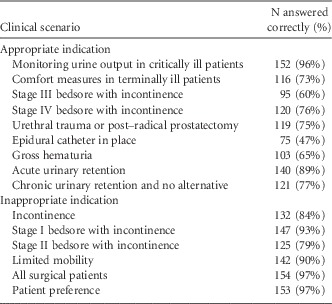
Only 5 respondents (3%) correctly identified the appropriate or inappropriate nature of every clinical scenario for catheter placement, scoring 100%. Most subjects (102 [64%]) scored between 75% and 99% on these 15 clinical scenarios (data not shown). Recognizing an epidural catheter as an indication for urinary catheter placement was the scenario most commonly missed. Of the inappropriate catheter placement scenarios, placing a catheter for a stage II bedsore with incontinence was the most common error. Respondents most reliably recognized that not all surgical patients required catheter placement and that patient preference was not an appropriate indication for catheter placement (Table 1).
Ability of 158 Respondents to Identify Appropriate or Inappropriate Indications for Urinary Catheter Use

Fifty-four respondents (34%) correctly identified when to remove a catheter postoperatively when other indications for catheterization were absent. When only anesthesia responses were considered, 7/24 (29%) answered correctly (P=.63); when only the surgical responses were considered, 17/30 (57%) answered correctly (P=.02).
DISCUSSION
We found that a small majority of housestaff respondents reported awareness of CAUTI prevention guidelines, which increased with training, and a large majority correctly identified catheter duration as the greatest risk factor for CAUTI development. Despite the high visibility of efforts aimed at CAUTI prevention, only a minority of respondents could correctly identify all appropriate/inappropriate indications for catheterization in common clinical scenarios.Reference Hooton, Bradley and Cardenas 1 – Reference Saint, Meddings and Calfee 3 This finding highlights the need to develop and implement educational tools targeting housestaff who frequently manage inpatient catheter orders.
Although published guidelines recommend frequent reassessment, less than half of respondents reported daily reassessment of catheter necessity in their patients.Reference Hooton, Bradley and Cardenas 1 Due to the anonymous nature of the survey, the frequency of reassessment cannot be independently verified; however, we believe it is unlikely that respondents would underestimate their practice. Although knowledge deficits related to CAUTIs may contribute to infrequent reassessment of catheterization, this deficiency may also reflect the lack of a systems-based approach to recognize the presence of an indwelling catheter and to reassess its necessity.Reference Meddings, Rogers and Krein 9
As noted above, when comparing surgery and anesthesia housestaff, the 2 groups most likely to care for the postoperative patient, surgery housestaff identified appropriate timing for postoperative catheter removal more frequently than anesthesia housestaff. This finding highlights the importance of educational initiatives that target specific patient populations most relevant to providers.
This study has several limitations. Although the survey response rate was low, thus limiting the generalizability of results, it was similar to those of published surveys regarding other medical topics in this population.Reference Grava-Gubins and Scott 10 This was a single-site study, again limiting generalizability. Owing to the nature of self-reporting, we cannot verify the information provided by respondents, and the results may be subject to social desirability bias. If this bias were present, however, respondents would likely overestimate their CAUTI awareness and positive practices in reassessing urinary catheter placement. Thus, the deficits reported are likely minimum estimates, providing further support for the need for targeted education about guidelines and catheter practices.
We found that housestaff knowledge of CAUTI guidelines, application to clinical scenarios, and catheter practices fall short of national goals. Because reducing CAUTIs is a healthcare priority, targeted interventions, including educational initiatives, need to be developed and aimed at housestaff who can play a major role in decreasing catheter use and duration.
ACKNOWLEDGMENTS
We acknowledge the assistance of Lynn Simpson, MPH, Enterprise Research Infrastructure and Services at Partners Healthcare; Keith Baker, MD, PhD, program director, Anesthesiology Residency, MGH; Hasan Bazari, MD, program director emeritus, Internal Medicine Residency, MGH; Evangeline Galvez, MD, program director, Internal Medicine-Pediatrics Residency, MGH; John T. Mullen, MD, program director, General Surgery Residency, MGH; and Eric Nadel, MD, program director, Emergency Medicine Residency, MGH.
Financial support. Doris Duke Charitable Foundation (grant to Harvard Medical School to fund Clinical Research Fellows, to H.E.H.); Massachusetts General Hospital Departmental Funds (to D.C.H. and E.S.S.); National Institutes of Health (training grant T32 A107061 to E.S.S.); the Harvard Center for AIDS Research (to R.P.W.); Harvard Catalyst, the Harvard Clinical and Translational Science Center (National Center for Research Resources and the National Center for Advancing Translational Sciences, National Institutes of Health Award UL1 TR001102); and financial contributions from Harvard University and its affiliated academic health care centers.
Potential conflicts of interest. All authors report no conflicts of interest relevant to this article.
Disclaimer: The content is solely the responsibility of the authors and does not necessarily represent the official views of Harvard Catalyst, Harvard University and its affiliated academic health care centers, or the National Institutes of Health.
SUPPLEMENTARY MATERIAL
To view supplementary material for this article, please visit http://dx.doi.org/10.1017/ice.2015.189.