Introduction
The bibliographic and bibliometric analyses of the parasitology literature is still in its infancy, despite the discipline being active in publications for well over 100 years. Falagas et al. investigated the research productivity of different regions of the world in parasitology (Falagas et al., Reference Falagas, Papastamataki and Bliziotis2006). They studied 18 well-known parasitology journals that contained 18 377 articles on parasitology. They highlighted the importance of the contributions from Western Europe and the USA to the discipline.
Other studies have highlighted the importance of South America in studies on malaria, leishmanisiasis and Chagas disease. Garrido-Cardenas and colleagues recently analysed the parasitology literature present in the Scopus database (Garrido-Cardenas et al., Reference Garrido-Cardenas, Mesa-Valle and Manzano-Agugliaro2018). They highlight the importance of technology that has led to major advances in our knowledge on parasitic organisms; for example, the in vitro culture of parasites, electron microscopy, immunology and molecular biology to name a few of the contributing technologies. Of interest was the additional fact that 20% of the literature they studied were in languages other than English. Analyses of keywords highlighted the prominence of malaria research as well as the contribution of technology such as polymerase chain reaction (PCR), pathology and immunology to the discipline of parasitology.
Several bibliometric analyses related to the malaria literature have been performed, including malaria in pregnancy (van Eijk et al., Reference van Eijk, Hill, Povall, Reynolds, Wong and Ter Kuile2012), insecticide resistance (Sweileh et al., Reference Sweileh, Sawalha, Al-Jabi, Zyoud, Shraim and Abu-Taha2016) and malaria drug resistance (Sweileh et al., Reference Sweileh, Al-Jabi, Sawalha, AbuTaha and Zyoud2017). There have also been studies focusing on malaria in specific countries such as Malawi (Mwendera et al., Reference Mwendera, de Jager, Longwe, Hongoro, Mutero and Phiri2017) and India (Gupta and Bala, Reference Gupta and Bala2011; Singh and Mahanty, Reference Singh and Mahanty2019). Most of these studies have however, concentrated on identifying the journals where most of the work is published, the dominant authors and institutions publishing the studies, the most productive countries and publication type. Analyses of the themes or topics of the research are usually limited to a simple database or keyword searches.
The published literature on Strongyloides was recently analysed for its content and change over time since 1968 (Sweileh, Reference Sweileh2019). The fatal consequences of disseminated infection and hyperinfection syndrome were identified as the main reason behind the growth of research into strongyloidiasis. Of interest to this study was that research themes were identified by analysing terms used in the title and abstract with a minimum occurrence of 20. The analyses identified four main clusters of research that focused on (1) immunosuppression and corticosteroids as risk factors for hyperinfection and disseminated strongyloidiasis; (2) epidemiology and prevalence of the disease; (3) treatment using ivermectin and other medications; and (4) diagnosis and new techniques such as PCR and ELISA. These analyses show the power of bibliometrics to identify research themes and topics in any scientific discipline.
Bibliometrics is a well-developed area of informatics that uses tools and methods for identifying new information from the text that is present in a wide variety of sources (Moral-Muñoz et al., Reference Moral-Muñoz, Herrera-Viedma, Santisteban-Espejo and Cobo2020). This may include twitter feeds, websites, books and scientific articles in databases. In the biomedical sciences, this is an active area of research, especially at a time when the scientific literature continues to expand at an increasing rate (Cohen and Hersh, Reference Cohen and Hersh2005; Lu, Reference Lu2011). In this study, we investigate the peer-reviewed literature on parasitology published over the last 30 years, by using bibliometric methods to identify the major trends in parasitology research. Our aim was to ultimately define the major themes, topics and trends that exist in the parasitology discipline by the dominance of key words. Networks and clusters were constructed based on co-occurrence of words found in publications identified by database searches. The results show convincingly that parasitology research is dynamic, continually changing in time, and closely aligned to the availability of technology.
Methodology
Database searches
Four publicly available databases were used in this study; Scopus (https://www.elsevier.com/en-au/solutions/scopus), Web of Science (WoS, https://clarivate.com/webofsciencegroup/solutions/web-of-science/), Dimensions (https://app.dimensions.ai/discover/publication) and MEDLINE (https://www.ncbi.nlm.nih.gov/pubmed). All were accessed through the University library catalogue, except MEDLINE that was accessed via the Pubmed interface (https://www.ncbi.nlm.nih.gov/pubmed/). A variety of search strategies were used to identify parasitology literature in the databases, taking advantage of the intrinsic features of the different databases; for example, when using MEDLINE the advanced search option was used with the MeSH subheadings (‘parasitology’[MeSH Subheading]) AND (‘1989’[Date – Publication]: ‘2019’[Date – Publication]).
Analyses using SciMAT
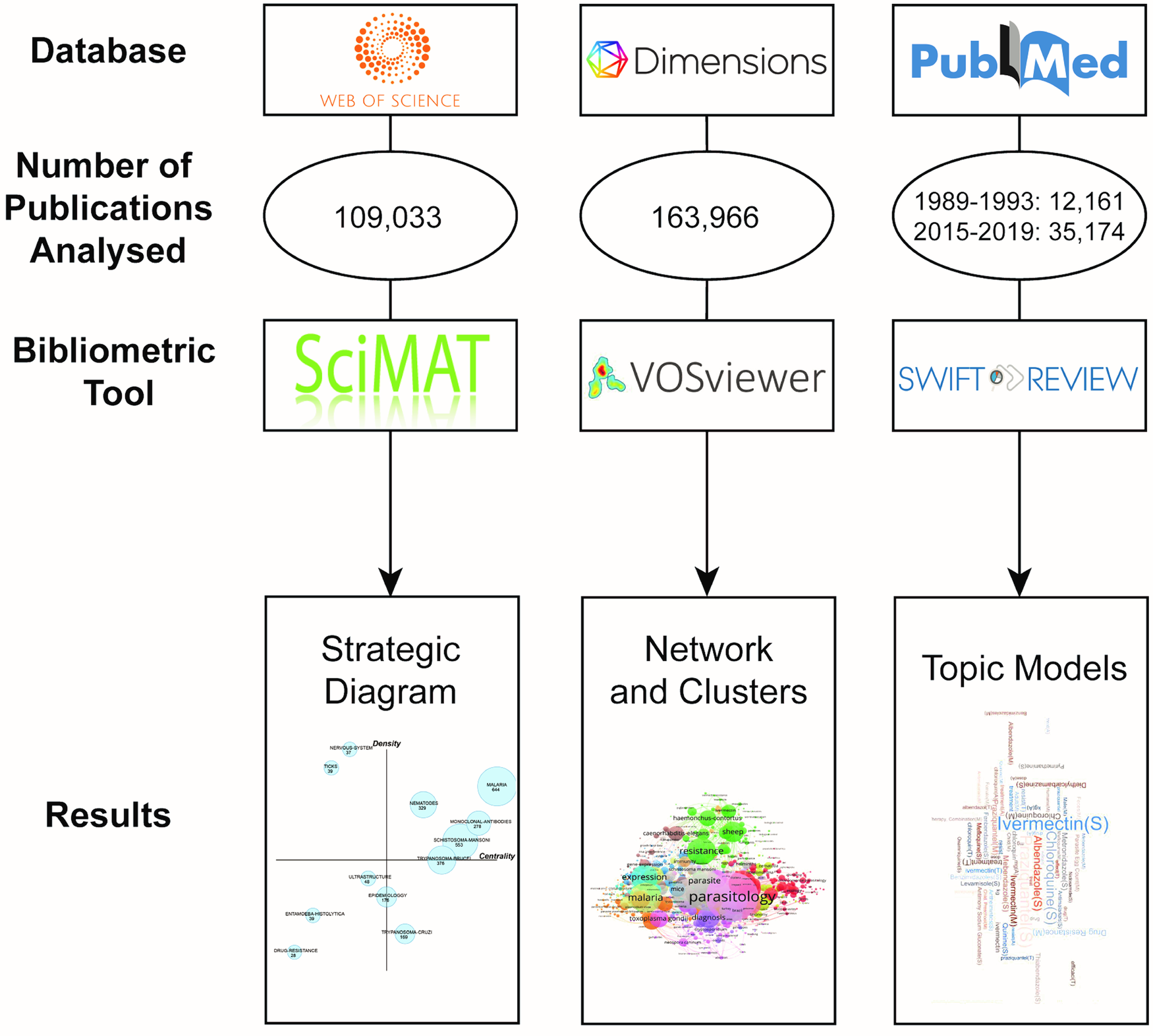
Figure 1 provides an overview of the bibliometric analyses conducted using peer-reviewed publication data from the Web of Science, Dimensions and the PubMed databases.
Schematic representing an overview of the main analyses described in this study.

Science mapping was performed using SciMAT v1.1.04 (Cobo et al., Reference Cobo, López-Herrera, Herrera-Viedma and Herrera2012), using the general workflow described elsewhere (Cobo et al., Reference Cobo, López-Herrera, Herrera-Viedma and Herrera2011). The dataset used was from the WoS category Parasitology (~109 000 publications) which was exported from the WoS. In SciMAT, singular and plural versions of the same words were grouped and words were also grouped by distance using the inbuilt search engine. This allows words with similar meaning but different spelling (e.g. leishmaniasis and leishmaniosis) to be grouped by curation. Short three-letter words (such as gene names) were discarded when they appeared in the search. In preliminary analyses, normalization was performed using the equivalence index; minimum frequency = 10, edge reduction value = 5, the simple centres algorithm was used, minimum network size = 5, evolution and overlapping maps used the Jaccard and inclusion indices respectfully. The workflow produces a strategic diagram that identifies four main types of themes: motor-themes that are well-developed and important to a discipline (upper-right-hand quadrant), themes of marginal importance (upper-left-hand quadrant), emerging or disappearing themes (lower-left hand quadrant) and underdeveloped yet important themes for a discipline (lower-right-hand quadrant).
Performance analyses of clusters identified in SciMAT were performed in the following way. The initial scoping analyses described above-identified clusters containing a range of broad terms. Stop words were therefore introduced into SciMAT in order to prevent these words from being included in the analyses. These included:
(1) Countries, geographical locations and geographical regions e.g. Brazil, Southern Brazil, Amazon.
(2) Technologies such as ELISA, western blot and terms related to microscopy, comparative genomics, DNA sequencing terms and mouse models (e.g. Balb/c, nude). These represent common technologies used in Parasitology.
(3) Variations on * parasite(s) e.g. gastrointestinal parasites, cattle parasites.
(4) Taxonomic groups higher than genus (e.g. Myxozoa, Cestoda).
(5) Other terms that were identified (e.g. N. sp.).
(6) Species names (e.g. Plasmodium falciparum, P. falciparum) were merged as they represent the same entity.
Using the new dataset, new clusters were built in SciMAT using normalization by the equivalence index; minimum frequency = 60, edge reduction value = 5, the simple centres algorithm was used, minimum network size = 5, maximum network size = 100, evolution and overlapping maps used the Jaccard and inclusion indices respectfully. For each cluster, the number of documents, citations and H-index was recorded.
Analyses in VOSviewer
Network and cluster analyses on co-occurrence of words were performed in VOSviewer v1.6.14 (van Eck and Waltman, Reference van Eck and Waltman2010). The full citation records present in databases were either (1) exported from the WoS in batches of 500 in plain text format, or (2) exported from Dimensions as a csv file in VOSviewer format. Data were initially imported into the DB Browser for SQLite in order to check for the presence of duplicate references using SQL. The data were then imported into VOSviewer using the Create Map option from text data using the following parameters: Title field, fractional counting method, minimum occurrences of a term = 20, scores calculated for 1500 or 2000 of the most important terms and only connected terms were displayed in the network.
Analyses in SWIFT-Review
In order to highlight an alternative approach for analyses, publications were further analysed in SWIFT-Review v1.43 (Howard et al., Reference Howard, Phillips, Miller, Tandon, Mav, Shah, Holmgren, Pelch, Walker, Rooney, Macleod, Shah and Thayer2016); the data from a MEDLINE search was exported to a file as a PMID list, which was then imported into SWIFT-Review. Topic modelling was used to identify keywords (such as species and countries) associated with that topic. The Tag Browser in SWIFT-Review was used for easy access to MeSH categories.
Citations of individual publications were examined in either Scopus or the NIH iCite open citation collection (Hutchins et al., Reference Hutchins, Baker, Davis, Diwersy, Haque, Harriman, Hoppe, Leicht, Meyer and Santangelo2019) that was accessed online (https://icite.od.nih.gov/analysis). Publications were ranked according to a number of citations before review.
Results
Comments on databases
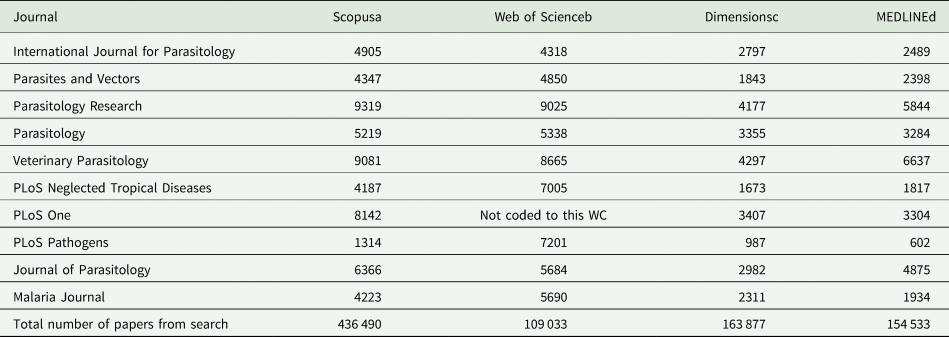
A search of MEDLINE identified 154 533 publications relating to parasitology published over the period 1989–2019, inclusive (Table 1). Up until 2010, the number of publications gradually increased leading to a plateau of around 7500 papers per year suggesting productivity was relatively constant since then (not shown). In the case of WoS, publication numbers increased to 2012, after which ~6700 papers were published each year. It should be noted that Scopus contains the highest number of articles, which includes book chapters, conference articles and editorials.
Summary of database searches performed and the content for a selection of relevant journals publishing primary data on parasitology research

a Advanced search: ALL (parasitology) AND PUBYEAR > 1988 AND PUBYEAR < 2020 (accessed 30/1/2020).
b Web of Science category: WC = (Parasitology); Timespan: 1989–2019; Refined by: LANGUAGES: (ENGLISH) AND DOCUMENT TYPES: (ARTICLE OR REVIEW) (accessed 5/4/2020)
c General search: parasite (free text in title or abstract) AND publication year 1989–2019 inclusive, limited by article type (accessed 5/4/2020).
d Advanced search: (((parasitology[MeSH Subheading]) AND (‘1989’[Date – Publication] : ‘2019’[Date – Publication]) AND MEDLINE[sb])) AND ‘International journal for parasitology’[Journal] (accessed 30/1/2020).
Table 1 shows four of the most commonly used databases and ten of the most popular Journals where papers in the parasitology discipline are published. Although the searches of the databases are not identical; they are presented to highlight the diversity of the data contained in them and that the searches identify different amounts of content assigned to the different journals. For example, the Web of Science category (Parasitology) does not necessarily include all journals publishing parasitology papers, as shown by the omission of papers from PLoS One. The content of the different databases, therefore, differs considerably across the Parasitology discipline. The total number of entries returned by the searches differ significantly, ranging from 436 490 (Scopus) to 122 335 (WoS).
Web of science
The WoS database has traditionally been used for bibliometric analyses due to the availability of citation data and an API. Consequently, we used this database initially for further analyses. A simple topic search of WoS with the keyword ‘Parasitology’ for the years 1989–2019 inclusive identified 6874 published papers (accessed 30/1/2020). If the topic search was expanded to ‘Parasitology OR parasite’ the number of papers identified increased significantly to 155 355, reflecting the fact that the term ‘parasite’ more commonly appears in publications, such as in the abstract or title. This count also includes early access papers in each year that have been published online but not assigned to a journal volume/issue with page numbers.
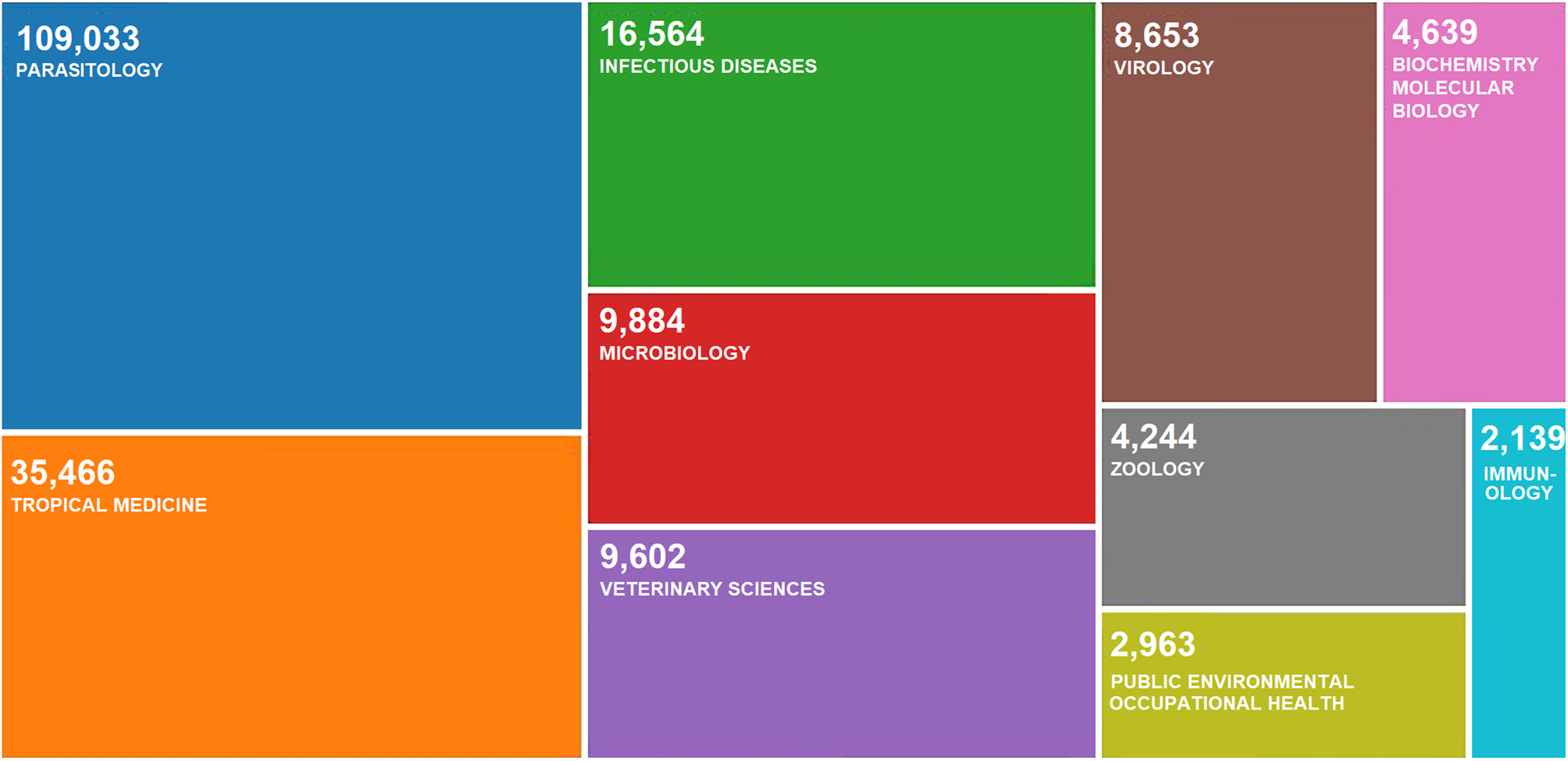
An overview of the WoS categories containing publications in Parasitology is shown in Fig. 2. The dataset crosses a wide range of WoS categories including ‘tropical medicine’, ‘veterinary sciences’, ‘biochemistry’ and ‘molecular biology’ and ‘immunology’ amongst many others. Clearly, this figure shows that ‘Parasitology’ is made up of a very wide multitude of disciplines and themes.
Multidisciplinary nature of Parasitology as displayed through Web of Science categories. The Web of Science was searched with the keywords ‘Parasitology’ or ‘Parasite’ for the years 1989 to 2019 inclusive.

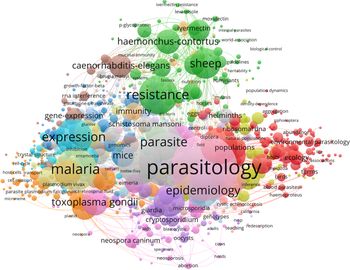
As a preliminary study in order to generate a simple overview of the Parasitology field, a small dataset from the WoS (search term Parasitology, 1989–2019, 6874 publications) was analysed in VOSviewer. This approach was adopted because of its simplicity of implementation. Using a cluster resolution of 2, 27 clusters were generated, and these are summarized in Supplementary Material 1 and represented in Fig. 3. In the Supplementary Material 1, keywords, names of parasite species, diseases and Countries mentioned are referenced in a breakdown of the content for each Cluster. For example, cluster 10 identifies a global effort across many countries to understand prevalence and transmission of echinococcosis and cysticercosis, and cluster 11 identifies Brazil as a significant country associated with research into ‘helminth infections’, ‘treatment of parasitic diseases’ and ‘children’.
VOSviewer visualization map of 6874 publications from a search of Web of Science with the keyword ‘Parasitology’ for the years 1989–2019. Cluster analyses identify 27 clusters that are summarized in Supplementary Material 1. The size of the nodes representing keywords is proportional to the frequency of occurrence of that particular keyword.

The main nodes in Fig. 3. represent the high representation of the use of specific words representing key themes in Parasitology and the network represents the links between them. For example, research into malaria is clearly highly represented as a major node linked to many others, and the nodes resistance, sheep, ivermectin and Haemonchus contortus are also strongly represented. Other key terms include expression, diagnosis and Toxoplasma gondii stand out in this figure.
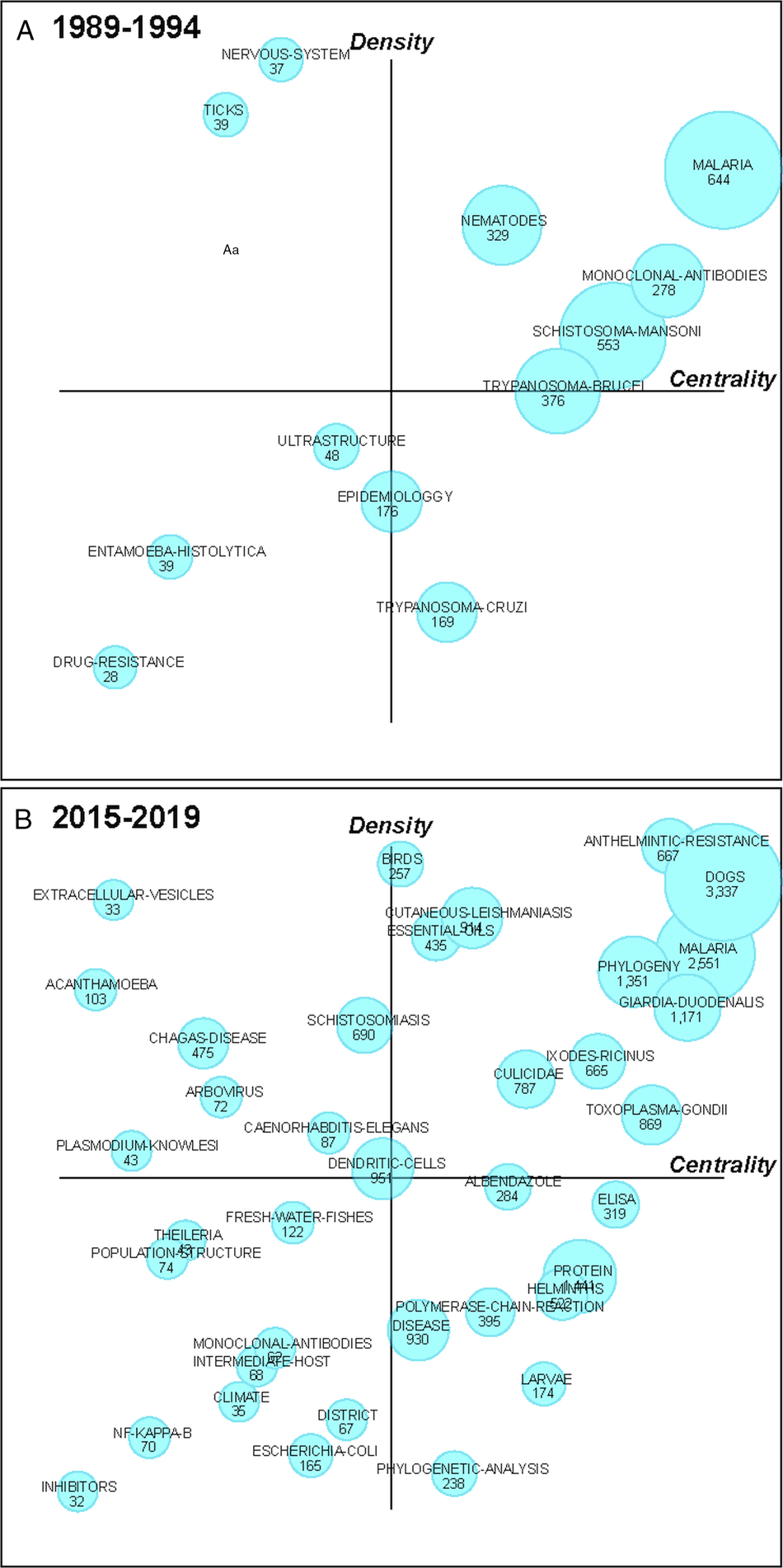
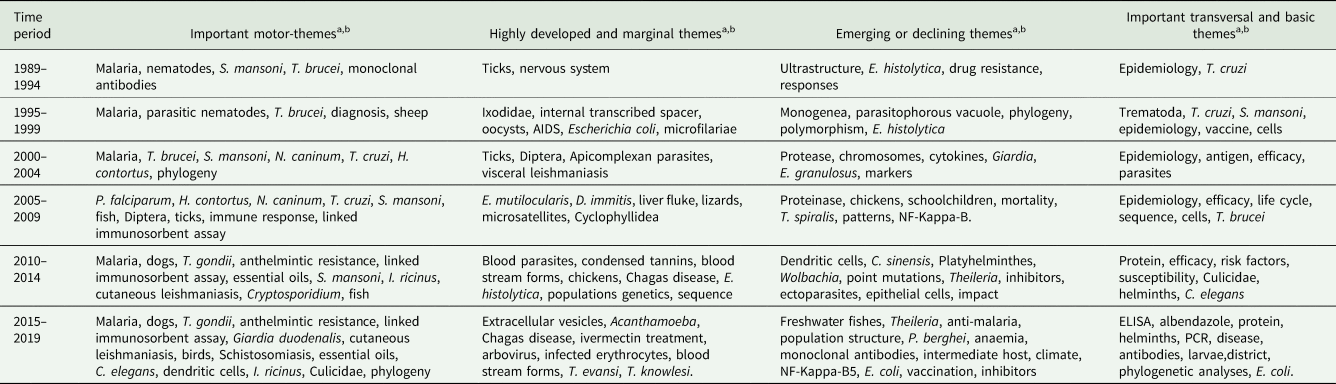
The WoS category ‘Parasitology’ identifies ~ 109 000 published papers (see Table 1), comprising 102 278 articles and 6755 reviews. The bibliometric data from WoS was imported into SciMAT for analyses by word co-occurrence and identifying the main themes and numbers of documents that contain those words (as simple document counts). The results of these exploratory analyses (using a minimum frequency of 10) are summarized in Table 2 and example strategic diagrams are shown in Fig. 4. The first point to make is that each 5-year period analysed contains very different themes in each of the four categories analysed (motor, marginal, emerging/declining, transversal/basic). This shows the rapid and dynamic nature of the parasitology discipline and how it changes significantly over time. A number of research themes are constantly referred to over this time period and are therefore important to the discipline of parasitology. For example, in the 1995–1999 window ‘phylogeny’ was identified as an emerging theme, while in 2000–2004 it appears as a major motor theme. Between 2015 and 2019, ‘phylogeny’ is a motor theme while ‘phylogenetic analyses’ is an important transversal and basic theme.
Example of strategic maps produced from 109 000 publications of the parasitology category in Web of Science using SciMAT for (a) 1989–1994, and (b) 2015–2019. The co-word analyses performed in SciMAT generates a series of clusters that represent groups of keywords and which correspond to the main research topics. The clusters (represented as circles in the figure) are automatically labelled by the most common keyword in the cluster. The axes represent Callon's centrality and density; centrality (on the X-axis) is a measure of the level of interaction amongst the clusters and so is considered a representation of the importance of a cluster (topic) in the development of the entire research field analysed. Density (on the Y-axis) is a measure of the internal strength of the cluster and therefore represents the theme's development. The size of each cluster reflects the number of documents assigned to that cluster.

Major themes identified using SciMAT with Web of Science dataset (WoS category ‘Parasitology’, 1989–2019, ~ 109 000 publications)

a Species names have been abbreviated for space reasons and should be considered as found in full.
b See legend of Fig. 4 for explanation of the terms from a strategic map.
Over the entire period studied, research on malaria, Trypanosoma brucei, Schistosoma mansoni and the nematodes tends to dominate. From the 2000 timeline, we note the emergence of ‘immunology’, ‘cytokines’, ‘NF-Kappa-B’ and ‘dendritic cells’ as important contributors to parasitology research; from a technology point of view we are able to record the presence of ‘ELISA’ and ‘PCR’. In terms of parasite control, major themes include ‘anthelmintic resistance’, ‘ivermectin treatment’, ‘inhibitors’, ‘efficacy’, ‘vaccine’ and ‘vaccination’.
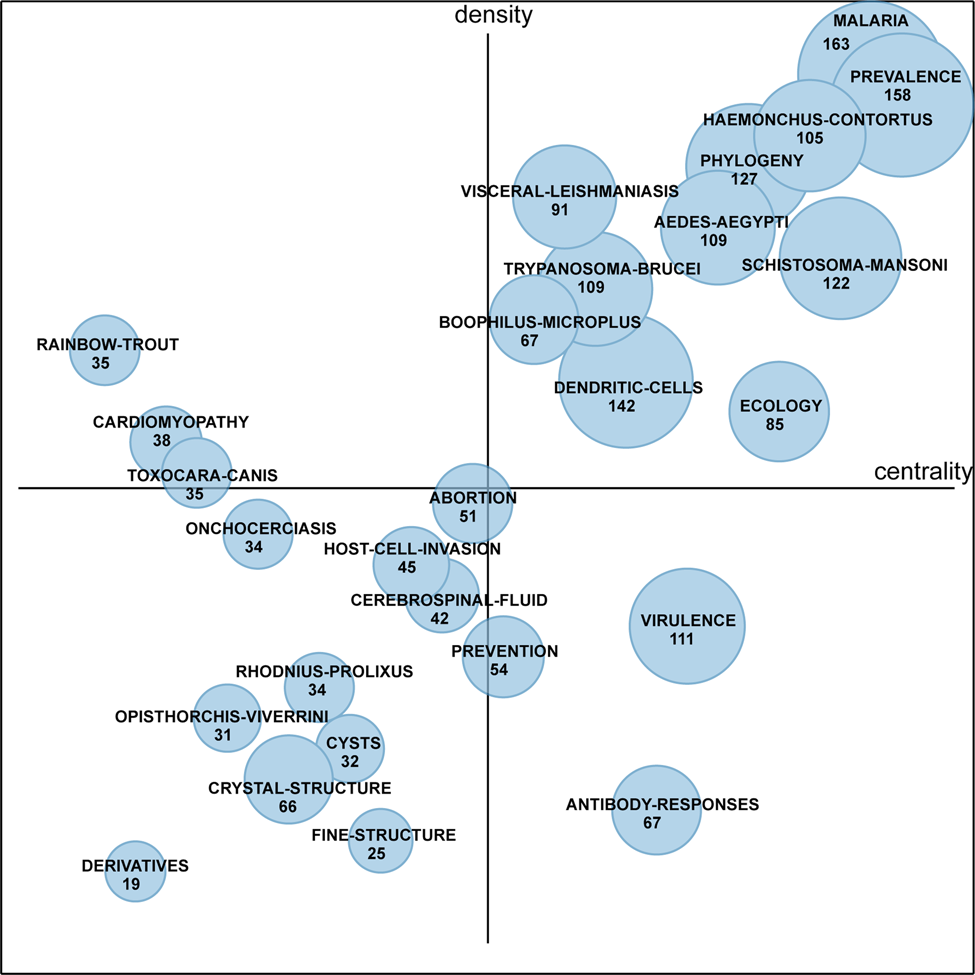
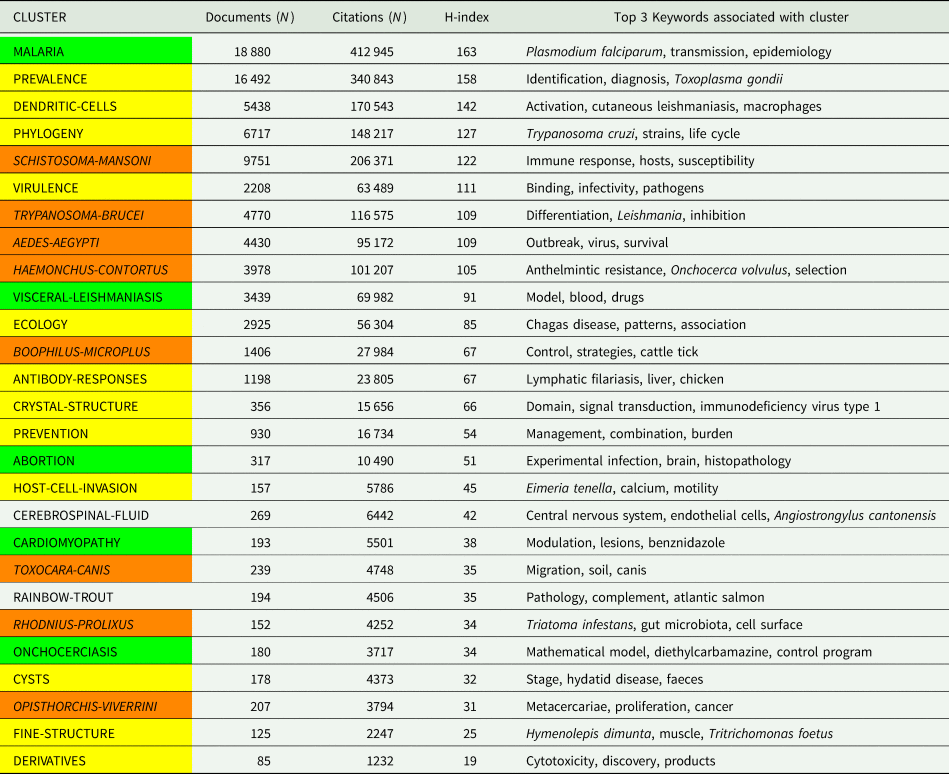
In order to build a strategic map for Parasitology representing only the entire period of 1989–2019, various categories of stopwords were subsequently introduced into the dataset in order to reduce the appearance of generic terms as clusters. Initially, the minimum frequency parameter of SciMAT was varied over the range 20–100 in an attempt to obtain ~20–30 clusters in the strategic diagram. Figure 5 shows the strategic map obtained using a minimum frequency of 60. The performance characteristics of these clusters are shown in Table 3. A cluster associated with ‘MALARIA’ was associated with the highest number of documents, citations and H-index over the time period studied; other important species identified (in rank order according to H-index) were S. mansoni, T. brucei, Aedes aegypti, Haemonchus contortus, Boophilus microplus and Toxocara canis. Key diseases include Malaria, Visceral leishmaniasis and onchocerciasis, with abortion and cardiomyopathy as disease outcomes. Terms representing key research areas include prevalence, dendritic cells, antibody responses, virulence, phylogeny, ecology, prevention and host cell invasion. Of the clusters identified, only one (Crystal structure) relating primarily to HIV was not completely focussed on parasitology. Nevertheless, the influence of HIV in parasitology and human health is highly significant and has been extensively studied (Stark et al., Reference Stark, Barratt, van Hal, Marriott, Harkness and Ellis2009; Barratt et al., Reference Barratt, Harkness, Marriott, Ellis and Stark2010).
A strategic map produced from the ~ 109 000 papers in the parasitology category of Web of Science using SciMAT for the period 1989–2019. The size of each cluster reflects the H-index assigned to that cluster.

Performance data for 27 dominant clusters of the Parasitology discipline (1989–2019) identified using SciMAT with Web of Science dataset WoS category ‘Parasitology’, 1989–2019, ~ 109 000 publications)

a Colour coding: Green: disease; Orange: species; Yellow: keywords; No colour: other.
Dimensions database
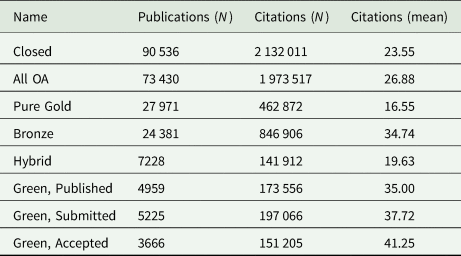
The Dimensions database was also used to investigate research trends in Parasitology. A simple search of Dimensions using ‘parasite’ in title or abstract for the years 1989–2019 identified 173 766 publications in total of which 163 966 matched the database criterion for a research article (viewed 17/4/2020). Approximately 45% of these publications were published in some form of open access (as determined by one of the core features of the database (Table 4), with Gold Open Access showing the lowest average number of citations per paper. The numbers of publications increased almost linearly over the time period analysed. If one allows for a lag in publications receiving citations (by restricting the dataset to publications for the years 1989–2013 inclusive), ~8% of publications do not receive a citation, ~62% receive at least 10 citations, 6% receive at least 100 citations and 0.25% receive 500 or more citations.

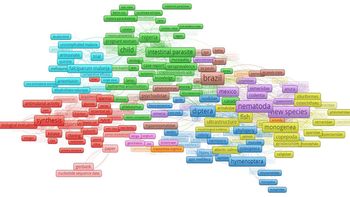
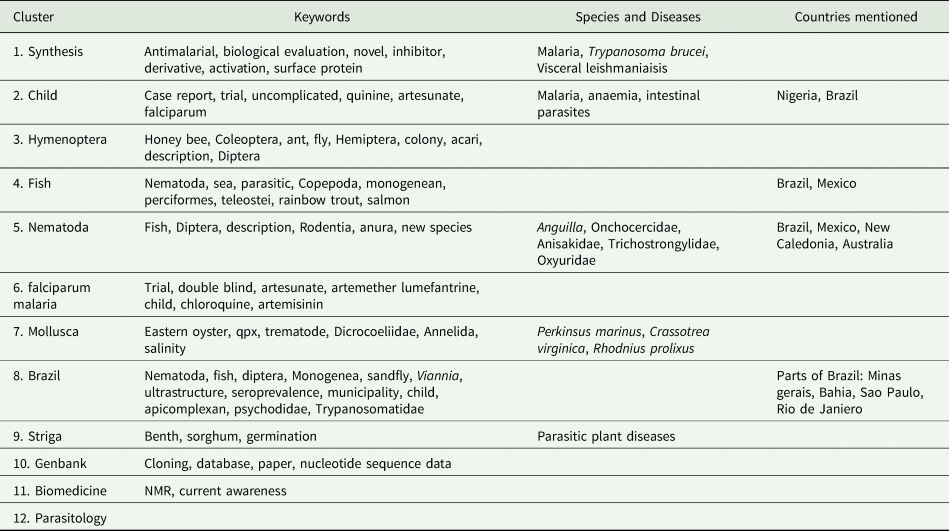
Complete bibliographic data from 173 766 publications were imported into VOSviewer for analyses. Dimensions do not include author keywords or abstracts and so the analysis was restricted to the most important 2000 words appearing in article titles providing a high-level overview of the discipline of parasitology. Eleven main clusters were identified (Fig. 6) and are summarized in Table 5. The network is dominated by seven main themes (clusters 1–6 and 8). The search for new drugs or inhibitors for the three main neglected tropical diseases (NTDs) (malaria, trypanosomiasis and leishmaniasis) dominates cluster 1 ‘Synthesis’. Cluster 2 is dominated by ‘child health’ and ‘malaria’ or ‘gastrointestinal parasites’; cluster 3 contains studies on a wide range of Insects – the Hymenoptera; cluster 4 is dominated by fish parasite studies mainly on Nematodes; this overlaps considerably with cluster 5. Cluster 6 reflects drug treatment of falciparum malaria. Cluster 8 demonstrates the considerable contribution made to parasitology by a wide range of studies emerging from Brazil. Four additional small, specialist clusters exist on parasites of molluscs (cluster 7), parasitic plants (cluster 9), nuclear magnetic resonance (cluster 11) and the publishing trend of depositing sequence data in GenBank (cluster 10).
VOSviewer visualization map of the 2000 most relevant words present in 174 300 publications identified in the Dimensions database using a search based on ‘parasite’ in title or abstract for the years 1989–2019 inclusive. Analysis in VOSviewer is based on publication title only.

Main clusters identified using VOSviewer and the 174 300 publications from the Dimensions dataset (1989–2019 inclusive)

Comparison between 1989–1993 and 2015–2019
SWIFT-Review was used to investigate trends in parasitology for the two time periods that represent the extremes of the 30-year time span (n = 12 161 and 35 174 publications, respectively). In the first instance, the power of SWIFT-review to generate topic models was used to prepare lists of topics for each time period (Supplementary Material 2). Lay descriptions are provided for the top 30 topic models as a way of providing an interpretation of that model. Although subjective, it does provide a way of labelling the topic. Consistently it can be observed that certain technology is common to both time periods; ‘in vitro culture’, ‘ELISA’ and ‘electron microscopy’ appear in both lists. In recent times, the emergence of ‘-omics’ technology, ‘molecular analyses’ and ‘diagnostics’ is apparent.
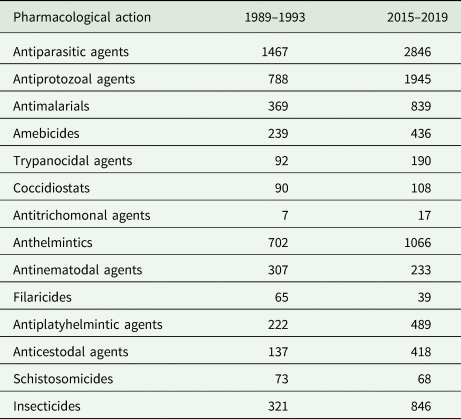
Topics associated with ‘antiparasitics’ were chosen for further study, as parasite control is an important theme in parasitology. The Tag Browser in SWIFT-Review allows easy access to MeSH categories and so MeSH Pharmacological Actions was used here to identify the number of publications appearing in the categories relevant to ‘antiparasitic agents’ (Table 6).
Number of published papers appearing with the designated Pharmacological action tag in SWIFT-Review over the two time periods 1989–1993 and 2015–2019

Data were from MEDLINE (n = 12 161 and 35 174 publications, respectively).
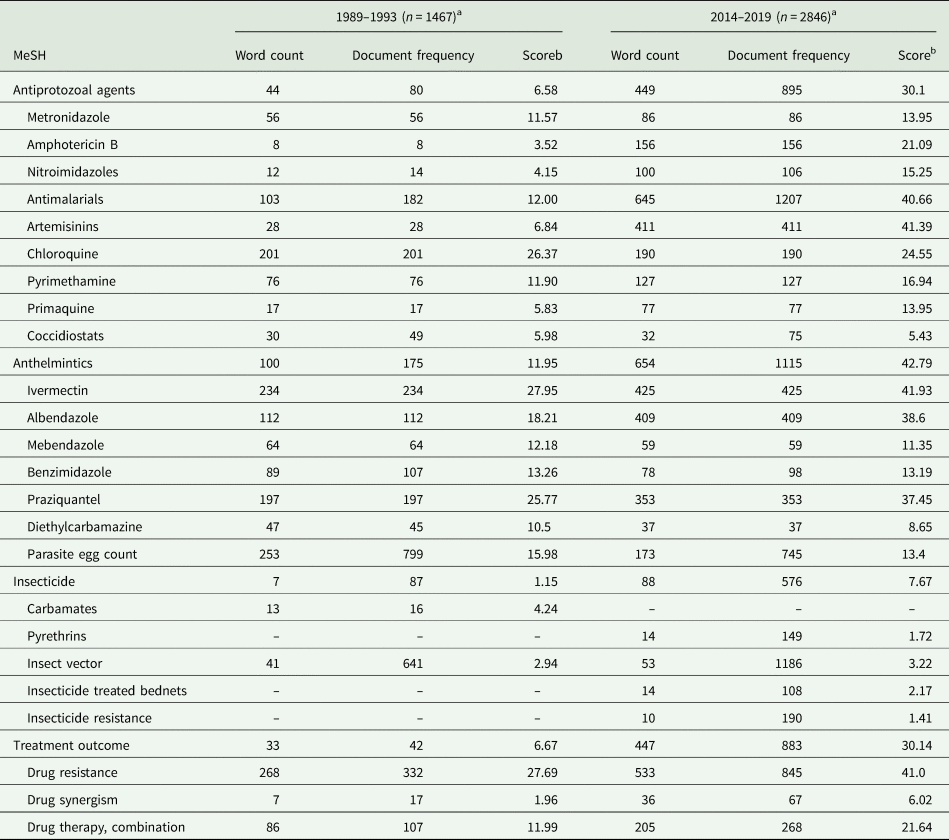
The data indicate that during the two time periods the number of papers being published on antiparasitic agents has increased significantly, with the greatest change being associated with antiprotozoal agents. The MeSH term ‘antiprotozoal agents’ is made up of five sub-categories and they were also investigated in order to explain the change (Table 7). The increase is partly explained by an increase in studies on ‘antimalarials’ and to a significantly less extent the other sub-categories, including the ‘nitroimidazoles’. Studies on ‘anthelmintics’ and ‘insecticides’ have also increased but to a lesser extent.
Differences in number of publications on antiprotozoal agents in the two time periods 1989–1993 and 2015–2019

Data from MEDLINE and analysed in SWIFT-Review.
a Accessed 28/3/2020.
b A SWIFT-Review score which is a modified term frequency/inverse document frequency (tf-idf) score for each term found in the selected documents. This quantifies the importance of terms in the selected documents as compared to the rest of the words representing the corpus.
Over-represented words in the two datasets were investigated by generating fingerprints and word clouds in SWIFT-Review. Examples of word clouds emerging from these analyses are present in Supplementary Materials 3. If the word clouds are compared for the antiprotozoal agents, we can see that between 1989 and 1993, the literature was dominated by studies on ‘chloroquine’ and ‘albendazole’, and to a lesser extent by terms such as ‘drug resistance’, ‘metronidazole’ and ‘pyrimethamine’. In the time period 2015–2019, ‘artemisinins’ and ‘albendazole’ emerge as the two main terms; this point is emphasized by the word clouds generated by the antimalarials category. In amebicides, we can document the rise of ‘amphotericin B’ in recent years.
In anthelmintics, ‘praziquantel’ and ‘albendazole’ are the most referenced drugs, but note the relative change in publication emphasis over the two time periods (as indicated by the size of the words appearing in the word clouds), with ‘albendazole’ being increasingly studied for the treatment of tapeworms and flatworms. If we consider insecticides, we see the same if not increasing emphasis on ‘ivermectin’ and ‘pyrethrins’, and in recent years the emergence of various other insecticides such as ‘decamethrin’, ‘selamectin’, ‘fipronil’ and others.
The MeSH heading ‘Treatment outcome’ significantly increases over the 30-year period, which is associated with a 20-fold increase in publications tagged with this heading, as does ‘Drug resistance’, ‘Drug synergism’ and ‘Drug combination therapy’ (Table 7).
Discussion
Text-mining analyses of the parasitology literature are presented here using a variety of commonly used bibliographic methods. The tools used in this study are relatively straight forward to use and limited only by the ability to extract data from public databases and the need to analyse thousands of publications. In this study, several different approaches were used to analyse data from the Dimensions, WoS and MEDLINE databases. All of these public databases possess advantages and disadvantages; for example, the Dimensions database allows the export of 50 000 lines of data but does not include author keywords; both Web of Science and Scopus have restrictions on data downloads and MEDLINE does not include citation data, which limits the usefulness of this database. Data from Dimensions are easily exported in csv format that is directly compatible with the software VOSviewer, providing another useful feature of this database. Nevertheless, bibliometric analyses are not trivial.
Natural language processing (NLP) is a branch of machine learning that deals with processing and analysing, ‘natural language’ (Bird et al., Reference Bird, Klein and Loper2009). Topic models are statistical models of natural language that are used to identify hidden structure in text. Common algorithms and approaches for performing topic modelling include Latent Semantic Analysis (LSA/LSI), Latent Dirichlet Allocation (LDA) and Non-negative matrix factorization (NMF). Fung and colleagues, for example, used LDA to analyse trends in global health twitter conversations (Fung et al., Reference Fung, Jackson, Ahweyevu, Grizzle, Yin, Tse, Liang, Sekandi and Fu2017), and demonstrated that the most popular topics mentioned were prevention, control, treatment, advocacy, epidemiological information and societal impact. SWIFT-Review contains a workflow for topic modelling based on LDA which was used in this study.
The MeSH subject headings were also used in this study (https://www.nlm.nih.gov/mesh/introduction.html). These tag articles in MEDLINE and link the article to important, well defined important biomedical concepts (Baumann, Reference Baumann2016). Ramos and colleagues used MeSH headings extensively in their analyses of Chagas disease research, highlighting the simplicity and powerful nature of this data system for analyses of topics (Ramos et al., Reference Ramos, González-Alcaide, Gascón and Gutiérrez2011; González-Alcaide et al., Reference González-Alcaide, Salinas and Ramos2018).
Regular changes in the use of terminology and nomenclature are common in science, as well as between different countries and languages. An example is the use of leishmaniasis and leishmaniosis, both of which are used to describe the disease resulting from infections by Leishmania species. Ideally, all analyses based on word co-occurrence require pre-processing of word data to merge such related terms; SciMAT allows the user to do this through built-in methods that require curation.
Research in parasitology over the last 30 years or so covers an exceedingly large number of topics and so it is not possible to discuss all the topics here; we simply attempt to highlight significant areas of interest raised by these analyses. Nearly all bibliometric studies in parasitology agree on several important points; the first is the amount of literature in the discipline is rapidly increasing over time (Garrido-Cardenas et al., Reference Garrido-Cardenas, Mesa-Valle and Manzano-Agugliaro2018). The dependency on technology is also increasingly clear, a point also emphasized by others, such as in the application of molecular technologies to parasitology (Selbach et al., Reference Selbach, Jorge, Dowle, Bennett, Chai, Doherty, Eriksson, Filion, Hay, Herbison, Lindner, Park, Presswell, Ruehle, Sobrinho, Wainwright and Poulin2019). Finally, the amount of literature on malaria dominates over all over species and diseases. We endorse these points as they are consistent with the outcomes of our studies presented here.
The WoS category ‘Parasitology’ identifies ~ 109 000 unique published papers published between 1989 and 2019; this data crosses over 200 WoS categories including ‘veterinary sciences’, ‘tropical medicine’, ‘biochemistry’, ‘molecular biology’ and ‘immunology’, amongst many others. This multidisciplinary nature of parasitology was noted previously by others (Stothard et al., Reference Stothard, Littlewood, Gasser and Webster2018).
Preliminary analyses of a small dataset comprising ~ 6800 papers identified through a simple search of WoS with the keyword ‘Parasitology’ for the years 1989–2019 was further broken down into 27 clusters from this time period using VOSviewer, an approach based on co-occurrence of words in the publication titles. The ten clusters containing the largest number of publications were ‘aquaculture’ and ‘parasitology’ (Lafferty et al., Reference Lafferty, Harvell, Conrad, Friedman, Kent, Kuris, Powell, Rondeau and Saksida2015), ‘drug resistance in nematodes’ (Kaplan and Vidyashankar, Reference Kaplan and Vidyashankar2012), ‘dendritic cells’ and ‘immunity’ (Ng et al., Reference Ng, Hsu, Mandell, Roediger, Hoeller, Mrass, Iparraguirre, Cavanagh, Triccas, Beverley, Scott and Weninger2008), ‘DNA barcoding of helminths’ (Derycke et al., Reference Derycke, Vanaverbeke, Rigaux, Backeljau and Moens2010), ‘human gastrointestinal infections’ (Thompson and Smith, Reference Thompson and Smith2011), ‘drug discovery’ (Miller et al., Reference Miller, Ackerman, Su and Wellems2013), ‘cell invasion by Apicomplexa’ (Sibley, Reference Sibley2011), ‘omics and helminths’ (Cwiklinski and Dalton, Reference Cwiklinski and Dalton2018), ‘protozoal abortifacients’ (Dubey et al., Reference Dubey, Buxton and Wouda2006) and research on Echinococcus (Zhang et al., Reference Zhang, Zhang, Wu, Shi, Li, Zhou, Wen and McManus2015). These topics are all consistent with the broader themes obtained from the WoS category ‘Parasitology’.
Analyses of a dataset containing ~109 000 publications from the WoS category ‘Parasitology’ using SciMAT showed that Parasitology is continuously evolving over time although several major themes are consistently identified such as ‘malaria’, ‘trypanosomiasis’ and ‘nematode research’ (including S. mansoni and liver fluke). Also worthy of mention, is the presence of terms relating to ‘phylogeny’ throughout the years. This reflects the use of molecular phylogenetic approaches to study a wide variety of taxonomic and evolutionary questions in parasitology; this point was also documented by Selbach and colleagues in their studies on ‘parasitology research in the molecular age’ (Selbach et al., Reference Selbach, Jorge, Dowle, Bennett, Chai, Doherty, Eriksson, Filion, Hay, Herbison, Lindner, Park, Presswell, Ruehle, Sobrinho, Wainwright and Poulin2019).
Analyses of the performance of the clusters of terms over the period 1989–2019 showed that malaria was the most heavily studied research area, with an H-index of 163 from 18 880 publications (Table 3). Other prominent diseases appear in a variety of clusters; toxoplasmosis, for example, emerges in a cluster associated with the prevalence of parasites. This clearly reflects the global effort in Toxoplasma research to define the population structure by sampling a wide variety of hosts including chickens (Dubey et al., Reference Dubey, Pena, Cerqueira-Cézar, Murata, Kwok, Yang, Gennari and Su2020). The kinetoplastids (Leishmania and Trypansosoma) also feature predominantly in the performance data; this covers a wide range of areas such as differentiation, immunology (through the Dendritic Cell cluster), drug development and the Cardiomyopathy cluster that is closely linked to T. cruzi (González-Alcaide et al., Reference González-Alcaide, Salinas and Ramos2018). In a veterinary context, the main performing discipline areas were haemonchosis (and anthelmintic resistance) (Laing et al., Reference Laing, Kikuchi, Martinelli, Tsai, Beech, Redman, Holroyd, Bartley, Beasley, Britton, Curran, Devaney, Gilabert, Hunt, Jackson, Johnston, Kryukov, Li, Morrison, Reid, Sargison, Saunders, Wasmuth, Wolstenholme, Berriman, Gilleard and Cotton2013) and ticks and tick-borne diseases (Jongejan and Uilenberg, Reference Jongejan and Uilenberg2004).
Analyses of the title data in Dimensions identified 11 main, high-level clusters representing the major themes within the discipline. The cluster containing ‘Synthesis’ is very much focussed on the discovery of new anti-infective agents (Jomaa et al., Reference Jomaa, Wiesner, Sanderbrand, Altincicek, Weidemeyer, Hintz, Türbachova, Eberl, Zeidler, Lichtenthaler, Soldati and Beck1999; Fidock et al., Reference Fidock, Rosenthal, Croft, Brun and Nwaka2004) as well as new ways of production of existing drugs and candidates (Martin et al., Reference Martin, Piteral, Withers, Newman and Keasling2003; Ro et al., Reference Ro, Paradise, Quellet, Fisher, Newman, Ndungu, Ho, Eachus, Ham, Kirby, Chang, Withers, Shiba, Sarpong and Keasling2006). These concepts are also highlighted in the ‘falciparum malaria’ cluster where the themes are dominated by treatment of malaria (White et al., Reference White, Pukrittayakamee, Hien, Faiz, Mokuolu and Dondorp2014) and the emergence of drug resistance to artemisinin (Dondorp et al., Reference Dondorp, Nosten, Yi, Das, Phyo, Tarning, Lwin, Ariey, Hanpithakpong, Lee, Ringwald, Silamut, Imwong, Chotivanich, Lim, Herdman, An, Yeung, Singhasivanon, Day, Lindegardh, Socheat and White2009).
The term ‘child’ networks frequently with ‘malaria’ or ‘intestinal parasites’; the Global burden of Diseases studies amongst others have highlighted the importance of this category of studies (Lozano et al., Reference Lozano, Naghavi, Foreman, Lim, Shibuya, Aboyans, Abraham, Adair, Aggarwal, Ahn, AlMazroa, Alvarado, Anderson, Anderson, Andrews, Atkinson, Baddour, Barker-Collo, Bartels, Bell, Benjamin, Bennett, Bhalla, Bikbov, Bin Abdulhak, Birbeck, Blyth, Bolliger, Boufous, Bucello, Burch, Burney, Carapetis, Chen, Chou, Chugh, Coffeng, Colan, Colquhoun, Colson, Condon, Connor, Cooper, Corriere, Cortinovis, Courville De Vaccaro, Couser, Cowie, Criqui, Cross, Dabhadkar, Dahodwala, De Leo, Degenhardt, Delossantos, Denenberg, Des Jarlais, Dharmaratne, Dorsey, Driscoll, Duber, Ebel, Erwin, Espindola, Ezzati, Feigin, Flaxman, Forouzanfar, Fowkes, Franklin, Fransen, Freeman, Gabriel, Gakidou, Gaspari, Gillum, Gonzalez-Medina, Halasa, Haring, Harrison, Havmoeller, Hay, Hoen, Hotez, Hoy, Jacobsen, James, Jasrasaria, Jayaraman, Johns, Karthikeyan, Kassebaum, Keren, Khoo, Knowlton, Kobusingye, Koranteng, Krishnamurthi, Lipnick, Lipshultz, Lockett Ohno, Mabweijano, MacIntyre, Mallinger, March, Marks, Marks, Matsumori, Matzopoulos, Mayosi, McAnulty, McDermott, McGrath, Memish, Mensah, Merriman, Michaud, Miller, Miller, Mock, Mocumbi, Mokdad, Moran, Mulholland, Nair, Naldi, Narayan, Nasseri, Norman, O'Donnell, Omer, Ortblad, Osborne, Ozgediz, Pahari, Pandian, Panozo Rivero, Perez Padilla, Perez-Ruiz, Perico, Phillips, Pierce, Pope, Porrini, Pourmalek, Raju, Ranganathan, Rehm, Rein, Remuzzi, Rivara, Roberts, Rodriguez De León, Rosenfeld, Rushton, Sacco, Salomon, Sampson, Sanman, Schwebel, Segui-Gomez, Shepard, Singh, Singleton, Sliwa, Smith, Steer, Taylor, Thomas, Tleyjeh, Towbin, Truelsen, Undurraga, Venketasubramanian, Vijayakumar, Vos, Wagner, Wang, Wang, Watt, Weinstock, Weintraub, Wilkinson, Woolf, Wulf, Yeh, Yip, Zabetian, Zheng, Lopez and Murray2012; Vos et al., Reference Vos, Flaxman, Naghavi, Lozano, Michaud, Ezzati, Shibuya, Salomon, Abdalla, Aboyans, Abraham, Ackerman, Aggarwal, Ahn, Ali, Almazroa, Alvarado, Anderson, Anderson, Andrews, Atkinson, Baddour, Bahalim, Barker-Collo, Barrero, Bartels, Basáñez, Baxter, Bell, Benjamin, Bennett, Bernabé, Bhalla, Bhandari, Bikbov, Abdulhak, Birbeck, Black, Blencowe, Blore, Blyth, Bolliger, Bonaventure, Boufous, Bourne, Boussinesq, Braithwaite, Brayne, Bridgett, Brooker, Brooks, Brugha, Bryan-Hancock, Bucello, Buchbinder, Buckle, Budke, Burch, Burney, Burstein, Calabria, Campbell, Canter, Carabin, Carapetis, Carmona, Cella, Charlson, Chen, Cheng, Chou, Chugh, Coffeng, Colan, Colquhoun, Colson, Condon, Connor, Cooper, Corriere, Cortinovis, De Vaccaro, Couser, Cowie, Criqui, Cross, Dabhadkar, Dahiya, Dahodwala, Damsere-Derry, Danaei, Davis, De Leo, Degenhardt, Dellavalle, Delossantos, Denenberg, Derrett, Des Jarlais, Dharmaratne, Dherani, Diaz-Torne, Dolk, Dorsey, Driscoll, Duber, Ebel, Edmond, Elbaz, Ali, Erskine, Erwin, Espindola, Ewoigbokhan, Farzadfar, Feigin, Felson, Ferrari, Ferri, Fèvre, Finucane, Flaxman, Flood, Foreman, Forouzanfar, Fowkes, Franklin, Fransen, Freeman, Gabbe, Gabriel, Gakidou, Ganatra, Garcia, Gaspari, Gillum, Gmel, Gosselin, Grainger, Groeger, Guillemin, Gunnell, Gupta, Haagsma, Hagan, Halasa, Hall, Haring, Haro, Harrison, Havmoeller, Hay, Higashi, Hill, Hoen, Hoffman, Hotez, Hoy, Huang, Ibeanusi, Jacobsen, James, Jarvis, Jasrasaria, Jayaraman, Johns, Jonas, Karthikeyan, Kassebaum, Kawakami, Keren, Khoo, King, Knowlton, Kobusingye, Koranteng, Krishnamurthi, Lalloo, Laslett, Lathlean, Leasher, Lee, Leigh, Lim, Limb, Lin, Lipnick, Lipshultz, Liu, Loane, Ohno, Lyons, Ma, Mabweijano, MacIntyre, Malekzadeh, Mallinger, Manivannan, Marcenes, March, Margolis, Marks, Marks, Matsumori, Matzopoulos, Mayosi, McAnulty, McDermott, McGill, McGrath, Medina-Mora, Meltzer, Memish, Mensah, Merriman, Meyer, Miglioli, Miller, Miller, Mitchell, Mocumbi, Moffitt, Mokdad, Monasta, Montico, Moradi-Lakeh, Moran, Morawska, Mori, Murdoch, Mwaniki, Naidoo, Nair, Naldi, Narayan, Nelson, Nelson, Nevitt, Newton, Nolte, Norman, Norman, O'Donnell, O'Hanlon, Olives, Omer, Ortblad, Osborne, Ozgediz, Page, Pahari, Pandian, Rivero, Patten, Pearce, Padilla, Perez-Ruiz, Perico, Pesudovs, Phillips, Phillips, Pierce, Pion, Polanczyk, Polinder, Pope, Popova, Porrini, Pourmalek, Prince, Pullan, Ramaiah, Ranganathan, Razavi, Regan, Rehm, Rein, Remuzzi, Richardson, Rivara, Roberts, Robinson, De Leòn, Ronfani, Room, Rosenfeld, Rushton, Sacco, Saha, Sampson, Sanchez-Riera, Sanman, Schwebel, Scott, Segui-Gomez, Shahraz, Shepard, Shin, Shivakoti, Silberberg, Singh, Singh, Singh, Singleton, Sleet, Sliwa, Smith, Smith, Stapelberg, Steer, Steiner, Stolk, Stovner, Sudfeld, Syed, Tamburlini, Tavakkoli, Taylor, Taylor, Taylor, Thomas, Thomson, Thurston, Tleyjeh, Tonelli, Towbin, Truelsen, Tsilimbaris, Ubeda, Undurraga, Van Der Werf, Van Os, Vavilala, Venketasubramanian, Wang, Wang, Watt, Weatherall, Weinstock, Weintraub, Weisskopf, Weissman, White, Whiteford, Wiersma, Wilkinson, Williams, Williams, Witt, Wolfe, Woolf, Wulf, Yeh, Zaidi, Zheng, Zonies, Lopez and Murray2012). The decrease in malaria mortality was noted in response to the global effort on control programs (Murray et al., Reference Murray, Rosenfeld, Lim, Andrews, Foreman, Haring, Fullman, Naghavi, Lozano and Lopez2012), having averted 663 (542–753 credible interval) million clinical cases between 2000 and 2015 (Bhatt et al., Reference Bhatt, Weiss, Cameron, Bisanzio, Mappin, Dalrymple, Battle, Moyes, Henry, Eckhoff, Wenger, Briët, Penny, Smith, Bennett, Yukich, Eisele, Griffin, Fergus, Lynch, Lindgren, Cohen, Murray, Smith, Hay, Cibulskis and Gething2015). Major themes on ‘child’ and ‘intestinal parasites’ focus on malnutrition (Stephenson et al., Reference Stephenson, Latham and Ottesen2000), disease burden (Brooker, Reference Brooker2010; Fürst et al., Reference Fürst, Keiser and Utzinger2012) and control (Gardner and Hill, Reference Gardner and Hill2001; Ottesen et al., Reference Ottesen, Hooper, Bradley and Biswas2008).
Hymenoptera is a very large order of insects that include bees, wasps, ants and sawflies. The cluster called ‘Hymenoptera’ covers a wide range of biology studies including social behaviour (Hamilton, Reference Hamilton1964), ecology (Steffan-Dewenter et al., Reference Steffan-Dewenter, Münzenberg, Bürger, Thies and Tscharntke2002) and concerns about pollinator decline (Goulson et al., Reference Goulson, Lye and Darvill2008), microbiomes (Singh et al., Reference Singh, Levitt, Rajotte, Holmes, Ostiguy, Vanengelsdorp, Lipkin, Depamphilis, Toth and Cox-Foster2010); biodiversity and phylogenetics (Wheeler et al., Reference Wheeler, Whiting, Wheeler and Carpenter2001; Cardinale et al., Reference Cardinale, Harvey, Gross and Ives2003) for example.
The clusters ‘fish’ and ‘Nematoda’ are very large and closely linked in content. Themes include ‘fish-borne parasitic zoonoses’ (Chai et al., Reference Chai, Murrell and Lymbery2005) and food-borne diseases (Dorny et al., Reference Dorny, Praet, Deckers and Gabriel2009), ‘impact of parasites on fish farming’ (Piasecki et al., Reference Piasecki, Goodwin, Eiras and Nowak2004; Torrissen et al., Reference Torrissen, Jones, Asche, Guttormsen, Skilbrei, Nilsen, Horsberg and Jackson2013), ‘immunity to parasite infections’ (Alvarez-Pellitero, Reference Alvarez-Pellitero2008), ‘biodiversity and phylogenetics’ (Poulin and Mouillot, Reference Poulin and Mouillot2003) and ‘ecology’ (Torchin et al., Reference Torchin, Lafferty, Dobson, McKenzie and Kuris2003).
Another major cluster identifies ‘Brazil’ as a rich source of parasitology research in many areas including Chagas disease (Schmunis and Yadon, Reference Schmunis and Yadon2010), toxoplasmosis (Dubey et al., Reference Dubey, Lago, Gennari, Su and Jones2012), malaria (Oliveira-Ferreira et al., Reference Oliveira-Ferreira, Lacerda, Brasil, Ladislau, Tauil and Daniel-Ribeiro2010), leishmaniasis (Barral et al., Reference Barral, Pedral-Sampaio, Grimaldi, Momen, McMahon-Pratt, Ribeiro De Jesus, Almeida, Badaro, Barral-Netto, Carvalho and Johnson1991), schistosomiasis (Dantas-Torres and Otranto, Reference Dantas-Torres and Otranto2014) as well as a wide range of veterinary parasites (Dantas-Torres and Otranto, Reference Dantas-Torres and Otranto2014; Grisi et al., Reference Grisi, Leite, Martins, de Barros, Andreotti, Cançado, de León, Pereira and Villela2014). The literature on and including Brazil is far too extensive to cover here; nevertheless, it is sufficient to recognize the importance of Brazil in the world of parasitology research. It is interesting to note that the research productivity of other countries is recognized as greater than Brazil (Falagas et al., Reference Falagas, Papastamataki and Bliziotis2006; Sweileh, Reference Sweileh2019); the emphasis on Brazil in this study occurs because of the frequent use of this term in the title and/or abstract of the publications analysed.
Themes in the ‘Mollusca’ cluster are concerned with the biology of those parasites that infect molluscs such as oysters and other shellfish (Guo and Ford, Reference Guo and Ford2016; Morley, Reference Morley2010) and the diseases they cause. Perkinsus (Villalba et al., Reference Villalba, Reece, Ordás, Casas and Figueras2004) and QPX (Whyte et al., Reference Whyte, Cawthorn and McGladdery1994) can have a devastating impact on the shellfish industries destined for human consumption.
The cluster ‘striga’ reflects the emerging theme associated with parasitic flowering plants, also called weedy root parasites, is increasingly recognized as economically important (Parker, Reference Parker2009) especially in crops (Scholes and Press, Reference Scholes and Press2008; Joel et al., Reference Joel, Steffens, Matthews and Kigel2017) such as Sorghum in sub-Saharan Africa (Haussmann et al., Reference Haussmann, Hess, Welz and Geiger2000).
The GenBank cluster relates to the practice of submitting sequence data to this database which is a very common practice in science. The document and word counts reflect the fact that a common statement is included in most manuscripts where sequence data are submitted to GenBank such as ‘DNA sequence data described in this manuscript was submitted to GenBank under accession numbers X, Y and Z’. The identification of this cluster provides a strong reassurance about the ability of the methodology used in this study to identify important themes in the discipline based on co-occurrence of words.
SWIFT-Review of the literature on ‘antiparasitics’ confirmed that bibliometrics could identify and confirm many of the well-known trends in parasitology that have emerged over the last 30 years. The importance of ivermectin (Campbell et al., Reference Campbell, Fisher, Stapley, Albers-Schonberg and Jacob1983), albendazole (Marriner et al., Reference Marriner, Morris, Dickson and Bogan1986) and praziquantel (Doenhoff et al., Reference Doenhoff, Cioli and Utzinger2008) as antiparasitics cannot be over emphasized, especially following their use to treat a range of parasitic diseases such as onchocerciasis, lymphatic filariasis (Taylor et al., Reference Taylor, Hoerauf and Bockarie2010), schistosomiasis (Rollinson et al., Reference Rollinson, Knopp, Levitz, Stothard, Tchuem Tchuente, Garba, Mohammed, Schur, Person, Colley and Utzinger2013) and hydatid disease (Horton, Reference Horton1989). The literature on the use of these drugs and their impact has risen significantly over the last 30 years. Further anthelmintic drug resistance has emerged as one of the greatest problems facing livestock producers today (Coles et al., Reference Coles, Jackson, Pomroy, Prichard, von Samson-Himmelstjerna, Silvestre, Taylor and Vercruysse2006; Kaplan and Vidyashankar, Reference Kaplan and Vidyashankar2012). The literature on antiprotozoal agents has increased and is dominated by antimalarial drugs and resistance to them including, artemisinin (Dondorp et al., Reference Dondorp, Nosten, Yi, Das, Phyo, Tarning, Lwin, Ariey, Hanpithakpong, Lee, Ringwald, Silamut, Imwong, Chotivanich, Lim, Herdman, An, Yeung, Singhasivanon, Day, Lindegardh, Socheat and White2009), pyrimethamine (White et al., Reference White, Pukrittayakamee, Hien, Faiz, Mokuolu and Dondorp2014) and primaquine (Howes et al., Reference Howes, Battle, Mendis, Smith, Cibulskis, Baird and Hay2016). Of further interest is the increase in reported studies on amphotericin B use for leishmaniasis (Sundar et al., Reference Sundar, Jha, Thakur, Engel, Sindermann, Fischer, Junge, Bryceson and Berman2002) and amebic meningoencephalitis (Vargas-Zepeda et al., Reference Vargas-Zepeda, Gomez-Alcala, Vasquez-Morales, Licea-Amaya, De Jonckheere and Lares-Villa2005) and nitroimidazoles for giardiasis and amebiasis (Jarrad et al., Reference Jarrad, Debnath, Miyamoto, Hansford, Pelingon, Butler, Bains, Karoli, Blaskovich, Eckmann and Cooper2016).
Trends in the development of antiparasitic drugs were investigated by comparing two time periods reflecting the beginning and end of the study period, namely 1989–199 and 2015–2019. Between these times there was a noticeable increase in papers reporting on antiparasitics, and evidence is provided that this increase is predominantly associated with the search for new antiprotozoal drugs, notably for NTDs (Shah and Gupta, Reference Shah and Gupta2019; Batista et al., Reference Batista, Gyau, Vilacha, Bosch, Lunev, Wrenger and Groves2020; Vermelho et al., Reference Vermelho, Rodrigues and Supuran2020), and to a lesser extent anthelmintics (Waller, Reference Waller2006; Vercruysse et al., Reference Vercruysse, Charlier, Van Dijk, Morgan, Geary, von Samson-Himmelstjerna and Claerebout2018). The important role of a global commitment in these endeavours, through public-private partnerships and major international consortia, cannot be over emphasized as contributing to these increases and hopefully successes (Engels and Zhou, Reference Engels and Zhou2020).
Several important research areas were not over-emphasized in this study, as being important contributors to the field of parasitology over the last 30 years. Vaccine development is one such area, and so we note here the value and importance of vaccine development in a time when drug resistance remains a concern. A ‘Call to Action’ on vaccine development was recently issued for NTDs (Bottazzi and Hotez, Reference Bottazzi and Hotez2019). The failure to identify topics such as vaccines as major themes or terms in these analyses is simply the outcome of scale; other themes simply had many more publications supporting them.
There are several limitations associated with this study that are in need of mentioning. The first relates to the different literature content contained within the different databases; this is not a new observation (Pautasso, Reference Pautasso2014), but it does potentially impact significantly on the outcomes of database searches (Moral-Muñoz et al., Reference Moral-Muñoz, Herrera-Viedma, Santisteban-Espejo and Cobo2020). Further, the use of keyword searches of title, abstract and keywords listed in publications has its limitations; it was recently reported that the content of a publication is not always accurately reflected in the title or abstract (Penning de Vries et al., Reference Penning de Vries, van Smeden, Rosendaal and Groenwold2020).
Systematic reviews (Moher et al., Reference Moher, Liberati, Tetzlaff, Altman and Group2009) are an important contributor to core knowledge in any discipline area and the number published in parasitology has been increasing over time (unpublished observations from PubMed). Such reviews are easily identifiable in PubMed through a search such as ‘parasitology AND systematic[sb]’. In 2019, there were 140 systematic reviews associated with parasitology, compared to 15 in 2010. The Cochrane library (https://www.cochranelibrary.com/search) currently contains 36 Cochrane Reviews matching parasitology in the Title Abstract Keyword. The approaches and tools outlined in this paper can fast track the identification of literature that is worthy of inclusion in a systematic review; this in itself is of considerable value to the academic community that is often faced with enormous amounts of literature to assess.
The analyses of OA publishing in parasitology shows that OA papers constitute nearly one-half of the total papers published. The results are a little miss-leading in that a significant proportion of the Green published papers are likely to be in subscription-based journals. Institutional repositories representing Green publishing are increasingly common in some countries such as Australia owing to the introduction of Government research reviews and assessments and mandates from funding bodies distributing public funds. The trends seen in this study from the citations received by the different groups of OA published papers indicate that Gold published OA papers receive the overall lowest average number of citations per group. This observation is in line with other, far more detailed bibliometric analyses that suggest there is no distinct advantage (from a citations point of view) in publishing Gold OA (Dorta-González and Santana-Jiménez, Reference Dorta-González and Santana-Jiménez2017; Breugelmans et al., Reference Breugelmans, Roberge, Tippett, Durning, Struck and Makanga2018). These observations may encourage authors to think more carefully about the value of publishing in Gold OA, and especially on the role of subscription journals and Institutional repositories, especially when research budgets are tight.
Bibliometrics represents an important and emerging area of study for the Parasitology discipline. There are many tools available now to perform these analyses; several of them based on topic modelling require a knowledge of programming in languages such as python. In keeping with the observation that technology is an important contributor to the evolution of the Parasitology discipline, we note that advances in machine and deep learning approaches to text mining provide alternative methods for the analysis of the scientific literature (Min et al., Reference Min, Lee and Yoon2017; Shardlow et al., Reference Shardlow, Ju, Li, O'Reilly, Iavarone, McNaught and Ananiadou2019).
Some specific topics delve increasingly into the area of vaccine approaches for solving parasitological issues and recent studies have highlighted pathways for N. caninum research (Reichel et al., Reference Reichel, Wahl and Ellis2020) that could be adopted for ‘Parasitology’ in general. With increasing awareness of the issues surrounding the increased resistance to chemical treatments in the field of parasitology, and reports that even the composition of the chemicals used might be in doubt (Leung et al., Reference Leung, Huang, St-Hilaire, Liu, Zheng, Cheung and Zwetsloot2020), the search for and development of efficacious vaccines will represent an increasingly important contribution to the field of Parasitology.
Supplementary material
The supplementary material for this article can be found at https://doi.org/10.1017/S0031182020001596.
Acknowledgements
We dedicate this paper to Professor Stephen Phillips MBE on his retirement as Editor in Chief of the journal Parasitology (Cambridge University Press). Thanks go to Scott McWhirter (UTS Research Office) for facilitating the use of the Dimensions database.
Financial support
This work was supported by a Spanish Ministry of Science and Innovation grant awarded to Dr Cobo with reference PID2019-105381GA-I00 (iScience).
Conflicts of interest
None.
Ethical standards
Not applicable.