Published online by Cambridge University Press: 21 April 2004
In July 2003, at the request of the APSA Committee on International Political Science, the National Office undertook a survey of APSA's international membership—defined as those members that live or work outside the United States. The survey was sent to all 1,460 APSA members who resided overseas at the time, generating 559 responses—a response rate of 38.2%.
The survey instrument consisted of 28 questions of mixed types, including: open-ended (4), yes/no (8), ranking (5), and multiple choice (11) questions. It was administered online between July 18 and September 1, 2003. The survey results will be used by the Committee and APSA staff as an important source of information during the ongoing reevaluation of APSA's international initiatives. More information about this process will be forthcoming in these pages over the next several issues.
For more information about the survey or its results, please contact Bahram Rajaee at brajaee@apsanet.org. To view complete results and the report's Appendix visit www.apsanet.org/about/international/survey.pdf.
The sections below summarize the highlights of the survey results.
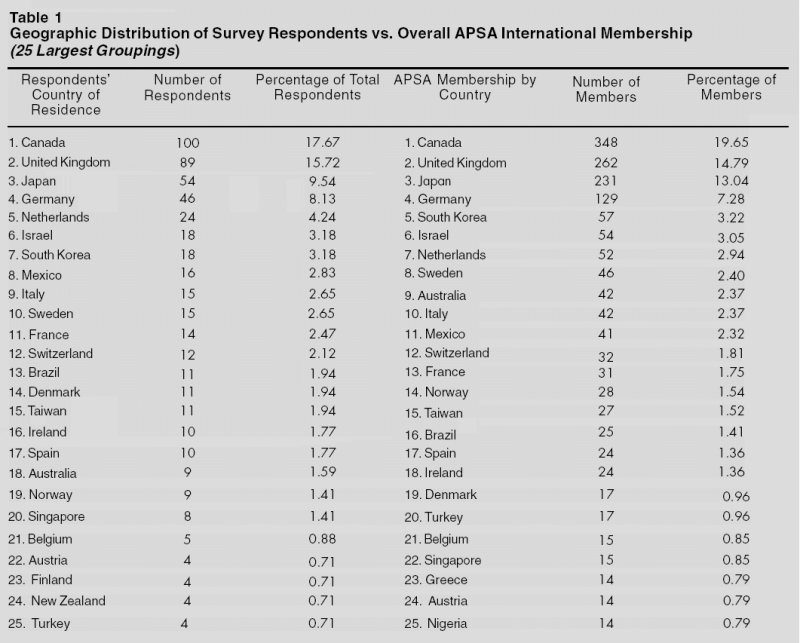
The geographic distribution of survey respondents generally mirrored that of the APSA international membership. Nine of the 10 largest national groupings of respondents are also represented in the 10 largest national membership groupings. This pattern is also evident in the rest of the 25 largest national groupings of respondents. Only two (New Zealand and Finland) were not represented in the 25 largest APSA national membership groupings.
75% of survey respondents are employed as political scientists in an academic setting (political science or social science department). This is significantly higher than the 44.10% of U.S.-based members that classify themselves in that manner.
75% of the survey respondents were male. This compares with 69% of the overall APSA membership.
47% of the survey respondents were over 40 years of age. Most of the rest were between the ages of 30 and 39.
88% of the survey respondents attended graduate school in North America or Europe.
54% of the survey respondents have been members of APSA for at least five years.
A significant majority of survey respondents joined APSA to participate in the Annual Meeting (58%) or to receive the journals (66%). Moreover, 75% of respondents say they attend thes Annual Meeting regularly or frequently, and 72% participate as a chair, discussant, panelist, or poster presenter when they do attend.
80% of respondents believe that the utility of the professional services and benefits provided by APSA is “Good” or “Excellent” when compared with that of other associations to which they belong.
58% of respondents believe that cost is a main or determining factor in preventing greater participation in APSA by their international colleagues.
91% of survey respondents say they are interested in publishing their research in APSA journals; however, only 19% have submitted articles for publication.
72% of respondents indicate that they access the APSA web site monthly or occasionally, and 77% rate the web site's userfriendliness as “Good” or “Excellent.” 62% state that their use of the web site is driven by the desire to have access to Annual Meeting information.
46% of respondents say they are aware of APSA's travel grant program for the Annual Meeting. Nevertheless, 87% indicate that they have never applied to the program.
75% of respondents state that they are not aware of APSA's Small Research Grant Program. As a result, 99% of respondents have never applied.
Significant numbers of respondents indicated a strong preference to see improvements in a number of areas. These include: reduced membership rates for those residing overseas (63%); greater opportunities for professional development (58%); more research assistance for international members (55%); greater institutional support for political science departments overseas (54%); and a greater internationalization of the APSA E-Jobs listings (50%).
Among the U.S.-based membership, out of the combined total of 21,315 specializations listed, 8,197, or 38.46%, are in the subfields of international or comparative politics. APSA records indicate a total of 24,372 combined listings of specializations for its overall membership (U.S. and non-U.S. members).1
This number significantly exceeds the total membership of APSA due to multiple listings of specializations per member.
The single largest APSA Organized Section is the Comparative Politics Section, with 1,579 members. No other Section membership exceeds 900. Of the combined total of 19,514 Section memberships, 3,713—approximately 19%—are in Sections with international themes.2
As with the case of academic specializations, the combined total of Section memberships exceeds that of the APSA memberships due to individual members belonging to multiple Sections.
APSA currently has 10 international political science departments that are members of its Departmental Services Program—out of a total of 698. These include departments in: Canada (5); Nigeria (1); The Netherlands (1); Turkey (1); and the UK (2).
APSA currently is engaged in two active exchange programs with other national associations. These involve the British Political Studies Association (PSA) and the Japanese Political Science Association (JPSA).
Out of 444 APSA members participating in voluntary governance activities, 16, or 3.6%, are international members.

May 13–16: Organization for the History of Canada Conference, “Canadian-American Relations: Do Borders Matter?” Ottawa, Canada, http://www.orghistcanada.ca/.
May 27–29: Slovenian Political Science Association Conference, “Slovenia in the European Union: Possibilities and Opportunities,” in Slovene and English, Portorose, Slovenia, http://guests.fdv.uni-lj.si/spod/default.htm.
June 3–5: Canadian Political Science Association Annual Conference, University of Manitoba, Winnipeg, Canada, http://www.cpsaacsp.ca/.
June 11–12: “Advancing Political Civilization in China,” Co-sponsored by the Association of Chinese Political Studies, Remin University of China, Chinaelections.org, and the Association of Chinese Professors of Social Sciences in the United States, Beijing, China, http://acps.sfsu.edu/.
June 18–19: European Political Science Network Plenary Conference, “Political Science After EU Enlargement, Challenges to the Discipline,” Charles University, Prague, http://www.epsnet.org/.
June 24–26: Research Committee on Political Philosophy Annual Conference, “Re-conceptualizing the Political Agenda: Cosmopolitan Citizenship, World Peace and Non-Violence,” Moscow, Russia, ilyin@politstudies.ru.
June 24–26: Second Pan-European Conference of the ECPR Standing Group on the EU, SAIS Bologna Center of the Johns Hopkins University, Bologna, Italy, http://www.jhubc.it/ecpr-bologna/.
July 6–9: Seventh International Conference of the History of Concepts, “Transatlantic Dialogues,” Rio De Janeiro, Brazil, jferes@iuperj.br.
July 7–8: Fifth ISA International Comparative Interdisciplinary Studies Section Millennium Conference, “Charting the Course of the International Order in the 21st Century,” Salzburg, Austria, http://www.isanet.org/sections/cis/2004.htm.
September 9–11: Fifth Pan-European ECPR International Relations Conference, “Constructing World Orders,” Netherlands Congress Center, The Hague, Netherlands, http://www.sgir.org/conference2004/.
September 20–21: International Colloquium Institute of Governance, “Governing the Corporation: Mapping the Loci of Power in Corporate Governance Design,” Institute of Governance, Public Policy and Social Research, Queen's University, Belfast, Northern Ireland, http://www.governance.qub.ac.uk/.
October 7–9: 25th International Congress of the Latin American Studies Association, Hotel Riviera, Las Vegas, USA, http://lasa.international.pitt.edu/call2004/Call2004.pdf.
November 11–14: African Studies Association Annual Meeting, Held Jointly with the Canadian Association of African Studies, New Orleans, USA, http://www.africanstudies.org/.
November 11–14: Annual Meeting of the American Studies Association, “Crossroads of Cultures,” Hyatt Regency Hotel, Atlanta, USA, http://www.georgetown.edu/crossroads/AmericanStudiesAssn/annualmeeting/.
November 20–23: 38th Annual Meeting of the Middle East Studies Association, Hyatt Regency, San Francisco, USA, http://fp.arizona.edu/mesassoc/cfp/CFPhome.htm.
December 4–7: 36th Annual Conference of the American Association for the Advancement of Slavic Studies, Boston Marriot Copley Place, Boston, USA, http://www.fas.harvard.edu/~aaass/.
March 18–23: ECPR Joint Sessions, Grenada, Spain, http://www.essex.ac.uk/ecpr/.
March 31–April 2: European Union Studies Association Ninth Biennial International Conference, Hyatt Regency, Austin, Texas, http://www.eustudies.org/conf2005.html.
April 14–19: ECPR Joint Sessions of Workshops, Granada, Spain, http://www.essex.ac.uk/ecpr/events/jointsessions/granada/index.asp.
August 24–27: 1st World International Studies Conference Meeting, Istanbul, Turkey, http://www.siyasiilimler.org/.
September 8–11: Third ECPR Conference, Budapest University of Economic Sciences, Hungary, http://www.essex.ac.uk/ecpr/.

April 25–30: ECPR Joint Sessions of Workshops, Nicosia, Cyprus, http://www.essex.ac.uk/ecpr/events/jointsessions/index.asp.
July 9–13: IPSA World Congress, “Is Democracy Working?” Fukuoka, Japan, http://www.fukuoka2006.com (available January 30, 2004).
September 7–10: First ECPR Graduate Conference, Essex, UK, http://www.essex.ac.uk/ecpr/events/graduateconference/index.asp.
Highlights of the International Section of the July Issue of PS:
* International events at APSA's 100th Meeting in Chicago
* Update on the activities of the International Committee
* International membership numbers

Geographic Distribution of Survey Respondents vs. Overall APSA International Membership (25 Largest Groupings)