On 4 May 1799, a British force of nearly 50,000 under the command of Major-General David Baird, stormed Seringapatam, the fortress capital of Mysore. Seeking to quash French hopes of an alliance with a major Indian power, Richard Wellesley, the Governor-General of India waged the fourth and final Anglo–Mysore War against Seringapatam's chief Tipu Sultan. The reasons for the war are many and multifarious, but were at best tenuous. The British attack was made in two columns, with a third in reserve. The latter was commanded by a junior Lieutentant-Colonel named Arthur Wellesley. The storming was successful, and Tipu's body was found among the debris. In the assault, a hole had been blown in the wall surrounding the city prison. Hundreds of criminals escaped. Baird fully expected to be appointed governor of Seringapatam, but the Governor-General instead appointed his younger brother, Arthur, amid much controversy. The scene was now set for the future Duke of Wellington's first independent military command.Footnote 1
For Lieutenant-Colonel Wellesley, life as the military-governor of Seringapatam was never mundane, as there was typically a large amount of trivial issues to deal with, from resistance to the remarriage of female Christian converts, to the number of pagodas a supply train needed.Footnote 2 Then, in early February, a new military threat reared its head. Reports were received of ‘a number of vagabond horsemen with evil intentions of different kinds’.Footnote 3 Banditry like this was nothing out of the ordinary, but evidence soon began to arrive of a series of widespread violent attacks that appeared coordinated.Footnote 4 Although Wellesley was unsure of who the ‘vagabond horsemen’ were or what they represented, one thing became clear: as attacks mounted, the British were facing a full-scale rebellion against their newly established authority in Mysore. The political and military actions taken to identify and counter this rebellion constitute Arthur Wellesley's ‘command apprenticeship’, and the experience furnished Wellesley with some of the most important and valuable skills of his military career.
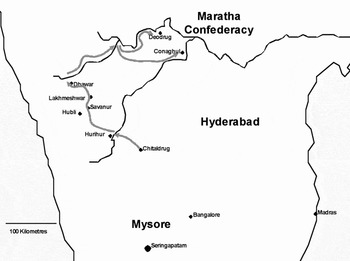
A rebellion was particularly worrying because of Mysore's strategic position, and the relatively weak state of British authority in the region. It is difficult to provide an accurate portrayal of the political geography of India, but broadly, Mysore was bordered to the north by the Maratha confederacy and the Nizam's territories, the latter centred in Hyderabad. Mysore was a huge province, with a mainly Hindu populace, although Tipu had enforced Islamic law. Seringapatam was the capital, but little central authority existed. Arthur would like to have changed this, but the diversity and conservatism of the population resisted the imposition of central rule. As such, the borders with the Maratha Confederacy, in particular, were guarded by a series of fortresses between Hurihur and Chitradurga, which the British occupied following the fall of Seringapatam.
The Maratha Confederacy was a loose conglomerate of Indian princes nominally ruled from the city of Poona by the Peshwa, Baji Rao II. Between 1664 and 1680 the Maratha Confederacy had been loosely established under the authority of a Chatrapatti or king, Shivaji, the son of a Maratha chieftain who had served in the armies of the Muslim kingdoms of Deccan India. Power was eventually concentrated in the hands of the first independent Peshwa, Baji Rao I, in the second quarter of the eighteenth century. Constant military reform had maintained the superiority of Marathan armies until the Battle of Panipat in January 1761 saw the Peshwa's army defeated by a joint Afghan–Indo–Muslim army. The Peshwa's central authority declined, and the Marathan Sardars (chieftains) gradually exerted their authority. The most powerful was Daulatrao Sindiah (hereafter Sindiah), but also threatening the stability of the Poona government was Jaswant Rao Holkar, Raghuji Bhonsle II and Dhoondiah Punt Goklah (hereafter Goklah, and not to be confused with the villain of this particular piece, Dhoondiah Vagh). By the turn of the nineteenth century, Britain and the East India Company (EIC) were faced by a disparate group of princely states which feared British encroachment, but competed with each other for influence. It was in Britain's interests to maintain this equilibrium, as, combined, the Maratha Confederacy could simultaneously threaten all three British presidencies in India.Footnote 5 Fearful of British encroachment into their territory, an insurgency that threatened British stability in Mysore was an ideal outlet for surreptitious and clandestine Maratha military action.
Added to the mix was an innumerable quantity of weak chieftains, who continued to press for the authority of the Peshwa. As well as making Maratha politics virtually impossible to comprehend, this internal rivalry weakened Maratha unity and the unpredictability and inconsistency of the Confederacy's policies towards Britain seemingly increased the vulnerability of Mysore. Relations, then, between British Mysore and the Maratha Confederacy were frosty at best. Those between Mysore and the Nizam were, by contrast, cordial. The Nizam was a British dependent, and contributed troops and horses to the British Indian Army. There was the odd controversy and rumour of betrayal, but in general Britain could rely on the Nizam for support in the event of conflict with the Confederacy, or if a rebellion developed in Mysore, because the Nizam was also threatened by the Marathas. The Marathas and the Nizam were the two major powers, but the borders of Mysore were sprinkled with numerous chieftains, minor princely states and town governors or amildars, all of which needed separate treatment. Most were, to varying degrees, loyal to Britain, but could be easily bought off, and would unilaterally change sides depending on which way the wind was blowing. They are too numerous to detail here, but several had important contributions to make to Wellesley's political and military career between February and September 1800.
When news of a series of rebellions in the northern districts of Mysore reached Seringapatam, it was Wellesley's first assumption that the Marathas were in some way involved.Footnote 6 In this assumption he was quickly proved wrong. At the centre of the rebellion that began in February 1800 was a freebooter and bandit named Dhoondiah Vagh. Certain identification of Dhoondiah Vagh has eluded many historians. The most likely explanation of his origins is that he was formerly a prisoner of Tipu Sultan. He escaped from Tipu's fortress capital of Seringapatam when the latter was stormed in 1799. Upon his escape, Dhoondiah began coordinating various disparate rebellions and, together with a large portion of trained regular soldiers, disbanded from Tipu's armies, and other disaffected individuals, Dhoondiah began to represent a significant threat to British primacy in the region. Identifying this threat, and its extent, was the first obstacle the British unknowingly faced.
The majority of the literature on Wellington's first independent command concentrates almost exclusively on the military aspects of the campaign,Footnote 7 but the operations against the insurgent leader Dhoondiah Vagh between May and September 1800 contained a significant political dimension. It is therefore in need of review. Most authors refer to the campaign affectionately, viewing it as the thirty-one year old Colonel Arthur Wellesley's ‘command apprenticeship’, where he proved his worth on the battlefield. Aside from this, the traditional view is that the campaign had very little of historical significance to offer.Footnote 8 Wellesley defeated an apparently disorganised rabble in little over two months (24 June–10 September were the actual dates of the military operations), sustaining minimal casualties having suffered very little resistance. Such an analysis would suggest that there was barely any military value in studying this campaign. But the campaign was enormously important because it provided Wellesley with crucial experiences that were to serve him in good stead later in his career. A more circumspect view, taking into account the months leading up to the opening phases of military operations, would suggest that Wellesley's success was the result more of sustained political activity aimed at denying the insurgent sanctuary, than any profound battlefield prowess. As such, the campaign against Dhoondiah can be seen as part of a wider narrative of British imperial expansion, one that rested on ambiguous moral authority supported by an image of military invincibility.
The British began their conquest of India at a time of immense social, political and military upheaval for the native Indian states. The unifying presence of the Muhgal Empire had gradually weakened and collapsed insofar as it offered no centralised authority over the increasingly autonomous and aggressive princely states. The relatively weak and divided nature of the princely states provided easy-pickings for the British, who established the EIC and its three presidencies in Bengal, Madras and Bombay. Although the EIC was allowed to recruit its own armies, numbering some 100,000 between all three presidencies by 1857, military conquest was the most unwieldy of Britain's tools of authority. Considerable economic and political authority was extended across India as Britain signed diplomatic alliances to secure the ‘independence’ of princely states from one another. Politics and economics were arguably senior to the military as a means of imposing and maintaining control.Footnote 9 Nevertheless, Britain and the EIC still faced threats from modernising Indian military forces, particularly at the end of the eighteenth and beginning of the nineteenth centuries, from Haider Ali of Mysore, followed by his son Tipu Sultan. There is a significant debate around the reasons for Britain's early poor performance, and why her forces proved more successful later on. Some argue that inherent command and control difficulties in Indian armies of the era would lead inevitably to defeat. Others contend that Britain was able to adapt to Indian methods of warfare (Haider Ali utilised cavalry extensively, whilst the British had trouble finding enough cavalry to counter this force).Footnote 10
The British tried to establish moral authority, backed up by economic and military might. Military prowess obviously had to be demonstrated to install it as a guarantor of tranquillity, but fighting the Indian princely states was seldom comparable to the conventional warfare of the European continent. Hard lessons were learnt in the half-century between the British arrival in India in force and Wellesley's first command. These lessons were recorded on paper for the historian to read about, although there is no evidence that Wellesley in particular, or the British in general, had a ‘doctrine manual’ to guide them in their operations against insurgent forces. It is more likely that institutional memory provided the experience which instructed Wellesley in the formation of his political and military strategy against Dhoondiah Vagh. The political component was a highly, if not the most, significant aspect of the campaign against Dhoondiah Vagh. Whether Wellesley pursued political primacy as the main instrument against the insurgent as a result of some unknown doctrine manual, or as the result of institutional experience is unknown; what is clear is that he did, and in this he had little option. The number of British (King's) troops in India at this time was small – ‘30,000 strangers’ as Wellesley later termed themFootnote 11 – certainly not weighty enough to restore authority to Mysore in the face of stubborn resistance from the Maratha Confederacy. To this end, military authority was necessary as a guarantor of moral authority. The British had to be seen as invincible, but fair. As such, it was ‘particularly desirable for a government, so constituted as the Company's, never to enter upon any particular object, the probable result of which should not be greatly in favour of success’.Footnote 12 In other words, Britain's moral force and reputation would be disgraced upon its first defeat, and military operations should only be entered into when success could be virtually guaranteed. To embark upon a military campaign in a theatre so unstable as the Deccan, without first ensuring political, if not military, support from the Marathas, would have been calamitous for the British if defeat had then ensued.
Once the nature of the threat from Dhoondiah was correctly identified, the British needed to develop a means of resisting it. Small detachments sent out to ‘restore tranquillity’ in rebellious localities, usually by the wanton torching of villages and livestock to instil in the inhabitants an ‘apprehension of their own safety’,Footnote 13 all failed to stop the attacks, undermined British moral authority and increased native support to Dhoondiah. This was partly because the insurgents were not fixed in certain areas as previous rebellions had been, and were able, for example to melt away to the safety of the border regions of the Maratha Confederacy. Such actions had nevertheless yielded results in the past, but when a figurehead for the rebellion became apparent, the inhabitants had another source of support and unity against the British. Such was the situation encountered by Lieutenant Colonel J. Montressor, an officer commanding a punitive expedition against the fortress and town of Arrakerry and its surrounding villages, in the south of Mysore. Following the capture of the fortress of Arrakerry on 1 May 1800, Montressor wrote that:
. . .the villages immediately surrounding it were burnt, but the enemy did not quit the forest, they retired into narrow pathways where I did not think it advisable to pursue them and on my directing my troops to return, they [the enemy] rallied with such spirit that I was occasionally obliged to charge them from the rear – and the following morning as I marched past the post, I observed that they had now occupied it with the same show of resistance.Footnote 14
The actions of what had previously been a suspected rag-tag band of freebooters, belied a clear understanding of British tactics in such situations, and evidently demonstrated a greater threat to the British military than anything which had occurred since Mysore had fallen the previous year. The rebels did not give up the fight when their villages were destroyed, and instead melted away into forests, or retreated into defensive positions which significantly threatened the safety of the British troops. In so doing they preserved their strength to continue to harass British troops, and, more importantly, British economic interests in the region. Such a situation was, and is, a classic characteristic of an insurgency – attacking at the weakest point, and refusing to fight a battle on conventional terms.
Clarification of the identity of the insurgent leader was a lengthy process, and so ridiculous did the intelligence seem that Wellesley at first ignored and then joked about it. Rumours that an unidentified individual was raising support amongst the local inhabitants first appeared between February and April 1800. At this point, nothing more than bazaar gossip and rumour had apparently identified this person as the son of Tipu Sultan – a rumour, incidentally, which Dhoondiah had himself spread. Responding to information from one Mr Hodgeson, the British commissary at Chernial, Wellesley wrote:
It appears that . . . the son of Tipu, about whom Col. Meignan gave me information, [is] the cause of desertion among [the] Sepoy recruits. . . I have explained . . . the present state [i.e. incarcerated] of Tipu's family, and the consequent impossibility that one of his son's, or even of Hyder's [Tipu's father, Hyder Ali] stock should be in or near [Kanara]. . . In answer to this, he said that the person alluded to might not be one of Tipu's sons, or might not belong to the family, but there was no doubt that there was a man in the southern part of Kanara who assumed that character, was collecting troops, and was well received, and respectfully treated by the disaffected in those parts.Footnote 15
Wellesley, though, did not regard Dhoondiah as much of a threat at this point:
A fellow came here this day and informed me he had come from the Maratha country . . . with a gang employed by Dhoondiah to carry me off when I should go out hunting. He says that Dhoondiah proposes to collect a large gang in this neighbourhood, and to join them himself. In order to prove to him how little I fear his gang, I go out hunting tomorrow; but I have desired my friend to join his gang again, and I have promised him a reward if he will enable me to lay hands upon them in this neighbourhood.Footnote 16
Clearly reflecting the arrogance of inexperience, Wellesley even here demonstrated some of the qualities which would lead to success in later life. Recognising the increasing importance of intelligence, he immediately took the opportunity of employing a spy inside Dhoondiah's gang. At this point, Dhoondiah was considered little more than a bandit, and little attention was devoted to it. Within ten days, however, more reports had arrived in Wellesley's hands. The first, from Captain MacFarlane, notified Wellesley that Dhoondiah had been joined by between seven and eight thousand men, and were marching towards Chitteldroog with the intention of plundering the region.Footnote 17 A second report, from a local chieftain, reported that there were men in several villages in the region signing up support for Dhoondiah's cause. Prompted by multiple and corroborating sources of intelligence, Wellesley found ‘all these rumours of men being raised in the country . . . very extraordinary, and they deserve the attention of this government. This story about Dhoondiah has come to me now through three different channels, and they appear to be distinct from each other’.Footnote 18 A single individual, who started out as a bandit with a gang trying to kidnap the military governor of Seringapatam, had, with the help of a grand rumour about his heritage, turned that gang into a several thousand strong, highly mobile and flexible army. He benefited from popular support, and increasing strength, and represented a growing political, military and economic threat to British government in India. By May, Wellesley pointed out that ‘Dhoondiah's name is being used wherever there is unrest, therefore it is necessary for the government to get the better of him’.Footnote 19
Thus the British appeared to be faced with a unified insurgency, capable of undermining their economic superiority. With a wide network of political agents throughout Mysore and the Deccan generally, intelligence on the gathering threat, and the seriousness of that threat, soon came to Wellesley's attention.Footnote 20
The only account of [Dhoondiah] I have of late been able to procure is that he is still endeavouring to do away the allegiance to the [East India] Company's Government of the inhabitants of Coubla [sic] and that neighbourhood, many of whom are said to have joined him. It is generally reported that the people about Manjaseer [sic] have lately appeared in large armed bodies, and that, in the vicinity of Mangalore, they are very disaffected. These, however, are merely bazaar reports, in all probability spread with the view of strengthening the rebel cause among the Mopillas of this district, who, although at present are perfectly quiet, would no doubt be easily induced to aid and assist our enemies on the slightest advantage gained over us. I am informed that several [chieftains] . . . have visited [Dhoondiah], who, as you observe, styles himself Tetty Hyder, and have received presents of bangles and other joys from him, as a commitment of their future cooperation. . . . I have sent a person . . . in order to ascertain [the accuracy of] this point, and will not fail to give you the earliest information of the result of his enquiries.Footnote 21
Particularly worrying was the news that Dhoondiah was collecting a miscellaneous collection of robbers, former soldiers and discontents from across Mysore and even from within Maratha territory. Aware also that the threat of rebellion could be as damaging to British authority as actual rebellion, Dhoondiah began spreading the rumours of his greatness, and of his invincibility. Clear evidence of Dhoondiah's growing strength was provided toward the end of May, from the resident at Calicut:
Some ignorant. . . people entertain a hope that Tipu is yet alive. This belief is encouraged by a rumour that he is at the head of a great army and will shortly enter the province from the eastward. These intrigues probably originate with Dhoondiah as this person has lately addressed a letter to the Rajah of Chernhal, wherein he excited him and the other Rajahs of Malabar to commit disturbances. . . There is . . . reason to believe that similar letters have been sent to more of these Chieftains. The predatory Mopillas especially would be ready to join Dhoondiah when he enters Malabar. . .Footnote 22
As well as representing a significant military threat, if the rumours about his strength and support proved accurate, Dhoondiah Vagh also posed a significant political and economic threat. Conducting an inquiry into the origins of Dhoondiah's insurgency, following the defeat of the latter, Lord Mornington, the Governor-General, identified the threat as fourfold. Politically, Dhoondiah sought to destabilise British rule by generating support for and engaging in a widespread uprising. Military stability was threatened by the occupation and destruction of fortresses, critical to the maintenance of lines of supply and communication. The rich and prosperous region of Bednore was particularly targeted for lightning strike operations, seeking to undermine British economic stability in the region. Finally, Dhoondiah sought to undermine all three by actively seeking support from the Marathas.Footnote 23 Reports that Dhoondiah had been engaged in secret negotiations with Sindiah were received as early as February. Similar reports suggested that Dhoondiah also sought to denude the British of cavalry, by bribing the Nizam of Hyderabad's horsemen, and persuading them to join his cause.Footnote 24
Unless Dhoondiah was defeated militarily he would continue to be identified as a figurehead of anti-British rule, to whom those with even the slightest grievance would pledge their support. But unless the flow of political and military support from local chieftains and rajahs could be stemmed, Wellesley was unlikely to be able to defeat the insurgent militarily. The political primacy of the campaign against Dhoondiah was thus established. In order to defeat Dhoondiah militarily, the British had first to isolate him politically.
Combined with this however, were several overriding long-term political imperatives, which could not be abandoned in the short-term campaign against Dhoondiah. Whilst peace nominally existed between the Maratha Confederacy and the British, relations since the fall of Mysore had been nothing less than fraught. Indeed, as the Maratha's suspected, Wellesley's over-ambitious brother had plans to bring the Marathas under British control, a plan which Wellesley strongly opposed.Footnote 25 With this in mind, Wellesley's room for manoeuvre was severely limited. Unable to form a direct alliance with the most powerful Maratha's,Footnote 26 Wellesley had to come to some arrangement with them to prevent them from supporting Dhoondiah when the latter inevitably retreated into Maratha territory. Such an accommodation had also to allow a British military force to pursue Dhoondiah into Maratha territory. All this had to be achieved without offering the Marathas any political or military guarantees.Footnote 27 Indeed, Wellesley had nothing tangible to offer the Marathas in return for their compliance. Such was the political situation before Wellesley began his counter-insurgency campaign, but it was imperative that he obtain their, at least, tacit support for his plans. He could not hope to gather a military force big enough to attack with success the Marathan Armies, so he had to isolate Dhoondiah from political support wherever possible.
But the political consent granted by external powers alone would not enable Wellesley to defeat the insurgency militarily. Wellesley also needed to impose tight restrictions on the conduct of his own troops; a lesson which was to prove invaluable later in his career. Traditional punitive tactics had been discredited because of the negative impact they had on the local populace. Nevertheless, some officers still advocated the ultimate utility of such an approach:
I am convinced that the force under my command is sufficient to march through any part of the country, but as the inhabitants are universally attached to the [rebel], it would be difficult to keep open a communication and small posts of communication could be subject to his drawing the whole force against them, I therefore think if the inhabitants are to be detached from him through apprehension of their own safety, it can only be done by constantly marching a considerable force through the country, & surprising & burning the villages.Footnote 28
Crushing a large-scale rebellion by traditional means, and in the process subjugating the population, would not work, as this would only add fuel to the flames of the insurgency. Nor was no action an option, as British authority would be seen to be overwhelmed by a relatively weak and undisciplined mob. Administering arbitrary justice and being too heavy-handed undermined Britain's moral authority; failing to punish identified supporters only encouraged the support of others. The response to the insurgency was therefore a unique and fine balance of politics and violence, and as such presented the youthful Colonel Wellesley with a much more difficult problem than was at first apparent.
Military operations could only take place with support from local Indian chieftains. Without political agreement throughout Mysore and, indeed, beyond, on the necessity to destroy Dhoondiah's force, reliable intelligence on the latter could not be guaranteed. Furthermore, Wellesley had little chance of operating successfully unless his supplies and transportation could be guaranteed.Footnote 29 Indeed, political, and by extension moral, support at every level was crucial for success.
Wellesley therefore had to achieve political success on four separate fronts, in order to achieve military success against Dhoondiah. First, he had to isolate the insurgent from support, both within individual localities and on a regional level. Secondly, he had to ensure political support for his military actions, without committing Britain or the EIC to an alliance with the Marathas. Thirdly, Wellesley needed political support to guarantee an accurate, reliable and timely supply of intelligence on his enemy, crucial in defeating any insurgency. Finally, Wellesley had to transform latent political support into active military cooperation, in order to guarantee supply lines, and transportation equipment. As complex as these tasks might seem, if the first two could be achieved, the latter two would follow almost be default.
On the first front, that of isolating Dhoondiah politically, Wellesley apparently adopted an approach typical of the British in India – that of assuming the automatic superiority of the British cause. In pursuing such an approach, Wellesley, initially at least, naively assumed that anyone with political authority in India, would pledge support to the British by default, since Dhoondiah represented a threat to all forms of government, not just British. And by and large, this approach succeeded in suborning most political authorities to the British plan to destroy Dhoondiah, at least in theory. In reality, the situation was not so clear cut. Individuals who had ostensibly pledged support to the operations to destroy Dhoondiah, failed to demonstrate such commitment. In many cases, political and military incompetence disguised the true nature of various chieftain's reluctance to participate in military action against Dhoondiah. On one occasion, Wellesley was moved to hint that such actions were tantamount to treachery. Whilst preparing his military plans at Hurihur (a town near a ford on the River Tungabadra), Wellesley became increasingly irate at the intransigence of the locals, despite receiving the political support of the town's amildar. In this case, a small fortress guarding the far bank of the river was abandoned and allowed to fall into the hands of the enemy without any resistance. At the time, the British were just six miles away, and well within reach of garrisoning it themselves.
I . . . begged that he would send over some people to keep possession till I came up; this he omitted. Dhoondiah's people are in the fort, and I must now take it by force. I can't impute treachery to him [the amildar] but he certainly wants ability and zeal and activity, and therefore ought not now to be at this important station.Footnote 30
Evidently, a certain portion of this diatribe can be attributed to what was to become one of the Wellesley's greatest foibles – his constant attempts to apportion blame elsewhere. Nevertheless, a certain level of political commitment was lacking from the Patel of Hurihur, as he would not maintain control of an important fortress which, in Dhoondiah's hands, now presented an extra obstacle to Wellesley's military plans. Nor was this an isolated example. The amildar of Chitradurga, upon whom Wellesley relied for logistical support, also failed on a number of occasions to live up to his promises. In the first instance, there was a delay in stocking the magazines for the army, which significantly undermined Wellesley's preparations.Footnote 31 On a more serious count, however, there was a failure to supply boats to cross the Tungabadra, something which predictably infuriated Wellesley:
The River is come down, and I shall be obliged to cross everything in boats. Of these there are scarcely any, and no materials here, notwithstanding that nearly two months have elapsed since you [Lt Col Close] and I spoke to [Amildar of Chitteldroog] upon the subject, and explained to him the necessity of having boats at this place [Hurihur], at Hoonelly, and Hooly Honore. I besides desired Colonel Pater to give his attention to this object; but he says that he never could prevail upon the Amildar to do anything in the business. This inattention in the Amildar is a most serious inconvenience at the present moment, and may be attended with very unpleasant consequences.Footnote 32
Whilst a certain amount of blame can be placed on the incompetent shoulders of his allies, Wellesley too must bear some responsibility for the inconveniences and ‘unpleasant consequences’ that affected his attempts to gain political support for his campaigns against Dhoondiah. In this situation, Wellesley overestimated his political authority. By assuming he had the unqualified political support of the local chieftains, he failed to understand the wider political situation. In effect, the local chieftains were being forced to make a choice between British rule by proxy, and an insurgency, which, to all intents and purposes, sought to rid Mysore of any British presence. No wonder then, that faced with nothing in return for their support, local chieftains, and amildars, should prove somewhat lackadaisical in the prosecution of their allotted tasks.
Efforts to secure the support of the Marathas, who viewed British presence in Mysore as a threat, were much more intensive, and probably because of this and a consequent lower expectation of success, the negotiations seemed, at least initially, to bear more fruit. Officially, the Marathas viewed Dhoondiah as a greater threat than the British, although Sindiah saw the potential to usurp the authority of the Peshwa, undermine the British in Mysore, and increase his own power within the Maratha Confederacy. As a result, political negotiations with the Marathas, principally conducted by the British resident in Poona, William Palmer, but also involving Arthur Wellesley, had two distinct fronts: the official negotiations with the Peshwa, and the ‘back-channel’ negotiations with Sindiah. The Peshwa, Baji Rao II, facing a serious threat of assassination from Sindiah, feared for his safety and that of his family, and consequently was relatively easy to coerce, but Sindiah could not be trusted. Almost certainly he lied to the British about his true intentions, so Palmer had to employ spies in Sindiah's court to unearth the truth.
Official negotiations therefore proceeded relatively smoothly. As he had no overt means of obtaining Maratha political support with promises of alliances or non-aggression pacts, Wellesley instead pointed out the growing threat to central authority that Dhoondiah represented. At the same time, whilst promising nothing in return, Wellesley undertook that if he entered Maratha territory, he and his army would in no way harm inhabitants, farmland or dwellings:
I . . . outline[d] Dhoondiah's history as far as we had anything to do with it, have told him that we were about to enter the Maratha territory, where we expected to be treated as allies, and have promised that I should exert myself to prevent any injury to the country in consequence of our Army being in it. I . . . should be glad to communicate . . . on our common object. . .Footnote 33
Compared to the way in which the British treated those that already supported their cause, a promise not to cause unnecessary damage was reasonably generous! Notwithstanding this munificence, Wellesley also sought to encourage the Marathas to participate in the military campaigns. Indeed, such a suggestion served two purposes. It unified British and Maratha objectives, without formally committing to any alliance or treaty, whilst also providing Wellesley with much needed manpower and, more importantly, cavalry, a fighting arm he was critically short of. This, however, was where a lasting bone of contention arose between Sindiah, the British and the Peshwa. When asked to supply a force to fight alongside the British, Sindiah recognised an opportunity to exert his authority over the chieftains in the south. He sent a strong force under the command of the Rajah of Kolapore, to the border with Mysore. There it was officially tasked to cooperate with the larger force of Goklah that the Peshwa had sent, but the presence of a British force in Maratha territory would potentially interfere with his true plan of territorial expansion. Sindiah consequently insisted that there was actually no need for Wellesley's force to enter Maratha territory, ‘as he had appointed a strong detachment of his own troops to attack and reduce the force of Dhoondiah’.Footnote 34
Palmer, however, was suspicious of Sindiah's true intentions. Even more was to be gained by Sindiah if Dhoondiah could be strengthened to inflict lasting damage on the smaller Maratha chieftains. This led to several suggestions that Sindiah was tacitly supporting Dhoondiah:
It is not improbable that Sindiah has motives for favouring the invasion of Dhoondiah. If he sincerely desires the expulsion of that depredator, he has had it in his power to effect it by a junction of his force with that of the Rajah of Kolapore and Dhoondia Punt Goklah; but I do not apprehend that he will venture to afford Dhoondiah any open assistance.Footnote 35
However, soon after he wrote this, Palmer received intelligence that the Rajah of Kolapore had sent a body of troops to fight alongside Dhoonidah, ‘and that it is the current opinion in the southern quarter of the Maratha territories that Sindiah has for some time supported that insurgent’.Footnote 36 When confronted with the evidence, Sindiah denied that it was true and that the reports were an attempt to discredit him in the eyes of the British. Palmer, on observing the state of Sindiah's government and the incoherent nature of his army, was forced to conclude that Sindiah ‘will carefully avoid drawing upon himself the resentment of the British power’.Footnote 37
Sindiah was never really a major threat to British military dominance of Mysore in 1800, although his quick reconstitution of his army made him a formidable adversary by 1803. Mainly, he represented a political threat to the integrity of the fragile alliance Wellesley was building between the lesser Maratha chieftains. Aside from the two largest, there were a variety of less well-equipped chieftains who had interests in the sovereignty of Mysore. These included Goklah, Appah Saheb, Sadoollah Khan, Ball Kishen Bhow, Ram Rao and Ball Kishen Punt. Each was jostling for position, seeking wherever possible to undermine those they perceived as a threat, in order to increase their own influence within the Confederacy. Goklah, who had brought his forces into action at the behest of the Peshwa, and Appah Saheb, had, for the purposes of defeating Dhoondiah, allied themselves with the British. Like Sindiah, Goklah was an extremely ambitious Maratha, and saw the opportunity of occupying Appah Saheb's territories, little realising that Sindiah had had similar thoughts.Footnote 38
Internal politics also jeopardised the arrangements Wellesley put in place for the management of the territories that had been Dhoondiah's base of operations. Wellesley had originally committed to handing control of these territories to Ball Kishen Bhow, as a means of guaranteeing support (a largely meaningless gesture, since Dhoondiah had, in fact, occupied Bhow's territory in the first place). When news of this arrangement reached Poona, Sindiah himself was reported to be considering attacking Bhow, and the British with him.Footnote 39 This placed Wellesley in an awkward position. Bhow was unpopular in Poona and amongst his people. Wellesley himself described him as a ‘bad manager’, but crucially, Bhow had given unconditional support to the British, and was allowing them to utilise his peons.Footnote 40 The political machinations were thus extremely complicated, with intra-confederacy rivalries possibly undermining the military coalition against Dhoondiah.
The political agreement that Palmer reached with Sindiah and the Peshwa was never more than tenuous, owing to the internal political divisions between the two principal leaders in the Confederacy. Wellesley would trust neither, and this put him on his guard when operating in Maratha territory later in the campaign. Although Palmer did most of the legwork, Wellesley gained valuable experience of dealing with slippery allies, which was to stand him in good stead later in his career. Added to these problems of trust, was the unrelenting pressure of time. Wellesley himself noted ‘how true it is that in military operations time is everything’,Footnote 41 and this was never more obvious than in the political negotiations with the Marathas. Despite the intra-confederacy wranglings, if Wellesley did not act quickly and decisively, and allowed Dhoondiah ‘to hold out at all, he will certainly receive support against us from the great body of Marathas’.Footnote 42 Nevertheless, although Sindiah was never completely trusted not to engage the British directly in battle, the Maratha declared that all his troops had been ordered to attack Dhoondiah.Footnote 43 With this tentative alliance in place, Wellesley began military operations against the insurgent.
The political primacy of the campaign was clear however. Without universal political support, any military campaign against Dhoondiah was doomed to failure from the outset. By securing agreements from local chieftains and, importantly, the Marathas, Dhoondiah's insurgency was starved of sanctuary and support. This alone was not enough to defeat Dhoondiah however. Without a swift military campaign which resulted in Dhoondiah's destruction, and the recentralisation of British military superiority, and with it moral authority, Wellesley's forces would face a growing insurgency, benefiting from much wider popular support. Any military campaign, particularly one against an insurgency, would be reliant on accurate and timely intelligence.
In the first instance, Wellesley suffered from the usual arrogance of the eighteenth-century military commander, in believing his intuition was more reliable than any intelligence he was presented with. Nevertheless, the system that was developed for the acquisition, analysis and application of intelligence was surprisingly complex for the period, and mirrored the complexity and reliability of the intelligence systems he was to develop and utilise later in his career.Footnote 44
Intelligence was gathered both on the enemy and on the local terrain. Topographical intelligence collection can be seen to be relatively simple to acquire, provided the personnel sent to map the terrain were reliable and sufficiently qualified to make judgements on distance and accessibility. Military intelligence collection and analysis was altogether more complex. Intelligence on Dhoondiah's insurgency was collected at the strategic, operational and tactical level. Strategic intelligence was used to keep an eye on those chieftains who had pledged their allegiance to the British cause and see that they followed through with their commitment. Operational intelligence was collected in an attempt to plot the likely movements of Dhoondiah's force in order to force it to battle on optimal terms to the British. Finally, tactical intelligence was important to learn the precise composition of Dhoondiah's force, its weaknesses, and its state of morale. Co-ordinating the whole intelligence collection effort was Lieutenant Colonel Barry Close, Wellesley's aide and confidant, based centrally at Seringapatam.Footnote 45 Strategic intelligence was provided by British residents based in the various courts of the Princely States, whilst operational and tactical intelligence was collected by military officers in the field, native sepoy soldiers who infiltrated Dhoondiah's camp, and local spies, or harkarrahs. The latter were native Indian messengers who were used for intelligence purposes by the British. They were often paid for the intelligence they collected, but this resulted in significant dissonance. Keen to provide more intelligence, to get paid more, the harkarrahs often fabricated the information they provided.
Wellesley's Pursuit of Dhoondiah Vagh, May–September 1800

Whilst the collection of topographical intelligence was not necessarily beset by the problems of military intelligence collection on a mobile and aggressive enemy, highly trained and specialised personnel were still necessary to accomplish it. Deducing the suitability of roads for the transportation of horses and artillery, as well as a lengthy baggage train, was a complex undertaking, as was identifying suitable river crossing points, and predicting when, and to what extent, those rivers would flood. However, formal training was only provided to a limited extent by the time Wellesley commanded the Anglo–Portuguese Army in the Iberian Peninsula.Footnote 46 In Mysore, Wellesley had to rely on self-trained intelligence officers to report on the nature of the terrain he would be operating in.
As such, it seems all officers deployed in and around Mysore were specifically tasked to report on the nature of the terrain over which they passed.Footnote 47 Throughout May and June, as Wellesley prepared his operations, a wide range of reports were received detailing the nature of the roads and rivers throughout Mysore, conforming with the 1780s principle of forming a reliable map of the region. Also included were tactical assessments of the strengths of fortresses, on their ability to withstand an assault, and on their defensibility.Footnote 48 Once Wellesley had determined the area in which he was to operate, officers were specifically tasked to provide detailed analyses of the ground, with attention paid to defensible battlefields.Footnote 49
Such intelligence prepared Wellesley for the forthcoming campaign in an unusual fashion. With the monsoon approaching, flooding could be expected in at least two of the rivers which flowed through the terrain across which the British were likely to be operating. Traditional operations would become slow and protracted, as the heavy baggage train which invariably followed an army got stuck crossing rivers, or on muddy and disturbed roads. To defeat Dhoondiah, Wellesley needed to inspire confidence in the local inhabitants and fear in the enemy, but this impression would certainly not be conveyed by a lumbering, seemingly over-stretched army, reliant on a lengthy and exposed baggage train and lines of communication. Wellesley therefore proposed a swift campaign, one which was not reliant on heavy supplies, and enabled the army to move quickly, with more mobility and manoeuvrability,Footnote 50 a form of military operation which Wellesley was to later describe as having ‘vigour, celerity and effect’.Footnote 51 However, smaller supplies obviously translated into a shorter campaigning season. Wellesley would have to defeat Dhoondiah in three months, or face a costly retreat to re-supply his forces.
Topographical intelligence also enabled Wellesley to predict, with a limited degree of accuracy, the route – obviously any pursuit was reliant upon the activities of the enemy – his army would march, and, by extension, the likely crossing points of any rivers. This enabled him to request the use of boats for crossing the swollen Tungabadra at Hoonelly and Hurihur, a request, it will be remembered, that fell upon deaf ears. The failure of the Amildar of Hurihur to supply transportation was a failure of the political level rather than one of intelligence, but the example serves to demonstrate once more the primacy of political agreement for successful operations. This necessity was only made more apparent when it became clear that Wellesley would have to pursue Dhoondiah with few supplies and equipment.
Whilst topographical intelligence was a key enabler in the planning of the campaign against Dhoondiah, military strategic, operational and tactical intelligence were necessary to execute that plan. The role and importance of strategic intelligence has already been eluded too. Britain's extensive resident network provided a regular and accurate supply of strategic intelligence, and it was by means of this network that Wellesley was able to identify the unified threat which Dhoondiah's insurgency represented. Political residents also supplied valuable information on the inclinations of the local chieftains and the degree of effort necessary to obtain their support for the military campaign.
Wellesley also needed to know the composition, strength, morale and fighting ability of the force that Dhoondiah had assembled. So varied and unreliable were the rumours, that this information could only be obtained direct from source. Under the unified coordination of Close, who acted very much as Wellesley's chief of staff, sepoy's were sent to infiltrate Dhoondiah's camp. These individuals fulfilled two functions. First, they provided valuable strategic intelligence on Dhoondiah's likely intentions and on the inherent weaknesses which his command possessed. Secondly, tactical intelligence on the strength of his forces was also provided.
This was quite a significant undertaking, given the communications restrictions of the period. Two intelligence operations were conducted by sepoys from the 11th Native Regiment of Madras, based in Hyderabad, whilst another three were conducted by harkarrahs, specifically commanded by the British resident at Hyderabad, Captain James Kirkpatrick. This was a reasonably secure form of intelligence collection. On each occasion, different individuals were used to maintain anonymity. The use of alternating sources for infiltration was linked to a fear that the sepoys might be ‘turned’ by Dhoondiah and desert, or, at worst, be used as counteragents against the British. Using different individuals would help maintain security, enforce the rigidity of the intelligence system, and provide multiple sources in order to aid analysis and corroboration.
Some sepoys were only able to manage two days in Dhoondiah's camp, before their identities began to be suspected by several camp members. Nevertheless, they were able to provide intelligence on the strength of Dhoondiah's force, and to a certain degree, on Dhoondiah's intentions. Of strategic significance was the fact that Dhoondiah's force never stayed longer than two days at any one site, making it difficult to track. With the main portion of the force directed against small fortresses, Dhoondiah's intention, it seemed, was to cut the British in Mysore off from communication with Calcutta, Bombay or Madras. Dhoondiah never announced his intentions to move, or where to move to, until the night before departure, and only himself and his ‘inner circle’ were privy to his longer term plans, making it very difficult for a low-level and temporary spy, to gain any credible long-term intelligence. Tactically, however, the sepoys were able to report very accurately on the strength of Dhoondiah's force. On 11 April, it numbered 15,000 horse, 5,000 infantry, 6,000 peons (Indian light infantry or militia), a ‘vast store of brinjarries’ (grain merchants whose services were retained to fill magazines), ‘two small guns and one elephant’. Crucially, however, this force could increase by between 25 and 1,000 men a day, as discontents flocked to Dhoondiah's cause.Footnote 52
Before they made their sudden departure from the camp, the two sepoys also discovered that, in pursuit of his apparent attempts to denude the British of secure fortresses, Dhoondiah was preparing to lay siege to the fortress of Gudduck. This report was subsequently verified by intelligence from a harkarrah received in Hyderabad on 25 April. Dhoondiah had attacked the place with ‘two thousand horse and two thousand foot’.Footnote 53 Dhoondiah was raiding several towns at once, creating panic and confusion amongst the inhabitants and restricting Wellesley's intelligence collection and communication capabilities. So long as Dhoondiah stuck to such tactics, Wellesley would find it very difficult to bring the insurgent to battle.
A further intelligence collection operation, once again conducted by volunteers from the 11th Native Regiment of Madras, made reports on the nature of Dhoondiah's camp and the morale of his troops that fully corroborated the earlier accounts. Whilst these sepoys were infiltrating Dhoondiah's camp, the latter was preparing to besiege the fortress of Dummal. Before the siege began, the sepoys were able to gain access to the latter, describing the fortresses defences in detail.Footnote 54 Although the fortress was defensible, the British were unable to intervene to save it, and eventually it fell into Dhoondiah's hands after ten days.Footnote 55 Such information further reinforced what was already suspected about Dhoondiah's strategies. Of much greater strategic importance however, was the news that Dhoondiah was collecting his entire force to march to meet Goklah, but with what intention could not, at that point, be determined.Footnote 56
Having made an informal agreement with the British, Goklah now sought to betray that agreement in order to gain the support of Dhoondiah for his own plan to rise to prominence within the Maratha Confederacy. With this plan in mind, Goklah sent his vaqueel (emissary), who had previously been negotiating with Wellesley, to Dhoondiah's camp.Footnote 57 Unwilling to subjugate himself to the terms of Goklah's alliance, Dhoondiah attacked and destroyed Goklah's force on 3 July. The latter was killed by Dhoondiah himself, who then proceeded to rub ‘his body over with [Goklah's] blood’.Footnote 58
Wellesley learned of Goklah's betrayal through a harkurrah in Dhoondiah's camp.Footnote 59 The betrayal initially deprived Wellesley of 4,000 cavalry, which would have been invaluable in tracking the insurgent's movements. The battle further inspired Dhoondiah's forces, and following this battle, it amounted to 50,000 troops of all arms, of which 30,000 were cavalry.Footnote 60 The camp itself became an economic force, with a prosperous market and bazaar, in which local goods and produce were sold at a fair rate regulated by Dhoondiah himself. He also sought to limit the atrocities committed against the local inhabitants, preferring instead to target British interests directly.Footnote 61 Indeed, the conclusion of one intelligence report indicated Dhoondiah's plans to begin harassing British troops directly:
We heard that 2,000 infantry and some cavalry of the British Army, having crossed the Tungabadra, had returned to the other bank. Dhoondiah was determined in leaving all his followers and baggage, and proceeding accompanied by his troops only, with which he proposes annoying without openly attacking the British troops, after they shall have crossed the Tungabadra.Footnote 62
The intelligence from the sepoys and harkarrahs which infiltrated Dhoondiah's camp proved useful in understanding the strength of the insurgent force, and its modus operandi. Widely dispersed and performing punitive raids on British interests, whilst engendering the support of the local populace, Dhoondiah's forces were using what was, and still is, a standard tactic of insurgencies. The victory against Goklah, which was more conventional than asymmetric, convinced Dhoondiah, incorrectly, that he could fight the British on similar grounds. This was a fatal mistake. In effect, Dhoondiah was making Wellesley's job easier, as the former would now be more prone to conventional attack than previously. Indeed, the decision of Dhoondiah to begin the regularisation of his force was potentially fatal.
However, the pursuit of a highly mobile and manoeuvrable army, whether it was an irregular force or not, would not be an easy task, and intelligence remained critical for the remainder of the military operation. The use of British intelligence officers would have been inappropriate in a situation which might expose them to risk of capture by Dhoondiah's forces. Instead, the highly mobile harkarrahs were used to collect intelligence on enemy movements once operations began. Each detachment commander seems to have had a group of harkarrahs at his disposal,Footnote 63 in particular Colonel James Stevenson, who was to lead one of the two columns which would pursue Dhoondiah.Footnote 64
Part of Dhoondiah's success was linked to his ability to convince Indian troops to join his cause. He was particularly successful with the remnants of Tipu Sultan's army, but also convinced many of Goklah's men to abandon the Maratha Army.Footnote 65 For some of these deserters, Dhoondiah was the only alternative, whilst for others he represented a much better source of income: a means to make a good living, through pillage and plunder, which had been restricted by their former masters.Footnote 66 Aware of this problem, particularly as sepoys had also abandoned the British cause early on in the insurgency,Footnote 67 the British did not automatically trust information brought in by the harkarrahs, particularly as Dhoondiah had used other sepoys to infiltrate the British camp, and spread seditious letters, encouraging a general revolt. Thus, multiple intelligence missions were completed before the campaign began. This resulted in a relatively sophisticated intelligence corroboration process, which produced verifiable intelligence on Dhoondiah's activities. This process continued after military operations began, and when a piece of intelligence was received, a follow-up intelligence operation was launched to verify its authenticity.Footnote 68
At the beginning of June, Wellesley had a sophisticated intelligence organisation at his disposal, which was able to track Dhoondiah's movements and actions, based on previous accounts of his exploits. The political campaign of isolation was paying off. Although Dhoondiah still received reinforcements every day, it was not the popular insurgency which the British had feared would grip Mysore and beyond. Wellesley now needed a new form of warfare to counteract Dhoondiah, even as the latter took on more regular characteristics. The concept which developed as a result was characterised as ‘light and quick’ movements. The intention was for Wellesley's army to advance rapidly, unencumbered with a large supply train. Wellesley divided his force into two main columns, one under his command, and the other under Colonel James Stevenson. Supporting columns were commanded by Colonels Bowser and Maclean. A small force of pindaris, Indian light cavalry, provided a third column of pursuit.Footnote 69 This would be augmented later in the campaign by the forces the Maratha's sent to support Wellesley. The plan envisaged by Wellesley involved a lightning strike against Dhoondiah's force, rolling up his outlying positions, and forcing him in to battle. The plan was clearly borne of an understanding of how difficult it was to bring an insurgency to conventional battle, but it was heavily reliant on near perfect intelligence, which, despite the system Wellesley had quickly organised, was not yet forthcoming. Furthermore, the risks associated with leaving behind the majority of his supplies were huge. If the plan faltered, and Dhoondiah was not brought to battle, then Wellesley and Stevenson would need to retreat from the newly captured territory to re-supply themselves, or their army would starve. In the first instance, this is nearly exactly what happened.
Before dividing his forces and approaching Dhoondiah from two directions, the British needed to cross the River Werdah. Despite only being a day late in approaching the Werdah, the river had flooded, and could only be crossed in boats, but these, although previously promised by local chieftains, were not forthcoming. Instead, Wellesley had to stop, and begin the time-consuming and laborious process of building a bridge, exhausting his supply of grain in the ten-day wait.Footnote 70 The slightest delay could have catastrophic consequences. In this case, Wellesley had fortunately already forced Dhoondiah across the Werdah, and secured the country behind him. The only injury was a delay to the start of the military operation in earnest, since Wellesley merely had to wait for more supplies to reach him. Nevertheless, an opportunity was lost.
The delay did, however, highlight a significant issue to Wellesley, which, if it had gone unnoticed, might have undermined his entire operation. As a result, the concept of ‘light and quick’ operations was altered. Although, Wellesley had been able to secure the country in his rear, if he advanced at speed now, when he was unsure of Dhoondiah's precise location or intentions, the insurgent could double back, and isolate Wellesley from the rear, or at the very least, cause the country at Wellesley's rear to become unstable again. Quite simply, ‘Light and Quick’ operations were only going to be successful when Dhoondiah was cornered, or precise intelligence had identified his location. In the meantime, the British had to advance in pursuit of the insurgent, securing the country as they did so:
I have made my arrangements for crossing the river and I hope I shall have everything over in a day or two. . . I propose to leave this bridge here, and a number of boats which I have besides. For the care of these, and of everything which will come up I shall establish a post immediately on the river side, and I am now constructing a redoubt for their security. As soon as this work gets tolerably forward, I shall seize Savanore, which I understand there are but few people at present. I do not intend to advance from Savanore until I hear that Bowser is tolerably forward, unless I should find it necessary in order to prevent Dhoondiah from putting in execution any design which might tend to give him more stability in the country. . . I propose to stretch out towards Hamgul and Budna Goor [sic], in order to clear the Soonda frontier. . .Footnote 71
Wellesley's new concept of operations therefore envisaged the achievement of three separate aims. First, as the British advanced, this time slowly but decisively, the territory they occupied was to be cleared of insurgent forces. Secondly, to ensure the captured territory did not fall back into the hands of rebellious forces once the British continued their advance, redoubts were to be built and garrisons were to be established, therefore consolidating British control, and, at the same time, starving Dhoondiah of sanctuary. Thirdly, Dhoondiah's movements were to be closely followed, a task which became easier as his options decreased with growing British success. Once Wellesley was sure of his enemy's location, then ‘Light and Quick’ operations were to be instituted again, striking against the insurgent rapidly, causing surprise and forcing a conventional battle on Wellesley's terms.
The British forces Wellesley had with him in the field were not strong enough to garrison captured territory as well as lead a counterinsurgency campaign, so Wellesley relied on the grudging support of the minor Maratha Sardars in the local vicinity. This was perhaps the first stumbling block in Wellesley's new concept of operations, as, typically, the native force ‘were so slow in their motions to take possession of the fort of Manowly, that the enemy re-occupied it on the night of the 31 July’. Inconveniences such as this aside, the benefits of this new plan soon became apparent. For the remainder of the campaign, Wellesley ‘enjoyed the greatest of all blessings for Troops, a quiet rear, and a secure communication with our own country, and I am anxious to a degree that it should not be disturbed for any trifling object’.Footnote 72 As the success of this tactic began to take effect, Wellesley began clearing enemy territory of rebels and consolidating it with native forces.Footnote 73
As the British force advanced, Wellesley became reliant on a continuous supply of intelligence on the whereabouts of Dhoondiah himself. He believed that if Dhoondiah could be captured or killed, that the insurgency would crumble, and he began sending officers and harkarrahs on intelligence gathering missions, specifically to locate Dhoondiah's encampments. Unfortunately, these were nearly always two days out of date by the time Wellesley received them.Footnote 74 On 11 July, however, he received information that Dhoondiah was moving to attack the British,Footnote 75 so Wellesley elected to seize Savanore earlier than expected, to provide somewhere of security for his baggage, whilst he engaged Dhoondiah. What appeared to be initially a conventional action, actually turned out to be a subtle adaptation of tactics. Dhoondiah began taunting the British, and on more than one occasion, Wellesley ‘dashed’ at his opponent, leaving his rear and flanks overly exposed, and resulting in no success, when it emerged Dhoondiah had already high-tailed it to a different area. This tactic had two effects. First, it led Wellesley on several wild-goose chases, which resulted in a drop in morale. Secondly, it gave Dhoondiah an opportunity to examine his opponent's abilities. Although Wellesley was slowly reasserting control, Dhoondiah still had relatively thorough intelligence coverage, allowing him to learn his enemy's routine and plan of action. This demonstrates a reasonably complex understanding of the military situation, and certainly one which Wellesley had underestimated. Wellesley is not to blame for these events. His plan remained sound, the problem was judging when Dhoondiah was bluffing and leading the British Army astray.
These clever tactics aside, the British were now pursuing a reasonably sensible counterinsurgency campaign, one that was already starving Dhoondiah of support, and would eventually starve his troops of food. If Wellesley could avoid being drawn into a conventional battle, in a weakened state, on Dhoondiah's terms, as Goklah had been at the beginning of July, then the insurgency would eventually start to lose strength. Rather than pursuing wild-goose chases, Wellesley diverted more effort to securing the territory he was advancing through. After Savanore was captured, the larger fortress of Koondgul was stormed on the evening of 14 July. This success reaped more strategic benefits. As the British began to re-assert military authority across the region, political support started to re-emerge. Wellesley noted following the fall of Koondgul that he had re-established his ‘superiority in the opinions of my own people, of [Dhoondiah's] and of the country’.Footnote 76 Wellesley continued the consolidation of military, and, with it, political authority by capturing the insurgent stronghold of Dummul on the morning of 26 July.Footnote 77 Moreover, Wellesley's decision to appoint the former governor of Dummul, a Maratha, to oversea the reconstruction of both, played well in Poona.Footnote 78
Renewed political authority brought with it an ad-hoc alliance between the minor Maratha powers, the remainder of Goklah's force and of the most powerful Maratha, Sindiah.Footnote 79 The arrival of the latter from Poona, armed with a significant cavalry force had certainly set the cat amongst the pigeons. The minor Mahrathas, including Ball Kishen Bhow, Britain's favoured custodian of the region captured from Dhoondiah, firmly believed that Sindiah had been sent by Poona to take control and establish a strong frontier against British interference. Far from the case, Sindiah had arrived instead to ensure the British withdrew from Maratha territory, so that he could establish authority there himself, further undermining the Peshwa. The political wrangling was eventually set aside to focus on destroying Dhoondiah, but the British, including Wellesley, were concerned that a hostile Maratha Confederacy would quickly replace the insurgent, as a new, and much more worrying, foe. The military success of Wellesley's concept of operations must hold some credit for keeping the Maratha's in line, at least until Dhoondiah was defeated.
On 31 July, following the capture of a fourth insurgent stronghold, Gudduck, Wellesley struck a highly successful blow against Dhoondiah's force. Responding to intelligence that Dhoondiah was encamped on the River Malprabha, near the stronghold of Manowly, Wellesley formed a lightning assault, which was to include Bowser's column. Arriving on the banks of the river, Wellesley found a sizeable portion of the insurgent's supplies, but not the man himself. The force guarding the supplies, numbering 5,000, was attacked and destroyed, with most drowning as they fled into the fast-flowing waters.Footnote 80 In the long-term, the attack was decisive, since it materially undermined Dhoondiah's source of supplies, and therefore threatened the main bargaining chip with which he maintained his force – a guaranteed supply of food and water and payment. But the pursuit of the insurgency was to last another month, and it is possible to direct criticism at Wellesley for striking too fast, when intelligence of Dhoondiah's presence had not been verified. Against this must be set the known difficulties of bringing an insurgent to battle. Wellesley's entire concept of operations was rooted in ‘light and quick’ movements, and if he waited for verified intelligence he might have lost the opportunity altogether.
The victory, partial as it was, continued to improve British political authority in the region, and the remaining month and ten days it took to track and defeat Dhoondiah can be seen as the final phase of the campaign, and was certainly the embodiment of ‘Light and Quick’ operations. Previously non-existent support came flooding in from local chieftains, suddenly and ‘sincerely desirous of being on the best terms with’ the British.Footnote 81 Politically, the campaign objectives had been achieved. British political and military authority in the region had been reasserted, and, it is possible to argue that the insurgency, starved of support and supplies, could have been left to wither on the vine. Dhoondiah, however, was much too dangerous to be left alone:
The war will literally have no object, nor no end, if we are to follow a single man with a few horsemen to the end of the world; and at the same time if we don't take some measures to strengthen the frontier, Dhoondiah or somebody else will certainly return as soon as we withdraw to our own country.Footnote 82
Continued stability depended on Dhoondiah's defeat. Not only would the message be sent that rebellion in any form would not be tolerated, but successive insurgencies might be discouraged. Wellesley therefore instituted a plan of operations that was decidedly risky for a force of the size he had, and one which bore the hallmarks of the military genius he was to utilise in the Peninsular Campaigns:
Bowser's corps, with an additional Regiment of Cavalry, and commanded by Col. Stevenson, proceeds along the Malprabha, and is to follow [Dhoondiah's] track, I shall go with my troops tomorrow to Beelgary, the next day to Kittoor, and shall keep at the distance of about 15 miles from the River. The Marathas will be on the look out between me and Stevenson, and me and Darwar, and thus we shall sweep along the whole line from Darwar to the River, and Dhoondiah must either go into the Jungles, or he must go to the southward of Darwar into the open country. If he goes into the Jungles, we shall easily come up with his rear, if he takes to the plain I shall cross upon him with my detachment.Footnote 83
The plan was instituted because the successful consolidation operations carried out so far had limited Dhoondiah's options for retreat. It also demonstrates Wellesley's capacity to plan for several likely scenarios. Dhoondiah could pursue one of two options, and Wellesley was prepared for both. In the event, the rebel fled into the jungles.
The continuing reverses Dhoondiah was suffering began to take a toll on his support, and intelligence reports indicated desertions were rampant, with miscellaneous groups of bandits breaking away from the main force, and cache's of arms being found in various villages in Dhoondiah's wake. Eager that a new insurgency should not form around any stragglers, Wellesley despatched small parties to destroy the groups.Footnote 84 Despite the ferocity of his pursuit, Wellesley was unable to prevent the insurgent escaping across the Malprabha.Footnote 85 A variation of the original plan of pursuit was adopted, but in essence, the British and Maratha force continued to sweep forward, preventing any possibility of being outflanked. Eventually, amid rumours that Dhoondiah was preparing to cross the Tungabadra, back into Mysore, Wellesley struck with lightning speed on 10 September, with the insurgent cornered at Conaghul. Any chance of escape was removed when Stevenson column swept down from the north, effectively encircling Dhoondiah's force. The ensuing events were less a battle and more a rout:
He had not heard of my being near him. . . He however drew up in a remarkably strong position when he saw me, and his people, which I think to have been 5,000 in number, stood with apparent firmness. I charged them with the 19th and 25th Dragoons, and the 1st and 2nd Regiments of Native Cavalry, and drove them till they dispersed, and were scattered over all parts of the country.Footnote 86
Dhoondiah was killed in the action; his body was found later in the day. British losses were slight, initial estimates accounting for ‘some horses, one man of the 25th [Dragoons] killed and a few wounded’.Footnote 87 With the death of the insurgent, British military and political authority was restored. The campaign had been highly successful, despite the fact that Dhoondiah had seemingly escaped so many times. Unsurprisingly, these instances were played down. British authority had taken a severe knock with the development of an organised insurgency. In documenting its defeat, there seemed little need to highlight every wild goose chase. The political and military lessons that Wellesley took from his ‘command apprenticeship’ are fundamental to understanding the development of Wellington's military genius. Throughout the eighteenth century, Britain's forces were regularly engaged in counterinsurgency campaigns, both in India and in North America. This had resulted in a set of rules of sorts, which ran contrary to the seemingly usual British tactic of subduing a rebellion simply by slaughtering all those who did or might support it. The new rules called for a well-planned and supplied military campaign against an insurgency, backed up by reliable and continuous intelligence and supported with a strong political mandate from local powers whose interests coincided with those of the British.Footnote 88 Wellesley constructed a campaign based on political support, which isolated Dhoondiah Vagh, and eventually led to his destruction. Even before the campaign was over and Dhoondiah killed, those local chieftains who had previously been reluctant to offer the British support, were only too willing to supply food, logistical equipment and military aid, as soon as Wellesley's forces began achieving notable victories. The campaign, as a case-study of early nineteenth-century counterinsurgency planning, is highly instructive. It demonstrated the pre-eminence of the political level in preparing for and winning a counterinsurgency. Also demonstrated was a need for a resolute plan, which despite setbacks and failures, would be implemented until it was successful. As Wellesley pointed out, the strategic aim had to be identified correctly, and military and political objectives had to coincide. Political negotiations to isolate, and military operations to destroy, the insurgent were grounded on the provision of regular and reliable intelligence from multiple sources. Although the fact that Wellesley's first independent command happened to be a counterinsurgency campaign was not a unique event in India, when viewed as part of Wellington's military career as a whole, it is clear that this turn of events was highly important. In 1800, this relatively junior Lieutenant-Colonel was destined to lead Britain's legendary military campaigns against Napoleonic France. Unusually, skills learned in India, political skills that could be applied in a military context, would be transferred to European warfare. Short as it may be, Wellesley's campaign against Dhoondiah Vagh was one of the defining events of the future Duke of Wellington's military career, and as such sowed the seeds of a military genius.
The status of British control over the region did not quite return to status quo ante bellum however. The insurgency had disturbed the delicate balance of power on the southern frontier of the Maratha Confederacy, and it had given Wellesley's older brother a thirst for conquest. These two potent ingredients were not to mix well over the next three years.