INTRODUCTION
Despite sound logic underlying community-based natural resource management (CBNRM) (Larson Reference Larson2003), and examples of successful projects (Agrawal & Ribot Reference Agrawal and Ribot1999; Brooks et al. Reference Brooks, Franzen, Holmes, Grote and Borgerhoff Mulder2006; Lund & Trueu Reference Lund and Trueu2008), several scholars have found reason to criticize CBNRM policies and implementation (Kellert et al. Reference Kellert, Mehta, Ebbin and Lichtenfeld2000; Batterbury & Fernando Reference Batterbury and Fernando2006; Blaikie Reference Blaikie2006). Though Ostrom (Reference Ostrom1990) and many others have long noted that traditional community-based institutions can lead to sustainable resource management, explicit CBNRM projects related to contemporary decentralization trends do not always succeed for reasons that include: inadequate local institutions (Agrawal & Ribot Reference Agrawal and Ribot1999), capture by local elites (Wyckoff-Baird et al. Reference Wyckoff-Baird, Klaus, Christen and Keck2001), incomplete transfer of power (Ribot et al. Reference Ribot, Agrawal and Larson2006), and/or inherent characteristics of the targeted resources and communities (Agrawal Reference Agrawal2003). Scholars and practitioners suggest that local communities can often manage natural resources more efficiently than states, and argue that if CBNRM efforts are implemented properly, and given sufficient time to work, the approach can succeed (Ribot Reference Ribot2004; Lund & Trueu Reference Lund and Trueu2008). The difficulty lies in determining which communities and resources are best suited for successful CBNRM (we define ‘success’ as the existence of institutions that lead to a reduction in, or the avoidance of, overexploitation of the resource [Tacconi Reference Tacconi2007] and ‘institutions’ as shared rules or norms about what is required, forbidden or permitted and that are predictably enforced [Ostrom Reference Ostrom1990]).
Common pool resource scholars have developed a long list of enabling characteristics (for example see Agrawal Reference Agrawal2003, table 2, p. 253) to identify the conditions under which CBNRM is most likely to succeed (Ostrom Reference Ostrom1990, Reference Ostrom2007). However, we currently lack an understanding of which characteristics/conditions are most relevant for assessing whether CBRNM is likely to be a viable approach in particular contexts. Given the complexity of socioecological systems, the compilation of enabling characteristics cannot be used as simple checklists for determining suitability for CBNRM (Ostrom Reference Ostrom2007).
Here, we analyse the harvest of the matsutake mushroom (Tricholoma matsutake) in two communities in the Kingdom of Bhutan and explain why a relatively small number of factors has made the development of institutions for managing the harvest difficult. The process of decentralizing resource management is relatively new in Bhutan, so understanding the impediments to sustainable matsutake harvest has implications for resources and communities across Bhutan. Below, we provide background information on matsutake and on the recent transition to decentralized resource management in Bhutan, before discussing the main objectives of the study.
Matsutake is an ectomychorrhizal symbiotic fungus (Pilz & Molina Reference Pilz and Molina2003) that depends on living organisms and is, therefore, extremely difficult to cultivate. The host trees that matsutake is most often associated with in Bhutan are Pinus wallichiana (Blue pine), Picea spinulosa (Sikkim spruce) and Quercus griffithii (oak) (Namgyel Reference Namgyel2005). The fruiting bodies of matsutake emerge during the summer monsoon season and grow between late June and early October, depending on the timing and intensity of the rains. However, there is uncertainty about the mix of climatic conditions, forest age and structure, levels of disturbance and leaf litter amounts that are ideal for matsutake productivity (Saito & Mitsumata Reference Saito and Mitsumata2008; Amend et al. Reference Amend, Fang, Yi and McClatchey2010).
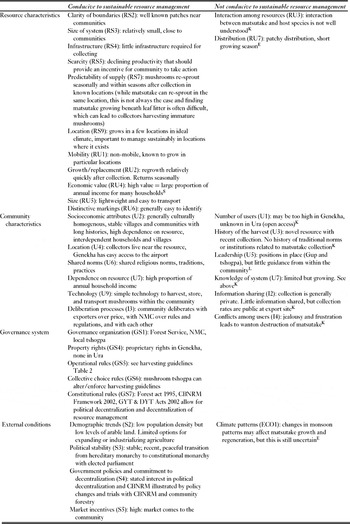
Several characteristics of matsutake make it amenable to community-based management and thus a good choice as a trial resource for CBNRM (Agrawal Reference Agrawal2003; Ostrom Reference Ostrom2007; Table 1). Most notably, matsutake is a static resource that grows in relatively well-known locations with well-defined boundaries, grows near human communities, has a relatively high replacement and growth rate, does not require extensive infrastructure to maintain or collect, and comprises a large proportion of annual household incomes, which should provide an incentive for sustainable harvesting (Gibson et al. Reference Gibson, Doods and Turner2007).
Conditions that may facilitate the sustainable harvest of matsutake in Bhutan as adapted from Ostrom (Reference Ostrom2007). Letters and numbers in parentheses represent Ostrom's categories. RS = resource system, RU = resource units, U = users, I = interactions, GS = governance system, S = socioeconomic/political settings and ECO = related ecosystems. Only factors that were directly relevant to this study were included here. Categories: K = knowledge, monitoring, and enforcement, E = environmental conditions and L = leadership.

Prior to the establishment of a commercial export chain in the early 1990s, few households collected matsutake and even fewer households sold it. Now, matsutake is exported to Japan where it is a highly priced delicacy. The Bhutanese name for matsutake sangay shamu (Buddha mushroom) represents the perception that matsutake is a gift because it has greatly benefited many households by vastly increasing their income. Matsutake is found in few locations across Bhutan and nowhere in such abundance as in the communities studied here.
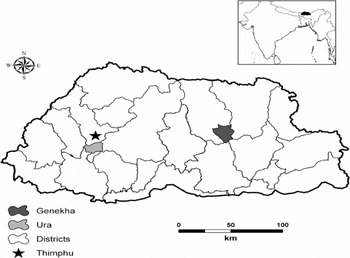
Bhutan is located in the Eastern Himalayas (see Fig. 1), has a human population of 634 982, and covers 38 394 km2 (OCC [Office of the Census Commissioner] 2005). Owing to its small population and the late start at concerted development efforts from 1961, Bhutan's biologically diverse environment remains largely intact, with > 60% of its land area under forest cover (FAO [Food and Agriculture Organization of the United Nations] 2000). Bhutanese forests are home to a variety of non-timber forest products used for subsistence and commercial purposes (MoA [Ministry of Agriculture] 2002b).
Diagrammatic map of Bhutan and study communities.

Bhutan's cultural heritage is also largely intact. The Vajrayana form of Mahayana Buddhism is the foundation for Bhutanese cultural values, institutions and philosophy (NEC [National Environment Commission] 1998). This religious philosophy is a mix of Buddhist teachings and Bon animistic beliefs that teaches preservation and inculcates a deep respect for the environment (Ura Reference Ura2001), and provides a cultural foundation that could facilitate CBNRM (Brooks Reference Brooks2010). Buddhism has also influenced Bhutan's development approach, which aims to balance development with environmental and cultural conservation, and, perhaps most importantly for this paper, promote good governance.
Historically, local people generally enjoyed unlimited rights and privileges for the use of nearby forests and natural resources in Bhutan (Wangchuk Reference Wangchuk2005). From this tradition, community-based resource management institutions such as sokshing (management of woodlots for leaf litter) emerged across Bhutan (Dorji et al. Reference Dorji, Webb and Shivakoti2006). However, many long-standing institutions were abolished with the 1969 Forest Act, which designated all land not previously held under title to be nationalized as Government Reserved Forest (MoA 1969; Tsering Reference Tsering2002). Nationalization led to effective protection of forest resources in some parts of the country, but had adverse social and environmental impacts in others, where local people lost the feeling of customary ownership of the nearby forests (MoA 2002a).
To regenerate a feeling of local ownership and control of development, the government embarked on a process of political decentralization in the 1990s (UNDP [United Nations Development Programme] 2002). This process included the establishment of district committees, or DYTs (Dzongkhag Yargye Tshogchung) in 1981, and community-level committees, or GYTs (Geog Yargye Tshogchung), in 1991. These committees allowed elected local leaders and local peoples to function as the agents of decentralization. This era of political decentralization also included policy changes that opened the door for CBNRM. First, the 1995 Forest and Nature Conservation Act replaced the 1969 Forest Act, and shifted the emphasis from centralized forest management to an approach that involved and returned ownership to the local people. Empowered by the 1995 Forest and Nature Conservation Act, the Department of Forestry initiated social forestry activities across the country (MoA 1993).
Second, the revised DYT and GYT Acts of 2002 gave more authority to community leaders and committees, and included language that made it possible for DYTs and GYTs to manage natural resources. These policy changes allowed for the integration of resource management within the overall structure of local governance. The Ministry of Agriculture began trials with CBNRM and developed the national CBNRM framework in 2002 (MoA 2002a), through which they sought to identify marketable non-timber forest products to help communities generate income and take ownership over resource management. One of the first of these trial forest resources was matsutake.
There is a favourable national institutional structure for CBNRM in Bhutan and the characteristics of matsutake make it a good candidate for community management. In addition, the communities have developed guidelines for harvesting that are similar to rules adopted in communities in Southern China (Xu & Ribot Reference Xu and Ribot2004; He & Weyerhaeuser Reference He, Weyerhaeuser, Kleinn, Yang, Weyerhaeuser and Stark2006; Yang et al. Reference Yang, He, Li, Ma, Yang and Xu2008). However, the communities in this study had yet to develop institutions to manage the harvest and had exploited matsutake to the point that we found (in contrast to earlier studies; Namgyel Reference Namgyel2005) a noticeable decline in harvest. Our first objective in this paper is to discuss how the absence of a relatively small number of factors has hindered the development of institutions and contributed to the decline in the matsutake harvest. Changes in environmental conditions, like weather variability and habitat change, may affect biological productivity. Further, biophysical characteristics of the forests surrounding the communities make it difficult to acquire knowledge of ecological dynamics, the practices of collectors and the interaction between the two, which is vital to monitoring and enforcement of appropriate institutions (Olsson et al. Reference Olsson, Folke, Galaz, Hahn and Schultz2007). Finally, there is a lack of leadership, which is noted as an important component of common pool resource management (Agrawal Reference Agrawal2003). Good leadership can be critical for community-based conservation (Olsson et al. Reference Olsson, Folke, Galaz, Hahn and Schultz2007; Padgee et al. Reference Padgee, Kim and Daugherty2006), helping to minimize conflict within communities (Kalipeni & Zulu Reference Kalipeni and Zulu2002; Sudtongkong & Webb Reference Sudtongkong and Webb2008) and motivating and organizing cooperative efforts.
Our second objective is to highlight an additional factor that we feel is crucial to understanding the matsutake decline. The communities in this study appear to be unwilling to assume the costs of institutional development, a likely function of uncertainty about the scarcity of matsutake and its salience to local livelihoods (Gibson et al. Reference Gibson, Doods and Turner2007) and a history of dependence on the paternalistic (though benign) government in the Kingdom of Bhutan. In this paper, we emphasize the latter point because it may be more difficult for the communities to overcome relative to the other obstacles, it is often overlooked in studies of CBNRM and it is especially relevant in countries with strong centralized governments that have earned the trust of the public, such as Bhutan. We describe the characteristics of the communities that harvest matsutake, the details of the harvest, and explanations for the inability of these communities to regulate the harvest and how these can be overcome.
Study sites
This study was conducted in two geogs (collection of villages or a community) from March–August 2005 and January–October 2006. Genekha geog is located approximately 30 km south-west of the capital city, Thimphu, and approximately 40 km south-east of Bhutan's only airport (Fig. 1). Genekha is composed of six villages totalling 105 households. These villages are situated at elevations ranging from 2100 m closest to the national highway to 3120 m in the village furthest from the highway. Household income is derived from small-scale agriculture, the sale of livestock products, wage labour and matsutake sales.
Ura geog is located approximately 300 km from Thimphu and nearly 400 km from the airport (Fig. 1). Ura is composed of six villages and over 200 households. Only the three villages that contain the majority of matsutake collecting households were used for this study. Similar to Genekha, household income is largely derived from agriculture, although there is more emphasis on livestock production in Ura.
The factors that could facilitate CBNRM include strong political support for decentralized resource management (MoA 2002a), the relatively small size of the communities and their proximity to the resource, shared Buddhist cultural norms, a history of inter-village marriage and the fact that villages within each community are highly interdependent (Table 1). Further, economic heterogeneity within communities and variation in dependence on matsutake may facilitate the development of institutions because some households are better able to absorb the costs of monitoring and enforcing rules, and may have a greater incentive to do so (Ruttan & Borgerhoff Mulder Reference Ruttan and Borgerhoff Mulder1999). Households in both communities also engage in labour exchange to facilitate farm work, villages in both communities cooperatively manage grazing lands and some villages in Genekha have been managing irrigation water for decades (government regulations in the 1969 Forest Act did not usurp traditional management regimes for these resources).
METHODS
Jeremy Brooks and four field assistants administered a structured survey (which was part of a larger study) in the national language of Dzongkha to collect data on household demographic information, household income, attitudes and behaviours related to the matsutake harvest and general environmental attitudes, among other information (Appendix 1, see supplementary material at Journals.cambridge.org/ENC). We surveyed one adult in all occupied independent households in Genekha (89 households in total). In Ura, we surveyed one individual from all independent households in Somrang village and approximately 20 households that were randomly selected from the larger villages of Ura Doshey and Pangkhar. Within this broader sample, we captured the 67 households that collected matsutake in Genekha and the majority of such households in Ura (33 households). For a small number of households in Ura, we administered the survey in the local language of Bumthap in which one field assistant was fluent. We supplemented survey data with information from 11 focus group meetings, informal interviews and participant observation, which took the form of accompanying harvesters on a total of seven collecting trips and mapping the eighteen total collection sites using a handheld global positioning system (GPS). The results of this study were communicated to collectors in Genekha during a follow-up visit in June 2008.
RESULTS
Community comparison
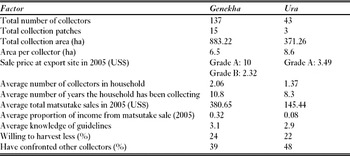
Differences in the abundance of matsutake, economic importance of the harvest, and in property rights between communities included there being more individual collectors, greater value per mushroom and matsutake growth over a wider area in Genekha (Table 2). Biological productivity was also higher in Genekha, where approximately 90% of all matsutake exported from Bhutan is presumed to be harvested (Namgyel Reference Namgyel2005). Environmental conditions were less favourable for matsutake growth in Ura; distance from the airport and sinuous mountain roads make the export of fresh mushrooms difficult, resulting in a lower price.
Community differences related to matsutake collection (US$ 1 = 43 Ngultrum in 2005).

The difference in property rights affected the ability of communities to exclude outsiders from harvesting. Genekha formed a tshogpa (committee) to oversee the harvest and appealed to the government to recognize their rights to matsutake within their borders. Genekha was subsequently granted the right to harvest and manage matsutake as well as the authority to exclude outsiders. In contrast, the harvest in Ura remained open access. The government will not give Ura the right to exclude outsiders until collectors form a tshogpa, which has been delayed by disputes over funding and a lack of pay for potential committee members. Despite these differences, the particulars of the harvest are similar between communities. Both communities had experienced declines in the harvest, the responses to key survey questions were similar in both locations (Table 2) and Ura had gone through a similar process of developing guidelines for the harvest.
Harvesting guidelines
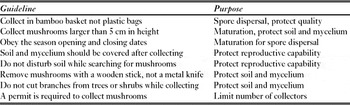
Because there were no traditional practices upon which to base formal institutions, the National Mushroom Center (NMC), a government agency in the Ministry of Agriculture, has been working with collectors to develop guidelines to protect the biological productivity and post-harvest quality of the mushrooms (Table 3). While the NMC provided semi-annual training sessions to remind collectors of these guidelines, they were not mandated to enforce them. The task of monitoring 400–900 ha of densely-forested mountainous terrain was being left to the two Forestry Department beat officers in Genekha, National Park rangers in Ura (all of which have many other responsibilities) and the community members themselves. In 2000, collectors in Genekha established a monitoring scheme in which each village selected two collectors to report poor harvesting practices to the Gup (village head), who was responsible for warning or fining the offender. This system failed after just one year because the Gup did not follow through with sanctions, the monitors never received the pay they were promised and collectors complained about giving away their secret collection patches while being monitored. Aside from this attempt, there had been almost no enforcement of the guidelines. A rule prohibiting sales of mushrooms smaller than 5 cm was enforced infrequently and there were no implications for ignoring the other guidelines in either community. Essentially, there were no functioning institutions in either community.
Existing guidelines for collecting matsutake in Bhutan

Decline of the matsutake harvest
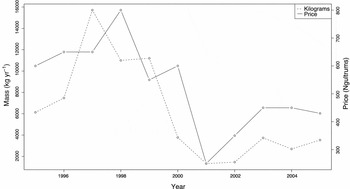
As a result of the absence of institutions, harvesters have overexploited matsutake. Annual national export data for Grade A matsutake (the highest value mushrooms) illustrated a precipitous decline beginning in 1998 (Fig. 2). The majority of collectors in both communities (82%, n = 100) believed that biological productivity was lower and several collectors noted declines in the size and quality of matsutake. Only 12% (n = 100) of collectors reported a decline in the productivity of other mushrooms collected for subsistence purposes.
Total mass (kg) of matsutake exported from Bhutan (dashed line) and average annual buying price (Ngultrums) 1995–2004 (solid line). Data courtesy of the National Mushroom Center, Semthoka, Bhutan.

DISCUSSION
Though Genekha gained proprietary rights (to harvest, exclude and manage) over matsutake that should have made institutional formation more likely than in Ura (Schlager & Ostrom Reference Schlager and Ostrom1992; Agrawal & Ostrom Reference Agrawal and Ostrom2001), this was not the case. While proprietary rights are often critical, they have not greatly enhanced the ability of collectors in Genekha to effectively regulate the harvest, nor have they been the key determinant in the inability of collectors in Ura to do so. As such, we focus on ten other factors that may hinder sustainable management of matsutake (Table 1; Ostrom Reference Ostrom2007).These ten factors can be placed into three categories: (1) environmental conditions, (2) leadership and (3) knowledge, monitoring and enforcement. However, because these factors are not insurmountable, we suggest that an additional factor is crucial: the reluctance of the communities to absorb the costs of developing institutions. This reluctance is due, in part, to a history of dependence on the state that resulted from successful government development programmes (NSB [National Statistics Bureau] 2007) and the replacement of traditional knowledge and practices by state-sponsored management strategies (Wangchuk Reference Wangchuk2005). This dependence may be the most difficult condition to address in order to facilitate a sustainable harvest. We discuss each of these factors in more detail below.
Environmental conditions
The drop in matsutake exports may simply reflect complex ecological dynamics and natural cycles in productivity. Reductions in matsutake productivity have been attributed to changes in weather (Yang et al. Reference Yang, He, Li, Jianzhong, Yongping, Jianchu, Kleinn, Yang, Weyerhaeuser and Stark2006), habitat destruction and change (Saito & Mitsumata Reference Saito and Mitsumata2008), and overharvesting (Amend et al. Reference Amend, Fang, Yi and McClatchey2010) However, a decline in export amounts of over 90% (Fig. 2) between 1997 and 2001 is likely to be caused by additional factors. When asked why productivity had decreased, 94% (n = 82) of respondents said it was because there were too many collectors, collectors were not following the guidelines, or both, while only 5% cited weather. There is disagreement regarding the impacts of collection on mushroom productivity and about whether removing leaf litter enhances or harms productivity (Luoma et al. Reference Luoma, Eberhart, Abbot, Moore, Amaranthus and Pilz2006; Arora Reference Arora2008; Saito & Mitsumata Reference Saito and Mitsumata2008; Amend et al. Reference Amend, Fang, Yi and McClatchey2010). However, matsutake declines in China have been attributed to destructive collection practices and overharvesting (Chen Reference Chen, Kusters and Belcher2004) and studies on other mushroom species suggest that trampling by collectors reduces production (Egli et al. Reference Egli, Peter, Buser, Stahel and Ayer2006). We conclude that intense harvesting and poor harvesting practices have affected matsutake productivity in Bhutan. The question is: why have these communities yet to enforce harvesting guidelines or develop additional rules?
Leadership
Leadership was lacking in these communities. Genekha's attempt at enforcement failed, in part, because the Gup did not follow through with sanctions.
There is also an important conflict of interests in Genekha. The export agencies that visit Genekha hire several prominent community members to buy mushrooms from their neighbours. These middlemen earn a commission and make decisions about the quality of the mushrooms they purchase. Grade A matsutake are the highest quality with unopened caps and have no damage to the body, whereas Grade B matsutake have opened caps, or have closed caps but are generally of lower quality. Most of the ‘middlemen’ paid by export agencies also serve on the mushroom tshogpa. These individuals have little incentive to lobby for limits on the number of collectors or collection amounts because they are paid based on the amount they purchase for exporters. In Genekha, good leaders could reinstate and support the community monitoring effort and push for additional rules. In Ura, leadership could facilitate the formation of a tshogpa and subsequently the ability of the community to have exclusive rights to the harvest.
While decentralized resource management can fail because resources fall under the control of elites who are not downwardly accountable (Agrawal & Ribot Reference Agrawal and Ribot1999), this is not the case here. Both communities elect the Gup and, in Genekha, the collectors themselves appoint members to the thsogpa, which gives them power to change leadership. Because leadership can be changed, it is not solely to blame for enforcement failures.
Knowledge, monitoring and enforcement
Gathering information on ecological dynamics and the practices of collectors is difficult because of natural interannual variation in matsutake production (Amend et al. Reference Amend, Fang, Yi and McClatchey2010), because matsutake is patchily distributed and grows in dense forests, because collectors prefer to be alone when harvesting and because collectors rarely share information. There is also no foundation of traditional ecological knowledge about matsutake or appropriate harvesting practices. While CBNRM institutions could take a decade or more to become fully established (Hanna et al. Reference Hanna, Folke and Maler1996; Fujita & Khamla Reference Fujita and Khamla2008), the process of institutional formation may take longer in this context due to these constraints (Brooks Reference Brooks2010).
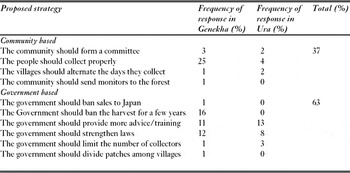
Collectors can obtain information with robust monitoring and enforcement, but they are hindered by the mountain ridges between villages in both communities and by the hectares of agricultural plots between households in Genekha. This physical separation may limit the ability of neighbours to enforce guidelines within forests and to note who has gone collecting and when (Altrichter Reference Altrichter2008). These conditions would constrain the collector's ability to enforce rules that limit the number of collectors per household and/or rotate the days that different villages can collect (Table 4).
Solutions to the decline of the matsutake harvest proposed by collectors

However, the prior enforcement scheme failed, not because of an inability to detect improper collection practices or unwillingness to report these practices, but because of insufficient leadership and complaints from collectors. Neighbours regularly cooperate on agricultural work, there are frequent community meetings and matsutake collectors interact at the export sites three times a week. These interactions can build trust, shape informal social norms and provide a forum for information sharing, all of which are thought to be essential for community resource management (Ostrom Reference Ostrom1990). With sufficient motivation these communities could more actively devise and enforce collection rules. Thus, we highlight an additional factor that may underlie some of these problems and may present a greater challenge to institutional development.
Unwillingness to bear costs and assume responsibility
There are three explanations for what appears to be reluctance on the part of the communities to make changes to ensure a sustainable harvest. The first is the time lag between the recognition of resource decline (scarcity) and community action. Namgyel (Reference Namgyel2005) indicated that collectors believed that matsutake was abundant and the harvest was sustainable. In this case, the community may have perceived the costs of developing resource management institutions to have been too high relative to the benefits (Gibson et al. Reference Gibson, Doods and Turner2007). Although collectors now largely agreed that the resource was in decline, this may be a relatively recent phenomenon and institutional development may take more time.
The second relates to whether the resource is as salient to these communities as believed (Gibson et al. Reference Gibson, Doods and Turner2007). Although matsutake collection is lucrative, this does not guarantee that developing institutions becomes a priority. Matsutake is a novel resource that is not essential for subsistence. That these communities have successfully managed grazing lands and irrigation water suggests that they are capable of developing institutions for subsistence resources with a long history of use. However, given the fluctuation in market prices (Fig. 1), natural variation in productivity, and their general unfamiliarity with the resource, it may be rational for collectors to view matsutake as a short-term blessing rather than a major component of their subsistence strategy (see Arora Reference Arora2008 for a similar point). The salience of the resource may be overstated because of the market price and these communities may, rightly, perceive the costs of institutional formation to outweigh the benefits.
The final dimension of the reluctance to develop community-based institutions is a historical dependence on the central government. These communities may not have the desire to assume the responsibility or absorb the costs of developing and maintaining institutions because they are accustomed to government control of forest resources and having the government care for their basic needs. This argument is best illustrated by the collector's responses to the question of what should be done to halt the decline in productivity (Table 4). The most frequent single response refers to individual responsibility (the people should collect properly), and this was echoed in a follow-up study in 2008. However, almost two-thirds of the responses reflected a desire for more government intervention.
Additionally, the trend of overexploitation is true of other common pool resources across Bhutan. A comprehensive review of CBNRM projects found similar problems with commercialized resources like bamboo, lemongrass, chirata and Cordyceps sinesis (MoA 2002a). Additionally, we found that 75% (n = 160) of respondents felt that their community would not be able to manage their forests well if they were given the opportunity by the government.
The Bhutanese have a great deal of faith in their government and kings and, in some contexts, appear to have more confidence in government than in local institutions, and with good reason. Since concerted development efforts began, Bhutan has seen increases in life expectancy, national income, healthcare and education (NSB 2007), as well as an increase in forest cover (FAO 2000). Because of the development progress made under centralized control, some Bhutanese communities are reluctant to manage resources themselves. The authors of Bhutan's CBNRM report summarized this trend when they wrote that centralized resource management ‘has eroded community-level capacity for self-governance and self-action and generated a widely held perception that the government is the provider of development and the caretaker of the people's well-being. Government officials often lack confidence in the people, and the people lack confidence in themselves’ (MoA 2002a, p. 5).
Other researchers have voiced concerns about how a culture of dependency might inhibit community-based resource management in Asia (MacKenzie Reference MacKenzie, Victor, Lang and Bornemeier1998; Thapa Reference Thapa2001). This issue raises the question of the appropriate amount of government intervention and the proper locus for institutional development. Critics argue that community-based resource management allows governments to relieve themselves of responsibilities and shift the burden onto the rural poor. Rural communities are made to feel solely responsible for their plight and must bear the costs of institutional development, often with little capacity to do so (Herbert-Cheshire Reference Herbert-Cheshire2000; Marcus Reference Marcus2008).
Conversely, too much government intervention may reinforce a culture of dependency and remove opportunities for communities take ownership. In some instances, government intervention can ‘crowd-out’ a community's capacity to manage forest resources (Cardenas et al. Reference Cardenas, Starnlund and Willis2000; Vollan Reference Vollan2008) by eroding trust among community members (Cook et al. Reference Cook, Hardin and Levi2005). It may be best for institutions to emerge endogenously because locally-devised management rules are more likely to be successful (Agrawal Reference Agrawal2003) and fit with existing cultural traditions and social structures (Barker Reference Barker2005).
A combination of community ownership and government intervention, or co-management, may be best both from the perspective of choosing development options and developing resource management institutions (Herbert-Cheshire Reference Herbert-Cheshire2000). However, determining the ideal amount and form of government input could be challenging. While the communities in this study have been involved in the management of matsutake through interactions with the NMC, they have not necessarily been empowered by the confidence of the government (Gebremedhin & Theron Reference Gebremedhin and Theron2007). On one hand, the government left the communities on their own (Marcus Reference Marcus2008) by initiating CBNRM projects without building local capacity. On the other hand, the involvement of the NMC and the presence of forestry beat officers and national park guards gave the community a crutch to lean on as matsutake began to decline. The government expected the community to manage the resource, while the community retained their reliance on government institutions ill-suited to the management of a local commercial non-timber forest product like matsutake.
CONCLUSIONS
Poorly implemented decentralization leading to overexploitation rather than sustainable use (Ribot et al. Reference Ribot, Agrawal and Larson2006) appears to be the outcome of many of the trial CBNRM projects in Bhutan. However, given the characteristics of many Bhutanese communities, there is potential for CBNRM to be successful and the community-based management of matsutake should not be considered a failure, but a work-in-progress. Collectors can accumulate knowledge of the resource and collection practices, the community could change leadership if they are concerned about the matsutake decline and collectors could develop monitoring and enforcement strategies based on their previous enforcement attempt and experience managing other resources. However, the reluctance to take action because of a historical reliance on the government and uncertainty about scarcity and salience has precluded community action. This conclusion points to the difficulty of balancing government intervention intended to build capacity with the need to empower communities to make resource management decisions independently. Our emphasis on the communities’ reliance on the government highlights the need to consider historical context when evaluating whether CBNRM is likely to succeed (Agrawal Reference Agrawal2003; Batterbury & Fernando Reference Batterbury and Fernando2006; Sudtongkong & Webb Reference Sudtongkong and Webb2008).
While the communities in this study embodied many of the characteristics thought to predicate successful management, the criteria that were not met were sufficient to hinder institutional formation. This result illustrates that particular criteria are likely to have different weights in different contexts, and that it may be difficult to identify a priori the communities and contexts in which CBNRM is most likely to succeed. This study adds to the growing chorus of researchers seeking to avoid the use of simple models of socioecological systems to solve problems associated with the overexploitation of resources (Ostrom et al. Reference Ostrom2007).
As one of the earliest examples of the CBNRM approach in Bhutan, the ability of these communities to manage the harvest may influence future policy decisions. While the Bhutanese government generally has an excellent record on environmental conservation, they have recognized the limits of centralized control of resource management and have followed the decentralization trend. In nations with strong centralized governments that have the trust of the populace, CBNRM approaches may be more difficult to implement and may require a longer transition to wean communities from government control. With patience, effort and, perhaps, well-placed government assistance, we believe that the collectors in Genekha and Ura will be able to solve the collective action problems with which they are currently faced, if they decide that a sustainable matsutake harvest is worth the cost.
ACKNOWLEDGEMENTS
We would like to thank Sonam Dendup, Karma Wangdi, Pema Tashi and Samdrup, for their help in collecting the data, Dawa Penjor and his staff at the National Mushroom Center for their assistance and insight, and NK Pradhan, Kezang Jamtsho and Chime P Wangi for their incredible guidance throughout the project. The views expressed herein are entirely the views of Doley Tshering and do not reflect the views of UNDP.