Introduction
Long-lived trees are keystone organisms of forest ecosystems. They harbor a unique genetic diversity and physiology (Pasques and Munné-Bosch Reference Pasques and Munné-Bosch2022), maintain ecosystems functionality, and generate microhabitats to several vulnerable species (Santi et al. Reference Santi, Carrari, De Frenne, Valerio, Gasperini, Cabrucci and Selvi2024). Ancient trees also hold cultural and aesthetic value, symbolizing resilience and complexity of life on earth (Gross Reference Gross2024), and serve as natural archives: wood tissues record and preserve evidence of environmental changes (e.g., Biondi et al. Reference Biondi, Jamieson, Strachan and Sibold2011) together with those involving land-use history (Ljungqvist et al. Reference Ljungqvist, Tegel, Krusic, Seim, Gschwind, Haneca, Herzig, Heussner, Hofmann, Houbrechts, Kontic, Kyncl, Leuschner, Nicolussi, Perrault, Pfeifer, Schmidhalter, Seifert, Walder, Westphal and Büntgen2018; Piovesan et al. Reference Piovesan, Biondi, Baliva, Dinella, Di Fiore, Marchiano, Presutti Saba, De Vivo, Schettino and Di Filippo2019). The correct determination of the age of tree rings is one of the prerequisites for accurate past climate reconstructions (Büntgen et al. Reference Büntgen, Tegel, Nicolussi, McCormick, Frank, Trouet, Kaplan, Herzig, Heussner, Wanner, Luterbacher and Esper2011) and can serve as a valuable source of information to investigate past exceptional atmospheric events, e.g., cosmic radiation (Quarta et al. Reference Quarta, Di, Calcagnile, D’Elia, Biondi, Saba, Baliva, De Vivo, Schettino and Piovesan2019; Pearson et al. Reference Pearson, Leavitt, Kromer, Solanki and Usoskin2022).
Despite the great importance of old trees, we still have a poor understanding of the potential longevity of most tree species. Such understanding is key to obtain critical insights into past, present, and future strategies for climate change adaptation, biodiversity conservation, carbon sequestration, and to derive insights on fundamental ecological processes (Birdsey et al. Reference Birdsey, DellaSala, Walker, Gorelik, Rose and Ramírez2023; Cannon et al. Reference Cannon, Piovesan and Munné-Bosch2022; Mikoláš et al. Reference Mikoláš, Piovesan, Ahlström, Donato, Gloor, Hofmeister, Keeton, Muys, Sabatini, Svoboda and Kuemmerle2023; Pasques and Munné-Bosch Reference Pasques and Munné-Bosch2024; Piovesan et al. Reference Piovesan, Cannon, Liu and Munné-Bosch2022; Piovesan and Biondi Reference Piovesan and Biondi2021). The tree age structure of a forest can also be used as an indicator of its ecological integrity (Rosenfield et al. Reference Rosenfield, Jakovac, Vieira, Poorter, Brancalion, Vieira, de Almeida, Massoca, Schietti, Albernaz, Ferreira and Mesquita2023), while variation in tree lifespans due to climate or environment (i.e., elevation, soil) can inform sustainable forest management (Martin-Benito et al. Reference Martin-Benito, Pederson, Férriz and Gea-Izquierdo2021). Therefore, monitoring forest ecosystems must encompass processes across all scales, from regeneration to old senescent trees.
While global trait datasets have expanded greatly in the past decades, including data on leaf, wood and reproductive traits (Díaz et al. Reference Díaz, Kattge, Cornelissen, Wright, Lavorel, Dray, Reu, Kleyer, Wirth, Colin Prentice, Garnier, Bönisch, Westoby, Poorter, Reich, Moles, Dickie, Gillison, Zanne, Chave, Joseph Wright, Sheremet Ev, Jactel, Baraloto, Cerabolini, Pierce, Shipley, Kirkup, Casanoves, Joswig, Günther, Falczuk, Rüger, Mahecha and Gorné2015), still very few approaches can be used to investigate species’ mean or maximum lifespans. Various studies have used growth projections to estimate tree ages (Adler et al. Reference Adler, Salguero-Gómez, Compagnoni, Hsu, Ray-Mukherjee, Mbeau-Ache and Franco2014; Bialic-Murphy et al. Reference Bialic-Murphy, McElderry, Esquivel-Muelbert, Hoogen, Zuidema, Phillips, Oliveira, Loayza, Alvarez-Davila, Alves, Maia, Vieira, Silva, Araujo-Murakami, Arets, Astigarraga, Baccaro, Baker, Banki, Barroso, Blanc, Bonal, Bongers, Bordin, Brienen, Medeiros, Camargo, Araújo, Castilho, Castro, Moscoso, Comiskey, Costa, Müller, Almeida, Costa, Kamimura, Oliveira, Pasquel, Derroire, Dexter, Fiore, Duchesne, Emílio, Farrapo, Fauset, Draper, Feldpausch, Ramos, Martins, Simon, Reis, Manzatto, Herault, Herrera, Coronado, Howe, Huamantupa-Chuquimaco, Huasco, Zanini, Joly, Killeen, Klipel, Laurance, Laurance, Fontes, Oviedo, Magnusson, Santos, Peña, Abreu, Marimon, Junior, Melgaço, Cruz, Mendoza, Monteagudo-Mendoza, Morandi, Gianasi, Nascimento, Nascimento, Neill, Palacios, Camacho, Pardo, Pennington, Peñuela-Mora, Pitmans, Poorter, Cruz, Ramírez-Angulo, Reis, Correa, Rodriguez, Lleras, Santos, Bergamin, Schietti, Schwartz, Serrano, Silva-Sene, Silveira, Stropp, Steege, Terborgh, Tobler, Gamarra, Meer, Heijden, Vasquez, Vilanova, Vos, Wolf, Woodall, Wortel, Zwerts, Pugh and Crowther2024), but the degree to which these mathematical projections reflect maximum tree ages is unclear. Common difficulties in obtaining reliable tree ages are represented by (i) the natural wood decay, which causes degradation of the heartwood and loss of inner stem portions; (ii) sampling obstacles, especially in case of huge, twisted, or polycormic trunks; (iii) unclear ring boundaries or lack of annual rings, which characterize most of evergreen hardwoods and tropical tree species; (iv) unusual growth circumstances (i.e., lack of circuit uniformity, intra-annual ring growth, tree buttress roots).
This paper presents a comparison between radiocarbon dating and tree-ring analysis, integrating both published data and new original radiocarbon results from Italian case studies, with the aim of highlighting how these complementary approaches can enhance our understanding of tree longevity.
Methods
Assessing tree longevity
Tree longevity is commonly expressed either as “cambial age”, i.e., the cumulative duration of secondary growth since pith formation at a specified height from the ground (Piovesan and Biondi Reference Piovesan and Biondi2021), or “genet age”, i.e., the age of vegetative material resulting from asexual reproduction (De Witte and Stöcklin Reference De Witte and Stöcklin2010).
Tree cambial age can be measured through tree-ring analysis (i.e., dendrochronology), which provides accurate age determinations and growth measurements at annual and subannual resolution. One of the strengths of this method is the high accuracy of age and growth estimates, especially when data are validated through crossdating (Schweingruber Reference Schweingruber1996). This method is, however, not applicable to most tropical species due to the lack of annual tree rings (Brienen et al. Reference Brienen, Schöngart, Zuidema, Goldstein and Santiago2016), and it is generally not applicable to species featuring diffuse-porous wood with indistinct ring boundaries (Schweingruber Reference Schweingruber2012). Furthermore, dendrochronology cannot be used to determine tree ages when trees present hollowed or rotten stems, which is often the case for old and ancient trees.
In the last few decades, radiocarbon dating has become more accessible due to the increased number of laboratories and decreased cost and has proven to be a flexible and easily usable method to assess tree longevity. It is, in fact, applicable to every tree species, regardless of its health condition, as long as there is inner woody material left to be sampled. Weaknesses of radiocarbon dating are represented by uncertainties in age estimations, primarily due to fluctuations in atmospheric 14C levels causing oscillations and plateaus of the calibration curve (e.g., Manning et al. Reference Manning, Birch, Conger and Sanft2020). Since the industrial revolution, the use of 14C-depleted fossil fuels has diluted the amount of 14C in the atmosphere, further widening uncertainty in calendar ages of individual 14C measurements for recent times. This phenomenon may be reduced by using multiple samples closely spaced along a tree radius to perform “wiggle-matching”, which commonly uses the time interval between samples to find the best fit between the sample dates and the calibration curve (Galimberti et al. Reference Galimberti, Ramsey and Manning2004); or alternatively to generate a “deposition model”, which allows for fluctuations in the growth rate according to the spatial distribution of samples along the sequence (Biondi et al. Reference Biondi, Santos, Palli, Piovesan and Sosa2025; Ramsey Reference Ramsey2008).
Other methods for estimating tree ages include the use of repeated growth measurements to develop age-diameter trajectories and matrix model projections, which predict changes in the population’s structure and can be used to indirectly estimate tree ages under specific circumstances (Bialic-Murphy et al. Reference Bialic-Murphy, McElderry, Esquivel-Muelbert, Hoogen, Zuidema, Phillips, Oliveira, Loayza, Alvarez-Davila, Alves, Maia, Vieira, Silva, Araujo-Murakami, Arets, Astigarraga, Baccaro, Baker, Banki, Barroso, Blanc, Bonal, Bongers, Bordin, Brienen, Medeiros, Camargo, Araújo, Castilho, Castro, Moscoso, Comiskey, Costa, Müller, Almeida, Costa, Kamimura, Oliveira, Pasquel, Derroire, Dexter, Fiore, Duchesne, Emílio, Farrapo, Fauset, Draper, Feldpausch, Ramos, Martins, Simon, Reis, Manzatto, Herault, Herrera, Coronado, Howe, Huamantupa-Chuquimaco, Huasco, Zanini, Joly, Killeen, Klipel, Laurance, Laurance, Fontes, Oviedo, Magnusson, Santos, Peña, Abreu, Marimon, Junior, Melgaço, Cruz, Mendoza, Monteagudo-Mendoza, Morandi, Gianasi, Nascimento, Nascimento, Neill, Palacios, Camacho, Pardo, Pennington, Peñuela-Mora, Pitmans, Poorter, Cruz, Ramírez-Angulo, Reis, Correa, Rodriguez, Lleras, Santos, Bergamin, Schietti, Schwartz, Serrano, Silva-Sene, Silveira, Stropp, Steege, Terborgh, Tobler, Gamarra, Meer, Heijden, Vasquez, Vilanova, Vos, Wolf, Woodall, Wortel, Zwerts, Pugh and Crowther2024; Brienen and Zuidema Reference Brienen and Zuidema2006). We do not address here the strengths and weaknesses of these additional methods because this paper focuses on methods that involve dating physical samples.
Sampling old wood for radiocarbon dating
In the search for ancient trees, individuals selected for sampling are typically identified based on distinct morphological and structural characteristics. These include large branches and trunk, the presence of strip-bark over some or most of the stem, and gnarled or stunted growth forms. In the temperate zone, such trees are most often found on steep, rocky slopes and exhibit complex stem-to-crown architectures indicative of their age and environmental adaptations (Filibeck et al. Reference Filibeck, Baliva, Calcagnile, Chiarucci, D’Elia, Quarta, Quilghini and Piovesan2023; Piovesan et al. Reference Piovesan, Baliva, Calcagnile, D’Elia, Dorado-Liñán, Palli, Siclari and Quarta2020; Schulman Reference Schulman1954). When dendrochronological methods are not feasible, as often happens in the study of tropical trees, wood sampling for radiocarbon dating is conducted manually by extracting material from the innermost portions of the trunk, typically accessed through large natural cavities (Patrut et al. Reference Patrut, Woodborne, Von Reden, Hall, Hofmeyr, Lowy and Patrut2015). Wood samples from temperate tree species can be further analyzed in laboratory using a binocular stereoscope to evaluate their proximity to the stem pith. Key measurements include: (i) the direction of growth; (ii) the curvature and width of annual growth rings; and (iii) the angle and density of parenchymal rays (Palli et al. Reference Palli, Baliva, Biondi, Calcagnile, Cerbino, D’elia, Muleo, Schettino, Quarta, Sassone, Solano, Zienna and Piovesan2023). When possible, two portions spaced by a known number of tree rings can be sub-sampled for wiggle matching dating (Galimberti et al. Reference Galimberti, Ramsey and Manning2004).
Radiocarbon dating of wood samples at CEDAD
Radiocarbon dating of samples from trees of the Italian peninsula presented in this paper was carried out by using Accelerator Mass Spectrometry (AMS) at CEDAD (Centre of Applied Physics, Dating and Diagnostics), Department of Mathematics and Physics, University of Salento, Lecce, Italy. Wood samples underwent chemical pre-treatment to eliminate potential contaminants through the standard acid–alkali–acid (AAA) protocol (Quarta et al. Reference Quarta, D’Elia, Valzano and Calcagnile2005). The purified material was then sealed in quartz tubes with CuO and silver wool and combusted to CO2 at 900 °C. The extracted CO2 was cryogenically purified under vacuum and subsequently converted to ca. 1 mg of graphite per sample in dedicated reaction cells using H2 as a reducing agent and iron powder as a catalyst (D’Elia et al. Reference D’Elia, Calcagnile, Quarta, Sanapo, Laudisa, Toma and Rizzo2004). The resulting graphite was used to measure the radiocarbon concentration with a 3 MV Tandetron-type AMS system (Model 4130HC, HVEE). The 14C/12C ratios of the samples were determined by comparing the ion beam currents and radiocarbon counts with those obtained from standard materials of known 14C concentration (IAEA C6 sucrose) (Calcagnile et al. Reference Calcagnile, Quarta and D’Elia2005). The measured 14C/12C isotopic ratios were corrected for mass fractionation using the δ13C values measured online by AMS and for background contributions to obtain conventional radiocarbon ages based on the radiocarbon decay law. Uncertainty was calculated as the larger value between the error resulting from radiocarbon counting (Poisson statistics) and the standard deviation of ten repeated measurements performed on each sample. The obtained radiocarbon ages were then calibrated to calendar years using the IntCal20 calibration curve (Reimer et al. Reference Reimer, Austin, Bard, Bayliss, Blackwell, Bronk Ramsey, Butzin, Cheng, Edwards, Friedrich, Grootes, Guilderson, Hajdas, Heaton, Hogg, Hughen, Kromer, Manning, Muscheler, Palmer, Pearson, Van Der Plicht, Reimer, Richards, Scott, Southon, Turney, Wacker, Adolphi, Büntgen, Capano, Fahrni, Fogtmann-Schulz, Friedrich, Köhler, Kudsk, Miyake, Olsen, Reinig, Sakamoto, Sookdeo and Talamo2020) in the OxCal 4.4 software (Ramsey and Lee Reference Ramsey and Lee2013).
Results and discussion
The study of tree longevity
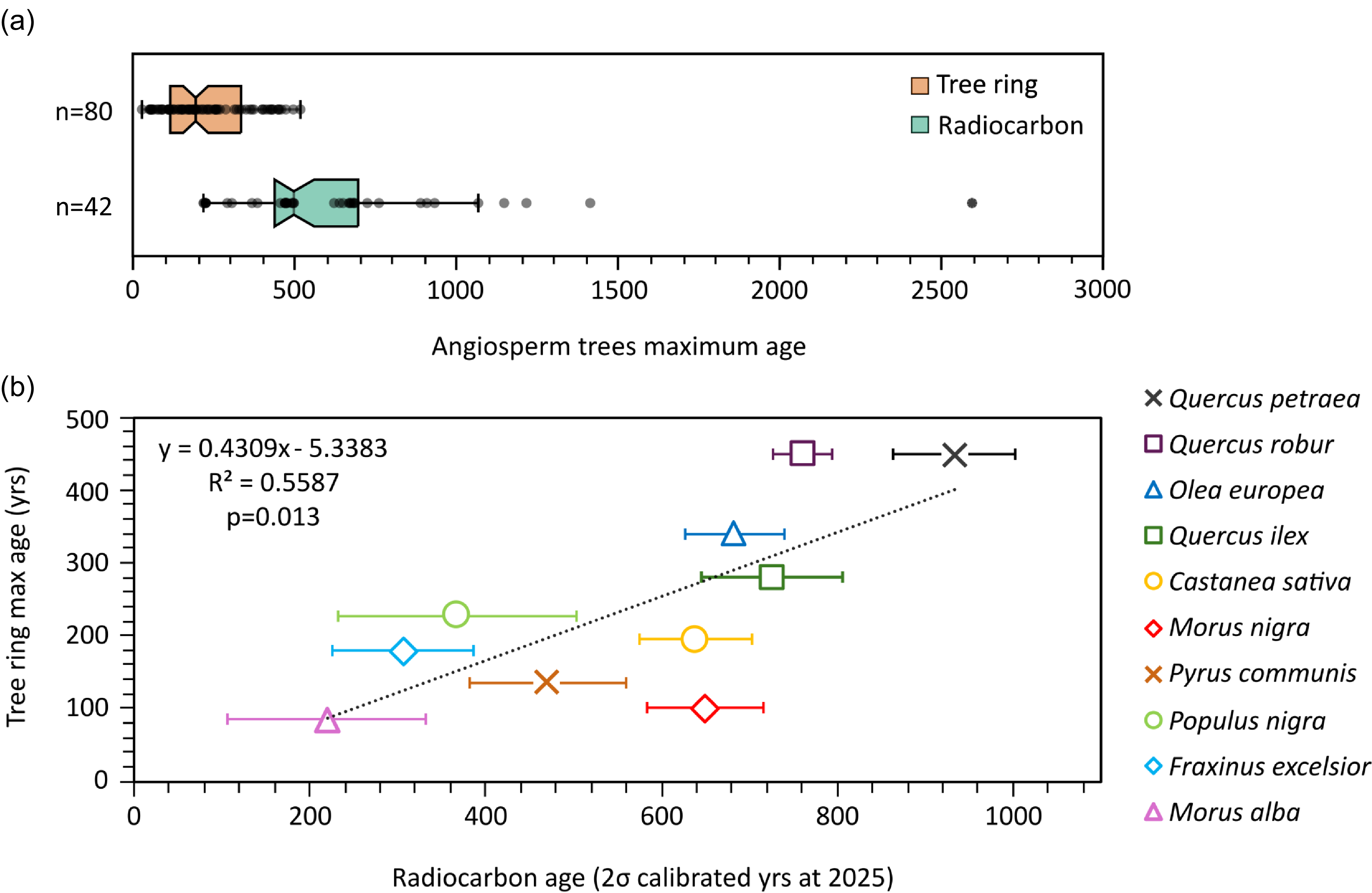
Reviews of public-domain tree-ring data indicate that gymnosperms (conifers) may become extremely old, with a mean maximum tree age of 616 years (n=157) and with 22 species around the world exceeding 1000 years, while angiosperms (flowering trees) are usually less long-lived Biondi et al. (Reference Biondi, Meko and Piovesan2023), with a mean maximum age of 229 years (n=80) and only one species exceeding 500 years (Figure 1a). This evidence, however, does not include most tropical angiosperms, as they usually lack annual growth rings and therefore cannot be included in dendrochronological datasets. In fact, of the estimated 70k angiosperm tree species (Cazzolla Gatti et al. Reference Cazzolla Gatti, Reich, Gamarra, Crowther, Hui, Morera, Bastin, De-Miguel, Nabuurs, Svenning, Serra-Diaz, Merow, Enquist, Kamenetsky, Lee, Zhu, Fang, Jacobs, Pijanowski, Banerjee, Giaquinto, Alberti, Zambrano, Alvarez-Davila, Araujo-Murakami, Avitabile, Aymard, Balazy, Baraloto, Barroso, Bastian, Birnbaum, Bitariho, Bogaert, Bongers, Bouriaud, Brancalion, Brearley, Broadbent, Bussotti, da Silva, César, Češljar, Moscoso, Chen, Cienciala, Clark, Coomes, Dayanandan, Decuyper, Dee, Del Aguila Pasquel, Derroire, Djuikouo, van Do, Dolezal, Đorđevic, Engel, Fayle, Feldpausch, Fridman, Harris, Hemp, Hengeveld, Herault, Herold, Ibanez, Jagodzinski, Jaroszewicz, Jeffery, Johannsen, Jucker, Kangur, Karminov, Kartawinata, Kennard, Kepfer-Rojas, Keppel, Khan, Khare, Kileen, Kim, Korjus, Kumar, Kumar, Laarmann, Labrière, Lang, Lewis, Lukina, Maitner, Malhi, Marshall, Martynenko, Monteagudo Mendoza, Ontikov, Ortiz-Malavasi, Pallqui Camacho, Paquette, Park, Parthasarathy, Peri, Petronelli, Pfautsch, Phillips, Picard, Piotto, Poorter, Poulsen, Pretzsch, Ramírez-Angulo, Correa, Rodeghiero, Del Pilar Rojas Gonzáles, Rolim, Rovero, Rutishauser, Saikia, Salas-Eljatib, Schepaschenko, Scherer-Lorenzen, Šebeň, Silveira, Slik, Sonké, Souza, Stereńczak, Svoboda, Taedoumg, Tchebakova, Terborgh, Tikhonova, Torres-Lezama, van der Plas, Vásquez, Viana, Vibrans, Vilanova, Vos, Wang, Westerlund, White, Wiser, Zawiła-Niedźwiecki, Zemagho, Zhu, Zo-Bi and Liang2022), only a fraction have been studied for their maximum lifespan. Several case studies of radiocarbon dating of iconic and monumental specimens have testified to the existence of extremely old angiosperm trees all over the world (Brienen et al. Reference Brienen, Maselli Locosselli, Krottenthaler, Gloor, Wrigley, Voelker, Altman, Altmanova, Anderegg, Baliva, Barua, Bazant, Black, Brown, Ceccantini, DeRose, Villanueva Diaz, Di Filippo, Dolezal, Duchesne, Earle, Fibich, Griesbauer, Helama, Klesse, Korznikov, Lindenmayer, Liu, Lopez, Mencuccini, Nagel, Pavlin, Pederson, Piovesan, Restaino, Reich, Sauchyn, Schöngart, Shaw, Smith, Sunny, Svoboda, Villalba, Wood and Zhang2026). Out of 42 angiosperm tree species dated through radiocarbon, 20 results were older than 500 years and 5 older than 1000 years (Table S1; Figure 1a). The oldest angiosperm species is Adansonia digitata, commonly known as the African baobab (2595 ± 167 years in 2025, Table S1; Patrut et al. Reference Patrut, Woodborne, Patrut, Rakosy, Lowy, Hall and von Reden2018b) which grows in savannas. In Mediterranean evergreen forests, the oldest dated angiosperm tree species is Quercus ilex, commonly known as holm oak (725 ± 80 years in 2025; Table S1; Filibeck et al. Reference Filibeck, Baliva, Calcagnile, Chiarucci, D’Elia, Quarta, Quilghini and Piovesan2023). Within the Mediterranean region, Olea europaea (olive tree) exhibits the oldest radiocarbon age reported for cultivated trees (683 ± 57 years in 2025; Table S1; Palli et al. Reference Palli, Baliva, Biondi, Calcagnile, Cerbino, D’elia, Muleo, Schettino, Quarta, Sassone, Solano, Zienna and Piovesan2023). In temperate broadleaf and mixed forests of Europe, Quercus petraea, commonly known as the sessile oak, is the oldest scientifically dated flowering tree (ca. 933 ± 70 years, Table S1; Piovesan et al. Reference Piovesan, Baliva, Calcagnile, D’Elia, Dorado-Liñán, Palli, Siclari and Quarta2020), while in tropical rainforests of south America, the oldest currently known angiosperm tree species is Cariniana micrantha, commonly known as jequitibá (ca. 1414 ± 48 years in 2025, Table S1; Chambers et al. Reference Chambers, Higuchi and Schimel1998).
Comparison between maximum age of angiosperm arboreal species measured through tree-ring analyses and estimated through radiocarbon dating. Radiocarbon ages included in this figure are calculated by subtracting 2σ calibration interval (IntCal20 curve, Reimer et al. Reference Reimer, Austin, Bard, Bayliss, Blackwell, Bronk Ramsey, Butzin, Cheng, Edwards, Friedrich, Grootes, Guilderson, Hajdas, Heaton, Hogg, Hughen, Kromer, Manning, Muscheler, Palmer, Pearson, Van Der Plicht, Reimer, Richards, Scott, Southon, Turney, Wacker, Adolphi, Büntgen, Capano, Fahrni, Fogtmann-Schulz, Friedrich, Köhler, Kudsk, Miyake, Olsen, Reinig, Sakamoto, Sookdeo and Talamo2020) to the current year (2025). (a) Boxplot showing maximum tree lifespan of tree species distributed all over the world. Tree-ring collections (80 species) were extracted from Biondi et al. (Reference Biondi, Meko and Piovesan2023). Radiocarbon dates (42 species) are obtained from literature search and presented in Table S1 (Supplementary Material). (b) Comparison of maximum longevity estimated through tree rings versus radiocarbon of 10 arboreal angiosperm species from Mediterranean and Temperate environments. Tree-ring data were extracted from Biondi et al. (Reference Biondi, Meko and Piovesan2023), Camarero et al. (Reference Camarero, Colangelo, Gracia-Balaga, Ortega-Martínez and Büntgen2021, Reference Camarero, González de Andrés, Colangelo and de Jaime Loren2022), Gea-Izquierdo et al. (Reference Gea-Izquierdo, Cherubini and Cañellas2011), Palli et al. (Reference Palli, Baliva, Biondi, Calcagnile, Cerbino, D’elia, Muleo, Schettino, Quarta, Sassone, Solano, Zienna and Piovesan2023). Radiocarbon dating data were extracted from Filibeck et al. (Reference Filibeck, Baliva, Calcagnile, Chiarucci, D’Elia, Quarta, Quilghini and Piovesan2023), Palli et al. (Reference Palli, Baliva, Biondi, Calcagnile, Cerbino, D’elia, Muleo, Schettino, Quarta, Sassone, Solano, Zienna and Piovesan2023), Patrut et al. (2011, Reference Patrut, Von Reden, Lowy, Patrut, Lucian Vaida and Margineanu2013, Reference Patrut, Woodborne, Patrut, Rakosy, Lowy, Hall and von Reden2018), Piovesan et al. (Reference Piovesan, Baliva, Calcagnile, D’Elia, Dorado-Liñán, Palli, Siclari and Quarta2020).

Selected case studies in Italy
In this paragraph, we present three case studies that contributed to expanding the known maximum longevity of several arboreal species growing in natural and semi-natural ecosystems of Italy, along an altitudinal gradient.
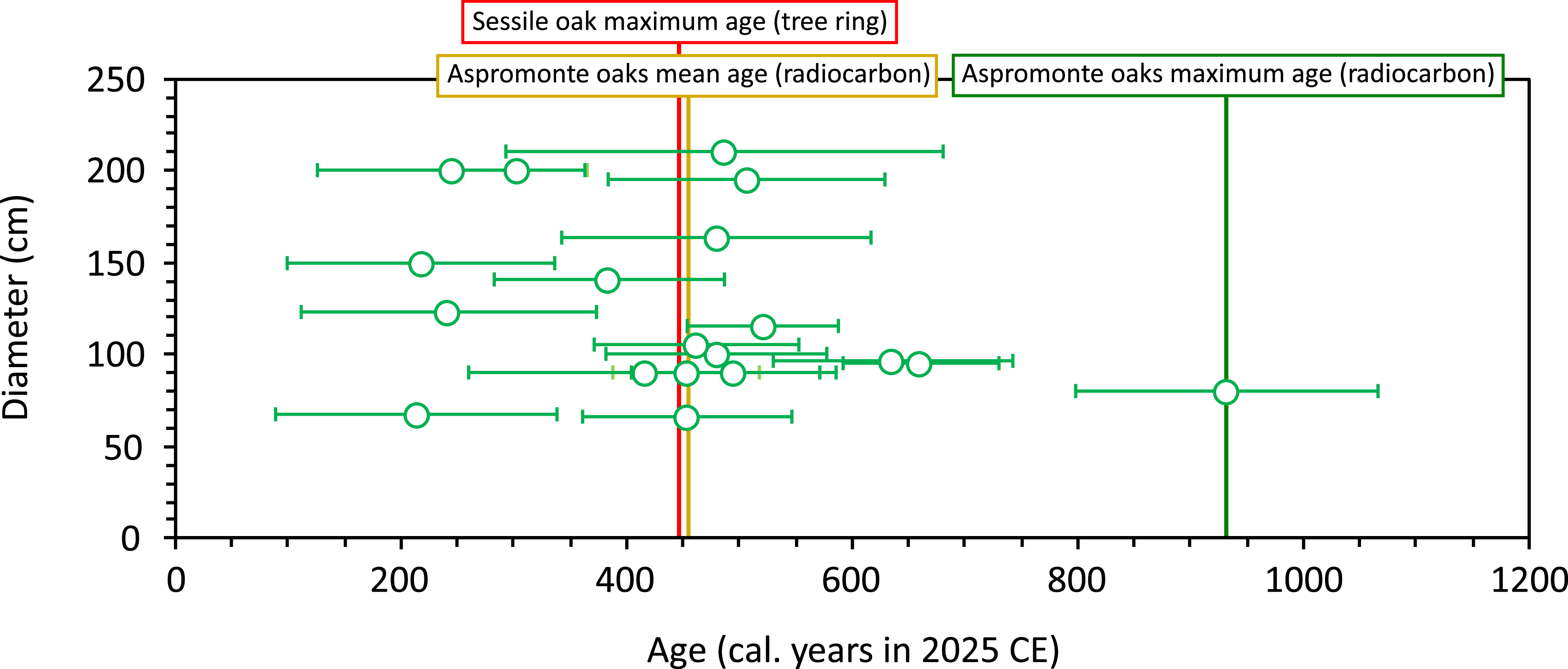
The first case study focuses on sessile oaks (Quercus petraea (Matt.) Liebl. subsp. austrotyrrhenica Brullo, Guarino & Siracusa) growing in the high mountain elevation belt in the Aspromonte National Park (Calabria, southern Italy). The findings published by Piovesan et al. (Reference Piovesan, Baliva, Calcagnile, D’Elia, Dorado-Liñán, Palli, Siclari and Quarta2020) are supplemented with new, original radiocarbon dating results. The survey involved 19 potentially ancient sessile oaks. Results indicate that 14 out of 19 individuals had radiocarbon ages exceeding the maximum lifespan of 449 years for this species based on tree-ring dating (Biondi et al. Reference Biondi, Meko and Piovesan2023; Figure 2). The highest obtained age of 933 (±70) calibrated years (calculated by subtracting the 2σ interval to 2025), is currently the world’s oldest flowering tree of temperate environments, whose age is determined through radiocarbon dating (Piovesan et al. Reference Piovesan, Baliva, Calcagnile, D’Elia, Dorado-Liñán, Palli, Siclari and Quarta2020). No relationship between size and age was found (Figure 2). Most stem ages (52%) were between 400 and 600 years, with three individuals older than 600 years. While these results demonstrate the potential high longevity of the species, they also confirm that only a small proportion of the population can achieve exceptional old ages, representing an emergent property of forest ecosystems that requires special protection (Cannon et al. Reference Cannon, Piovesan and Munné-Bosch2022).
Aspromonte sessile oaks (Quercus petraea (Matt.) Liebl. subp. austrotyrrhenica Brullo, Guarino & Siracusa) monumental trees dated through radiocarbon analysis. Ages were calculated by calibrating 14C ages with the IntCal20 curve (Reimer et al. Reference Reimer, Austin, Bard, Bayliss, Blackwell, Bronk Ramsey, Butzin, Cheng, Edwards, Friedrich, Grootes, Guilderson, Hajdas, Heaton, Hogg, Hughen, Kromer, Manning, Muscheler, Palmer, Pearson, Van Der Plicht, Reimer, Richards, Scott, Southon, Turney, Wacker, Adolphi, Büntgen, Capano, Fahrni, Fogtmann-Schulz, Friedrich, Köhler, Kudsk, Miyake, Olsen, Reinig, Sakamoto, Sookdeo and Talamo2020) and then subtracting the 2σ interval to the current year (2025). The vertical red line indicates the maximum age of the species measured through tree-ring analysis (Biondi et al. Reference Biondi, Meko and Piovesan2023).

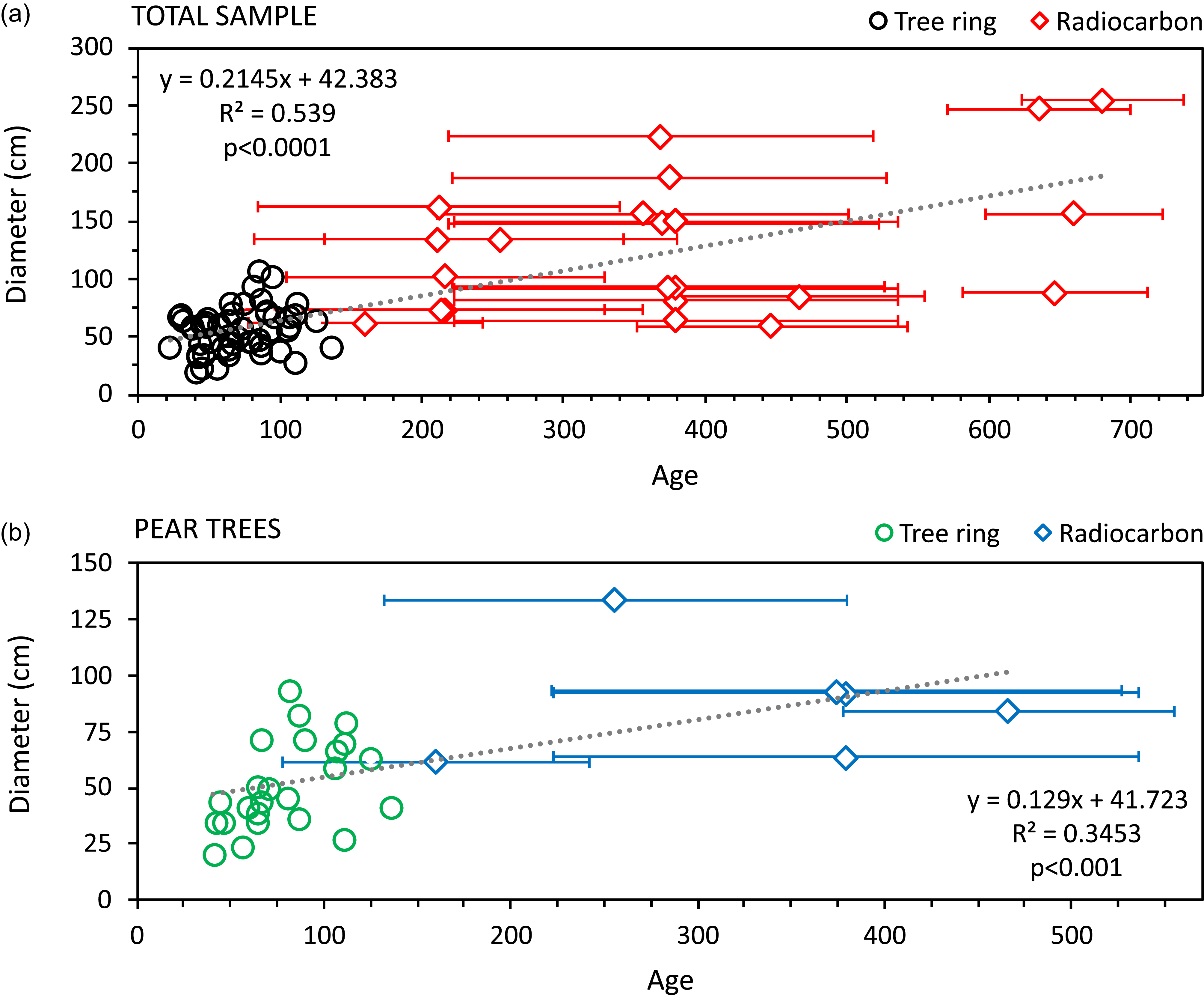
The second case study presents the results of research supported by the Lucan Agency for the Development and Innovation in Agriculture (ALSIA) to assess the age of ancient fruit trees located in the historical agroecosystems of Basilicata (southern Italy), at hilly elevations. A total of 75 presumably old fruit trees of nine different species and several varieties were sampled for age determination by employing both radiocarbon dating and tree-ring methods. Full methodological details are given in Palli et al. (Reference Palli, Baliva, Biondi, Calcagnile, Cerbino, D’elia, Muleo, Schettino, Quarta, Sassone, Solano, Zienna and Piovesan2023). While tree-ring measurements showed a maximum age of 136 years considering the whole sample, radiocarbon results provided age estimates ranging from 160 to 680 years (Figure 3a). The linear regression between size and age suggests that the oldest individuals are also the biggest (Figure 3a, 3b). In this case, results contrast with patterns observed in old-growth forest ecosystems, where the oldest individuals are often not the largest (Piovesan and Biondi Reference Piovesan and Biondi2021). This survey of the ancient fruit trees of Basilicata provided remarkable ages, especially for chestnut, mulberry and olive trees, which were all found to be older than 600 years. Pear trees provided interesting results as well, with four individuals around 400–450 years. This species also showed a significant relationship between age and size (Figure 3b).
Age-size relationships of ancient fruit trees in Basilicata (Italy) (from Palli et al. Reference Palli, Baliva, Biondi, Calcagnile, Cerbino, D’elia, Muleo, Schettino, Quarta, Sassone, Solano, Zienna and Piovesan2023, modified). Radiocarbon ages included in this figure are calculated by subtracting 2σ calibration interval (IntCal20 curve, Reimer et al. Reference Reimer, Austin, Bard, Bayliss, Blackwell, Bronk Ramsey, Butzin, Cheng, Edwards, Friedrich, Grootes, Guilderson, Hajdas, Heaton, Hogg, Hughen, Kromer, Manning, Muscheler, Palmer, Pearson, Van Der Plicht, Reimer, Richards, Scott, Southon, Turney, Wacker, Adolphi, Büntgen, Capano, Fahrni, Fogtmann-Schulz, Friedrich, Köhler, Kudsk, Miyake, Olsen, Reinig, Sakamoto, Sookdeo and Talamo2020) to the current year (2025). (a) Total sample composed of chestnut (Castanea sativa), walnut (Juglans regia), apple (Malus domestica), mulberry (Morus alba & Morus nigra), olive (Olea europaea), pear (Pyrus communis), cherry (Prunus avium), service tree (Sorbus domestica). (b) Focus on pear trees.

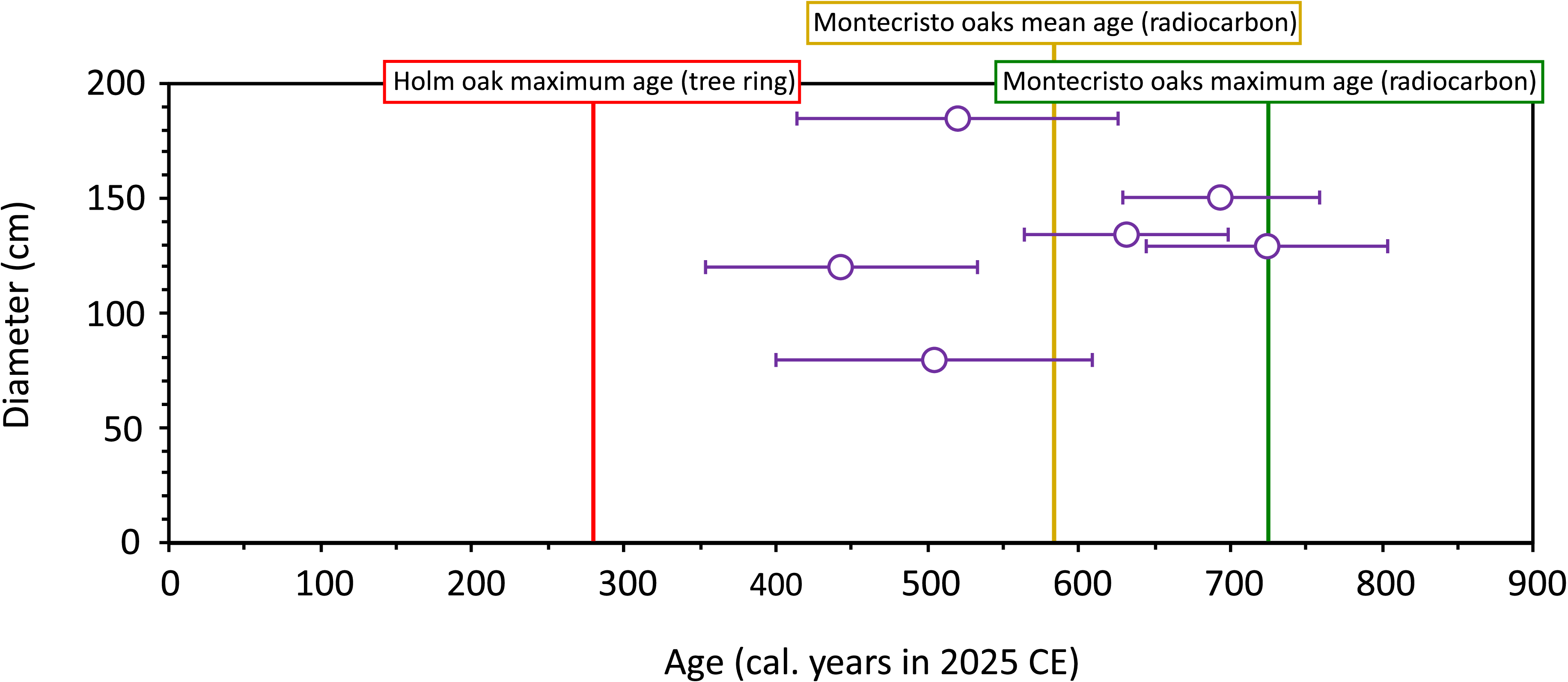
The third case study involves an isolated population of ca. 200 monumental holm oaks (Quercus ilex L.) growing in the island of Montecristo (Tyrrhenian Sea, Italy), in a coastal environment (Filibeck et al. Reference Filibeck, Baliva, Calcagnile, Chiarucci, D’Elia, Quarta, Quilghini and Piovesan2023). The island, which gained international fame through the Alexandre Dumas novel The Count of Monte Cristo, is today a state-owned, strictly protected area managed by Carabinieri Forestali. Radiocarbon dating of six trees indicates a mean age of ca. 585 years and a maximum age of ca. 725 years (Figure 4). Despite the small number of radiocarbon dates, these results more than doubled the previous age estimates for the species, whose longest tree-ring chronology to date did not exceed 280 years (Gea-Izquierdo et al. Reference Gea-Izquierdo, Cherubini and Cañellas2011).
Montecristo holm oaks (Quercus ilex L.) monumental individuals dated through radiocarbon analysis (from Filibeck et al. Reference Filibeck, Baliva, Calcagnile, Chiarucci, D’Elia, Quarta, Quilghini and Piovesan2023, modified). Ages were calculated by calibrating raw radiocarbon aged with the most recent calibration curve (IntCal20, Reimer et al. Reference Reimer, Austin, Bard, Bayliss, Blackwell, Bronk Ramsey, Butzin, Cheng, Edwards, Friedrich, Grootes, Guilderson, Hajdas, Heaton, Hogg, Hughen, Kromer, Manning, Muscheler, Palmer, Pearson, Van Der Plicht, Reimer, Richards, Scott, Southon, Turney, Wacker, Adolphi, Büntgen, Capano, Fahrni, Fogtmann-Schulz, Friedrich, Köhler, Kudsk, Miyake, Olsen, Reinig, Sakamoto, Sookdeo and Talamo2020) and then subtracting the 2σ interval to the current year (2025). The vertical red line indicates the maximum age of the species measured through tree-ring analysis (Gea-Izquierdo et al. Reference Gea-Izquierdo, Cherubini and Cañellas2011).

Comparison between radiocarbon dating and tree ring analysis
A literature review identified ten angiosperm tree species for which maximum longevity has been assessed using both radiocarbon dating and tree-ring analysis. Comparison of these results revealed substantial discrepancies in longevity estimates (Figure 1b). Tree-ring estimates of the maximum tree age were ca. 330 years lower on average than those obtained by radiocarbon dating (minimum difference 127 years; maximum difference 550 years) (Figure 1b). The underestimation increases as the potential longevity increases (Figure 1b). One of the species affected by the greater discrepancy between tree-ring measurements and radiocarbon dating estimations was Olea europaea, for which age determination through tree-ring measurements is especially challenging because of intra-annual wood density fluctuations, variability in tree-ring boundary structure, and restriction of its cambial activity to shifting sectors of the circumference (Cherubini et al. Reference Cherubini, Humbel, Beeckman, Gärtner, Mannes, Pearson, Schoch, Tognetti and Lev-Yadun2013). Indeed, recent research has used radiocarbon dates for estimating growth rates and ages of iconic olive trees growing in the Middle East (Lebanon) (Bernabei Reference Bernabei2015; Camarero et al. Reference Camarero, Touchan, Valeriano, Bashour and Stephan2024).
The possible reasons for the divergence in tree-ring and radiocarbon estimates are varied. Firstly, radiocarbon dating is more expensive than tree-ring analyses, and thus often only applied for trees suspected to be old. Secondly, radiocarbon dating does not provide accurate estimates for the last 250–350 years a consequence of poor chronological resolution due to the “flat” shape of the calibration curve. Thirdly, radiocarbon dating can be applied to small fragments of the inner portions of the tree stem, even if large parts of the tree have decayed. In contrast, tree-ring analysis requires a fully intact core with well-defined rings, which is rare for old angiosperms. This latter reason is probably the main explanation why radiocarbon dating provides much older ages even when comparing the same species (Figure 1b).
Indeed, radiocarbon dating has been less frequently applied to gymnosperms Brienen et al. Reference Brienen, Maselli Locosselli, Krottenthaler, Gloor, Wrigley, Voelker, Altman, Altmanova, Anderegg, Baliva, Barua, Bazant, Black, Brown, Ceccantini, DeRose, Villanueva Diaz, Di Filippo, Dolezal, Duchesne, Earle, Fibich, Griesbauer, Helama, Klesse, Korznikov, Lindenmayer, Liu, Lopez, Mencuccini, Nagel, Pavlin, Pederson, Piovesan, Restaino, Reich, Sauchyn, Schöngart, Shaw, Smith, Sunny, Svoboda, Villalba, Wood and Zhang2026. This underutilization may be attributed to the durability of their wood, which facilitates tree-ring studies and obviates the need for radiocarbon dating, and their main distribution in temperate and boreal climates (Biondi et al. Reference Biondi, Meko and Piovesan2023; Piovesan and Biondi Reference Piovesan and Biondi2021). However, in the case of Cupressus dupreziana (Saharan cypress) (Abdoun et al. Reference Abdoun, Jull, Guibal and Thinon2005), and Juniperus cedrus (Canary Islands juniper) (Sangüesa-Barreda et al. Reference Sangüesa-Barreda, García-Cervigón, García-Hidalgo, Rozas, Martín-Esquivel, Martín-Carbajal, Martínez and Olano2022), radiocarbon dating has revealed remarkable ages, expanding the maximum lifespan of the two genera beyond 1000 years. Furthermore, the combination of radiocarbon and tree-ring methods has improved the dating of the Bosnian pine Italus (Piovesan et al. Reference Piovesan, Biondi, Baliva, Calcagnile, Quarta and Di Filippo2018). Such successful case studies suggest that radiocarbon dating has the potential to reveal unprecedented tree ages, even for species already extensively investigated through dendrochronology. As an example, Fagus sylvatica (European beech), a species occurring within the European network of old-growth forests designated as a UNESCO World Heritage Serial Site, has been thoroughly studied through tree-ring analyses but remains underexplored through radiocarbon dating.
Conclusion
While tree-ring analysis is a powerful tool for assessing forest productivity, growth trends, climatic responses, and other parameters requiring high chronological precision, it often underestimates the maximum longevity of trees. Indeed, tree-ring and radiocarbon-derived estimates of tree longevity differed when compared for the same species, with tree-ring maximum ages often less than half of those obtained through radiocarbon dating. Our results indicate that ages of 400–500 years are a common feature for some broadleaved species, and in fact even public-domain tree-ring data, which do not include radiocarbon ages, revealed maximum ages of 400–500 years for 15 angiosperm species, of which three in the southern hemisphere and two in the tropics and subtropics (Biondi et al. Reference Biondi, Meko and Piovesan2023). Radiocarbon dating of a single specimen provides a fast and straightforward method for determining its age, although statistical approaches such as wiggle matching or depositional models may be required to reduce the large range of probable dates characterizing radiocarbon measurements from the last few centuries. For tropical angiosperms, which mostly lack annual rings, radiocarbon dating is the primary reliable way to determine tree ages, and wider application of these methods would greatly help in understanding the diversity of differences in life history strategies for the most biodiverse biome on Earth. The heartwood of old and ancient angiosperms is also frequently subjected to degradation and loss of material. For these reasons, scientists are increasingly using combinations of tree-ring and radiocarbon methods to anchor floating chronologies to the calendar time scale and to estimate the age of trees lacking consistent annual growth rings (Caetano Andrade et al. Reference Caetano Andrade, Clement, Herrera-Ramírez, Larsen, Durgante, Boivin, Schöngart, Trumbore and Roberts2024; Fontana et al. Reference Fontana, López, Santos, Villalba, Hornink, Assis-Pereira, Roig and Tomazello-Filho2024; Ngugi et al. Reference Ngugi, Hua, Knight, Dowling, Kington and Burns2024; Wood et al. Reference Wood, Hua, Allen and Bowman2010).
Interestingly, the oldest dated broadleaved trees in temperate and Mediterranean environments were not discovered within closed old-growth forests. Instead, sessile oaks in the Aspromonte National Park and holm oaks in the Montecristo Island grew in rocky environments, where trees occurred scattered across a “savanna-like” landscape. These open oak woodlands have historically been maintained by livestock grazing (domestic or feral goats). In addition, shepherds occasionally pruned these trees, a practice especially observed in long-lived fruit trees such as olives, chestnuts, and mulberries. The influence of pruning on the maximum lifespan of trees is therefore a potentially new area of scientific research (Olano et al. Reference Olano, Micó, Durà-Alemañ, García-Hidalgo and Sangüesa-Barreda2025).
Radiocarbon dating of old and ancient trees across the Italian peninsula has revealed their widespread presence, ranging from the Mediterranean coast to the high mountains. Notably, the most ancient hardwood trees thrive within a complex mosaic of natural and cultural landscapes, underscoring their role as an invaluable natural heritage (Piovesan et al. Reference Piovesan, Cannon, Liu and Munné-Bosch2022). However, we note that radiocarbon dating remains underutilized in forest ecology and conservation. Accurate dating is essential to fully investigate the irreplaceable ecological contributions of old and ancient trees as functional and structural hubs in biodiversity conservation and ecosystem resilience. Given these key points, we advocate for intensified efforts to locate, protect, and study old and ancient trees. Precise age information gives a crucial historical baseline, empowering policymakers to set informed targets for forest management. This includes guiding restoration programs, developing robust old-growth conservation strategies, and refining sustainable forestry practices rooted in long-term ecological realities.
Supplementary material
To view supplementary material for this article, please visit https://doi.org/10.1017/RDC.2026.10196
Acknowledgments
We thank the Pollino National Park, the Aspromonte National Park, the Lucan Agency for the Development and Innovation in Agriculture (ALSIA) and the Carabinieri Forestali for providing financial and technical support. GP was partially supported by the European Union - NextGenerationEU through the Italian Ministry of University and Research under PNRR - M4C2-I1.4 Project code: CN00000033, Title: NBFC - National Biodiversity Future Center (CUP: J83C22000860007) and by BANDO PRIN 2022 - Shifting Paradigms: Biodiversity Law, Ecological Primacy and the Redefinition of Sustainability in the European Green Deal (CUP: J53D23006310006). F.B. was funded in part by the Experiment Station of the College of Agriculture, Biotechnology, and Natural Resources at the University of Nevada, Reno, USA.
Competing interests
The authors declare no financial conflicts of interest.