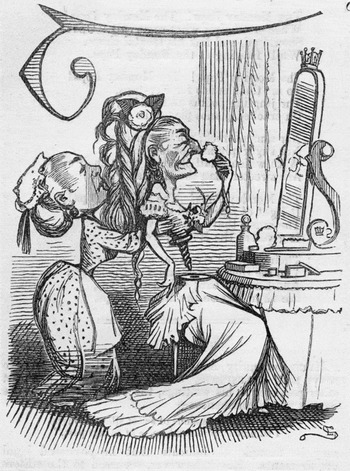
Inasmuch as they offer advice on how to improve appearances, nineteenth-century beauty manuals also vividly describe the dangers of putting on a face. The consequences of using cosmetics – often comprised of toxic ingredients such as arsenic, mercury, and lead – might range from the discomfort of surface irritation to the fatality of poisoning. Several manuals recount the unfortunate story of Lady Mary Montagu, who suffered an allergic reaction to a popular cosmetic, the Genuine Balm of Mecca, which led her face to turn red and swell “to a very extraordinary size . . . . It remained in this tormentable state three days, during which you may be sure I passed my time very ill” (Toilette of Health 64). Another woman succumbed to an equally unfortunate fate as the facial powder, or “pearl white,” she wore to a scientific demonstration suddenly turned black in an adverse reaction to the chemicals used in the experiment. In an even more tragic case, “Mrs. S, being much troubled with pimples, applied an alum poultice to her face, which was soon followed by a stroke of the palsy, and terminated in her death” (Clark iv, 46). These stories caution that beautification through artificial means may eradicate the very self that had sought improvement.
Aside from their legitimate warnings about the real hazards faced by women who use toxic cosmetics, accounts of danger at the toilet table are indisputably moralistic. They recall the disastrous narratives recounted in such didactic works as Maria Edgeworth's “Out of Debt out of Danger” (1801) from her Popular Tales. The story depicts the downfall of the vain and profligate Mrs. Ludgate, who is swept into the self-destructive cycle of applying one cosmetic after another to repair the ills caused by the last, until she finds herself paralyzed, “speechless,” “totally disfigured,” and an object of ridicule (Edgeworth 151 and Angeloglou 94). The Victorian suspicion of cosmetics was centered on the presumption that artificial means of beautification were deceptive. Referring to an advertisement offering make-up tips to young women, an 1864 article from Punch avows that a father “would as soon allow his sons to take in a miscellany of which the advertising columns contained offers to give them lessons in forgery, as let his daughter read one by whose means they might be corrupted with instruction in the art of falsifying their own faces” (“Fraudulent Faces”). One way of curtailing this deception was to pierce through the fictionality of female disguise by warning women of the bodily harm that might ensue from wearing masks of beauty. Punch uses its characteristic satire to enumerate the dangers inherent in artificial substances, punning on the homophone of “dye” (“In order to look killing, ladies dye themselves”) and on the dual meaning of “finish” (the practice of enameling is “likely enough to induce disease which might ‘finish’ a foolish woman”) (“Fashionable Forgery” and “Finishing for Faces”).
In what follows, I will examine another motive for the cosmetic tragedy, based less in morality than in profound anxiety about the far-reaching consequences of a woman's inability to embellish herself. While the trope of the cosmetic tragedy ostensibly warns against using cosmetics, it also brings attention to the negative effects of a woman's failure to do so. Such sensationalistic descriptions of defacement and death convey the cataclysmic repercussions of her incapacity to control her image. Drawing on twentieth-century psychoanalytic theories of femininity and masquerade, I will argue that chief among these are the harm a woman may inflict on herself and on the heterosexual structures that surround her. I will focus my analysis on Wilkie Collins's sensation novel The Law and the Lady (1875), which deploys the cosmetic tragedy to emphasize its serious implications for male-female relations. The text adapts the disastrous stories told in beauty manuals to the popular genre of sensationalism, which relies on the narrating of catastrophe. As I will argue, The Law and the Lady offers a model of cosmetic masquerade that attests to the transitive nature of this practice, the fact that it is responsible for creating and preserving heterosexual relationships. The disasters that result from failed masquerade undermine the social structures to which a woman belongs. Collins's often lurid fictionalization of the cosmetic tragedy describes female adornment as a far from superficial enterprise.
The Power of Powder
The term “cosmetics” in the nineteenth century encompassed a wide range of beauty products intended to grant the wearer a more pleasing visuality. In the words of a contemporary beauty expert, the word “is applied to preparations used for the purpose either of cleansing and purifying the skin, or of artificially embellishing and giving it a factitious colour” (Walker 17). Like today, cosmetics included products such as washes, potions, and treatments that were meant to improve the complexion, as well as paints and powders intended to enhance features or cover up defects. The second category of cosmetics was generally held under greater moral suspicion than the first during the Victorian period. As one 1837 manual explains, while therapeutic cosmetics “often really do impart whiteness, freshness, suppleness, and brilliancy to the skin,” paints “cannot give the skin the desired qualities – they only imitate them in a manner more or less coarse: in a word, they may be aptly denominated corporeal hypocrisy” (Book of Health & Beauty xviii).Footnote 1 Accounts of the cosmetic tragedy, however, often override this distinction by prioritizing a discourse of danger over one of morality, according to which creams as well as paints could be sources of disfiguration or death. Even manuals that sanction therapeutic cosmetics and censure makeup designate the potential hazards of both substances when not administered properly.
This discourse of danger conveys the importance of self-regulation in matters of adornment. While it warns that all products may harbor risks, it also implies that these can be averted with proper care. Indeed, tales of cosmetic terror often suggest that products that are harmful to some, less cautious, wearers may be perfectly safe to others. One manual that recounts Lady Montagu's misadventure with the Genuine Balm of Mecca, for instance, ultimately reassures readers of the safety and effectiveness of this product: “It cannot be denied, notwithstanding the inconvenience suffered by her ladyship, which might be attributable to a variety of causes, that the balm of Mecca is used with advantage by the most beautiful women” (Toilette of Health 64). A woman can use cosmetics if she is skilled enough to avoid their physical or social dangers. A striking number of Victorian beauty manuals start off by rejecting a certain cosmetic on moral and health-based grounds, only to shift to an “if you must” attitude that informs readers of how to use the same product with moderation. After decrying the various hazards of painting, for example, The Elixir of Beauty (1848) adds, “But if any lady is obstinately bent upon becoming a painter, let her remember that her aim must be to imitate, not surpass, nature, and be sparing, very sparing, of her colours!” (59). One prominent beauty specialist, Mary Haweis, justifies her endorsement of cosmetics by writing that artificial beautification “is generally a harmless, and, in some cases, a most necessary and decent practice. There are numberless girls who are most amiable, and who would be almost pretty, perhaps quite so, if they were not afflicted with thoroughly bad complexions” (qtd. in Williams 112).
Mrs. Haweis verbalizes one of the primary reasons for which writers do not altogether reject cosmetic modifications: they are concerned about the consequences of a woman's inability or unwillingness to adorn herself. Her ugliness threatens to have serious repercussions both for herself and for those around her. Haweis asserts that physical defects might not only be “pernicious” for the “moral character” of women, but may have ruinous effects on others: “If a girl has the trial of a complexion so bad that the sight of it gives one a turn, it is simply a duty for her either not to go into society at all, or, if she does, to conceal it as she would not scruple to conceal lameness or leanness. You have no right to inflict your misfortunes on everybody – it is an unpardonable offence against good taste” (qtd. in Williams 113). Other writers follow this logic in describing beauty as a woman's absolute “duty” both to herself and to her environment. As one advocates, “Ladies, if you are not attractive then it is your duty to yourself and nature to use all your possible efforts to become so . . . . A beautiful woman is endeared to her husband as well as to the rest of the world” (Ruppert 3, 6). Moreover, there is a strong sense in this literature that if she cannot control her own image, a woman will not be able to perform her social functions. The beauty writer Susan Power advises, “The first requisite in a woman toward pleasing others is that she be pleased with herself. In no other way can she attain that self-pose, that satisfaction, which leaves her at liberty to devote herself successfully to others” (9). Wearers of cosmetics who counterfeit nature may be less nefarious than women who project their ugliness onto the world because they cannot or will not paint. Georg Simmel's discussion of adornment as a transitive quality that “intensifies or enlarges the impression of the personality by operating as a sort of radiation emanating from it” (339) can also be applied to its absence: ugliness, like beauty, has the power to contaminate its observers.
Although the cosmetic tragedy delineates the dangers that a woman might face in trying to enhance her image, it simultaneously warns of the dire consequences of not being able to achieve physical enhancement. It is at once a moralistic condemnation of artificial adornment and a means of conveying to women the importance of using beauty products carefully enough to conceal their flaws without destroying themselves or others in the process. Joan Riviere's post-Victorian essay “Womanliness as a Masquerade” (1929) seems informed by such fears of failed adornment. Riviere argues that a woman can assume a “mask of womanliness” through the use of clothing and cosmetics in order to conceal any part of her identity that might threaten her relationship with men: “Womanliness therefore could be assumed and worn as a mask, both to hide the possession of masculinity and to avert the reprisals expected if she was found to possess it – much as a thief will turn out his pockets and ask to be searched to prove that he has not the stolen goods” (38). Throughout her essay, Riviere delineates the dangers that may befall a woman who does not or cannot assume a reassuring feminine façade: “anxiety,” “retribution . . . from men,” “horrible dread of the retribution the father would . . . exact,” and so on (35, 37). She describes one woman who takes on an excessively feminine guise in order to mitigate her fearful “dealings with men such as porters, waiters, cabmen, tradesmen, or any other potentially hostile father-figures, such as doctors, builders and lawyers” (39). Riviere associates masquerade with the safety of a balanced heterosexual contract, and the absence or failure of masquerade with the violence that would ensue from a violation of that contract. According to this model, masquerade is a transitive act that solidifies male-female bonds and saves the woman from male retaliation.
Wilkie Collins's The Law and the Lady stresses the far-reaching importance of female cosmetic masquerade. The novel features Valeria Brinton, who marries the mysterious Eustace Woodville only to discover that his actual surname is “Macallan” and that he harbors a shady secret. Assuming the role of detective, Valeria adorns herself with cosmetics to obtain information from Major Fitz-David, a so-called “modern Don Juan” (177; ch. 22) who holds important information about her husband's past. She discovers that Eustace had been accused of poisoning his first wife, Sara, but had never been fully convicted of the crime. The case was left hanging in the so-called Scotch Verdict of “Not Proven,” which placed Eustace in the liminal position of being neither a criminal nor an absolved man. Valeria resolves to vindicate her husband and find out who was responsible for the death of Sara Macallan. She eventually learns through a letter, consisting of reconstituted fragments found in a dust heap, that Sara had committed suicide because of her husband's indifference toward her. A plain woman with a terrible complexion, she had purposefully ingested a lethal quantity of the arsenic she had been using to improve her skin. Although it absolves Eustace of the accusation of crime, Sara's letter presents a disparaging view of him that reveals his flirtation with his attractive cousin, Helena Beauly, and his indifference to his wife's despair. Valeria is at once relieved and disturbed by this morally ambivalent presentation of her husband; the outcome of her investigation is not much clearer than the Scotch Verdict. In the last part of the novel, she persuades Eustace not to read Sara's letter, and he never finds out the truth about his first wife's death.
The novel was inspired by the highly publicized 1857 trial of Madeleine Smith, who was charged with poisoning her lover, Emile l'Angelier, with arsenic dropped in his hot chocolate. Prefiguring the events of the novel, Smith admitted to bathing with arsenic to improve her complexion (MacGowan 92–93), and the trial concluded with the Scotch Verdict of “Not Proven.”Footnote 2 The use of arsenic for cosmetic purposes had become a notorious trend by the second half of the nineteenth century. A series of accounts appearing in British periodicals and beauty manuals beginning in the 1850s detailed the ingestion of arsenic by Styrian peasants who wanted to ameliorate their complexions. As one manual explains,
It is said that by doses of a quarter of a grain, gradually increased to the large amount of ten grains daily, a trebly fatal dose to persons not gradually inured to it, a pale, thin young woman, with few or no suitors, is often soon metamorphosed into a well-conditioned, blooming creature, with glowing cheeks and sparkling eyes, and with, as the natural and intended consequence, a band of young admirers of the opposite sex, “Each shouldering for her smile!” (Dick 48)
This standard report warns readers of the dangers of the practice (the author goes on to say that a woman should only ingest arsenic when supervised by a physician) while expounding on its impressive benefits. One of Sara's friends testifies about her own knowledge of this beauty ritual at Eustace's trial, explaining that she herself “had read of the practice of eating arsenic, among the Styrian peasantry, for the purpose of clearing the colour, and of producing a general appearance of plumpness and good health” (161; ch. 19). Her words reproduce the ambivalence with which the ingestion of arsenic – and other toxic substances – was treated in nineteenth-century journals and beauty manuals, which mitigated their accounts of cosmetic tragedies with descriptions of successful usages of the same cosmetics.
The Law and the Lady does not blame Sara's death on the poisonous properties of arsenic, but on the fact that it fails her as a cosmetic. She is unable to use this product to regulate her appearance; as she writes to Eustace, “My true reason [for ingesting the arsenic] was to try if I could not improve my ugly complexion – not from any vain feeling of mine: only to make myself look better and more lovable in your eyes. I have taken some of it for that purpose; but I have got plenty left to kill myself with. The poison will have its use at last. It might have failed to improve my complexion. It will not fail to relieve you of your ugly wife” (363; ch. 47). Sara describes the arsenic as a product that disappoints its wearer by not making her more attractive in her husband's eyes. It does not improve her face, which, according to her maid, featured “one of the most muddy, blotchy complexions it was ever my misfortune to see” (124; ch. 16). Although she admitted to her mother-in-law that “there was no risk she would not run, and no pain she would not suffer, to improve” her complexion (158; ch. 19), Sara is incapable of using cosmetics to her advantage. Her inability to regulate her appearance is reflected in the excessiveness of her suicide: she ingests a surplus of the arsenic that other women might have administered drop by drop.
Sara's cosmetic tragedy is particularly striking given the presence of female characters in the novel who use cosmetics successfully. Valeria understands that in order to obtain an interview with the womanizing Major Fitz-David, she needs to make herself especially attractive. She prefigures Riviere's masquerading women, who don an exaggeratedly feminine appearance in order to become desirable to men. Laying aside her usual distaste for artifice, Valeria submits herself to the hands of an experienced maid: “I saw, in the glass, my skin take a false fairness, my cheeks a false colour, my eyes a false brightness – and I never shrank from it. No! I let the odious deceit go on” (55; ch. 7). The maid, who had warned Valeria that she would “frighten” the Major if she faced him with an unadorned complexion, tells her approvingly, “You're the prettiest woman (of your style) in London. Ah, what a thing pearl powder is, when one knows how to use it!” (55; ch. 7). The makeover facilitates Valeria's successful encounter with the Major, who agrees to see her when his servant describes the masquerading woman as “better than pretty” (57; ch. 8). This superlative captures the excessive power of the cosmetic masquerade; it involves more than surface beauty. Cosmetics endow Valeria with a properly feminine attitude, as she utters a phrase that could have been a rallying cry for the female subjects of Riviere's essay: “I am only a woman” (60; ch. 8). She reassures the Major of her helplessness at the very moment in which she undertakes an active investigation of her husband's past.Footnote 3
Eustace's flirtatious cousin, Helena Beauly, also appears to be skilled at masquerade. On the surface, she seems to refuse cosmetic temptations. Having long envied her beauty, Sara had asked her the secret of her complexion: “Using no artificial means (and knowing nothing whatever of cosmetics), Mrs. Beauly had resented the question; and a temporary coolness between the two ladies had been the result” (159; ch. 19). Sara's nurse also denies her mistress's allegations that Mrs. Beauly “painted” (124; ch. 16). However, these assessments seem suspect in light of the novel's insistence on the link between cosmetics and secrecy. The consensus during the Eustace trial is that women who use cosmetics never admit to doing so. The Dean of Faculty who serves as Eustace's defense tells the Lord Advocate,
“Does my learned friend actually suppose, that women are in the habit of mentioning the secret artifices and applications by which they improve their personal appearance? Is it in his experience of the sex, that a woman who is eagerly bent on making herself attractive to a man, would tell that man, or tell anybody else who might communicate with him, that the charm by which she hoped to win his heart – say the charm of a pretty complexion – had been artificially acquired by the perilous use of a deadly poison?” (169–70; ch. 20)
Eustace had already pronounced that if his wife had been using arsenic, “Surely, I should be the last person admitted to the knowledge of such a secret of her toilet as that?” (143; ch. 17).Footnote 4 Victorian beauty manuals advocated a form of self-regulation that enforced the link between secrecy and cosmetics; in the words of one author, “We do not show these secrets . . . to men; we do not even talk about them, but for the greater number of us they are, nevertheless, necessities” (Kingsford 34). During her trial, Madeleine Smith confessed that when she had purchased the arsenic, “I think I said it was for a gardener to kill rats or destroy vermin about flowers, and I only said this because I did not wish them to know that I was going to use it as a cosmetic” (qtd. in MacGowan 93). Some women followed the injunction to secrecy so closely that they refused to admit – even to their physicians – that their beauty products had made them dangerously ill (Peiss 41, Sayre 3). Mrs. Beauly may be particularly successful at keeping her cosmetic masquerade a secret; the fact that she once dressed herself as her maid to attend an ill-reputed masked ball makes us question what other disguises she may wear.Footnote 5
Another reason for disbelieving Mrs. Beauly is that her very existence may depend on whether or not she paints. Collins's novel links the persistence of identity to cosmetic success or failure. Quite simply, knowing how to masquerade is crucial to establishing selfhood, whereas miscarrying the practice may lead to oblivion. The serious consequences of cosmetic usage in The Law and the Lady recall one of the most perplexing passages of Riviere's essay: “The reader may now ask how I define womanliness or where I draw the line between genuine womanliness and the ‘masquerade’. My suggestion is not, however, that there is any such difference; whether radical or superficial, they are the same thing” (38). As several critics have argued, this passage implies that there is nothing to woman other than masquerade. In Mary Ann Doane's words, Riviere's theory proposes “that it is femininity itself which is constructed as mask – as the decorative layer which conceals a non-identity” (138; see also Heath 54). In his subsequent theory of the masquerade, Jacques Lacan would emphasize the nothingness that lurks behind the mask: “There is no such thing as The woman since of her essence . . . she is not at all” (“God and Jouissance” 144; see also “Meaning of the Phallus” 83–85). A woman exists only when she has achieved a visibility that allows others to read her as properly feminine. There is nothing beneath the surface of her visual appearance; she consists of paint covering an emptiness. Charles Dickens's Dombey and Son (1848) illustrates this model of female identity in its description of Mrs. Skewton's (a.k.a. Cleopatra's) disintegration when her maid strips her of cosmetics: “Her touch was as the touch of Death. The painted object shrivelled underneath her hand; the form collapsed, the hair dropped off, the arched dark eyebrows changed to scanty tufts of grey; the pale lips shrunk, the skin became cadaverous and loose” (472; ch. 27). This sudden deflation attests that the removal of makeup is a fatal act that melts the wearer into nothingness. An 1872 illustration from Punch, which shows a woman in the process of being assembled by her maid at her toilet table, dramatically conveys the vacuity of female identity (Figure 9). Sara's suicide in Collins's novel confirms that when masquerade fails, the female subject dissolves. The image of masquerade as a delicate surface that barely conceals the fictiveness of female identity is captured in the broken vase with “a woman's face painted on the china” that Valeria discovers in the Major's home (87; ch. 10). She learns that this object was a gift given to the Major by Eustace and Sara “only a week before the poor woman's terrible death” (103; ch. 13). The cosmetic tragedy heralds the disintegration of the female self.
“Extracts from the Diary of the Coming Woman.” Engraving from Punch 27 Jan. 1872: 34. Courtesy George J. Mitchell Department of Special Collections & Archives, Bowdoin College, Brunswick, Maine.

In contrast, cosmetic masquerade gives Valeria a tangible presence in the novel. Before she succumbs to the maid's skillful makeover, she appears to be a non-entity, on the verge of fading off the page. Evaluating her own appearance in a mirror, she describes herself as “not at all the sort of person who attracts attention in the street, seeing that she fails to exhibit the popular yellow hair and the popular painted cheeks”; “rather too pale”; “a person who fails to strike the ordinary observer at first sight”; and as wearing a nondescript dress that “studiously conceals, instead of proclaiming, that she had been married that morning” (14; ch. 1). These “self”-effacing terms build up to a negative description that questions the solidity of Valeria's selfhood. The maid uses cosmetics to grant her the visibility that she otherwise lacks. They also allow her to confirm her legal identity. As Jenny Bourne Taylor argues, Valeria reopens the case not only to salvage her husband's reputation, but also “to establish her own position as his legitimate wife – to provide herself with a full selfhood within a given set of symbolic meanings and social conventions – in other words, within the Law” (xiv; see also Mangum 287). In the beginning of the narrative, she appears to be a non-person: she forgets her maiden name while standing in front of the wedding register and signs with her married one. This act not only effaces her original identity, it also suggests that she writes herself into nothingness. The last name she uses at this point, Woodville, is a fake, an alibi adopted by Eustace to mask his real name, Macallan. In discovering the complications of her marriage to Eustace, her landlady reproaches her, “You are neither maid, wife, nor widow. You are worse than nothing, madam” (40; ch. 5). The text leads us to believe that if Valeria's masquerade had failed and the Major had refused to help her with her investigation, she would have succumbed to the fatal transparency that destroys Sara Macallan. This realization adds new meaning to the maid's exclamation, “What a thing pearl powder is, when one knows how to use it!” (55; ch. 7). Without pearl powder, Valeria would have disappeared altogether.
The superlative aspect of cosmetics, the fact that they can make women “better than pretty” (57; ch. 8), extends to the protection they afford to men. We first discover this when Valeria informs us that her makeover has increased both her faith in herself and in the Major as agents in the investigation: “I felt an unreasoning confidence in myself, and a blind faith in him” (56; ch. 8). She realizes that the influence of cosmetics extends beyond the female body to reinforce male identity; it is her decision to wear makeup that ultimately protects her husband's reputation and proves that he is not a criminal. Once she paints, she transforms into a human cosmetic that covers up his shortcomings. As Valeria progressively discovers the truth about her husband's role in his first wife's death, she experiences the urgent need to keep these compromising discoveries from the rest of the world. In reading Sara's letter, she avows, “My one hope was that he might never see it! My one desire was to hide it from the public view!” (367; ch. 48). The number of apologies for her husband pervading the end of the novel exposes her desperate attempt to shield Eustace from the readers’ accusation. Her last lines to us are: “Don't bear hardly, good people, on the follies and the errors of my husband's life. Abuse me as much as you please. But pray think kindly of Eustace, for my sake” (383; ch. 50). Valeria's use of actual cosmetics transforms her into a figurative cosmetic that covers up her husband's flaws.
Conversely, the failure of female masquerade has a devastating effect on men. Sara's inability to conceal her ugliness impedes her from masking her husband. Her suicide letter is not a cosmetic text: it exposes her physical flaws and Eustace's moral shortcomings. She explicitly links her decision to end her life to her husband's failure to notice her. She had decided that she would save herself by admitting to the ingestion of cosmetics if he acknowledged her in entering the room: “I thought to myself, ‘If he looks at me kindly, I will confess what I have done, and let him save my life.’ You never looked at me at all” (364; ch. 47). Sara's description exposes Eustace as a negligent husband who is responsible for her death. Even more troublingly, she asserts that her cosmetic tragedy will have a deleterious effect on his identity:
‘Farewell, my dear. I wish I had been a prettier woman. A more loving woman (towards you) I could not be. Even now, I dread the sight of your dear face. Even now, if I allowed myself the luxury of looking at you, I don't know that you might not charm me into confessing what I have done – before it is too late to save me.
‘But you are not here. Better as it is! better as it is!
‘Once more, farewell! Be happier than you have been with me. I love you, Eustace – I forgive you. When you have nothing else to think about, think sometimes, as kindly as you can, of your poor, ugly ‘SARA MACALLAN’ (366; ch. 57)
This send-off mirrors Valeria's desperate attempts to exonerate Eustace, while simultaneously exposing Sara's ugliness as a powerful force that will annihilate him. Sara's mention of her own unattractiveness in the first paragraph immediately precedes her description of his “dear face” as something that should be dreaded. Eustace's physical person becomes abject at the moment in which she asserts her ugliness. The later phrase, “But you are not here,” has an even more dramatic impact by undermining Eustace's physicality. Just as Sara's cosmetic tragedy leads her to disappear, it also assaults his concreteness. She puts his entire identity into question by challenging the tangibility of his visual self. He seems no more real than a woman whose masquerade has failed; this substantiates Dean and Juliet Flower MacCannell's assertion that within the “beauty system,” “Women must pretend to be women so that men can be thought of as real” (234). The last lines of Sara's letter fill in Eustace's vacuity with her ugliness – emphasized by the capitalization of her name – which becomes a signifier both of herself and of his sin. By absolving Eustace at the very moment in which she announces her persistent ugliness, she suggests that her unsightly appearance has transfigured into his moral flaw and has become the concrete proof of his wrongdoing. Appropriately, Valeria employs a similarly desperate rhetoric in covering up her husband's reputation as Sara had used in describing her need to conceal the flaws in her complexion. Compare Valeria's “My one hope was that he might never see [the letter]! My one desire was to hide it from the public view!” (367; ch. 48) to Sara's “There was no risk she would not run, and no pain she would not suffer, to improve” her complexion (148; ch. 18).Footnote 6 This parallel connects Sara's failure to enhance her appearance to her husband's social exposure.
The quotation from Peter 3.5-6 that opens the novel intimates the far-reaching effects of masquerade: “For after this manner in the old time the holy women also, who trusted in God, adorned themselves, being in subjection onto their own husbands; even as Sarah obeyed Abraham, calling him lord” (11; ch. 1). This biblical injunction positions female adornment as the basis of heterosexual relations. Its mention of the matriarch Sarah ironically anticipates a character who is unable to fulfill her aesthetic and domestic responsibilities. Collins shows us the darker aspects of the collectivity of masquerade. His lethal female character recalls another Sara, this one described in an 1870 beauty manual emphasizing the dangers that a woman's poisonous rituals may have on the men in her life:
It is altogether likely that a woman who is an arsenic-eater exhales from her person a sufficient amount of the poison to render her most undesirable for a wife, unless she occupies a separate apartment. Otherwise, she may share the fate of the damsel Sara, mentioned in the Apocrypha, the heroine of the book of Tobit, who had seven husbands, all of whom were destroyed on the marriage night by an evil spirit. For the emanations from her body will certainly carry with them the minute particles of the poisonous metal. (Brinton 240)Footnote 7
While Collins's Sara does not literally poison her husband, her unregulated use of cosmetics contaminates his reputation and identity; she transmits what Simmel would term a “human radioactivity” (339) that taints Eustace.
The danger that the cosmetic tragedy poses to men as well as women provides an important alternative to Riviere's theory of masquerade, which focuses on the perils that a woman alone may face if she does not wear a “mask of beauty.” According to Riviere, masquerade grants her an important protection against male retribution. In contrast, Collins proposes that men themselves rely on female masquerade for self-protection and are among the first casualties of its failure.Footnote 8 His narrative echoes the popular beauty manual Mirror of the Graces (1811): “I cannot see any shame in the most ingenuous female acknowledging that she occasionally rouges. It is often, like a cheerful smile on the face of an invalid, put on to give comfort to an anxious friend” (qtd. in Corson 291; italics added). Anxiety does not belong exclusively to the masquerading woman, but also to the spectator of her masquerade. This structure prefigures Lacan's notion of masquerade as essential to both genders, which Judith Butler explains in the following terms: “The masculine subject only appears to originate meanings and thereby to signify . . . . But that process of meaning-constitution requires that women reflect that masculine power and everywhere reassure that power of the reality of its illusory autonomy” (45). By describing the cover-ups used by both genders, Collins attests to the tenuous nature of the reassurances offered by the masquerade. Traditional masculinity and heterosexual relationships are compromised when they are shown to rely on barely sustainable disguises. Through its narrative of disaster and cosmetics, The Law and the Lady depicts relations between men and women as precariously concealed voids.
Domestic Cover-Ups
Masculinity in The Law And The Lady requires a double cover-up to sustain itself. The men in the novel depend both on the protection afforded by women who use cosmetics successfully and on real cosmetics to conceal their physical and ethical flaws. They defy what J. C. Flugel termed the “Great Masculine Renunciation” in clothing, when from the end of the eighteenth century, men allegedly “gave up their right to all the brighter, gayer, more elaborate, and more varied forms of ornamentation, leaving these entirely to the use of women, and thereby making their own tailoring the most austere and ascetic of the arts” (111).Footnote 9 Before her makeover, Valeria discovers a box of cosmetics in Eustace's room: “I took out the bottles and pots and brushes and combs, the knives and scissors in one compartment, the writing materials in another. I smelt the perfumes and pomatums; I busily cleaned and dusted the bottles with my handkerchief as I took them out” (26; ch. 3). Eustace uses these cosmetics to conceal flaws in his appearance and to hide his private papers. Valeria finds these papers in a secret compartment beneath the bottles; her compulsion to serve as a human cosmetic dissuades her from reading his personal documents. Her cosmetic function is further confirmed by her cleaning of the bottles, which acknowledges her protective affinity to the beauty products. Likewise, Major Fitz-David participates in his own double cover-up as he uses both literal and female cosmetics throughout the novel. When we first encounter him, we notice that he seems “finely-preserved,” as he wears a “beautiful brown wig,” exhibits a suspiciously “rosy complexion,” and has dyed his eyebrows to “match his whiskers” (58, 59; ch. 8). When Valeria asks him to introduce her to the shady Miserrimus Dexter, “the Major turned pale under his paint” (179; ch. 22). His use of real cosmetics is complemented by the attractive, elaborately adorned women who jealously guard him to make sure he does not fall into the grips of ill-intentioned (i.e., other) females. Significantly, there is a hidden clue about the double cover-up of masculinity in the title of Ogilvie's Imperial Dictionary, which Valeria consults early on to obtain a definition for the “Scotch Verdict” (108; ch. 14). In the Madeleine Smith case, Ogilvie was the name of a man who testified that Emile L'Angelier – Smith's poisoned lover – had told him that arsenic was beneficial to the complexion, thus leading him to infer that he “took it for the purpose” (MacGowan 132). L'Angelier could have been poisoned by his own cosmetics rather than by Smith's. If this were the case, he might have framed her for murder to cover up the scandal of his suicide.Footnote 10
As might be expected, the rules delimiting Victorian men's proper relationship to cosmetics were more stringent than for their female counterparts. Men had to restrict themselves to minimal cosmetic enhancements, such as dyeing their whiskers or wearing pomade to shape their hairstyles. Anything more obvious might betray a feminizing vanity. As the writer J. Scoffern clarifies in an Reference Scoffern1867 article, “Cosmetics, so they be innocent, are very appropriate for the fair sex, but mostly stupid for men; usually provocative of what their use elicits – contempt” (“Cosmetics” 208). In another piece, Scoffern invokes the trope of cosmetic tragedy to describe the social dangers that might befall a man who overadorns himself: “Talk of suicide – hanging one's self, drowning one's self, poisoning one's self, or cutting one's throat, the supreme moment is all in all; the deed is done, and your friends shudder, but yourself are out of it. But to dye one's hair, and live! To stand the gibes and staring, the chaff and innuendoes and allusions and questioning, that indeed is courage” (“Cosmetics for the Hair” 388). In Collins's novel, however, men's use of cosmetics does not indicate effeminacy or transgression, but their proper insertion within the gendered order. The real cosmetics they apply complement the less tangible cover-ups that are afforded to them by women. Without this double structure of concealment, they are in danger of losing their identities altogether.
The character who most clearly embodies men's need for a double cover-up is Miserrimus Dexter, whose name leads the Major to turn “pale under his paint” (179; ch. 22). The locus of much of the novel's sensationalism, he is a temperamental man whose body is truncated from the waist down. He is under the constant care and supervision of his cousin Ariel, a mannish woman who adorns him with cosmetics and ornate clothing that purposefully renounce the Great Renunciation. As Dexter explains, “I despise the brutish contempt for beauty and the mean dread of expense which degrade a gentleman's costume to black cloth, and limit a gentleman's ornaments to a finger ring, in the age I live in” (216; ch. 27). Unlike the other characters who paint, Dexter is not discreet about his use of cosmetics. He flaunts the artifice that allows his upper half to maintain the concreteness and visibility otherwise missing from his body. His grotesque appearance provides a disturbing view of male identity as an absence covered over by ornaments. When he first appears in court, we read:
Gliding, self-propelled in his chair on wheels, through the opening made for him among the crowd, a strange and startling creature – literally the half of a man – revealed himself to the general view. A coverlid, which had been thrown over his chair, had fallen off during his progress through the throng. The loss of it exposed to the public curiosity the head, the arms, and the trunk of a living human being; absolutely deprived of the lower limbs. To make this deformity all the more striking and all the more terrible, the victim of it was – as to his face and his body – an unusually handsome, and an unusually well-made man. His long silky hair, of a bright and beautiful chestnut colour, fell over his shoulders that were the perfection of strength and grace . . . . He would have looked effeminate, but for the manly proportions of his throat and chest. (163; ch. 20)
The over-perfection of his upper body and the monstrous absence of his lower half make his appearance grotesque. Collins insists on the masculine aspects of this strange figure; even though the novel scandalously suggests that Dexter may “lack a penis” (Mangum 296) – given the absence of the bottom half of his body – it insists on the manliness of his form. The fact that his masculinity is maintained through cosmetics and clothing complements the novel's image of femininity as an absence covered by paint. The sensationalistic description of Dexter's disability recalls nothing more than the Major's painted vase, a perfect object whose crack reveals a void. Likewise, Dexter's body draws attention to the nothingness that hides beneath the deceptive surfaces of masculinity. It is thus fitting that among the horrible objects he collects in his cabinet of curiosities are the skin of an aristocrat killed during the Reign of Terror and a skeleton that bears the portentous phrase: “Behold the scaffolding on which beauty is built!” (230; ch. 29).Footnote 11
Dexter further exposes the flimsiness of male identity by relying on women to conceal his flaws. In planning a dinner party, the Major tells Valeria, “We want a perfect galaxy of beauty round the table, as a species of compensation, when we have got Miserrimus Dexter for one of the guests . . . . Shall we have my young prima donna to sing to us in the evening? I think so. She is pretty; she will assist in obscuring the deformity of Dexter” (180–81; ch. 22). The Major who, given his wig, may be an expert in how to compensate for absent body parts, suggests that Dexter's flaws can only really be covered up with human cosmetics. The woman who serves this purpose most effectively, even though she is far from being a beauty herself, is Dexter's cousin Ariel. Her main occupation is to embellish the disabled man in order to conceal the absence into which he might otherwise disappear. What is most striking about Ariel is how adamantly she takes it upon herself to perform this cosmetic task; she asserts repeatedly that “Nobody, as long as I live, shall touch you but me” (198; ch. 25) and is violently suspicious that Valeria will try to assume her role: “You want to take my place. You want to brush his hair and oil his beard, instead of me. You wretch!” (211; ch. 27). Although Ariel is mistaken in thinking that Valeria wants to adorn Dexter, her statement does address an important resemblance between the women: each will stand by her man at all costs. The similarities in their names (“Valeria” contains an anagram of “Ariel”) confirms their parallel function as human cosmetics. When Valeria is angry at Dexter, Ariel hands her a stick and begs, “Take it out on Me. Here's the stick. Beat me” (283; ch. 36). Her words anticipate Valeria's last plea to her readers, who have discovered her husband's dark secrets: “Don't bear hardly, good people, on the follies and the errors of my husband's life. Abuse me as much as you please. But pray think kindly of Eustace, for my sake” (383; ch. 50). Valeria and Ariel acknowledge that masculinity requires a double cover-up to sustain itself – the aesthetic disguise offered by cosmetics and the protection afforded by submissive women.
There is a crucial element of reciprocity in men's use of women as cosmetics. Masquerade in the novel is a collaborative act having the purpose of managing both male and female identities. Lacan's notion of masquerade proves useful here as well, as he writes that it is “through the mediation of masks that the masculine and the feminine meet in the most acute, most intense way” (qtd. in Cowie 236). He posits that neither gender occupies a stable and concrete identity, but is in perpetual need of the other to define itself. Butler describes this structure as a “failed model of reciprocity,” in that “both masculine and feminine positions are signified, the signifier belonging to the Symbolic that can never be assumed in more than token form by either position” (45). As the grotesque extremes of the narrative, Ariel and Dexter expose the desperate complementarity of heterosexual relations. Inasmuch as Dexter depends on his cousin to conceal his lack, she uses him to shield her physical deformity. Collins repeatedly describes Ariel as a monstrously shapeless and masculine figure. As Valeria writes, “I could now see the girl's round fleshly inexpressive face, her rayless and colourless eyes, her coarse nose and heavy chin. A creature half alive; an imperfectly-developed animal in shapeless form, clad in a man's pilot jacket, and treading in a man's heavy laced boots” (196; ch. 25). Modifying Riviere's claim that a woman may use cosmetics to conceal the masculinity that lurks within her, Ariel attenuates her masculine traits by adorning Dexter rather than herself. She transforms him into a human cosmetic, an alibi for her absent female identity. Once she embellishes him, she becomes more feminine: “The girl's dull face began to brighten. The girl's mechanically-moving hand stopped, and held the comb in suspense . . . . Her eyes melted softly into light and life. Her strange unwomanly voice sank to the gentlest tones that I had heard from her yet” (198; ch. 25). By masquerading Dexter, Ariel transforms into the woman she could not otherwise be. The repetition of the word “girl” reinforces her true gender, and her “unwomanly” voice takes on a more feminine timbre. These two characters are so interdependent that they cannot survive without the other. Once Dexter dies, Ariel follows close behind: “Alas for Ariel! She had lived for the Master – what more could she do, now the Master was gone? She could die for him” (377; ch. 50). Her reliance on Dexter explains her jealous protection of her role as his one and only beautician.Footnote 12
Other heterosexual relations in the novel depend on mutually successful masquerades in which men and women urgently cover up for each other. Eustace offers Valeria the protection of marriage, without which – along with the cosmetics she uses to legitimate this marriage – her identity would be jeopardized. Unexpectedly, given his later behavior, he had also covered up for Sara; during the trial, her aunt admits that he had married her to salvage her reputation. After the infatuated young woman had imprudently stolen into his bedroom to await him, Eustace had protected her by “concealing her in the nearest room,” and in “a fortnight from that time, he silenced scandal in the one way that was possible – he married her” (147; ch. 18). The Major is involved in his own reciprocal cover-up: he uses beautiful women to conceal his inadequacies, in exchange for which he supports their singing careers. Finally, Dexter (besides his interdependent relationship with Ariel) fantasizes about a collaborative cover-up with Sara, as he falls in love with a woman whom no one else can love. The novel points to the possibility of an ideal heterosexual union between characters whose defects mirror each other; Sara admits that she feels a “fellow-feeling” for this disabled man, since she is “that next worst thing . . . to a deformity – a plain woman” (360; ch. 47). These two characters possess perfections amidst their flaws that, taken together, would create a faultless physique. While Dexter has a beautiful face on a grotesque body, Sara has a grotesque face on a beautiful body. In the words of her nurse, “Plain as she was in face, she had a good figure; her hands and feet, I was told, had been modelled by a sculptor” (133; ch. 16). Given the novel's view of heterosexuality as a cover-up for imperfections, a perfect individual might be created through a collaborative masquerade between Dexter and Sara.
The only woman who disrupts this model of heterosexuality as cover-up is one who fails to embellish herself. No matter how much she tries, Sara cannot improve her complexion. More than this, however, she is unwilling to do all she can to integrate into the social order. Unlike Ariel, she does not compensate for her ugliness by adorning another man. She also does not explore all means of beautification; in contrast to Valeria, and perhaps Mrs. Beauly, she does not paint. Her refusal is not a laudable gesture, but a rejection of her duty to be beautiful and a direct affront against the heterosexual contracts of the novel. Her subversive role in questions of beauty may explain Eustace's excessive repulsion with her: “I wonder what it is that makes her so utterly distasteful to me. She is a plain woman; but I have seen uglier women than she, whose caresses I could have endured, without the sense of shrinking that comes over me when I am obliged to submit to her caresses” (154; ch. 18). His comment about the intangible horror of his wife's ugliness contrasts the earlier statement made by the Major's servant that Valeria is “better than pretty.” While Valeria's artificial beauty has the supplementary power to protect her husband, Sara's ugliness affronts him in impalpable ways. Her ugliness also has nefarious effects on the broader community; the suicide letter she leaves behind creates a chain reaction that dismantles its carefully balanced cover-ups. After her letter is discovered, Dexter and Ariel die, Eustace is tainted in the reader's mind, Valeria is left with the sour knowledge of her husband's injustice, and the Major loses his ability to masquerade. When Valeria meets him after having read the letter, she finds that “he had lost all his pretensions to youth: he had become, hopelessly and undisguisedly, an old man” (379; ch. 50; italics added). The Major's physical transformation attests to the failure of masquerade that follows from Sara's cosmetic tragedy.
This tragedy has an unexpected effect: it gives Sara a physical concreteness that the other characters lack. Her solitary, wounded body becomes a grotesque remainder in the otherwise balanced equation between males and females. The novel describes the effects of the arsenic on her body in often surprisingly graphic detail that confirms the presence of a corporeal self, not just a mask covering an emptiness. We learn that when she vomited, “what came from her was muddy and frothy, and faintly streaked with blood” (130; ch. 16); that her poisoning was confirmed through “a chemical analysis of certain of the interior organs of her body” (135; ch. 17); and that she experienced a painful physical “agony” after having ingested the arsenic (364; ch. 47). Her embodiment illuminates the disruptive effects that an inability to beautify oneself inflicts on heterosexual masquerades. It recalls Eustace's complaint to his new wife that “the spectre of the poisoned woman rises between us” (105; ch. 13). While most specters are diaphanous, Sara's is a concrete body that obstructs domestic harmonies. The novel makes the disheartening suggestion that a woman can only achieve a solid corporeality after death, whereas in life she is either invisible or masked. At the same time, Collins alerts his readers to the deleterious effects that the failure of female masquerade has on normative gender structures. The danger of Sara's untamed physicality recalls Judith Halberstam's description of the scraps of female bodies that remain in Doctor Frankenstein's laboratory after he destroys the bride he was creating for his monster; these scraps are “the fleshy center” that “haunts the articulate narrative” (49). Sara's fleshy presence haunts this sensation novel with the image of a disordered female identity.
Sara's post-mortem return is mirrored in the form of the letter that tells her story. The letter consists of a pile of fragments, neglected on a dust heap, that is reconstituted by a team of men whom Valeria enlists to help her solve the mystery. Although her hope is that this letter will exonerate her husband, its revelation of the cosmetic tragedy unsettles the narrative with the story of Sara's suicide.Footnote 13 The structure of the letter ironically invokes the heterosexual cover-ups of the novel – the idea of a blemished man and woman fusing into a complete individual – while disrupting the possibility of such fusions. It is initially discovered by a maid who, while cleaning the room in which Sara died, sees one of her children painting the face of the other with a gum brush next to fragments of the letter. The children's peculiar play with the sticky substance reflects the adhesiveness expected of cosmetics in the novel; the maid, however, overlooks this image and casts the letter's fragments on a dust heap. The only reconstruction achieved by its eventual reassembly is the recreation of Sara's body. After reading the letter, Valeria announces, “I cursed the day which had disinterred the fragments of it from their foul tomb” (367; ch. 48). Her funereal analogy solidifies the connection between the excavation of a letter and the gothic exhumation of a corpse that will haunt the world of the living and disrupt its male-female unions.
Strangely, in trying to conceal the contents of the letter from her husband, Valeria places a sealed version of it in the hands of their sleeping baby. The novel ends with Eustace's assertion that he will never read the letter, as confirmed by his words to the infant: “I leave it to You!” (382; ch. 50). In transmitting the letter to their son, the parents enlist him to participate in their domestic structures of concealment. They construct him into a human cosmetic who will hopefully perpetuate the elaborate cover-up of their marriage by keeping Sara's story a secret. At the same time, however, this bequeathing of the letter heralds a troubling inheritance structure – initiated by Valeria – that passes the cosmetic tragedy down to the next generation. The good wife, despite her efforts at concealment, may have been compelled by Sara's story to disclose the mystery of Eustace's first marriage, albeit with a significant delay; the cosmetic tragedy will emerge from its hiding place when her son learns to read.
The image of collaborative masquerade in The Law and the Lady sets forth the disruptive view that heterosexuality emerges out of a panicked need for concealment. Male-female relations require a delicate balance of mutual screenings so that each half may be properly sustained. Without the cosmetic cover-up afforded by the other gender, men and women are in constant danger of exposing their vacuity. This view concurs with Kerry Maguire's description of masquerade as a “trompe l'oeil” strategy that distracts from the absence of a natural identity for both genders. Maguire adds that it is a “fantasy construct devised to cover up the fact that there is nothing there behind the veils of symbolic definition” (57, 60). Collins's novel points not only to the fictiveness of identity, but to the spurious heterosexual relationships in which identities are contained. The revelatory nature of his narrative parallels Lacan's conception of masquerade as an elaborate charade that creates gender difference through an empty relationality. As Jacqueline Rose clarifies, his writings urge that “psychoanalysis should not try to produce ‘male’ and ‘female’ as complementary entities, sure of each other and of their own identity, but should expose the fantasy on which this notion rests” (33). By divulging the fictionality of conventional gender narratives, The Law and the Lady previews the sensational exposures of twentieth-century psychoanalysis.
The cosmetic tragedy in Collins's novel, however, is most troubling for what it tells us about male identity and its reliance on the successes and failures of female beautification. Unlike Lacan, who describes woman as a “symptom of the man” (Cowie 239), Collins asserts that men are the products of female adornment. Men are not only the cause of a woman's decision to masquerade, they are the effect of that masquerade; women control the fiction of masculine identity. This uncanny reversal is dramatized in Oscar Wilde's The Picture of Dorian Gray (1891), a fin-de-siècle novel that fulfills the generational transmission of Collins's cosmetic tragedy. The young actress Sibyl Vane kills herself by swallowing stage makeup after she is rejected by Dorian for loving him too much to act well. Although the Mephistophelean Lord Henry tries to comfort Dorian by emphasizing Sibyl's fictiveness – he famously claims that she is “less real” than the Shakespearian roles she played on stage (138; ch. 8) – the painter Lord Basil turns the young man's attention to the reality of her death: “There are horrors in store for that little white body of hers!” (143; ch. 9). Like Sara's, Sibyl's dead body comes into prominence after it has ceased to live. It is as a direct result of this cosmetic tragedy that Dorian's portrait begins its slow degeneration into sin and age: “The vicious cruelty that marred the fine lines of the mouth had, no doubt, appeared at the very moment that the girl had drunk the poison” (139; ch. 8). The portrait succumbs to the contagion of Sibyl's suicide; its transformations recall the inefficiency of a poor cosmetic that highlights the flaws and wrinkles it was intended to conceal. While the degradation of the portrait temporarily allows Dorian to preserve his mask of purity – the painting alters, but he does not – it also conveys an unmistakable image of the painted surfaces meant to shield male identity. Once the painting ceases to exert its magic, he becomes “withered, wrinkled, and loathsome of visage” (251; ch. 20). Wilde follows Collins in demonstrating that the truth of masks rests in their transitive nature: Sibyl's cosmetic tragedy induces Dorian's bad makeover.