Introduction
The Solvik Formation of the central Oslo Region preserves an uncommonly rich atrypid fauna. The formation corresponds to an age crossing the Ordovician/Silurian (O/S) boundary and extending through much of the Rhuddanian and Aeronian stages. The Late Ordovician extinction was one of the five mass extinctions (Raup and Sepkoski, Reference Raup and Sepkoski1982). The final episode during that extinction coincided with a severe, but very brief drawdown in sea level due to glaciations (Ling et al., Reference Ling, Zhan, Wang, Wang, Amelin, Tang, Liu, Jin, Huang, Wu, Xue, Fu, Bennett, Wei, Luan, Finnegan, Harper and Rong2019). The biotic record leading up to and following that drawdown is not as well known as for some of the other mass extinctions due to resulting erosion and large gaps in the sedimentary record worldwide (Hallam and Wignall, 1999). The Central Oslo region also has gaps in the record, however, the gaps are quite short at some localities. The region in the beginning of Hirnantian was a coastal area with incised valleys and had a varied topography (Bockelie et al., Reference Bockelie, Baarli and Johnson2017). When the sea level started to rise again at the base of the Metabolograptus persculptus Biozone near the middle Hirnantian age (Bergström et al., Reference Bergström, Chen, Gutiérrez-Marco and Dronov2009), a rich and laterally variable brachiopod fauna was present from the beginning of the transgressive depositions already in latest Hirnantian.
Baarli (Reference Baarli2014) described 31 genera from the O/S boundary section and investigated the post-extinction recovery in the Oslo Region. Only three ribbed atrypid genera from the Rhuddanian of the formation were registered. The present contribution, together with Baarli (Reference Baarli2019), increases the number of taxa and gives a taxonomic update of the ribbed atrypid boundary faunas. It has the possibility for insights on the nature of the origin and recovery of the ribbed atrypides.
Copper (Reference Copper, McKinnon, Lee and Campbell1991) noted that there are still a number of genera left to be described from early Llandovery sections. This is partly because of poor preservation of the O/S boundary strata at most places in the world. In addition, their determination depends on sectioning of whole specimens, which is very labor intensive or impossible to do where the fauna is preserved as molds. Most of the atrypides described here are whole shells culled from the collection of the Natural History Museum in Oslo giving the opportunity for sectioning. Additional material was collected in the field for this contribution. Baarli (Reference Baarli2019) described atrypids from the subfamily Atrypinae in the family Atrypidae from the Solvik Formation This contribution considers a few additional taxa from that group, but mainly representatives of the family Atrypinidae.
The subfamily Spirigerinae occurs from the late Caradoc (Copper and Gourvennec, Reference Copper, Gourvennec, Copper and Jin2018), while the other subfamilies of the family Atrypinidae are shown as solely Silurian in age by those authors. There has long been confusion about the taxonomy, timing, and exact relationship between members of these two subfamilies. This contribution offers a good opportunity to solve some of the related problems.
First and foremost, the aim of this paper is to compile a taxonomic investigation of the atrypides of the Solvik Formation. Because the fauna from this time period is poorly known, the results have wide implications. The study's conclusions aim to elucidate the environmental preferences of these atrypides, the taxonomic relationships within the subfamilies, and possibly some migration routes after the mass extinction.
Geological setting
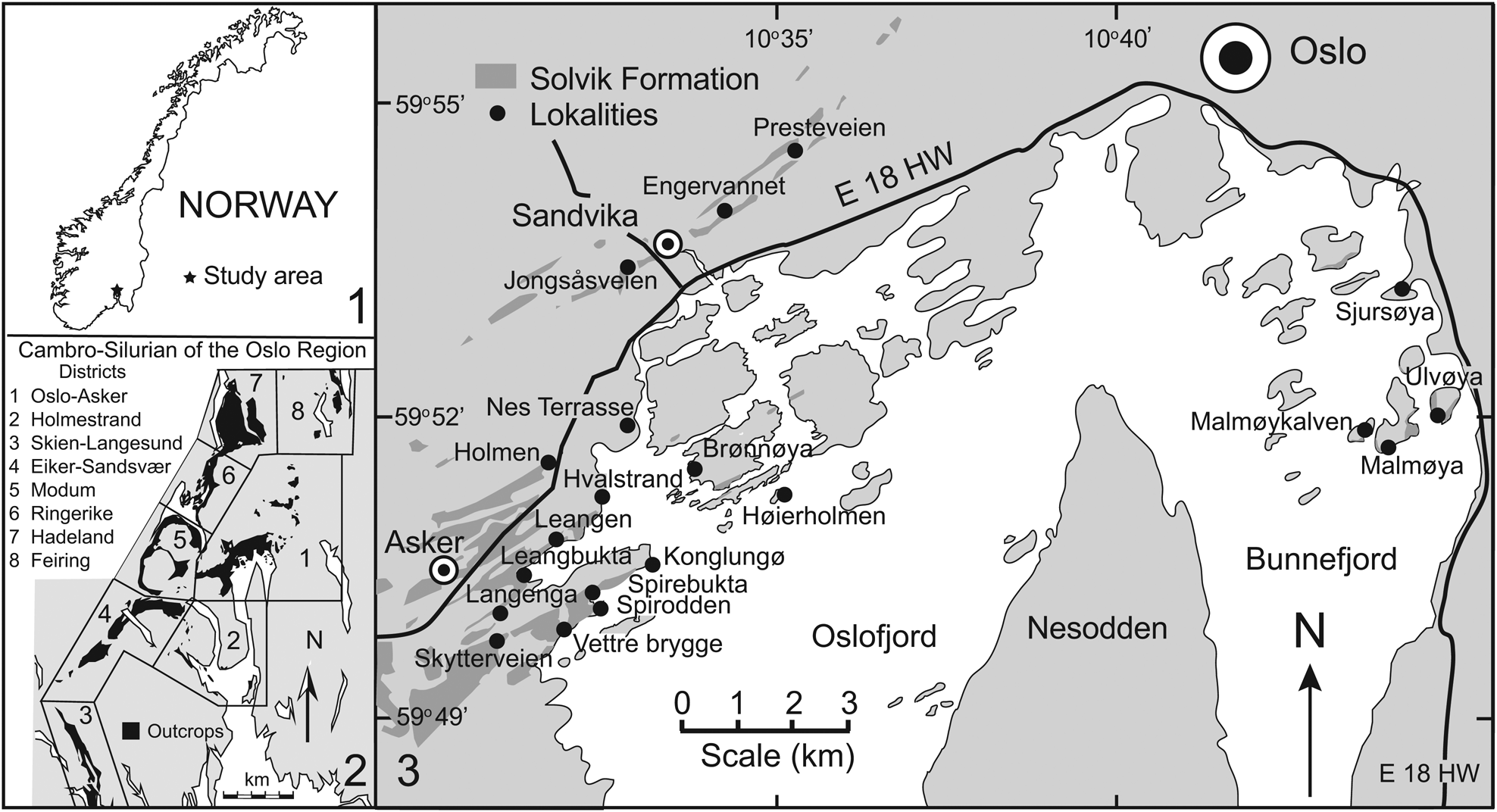
Outcrops of marine lower Paleozoic in the Oslo Region stretches from Ringsaker in the north to Skien in the south (Fig. 1.1). The strata occur in a relatively narrow Permian graben that has a length of ~220 km. The rocks are allochthonous, partly tectonized, and folded. The central Oslo Region consists of the Oslo and Asker areas (Fig. 1.2), with outcrops used in this paper found mostly in coastal areas of the Oslo Fjord (Fig. 1.3). The Upper Ordovician and the lower Silurian are influenced by the proximal Caledonian front with incoming siliciclastic material. The Solvik Formation is up to 245 m thick and encompasses layers from uppermost Hirnantian to strata coeval with the Stimulugraptus sedgwickii Biozone in the later parts of Aeronian. During deposition of the formation, a persistent slight slope from west to east was present with deeper conditions to the east.
(1) Map of Norway showing the study area with a star. (2) Map showing the Paleozoic outcrops in the Oslo Region with different districts identified. (3) Maps of the central Oslo Region showing marked localities where collections were made. Note: Outcrops of the Solvik Formation marked in gray.

The Upper Ordovician strata reflect a landscape with coastal deposition and several incised valleys. Physical evidence, such as open channels filled with transgressive shale (e.g., Torbjørnsøya; Johnson and Baarli, Reference Johnson and Baarli2018), together with brachiopods (Baarli, Reference Baarli2014), graptolites (Howe, Reference Howe1982; Štorch and Schoenlaub, Reference Štorch and Schoenlaub2012), conodonts (Aldridge et al., Reference Aldridge, Jeppsson and Dorning1993; Bergström et al., Reference Bergström, Saltzman and Schmitz2006), and a number of δ13C curves (Brenchley and Marshall, Reference Brenchley and Marshall1999; Kaljo et al., Reference Kaljo, Martma, Neuman, Rønning, Hints and Ainsaar2004; Bergström et al., Reference Bergström, Saltzman and Schmitz2006; Calner et al., Reference Calner, Calner and Lehnert2017), showed that deposition after the drawdown at some localities commenced in late Hirnantian. Kaljo et al. (Reference Kaljo, Martma, Neuman, Rønning, Hints and Ainsaar2004) and Calner et al. (Reference Calner, Calner and Lehnert2017) both found that completeness of the δ13C curves varied across the region and the westernmost parts of the central Oslo area like inland Asker, and areas between incised valley had the largest gaps and lack Ordovician strata above the gap. Calner et al. (Reference Calner, Calner and Lehnert2017) also showed that the valley sections exhibited the falling limbs of the curve. These are the sections where deposition with rich benthic fossil associations commenced in the uppermost Hirnantian and continued across the O/S boundary.
The succeeding Solvik Formation transgressed across this landscape. The formation is dominated by shales in the east and mudstones in the west, with very thin to thin siltstone and limestone intercalations (Fig. 2). In the east, it is estimated to be 190 m thick and consists of the basal Myren Member and the 30 m thick Padda Member (Fig. 2). The lower parts of the Myren Member are nearly void of fossils, with the exception of a few graptolites, but the fossil density and diversity increase upwards with lowering of the eustatic sea level. To the west, the base of the Myren Member (Fig. 2) reflects the underlying uneven landscape first and foremost in the fossil assemblages that are diverse from the very base. The member is 110 m thick with thin silty interbeds. The succeeding Spirodden Member displays thin silty calcareous intercalations with many corals and stromatoporoids reflecting a shallowing-upwards trend. A rapid deepening is recorded at the base of the overlying 75 m thick Leangen Member, followed with renewal of shallowing-upward conditions. The Leangen Member consists mainly of mudstones with thin to medium-thick fine sand intercalations of storm origin (Baarli, Reference Baarli1985).
Lithostratigraphic columns from the central Asker area correlated with the column from islands on the east side of the Oslofjord. Both are composite sections. A* denotes the Pilodden Member.

The age of the basal Myren Member varies, but many outcrops can be correlated to the uppermost Hirnantian M. persculptus Biozone or earliest Rhuddanian on the islands and coastal areas. Deposition first commenced in the Coronograptus cyphus Biozone, late Rhuddanian, inland far to the west in Asker at Olledalen (Bockelie et al., Reference Bockelie, Baarli and Johnson2017). The base of the overlying Spirodden Member is correlated to the topmost part of the Lagarograptus acinaces Biozone in Asker (Fig. 2). The base of the succeeding Leangen Member is dated to the base of Aeronian, according to the Stricklandia lens (Sowerby, Reference Sowerby and Murchison1839)/Stricklandia laevis (Sowerby, Reference Sowerby and Murchison1839) lineage and the base of the overlying Rytteråker Formation is from the S. sedgwickii Biozone (Baarli, Reference Baarli1986).
Materials and methods
Map references for the outcrops
The main collection sites are marked in Figure 1.3. The outcrops are of strata from the Solvik Formation.
(1) Coastal outcrops, entire Solvik Formation, Malmøya (59°52'14.00" to 59°51'40.27.00"N, 10°45'48.42" to 10°44'58.75"E).
(2) Coastal outcrops, Padda Member, Malmøykalven (59°51'54.28" to 59°51'45.00"N, 10°44'55.00" to 10°44'28.00"E).
(3) Coastal outcrops, Myren Member at Sjursøya (59°53'12"N, 10°45'21"E), now built over.
(4) Coastal outcrops, Myren and Padda members at Ulvøya (59°52"01.37"N, 10°46'14.53"E).
(5) Coastal outcrops, basal Myren Member, Brønnøya west (59°51'05.88"N, 10°32'14.63"E).
(6) Coastal outcrops, basal Myren Member, Høyerholmen (59°51'05.78"N, 10°33'26.46"E).
(7) East side of Engervannet, Spirodden Member (59°53'45.94"N, 10°32'04.65"E).
(8) Road cut opposite Presteveien 48b, Spirodden Member (59°54'08.48"N, 10°32'43.70"E).
(9) Old collection, unsure exact location at Gulleråsen (59°57'20.73"N, 10°41'47.45"E). Probably outcrops of Leangen Member, outside the map.
(10) Destroyed road cut, Leangen Member, Jongsåsveien (59°53'17.83"N, 10°30'48.06"E).
(11) Hillside, basal Myren Member, Nes Terrasse 14b (59°51'44.46"N, 10°30'12.49.74"E).
(12) Coastal outcrops, Myren to Spirodden members, Hvalstrand (59°50'37.05"N, 10°29'32.74"E).
(13) Road cut, Leangen Member, Leangbukta (59°50'07.65" to 59°49'56.00"N, 10°28'09.34" to 10°28'13.34"E).
(14) Leangen, old collection, uncertain exact site, may be same as 13 above.
(15) Coastal outcrops, basal Myren Member, Konglungø (59°50'22.01"N, 10°30'53.83"E).
(16) Coastal outcrops, basal Myren Member, Spirebukta (59°49'56.16"N, 10°29'46.08"E).
(17) Coastal outcrops, Myren into lowest Leangen members, Spirodden (59°49'57.68" to 59°49'50.28"N, 10°29'54.61" to 10°29'46.08"E).
(18) Coastal outcrops, transition Spirodden to Leangen members, Vettre Brygge (59°49'39.82"N, 10°29'16.55"E).
(19) Road cut along motorway E18 (parallel to Nye Vakås road). Steep outcrop from base to 100 m up in Myren Member, Holmen (59°49'39.82"N, 10°29'16.55"E).
(20) Road cuts, Leangen Member, Langenga (59°49'25.70"N, 10°27'38.04"E to 59°49'25.70"N, 10°27'38.04" E).
(21) Road cut, Skytterveien, (59°49'25.15"N, 10°27'40.63"E to 59°49'24.08"N, 10°29'33.96"E). Entire Leangen Mb north side, the upper parts of the Spirodden Member and slightly into the lower Leangen Member on the south side.
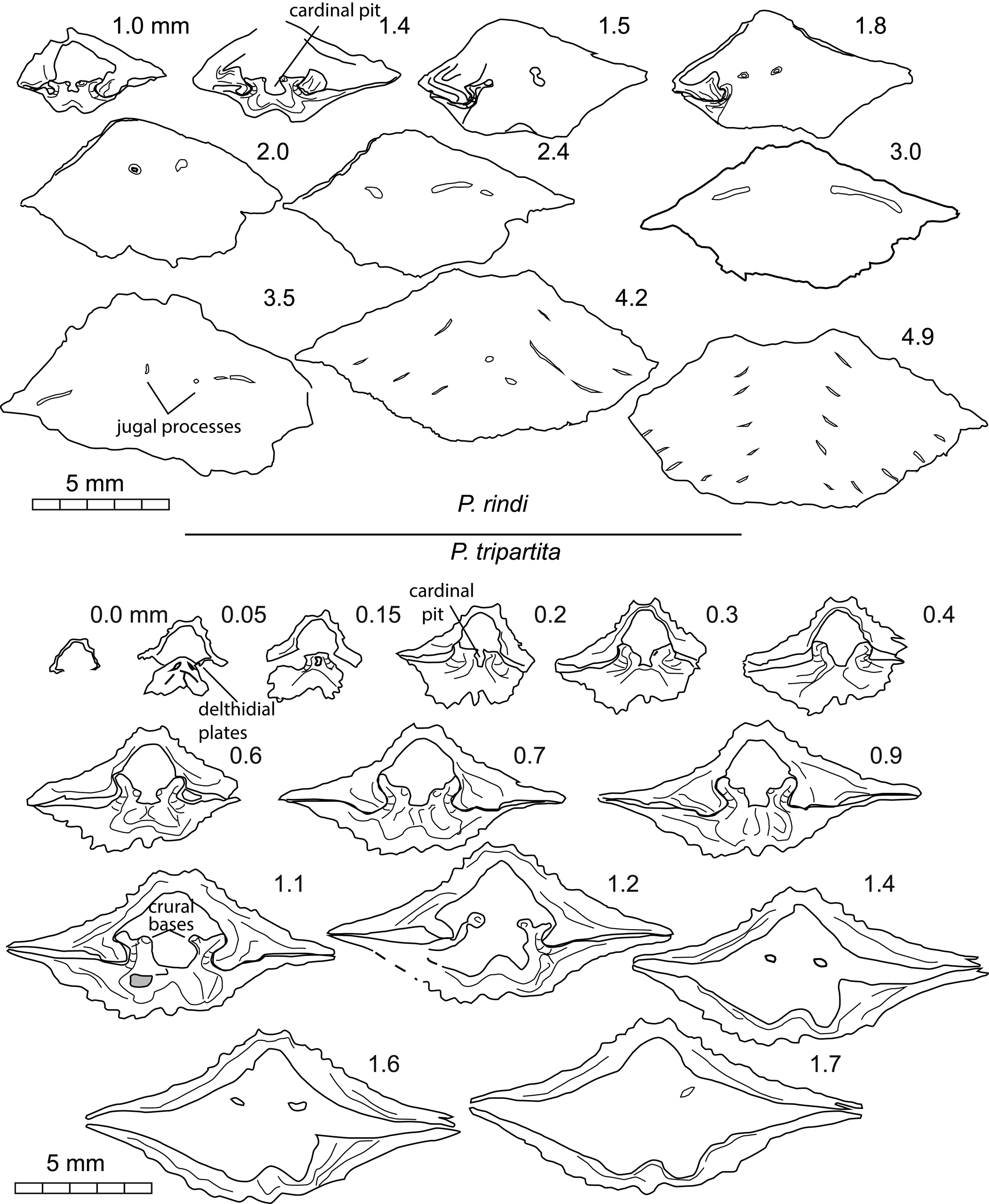
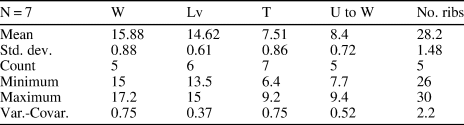
All the fossil material was measured for maximum width, length, and thickness, and the number of ribs at the anterior margin was counted, if possible. Univariate summary statistics were generated using the program PAST 4 by Hammer et al. (Reference Hammer, Harper and Ryan2001). Whole shells were sectioned if there were more than two whole individuals of a given taxon. Detailed information of the method used is given in Baarli (Reference Baarli2019), but is summarized, herein. The specimens were encased in resin and sectioned by a precision saw every 0.05 mm for small valves and 0.1mm for larger ones. The sectioning was stopped at half length of the shells or more posterior if spiralia were missing. Peels were taken for each cut and then photographed using a petrographic microscope. Tracings of the photographs are shown for each taxon. A simplified three-dimensional diagram was drawn of the cardinalia of each taxon. Molds are sometimes present and careful comparison with the drawn diagrams often made it possible to identify these. Spiralia are often not preserved, or they may be preserved detached in the bottom of the shell. In other instances, they are there, but coarse secondary calcite obscures them. Jugal processes are especially hard to discern.
Repository and institutional abbreviation
All the material in this study originates from the Paleontological collection (PMO) of the Natural History Museum in Oslo, Norway.
Systematic paleontology
Superfamily Atrypoidea Gill, Reference Gill1871
Family Atrypidae Gill, Reference Gill1871
Subfamily Atrypinae Gill, Reference Gill1871
Remarks
Most of the taxa from the Solvik Formation belonging to this subfamily have been treated by Baarli (Reference Baarli2019) where 10 taxa were described. A few additional species from this group are added here due to new specimens from field collecting or new information on internal feature.
Genus Dihelictera Copper, Reference Copper1995
Type species
Dihelictera acrolopha Copper, Reference Copper1995, by original designation, from the East Point Member of the Jupiter Formation (Aeronian), Anticosti Island, Canada.
Holotype
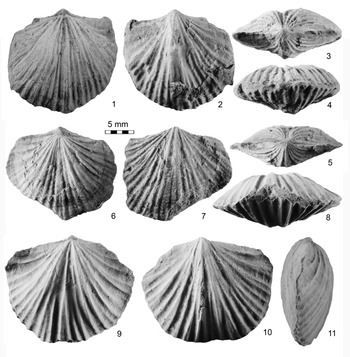
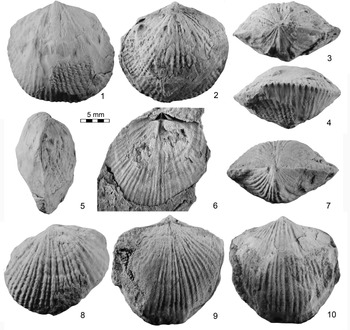
PMO 52.945b, whole shell (Fig. 3.1–3.4), from Vettre Brygge, Asker, Spirodden Member, Solvik Formation, uppermost Rhuddanian.
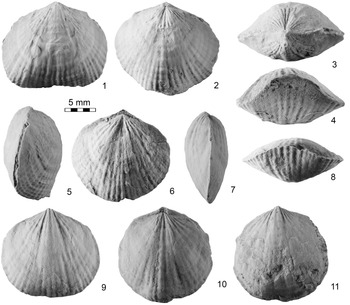
Dihelictera engerensis n. sp. (1–4) Holotype PMO 52.945b, brachial, pedicle, posterior, and anterior views, top of the member, Vettre Brygge, Asker; (5–7) PMO 233.995, posterior, brachial, and pedicle views, Presteveien, Sandvika; (8–11) PMO 91.537, anterior, brachial, posterior, and side view of denuded specimen, base of the member, Spirodden, Asker. All Spirodden Member.

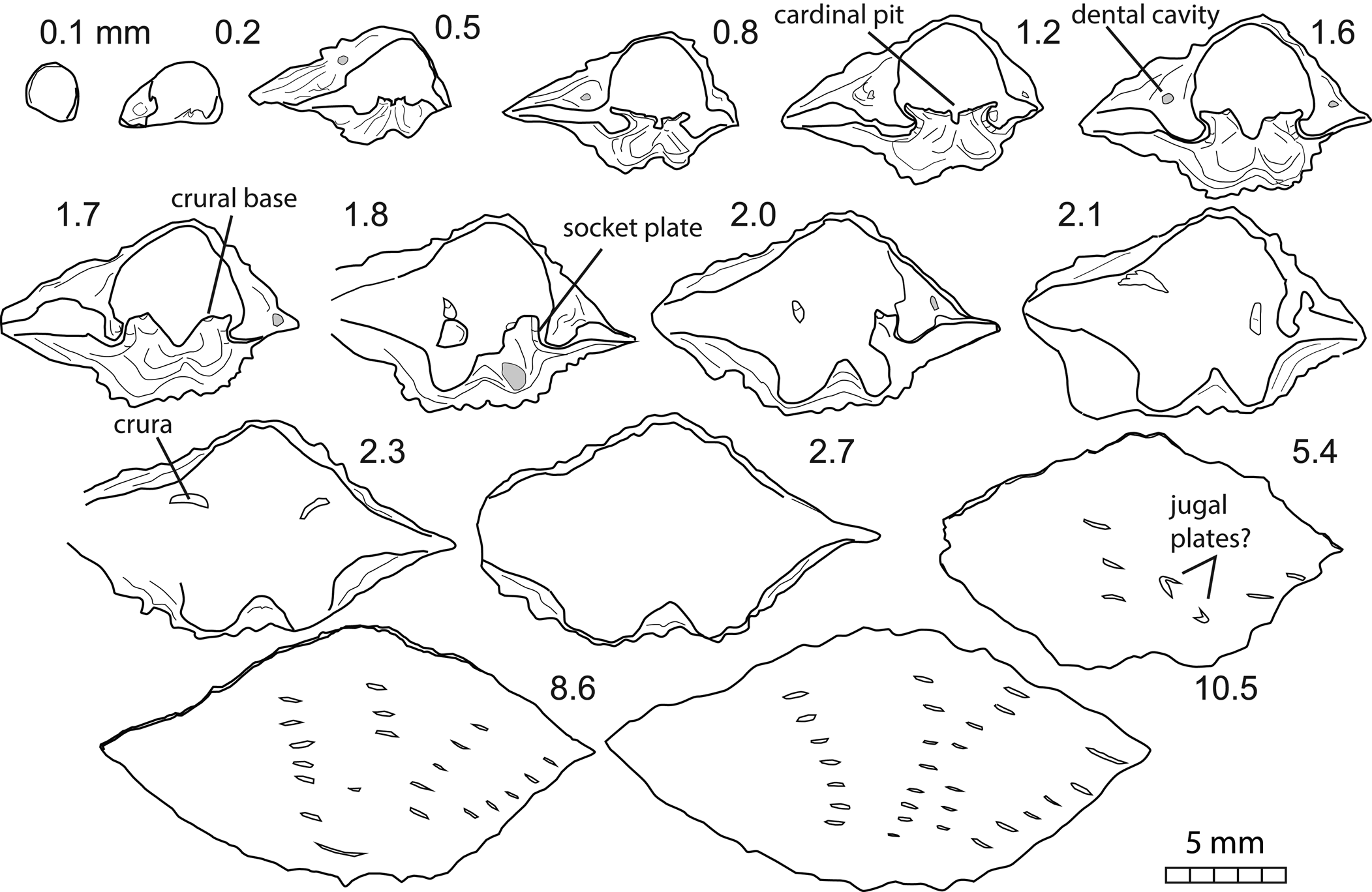
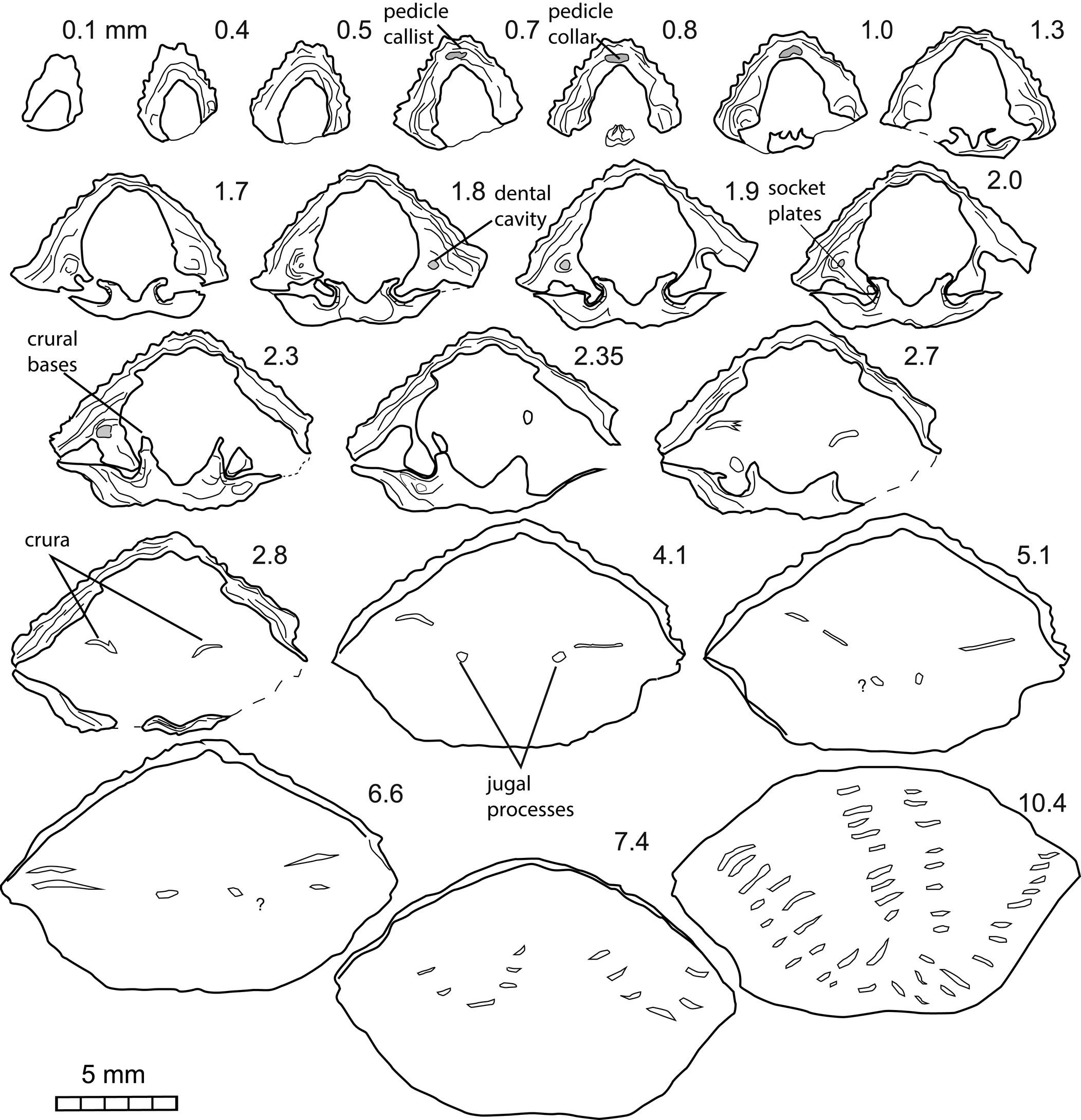
Dihelictera engerensis n. sp. Serial section of specimen PMO 91.336 from the lower part of Spirodden Member, Spirodden, Asker.

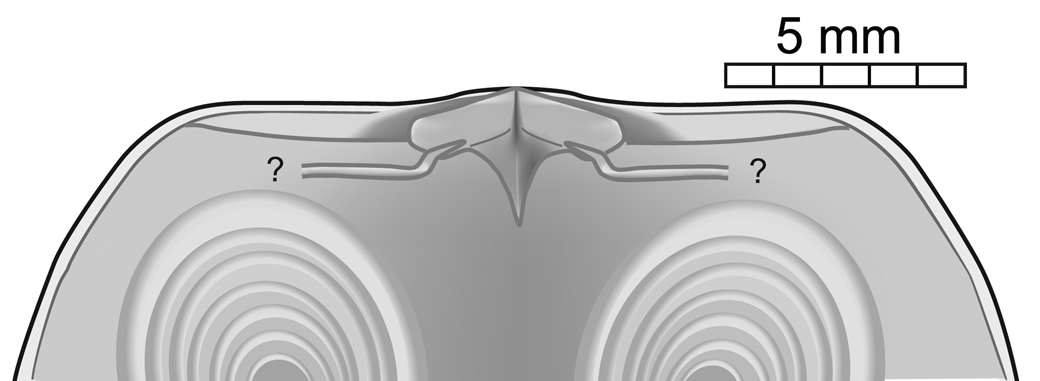
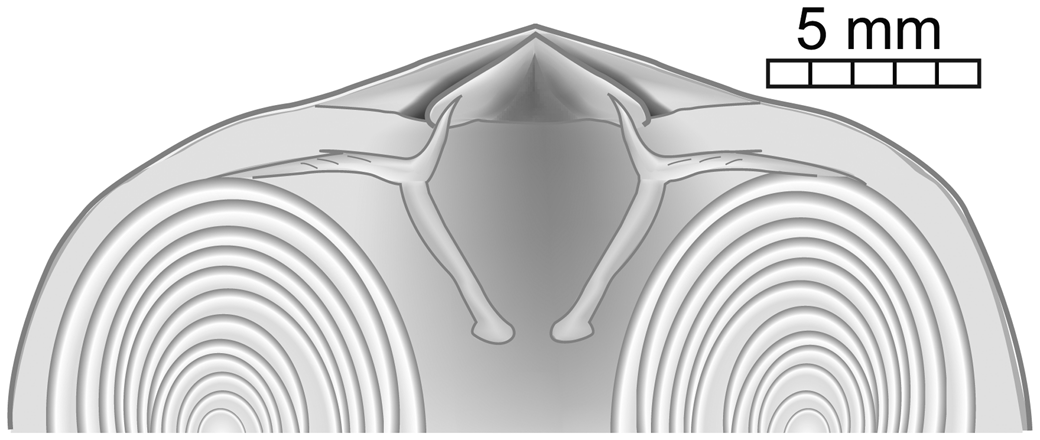
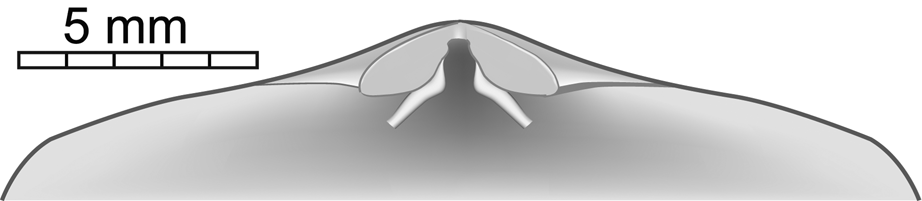
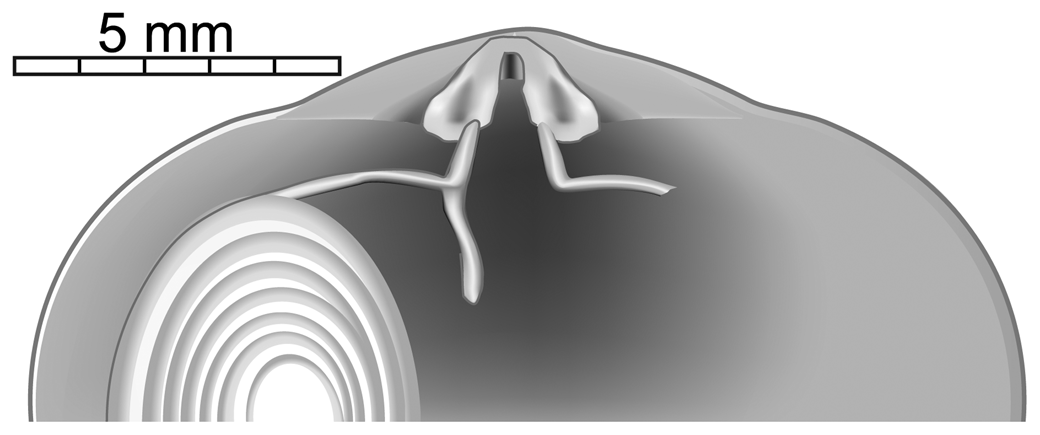
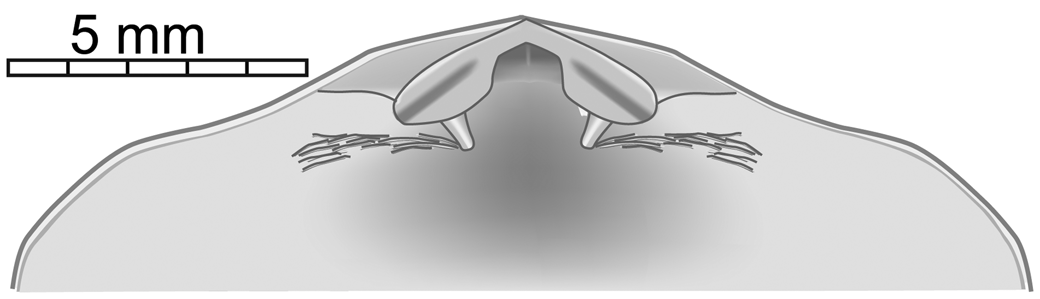
Dihelictera engerensis n. sp. Reconstruction of internal structures based on specimen PMO 91.336 (see Fig. 4).

Diagnosis
Relatively flat, large and biconvex Dihelictera with long, fairly straight hinge line. Small beak and orthocline to anacline interarea. Narrowly carinate and rectimarginate to narrowly uniplicate anteriorly. Long, medium-coarse, tubular ribs with very fine lamellae and simple filae. Internally short teeth with small dental cavities. Cardinal pad with small cardinal pit and laterally directed, disjunct hinge plates with thin supporting socket plates. Small crural bases and medium strong crura. There are eight whorls in the narrow spiralia.
Occurrence
Spirodden Member at Spirodden and Vettre Brygge, Asker and opposite Presteveien 48b, and eastern side of Engervannet, Sandvika, all upper Rhuddanian.
Description
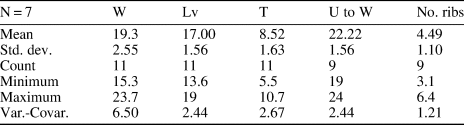
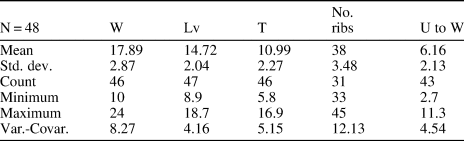
Medium large, sub-equally biconvex to slightly ventribiconvex valves, broader than long (length ~88% of width, Table 1) and fairly flat (maximum thickness 50% of length). Broad hinge line sometimes drawn out in alae (Fig. 3.1) and maximum width at or just in front of the hinge line. Carinate ventral valve caused by two slightly swollen mid-ribs that may end in a narrow, slight sulcus. Sulcus posterior in brachial valve with a mid-rib that may bifurcate anteriorly in large specimens. Anterior margin rectimarginate to uniplicate. Straight beak with orthocline to anacline area, small apical foramen and disjunct delthidial plates. Most specimens are denuded. The tubular ribbing is relatively coarse (average 22 ribs at anterior margin), straight, and rounded, with even, simple, and coarse filae present.
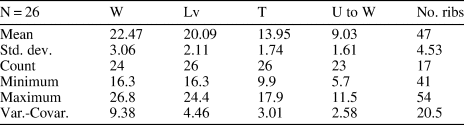
Univariate summary statistics based on measurements of Dihelictera engerensis n. sp. N = number of specimens measured, Lv = saggital ventral length, T = maximum thickness, No. ribs = number of ribs counted along anterior marigin of valve, U to W = distance from umbo to the maximum width of the valve measured along the mid-length, St. dev. = standard deviation from the mean, and var.-covar. = variance-covariance matrix. Mean, maximum and minimum are in mm.

No pedicle callist, strong, very short teeth directed dorsomedially with small dental cavities (Fig. 4). Shallow, well-developed, but narrow cardinal pit on strong cardinal pad with small cardinal process. The pad descends to the valve floor in front of the cardinalia, but continues in a median ridge that projects forward 3–4 mm. Thick hinge plates and fairly thin socket plates directed laterally. The crural bases are small and turn into ventral crus (Fig. 5). One of the spiralia is broken off and displaced against the other one that may be in place. They are both narrow with minimum eight whorls. Jugal processes are not seen in the part with coarse calcite filling. The two hook-like shell pieces seen in section 5.4 mm (Fig. 4) may be jugal plates that are broken off. There are no other shell fragments in the fine matrix.
Etymology
From Engervannet, a small lake in Sandvika.
Materials
PMO 52.727f, h, k, 52.945a, b (holotype), 91.336 (sectioned), 91.337, 91.338, 91.346, 158.353b, 233.995. All the specimens are whole.
Remarks
Two other species, D. acrolopha Copper, Reference Copper1995 and D. askeriensis Baarli, Reference Baarli2019 are finer ribbed, have weaker carination, and are more ventribiconvex. They are both smaller, but the first is overlapping in size. Internally D. askeriensis has larger dental cavities and hinge plates that reach high up in the ventral valves. Neither of the two has a hinge pad and medium septum, and both have just six whorls in the cardinalia, as opposed to eight in D. engerensis n. sp. The new species overlaps the lower part of the range and cooccurs with D. askeriensis. It is closest to the species D. acrolopha from Telychian into Wenlock in Canada and on the Siberian Platform, but occurs earlier in late Rhuddanian. Dihelictera lepidota Nikiforova and Modzalevskaya, Reference Nikiforova and Modzalevskaya1968 from Wenlock to Ludlow strata in Novaja Zemlya is again very small, has more pronounced concentric lamellae, a shorter hinge line, and much larger dental cavities.
Genus Gotatrypa Struve, Reference Struve1966
Type species
Atrypa (Gotatrypa) hedei Struve, Reference Struve1966, from Kap Gnisvärd, Gotland, lower Visby beds, upper Llandovery. The genus occurs in mid- to late Llandovery strata from North America, NW Europe, Kazakhstan, south China, and Siberia.
Holotype
PMO 233.917 (Fig. 6.1–6.5) from the lower part of the Leangen Member, Solvik Formation, lower Aeronian, road section in curve, Langenga, Asker.
Gotatrypa vettrensis n. sp. (1–5) Holotype PMO 233.917, pedicle, brachial, posterior, anterior, and side views of whole valve from lower part of member, Langenga, just after curve in Asker; (6) PMO 153.998b, mold of brachial valve from 25–30 m above the base of member, Skytterveien; (7, 9, 10) PMO 158.290e, posterior, brachial, and pedicle views; (8) PMO 158.290c, brachial view, from the Vettre Bed, 5–10 m above the base of the member. All from the Leangen Member, Asker.

Diagnosis
Medium sized, biconvex valves with relatively long posterior margin and weak posterior sulcus. The ventral valve has weak carination and may appear keeled posteriorly. Anacline to adpressed area and small beak with small apical foramen. Rectimarginate to weakly sulcate anterior margin. Fine, straight ribs with close and evenly spaced growth lamellae covering the valves. The lamellae are rounded and slightly drawn out in the furrows. Pedicle callist thick with pedicle collar. Teeth weak and short with small dental cavities. Low cardinalia with cardinal pit, thin socket plates and small crural bases curving into fibrous crura. Long jugal processes with small jugal plates.
Occurrence
Spirodden Member on Spirodden, the lower 20 m of the Leangen Member at Vettre, Vettre Brygge and Langenga, Leangen Member at Skytterveien and Leangbukta, all in Asker. Upper Myren Member, Ulvøya, Oslo. In strata of late Rhuddanian age into middle Aeronian.
Description
Medium sized, biconvex, somewhat globose (average thickness 57% of length, Table 2), shield-shaped shells, slightly wider than long (length 90% of width) with long hinge line (Fig. 6.9). Maximum width is close to mid length (average 48% of total length from umbo). Ribs straight, even, and fine with fine wavelike, surface ornament projecting slightly in the furrows. The rib count is on average 32 ribs along the anterior margin, increasing by bifurcation. No or slight carination and the anterior margin is faintly sulcate to rectimarginate. The beak small and incurved, anacline to hypercline and with an apical foramen. There is often a posterior sulcus in the brachial valve with an enlarged mid-rib that does not extend all the way anteriorly.
Univariate summary statistics based on measurements of Gotatrypa vettrensis n. sp. See Table 1 for explanation of abbreviations.

Thick pedicle callist with small pedicle collar (Fig. 7). Slender teeth with minute dental cavities and shallow accessory lobes. Well-developed cardinal pit, low hinge plates with thin socket plates, and small crural bases. The shell is filled with coarse secondary calcite partly obscuring internal structures, but the crura seem to be broad, low, and slightly fibrous. The jugal processes are long and tipped by small jugal plates. There are 12 whorls directed dorsomedially (Figs. 7, 8). Ventral valve shows long, fairly narrow diductor scars enclosing small adductor scars (Fig. 6.10). Mold of brachial valve has weakly impressed muscle scars.
Gotatrypa vettrensis n. sp. Serial section of specimen PMO 158.290k from the lower part of Spirodden Member, Spirodden, Asker.

Gotatrypa vettrensis n. sp. Reconstruction of internal structures based on specimen PMO 158.290k (see Fig. 7).

Etymology
From the locality it was most common; Vettre.
Materials
PMO 51.968c, n and u1, 52.717b, f, s (mold pedicle valve), u, 52.727d, e, g, 52.979 c, d, f, g, l, 52.980, 52,981, 103.541, 105.229, 153. 998, 158.100, 158,230 (last five all mold), 158.235b, 158.288, 158.290c-g, k (thin section), 158.352 (brachial valve), 233.911 (mold pedicle valve), 233.916, 233.917, 233.929, 233.998. Whole shells, except where marked.
Remarks
Nikiforova in Nikiforova and Andreeva (Reference Nikiforova and Andreeva1961) described Gotatrypa septentrionalis from Telychian of the Siberian platform. That species is close externally. However, G. septentrionalis is generally smaller and has a more protruding beak with delthidial plates. Internally it has a strong, but short median septum, short dental lamellae, and nine whorls of the spiralia, all traits that differ from G. vettrensis n. sp. Gotatrypa vettrensis n. sp. is the oldest Gotatrypa known occurring from upper Rhuddanian strata. It differs from typical Gotatrypa by slightly fibrous crura and a very thick pedicle callist and collar. These characteristics are seen in some other species of Gotatrypa.
Genus Rhinatrypa new genus
Type species
Plectatrypa henningsmoeni (Boucot and Johnson, Reference Boucot and Johnson1967), PMO 21.212, Myren Member, Solvik Formation, Rhuddanian, Malmøya, Oslo.
Diagnosis
Medium to large, strongly dorsi-biconvex shells that is broader than long in adult shells. A broad, nose-like and adpressed beak is obscuring an area with minute delthidial plates. No to weak carination and a strong U-shaped fold and sulcus. Fine, rounded and straight ribs with uneven imbrication. A thin pedicle callist is present and the teeth are massive, but short with dental cavities and accessory lobes. Strong socket plates with a well-developed cardinal pit and thick, fibrous crura with simple jugal processes tipped with small plates. The spiralia has 10-12 whorls directed dorsi-medially.
Occurrence
Central Oslo Region and in Gorny Altai, southern Siberia. In both areas it has a long range from early Rhuddanian (possibly latest Ordovician in Altai) through Aeronian.
Etymology
Greek, rhinos, nose referring to the broadly nose-shaped beak.
Remarks
Both Boucot and Johnson (Reference Boucot and Johnson1967) and Copper (Reference Copper2004) placed Rhinatrypa henningsmoeni (Boucot and Johnson, Reference Boucot and Johnson1967) under Plectatrypa. However, internal sections were not described and the former authors noted several traits that are not compatible with the amended definition of Plectatrypa by Copper (Reference Copper2004). This species is large to be a Plectatrypa, carination varies from weak to non-existent and there are no swollen ribs. The fold and sulcus are mostly strong, but not with a sharp edge. The ribs are even, fine and with variably spaced imbricated. Only anterior is it closely spaced as is characteristic for Plectatrypa. Internally there is a thin pedicle callist, dental cavities, fibrous crura and up to 11 whorls of the spiralia. Plectatrypa typically lacks a pedicle callist, dental cavities and have thin, non-feathery crura and less than 8 whorls in the spiralia. These traits are common in the subfamily Atrypinae so the species is moved to this group.
The genus Askerina Baarli, Reference Baarli2019 of the Atrypinae is close to Rhinatrypa n. gen. in internal characters. It has a pedicle callist, strong cardinalia, feathery crura and high number of whorls. Externally they both are medium to large in size, strongly biconvex, although Askerina has a much flatter pedicle valve than Rhinatrypa n. gen. and is less transverse in outline. They both have fine ribbing, but Askerina differs in wave-like imbrication, a smaller beak and the fold and sulcus originate further anterior. Askerina occurs from the uppermost Hirnantian while Rhinatrypa n. gen. appears in mid-Rhuddanian.
Rhinatrypa henningsmoeni (Boucot and Johnson, Reference Boucot and Johnson1967)
Figures 9–12
Reference Boucot and Johnson1967 Plectatrypa henningsmoeni Boucot and Johnson, p. 96, pl. 4, figs. 1–12.
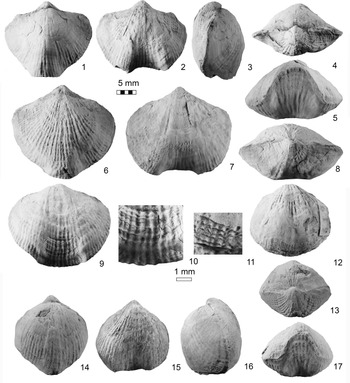
Rhinatrypa henningsmoeni n. gen. (1–4) PMO 21.059, brachial, pedicle, side, and posterior views, from middle Myren Member, Ulvøya; (5–8) PMO 21.214, anterior, brachial, pedicle, and posterior views, upper parts of Padda Mb, Malmøya; (9, 10) PMO 21.058, pedicle view and enlarged ribbing, skerry near Ulvøya, from middle Myren Member; (11, 12) PMO 42.201 enlarged ribbing and pedicle view, from upper parts of Myren Member, Ulvøya; (13–17) PMO 41.200 (sectioned), posterior, brachial, pedicle, side, and anterior views, Padda Member, Malmøya. All Oslo.

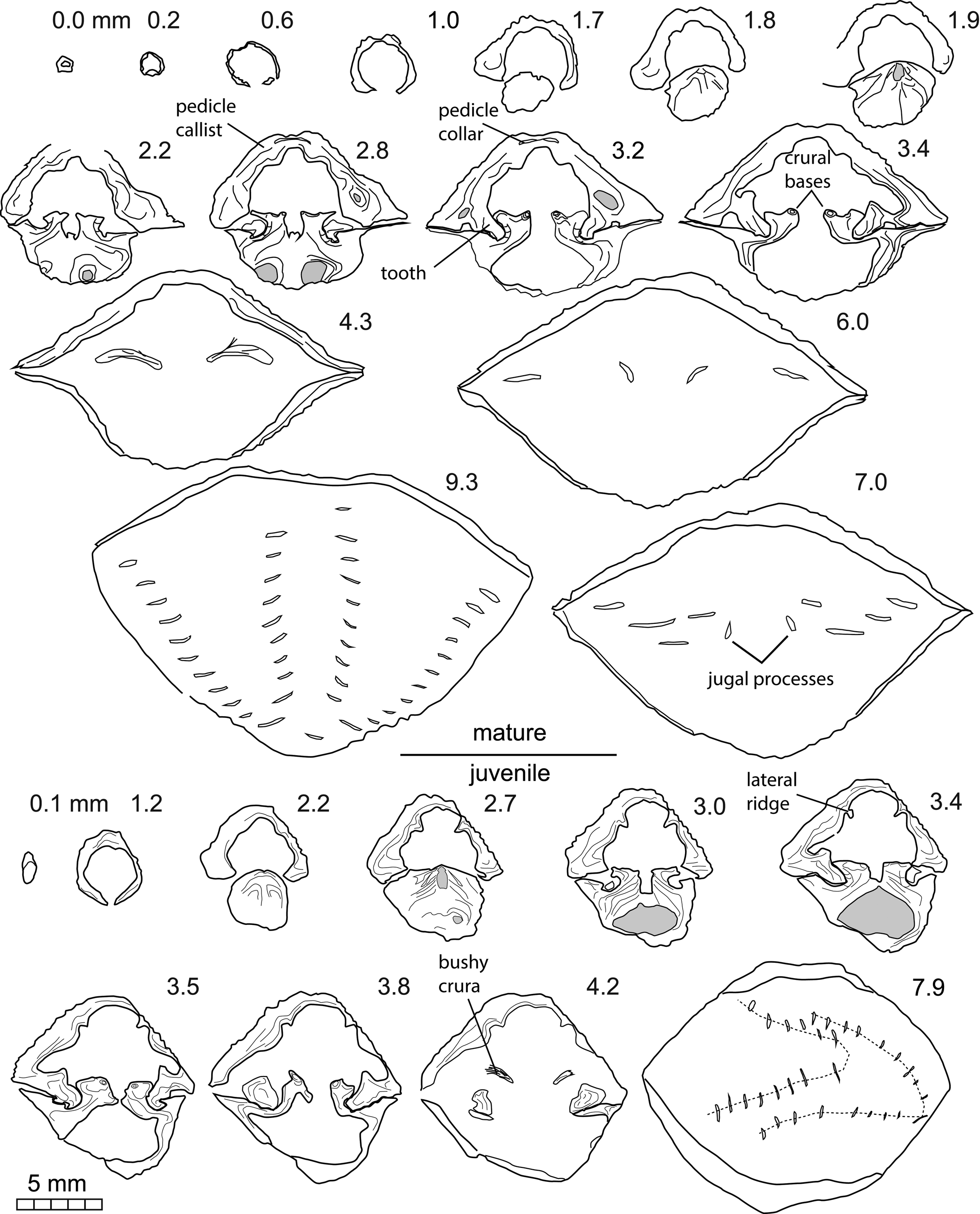
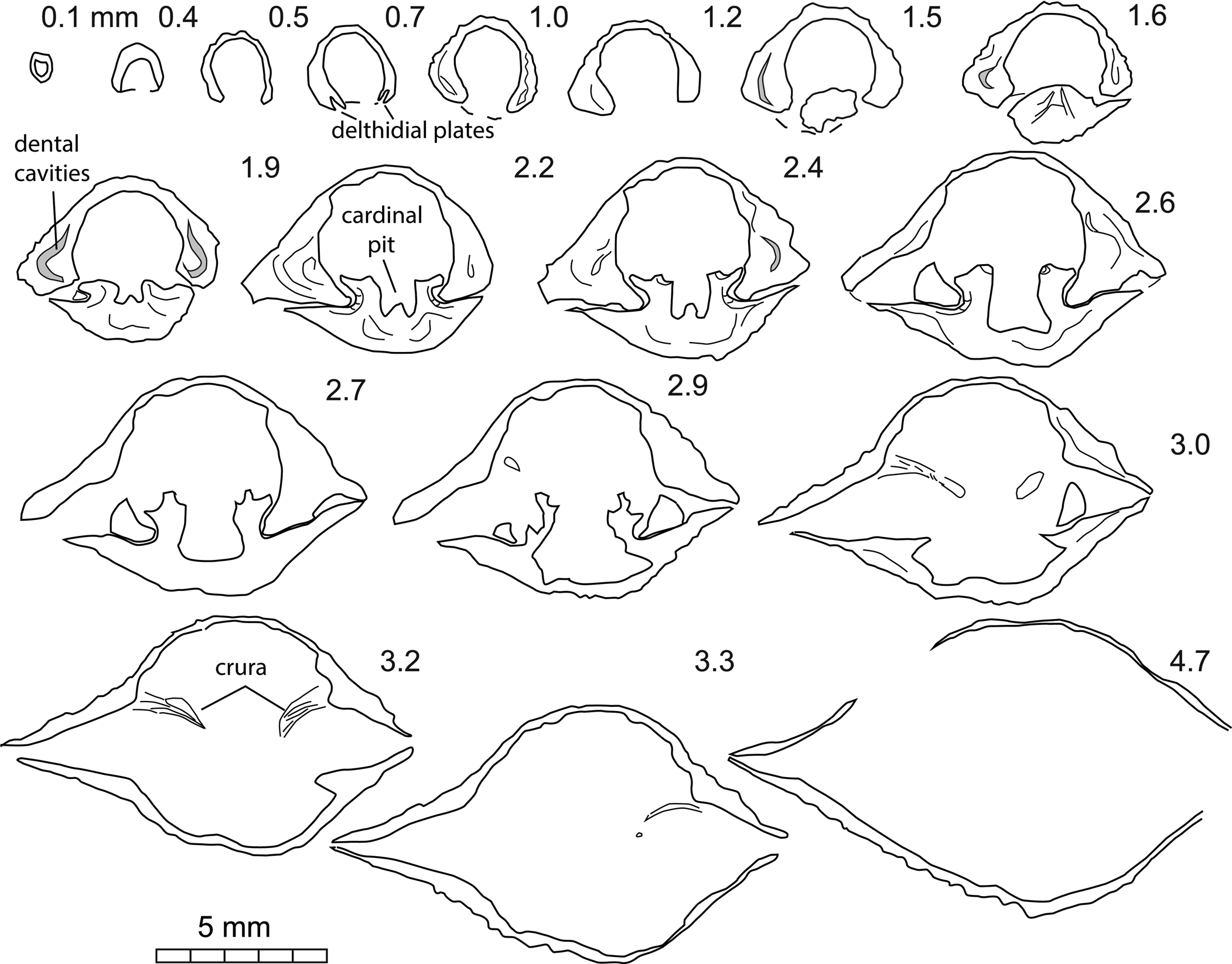
Rhinatrypa henningsmoeni n. gen. Serial section of mature specimen PMO 158.415 from the uppermost part of Padda Member, Malmøykalven. Serial section of juvenile specimen PMO 41.200, Padda Member, Malmøya, both Oslo.

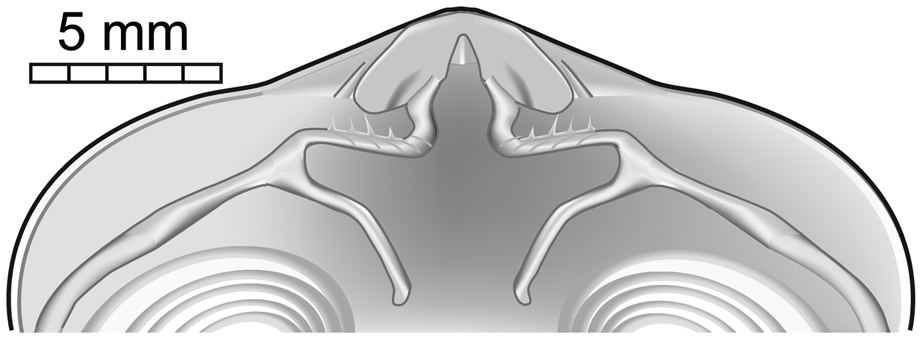
Rhinatrypa henningsmoeni n. gen. Reconstruction of internal structures based on specimen PMO 158.415 (see Fig. 10).

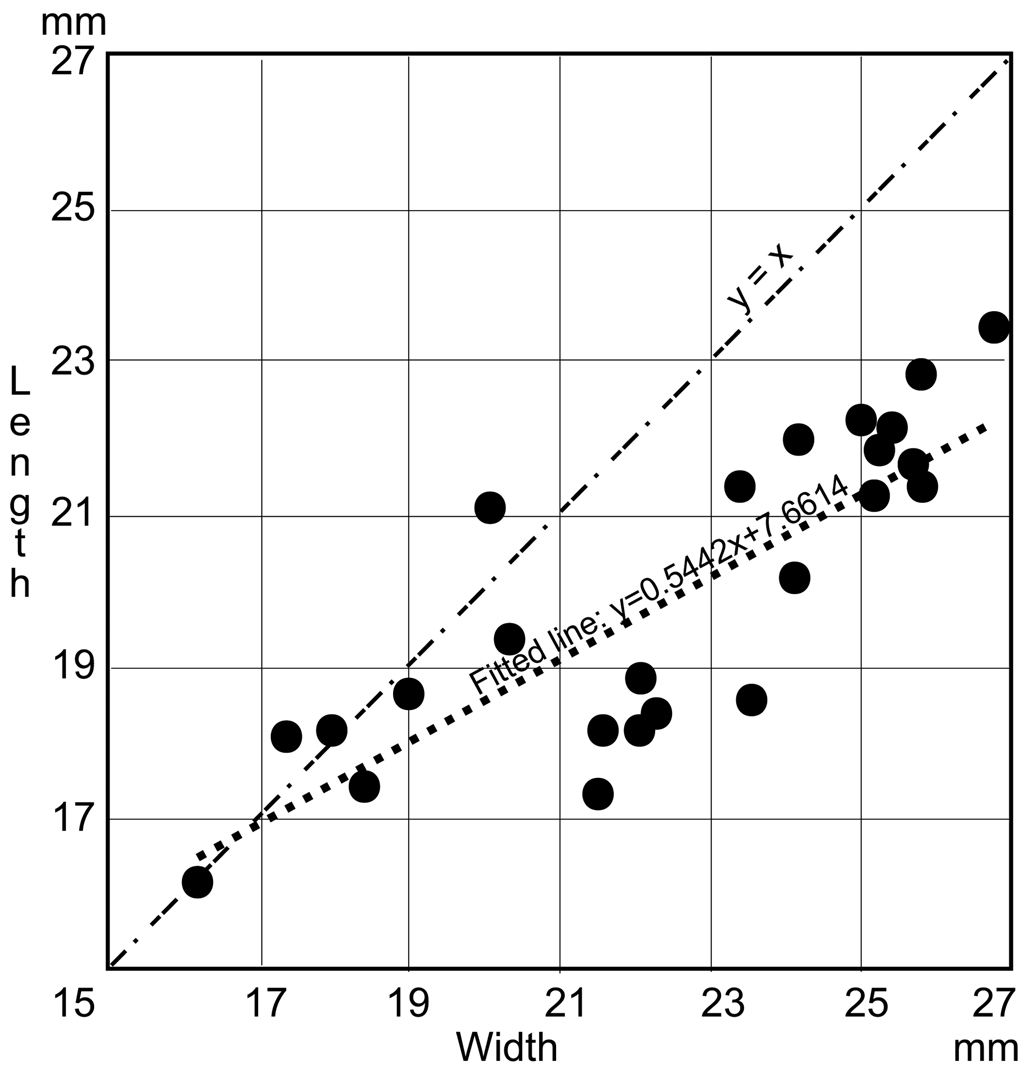
Scatterplot for width (x) and length (y) of Rhinatrypa henningsmoeni n. gen., with fitted line and line where x = y, showing that valves get broader compared with length in larger specimens.

Reference Thomsen, Baarli and Worsley1982 Plectatrypa henningsmoeni; Thomsen and Baarli, pl. 3, figs. 16, 19.
Reference Kulkov and Severgina1989 Plectatrypa aff. henningsmoeni; Kulkov and Severgina, p. 179, pl. 31, figs. 8–10.
Holotype
PMO 21.212, Myren Member (middle part?), Solvik Formation, Rhuddanian), Malmøya, Oslo.
Occurrence
Most of the material comes from the upper part of the Myren and the Padda members of the Solvik Formation (upper Rhuddanian to Aeronian) from Malmøya, Malmøykalven, and Ulvøya in the eastern parts of the Oslo area. A few additional specimens are from the uppermost Spirodden and Leangen members, Skytterveien in Asker, and Jongsåskollen in Sandvika and Spirodden Member, Presteveien 25, Sandvika. Boucot and Johnson (Reference Boucot and Johnson1967) stated that their material is from 6a (i.e., uppermost Hirnantian to basal Rhuddanian strata), both from Malmøya and Asker. However, the original labels only state Solvik Formation (stage 6), uppermost Hirnantian throughout Aeronian. The designation to basal Rhuddanian is surely a mistake because these rocks at Malmøya are virtually devoid of fossils and no specimens were found by the present author in those layers in Asker, despite extensive collection.
Description
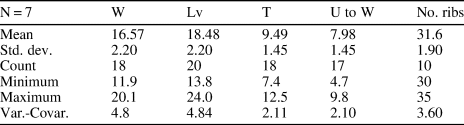
Boucot and Johnson (Reference Boucot and Johnson1967) gave a good description when they defined the species. However, they did not section the specimen. Also, they did not provide any specimen measurements. Here, 24 specimens from the collections at the Natural History Museum in Oslo are measured (Table 3), and PMO 158.415 from Padda Member, Malmøya is sectioned.
Univariate summary statistics based on measurements of Rhinatrypa henningsmoeni n. gen. See Table 1 for explanation of abbreviations.

The interior displays a strong pedicle callist and small, thin delthidial plates (Fig. 10). Dental nucleus well developed. Strong teeth pointing dorsi-medially with crural notches and small accessory lobes. Dorsal valve exhibits a wide cardinal pit and insignificant median ridge. The hinge plates are strong with well-developed socket ridges and crural bases giving rise to feathered crura directed ventri-laterally and thin simple jugal processes directed forwards (Figs. 10, 11). Spiralia with at least 11 whorls directed mediodorsally.
Materials
PMO S3470, 21.058–21.064, 21.066–67, 21.213, 21.214, 41.191, 41.199, 41.200 (sectioned), 41.201, 42.106 c, d, 41.640 (sectioned), 42.164 a–c, 113.685 (mold pedicle valve), 155.488, 158.415 (sectioned), 209.200, 233.996, 233.997, 233.999, 234.071 (mold). All whole specimens except when marked.
Remarks
Rhinatrypa henningsmoeni n. gen. is defined as being large and transverse with a long hinge line. The juvenile specimens show a distinctly different morphotype (Figs. 9.12–9.17). They have a short, narrow outline with strongly sloping hinge line, without being inflated and wide. The length is close to maximum width. In addition, the brachial valve is deeper than the pedicle valve, as opposed to equally biconvex as in the main population. They fit comfortably within Atrypinae, strengthening the case for moving this species. Figure 12 shows there is no significant break in outline and the valves broaden as they get older. Initially this was taken as a different taxon and sectioned, but there were no major differences internally. The juveniles lack the dental nuclei. There are two strong projections of shell material ventrolaterally in the pedicle valve of the section from the juvenile that must have constituted a lateral ridge running on both sides of the midline near the umbo. These are less prominent and rounded in the sectioned mature valve. However, Boucot and Johnson (Reference Boucot and Johnson1967, p. 97), working on molds, called these “knob-like protuberances delineating the notothyrial chamber” and depicted deep protuberances in a mature specimen, so this is not a consistent difference.
Family Atrypinidae McEwan, Reference McEwan1939
Subfamily Plectatrypinae Copper, Reference Copper1996
Remarks
The members of Plectatrypinae from the uppermost Hirnantian and the lowermost Rhuddanian strata have been difficult to differentiate to genus (Copper, Reference Copper2004). Plectatrypinae is a new subfamily after the end-Ordovician mass extinction with just three genera and with a questionable origin in the Hirnantian according to Copper (Reference Copper2004). However, the Norwegian material is especially rich in plectatrypids occurring from the very base of the Solvik Formation.
Members of the two subfamilies Spirigerinae and Plectatrypinae may not be easy to distinguish, especially based solely on external criteria. Copper (Reference Copper2004) wrote that the older specimens of Plectatrypa in early Rhuddanian do not possess true imbricate shells and are probably assignable to Eospirigerina. He also used the criteria of Silurian position in the definition of Plectatrypa (Copper, Reference Copper1996). Both Eospirigerina and Plectatrypa are common in the O/S boundary layers, so the material may be used to achieve a better distinction between the subfamilies.
Genus Bockeliena new genus
Type species
Atrypa flexuosa (Marr and Nicholson, Reference Marr and Nicholson1888) from the Lower Skelgill beds, lower Rhuddanian, Skelgill, Ambleside, Westmoreland, Great Britain.
Diagnosis
Medium sized, transverse and globose shells with carination and a very deep uniplicate, u-shaped commissure with ventral sulcus and dorsal fold. Fairly coarse to coarse, rounded ribs with distinct undulose, swollen growth lamellae spread wide apart at irregular distances, similar to Sypharatrypa, and simple, straight filae. Strong brachial mid-rib. Anacline to adpressed area with well-developed, small delthyrium and apical foramen. Thick teeth without dental cavities or nuclei. Thick swollen socket ridges and massive hinge plates. Crura trending anteroventrally. Around seven whorls in spiralia.
Occurrence
The genus is so far known only from its type area, Bærum and Asker in Norway and possibly Tajmyr, Russia.
Etymology
The genus is named in honor of the late paleontologist Fredrik Bockelie and his wife Angie who gave me access to Fredrik's collections. This genus was amply represented in his collection and in his yard where the base of the formation is exposed.
Remarks
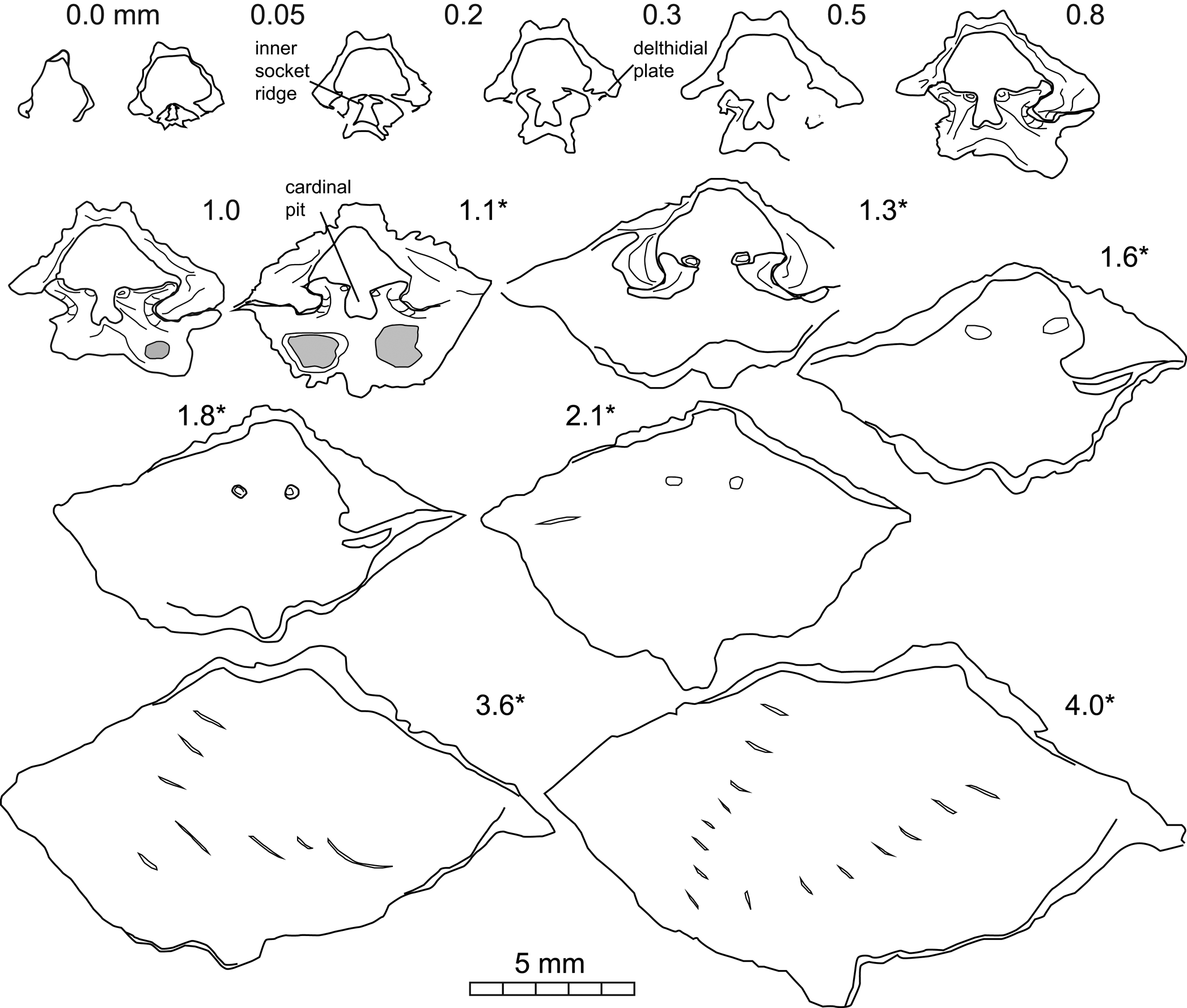
The genus occurs from the O/S boundary layers near the time of the origin of the Plectatrypinae. It reflects the ribbing of the contemporaneous or possibly younger Sypharatrypa, the shape, carination, and lack of dental nuclei seen in Plectatrypa, and the internal of Xanthea. Bockeliena n. gen. can be distinguished from Sypharatrypa by its strong carination, sharp fold, filae, and anacline interarea. Internally, it lacks dental nuclei and has more whorls of the spiralia. In these characters, it is similar to Plectatrypa, but the characteristic imbrication seen in Plectatrypa is missing. It also has coarser ribs. Xanthea shares shape, but not ornamentation with Bockeliena n. gen., although filae are present as in the former. In addition, Xanthea has a peculiar swelling and fusing of the inner socket ridges, which is seen in a modified form in Bockeliena n. gen. (Fig. 14, 0.05–0.3 mm). The inner socket ridges are globose, swung up, and nearly touching in sections close to the umbo. Copper (Reference Copper1996) described the genus Xanthea from lower Wenlock beds at Gotland, but he mentioned that there are older specimens known with a finer ornamentation both in Gotland and in England. Copper (Reference Copper2004) tentatively assigned the type species of B. flexuosa to Plectatrypa. Furthermore, he speculated that it instead might be assigned to Sypharatrypa, which is a valid observation based on the external ornament. As outlined above, it does not fit within any of these genera.
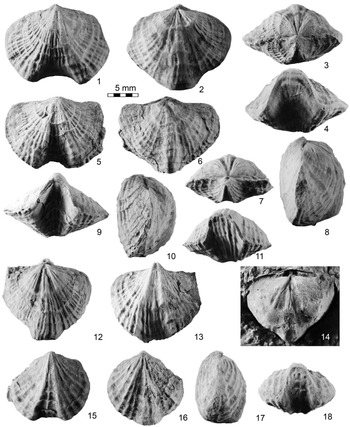
Bockeliena flexuosa n. gen. (1–4, 8) PMO 52.007a, pedicle, brachial, posterior, anterior, and side views; (5, 6, 9, 10) PMO 52.007, pedicle, brachial, anterior, and side views; (7, 11–13) PMO 52007h, posterior, anterior, brachial, and pedicle views. All from the base of Myren Member, Høyerholmen. (14) PMO 108.280 mold of brachial valve, from 40 m above the base of the Spirodden profile, lower parts of Myren Member, Spirodden. All Asker. Bockeliena sp. (15–18) PMO 233.993 pedicle, brachial, side, and anterior views, Spirodden Member, Presteveien 48b, Sandvika.

Bockeliena flexuosa n. gen. Combined serial sections of specimens PMO 157.943 and PMO 233.977. Sections marked with * belong to the latter. From 5–7 m above the base of the Myren Member (uppermost Hirnantian), Konglungø, Asker.

Bockeliena flexuosa (Marr and Nicholson, Reference Marr and Nicholson1888)
Figures 13.1–13.14, 14, 15
Reference Marr and Nicholson1888 Atrypa flexuosa Marr and Nicholson, p. 725, pl. 16, figs. 20, 20a, 20b.
Reference Boucot and Johnson1967 Plectatrypa flexuosa; Boucot and Johnson, p. 94.
Reference Thomsen, Baarli and Worsley1982 Eospirigerina gaspéensis (Cooper, Reference Cooper1930); Thomsen and Baarli, pl. 3, figs. 1, 2.
Reference Baarli and Harper1986 Eospirigerina gaspéensis; Baarli and Harper, pl. 3c, g, h.
Reference Baarli1987 Eospirigerina gaspéensis; Baarli, fig. 5B.
Reference Copper2004 ?Plectatrypa flexuosa; Copper, p. 80.
Lectotype
SMA40308 (Sedgwick Museum) the original of Marr and Nicholson, Reference Marr and Nicholson1888, listed for type species.
Occurrence
The Norwegian material is from Nes Terrasse 14b, Hvalstrand, Konglungø, Leangen, Vettre, Holmen, Spirodden and Spirebukta in Asker, Høyerholmen and Brønnøya, Bærum. The specimens are very common near the base of the Myren Member, with rare occurrences in the Spirodden and Leangen members, Solvik Formation, uppermost Hirnantian and into Aeronian. Bockeliena flexuosa n. gen. is otherwise known from its type area Westmoreland, England, in the Skelgill beds (lower Rhuddanian).
Description
Medium sized, globose, dorsi-biconvex with an outline wider to nearly equally as wide as long (average length to width 82% and thickness to width 61%), with maximum in the posterior third of the valves (Table 4). Carinate with sharply defined ventral sulcus (22% of maximum width at 1 cm from umbo). The ventral sulcus is defined by two swollen ribs diverging evenly anteriorly, the mid-rib bifurcates early, and the sulcus is covered by 6–9 ribs anteriorly. The commissure is deeply uniplicate with a u-shaped even fold (Fig. 13.4, 13.8). Strong swollen brachial mid-rib that bifurcates about midway down the valve. Larger, very thick specimens may show geniculation of both valves near the anterior margin. Relatively wide hinge line and evenly rounded cardinal angles. Small and incurved ventral beak with anacline interarea. Small, delthidial plates and apical foramen. The ribs are medium coarse and somewhat irregular to fascicostellate, rounded, and branching. The growth lamellae are undulose and swollen at fairly long and irregular distances. In some well-preserved specimens, a few of these lamellae near the anterior commissure are corrugated. Fine, straight filae are present as micro-ornament.
Univariate summary statistics based on measurements of Bockeliena flexuosa n. gen. See Table 1 for explanation of abbreviations.

No pedicle callist. Thick, solid teeth without dental cavities (Fig. 14). Thick, well-separated hinge plates with a flat upper surface and thick, massive, and swollen inner socket ridges (Fig. 15). Posteriorly, the socket ridges are bridged (Fig. 14, 00.05–0.3 mm). The crura are relatively thin tending anteroventrally, but broken. Some of the jugal processes are observed in a ventral position placed fairly close together. One whole spiralia is found lying loose sidewise with eight whorls. Dorsal muscle scars weakly impressed, diductor scars in pedicle valve prominent, parallel, track-like, diverging but straight.
Bockeliena flexuosa n. gen. Reconstruction of internal structures based on the combined specimens PMO 157.943 and PMO 233.977 (see Fig. 14).

Materials
PMO 51.968a, 52.007a, c, e–i, k–n, 52.309a–d, 52.455b, 52.456a, 52.529 a–i, 52.717a, d, e, 53.063a, b, 53.069, 108.277 (ventral mold), 108.280 (brachial mold), 143.275, 157.932c, 157.943 (sectioned), 159.060, 159.061, 209.199, 220.507a, b, 233.960–76, 233.977 (sectioned), 233.979, 233.985.
Remarks
The type material of Bockeliena flexuosa n. gen. is not well preserved. However, it is clearly quite globose like the material from Norway, the outline and the strong, well-spaced, undulose ribbing are similar, although filae are not visible. Since it is found in strata of the same age, it is likely the same species.
Bockeliena sp.
Figure 13.15–13.18
Occurrence
Across from Presteveien 25 and 48, Spirodden Member, Solvik Formation, upper Rhuddanian, Sandvika.
Description
The shell is small, globose, and dorsibiconvex with maximum width near the mid line and a semicircular outline (Table 5). There is an apical foramen and the beak is small, incurved, and adpressed. The fold in the pedicle valve is relatively deep, with one pronounced mid-rib and strong carination. The ribbing is sparse, with 15–16 ribs anteriorly. They are distinctly undulose and have swollen growth lamellae with large interspaces every 1.5–2 mm.
Measurements of Bockeliena sp. See Table 1 for explanation of abbreviations. PMO no = Numbers for specimens from the Paleontological collection of the Natural History Museum in Oslo, Norway.

Material
PMO 233.992–4, 234.000–1, one brachial, one pedicle, and three whole valves.
Remarks
Only three whole and two single valves are known. They occur commonly in a road cut that is difficult to access. This species is smaller than B. flexuosa n. gen. and it has more regular and coarser ribs. The beak is also more strongly incurved.
Subgenus Plectatrypa (Plectatrypa) Cooper, Reference Cooper1930
Type species
By original designation, Terebratula imbricata J. de C. Sowerby, Reference Sowerby and Murchison1839, from Much Wenlock Limestone Formation (Homerian) Tame Bridge, Walsall, West Midlands, England.
Remarks
Copper (Reference Copper2004) claimed that true Plectatrypa does not occur before Wenlock time. Nevertheless, he assigned P. porkuniana (Jaanusson in Rubel, Reference Rubel1970) from Hirnantian into Rhuddanian strata of Estonia and Kazakhstan to the genus. Copper (Reference Copper2004) argued that early species assigned to Plectatrypa most likely belonged to Eospirigerina. Plectatrypa is present as three different species in the Solvik Formation. It is not very common, but each species occurs in small numbers in different facies and localities. Imbricated specimens with shapes like Plectatrypa occur in the material from the base of the formation of uppermost Ordovician age. Few of the species from Hirnantian to early Rhuddanian strata have been sectioned before. This situation is rectified by this work with three species revealing internal details.
Plectatrypa (Plectatrypa) rindi new species
Figures 16.1–16.14, 17, 18
Holotype
PMO 158.125, (Fig. 16.1–16.5), from a level 45 m above the base of the profile at Spirodden, lower to middle part of the Myren Member, Solvik Formation
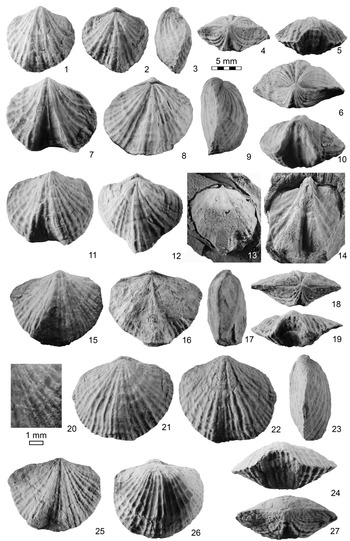
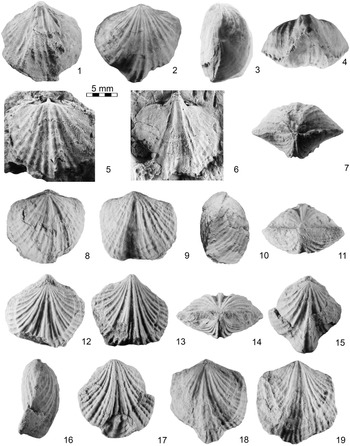
Plectatrypa rindi n. sp. (1–5) Holotype PMO 158.125, pedicle, brachial, side, posterior, and anterior views, 55 m above base, Myren Member, Spirodden; (6–9) PMO 52.456, posterior, pedicle, brachial, and side views, basal Myren Member, Spirebukta; (10–12) PMO 157.940, anterior, pedicle, and brachial views, 5–7 m above base of the Myren Member, Konglungø; (13) PMO 233.984, mold of brachial valve, 15–17 m above base of profile, lower Myren Member, Spirodden; (14) PMO 233.989, mold of pedicle valve, upper Myren Member, Hvalstrand. All Asker. Plectatrypa tripartita (15–20) PMO 233.983, pedicle, brachial, side, posterior, and anterior views, and enlargement of ribs, base of Spirodden Member, Hvalstrand, Asker; (21–24, 27) PMO 41.941d, brachial, pedicle, side, anterior, and posterior views, Padda Member, Malmøya, Oslo; (25, 26) PMO 233.982, pedicle and brachial views, base of Spirodden Member, Hvalstrand, Asker.

Diagnosis
Small, pentagonal, and slightly dorsibiconvex valves with strong ventral sulcus originating as two swollen ribs near the beak. One thin rib in the ventral sulcus. The dorsal fold has several ribs. Medium-fine ribbing with 25–30 sub-angular ribs anterior. Tightly spaced imbrication all over the valves. Thick, massive teeth directed dorsomedially. Fairly thick hinge plates with a rounded cardinal pit, fine crura, and five whorls in the cardinalia.
Occurrence
Brønnøya west, Hvalstrand, Konglungø, Spirebukta, and Spirodden, occurring near the base of the formation in uppermost Hirnantian and into mid Rhuddanian strata.
Description
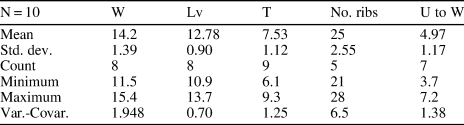
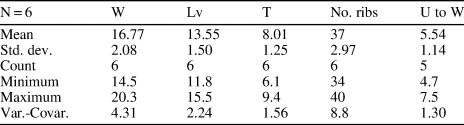
Small biconvex shells with pentagonal outline, slightly shorter than wide (length 91% of width, Table 6) and fairly deep (thickness 55% of width) with maximum width in the posterior half. The hinge line is short and the beak is fairly strong, anacline to adpressed. A triangular short delthyrium is present (Fig. 16.2) where the plates meet below a small apical foramen. The valves are strongly carinate with a sulcus delineated by two swollen ribs. A single rib originates between these ribs, and there may be weaker side ribs far anterior. A well-delineated fold occurs in the brachial valve. It originates as a single rib that bifurcates anteriorly. The ribs are sub-angular and straight, with short imbricate lamella all over the valves, although this is very poorly preserved (Fig. 16.3).
Univariate summary statistics based on measurements of Plectatrypa rindi n. sp. See Table 1 for explanation of abbreviations.

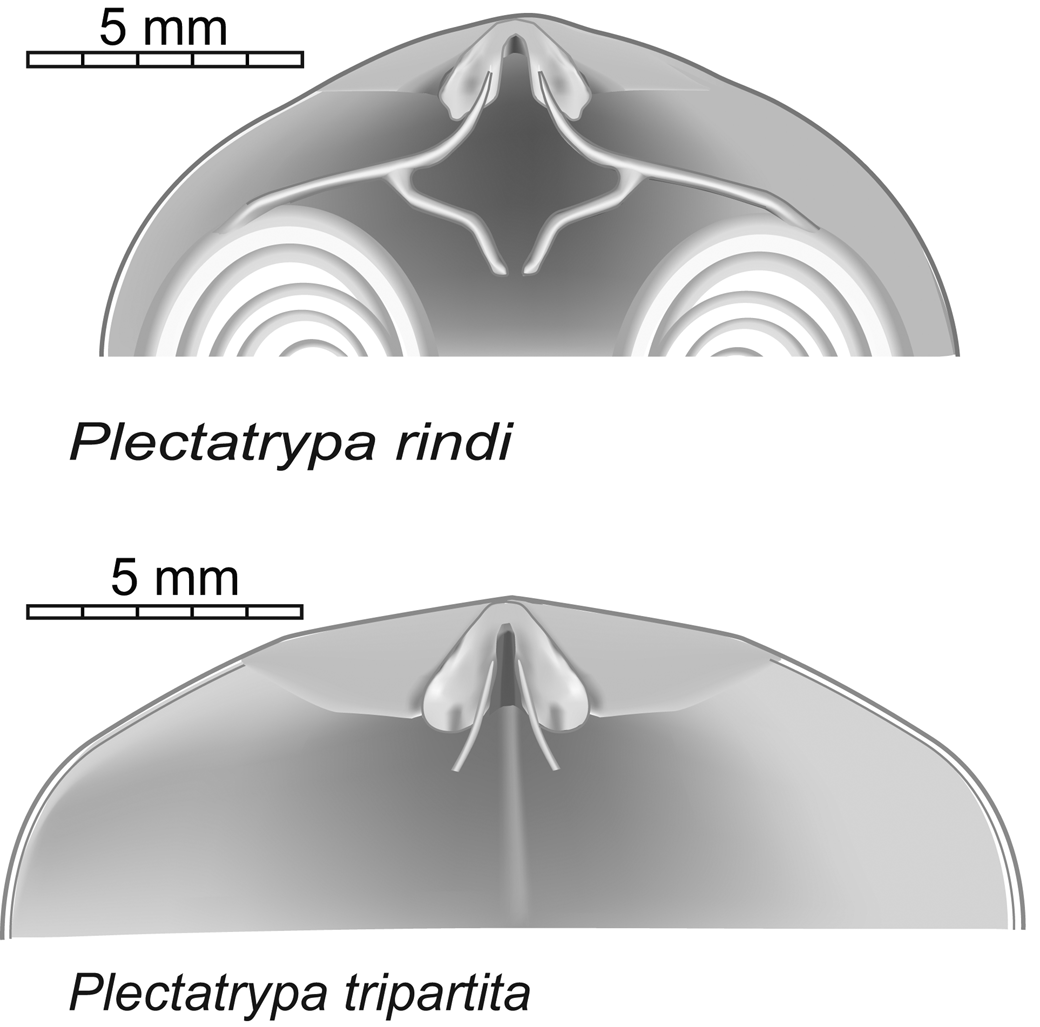
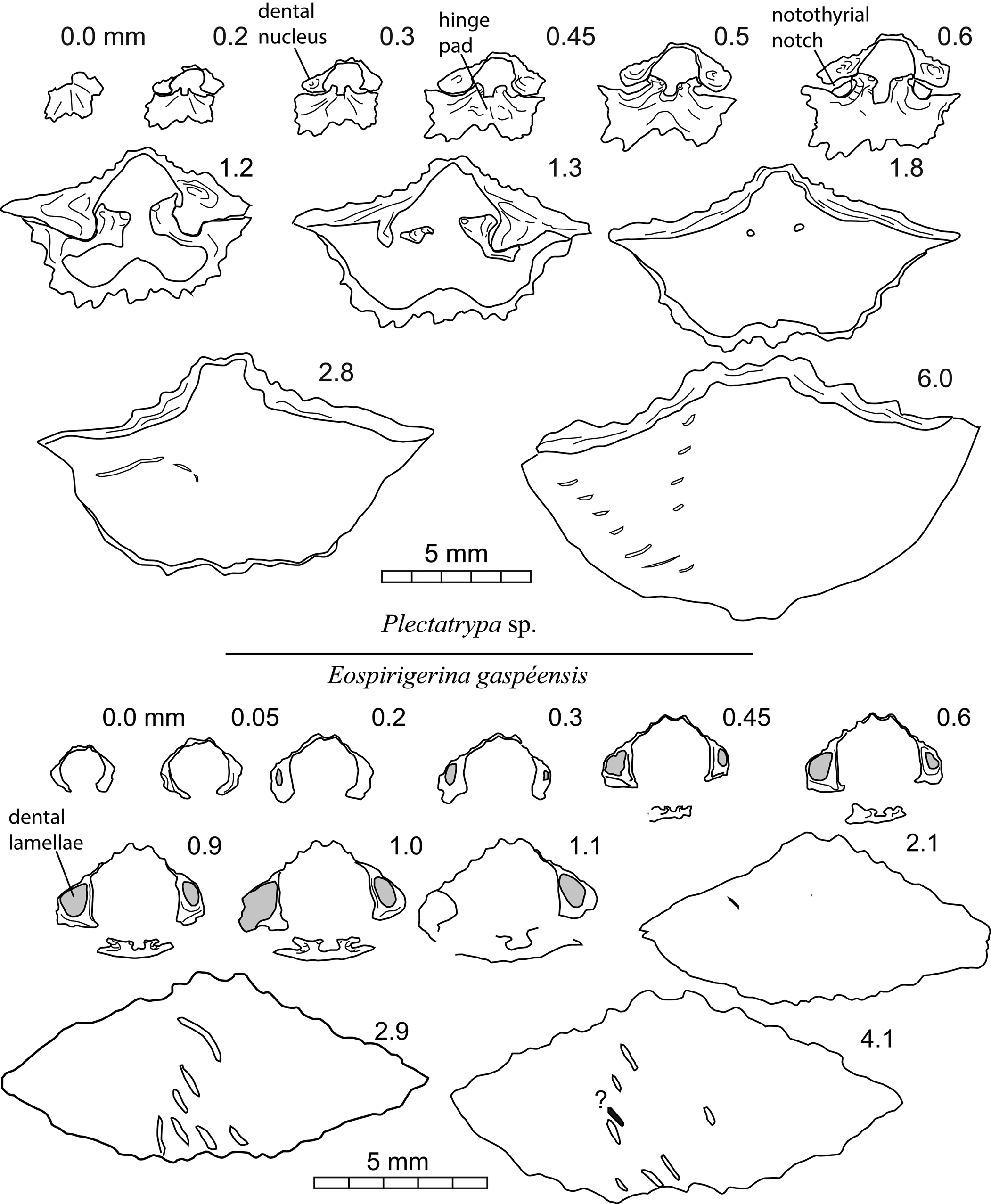
Massive teeth directed dorsomedially (Fig. 17). A small notothyrial notch is present posteriorly. The cardinalia are low and have moderate hinge plates supporting laterally directed thick socket plates with small crural bases. The cardinal pit is rounded and widens anteriorly. The crura are directed ventrolaterally and are relatively thick and non-bushy, and the jugal processes seem to be thin, possibly with plates like small swollen knobs (Fig. 18). The spiralia has five whorls and are directed mediodorsally.
Plectatrypa rindi n. sp. Serial section of specimen PMO 157.932a from the base of the profile, basal Myren Mb, Spirodden, Asker. Plectatrypa tripartita. Serial section of specimen PMO 233.991 from the base of the Løkenes Bed, Myren Member, Hvalstrand, Asker.


Etymology
Rind's Plectatrypa from the Norse goddess Rind, consort of Odin.
Material
PMO 52.151, 52.171, 52.456, 52.462, 89.015, 157.932a (sectioned), b, 157.940, 158.103 (mold), 158.125, 233.984 (mold), 233.989 (mold), 233.99, 234.002.
Remarks
There are few species described from Llandovery rocks. ?Atrypa expansa Lindström, Reference Lindström, Angelin and Lindström1880 from middle Llandovery of SW Sweden is a large species and may possibly be assigned to Eospirigerina, according to Copper (Reference Copper2004). Plectatrypa rindi n. sp. is distinguished from the other two species described herein by its small shell with a pentagonal outline and its single rib in the ventral sulcus.
Plectatrypa (Plectatrypa) tripartita (Sowerby, Reference Sowerby and Murchison1839)
Figures 16.15–16.27, 17, 18
Reference Sowerby and Murchison1839 Terebratula tripartita J. de C. Sowerby, p. 641, pl. 21, fig. 15.
Reference Davidson1869 Rhynchonella tripartita; Davidson, p. 185, pl. 24, figs. 15, 16.
Reference Strahan, Cantrill, Dixon, Thomas and Jones1914 Atrypa marginalis (Dalman, Reference Dalman1828); Strahan et al., p. 90.
Reference Strahan, Cantrill, Dixon, Thomas and Jones1914 Atrypa imbricata; Strahan et al., p. 94.
Reference Williams1951 Camarotoechia cf. tripartita; Williams (part), p. 129.
Reference Williams1951 Plectatrypa marginalis; Williams (part), p. 129.
Reference Boucot and Johnson1967 Plectatrypa gaspéensis (Cooper, Reference Cooper1930); Boucot and Johnson (part), p. 92, pl. 2, figs. 1–15.
Reference Temple1970 Plectatrypa gaspéensis; Temple, p. 59, pl. 17, figs. 13–22.
Reference Cocks1978 Eospirigerina tripartita; Cocks, p. 157.
Reference Hiller1980 Plectatrypa cf. gaspéensis; Hiller, p. 206, figs. 393, 394, 396, 397.
Reference Temple1987 Plectatrypa tripartita tripartita; Temple, p. 108, pl. 13, figs. 1–7.
Reference Heath and Owen1991 Plectatrypa tripartita; Heath and Owen, p. 94.
Reference Davies, Waters, Molyneux, Williams, Zalasiewicz, Vandenbroucke and Verniers2013 Plectatrypa tripartita tripartita; Davies et al., p. 323.
Reference Cocks2019 Plectatrypa tripartita; Cocks, p. 137.
Lectotype
GSM (Institute of Geological Sciences), Geological Society Collection 6893 from Rhuddanian strata, Goleugoed, Llandovery, Dyfed, Wales.
Occurrence
From the top of the Myren Member and near base of the Spirodden Member (middle to top of Rhuddanian), Hvalstrand, Asker and Padda Member, Malmøya, Aeronian, Oslo and Wales.
Description
Small to medium size with weakly dorsi-biconvex valves. Carinate with two clear ribs defining the sulcus and one mid-rib posterior that bifurcates into three to four even ribs in a relatively narrow sulcus. The commissure is uniplicate with a u-shaped, moderately deep fold. The outline is wider than long (average length 79% of width, Table 7), with maximum width in the posterior third and a rounded outline. The thickness is about half of maximum width (average 47%). Hinge line is wide and lateral flanks are weakly convex. The ventral beak is small and incurved, with a small apical foramen and the area is anacline or not exposed. The ribs are fairly fine, rounded and continuous. The growth lamellae are closely spaced all over the valve (Fig. 16.20) and imbricate, although not so robust.
Univariate summary statistics based on measurements of Plectatrypa tripartita. See Table 1 for explanation of abbreviations.

Measurements of Plectatrypa sp. See Table 1 for explanation of abbreviations. PMO no = Numbers for specimens from the Paleontological collection of the Natural History Museum in Oslo, Norway.

Delthidial plates visible in thin section. Solid and short teeth (Fig. 17). Massive hinge plates and inner socket ridges that expand up into the ventral valve anteriorly and fit into a groove in the valve wall (Fig. 17, 0.6–0.9 mm). The cardinal pit has a flat bottom and starts out narrow, but widens anteriorly (Fig. 18). Short median ridge. Start of crura delicate. Jugal processes and spiralia are not preserved.
Material
PMO 21.071, 41.941d, 233.980, 233.982–83, 233.988, 233.991 (sectioned). All whole valves.
Remarks
The species has been moved back and forth between Eospirigerina and Plectatrypa. Sectioning, done for the first time herein, revealed that it undoubtedly belongs to Plectatrypa since it has both imbrications and cardinalia fitting this genus.
The type species of the genus comes from the thin Spengill Mudstone Member of the Skelgill Formation that spans the Hirnantian to Rhuddanian boundary in the southern Lake District (Scott and Kneller, Reference Scott and Kneller1990). Davies et al. (Reference Davies, Waters, Molyneux, Williams, Zalasiewicz, Vandenbroucke and Verniers2013) showed that P. tripartita first occurs in the Atavograptus atavus-Huttagraptus zone, a little above the Rhuddanian base and extends into mid-Aeronian in the Llandovery type area. That overlaps in age with the present described material. Plectatrypa tripartita has been used as a lineage for stratigraphic purposes in Wales (Davies et a. 2013). Early specimens display finer ribbing than later ones and the lateral profile of the ventral valve is concave to flat in the early variant, but becomes more convex in later variants (Temple, Reference Temple1970). The Norwegian material is not abundant enough to say if these traits also can be used here.
Plectatrypa sp.
Figures 19.1–19.11, 20, 21
Occurrence
Upper part of Spirodden Member, Spirodden, Leangen Member, Leangbukta and Skytterveien, upper Rhuddanian into Aeronian, all Solvik Formation, Asker.
Description
Small, dorsibiconvex and pentagonal shells with a small, incurved beak covering the delthidial plates (Fig. 19.8). Maximum width in the posterior part. The pedicle valve is carinate with a pronounced sulcus slightly drawn out anteriorly (Fig. 19.1) and three to four ribs in the sulcus. The ribs are fairly fine, sub-angular, and bifurcate anteriorly. They have well-developed imbricated lamellae all over.
Plectatrypa sp. (1–4, 7) PMO 51.968a1 (sectioned), pedicle, brachial, side, anterior, and posterior views, Leangen Member, Leangen, Asker. (5) PMO 103.543, mold of brachial valve and (6) PMO 113.687, mold of pedicle valve, both 10 m above base of Leangen Member, Skytterveien, Asker. (8–11) PMO 233.987, brachial, pedicle, side, and posterior views, 19 m below base of Rytteråker Formation, Leangen Member, Jongsåsveien, Sandvika. Eospirigerina gaspéensis. (12–14) PMO 41.318a (sectioned), brachial, pedicle, and posterior views. (15–17) PMO 41.318b, brachial, side, and pedicle views (notice frills). Both from basal Myren Member, Brønnøya. (18, 19) PMO 52.455, brachial and pedicle views, basal Myren Member, Spirebukta. All Asker.

The shell wall is medium thick. Short, stubby teeth are mediodorsally directed (Fig. 20), with tiny dental nuclei and short notothyrial notches. Secondary lobes are not well developed. The hinge plates are short and thick, sitting on a socket pad with a straight-sided cardinal pit that expands into a gap. Medium-thick socket ridges turn ventrolaterally into the ventral valve. Crural bases small and crura delicate with seemingly simple jugal processes (Fig. 21). Spiralia with seven whorls.
Serial section of specimen Plectatrypa sp., PMO 51.968a1from the Leangen Member, Leangen, Asker. Eospirigerina gaspéensis. Serial section of specimen PMO 41.318a from the basal Myren Member, Brønnøya, Asker.

Plectatrypa sp., reconstruction of internal structures of specimen PMO 51.968a1 (see Fig. 20).

Material
PMO 51.968a1 (peel), 52.717c, 103.543 (mold of pedicle valve), 113.687 (mold of brachial valve), 233.987, three whole shells and one pedicle and one brachial valve.
Remarks
Three whole specimens are not enough to establish a new species. One of them was mistakenly identified as P. rindi n. sp. and sectioned. This species has the same shape and size as the older P. rindi n. sp., but differs externally in a deeper valve and the presence of three or four smaller ribs in the ventral sulcus. Internally, it has pronounced notothyrial notches and a deeper, narrower cardinal pit than P. rindi n. sp. Also, the cardinal plates swing up into the ventral valves, while they stay low and flat in the latter. Notothyrial notches seem to be a trait common in later Wenlock species, so it is worthy to note that they also are well developed in this species.
Subfamily Spirigerinae Rzhonsnitskaya, Reference Rzhonsnitskaia1974
Genus Eospirigerina Boucot and Johnson, Reference Boucot and Johnson1967
Type species
Eospirigerina putilla (Hall and Clark, Reference Hall and Clarke1894) from the Edgewood Group, Hirnantian, Edgewood, Pike County, Missouri.
Remarks
Copper (Reference Copper2004) claimed that there was no satisfactory published data on internal structures of Eospirigerina. It is true that complete thin sections of Eospirigerina are rare, but taken together there is enough evidence. Amsden (Reference Amsden1974) sectioned the type species E. putilla (Hall and Clarke, Reference Hall and Clarke1894); E. vetusta Cocks and Modzalevskaya, Reference Cocks and Modzalevskaya1997 was sectioned by the authors; E. yulangensis (Liang in Liu et al., Reference Liu, Xu and Liang1983) was sectioned by Zahn and Cocks, Reference Zahn and Cocks1998; and E. milleri Nikitin, Popov, and Bassett, Reference Nikitin, Popov and Bassett2006 by the authors. Kulkov and Severgina (Reference Kulkov and Severgina1989) sectioned E. gaspéensis, and this species is also described below. Internal structures of E. pennata (Rukavishnikova, Reference Rukavishnikova1956) were shown by Popov et al. (Reference Popov, Nikitin and Sokiran1999). The five former species are preserved without jugal processes and spiralia, while the last is lacking much of the cardinalia, but has crural processes and spiralia well preserved. All five have stout teeth and well-developed dental lamellae. The lamellae are not always small and slit-like, as stated in the definition, but may be expanded, although confined to the very posterior portion on the valve. All also show relatively small, ventrally directed hinge plates with flat surfaces that are separated in mature specimens. Eospirigerina pennata has short, strong, and medially directed crural processes with jugal plates and seven whorls in the spiralia.
Eospirigerina gaspéensis (Cooper, Reference Cooper1930)
Figures 19.12–19.19, 20
Reference Cooper1930 Plectatrypa gaspéensis Cooper, p. 278, pl. 2, figs. 13–15.
Reference Boucot and Johnson1967 Spirigerina (Eospirigerina) gaspéensis; Boucot and Johnson, p 92, pl. 1, figs. 17–20.
Reference Sheehan and Lespérance1979 Spirigerina (Eospirigerina) gaspéensis; Sheehan and Lespérance, p. 965, pl. 3, figs. 30, 31.
Reference Hiller1980 Plectatrypa cf. sulevi Jaanusson in Alikhova, Reference Alikhova, Alikhova, Balashova and Balashov1954; Hiller, p. 205, figs. 386, 387.
Reference Sheehan1987 Eospirigerina cf. sulevi; Sheehan, p. 44, pl. 16, figs. 18–27.
Reference Kulkov and Severgina1989 Spirigerina (Eospirigerina); Kulkov and Severgina, p. 180, pl. 21, fig. 18, pl. 15, figs. 7–9, 19.
Holotype
YPM 12897, Yale Peabody Museum, from Rhuddanian strata, Grand Coupe, Percé, Quebec, Canada.
Occurrence
Base of the Myren Member, at Brønnøya and Spirebukta, Asker. Uppermost Hirnantian to possibly lowermost Silurian. Eospirigerina gaspéensis is a cosmopolitan species, occurring from the base of Hirnantian throughout Rhuddanian. It was originally described from Quebec, Canada (Schuchert and Cooper, Reference Schuchert and Cooper1930), but may occur in Canada, Britain, Belgium, Sweden, Kazakstan, Omulev Mountains, Tuva, southern Siberia, and Venezuela (Koren and Sobolevskaya, Reference Koren and Sobolevskaya2008; Nikitina et al., Reference Nikitina, Nikitin, Olenicheva and Palets2015; Sennikov et al., Reference Sennikov, Obut and Izokh2015).
Description
Small, biconvex to dorsibiconvex shells with a rounded to pentagonal outline about as long as wide (Fig. 19.18, Table 9). Long hinge line and protruding beak with transapical foramen. Orthocline to anacline interarea with small triangular disjunct delthidial plates. The ventral valve is strongly carinate due to two swollen ribs that diverge to varying degrees forming a fairly narrow sulcus. The sulcus is drawn out in a tongue (Fig. 19.19) and has several ribs within it near the anterior margin. The brachial valve has a corresponding sharp fold bounded by furrows. The ribs are rounded with large interspaces where new ribs are created by bifurcation. There are several clear lamellae near the anterior margin. One specimen shows frills, which also were found in topotypes from Gaspé in Quebec by Sheehan and Lespérance (Reference Sheehan and Lespérance1979, pl. 3, fig. 32).
Measurements of Eospirigerina gaspéensis. See Table 1 for explanation of abbreviations. PMO no = Numbers for specimens from the Paleontological collection of the Natural History Museum in Oslo, Norway.

The pedicle valve has stout teeth oriented mediodorsally with short, well-developed dental lamellae (Fig. 20). The brachial valve has low cardinalia with disjunct socket plates that sit directly on the valve floor. Hinge plates are flat, oriented laterally, with small crural bases. Crura and jugal processes unknown. One spiralium is preserved lying sidewise on the brachial floor with fragments of the other one spread around in the matrix. There are at least five whorls.
Material
PMO 41.318a (peel), b, 52.455a, three whole valves.
Remarks
Sheehan and Lespérance (Reference Sheehan and Lespérance1979, pl. 3, figs. 30–32) figured topotype specimens. The ribbing, narrow sulcus, and thickening of the bounding ridges are the same as in the Norwegian material. Kulkov and Severgina (Reference Kulkov and Severgina1989) described E. gaspéensis from Gorny Altai, Russia. Their material is poorly preserved, but the outline, ribbing, and, importantly, internal structures seem to agree with the Norwegian material. The material is also very close to E. cf. sulevi (Jaanusson in Alikhova, Reference Alikhova, Alikhova, Balashova and Balashov1954), described by Sheehan (Reference Sheehan1987) from Belgium. Those specimens were tentatively included in E. sulevi based on a very narrow sulcus and the strength of the costae. However, the holotype of E. sulevi is much smaller and has coarser and fewer bifurcating ribs than Sheehan's (Reference Sheehan1987) material. Boucot and Johnson (Reference Boucot and Johnson1967) redescribed the species based on material from Britain and Venezuela. Sheehan and Lespérance (Reference Sheehan and Lespérance1979) questioned whether the material described by Boucot and Johnson (Reference Boucot and Johnson1967) from Britain should be assigned to this species and speculated that it may belong to E. hibernica (Reed, Reference Reed1952). I agree with this because the ribbing is finer than in E. gaspéensis and it lacks the thickening of the two bounding ridges.
Genus Euroatrypa Oradovskaya in Nikiforova et al., Reference Nikiforova, Oradovskaya and Popov1982
Type species
Euroatrypa tajmyrica Oradovskaya in Nikiforova et al., Reference Nikiforova, Oradovskaya and Popov1982. Central Tajmyr.
Remarks
Cocks and Modzalevskaya (Reference Cocks and Modzalevskaya1997) made Euroatrypa a junior synonym of Quilianotryma Xu, Reference Xu, Wang, Jin, Ye, Xu and Sun1979. However, Nikitin et al. (Reference Nikitin, Popov and Bassett2006) disputed this assertion and pointed out there were persistent differences between the two genera. The first has an incurved beak, globose outline, with short hingeline and a uniplicate, rounded sulcus that originates midway on the shell. Qilianotryma has a sharply delineated sulcus starting at the umbo and a fold bounded by strong plications, orthocline beak, and wide hinge line. The present material clearly is closest to Euroatrypa by having a similar shape, incurved beak, an uniplicate sulcus originating far from the umbo, and an interior very like the type species. I follow Nikitin et al. (Reference Nikitin, Popov and Bassett2006) and retain the genus. However, the two genera mentioned above typically have very fine, evenly sized ribs. The present specimens have even, but medium-coarse ribs. Also, the crura are fibrous and that is a trait not seen in Spirigerininae. Euroatrypa and Qilianotryma both extend their range through Hirnantian strata. The present material is from basal Aeronian. There is no doubt that the two former genera are closely related to the present material, but there are differences that may warrant a new genus. However, the material is limited and the external ribbing is not well preserved so for now, I align it with Euroatrypa.
Euroatrypa? sigridi new species
Figures 22–24
Holotype
PMO 87545 (Fig. 22.1–22.5) whole specimen from Padda Member, Solvik Formation, Malmøya, Aeronian strata.
Euroatrypa? sigridi n. sp. (1–5) Holotype PMO 87.595, pedicle, brachial, posterior, anterior, and side views, Padda Member, Malmøya, Oslo; (6–9) PMO 51.968a2, brachial, side, anterior, and pedicle views; (10, 11) PMO 51.968e2 brachial and pedicle views, both from the Leangen Member, Leangen, Asker.

Diagnosis
Fairly small, dorsibiconvex species with a rounded outline, a broad, u-shaped sulcus, and even, but medium-coarse ribs. Small incurved beak and anacline interarea with large foramen. No carination and uneven short lamellae. Internally there are hollow delthidial plates and slit-like dental cavities in short, stubby teeth. The cardinal pit has shape like a “w.”
Occurrence
Padda Member, Malmøya, Oslo and Leangen Member at Leangen, Asker, Aeronian.
Description
Small rounded shell, dorsi-biconvex to subequal and slightly wider than long (length 92% of width, Table 10). A wide, gentle sulcus originates in the anterior part of the ventral shell, the corresponding fold in the dorsal valve is not pronounced. Slight sulcus posterior in the brachial valve with a pronounced mid-rib seen especially well in smaller specimens (Fig. 22.10). Anacline beak often obscuring small delthidial plates. The apical, large foramen seems to be rimmed. The material is denuded, but one specimen (PMO 87.545) has a small patch of shell material posterior showing fine growth imbrications. There is a ringed quality to the shells, probably representing lamellae that are spaced somewhat unevenly over the valve. The ribs are even, fairly fine (average 28 along the anterior margin) and they bifurcate. Hollow delthidial plates. Short, sturdy teeth directed dorsi-medially with very thin, short, slit-like dental cavities (Fig. 23). The hinge plates are bisected by a w-shaped cardinal pit. They are situated on a platform with horizontal hinge plates and thin socket plates. Distinct crural bases and strongly feathery crura situated high up in the ventral valve. Jugum and spiralia are not known. Long narrow adjustor and adductor scars bounded by deep ridges and possibly small diductor scars in the pedicle valve (Fig. 22.9, 22.10).
Euroatrypa? sigridi n. sp. Serial section of specimen PMO 21.073 from the Padda Member, Malmøykalven, Oslo.

Univariate summary statistics based on measurements of Euroatrypa? sigridi n. sp. See Table 1 for explanation of abbreviations.

Etymology
After my granddaughter Sigrid.
Material
PMO 21.073 (sectioned), and 51.968 a2–e2, 51.968r, 1, 87.545 (holotype). The material consists of eight whole shells.
Remarks
As for the genus.
Results
Herein are described 10 different taxa of ribbed atrypides. Of these, there are two new genera (Rhinatrypa and Bockeliena) and four new species (Dihelictera engerensis, Gotatrypa vettrensis, Plectatrypa rindi, and Euroatrypa? sigridi). Baarli (Reference Baarli2019) treated the subfamily Atrypinae from the Solvik Formation. However, new material and information derived from thin sections led to three additional species being described, making this subfamily the most diverse and abundant atrypides in the formation with 13 different taxa. Of the remaining species, all in the family Atrypinidae, most (five species) belong to the subfamily Plectatrypinae, a group that may be dominant in some environments. Three species are rare and belong to the Spirigerininae.
Stratigraphic distribution
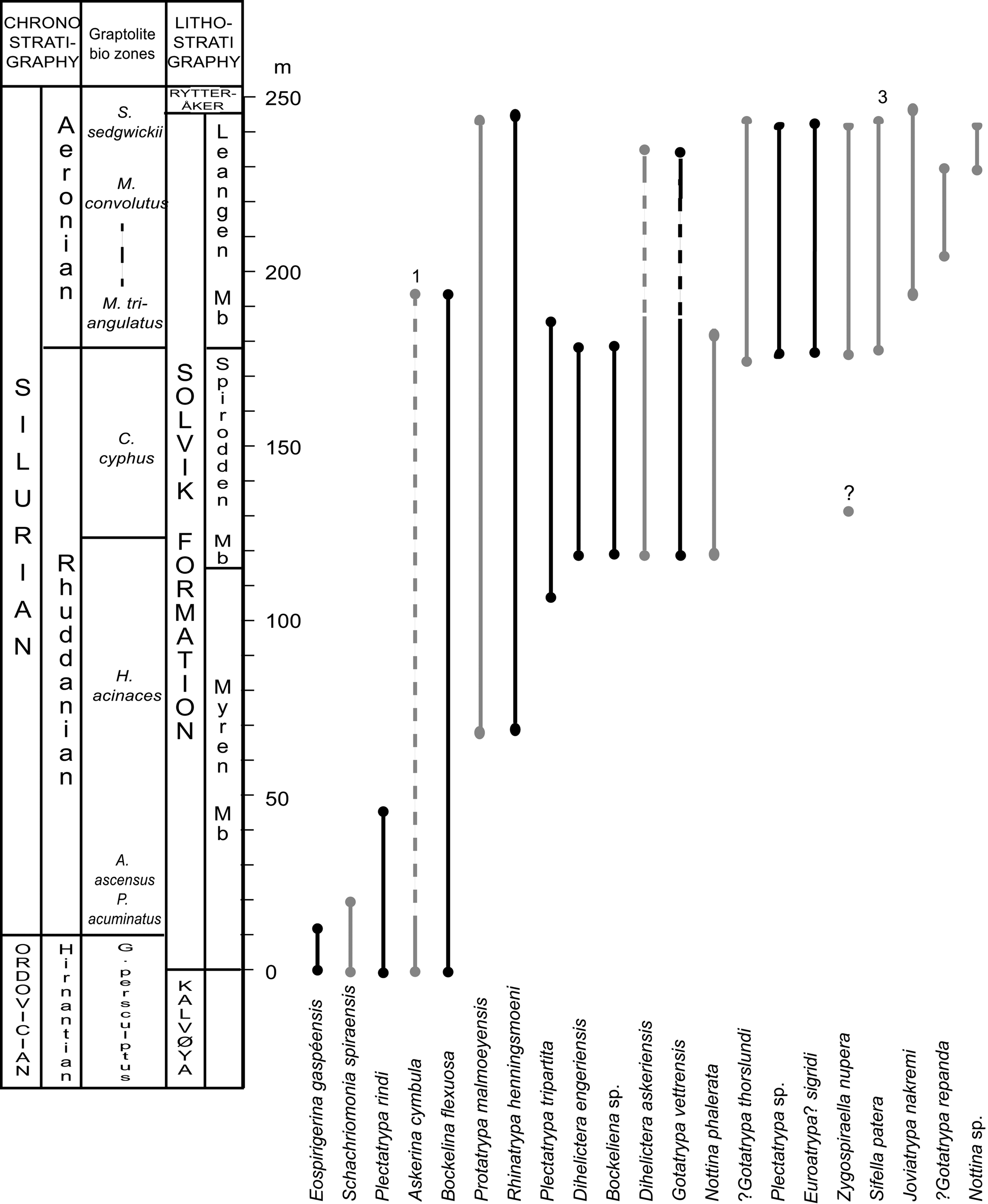
Figure 25 depicts the ranges for all the ribbed atrypid taxa from the Solvik Formation, with the ranges of the taxa from this paper shown in black. Five ribbed atrypide taxa occur in the boundary layers. Three atrypid species from the O/S boundary layers are described in this contribution; Bockeliena flexuosa n. gen., Plectatrypa rindi n. sp., and Eospirigerina gaspéensis. Both B. flexuosa n. gen. and P. rindi n. sp. are common in the boundary strata and into lower Rhuddanian, with the first at times dominant. Eospirigerina is rare in spite of it being common in the deeper Hirnantian Onniella association in strata below (Brenchley and Cocks, Reference Brenchley and Cocks1982). The next species to appear are Rhinatrypa henningsmoeni n. gen. and Protatrypa malmoeyensis (Fig. 25). The first mainly occur at Malmøya, where its first appearance is well below the Coronograptus cyphus Biozone in strata of middle Rhuddanian age. Both are typical fossils from upper Rhuddanian at Malmøya. Six species (Plectatrypa tripartita, Bockeliena sp., Dihelictera engerensis n. sp., D. askerensis Baarli, Reference Baarli2019, Gotatrypa vettrensis n. sp., and Nottina phalerata Baarli, Reference Baarli2019) appear just below or in the Spirodden Member (upper Rhuddanian) of Asker and Sandvika. The Aeronian strata have the most diverse atrypid fauna with eight species having their first occurrence and 14 species appearing there in total (Fig. 25). The family Atrypidae dominates the fossil assemblages. The two members of the Atrypinidae (Plectatrypa sp. and Euroatrypa? sigridi n. sp.), with first occurrence in Aeronian strata, are rare.
Euroatrypa? sigridi n. sp. Reconstruction of internal structures based on specimen PMO 21.073 (see Fig. 23).

Stratigraphic range of the ribbed atrypides from the Solvik Formation. The left column shows the lithostratigraphy from the Asker area. Ranges shaded in gray belong to taxa described in Baarli (Reference Baarli2019), black are those treated in this paper. A few taxa occur only in the Oslo area and the ranges for those are correlated to the Asker lithostratigraphy.

The O/S boundary assemblages
Baarli and Harper (Reference Baarli and Harper1986) treated a “relict Ordovician” brachiopod fauna existing at the base of the supposedly Silurian Solvik Formation in the Oslo Region. Any section of transgressive shales above uppermost Ordovician strata terminated by an unconformity was at that time erroneously deemed to be of Silurian age. This fauna is of uppermost Ordovician age and tapers off into the earliest Rhuddanian. Taxonomic work has later been done on the orthids and strophomenids (Baarli, Reference Baarli1988a; Reference Baarli1995), leading to an update on this brachiopod fauna in Baarli (Reference Baarli2014) where 31 genera were found in the boundary layers. Baarli (Reference Baarli2019) and the present paper added three new genera to the highly diverse fauna.
Benthic assemblages
The paleo-assemblages of the Solvik Formation were treated in Baarli (Reference Baarli1987) and the relative depth relationships were corroborated in Baarli (Reference Baarli1988b) using proximality analysis. The Oslo area lacks brachiopods in basal Rhuddanian strata. The assemblages in the lowermost O/S boundary layers in Asker have distinctly different assemblages laterally, depending on the underlying geography. Those occurring above former incised valleys tend to be diverse and at places dominated by plectatrypids and the lissatrypids Becscia and Meifodia together with Brevilamnuella, all with more or less well-developed sulci. Other typically Benthic Assemblage (BA) 5 taxa such as the orthids Dicoelosia, Isorthis, and Skenidioides, and strophomenids such as Eoplectodonta are present. The intervening sections, especially above oolite banks, are dominated by large orthids such as Dolerorthis, Schizonema, and Hesperorthis, and strophomenids such as Katastrophomena, Leptaena, and Crassitestella. These differences are smoothed out higher stratigraphically, and a depauperated and stunted assemblage occurs where rare Plectatrypa and Meifodia may be found (Baarli, Reference Baarli2014).
There is a gradual eustatic shallowing up through the Myren Member (through Rhuddanian). In the Oslo area, the Benthic Assemblage (BA) changes from BA6, void of brachiopods, to upper BA5. Protatrypa malmoeyensis first appears in BA5 assemblages in mid-Rhuddanian strata, together with Meifodia and Rhinatrypa henningsmoeni n. gen., and persists throughout the Myren Member. The Padda Member, of Aeronian age, is dominated by P. malmoeyensis Boucot, Johnson, and Staton, Reference Boucot, Johnson and Staton1964 and Stricklandia lens (BA 4), less frequent ribbed atrypides are R. henningsmoeni n. gen. and Sifella patera Baarli, Reference Baarli2019.
Upper BA 5 assemblages with Protatrypa malmoeyensis first appear in low to mid-Rhuddanian strata in Asker. This species is among the dominant ones in the overlying BA 4 Stricklandia assemblage of the Spirodden Member. The member is inhabited by many corals and stromatoporoids, giving a diverse habitat where a host of non-prominent atrypides such as Dihelictera, Gotatrypa, Nottina, and rare Bockeliena n. gen. lived. A deepening back to BA 5 at the start of the Aeronian is seen in the Leangen Member, with a rapid renewal of shallowing up into BA 3 in the middle part of the member. ?Gotatrypa thorslundi Boucot and Johnson, Reference Boucot and Johnson1964, Zygospiraella nupera Baarli, Reference Baarli2019, and Thulatrypa gregaria Huang et al., Reference Huang, Baarli, Zhan and Rong2016 dominate together with Stricklandia lens, while many other atrypides are present (Fig. 25).
Discussion
Stratigraphic occurrences of the atrypides
The termination of the end-Ordovician glaciations led to more than 100 meters increase in eustatic sea level (Brenchley et al., Reference Brenchley, Marshall, Harper, Buttler and Underwood2006). In epicontinental basins, this initially led to very deep or anoxic black shale environments that were inhospitable to brachiopods many places in the world (Hallam and Wignall, Reference Hallam and Wignall1997). Areas like the Oslo Region, where there had been incised valleys and a varied topography favorable for short migration when sea level rose, may have acted as a nexus for survival, radiation, and later dispersal from these areas. This is contrary to the situation in level-bottomed epicontinental seas.
The atrypides are a small, but important part of the rich fauna in the O/S boundary layers. The plectatrypids Plectatrypa and Bockeliena n. gen. are especially common together with smooth atrypides such as the lissatrypids Meifodia and Bescsia. All these newcomers have in common a deep sulcus and fold. A deep sulcus enhances waste elimination and is advantageous in quiet, deeper environments (Fürsich and Hurst, Reference Fürsich and Hurst1974). The prevalence of sulci may be an adaption to the generally deeper environments that was pervasive at the end of Ordovician.
Subsequently, the transgression created vast new epicontinental seas with new niches for brachiopods (Huang et al., Reference Huang, Jin and Rong2018). The former authors analyzed global atrypide faunas throughout the Rhuddanian and into the Aeronian, and found that there was a significant increase in diversity for atrypides in the late Rhuddanian, but the largest burst of radiation happened from Rhuddanian into Aeronian. This might be mirrored in the Solvik Formation, with newcomers in late Rhuddanian and much larger diversity of ribbed atrypides in Aeronian (Fig. 25). Local change in depth and environments also has to be taken into consideration. The Spirodden Member was more calcareous with corals and stromatoporoids favoring atrypides, while the Leangen Member represented a new kind of environment with storm beds and higher energy levels (Baarli, Reference Baarli1988a).
Ribbed atrypides and benthic assemblages
According to Bassett et al. (Reference Bassett, Popov and Sokiran1999), from Hirnantian on, atrypides are common in shallow carbonate settings or reefal habitats, as is seen in Estonia, Anticosti, and Gotland. However, this contribution shows that there is a strong contrast between the appearance of atrypides from the family Atrypinidae and the Atrypidae in the Solvik Formation. Species of the former family are common already from the top of Hirnantian strata, while the latter are rare. Atrypidae flourish first in the carbonate-rich Spirodden Member. Plectatrypids were better adapted to deeper and quieter environments (BA 5), as also noted by Copper (Reference Copper2004). By late Rhuddanian time, this was not universal because Bockeliena sp., which is only found in the Spirodden Member in Sandvika, and Sypharatrypa hillistensis (Rubel, Reference Rubel1970), from carbonate settings in Estonia, thrived in shallower environments. By Aeronian time, the family Atrypidae also dominated and increased in diversity in the more arenaceous and storm-influenced, shallow upper part of the formation (BA 3) and members of the family Atrypinidae were rare inhabitants.
The early evolution of Plectatrypinae
Eospirigerina has long been proposed as an ancestor to Plectatrypa (e.g., Boucot and Johnson, Reference Boucot and Johnson1967; Copper, Reference Copper1973). The external differences between Eospirigerina and Plectatrypa are orthocline to anacline beak and straight ribs with few growth lamellae only in the anterior part for the former, and anacline to hypercline beak and imbricated ribs in the latter. Internally, Eospirigerina has slit-like dental cavities, delicate hinge plates, and strong crura. Plectatrypa has massive teeth and hinge plates with delicate crural bases. The early development of the genus Plectatrypa and its relationship to Eospirigerina has not been well known. Plectatrypa occurs commonly in the Solvik Formation with two species found in strata of Rhuddanian age—P. rindi n. sp. appearing in the O/S boundary layers, while P. tripartita appears in mid Rhuddanian, but is known from uppermost Hirnantian strata in Britain. The Norwegian material shows that true Plectatrypa was established already in the uppermost Hirnantian, as opposed to what is indicated by Copper and Gourvennec (Reference Copper, Gourvennec, Copper and Jin2018) where plectatrypids are exclusively drawn in their Figure 2 as Silurian in age. Both P. rindi n. sp. and P. tripartita have internal strong, massive teeth and hinge plates and delicate crura. They also have tightly spaced imbrication all over the valve and the beaks are anacline to adpressed. The imbrication in P. rindi n. sp. is poorly preserved, but it is not as robust as in the later Plectatrypa occurring in late Llandovery and Wenlock (Copper, Reference Copper2004). Plectatrypa tripartita has very delicate imbricated growth lamellae. However, P. porkuniana Rubel, Reference Rubel1970, from Hirnantian and Rhuddanian strata in Estonia, has robustly developed imbrication so this trait varies among the early Plectatrypa species. Plectatrypa porkuniana has dental lamellae, albeit short, which is a trait typical for Eospirigerina and not found in Plectatrypa. The fairly robust hinge plates point towards Plectatrypa. Plectatrypa porkuniana, thus, does not fit into either of these two genera. It reflects a transitional stage in the evolution from Eospirigerina to Plectatrypa. Because so few specimens are sectioned, it is best to rely on the external features and place it with Plectatrypa. The transition between the two genera happened in the latest Ordovician.
Plectatrypa? laticostata Cocks and Modzalevskaya, Reference Cocks and Modzalevskaya1997 is a species found in middle Ashgill strata (upper Katian) from the Korotkinskaya Formation of Tajmyr, Arctic Russia. Its ornamentation, including filae, is close to Bockeliena n. gen. The broad outline with maximum width in the posterior third, a small incurved beak, and a well-developed sulcus also align it to Bockeliena. However, internally it differs sharply by having large dental lamellae and relative thin socket ridges like Eospirigerina, while Bockeliena has compact teeth and thick socket ridges. Plectatrypa? laticostata occurs in the upper Katian while Bockeliena appears from the topmost Hirnantian. Eospirigerina pennata (Rukavishnikova, Reference Rukavishnikova1956) is known from the middle Katian from Kazakhstan (Popov et al.,1999). It may be that P.? laticostata is an intermediate link in the evolution from Eospirigerina to Bockeliena As argued for P. porkuniana above, I propose the name Bockeliena laticostata because specimens are most often distinguished by external features.
Bockeliena first occurs from the base of the O/S boundary layers of uppermost Hirnantian age in Norway. The related genus, Sypharatrypa, appears in lower Rhuddanian age strata (Bergström et al., Reference Bergström, Kleffner, Schmitz and Cramer2011) of the Manitoulin Formation on Manitoulin Island. A simple evolutionary lineage from Eospirigerina to Sypharatrypa was proposed by Copper (Reference Copper1982), but it might have gone through Bockeliena. In both the lineage from Eospirigerina to Plectatrypa and from Eospirigerina to Bockeliena and Sypharatrypa, the characteristic external ribbing appeared before the internal dental lamellae was changed into solid teeth.
Eospirigerina is a common, cosmopolitan genus from uppermost Ordovician strata that lived through the Late Ordovician sea-level fluctuations and the last extinction. It likely gave rise to the two types of plectatrypids appearing near the O/S boundary; those with imbricate ribbing (e.g., Plectatrypa) and those with more undulating ribbing (e.g., Bockeliena n. gen. and Sypharatrypa).
Geographic affinity
The Plectatrypinae in all likelihood evolved from the cosmopolitan genus Eospirigerina. However, the transitional forms between Eospirigerina and the two branches of plectatrypids discussed above, both occur on the Baltic paleo plate with one in Estonia and the other in Taymyr. Taymyr was a part of northern Baltica (Cocks and Modzalevskaya, Reference Cocks and Modzalevskaya1997). Hence, Plectatrypinae originated in Baltica. Plectatrypa tripartita occurred in Wales already in the latest Hirnantian. Avalonia docked to southern Baltica during Hirnantian time (Torsvik and Rehnström, Reference Torsvik and Rehnström2003), so migration along the continental margins happened fast.
Bockeliena n. gen. has been identified in Baltica in latest Hirnantian. Sypharatrypa occurred in lower Rhuddanian strata in Laurentia (i.e., present day Manitoulin Island). Migration across the closing Iapatus Ocean must have happened rapidly either under the influence of the east-west trade winds or the prevailing storm track (see Baarli, Reference Baarli2019, fig. 37). Very high sea levels flooding the continents would also be conducive to dispersal into the epicontinental seas on the Laurentian continent.
Qilianotryma and Euroatrypa of the subfamily Spirigerininae are closely related. The first is the older, occurring from Late Katian Beds in South China (Popov et al., Reference Popov, Nikitin and Sokiran1999), while all the species from the latter are of Hirnantian age (Nikitin et al., Reference Nikitin, Popov and Bassett2006) and occur in Kazakhstan and Siberia. The two are found together in beds of Hirnantian position, Central Kazakstan, while Euroatrypa occurs as far west as Taymyr in mid Hirnantian strata (Cocks and Modzalevskaya, Reference Cocks and Modzalevskaya1997). Taymyr was a part of northern Baltica at the time. Again, there appears to have been a migration from the east towards the west. The closely related Euroatrypa? might have survived, possibly as a Lazarus taxon, to appear in Aeronian in the central Oslo Region.
Conclusions
The brachiopod fauna in general and atrypides in particular are not well known after the end-Ordovician mass extinction event. The central Oslo Region differs from many other regions in having a relatively complete stratigraphic record with a rich benthic fauna in place by the late Hirnantian at the end of the Ordovician. The region probably served as a nexus for radiation and dispersal during the earliest Rhuddanian. The Solvik Formation has strata of uppermost Hirnantian to Aeronian position where the survival and the recovery fauna may be investigated throughout. A taxonomic investigation of the ribbed atrypid fauna has revealed the following. There is a total of 13 taxa in the subfamily Atrypidae in the formation. Three of those taxa are treated in the present contribution; Dihelictera engerensis n. sp., Gotatrypa vettrensis n. sp. and Rhinatrypa henningsmoeni n. gen. Taxa of the Atrypidae follow the global recovery strategy in being uncommon in the deeper water environments near the Ordovician/Silurian boundary and significantly increased in diversity in more calcareous and shallower environments during the upper Rhuddanian. In the Aeronian, the family became very diverse, like the coeval global fauna, but inhabited high-energy shallow arenaceous environments in the central Oslo Region.
The main focus of the taxonomic investigation herein is on the family Atrypinidae with eight taxa. The most important subfamily is the Plectatrypinae, with two genera and five species; Bockeliena flexuosa n. gen., B. sp., Plectatrypa rindi n. sp., P. tripartita, and P. sp. These species are dominant in deeper environments from the base of the formation in the O/S boundary layers and fairly rare where members of the Atrypidae are common. Probably the deeply sulcate plectatrypids evolved to cope with a generally deep environment caused by fast eustatic sea level rise after the end-Ordovician glaciation. The genera Bockeliena n. gen. and Sypharatrypa were able to inhabit shallower environments from late Rhuddanian on.
Rare members of the subfamily Spirigerininae are Eospirigerina gaspéensis and Schachriomonia spiraensis Baarli, Reference Baarli2019, found near the base of the member. Euroatrypa? sigridi n. sp. occurs in the upper parts of the Solvik Formation in early Aeronian.
True Plectatrypa (e.g., P. rindi n. sp. and P. tripartita) appear from the uppermost Hirnantian. Plectatrypa porkuniana, found in Hirnantian strata in Estonia, is a transitional species between Eospirigerina and Plectatrypa. Eospirigerina is a cosmopolitan genus appearing commonly in Upper Ordovician strata, and from the above fact, it is highly likely the ancestor of Plectatrypa.
Eospirigerina is also a likely ancestor of Bockeliena, which is a new genus with short wavy growth lamellae that are widely spaced. Bockeliena laticostata n. gen. is a transitional species occurring in upper Katian strata in Taymyr. On the basis that both transitional species occur in Baltica, plectatrypids had their origin there and spread from there.
The family Atrypidae, showed a general east to west migration following the general pattern of marine circulation and storm tracks (Baarli, Reference Baarli2019). The same pattern is seen in Bockeliena n. gen. and the closely related Sypharatrypa, which appears in early Llandovery in Canada. Likewise, Euroatrypa is closely related to Qilianotryma, a genus with origin in South China. Euroatrypa occurs farther west in Kazakhstan and Taymyr during Hirnantian time, while Euroatrypa?, found in the Oslo Region, appears in early Aeronian, following the east to west paleocurrents to Taymyr in northern Baltica, with further migration along the coast to the Oslo Region.
Acknowledgments
I thank my partner M.E. Johnson, Williams College, for steady support, and help with the English. H.A. Nakrem of the Natural History Museum in Oslo facilitated study of the collections there. A. Bockelie generously enabled use of her late husband's private collections. The Geosciences Department at Williams College provided access to lab equipment and facilities. I also thank B. Huang, Nanjing Institute of Geology and Palaeontology, and T. Modzalevskaya, A.P. Karpinsky Russian Geological Research Institute, for help with specific questions.