

Introduction
Financial performance on Irish suckler beef farms is historically low (Hennessy and Moran, Reference Hennessy and Moran2015). Although there are a number of factors outside of the farmers’ control contributing to this including beef market volatility (Mosnier et al., Reference Mosnier, Agabriel, Lherm and Reynaud2009) and input price inflation (Central Statistics Office, Reference Crosson and McGee2015), optimising production efficiency on the farm maximises the effect farm management has on financial performance. Increasing gross output (GO), through higher stocking rates and beef live weight produced per livestock unit and per ha has been identified as a major driver of suckler beef farm profitability (Taylor et al., Reference Taylor, McGee, Kelly, Grant and Crosson2016). As the calf is the primary output generated in beef suckler cow systems, maximising herd profitability largely centres around the production of a calf per cow in the herd annually. Therefore, reproductive efficiency of the suckler cow is crucial to the biological and economical sustainability of suckler beef cow production systems (Diskin and Kenny, Reference Diskin and Kenny2014).
Reducing age at first calving (AFC) of beef heifers from 3 to 2 years old was found to increase farm net margin by 50% under controlled spring-calving, whole-farm modelling conditions (Crosson and McGee, 2012a). Furthermore, within a spring-calving pasture-based suckler beef system, coinciding mean calving date with the onset of grass growth resulted in higher profitability than systems with mean calving dates earlier or later than this (Crosson and McGee, Reference Crosson and McGee2015). Attaining a calving interval (CI) of 365 days, through operating a compact calving season, and good animal husbandry in terms of meeting cow nutritional requirements after-calving to ensure resumption of oestrous, were identified as necessary in order to optimise calving rate (CR) (Diskin and Kenny, Reference Diskin and Kenny2014).
Although the financial impacts of these reproductive traits are quantified at research level (Crosson and McGee, Reference Crosson and McGee2012b), little comparable investigation has been carried out at commercial farm level. Therefore, using the data from 37 Irish suckler beef farms over a 7-year period, the aim of this study was to analyse suckler cow reproductive performance and identify the effect of its contribution to farm profitability.
Material and methods
Herd level reproductive data from 37 Irish suckler beef farms was obtained from the Irish Cattle Breeding Federation’s database. All farms were, for at least 3 of the 7 years, participants in the Teagasc/Irish Farmers Journal BETTER farms beef programme. This programme promoted an increase in technical efficiency in the areas of herd reproductive performance, grassland management and financial performance. Financial data for these farms was available through Teagasc eProfit Monitor software. Farms were divided into one of three systems as described by Taylor et al. (Reference Taylor, McGee, Kelly, Grant and Crosson2016); suckler-to-live sale (Live), suckler-to-finishing (Finishing) farms and a combination of both (Mixed).
Reproductive data
A total of 15 269 calving records from 4939 suckler cows were collected from the 37 farms over the 7-year period. CI was calculated as the number of days between consecutive calvings. Records reporting a CI of either <300 days or >800 days were removed as per Berry and Evans (Reference Berry and Evans2014). Calving difficulty scores (Berry and Evans, Reference Berry and Evans2014) were recorded on a per calving basis using a scale of 1 to 4: 1=unassisted, 2=slight assistance, 3=substantial assistance and 4=veterinary assistance – mainly caesarean section. Age at first calving was recorded as the age of dam at parity one calving date. After all edits a total of 15 046 calvings remained from 4837 cows. Animal records were then collated on an annual herd basis. Based on the annual herd data, variables such as; CR – number of calves alive at 28 days of age per total number of females selected for breeding annually; weaning rate (WR) – number of calves at 270 days per total number of breeding females; and empty rate (ER) – number of cows that did not calve within the calendar year per total number of breeding females, were calculated on a farm by year basis resulting in a total of 210 farm by year observations.
Economic farm data
Information recorded included farm descriptive factors; such as land area, number of livestock units and physical output produced, and financial factors; gross output, direct costs, gross margin, fixed costs and net margin. For the purpose of this study gross output value (sum of sales less sum of purchases plus inventory changes) expressed on a per livestock unit (LU) basis was used.
Statistical analysis
A detailed descriptive analysis of the data set was obtained from PROC UNIVARIATE (SAS 9.4). A Spearman partial correlation analysis was carried out using PROC CORR (SAS 9.4), accounting for year. Stepwise regression (PROC REG, SAS 9.4) across and within systems was used to quantify reproductive variables that contribute to variation in gross output per LU.
Results and discussion
In the current study, mean cow herd size was 58 (SD 24.4) which is over double the number (27) of breeding females in suckler herds nationally (Hennessy and Moran, Reference Hennessy and Moran2015).
Reproductive targets for a suckler cow herd include a CR of greater than 0.95, an ER of less than 5%, a calving-to-calving interval of 365 days, an average AFC of 24 months, calf mortality of less than 5% and compact calving, with 80% calving in 42 days (Diskin and Kenny, Reference Diskin and Kenny2014).
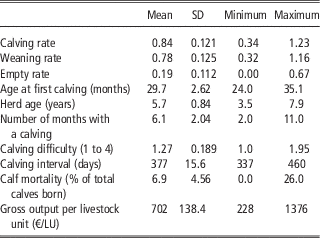
Table 1 provides an overview of herd reproductive data obtained from the 37 farms in this study. Calving rate was 0.84, slightly greater than the 0.82 achieved nationally (Irish Cattle Breeding Federation (ICBF), 2016). Calf mortality was close to 7% and WR was slightly lower than CR, at 0.78.
Mean, standard deviation, minimum and maximum value of reproductive variables and gross output value per livestock unit from 37 Irish suckler beef farms

Age at first calving was almost 30 months, which is 2 months lower than the national average (ICBF, 2016). Number of months with a calving (NMC) was 6, a consequence of a combination of unrestricted breeding seasons leading to protracted calving and farms operating a split – spring and autumn – calving system. In general relatively little assistance was required at calving. Calving interval was 377 days, considerably lower than the 407 days achieved nationally (ICBF, 2016). However, the substantial variation around this value further indicates that many farms are operating unrestricted breeding seasons and allowing cows to alternate between calving seasons where split calving is present, as well as isolated incidences such as reproductive diseases.
Gross output per livestock unit was €702/LU although there was an almost sixfold difference between farms. However, this average was greater than that achieved nationally over the same time period, €550/LU (Hennessy and Moran, Reference Hennessy and Moran2015).
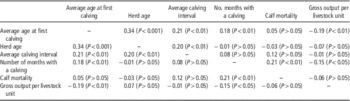
Table 2 shows the correlations found between reproductive variables and GO/LU across all systems. Age at first calving showed positive correlations with AGE (P<0.001), CI (P<0.01) and NMC (P<0.01), and a negative correlation with GO/LU (P<0.01). The positive correlation between AFC and CI is in agreement with the genetic correlation coefficient (0.22) reported by Berry and Evans (Reference Berry and Evans2014). Herd cow age was positively correlated with CI (P<0.01), which contrasts previous research carried out at animal level whereby cow age was not associated with CI (Drennan and Berry, Reference Drennan and Berry2006). The positive correlation between NMC and calf mortality (P<0.01) may be as a result of less stringent calving management when calving season is prolonged as other farm practices become a priority. The negative correlation between NMC and GO/LU (P<0.05) is likely to be associated with the aforementioned greater calf mortality, coupled with lighter weaning weights of later-born calves when fixed date weaning is practiced, which is not compensated for subsequently (Drennan et al., Reference Drennan, McGee and Keane2005).
Spearman partial correlation analysis between suckler cow reproductive variables and gross output per livestock unit across all systems

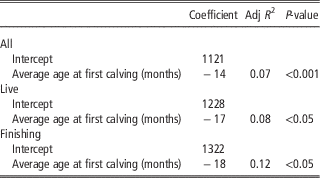
Table 3 shows the results of the stepwise regression between reproductive variables and the dependent variable GO/LU both across and within systems. No statistically significant findings were observed within Mixed systems hence this system is omitted from the table. Lack of findings is likely to be as a result of these farms alternating production systems regularly. Age at first calving was found to be the only statistically significant reproductive variable affecting GO/LU. Across systems, AFC accounted for 6.5% of the variation in GO/LU (P<0.001) with each monthly increase in AFC reducing GO/LU by €14 or €0.46/day. Within systems, the contribution of AFC to GO/LU was greater, accounting for 8% and 12% (P<0.05) of the variation in GO/LU on Live and Finishing farms, respectively. This corresponded to a reduction in GO/LU of €17 (€0.57/day) and €18 (€0.60/day) per 1 month increase in AFC, respectively. Similarly, using a research model Crosson and McGee (Reference Crosson and McGee2012b) concluded that for each day AFC extends beyond 24 months the net margin per heifer calving reduced by €1.65.
Stepwise regression analysis identifying the main suckler cow reproductive variables contributing to gross output per livestock unit across and within systemsFootnote *

* No significant findings were observed within Mixed systems therefore omitted.
It is surprising that the other reproductive variables did not have an effect on GO/LU. For example, Crosson and McGee (Reference Crosson and McGee2012b) concluded that each day CI extends beyond the target of 365 days, net margin is reduced by €2.20, equivalent of €110 daily for a 50 cow herd. However, this lack of association may be attributed to the nature and variablity of the data available within this study. Therefore, further research at an animal level is warranted in order to determine key reproductive factors contributing to farm financial performance.
Implications
Reducing the age of first calving of heifers was associated with fewer months with a calving, a shorter herd calving interval and higher gross output value per livestock unit. Furthermore, reducing the number of months with a calving was associated with lower calf mortality.
Acknowledgements
The authors thank the financial support of the Walsh Fellowship fund for Rachel Taylor. The authors also thank the management team and participants of the Teagasc/Irish Farmers Journal BETTER farms beef programme and the Irish Cattle Breeding Federation.