[W]e are all united in the effort to create democratic systems in which not determination from outside or from above but responsible self-determination is to be the dominating social principle […]. We are not a closed society but an association of independent parties whose representatives feel they can learn from each other and can by joint effort achieve something useful […].
—Willy Brandt, speech to the Socialist International Congress, Vancouver Footnote 1
The debate today is no longer about whether we modernise, but how and how fast. My case is straightforward. The left and centre-left has to stay true to its values but rediscover fundamental radicalism in applying those values to the modern world and jettison outdated doctrine and dogma that stands in our way.
—Tony Blair, address to the 1999 Socialist International Congress Footnote 2
Introduction
ANALYSES of the Socialist International,Footnote 3 Social Democratic party cooperation at the European level,Footnote 4 and social democracy’s reorientation toward Third Way policies during the 1990sFootnote 5 suggest strong policy linkages within the Social Democratic party family. But studies of cross-national policy linkages between parties highlight success, rather than party family, as the mechanism driving transnational policy diffusion.Footnote 6 According to these studies, political parties seek to construct a winning electoral strategy at home by taking cues from foreign incumbents in general, that is, successful political parties abroadFootnote 7 and not necessarily only those in the same party family. In this article, we revisit the role of party family in the policy diffusion process and argue that due to their ideology, extensive transnational linkages, and unique challenges, successful Social Democratic parties transmit policies more strongly within their party family than do successful parties in other families.
When politicians and party strategists make programmatic choices to position their party for electoral success, they face considerable uncertainty. Previous research emphasizes that political parties respond to such uncertainty by employing the heuristicFootnote 8 of learning from and emulating other successful parties’ positions. This learning and emulation occurs not only in their domestic sphere,Footnote 9 but also in the wider world by looking at successful parties abroad.Footnote 10 The expectation is that success, operationalized as incumbency, drives policy diffusion for all political parties; that is, political parties emulate and learn from foreign incumbents.
Markedly absent from our understanding of cross-border policy diffusion between parties is the role of party family.Footnote 11 Successful incumbents who lead governments are overwhelmingly Social Democrats, Christian Democrats, or Conservatives. These parties cluster in familles spirituelles, defined by their origins in the great ideological movements of the nineteenth and early twentieth centuries, history, and transnational linkages.Footnote 12 We examine whether party family matters for international policy diffusion by combining the literature on party families, and specifically Social Democratic parties,Footnote 13 with research on party policy diffusion.Footnote 14
We expect party family to influence international policy diffusion from successful, incumbent parties for two reasons. First, the shared ideological ambitions and cross-border linkages within party families affect what information is available to party strategists through the organizational channels that exist to transmit policy ideas. These channels vary across party families. Second, the unique cross-national challenges faced by a party family condition the relevance that party strategists attach to the success of foreign sister parties in their own search for a winning electoral strategy. Both mechanisms, we contend, make the Social Democratic party family an exception to the otherwise limited role of party families in cross-border policy diffusion. Defined by the shared internationalist goal of building more egalitarian capitalist democracies, social democracy developed exceptionally strong transnational organizational channels to facilitate policy exchange.Footnote 15 These channels made information on the platforms of successful sister parties readily available to party strategists. Moreover, the unique challenges that social democracy has been facing since the 1970s, including the decline of the industrial working class, globalization, the fall of communism, and the rise of green parties,Footnote 16 made the platforms of successful sister parties within the family the most relevant precedent for leaders searching for winning platforms. Our theoretical and empirical arguments suggest that by contrast, transnational organizations have not remained as strong for the other major party families that have generated most incumbents—the Christian Democrats and ConservativesFootnote 17—nor were unique policy challenges as critical to them.Footnote 18
We test our expectations using quantitative data on twenty-six established democracies in Europe from 1977 to 2017. The results show that social democracy is exceptional and, unlike the Christian Democratic and Conservative party families, characterized by extensive crossnational emulation of left-right policy positions from Social Democrats abroad who were incumbents in the recent past.Footnote 19 We find that a party family is important and influences cross-national learning when it shares sufficiently strong transnational organizations and significant political challenges. This result has crucial implications for four important political science literatures: studies of programmatic policy learning, social democracy, party election strategies, and policy diffusion in general. We expand on these contributions in the conclusion.
Party Policy Diffusion, Heuristics, and Party Family
When parties seek to position themselves for electoral success in a changing environment, they face complex and uncertain choices.Footnote 20 Parties’ strategies may, for instance, focus on taking or altering ideological positions,Footnote 21 picking issues to prime voters or to shift their attention,Footnote 22 and choosing broad or narrow appeals.Footnote 23 Complexity and uncertainty make the calculation of optimal electoral strategies challengingFootnote 24 and tax the decisional capacities of party strategists. Parties, therefore, use heuristics to identify relevant information in constructing winning strategies.Footnote 25 Heuristics are cognitive shortcuts—guides to rational action in conditions of uncertainty and complexity with a fair chance of success.Footnote 26 Two types of cognitive heuristics guide parties in their search for electorally successful strategies: the availability heuristic and the representativeness heuristic. Decision makers who use the availability heuristic estimate “frequency or probability by the ease with which instances or associations can be brought to mind.”Footnote 27 Under the representativeness heuristic, “probabilities are evaluated by the degree to which A resembles B.”Footnote 28 These heuristics have been shown to explain not only why parties learn from and emulate foreign policies, but also, crucially, whose policies are likely to be emulated. In particular, these are dominant governing parties that won office alone or that lead their coalitions because information on their policies is both readily available and a relevant precedent demonstrating how to win votes and how to dominate a government.Footnote 29
Party families, or (perceived) ideological similarity, may also affect the availability of information and the relevance of precedents. Nevertheless, previous accounts of international policy diffusion downplay the role of party family and ideologyFootnote 30 or do not find empirical support that party families matter for diffusion.Footnote 31 A reevaluation of party family is warranted, given that parties pursue not only electoral success, but also policy goals.Footnote 32 Clearly, the search for electoral victory can cause parties to assimilate some programmatic stances of successful parties from other ideological blocs,Footnote 33 as illustrated by the way some Social Democratic parties have adopted parts of the center-right’s neoliberal economic program. But to remain competitive, parties must negotiate the tension between pursuing policy and electoral success.Footnote 34 In this respect, sister parties with similar goals that succeed in winning office abroad are likely to be particularly relevant precedents. Hence, learning from and emulating their policies may be an important heuristic. Likewise, at the domestic level, there is evidence that parties pay close attention to the peers within their own ideological bloc.Footnote 35
Although it is plausible that ideological affinity matters for international policy diffusion, it is likely more influential for some party families than for others. Specifically, we contend that party strategists can be expected to privilege learning from successful sister parties abroad under two conditions. First, when transnational organizations within the famille spirituelle make information on sister parties abroad readily available and, second, when unique challenges faced by the family make the choices of sister parties the most relevant precedent. Under these circumstances, party family links condition the availability and representativeness heuristics applied. Below, we discuss these two mechanisms and show that they apply to social democracy but not to the other party families, and in particular, not to the Christian Democratic and Conservative families that produced the majority of incumbents on the political right.Footnote 36 This makes the Social Democratic party family the exception to the otherwise muted role of party families in transnational policy diffusion.
Social Democratic Party Exceptionalism
Transnational Linkages and Learning from Available Precedents
Comparative research clusters parties into families because of their shared origins in the great ideological movements of the nineteenth and early twentieth centuries and because international linkages likely have consequences for their behavior.Footnote 37 Party families mobilizing to represent social groups in specific historical contexts developed organizational structures of varying strength to suit their goals. In cross-national policy diffusion, such family links may shape the information available to party strategists in their search for winning strategies, that is, they affect how the availability heuristic is applied.Footnote 38 Previous work assumes that information availability is driven by the media coverage that successful incumbents receive compared to opposition parties.Footnote 39 We argue that strong transnational organizations specific to party families are an additional channel that makes information about the programs of successful incumbent sister parties easily available within the family. Enhanced organizational and informational linkages increase the probability that party leaders and their advisers learn from and emulate foreign incumbents in the same party family.
Social democracy, unlike other party families, featured exceptionally strong cross-national links from its inception for two reasons. Ideologically, social democracy retained from its revolutionary origins the shared ideological goal of transforming capitalismFootnote 40 and subscribed to socialist internationalism—cross-national collaboration to develop shared policy approaches.Footnote 41 Organizationally, the party family developed transnational institutional links supporting this policy collaboration. The Socialist International channeled consultation between socialist parties on international issues.Footnote 42 Regionally, Social Democratic parties formed an effective and powerful party federation in the European Parliament (ep) and the Party of European Socialists (pes ). Recent work shows that party groups in the ep are effective institutional channels of policy diffusion,Footnote 43 but the pes proved institutionally more powerful than others.Footnote 44 It has not only been coordinating European policies of national Social Democratic parties since the 1970s, but it has also grown increasingly influential with the 1992 Maastricht Treaty negotiations and a pes statute that provides “for majority decision making in all areas of ec policy where qualified majority is used in the Council of Ministers, and in certain areas decisions can be made which are binding on the national socialist parties.”Footnote 45
These transnational organizations were employed by successful leaders within the party family to disseminate policy ideas and influence sister parties abroad. Willy Brandt, for instance, made use of his presidency of the Socialist International (1976-1992) to promote the normalization of relations with the USSR, an extension of the objectives that he pursued through Ostpolitik as German Chancellor. Similarly, Tony Blair, addressing the Congress of the pes in Malmö in 1996, called on fellow European socialist leaders to “modernize or die,” and to embrace Third Way reforms by holding “our values dear, then revolutionize our method of implementing them.”Footnote 46
Incumbents of the political right, by contrast, have traditionally been significantly less united ideologically and organizationally. Successful parties representing that part of the political spectrum since 1945 are drawn from the Christian Democratic and Conservative party families and display greater ideological heterogeneity than social democracy.Footnote 47 Key ideological fault lines among Christian Democrats include the centrality they accord to their Christian roots (for example, dividing the Dutch Christian Democratic Appeal from the German Christian Democratic Union/Christian Social Union), antisocialism (central for many of these parties, but for others, such as the Belgian, Dutch, and Italian parties, it contradicts their domestic Christian Democratic-Socialist alliances), and different welfare state models.Footnote 48 Moreover, while Christian Democrats embraced supranational cooperation and European integration, Conservatives did not necessarily do so. These differences hampered the creation of effective transnational organizations by these parties. Although the Conservatives formed the European Democratic Union, it remained weaker than other federations and eventually merged in the 1990s with the European People’s Party (epp) formed by the Christian Democrats.Footnote 49 Thus, although with the epp the Christian Democratic parties had a strong transnational party organization, it was less effective as a channel for policy diffusion than the equivalent organizational ties among Social Democrats for two reasons: ideologically, Christian Democracy is more heterogeneous, and organizationally, it coalesced with another major party family at the European level since the 1990s.
In sum, the strength of transnational organizations within the Social Democratic party family is exceptional and instrumental in making information on the policy platforms adopted by successful sister parties abroad readily available to party strategists.
Shared Policy Challenges and Learning from Representative Precedents
In cross-national policy diffusion, the second type of cognitive shortcut applied by party strategists is the representativeness heuristicFootnote 50—the degree to which the ambition and strategic choices open to a foreign party resemble those of the focal (domestic) party that is aiming to construct a winning platform. Existing research suggests that the representativeness heuristic leads party strategists aiming to position their party for electoral success to focus on foreign parties whose programmatic choices have won them office.Footnote 51 We claim that whether a winning foreign party’s choices represent the dilemmas faced by the focal party can be mediated by party family. Specifically, when unique cross-national challenges are confronted by parties within a family, the choices of successful sister parties become a particularly relevant precedent.
Social Democratic parties have faced significant and unique competitive pressures since the mid-1970s. In the postwar years, they successfully adopted catchall strategies that broadened their electoral support beyond the working class.Footnote 52 This strategy saw their support peak in the 1960s-1970sFootnote 53 and their coalition options expand, and it propelled them into governments across Europe. But beginning in the 1970s, the catchall strategies of these parties came under pressure.Footnote 54 The challenges facing the party family in the 1970s and 1980s were economic, ideological, and political. Economic development precipitated a shift toward nonindustrial occupations,Footnote 55 which sent the industrial working class, traditionally the core electorate of Social Democratic parties, into secular decline. The oil crisis of the 1970s was accompanied by high levels of unemployment, stagnation, and inflation, which challenged the assumptions of Keynesian economics and led to the adoption of neoliberal approaches that opened up national economies to global trade.Footnote 56 The resulting pressures on Social Democratic parties were further compounded by the collapse of Communism and the introduction of the single European market.Footnote 57 Ideologically, these developments called into question the programmatic identity of social democracy and the effectiveness of policies that it had traditionally espoused to promote workers’ rights and social justice. Politically, competition from the left for socially liberal voters from rising Green parties put further strain on the electoral coalition underpinning social democracy. The confluence of these factors required a renewal of social democracy.
In response to these challenges, leaders within the movement proposed the reorientation of Social Democratic parties toward Third Way politics that generally accepted free markets but also sought to regulate their effects. We argue that the rapid diffusion of many of these ideas within the party family, albeit with national differences,Footnote 58 was powerfully driven by the specificity of the challenges that social democracy faced. The strategists of Social Democratic parties across Europe learned from the programmatic choices of the first Social Democrats carried to power in the 1990s by the adoption of Third Way ideas, because those choices resolved dilemmas that closely resembled those of their own party. Hence, Social Democratic party family mediated policy diffusion because successful Social Democratic parties were most representative of the precedent that focal party strategists aimed to emulate.
Anecdotally, there is ample evidence of the diffusion of Third Way policies within the Social Democratic party family. As Anthony Giddens notes, “[w]hen New Labour first came into government, there was intense interest among Social Democratic parties in Continental Europe.”Footnote 59 In April 1999, Bill Clinton sponsored a dialogue in Washington, D.C., on the Third Way that was attended by several European heads of government: Blair, Gerhard Schröder, Wim Kok, and Massimo D’Alema. Later that year, Blair and Schröder published a joint vision for a reformed social democracy in “The Third Way/Die Neue Mitte,”Footnote 60 drafted by their strategists Peter Mandelson and Bodo Hombach.Footnote 61 Through the mid- to late-1990s, the concomitant centrist policy shifts proved electorally successful: European Social Democratic parties dominated elections and entered governments either solely or in coalition. In 1998, the only exceptions in Europe were Ireland, Norway, and Spain.Footnote 62
But this success proved transient, and social democracy continued to face severe challenges. Since 2000, the electoral support of these parties has sunk to historical lows with the continued decline of the industrial working class, the defection of socially conservative socialist voters to populist parties, and a loss of public-sector support in light of severe constraints on public spending following the Great Recession.Footnote 63 The uniqueness of these challenges to the Social Democratic party family can be expected to provide powerful incentives for party strategists to learn from and emulate the first successful responses, once they emerge, by sister parties abroad.
Although the same social, economic, and geopolitical changes also affected the competitive environment of Conservatives and Christian Democrats, the impact on these parties was neither as uniform nor as existentially threatening as it was for the Social Democrats. The decline of the industrial working class represented more opportunities than challenges for the Conservatives and Christian Democrats.Footnote 64 While economic globalization forced the political right to reform their welfare policies, individual parties were committed to different welfare-state models,Footnote 65 which made the challenges they faced heterogeneous. Globalization, with the spread of neoliberalism and labor market liberalization, also represented a less fundamental threat to Conservatives and Christian Democrats because they held economic positions to the right of their Social Democratic counterparts.Footnote 66 And how the collapse of Communism and post-material value change, including the rise of secularism, influenced Conservatives and Christian Democrats differed based on whether antisocialism, traditionalism, or their confessional roots remained central to their identities.Footnote 67 67 Thus, the challenges that Conservatives and Christian Democrats faced were more varied and less existentially threatening than those faced by Social Democrats, which weakened incentives for cross-national family-specific learning.
In sum, party leaders and strategists focus on successful foreign parties as a useful heuristic to develop a model for their own success. We argue that party family mediates this strategy under two conditions: first, when the family features strong transnational organizational links (making information on successful programmatic choices within the family readily available to party strategists) and, second, when it faces significant and unique challenges to success (making successful responses by sister parties the most representative precedents). Among the party families that have generated significant numbers of incumbents throughout the postwar era, both conditions apply to Social Democrats from the 1970s onward, in contrast to Christian Democrats and Conservatives. Hence, we hypothesize that policy diffusion within the Social Democratic party family through learning from its successful foreign incumbents is the exception to the otherwise muted role of party family in mediating transnational policy diffusion.
—H1. Social Democratic Party Family Hypothesis. Policy diffusion within the Social Democratic party family from its incumbents is exceptionally strong, compared to other party families.
Research Design
The unit of analysis in our data set is party-year, and we analyze 264 political parties in twenty-six European democracies over a forty-year period from 1977 to 2017. New parties enter the data set with the first election they compete in and parties leave the data once they no longer participate in national elections. To define parties and their entry and exit dates, we rely on the Comparative Manifesto Project (cmp ). Footnote 68 All parties are included when data are available, including regional, agrarian, and other small, specialized party families coded by the cmp investigators. The total number of observations is 4,049 party-years. The two central components of our research design are the dependent variable, which captures left-right policy positions of Social Democratic parties, Christian Democrats, and Conservatives, and our empirical method, which tests whether policy diffusion occurs within the major party families (Social Democrats, Christian Democrats, and Conservatives). This research design maximizes parsimony and clarity, allowing for a direct test of our hypothesis by examining the contrast between diffusion in the three party families that have generated the overwhelming majority of incumbents.Footnote 69
For the dependent variable in our models, the cmp provides a left-right measure on party positions.Footnote 70 In tables A10 and A11 of the supplementary material, we discuss additional analyses that account for the potential multidimensionality of the policy space.Footnote 71 The left-right dimension is the most important one for issue competitionFootnote 72 and for political elites and voters, it is a common vocabulary relating to the salient issues of governments’ role in the economy and the distribution of income.Footnote 73 The cmp’s left-right measure is broadly consistent with those derived using other methods.Footnote 74 We rescale the original variable to an interval ranging from one (extreme left) to ten (extreme right) to make it consistent with our median voter scale (see below). Interpolation is required because parties’ policy positions are measured only in election years. For this interpolation, we assume that party positions do not change until the next election year.Footnote 75
Our main focus is on Social Democratic parties, but we also examine models concentrating on Christian Democrats and Conservatives.Footnote 76 We follow Giacomo Benedetto, Simon Hix, and Nicola MastroroccoFootnote 77 and define Social Democratic parties as those that are “a member of the Socialist International or Party of European Socialists at a particular time.” The terms socialism and social democracy are often used interchangeably, though Social Democrats are sometimes viewed as more centrist than other members of the Socialist International in a particular country. The cmpFootnote 78 provides detailed information on the type and family of each party coded. We use this information to initially create a binary variable capturing whether a party is Social Democratic (1) or not (0). Out of the 4,049 party-years in our data, 747 pertain to Social Democratic parties (18.45 percent of all observations). Table A1 of the supplementary material provides a detailed overview of the Social Democratic parties that are included in our data with entry and exit years. Note that some countries have more than one Social Democratic party at the same time. This phenomenon affects only a small number of cases: specifically, pairing each party in our data set with all others produces 431,780 cases and only 256 of those party-dyad years signify pairs of Social Democratic parties in the same country (0.0006 percent). The focus of our analysis is on international programmatic diffusion between Social Democratic parties, but domestic-level diffusion is controlled for in the supplementary material in Table A7, in which we account for the possibility that domestic rival parties influence one another.Footnote 79 To examine whether policy diffusion within the Social Democratic party family is indeed exceptional and different from diffusion within the Christian Democrat and Conservative party families, we draw on the party family information contained in the cmp dataFootnote 80 and create binary variables that capture the latter groups of parties. In our data set, 588 cases (14.52 percent of all party-years) are coded as Christian Democrats and 472 (11.66 percent) are defined as Conservatives. Based on previous studies by Zeynep Somer-Topcu and by Tobias Böhmelt and colleagues,Footnote 81 we also aggregate these blocs of parties and examine Conservatives and Christian Democrats jointly (see Table A8).
We use spatiotemporal lag modelsFootnote 82 to capture party policy diffusion and the role of social democracy’s exceptionalism. The models estimate a party’s position as a function of foreign parties’ positions. We achieve this via a weighting matrix, W, which specifies the relationship between parties (senders and receivers) and, thereby, the subset of foreign parties that potentially exert an influence. We multiply this connectivity matrix with a temporally lagged version of our dependent variable (y e-1) to construct the spatial lags—the core components in our models (Wye-1)—which thus combines data on parties’ policy positions with information on party-family membership. The temporal lag we use for the spatial lags (e-1) pertains to the year before the last election in a sender country. That is, we focus on the positions of potentially influential parties in the year before their last election. To illustrate this design, consider estimating the influence of the German Social Democratic Party (spd) on the British Labour Party’s 2015 manifesto: the temporal lag will take on the German spd’s 2012 policy position. The last German election before 2015 was held in 2013 and the lag pertains to the year before the last election (2012). The rationale behind this design is based on the observation that developing party manifestos is a “time-consuming process […] which typically takes place over a two-three year period during which party-affiliated research departments and committees draft sections of this manuscript, which are then circulated for revisions and approval upward to party elites and downward to activists.”Footnote 83 Considering this argument and following previous studies,Footnote 84 instantaneous diffusion effects are unlikely and therefore, we use parties’ policy positions from the year before the last election in their country when constructing the spatial lags.
To allow for distinct effects among Social Democratic parties and Christian Democrats or Conservatives, we specify different weighting matrices. We multiply a first matrix with the temporally lagged dependent variable, where matrix entries are set to 1 only if both parties i (receiver party) and j (sender party) are Social Democratic according to the cmpFootnote 85 and they do not compete for office in the same country. This leads to the first spatial variable, WySocial Democrats, which captures the policy position of all Social Democratic parties abroad as a potential influence on Social Democrats “at home.” The impact of non–Social Democratic parties is set to 0, and the matrix does not allow for a Social Democratic influence from abroad on non–Social Democrats at home (as the entries are set to 0 here, too). A second spatial variable captures the influence of incumbent parties abroad in the context of party policy diffusion. Here, we modify the matrix so that its entries only receive a value of 1 if both parties, i and j, are Social Democratic parties, j is active in another country, and j was recently in government (either forming the government on its own or as a member of a coalition). Data for incumbency are taken from Holger Döring and Philip Manow.Footnote 86 We label this second spatial lag WyIncumbent Social Democrats. A last set of spatial variables follows the setup of the first two items, but we focus instead on Christian Democrats or Conservatives: WyChristian Democrats and WyConservatives capture the policy positions of all Christian Democratic or Conservative parties abroad as a potential influence on Christian Democratic and Conservative parties at home; and WyIncumbent Christian Democrats and WyIncumbent Conservatives provide the information on whether the “sender” Christian Democratic or Conservative party abroad was recently in power.
We do not row standardize the spatial lags for theoretical reasons.Footnote 87 Row standardization implies that the number of (Social Democratic incumbent) parties abroad at a given time is not relevant. But rational strategists should only consider other parties’ positions if they expect the marginal value of the information gathered to exceed the marginal cost of obtaining it, which is not consistent with the allocation of a fixed amount of effort. In other words, as the number of foreign parties increases, diffusion effects are likely to increase but at a rate that diminishes with each additional party. We use spatial ols (s- ols) regression, which is justifiable because our explanatory variables are temporally lagged.Footnote 88
To credibly ensure that contagion “cannot be dismissed as a mere product of a clustering in similar [party or state] characteristics,”Footnote 89 we follow Robert Franzese and Jude HaysFootnote 90 by accounting for the common exposure of parties to similar economic (and other exogenous) factors.Footnote 91 We do so by including the (one-year) temporally lagged dependent variable, party fixed effects, and year fixed effects. We also include several additional control variables. Parties may respond to the positions of other domestic partiesFootnote 92 and there are likely more general influences across borders than the Social Democratic ones we seek to examine.Footnote 93 To control for these effects, we define two additional spatial lags. First, in WyDomestic, matrix entries only receive a value of 1 if i and j are different parties competing in the same political system, 0 otherwise. Second, we specify WyForeign, which is defined in a similar manner except that matrix cells contain 1 only if i and j are different parties not competing in the same system, 0 otherwise. Note that foreign Social Democratic, Christian Democratic, and Conservative parties are a subset of all parties abroad. Hence, although this last spatial variable addresses general cross-border diffusion effects not distinguishing between party families or incumbency status, including it in the models likely soaks up explanatory power of the main variables, making our estimations more conservative.Footnote 94 We further account for the position of the median voter using Eurobarometer data on respondents’ left-right self-placement on a scale of one (left) to ten (right).Footnote 95 We lag this variable by one year to allow for delayed responses by parties. Finally, the effects of economic globalization are conditioned by the position of the median voter.Footnote 96 We thus control for the economic component of the kof Globalization IndexFootnote 97 and include the multiplicative interaction lagged median voter * lagged economic globalization.
Empirical Results
Hypothesis 1 expects policy diffusion within the Social Democratic party family (from its incumbents) to be stronger than diffusion within other party families. Table 1 presents the results for Social Democratic parties. Model 1 includes only the control variables, and we omit the core spatial variables. Model 2 adds only WySocial Democrats, and model 3 includes only WyIncumbent Social Democrats (“while omitting “WySocial Democrats) Model 4 considers all control variables and both Social Democratic spatial variables simultaneously. We can directly interpret signs and statistical significance in this table. A spatial lag captures the weighted values of all neighboring units, in this case Social Democrats and Social Democratic incumbents. A coefficient estimate refers to the unit change in a focal party’s position if, for example, all Social Democratic incumbents abroad (WyIncumbent Social Democrats) would increase their party position by one unit. But the interpretation is more complex because our weighting matrices are not standardized and there is a possibility of temporal as well as spatial spillover effects. Therefore, first, to assess short-term effects directly, the coefficients of the spatial lags are multiplied by the average number of neighbors.Footnote 98 Second, we also calculate the long-term (asymptotic) effects of the spatial lags following Thomas Plümper, Vera Troeger, and Philip Manow.Footnote 99 Asymptotic long-term and short-term effects of the core spatial variables in Table 1 are presented in Figure 1. Last, to fully account for spatial spillover effects, we calculate spatial long-term equilibrium effects for the core spatial lags, which allow us to estimate “responses of the dependent variable across all units.”Footnote 100 Table 2 presents the spatial influence after diffusion has occurred and accounts for first-order, second-order, and feedback effects.Footnote 101
Temporal short-Term and Asymptotic Long-Term Effectsa
aThe horizontal bars are 90 percent confidence intervals. Spatial effect of zero marked with dotted vertical line. Estimates are based on model 4. Short-term effects are reported in grey below asymptotic long-term effects (in black).

Party Policy Diffusion: Social Democratic Family a

*p < 0.10, **p < 0.05, ***p < 0.01
a Table entries are coefficients; standard errors in parentheses; constant as well as year and party fixed effects (FEs) are included in all models, but are omitted from presentation; the scale for party position (dependent variable) is recalibrated from the left-right estimates reported by the CMP to fit on the one to ten median voter scale; all explanatory variables are one-year lags; the spatial lags capture parties’ policy positions of the year before the last election.
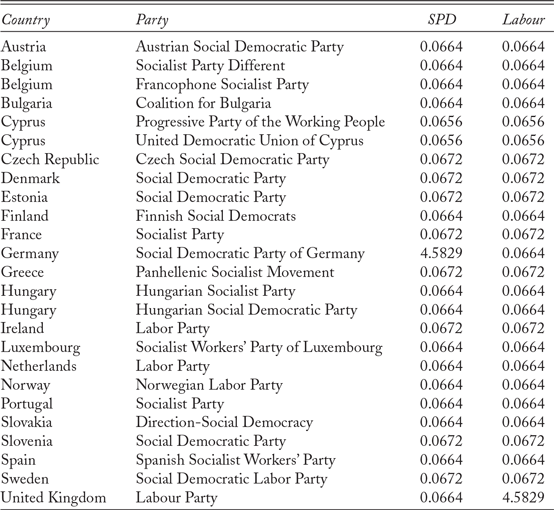
Spatial Long-Term Equilibrium Effects a: WyIncumbent Social Democrats

a Table entries pertain to spatial long-term equilibrium effects when raising the party policy position of one of the parties highlighted in the last two columns by one. Entries are based on four decimal places and rounded accordingly. The table only captures a selection of parties and countries in 2010, and not the whole sample. Effects in the last two columns are calculated based on one-unit shifts to the right for the German Social Democratic Party (SPD) and the UK Labour Party.
The two spatial lags WySocial Democrats and WyIncumbent Social Democrats, are positively signed and statistically significant at conventional levels in Table 1, models 2 and 3, respectively. This suggests that party policy diffusion does occur between Social Democratic parties, and that Social Democratic incumbents are more influential than Social Democrats who are currently not in government. This is confirmed in model 4, in which WySocial Democrats is no longer statistically significant, but WyIncumbent Social Democrats remains significant at conventional levels and positively signed. This reemphasizes that Social Democrats learn from and emulate the policies of other Social Democratic parties, particularly if the latter were recently in power. As all foreign Social Democratic incumbents are also Social Democrats (and, as discussed above, they belong to the set of parties abroad), the inclusion of WySocial Democrats next to WyIncumbent Social Democrats naturally lowers the impact of the latter variable in model 4 when compared to model 3. Therefore, model 4 controls for the influence of Social Democratic opposition parties abroad more directly than model 3 (which omits them from the estimation and treats them as noise). Substantively, focusing on model 4 and after spatial-lag coefficients are multiplied by the average number of neighbors, a Social Democratic party’s left-right policy position would be 0.0025 points higher in the short run, if all foreign (neighboring) Social Democratic parties shift one unit to the right, compared to the year before.Footnote 102 But this estimate is not statistically significant. The effect of foreign Social Democratic incumbent parties is calculated at 0.0045 in the short run. That is, a Social Democratic party’s left-right policy position would be 0.0045 points higher (after the spatial-lag coefficient is multiplied by the average number of neighbors), if all foreign Social Democratic incumbents had shifted one unit to the right in the year before their last election. Hence, incumbency almost doubles the overall diffusion impact for Social Democrats, and this effect is significant. Asymptotically (Figure 1), the effect associated with WySocial Democrats is estimated at 0.0141 (statistically significant) and the impact linked to WyIncumbent Soad Dcmoa-ats is 0.0250 when a spatial lag is increased by one unit. These results are based on model 4, and adding or dropping specific variables does not alter the substantive findings.
For the long-term equilibrium effects of party policy diffusion among Social Democrats for cases in which the sender party was recently in power, we first assume that the spatial weights and all other variables remain at 2010 values. We then hypothetically increase some preselected Social Democratic parties’ policy positions by one unit. This shock has direct (first-order) effects in the system via linkages among Social Democratic parties, but also has indirect (second-order) effects via longer chains of intermediaries and eventually feeds back to the source party. Since each party will have a different set of linkages to its neighbors, the impact of a hypothetical change in a party’s policy position depends on which party’s position is altered. We calculate the long-term effects on all parties as the shock reverberates through the system of spatial and temporal lags, that is, the effects presented in Table 2 comprise both direct and indirect influences.Footnote 103 Our calculations are based on model 3, which discards spatial variables other than WyIncumbent Social Democrats for simplicity.
Table 2 summarizes the findings for the effect of a one-point increase in the positions of the German SPD and the UK’s Labour Party. We report the median equilibrium impact that incorporates first-order, second-order, and feedback effects, which is based on one thousand random draws from the multivariate normal distribution of the spatial and temporal lags. The simulations suggest that a one-unit increase in the British Labour Party’s policy position would positively affect all other Social Democratic parties in the system. The German spd, for instance, would react by increasing its policy position by 0.0664 units to the right (accounting for all direct and indirect influences). If the British Labour Party had moved to the right by one unit, the Irish Labour party would have emulated this move by adjusting its position 0.0672 units to the right of its initial left-right placement. Linking these findings to our theory, we find strong and robust support for H1.
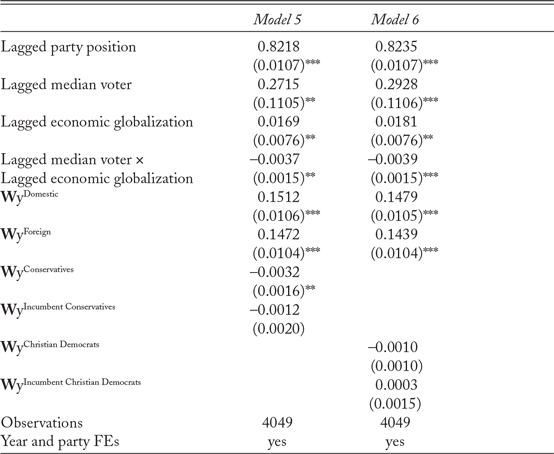
We now turn to a comparison of incumbent political parties to the right of the political spectrum. The setup in Table 3 mirrors model 4 in Table 1, except in it we focus on the Christian Democratic and Conservative spatial variables. The Conservative spatial lags are negatively signed while the coefficient estimates for the Christian Democrat variables are all insignificant (with varying signs). This suggests that international party policy diffusion does not occur within Christian Democratic or Conservative parties, and that Christian Democratic and Conservative incumbents do not have a special influence, either. These findings support our theory: party family–specific crossnational diffusion from successful sister parties is only strong within the Social Democratic family, and it is not a characteristic of right-wing incumbent party families.
Christian Democratic/conservative party Familya

*p < 0.10, **p < 0.05, ***p < 0.01
a Table entries are coefficients; standard errors in parentheses; constant as well as year and party fixed effects (FEs) are included, but are omitted from presentation; the scale for party position (dependent variable) is recalibrated from the left-right estimates reported by the CMP to fit on the one to ten median voter scale; all explanatory variables are one-year lags, the spatial lags capture parties’ policy positions of the year before the last election.
The results concerning the control variables mirror previous research.Footnote 104 First, the coefficients of the domestic-level spatial lag, WyDomestic, and of the foreign-level spatial lag, WyForeign, have positive estimates, which emphasizes that parties learn from and emulate not only rival parties, but also other political parties in other countries. This replicates the findings of previous work.Footnote 105 Second, economic globalization conditions the effect of the median voter on parties’ policy positions. The coefficient of the interaction between these two variables shows that the further to the left the median voter, the more globalization pushes parties’ positions to the right.Footnote 106
In Table A1 of the supplementary material, we give an overview of the parties that are coded as Social Democratic and we discuss a number of additional analyses. First, we take the size of a source (or sender) party’s country into account because it may be plausible that parties, including Social Democratic ones, are more likely to learn from parties in larger states (Table A2). Second, we control for inflation and gdp growth as additional economic influences (Table A3). Third, we model thoroughly systemic changes in the international context, which may affect party policy positions, by accounting for Cold War developments and EU membership. We also examine whether diffusion within the Social Democratic party family changed over time, given its Third Wayturn discussed above, by restricting our analysis to the pre-2000 period (tables A4 and A5). Fourth, we test the robustness of our findings after adjusting for uncertainty around the estimates of party position (Table A6). Fifth, we control for the presence of more than one Social Democratic party in a focal country, we aggregate Christian Democrats and Conservatives into one party group (an ideological bloc), and we consider parties to the left of the Social Democrats (rather than to the right) as our reference point (tables A7 to A9). Sixth, we address the argument that Social Democratic parties compete in a two-dimensional political space. For instance, these parties’ progressive positions on the cultural dimension of competitionFootnote 107 may have “alienated the core constituency of social democracy, the working class.”Footnote 108 Our main analyses focus on the left-right scale and thus, a one-dimensional issue space. But we account for the existence of a multidimensional issue space in two ways: we first omit and then control for countries that are likely characterized by only one dimension (Table A10).Footnote 109 Next, we examine the diffusion of party policy positions on an issue that the literature identifies as part of a second dimension (Table A11). Following recent work,Footnote 110 we analyze this second dimension using party positions on European integration. Both analyses confirm that Social Democratic party policy diffusion is exceptional—not just for the left-right policies but also for European integration. Last, we focus more closely on the relevance of the two diffusion pathways that our theory identifies (social democracy’s institutional linkages and shared challenges), for the exceptional level of policy diffusion within this party family. We shed light on the centrality of strong transnational institutional links to the exceptional level of policy diffusion among Social Democrats by studying the impact of membership in the ep’s pes group (Table A12). To model the effect of the unique cross-national challenges facing Social Democratic parties, we interact WyIncumbent Social Democrats with the globalization item and examine whether diffusion rates increase in the magnitude of the challenge, as measured by levels of globalization (Table A13 and Figure A1). The results of all these additional analyses support H1.
Conclusion
We theorize that party family becomes an important channel for policy learning from and emulation of successful sister parties abroad when it features strong transnational organizational ties and faces unique and powerful challenges. Both of these factors identify Social Democratic parties as exceptional compared to the other major party families, in particular Christian Democratic and Conservative parties. Our empirical findings provide strong and robust evidence for H1, the Social Democratic party family hypothesis, that cross-national policy diffusion is more likely to occur from successful incumbents within the Social Democratic family than within other party families. This result makes contributions to four important literatures in political science.
First, for work on programmatic policy diffusion, we clarify the conditions under which party families are (and are not) consequential for transnational policy emulation.Footnote 111 Second, to the study of social democracy, we add a systematic theoretical and empirical account of the exceptional amount of policy learning that has occurred across borders from successful parties within this family since the mid-1970s in contrast to other major party families. This analysis complements other prominent research that emphasizes the uniqueness of this party family.Footnote 112 Third, with respect to the literature on political parties’ election strategies, we highlight that parties can be powerfully influenced by sister parties abroad. This adds an international dimension to a body of work that otherwise naturally gravitates toward domestic-level explanations.Footnote 113 Fourth, to the extent that Social Democratic parties account for a significant share of the incumbents that then influence governing policies, our research has broader implications for the literature on policy diffusion.Footnote 114 As we show, among Social Democrats, in contrast to Christian Democrats and Conservatives, party family is a channel that facilitates the emulation of and learning from policies adopted by foreign incumbents.
This article also raises several questions for future research. For example, our theory suggests that the continuing unique and existential challenges that have driven the decline of social democracy generate strong incentives within this family for cross-national emulation of future programmatic choices that prove capable of carrying Social Democrats back to power. It may also be interesting to conduct analyses of policy diffusion within party families on more narrowly defined issue dimensions than the left-right, such as immigration or the environment. The success of populist challengers, for instance, may be a byproduct of cross-national policy transmission on the specific dimension of immigration within this bloc.
The role of party organization also deserves further attention. Gijs Schumacher, Catherine de Vries, and Barbara VisFootnote 115 claim that the balance of power between party activists and party leaders affects parties’ policy shifts.Footnote 116 Hierarchical parties may be more active in engaging in policy diffusion processes because leaders have more authority to adopt successful party strategies. Alternatively, internally democratic and less hierarchical parties could develop more channels for emulation through transnational ties between their supporters.Footnote 117 Depending on which intraparty mechanism is at work, there will be important consequences for our understanding of how party policy diffusion occurs. To generate a complete understanding of cross-border policy learning within party families, our quantitative study would also benefit from complementary qualitative and process-oriented comparisons to observe specific interactions (or the lack thereof) between party elites.
And while much of the established literature concentrates on the cross-border diffusion of policies from one government to another,Footnote 118 we add support to the claim that parties’ policy positions also travel across countries. This finding is important because parties’ manifesto rhetoric usually precedes legislative action.Footnote 119 That said, a more comprehensive analysis of how levels of diffusion interact is required, that is, how diffusion works across voters, parties, and governing policies. For example, it may be plausible that political parties react especially strongly to governing parties’ concrete policy outputs (although arguably, these may be based on their manifesto pledges). The notion that governing parties’ policy outputs could be influential is straightforward, and it is consistent with research showing that voters are more likely to update their perceptions of governing parties versus opposition parties.Footnote 120 If voters are more attentive to incumbents, this would also suggest that policy diffusion will occur more readily from successful political parties and the subsequent policy outputs they legislate.
We conclude that our findings open several avenues for future research and contribute to a more nuanced understanding of social democracy, party families, parties’ election strategies, and policy diffusion. The Social Democratic party family is unique because incumbents have an exceptional level of influence on the policies of their sister parties abroad.
Supplementary Material
Supplementary material for this article can be found at https://doi.org/10.1017/S0043887121000022.
Data
Replication files for this article can be found at https://doi.org/10.7910/DVN/DYWBRH.
Acknowledgments
We thank the editors of World Politics and four anonymous reviewers for their helpful comments and suggestions.
Authors
Petra Schleiter is a professor of comparative politics at the University of Oxford. Her research focuses on comparative political institutions, parties, and behavior. She can be reached at petra.schleiter@politics.ox.ac.uk.
Tobias Böhmelt is a professor of government at the University of Essex. His research focuses on comparative politics and international relations. He can be reached at tbohmelt@essex.ac.uk.
Lawrence Ezrow is a professor of government at the University of Essex. His research focuses on parties’ election strategies, political representation, and party policy diffusion. He is the author of Linking Citizens and Parties (2010). He can be reached at ezrow@essex.ac.uk.
Roni Lehrer is a senior research fellow at the Mannheim Centre for European Social Research. His research focuses on intraparty politics, policy diffusion, and citizens’ response to the COVID-19 pandemic. He can be reached at lehrer@unimannheim.de.