Introduction
Morphosyntactic structures are linguistic units or grammatical categories that have both morphological and syntactic properties. In English they include, but are not limited to, the markings of grammatical tense (past, present, future), agreement between subject and verb, determiners (definite and indefinite articles, demonstratives, possessives), and singular and plural constructions. Plurals, for example, are considered a morphosyntactic structure because they require both a morphological change and syntactic agreement between the noun and verb.
Defining morphosyntactic awareness
Morphosyntactic awareness, we would argue, is a type of metalinguistic awareness. Perhaps the most widely accepted, yet strictest, definition of metalinguistic awareness is the conscious ability to reflect on and intentionally manipulate structures in a language – including morphosyntactic structures (Blackmore, Pratt & Dewsbury, Reference Blackmore, Pratt and Dewsbury1995; Gaux & Gombert, Reference Gaux and Gombert1999). A controversial aspect of this definition is the degree to which consciousness is a necessary requirement for metalinguistic awareness (Kuo & Anderson, Reference Kuo, Anderson, Koda and Zehler2008). According to Gombert (Reference Gombert1992, Reference Gombert, van Lier and Corson1997), Gaux and Gombert (Reference Gaux and Gombert1999), and others (Karmiloff-Smith, Reference Karmiloff-Smith and Levin1986), consciousness plays a central role in metalinguistic awareness, and is preceded by the acquisition of epilinguistic control (e.g., Gombert, Reference Gombert, van Lier and Corson1997). For example, epilinguistic detection of ungrammatical structures can occur when the child is alarmed by the dissonance of the utterance or when the child realizes she does not understand the ill-formed utterance. However, it is only after epilinguistic control has become stable and efficient that metalinguistic awareness (e.g., intentionally applying syntactic knowledge to judge grammaticality) can become possible (Gombert, Reference Gombert, van Lier and Corson1997). In contrast, other authors suggest that having explicit mental representations of language properties does not necessarily entail the ability to intentionally manipulate them or verbalize about these language properties (see Kuo & Anderson, Reference Kuo, Anderson, Koda and Zehler2008, for a discussion).
This issue is important when one considers that children between 5 and 8 years of age can distinguish between grammatically correct and incorrect instances of syntactic structures in oral speech beyond that expected by chance, but not necessarily be able to manipulate these structures or explain their judgments (e.g., Davidson, Raschke & Pervez, Reference Davidson, Raschke and Pervez2010). Thus, in the present research, we assessed whether 5- and 6-year-old children were able to judge the grammaticality of sentences that included morphosyntactic structures that varied in level of difficulty. Children were also asked whether they could explain their answers when they identified a grammatically incorrect morphosyntactic structure in a sentence. For ease in presentation, we refer to this behavior as early “morphosyntactic awareness”, although this does not mean that we do not consider this behavior as epilinguistic in nature, a point we will return to later in the paper.
With this in mind, the objectives of this research are discussed in light of (1) the importance of morphosyntactic awareness in monolingual and heritage language children, (2) the potential role language dominance and receptive vocabulary ability may play in morphosyntactic awareness, (3) whether language group (monolingual, English–Spanish, English–Urdu) differences exist in the early stage of morphosyntactic awareness, and (4) how the syntactic structure itself may affect early morphosyntactic awareness. Heritage language children were defined as those children raised in a home in which a non-majority language is spoken and are, to some degree, proficient in that language and the majority language (Simard, Fortier & Foucambert, Reference Simard, Fortier and Foucambert2013; Valdés, Reference Valdés, Peyton, Ranard and McGinnis2001). Thus, heritage language children are bilinguals in a minority language context (Montrul, Reference Montrul, Roberts, Lindqvist, Bardel and Abrahamsson2012), and may represent a special class of bilinguals (Grosjean, Reference Grosjean2012). By adulthood, heritage language speakers are typically weaker in their heritage language (Montrul, Reference Montrul2016).
Importance of morphosyntactic awareness in monolingual and heritage language children
The study of morphosyntactic awareness is important because research has shown that this metalinguistic process is positively related to both the development of language and reading skills (Assink & Sandra, Reference Assink and Sandra2003; Carlisle, Reference Carlisle2003; Gaux & Gombert, Reference Gaux and Gombert1999; Kuo & Anderson, Reference Kuo, Anderson, Koda and Zehler2008; Takacs, Reference Takacs2007). In fact, when studies have specifically separated syntactic awareness (e.g., judging the grammaticality of word order) and morphosyntactic awareness (e.g., judging the grammaticality of inflections), the latter showed both direct and indirect relations to reading comprehension via decoding, whereas the former did not (Rothou, Reference Rothou2015). Moreover, assessing syntactic awareness may be less informative than assessing morphosyntactic awareness because the former may result in children judging meaningless sentences. That is, the syntactic error renders the sentence meaningless (Pratt, Tunmer & Bowey, Reference Pratt, Tunmer and Bowey1984).
Whether assessing syntactic or morphosyntactic awareness, it is of some concern that past studies have shown conflicting results with regard to heritage language children's performance. Most, however, have focused on syntactic awareness in general and not morphosyntactic awareness specifically, or have not separated syntactic from morphosyntactic constructions on the awareness measure. In particular, several studies have shown that heritage language children perform more poorly on these measures than monolingual children (e.g., Da Fontoura & Siegel, Reference Da Fontoura and Siegel1995; Lipka, Siegel & Vukovic, Reference Lipka, Siegel and Vukovic2005), whereas other studies have found that heritage language children either perform the same (Simard et al., Reference Simard, Fortier and Foucambert2013) or better than monolingual children (e.g., Bialystok, Reference Bialystok1986; Cromdal, Reference Cromdal1999; Davidson et al., Reference Davidson, Raschke and Pervez2010; Foursha-Stevenson & Nicoladis, Reference Foursha-Stevenson and Nicoladis2011; Rainey, Davidson & Li-Grining, Reference Rainey, Davidson and Li-Grining2015). A number of reasons may explain these mixed findings, including both task and individual characteristics. For example, it has been suggested that heritage language children perform better than monolingual children on syntactic awareness tasks when the measure requires a high level of attentional control, an executive function (EF) skill that may be enhanced in bilingual children, including heritage language children (Bialystok, Reference Bialystok2015; Bialystok & Barac, Reference Bialystok, Barac, Li and Grosjean2013). Not all studies, however, have shown this advantage across heritage language children. In a recent study, Rainey et al. (Reference Rainey, Davidson and Li-Grining2015) showed that only heritage language children who were language brokers (i.e., engaged in significant translating for their parents) outperformed monolinguals on a syntactic awareness task requiring high levels of attentional control. Heritage language children who were non-brokers, on the other hand, did not outperform monolinguals. Moreover, some studies have found a ‘bilingual advantage’ on metalinguistic measures, including those that required only low levels of control and that tested at least some morphosyntactic structures (e.g., Davidson et al., Reference Davidson, Raschke and Pervez2010).
Morphosyntactic awareness, language dominance and receptive vocabulary
Two variables internal to the child that may affect morphosyntactic awareness include language dominance and receptive vocabulary. In line with the complementarity principle, bilinguals, including heritage language children, acquire and use their languages for different purposes, in different contexts, and with different people (Grosjean, Reference Grosjean1998, Reference Grosjean2010). Consequently, bilinguals, and especially heritage language children, are rarely equally proficient in both of their languages (e.g., Gathercole & Thomas, Reference Gathercole, Thomas, Cohen, McAlister, Rolstad and MacSwan2005; Grosjean, Reference Grosjean2010; Thordardottir, Rothenberg, Rivard & Naves, Reference Thordardottir, Rothenberg, Rivard and Naves2006; Yip, Reference Yip, Grosjean and Ping2013). Therefore, one factor that may be important in accurately assessing morphosyntactic awareness in heritage language children is whether testing is taking place in their stronger (dominant) or weaker (non-dominant) language. Specifically, language dominance is used to describe a situation in which one of a bilingual individual's languages is more advanced than the other, or is developing faster than the other, which is often the case with heritage language children (Grosjean, Reference Grosjean2010; Hoff, Core, Place, Rumiche, Señor & Parra, Reference Hoff, Core, Place, Rumiche, Señor and Parra2012; Montrul, Reference Montrul2008; Yip & Matthews, Reference Yip and Matthews2006; Yip, Reference Yip, Grosjean and Ping2013).
To our knowledge, past studies have not explored how language dominance affects language group differences between monolingual and heritage language children on a morphosyntactic awareness measure. Several studies have shown, however, that language dominance is important in minimizing language group differences when examining the acquisition of morphosyntactic structures. For example, past research has revealed that language group differences in morphosyntactic abilities may be minimized when heritage language children are examined in their dominant language (Gutiérrez-Clellen, Restrepo & Simón-Cereijido, Reference Gutiérrez-Clellen, Restrepo and Simón-Cereijido2006; Gutiérrez-Clellen & Simón-Cereijido, Reference Gutiérrez-Clellen and Simón-Cereijido2007), or when heritage language children have received more exposure to the language being examined (Pearson, Reference Pearson, Oller and Eilers2002).
Nevertheless, testing in a heritage language child's dominant language may not be enough to diminish differences between heritage language learners and their monolingual peers. That is, a heritage language child may show dominance in one language over another, although proficiency in that dominant language may be subpar in comparison to their age-matched monolingual peers. Our contention is that heritage language children must also show age-level proficiency, or at least close to age-level proficiency, in their dominant language, particularly in terms of receptive vocabulary.
Generally speaking, receptive vocabulary includes all of the words one can recognize upon hearing or reading them. In addition to spoken and written form, receptive vocabulary knowledge may include the proper form or the grammatical pattern that must be used with the word (Nation, Reference Nation1990, Reference Nation2013). Although correlated with productive vocabulary, or the words a child can produce, typically one can recognize and understand more words than one can actually produce, as contextual cues or similarities to other words may make an otherwise unfamiliar word understandable (Wagner, Muse & Tannebaum, Reference Wagner, Muse, Tannebaum, Wagner, Muse and Tannenbaum2007). In past research, it has been shown that receptive vocabulary size can be an important indicator of proficiency in a language (e.g., Genesee, Nicoladis & Paradis, Reference Genesee, Nicoladis and Paradis1995; Nagy, Reference Nagy, Wagner, Muse and Tannenbaum2007; Nicoladis, Reference Nicoladis2006).
Several studies support an association between receptive vocabulary ability and syntactic awareness. Davidson et al. (Reference Davidson, Raschke and Pervez2010) found that heritage language (English–Urdu) children were better at detecting grammatically incorrect constructions, including several morphosyntactic structures such as subject-verb agreement, than their monolingual peers when heritage language children were tested in their dominant language (English) and were at or above age level on a receptive vocabulary measure of that language. Galambos and Hakuta (Reference Galambos and Hakuta1988) found a ‘bilingual advantage’ on syntactic awareness measures across two experiments, but only when bilingual (English–Spanish) children were proficient on receptive vocabulary measures in both languages. Likewise, Cromdal (Reference Cromdal1999) found that highly bilingual (Swedish–English) children, as measured by performance on a receptive vocabulary test, performed better on a grammatical correction task than less proficient bilingual children, the latter of whom performed the same as monolingual children.
In line with the metalinguistic hypothesis (Nagy, Reference Nagy, Wagner, Muse and Tannenbaum2007), morphosyntactic awareness is associated with vocabulary development and receptive vocabulary ability. A large percentage of the words school-age children learn are derived words, or words that have a base word with one or more affixes that change the meaning of the word (Carlisle, Reference Carlisle, Wagner, Muse and Tannenbaum2007). It is postulated that morphological analysis, which may be predicated on morphosyntactic awareness, is used frequently by children to acquire new words, including derived words as well as compound words and inflections (Taft, Reference Taft, Assink and Sandra2003). Indeed, studies have shown that greater vocabulary knowledge in a language is typically associated with more efficient linguistic processing in that language (e.g., Marchman, Fernald & Hurtado, Reference Marchman, Fernald and Hurtado2010), whereas limited vocabulary knowledge is associated with weaker relations across lexical and morphosyntactic forms (e.g., Moyle, Ellis Weismer, Lindstrom & Evans, Reference Moyle, Ellis Weismer, Lindstrom and Evans2007).
Type of language structure and morphosyntactic awareness
In general, when assessing syntactic or morphosyntactic awareness in children, performance is often gauged on answering a series of questions correctly, for example, identifying grammatically correct and incorrect use of specific syntactic structures, without regard for the type of structure or its use in a language. However, when assessing children's awareness of the grammaticality of morphosyntactic structures, type of structure may be important. Using a grammaticality judgment test with 6- to 11-year-old monolingual English-speaking children, McDonald (Reference McDonald2008) found that 6- to 7-year-olds were able to detect omission of articles and grammatically correct and incorrect word orders. Next mastered were regular and irregular plurals, followed by constructions omitting auxiliaries and finally the present progressive suffix –ing. Structures not mastered (i.e., not correctly detected on the grammaticality judgment test) by even the oldest children included irregular past tense and third person singular verb agreement.
Additional research has shown that awareness of grammatically correct and incorrect morphosyntactic structures may be more difficult for some structures than others (e.g., Bialystok & Miller, Reference Bialystok and Miller1999; Johnson & Newport, Reference Johnson and Newport1989; McDonald, Reference McDonald2006). In a study with adults, McDonald (Reference McDonald2006) found that late L2 learners of English, and native speakers of English under noise or compressed speech stress conditions, had the least difficulty in identifying grammatically correct and incorrect word order constructions and present progressives. In contrast, both language groups showed errors in identifying incorrect use of irregular plurals and irregular past tense, especially under noise conditions, although these errors were greater for late L2 learners of English than monolingual English-speakers.
Constructivist models of language acquisition (e.g., Bybee, Reference Bybee2001; Gathercole, Reference Gathercole, Oller and Eliers2002; Tomasello, Reference Tomasello2003) provide a potential theoretical framework for why the awareness of the grammaticality of some morphosyntactic structures may be more difficult than for other structures. Under the constructivist model, acquisition of a number of morphosyntactic structures is piecemeal at first, to the extent that children's first productions of correct morphemes are not truly productive but are the result of item-based learning. Fully abstract schemas for these constructions develop over time, as a function of exposure to the language. More specifically, schemas for these morphosyntactic structures are affected by input factors such as the frequency of the morpheme in the language, the distributional consistency of the schema in the language in which the structure appears, and the transparency between form-to-function mappings (Paradis, Reference Paradis2010). According to Paradis, Nicoladis, Crago and Genesee (Reference Paradis, Nicoladis, Crago and Genesee2011), “because regular past tense forms can be acquired on the basis of type [schema] and token frequency, but irregular forms rely heavily or exclusively on token frequency, schema productivity and accuracy with regular verbs should emerge earlier than accuracy with irregular verbs, as a group, and regardless of whether children are monolingual and bilingual” (p. 55). It is not known, however, the extent to which the constructivist model might explain children's awareness of the grammaticality of morphosyntactic structures. Moreover, past research has not determined whether differences exist between monolingual and heritage language children in terms of their early awareness of specific morphosyntactic structures in English, and rarely have they explicitly assessed how language dominance or receptive vocabulary ability may affect early awareness of English morphosyntactic structures.
The present study
In the present research, morphosyntactic awareness was examined in monolingual English-speaking children and two groups of heritage language (English–Spanish, English–Urdu) children. In addition to examining whether language group differences on a morphosyntactic awareness measure (i.e., the grammaticality judgment test) were present, the current research sought to determine whether language group differences were associated with children's level of receptive vocabulary proficiency and type of morphosyntactic structure (e.g., irregular past tense) being assessed. Predictions were as follows:
-
1. We expect that, overall, children with higher English receptive vocabulary scores will outperform children with lower English receptive vocabulary scores within their respective language group on a morphosyntactic awareness measure (i.e., grammaticality judgment test).
-
2. In a sample of English-dominant heritage language children (English–Spanish, English–Urdu) and English-speaking monolingual children, we expect fewer language group differences will be found on a morphosyntactic awareness measure when comparisons are made between English-proficiency matched groups. This finding would parallel the results of other studies showing fewer differences between monolingual and heritage language children when tests were administered in the dominant language of heritage language children on syntactic awareness (e.g., Davidson et al., Reference Davidson, Raschke and Pervez2010), or when the task assessed acquisition of morphosyntactic structures (e.g., Pearson, Reference Pearson, Oller and Eilers2002).
-
3. Based on past research on the developmental awareness of morphosyntactic structures where children had more difficulty in detecting the grammaticality of certain structures than others (e.g., McDonald, Reference McDonald2008), children are expected to show higher levels of awareness in this order: articles (i.e., presence or absence of articles), present progressive suffix -ing, regular plurals, regular past tense, irregular plurals, and irregular past tense. Examining morphosyntactic awareness of monolingual and heritage language children in the same study allowed us to assess whether the heritage language experience, including English language dominance, affected this sequence. Relatedly, it was predicted that differences in this sequence would either be minimized, or would show an advantage (i.e., greater accuracy in grammaticality detection) for English-dominant heritage language children when they show a comparable or greater receptive vocabulary level in English to monolinguals.
Methods
Participants
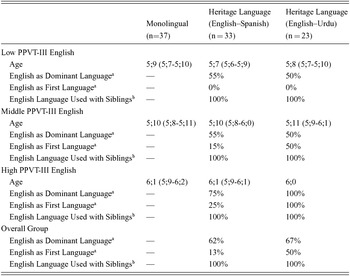
A total of 93 children participated in this study. Thirty-nine children were monolingual English-speaking children (mean age 5;11, age range 5;7–6;2), 33 were English–Spanish-speaking children (mean age 5;10, age range 5;7–6;1) and 23 were English–Urdu-speaking children (mean age 5;10, age range 5;–6;0). No significant differences were found between language groups for age, F(2, 90) = 1.22, n.s. (see Table 1).
Parent-reported Characteristics of Monolingual and Heritage Language Children.

Notes. a Percent of parents’ estimation that child's dominant language was English.
b In heritage language children, percent reflects the extent to which English was used more often between siblings than the children's heritage language. Age is provided in years; months.
Monolingual and heritage language children were recruited from schools in lower-middle class neighborhoods of Chicago, IL and surrounding suburbs. All monolingual children and all English–Spanish-speaking children were attending English-only schools, although some music (songs) and cultural activities were conducted in Spanish at the schools serving English–Spanish-speaking children. English–Urdu-speaking children were also in English-only classrooms; instruction in Arabic was offered in the upper grades at the school, but had not yet begun for these children.
All parents of heritage language children were asked to report the age in which their child learned their second language. Based on parent reports, 83% of heritage language children began learning their second language prior to, or by, age three, about 94% by age four and 100% of heritage language children learned their second language by age five. According to Meisel (Reference Meisel2009), first exposure to L2 below the age three corresponds to simultaneous bilingual acquisition, whereas children who learn a second language after age four are considered successive child L2 learners. Furthermore, all of the children who were successive L2 learners (17%) were English–Spanish heritage language learners and scored within the lowest English receptive vocabulary group. Differences were also observed in terms of the language that heritage language children were reported to learn first: parents of English–Spanish-speaking children were more likely to report that their children learned Spanish first followed by English, whereas parents of English–Urdu-speaking children were about split in whether their children learned English or Urdu first (see Table 1). However, it should be noted that information about L1 and L2 age of onset was provided retrospectively by parents based on what had occurred at least three years prior. Thus, it may have been difficult for parents to specify these ages in their children accurately.
All children were born in the United States. In each language group, approximately equal numbers of boys and girls were tested. Data from four monolingual, seven English–Spanish and four English–Urdu children were not included in the analyses due to lack of discrimination between correct and incorrect sentences (e.g., responded that all sentences “sounded ok”) or due to missing data (i.e., absent from the second or third day of testing). Our sample sizes reflect our final participant numbers following these eliminations.
Materials and procedure
Receptive vocabulary, parent reports and language dominance
Children were tested individually in a quiet room of their school over the course of two or three 20- to 30-minute testing sessions separated by two to four days. Children's receptive vocabulary in English was measured using the Peabody Picture Vocabulary Test (PPVT-III Form A; Dunn & Dunn, Reference Dunn and Dunn1997). The PPVT-III requires children to identify the picture that corresponds with a given word from an array of four pictures, and includes a total of 228 plates. The PPVT-III presents increasingly difficult vocabulary terms including nouns, verbs, and adjectives, has high internal consistency (α = .92 - .98) and is highly correlated with other measures of verbal ability (e.g., WISC-III Verbal IQ, r = 0.91). Language dominance was also determined with the PPVT-III Form A (English) and translated versions (Form B; Spanish, Urdu), administered to all heritage language children. PPVT-III raw scores were compared between the English and the heritage language to determine the dominant language for each child.
Using Forms A and B of the PPVT-III allowed us more readily to make comparisons between language groups. Although translated versions of the PPVT-III have not been standardized in Spanish or Urdu, steps were taken to ensure their adequacy in measuring receptive vocabulary. The PPVT-III Urdu version was available and has been used in previously published research (Davidson et al., Reference Davidson, Raschke and Pervez2010; Davidson & Tell, Reference Davidson and Tell2005). The PPVT-III Spanish was translated and back-translated by two native speakers of Spanish who were also fluent in English (i.e., had completed a doctorate in English). To ensure validity and acceptability of our use of the PPVT-III Spanish translation, we then compared 40% of the English–Spanish children's scores from the PPVT-III Form B with their scores from the Test de Vocabulario en Imágenes Peabody, a standardized test of receptive vocabulary in Spanish (TVIP; Dunn, Lugo, Padilla & Dunn, Reference Dunn, Lugo, Padilla and Dunn1986). We did not find a significant difference in age level proficiency between the PPVT-III Form B Spanish and the TVIP, t(12) = 1.4, n.s.
For monolingual children, half of the children were administered the PPVT Form A test before the grammaticality test and half were administered the PPVT Form A afterwards. For heritage language children, administration of Form A and Form B of the PPVT was counterbalanced across children, with half the heritage language children receiving Form A before the grammaticality test (i.e., PPVT-Form A, grammaticality test, PPVT-Form B), and the remaining half of the children receiving Form B before the grammaticality test (i.e., Form B, grammaticality test, Form A). This method of administration was chosen because pilot testing revealed that heritage language children found it too taxing to complete both forms of the PPVT together.
All parents were asked to complete a Parent Report on Language Development Questionnaire. The Parent Report on Language Development Questionnaire was created specifically for this study and was attached to the parent permission letter. This questionnaire asked parents to identify their child's first language (heritage language children), the age their child learned a second language (heritage language children), estimation of their child's proficiency in each language they spoke, estimation of their child's language dominance, and with whom their child spoke their heritage and English language, see Table 1. Because the degree to which parents knew English was not known, parent permission letters and the Parent Report on Language Development Questionnaires were provided in English and the child's heritage language (Spanish or Urdu).
Grammaticality judgment test of morphosyntactic awareness
All children completed a grammaticality judgment test in English. The grammaticality judgment test was chosen for a number of reasons. Firstly, it can tap into attentional control (i.e., judging the grammaticality of the sentences) and knowledge analysis skills (i.e., explanation of the grammaticality judgments) separately (Simard et al., Reference Simard, Fortier and Foucambert2013). Past research has shown conflicting results with regard to language group (e.g., monolingual vs. bilingual) differences, and whether the task must tap into both attentional control and knowledge analysis skills in order for language group differences to be found (Bialystok & Barac, Reference Bialystok, Barac, Li and Grosjean2013; Rainey et al., Reference Rainey, Davidson and Li-Grining2015). Secondly, asking children to judge the grammaticality of morphosyntactic structures in sentences and explain their answers when they detected a grammatically incorrect construction, allowed us to assess whether children were exhibiting conscious awareness of morphosyntactic structures or whether their judgements were more likely reflecting epilinguistic behavior. That is, being able to explain their judgments in terms of morphosyntactic structures should tap into conscious awareness, whereas making such judgments would not, in and of themselves, require conscious awareness (see Gombert, Reference Gombert, van Lier and Corson1997, for a discussion). Finally, the grammaticality judgment test allowed us to assess how early morphosyntactic awareness may be affected by receptive vocabulary ability and type of language structure.
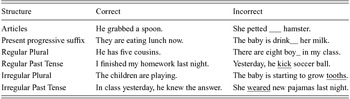
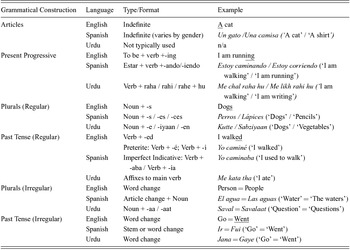
The grammaticality judgment test assessed six different grammatical structures: one indefinite article presented in the singular form “a”, and five inflectional affixes: present progressive suffix, regular plural, regular past tense, irregular plural, and irregular past tense. This test included a total of 60 sentences, 10 sentences per structure, with half correct (30) and half incorrect (30) sentences. Examples of these constructions are shown in Table A1 of the Appendix. Although all children were tested in English, for comparison, Table A2 of the Appendix provides examples of how these language structures can vary across English, Spanish and Urdu. Thus, there were a total of five sentences administered for each structure by grammaticality (i.e., correct vs. incorrect). Given the length of the grammaticality judgment measure, and because of time constraints placed on us by the school, no distractors or filler sentences were included in the total set of sentences. All sentences were presented in a random order to the children.
No significant differences were found between length of sentences used for each morphosyntactic structure, F(5, 20) = 1.76, p = .17, or by length of sentence x grammatically, F(5, 20) = .35, p = .88. Six practice sentences were presented at the start of the experiment, representing each grammatical structure. Children's responses to these items were not scored.
Following Davidson et al. (Reference Davidson, Raschke and Pervez2010), children were told, “I'm going to read several sentences to you and I would like for you to tell me if each sentence sounds ok. Some sentences will sound ok and some will not, you will have to decide which is which. Ok?” Various probes were used, including: “Does this sentence sound ok?” “Did I say that sentence ok?” “Does that sentence sound right or wrong the way I said it?” If a child said “No, it didn't sound ok” or something to that effect (e.g., “You said it wrong”), he or she was asked, “Tell me if you can, what is wrong with the way I said the sentence. If you can't tell me what is wrong with the sentence then that is fine. But if you know, please tell me why what I said was wrong.”
All testing was dispersed across two to three testing sessions. Typically, a session included the PPVT Form A or B, and a third to half of the grammaticality judgment items randomly presented depending on the child's schedule and the time allocated on that day by the child's school.
Results
Preliminary analyses
In order to ensure adequacy of inferential procedures, data were checked for missing values, outliers and normality of distributions (Tabachnick & Fidell, Reference Tabachnick and Fidell2007). Although some skewing of data was found (e.g., scores on the morphosyntactic measure for the grammatically correct sentences were moderately positively skewed), no advantage to using transformed log scores over raw proportion scores was found. Moreover, raw vocabulary scores were used in all subsequent analyses, primarily because translations of the PPVT-III had not been standardized. Finally, when age and combined receptive vocabulary score (i.e., combined English and heritage language PPVT scores for heritage language children) were used as co-variates, the pattern of significant findings did not change.
Receptive vocabulary, parent reports and language dominance
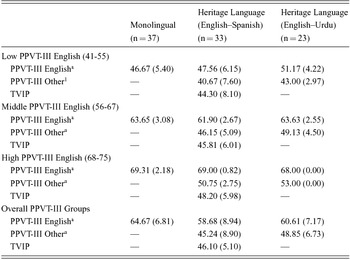
Table 2 includes results of the PPVT-III administered in English (Form A), administered in children's heritage language (Form B), and results of the TVIP for 40% of the English–Spanish-speaking children. Significant differences were found between language groups on their performance on the English version of the PPVT, F(2, 90) = 6.16, p < .003, partial η² = .12. Follow-up t-tests with Bonferroni correction revealed that, overall, monolingual children had significantly higher receptive vocabulary scores than English–Spanish-speaking children, t(68) = 3.84, p < .001 and English–Urdu-speaking children, t(58) = 3.46, p < .01. No significant differences were found between heritage language groups, t(54) = 1.8, n.s. Note, however, that both groups of heritage language children performed better on the English version of the PPVT than on the heritage language version, t(31) = 2.88, p < .01; t(22) = 3.1, p < .01, English–Spanish and English–Urdu, respectively. Comparison of the English–Spanish-speaking children who were administered the PPVT (English) and the normed TVIP (Spanish) revealed additional support for English dominance, t(12) = 2.2, p < .05, see Table 2. Finally, examining children's scores individually, we found no instances in which a heritage language child's PPVT score in his or her heritage language (or TVIP score for those children tested) was higher than the child's score in English.
Receptive Vocabulary of Monolingual English-speaking and Heritage Language Children.

Notes. a PPVT-III Form A was administered to all children in English. PPVT-III Form B was administered in the child's heritage language, Spanish or Urdu (see text for explanation). Standard deviations are in parentheses.
Overall, the majority of the children had raw scores on the PPVT within the 56–67 range (about 60% overall), which was at their age level. Across language groups, 23% of the children scored within the 41–55 range, which was within one standard deviation below their age level. For monolingual children, 35% obtained a score of 68 or greater (68–75) on the PPVT, whereas very few heritage language children (four English–Spanish, one English–Urdu) scored in this higher range. No children scored above 75 on the PPVT Form A. These results can be seen in Table 2.
Based on these findings, and to aid in subsequent analyses, we designated three groups of children: those in the lowest range (41–55), those in the middle or average range (56–67), and those in the highest range (68–75) on the PPVT Form A (English) for our sample. This designation took into account that no child received a score of 55 or 67, suggesting naturally occurring breaking points between groups in our sample. No differences between language groups were observed in receptive vocabulary scores within PPVT-III range groups, F(2, 18–53) = 2.4, n.s.
Also examined was whether age differences existed between our three receptive vocabulary ranges. No significant differences were found between children in the middle range (mean age 5;10) and the highest range (mean age 6;1), t(70) = 1.2, n.s. Nor were significant differences found between children in the lowest range (mean 5;8) and the middle range, t(74) = 1.0, n.s. However, a marginal difference was found between children in the lowest and highest range on the PPVT (Form A), t(36) = 1.71, p = .09.
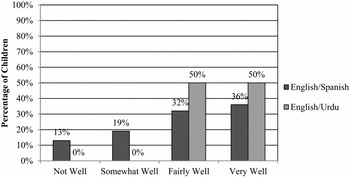
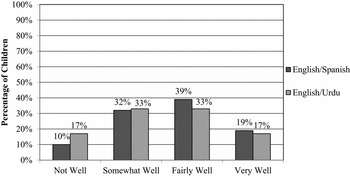
In the highest PPVT groups, parents were more likely to rate that their child was dominant in English than parents of children in the middle, t(70) = 2.92, p < .01, or lower PPVT groups, t(36) = 2.71, p < .01, (see Table 1). However, in the lower and middle groups, parents were about equally divided in their estimation of language dominance in their children (see Table 1). Nevertheless, parents’ ratings on a 4-point scale (1 = Not Well, 2 = Somewhat Well, 3 = Fairly Well, 4 = Very Well) revealed that 68% of the parents of English–Spanish-speaking children rated their child's English proficiency as “Fairly Well” or “Very Well,” and 100% of the parents of English–Urdu-speaking children rated their child's English proficiency as “Fairly Well” or “Very Well” (see Figure 1). In contrast, only 58% of parents of English–Spanish-speaking children and 50% of English–Urdu-speaking children rated their children's proficiency in their heritage language as being “Fairly Well” or “Very Well” (see Figure 2). Parents of children who were estimated to have less ability in English were almost equally split between the lowest and middle PPVT group; none of the parents of children who were in the highest PPVT group rated their child's English proficiency as less than “fairly well”. Overall, parents’ reports of English proficiency were found to be positively related to PPVT English scores in heritage language children, r(47) = .76, p < .001.
Parents' ratings of children's English language proficiency.

Parents' ratings of children's heritage language proficiency.

Grammaticality judgment test of morphosyntactic awareness
Because so few of the heritage language children scored in the highest PPVT range, the first set of analyses compared all children (monolingual English, English–Spanish, English–Urdu) that scored in the lower (41–55) and middle (56–67) range on the English PPVT (Form A), but did not include children with high raw scores (68–75). Then, using all of the children's data, multiple regression analyses were conducted to examine how well receptive vocabulary abilities and language group predicted children's performance on the grammaticality judgment test.
A mixed-model analysis of variance was conducted on monolingual and heritage language children's identification of grammatically correct and incorrect sentences. Children were awarded one point for each sentence they correctly identified (i.e., identified a correct statement as correct or an incorrect statement as incorrect) with the maximum score being 60. Number of correct responses per structure across grammaticality (i.e., correct, incorrect) were used in the analyses, out of a possible score of five per structure and grammaticality.
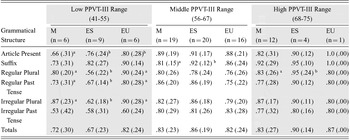
Between-subjects variables included Language Group (monolingual-English, English–Spanish, English–Urdu) and raw score range on the PPVT Range (41–55 or “Lower Range”; 56–67 or “Middle Range”). The within-subjects variables included Grammaticality (Correct Constructions, Incorrect Constructions) and Language Structure (Articles, Present Progressive Suffix, Regular Plural, Regular Past Tense, Irregular Plural, Irregular Past Tense). Main effects of Grammaticality, F(1, 60) = 57.73, p < .0001, partial η2 = .49, and Language Structure, F(5, 300) = 7.28, p < .0001, partial η2 = .14, were found. All children in the lower and middle ranges of English receptive vocabulary scores for our sample were better at detecting grammatically correct use of language structures than grammatically incorrect use of these structures, F(1, 60) = 57.73, p < .0001, partial η2 = .49. Follow-up analyses also revealed that, overall, children performed more poorly at detecting correct and incorrect use of irregular past tense, t(91) = 3.3, p < .001, see Tables 3 and 4.
Monolingual (English) and Heritage Language (English–Spanish; English–Urdu) Children's Mean Proportion Correct Judgment Scores for Grammatically Correct Morphosyntactic Structures.

Notes. M = Monolingual English-speaking children, ES = English–Spanish-speaking children, EU = English–Urdu-speaking children. All children were tested in English. Each structure is based on children's responses to 5 items. Standard deviations are in parentheses. Superscripts indicate significant group differences within each PPVT-III range. See text for group differences between PPVT-III ranges. Suffix refers to present progressive suffix.
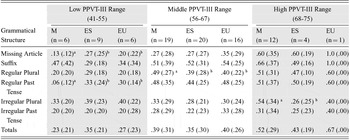
Monolingual (English) and Heritage Language (English–Spanish; English–Urdu) Children's Mean Proportion Correct Judgment Scores for Grammatically Incorrect Morphosyntactic Structures.

Notes. M = Monolingual English-speaking children, ES = English–Spanish-speaking children, EU = English–Urdu-speaking children. All children were tested in English. Each structure is based on children's responses to 5 items. Standard deviations are in parentheses. Superscripts indicate significant group differences within each PPVT-III range. See text for group differences between PPVT-III ranges. Suffix refers to missing present progressive suffix.
A significant Grammaticality X Language Structure X Language Group three-way interaction, F(10, 300) = 2.08, p < .03, partial η2 = .10, was also revealed. A four-way Grammaticality X Language Structure X Language Group X PPVT Range interaction approached significance, F(10, 300) = 1.98, p < .07, partial η2 = .08. The Bonferroni approach was used to further examine these results. Comparisons were first made between PPVT range groups (e.g., low vs. middle) in monolingual and heritage language children. Analyses were then conducted to assess language group differences within each PPVT range.
Overall, monolingual children and both groups of heritage language children in our middle range of receptive vocabulary scores for our sample performed better than children in our lower range at detecting grammatically correct constructions t(74) = 3.1, p < .01, and grammatically incorrect constructions, t(74) = 4.5, p < .001, see Tables 3 and 4. Examining Grammaticality x Language Structure x PPVT Range revealed additional findings. All children in the middle range outperformed all of their peers in the lower range for grammatically correct articles, t(74) = 2.7, p < .01, and grammatically correct irregular past tense, t(74) = 4.6, p < .001. Monolingual English-speaking and English–Spanish-speaking children in the middle range were also better than their monolingual and English–Spanish-speaking peers in the lower range at detecting correct present progressive, t(52) = 2.64, p < .01, and correct regular past tense structures, t(52) = 3.81, p < .001. Additionally, English–Spanish-speaking children in the middle range outperformed their English–Spanish-speaking peers in the lower range on detecting correct regular plurals t(27) = 4.2, p < .001. These results are shown in Table 3.
For incorrect constructions, middle range children in our sample were better than children in the lower PPVT range at detecting incorrect regular plural, t(74) = 2.4, p < .02 and incorrect regular past tense, t(74) = 3.4, p < .001. Moreover, heritage language children in the middle range were better than their heritage language peers in the lower range at detecting incorrect present progressive structures, t(49) = 3.9, p < .001. Additionally, monolingual children in the middle range for our sample outperformed their monolingual peers in the lower range in detecting incorrect articles, t(23) = 2.9, p < .01, whereas English–Urdu-speaking children in the middle range outperformed their English–Urdu peers in the lower range in detecting incorrect irregular past tense, t(20) = 2.1, p < .05. Finally, English–Spanish-speaking children in the lower range outperformed their English–Spanish-speaking peers in the middle range on the detection of incorrect regular plurals, t(27) = 3.79, p < .001. These results are shown in Table 4.
Additional analyses also explored how language groups (monolingual, English–Spanish, English–Urdu) differed in their grammaticality judgments across language structures (see Tables 3 and 4). Within the middle range of receptive vocabulary scores for our sample, monolingual and both groups of heritage language children performed nearly the same when asked to detect grammatically correct, t(53) = .96, n.s., and incorrect t(53) = 1.3, n.s., constructions. Only two comparisons between monolingual and heritage language children in the middle range for our sample were significant. English–Spanish-speaking children were significantly better than monolingual children at detecting grammatically correct present progressive constructions, t(37) = 2.8, p < .01, whereas monolingual children were significantly better than all heritage language children in the middle range at detecting incorrect regular plural constructions, t(53) = 2.7, p < .01. No statistical differences between monolingual and heritage language children in the middle range of receptive vocabulary were observed for grammatically correct structures, including articles, regular plural, regular past tense, irregular plural, and irregular past tense, t(53) = 1.1, n.s., and for grammatically incorrect structures, including articles, present progressive, regular past tense, irregular plural, and irregular past tense, t(53) = .92, n.s.
At the lower range, heritage language children were better at detecting grammatically correct and incorrect constructions involving the presence or absence of an article than monolingual children, t(19) = 2.9, p < .01. Significant differences were also obtained in favor of heritage language children in the lower range at detecting correct instances of the present progressive, t(19) = 2.6, p < .01, and incorrect instances of regular past tense, t(19) = 3.2, p < .01. However, English–Spanish-speaking children in this lower range performed less well than the other groups of children in detecting grammatically correct regular plural, regular past tense and irregular plural constructions, t(19) = 3.1 - 3.6, p < .01, see Table 3. No significant differences were found between the language groups in the lower range when detecting grammatically correct irregular past tense, t(19) = .93, n.s., and grammatically incorrect present progressive, regular plural, irregular plural, and irregular past tense, t(19) ≤ .89, n.s. These results can be seen in Tables 3 and 4.
Finally, we conducted planned comparisons between monolingual and English–Spanish-speaking children at the upper range (only one English–Urdu heritage language child was at the upper range and he was not included). English–Spanish-speaking children were better than monolinguals at detecting grammatically correct instances of regular plurals, t(14) = 2.2, p < .05, and regular past tense, t(14) = 3.8, p < .01, whereas these same children were worse at detecting grammatically incorrect instances of present progressives, t(14) = 3.5, p < .01, and irregular plural, t(14) = 4.1, p < .001. No other significant differences were found between monolingual and English–Spanish-speaking children at the upper range, t(14) = .86. See Tables 3 and 4 for these results.
Assessing predictors of morphosyntactic awareness
Using the data from all of the children, linear multiple regression analyses were conducted to determine how language group (Monolingual English, English–Spanish, English–Urdu), receptive vocabulary in English, and receptive vocabulary in the child's heritage language (Spanish or Urdu), uniquely predicted children's performance on the grammaticality judgment test. Prior to conducting the analyses, the relevant assumptions of multiple regression analysis were examined. First, the sample size (N = 93) was considered appropriate for running regression analyses with three independent variables (Tabachnick & Fidell, Reference Tabachnick and Fidell2007). Furthermore, the independent variables were not a combination of any of the other independent variables in the model, and thus the assumption of singularity was sustained. Because the collinearity statistics were all within accepted limits (r < .90), the assumption of multicollinearity was met (Coakes, Reference Coakes2005).
Grammatically correct constructions
Three predictors (language group, PPVT A, PPVT B) were entered simultaneously in the linear regression model. The results showed that overall the predictors accounted for a significant amount of variance in children's ability to detect correct irregular past tense structures, F(3, 90) = 3.43, p = .02, R2 = .17, R2 adjusted = .12. Further inspection revealed that the 17% of variance in detecting correct irregular past tense was primarily driven by the PPVT A, β = .38, t(89) = 2.53, p = .01. Language Group, t(89) = −.58, p = .57, and PPVT B, t(89) = .28, p = .78, were not significant predictors of children's performance.
Overall, Language Group, PPVT A, and PPVT B, did not account for a significant amount of variance in children's ability to detect the remaining grammatically correct structures: articles, F(3, 90) = 2.06, p = .12, present progressive, F(3, 90) = .63, p = .60, regular plural, F(3, 90) = 1.40, p = .26, regular past tense, F(3, 90) = 1.21, p = .32, and irregular plural structures, F(3, 90) = 1.07, p = .37.
Grammatically incorrect constructions
Although the overall model did not explain a significant amount of variance in children's ability to detect missing articles, F(3, 90) = 2.41, p = .11, R2 = .11, R2 adjusted = .06, when looking at the individual predictors, PPVT A scores significantly predicted children's detection of incorrect articles, β = −.02, t(89) = −.12, p = .02 The three predictor model approached significance in children's detection of incorrect present progressive structures, F(3, 90) = 3.48, p = .07, R2 = .13, R2 adjusted = .08. However, Language Group was the only variable that significantly predicted children's ability to detect incorrect present progressives, β = −.30, t(89) = −2.23, p = .03. Moreover, when examining children's ability to detect incorrect irregular plural structures, the three predictor model approached significance, F(3, 90) = 2.53, p = .07, R2 = .13, R2 adjusted = .08. However, only PPVT A predicted a significant amount of variance in children's identification of incorrect irregular plural structures, β = −.33, t(89) = −2.18, p = .03. The three-predictor model did not account for a significant amount of variance in children's ability to identify incorrect regular plural, F(3, 90) = 1.04, p = .38, incorrect regular past tense, F(3, 90) = 1.23, p = .31, or incorrect irregular past tense structures, F (3, 90) = .94, p = .43. Moreover, none of the independent variables (i.e., Language Group, PPVT A, PPVT B) in the model were significantly predictive of these structures.
Children's explanations of their answers
Neither monolingual nor heritage language children were able to explain why a sentence was incorrect, regardless of receptive vocabulary performance or other variables. Instead, children were only able to respond with replies such as “You just said it wrong.” Very rarely were children able to explain what was grammatically incorrect about the sentence, although a few children mentioned that “they had been taught the right way to do it” and wondered why “we had not been taught the right way?”
Discussion
In the present research, we compared monolingual and heritage language children's ability to detect and explain grammatically correct and incorrect sentences in English that varied in terms of morphosyntactic structures. As past research has shown, morphosyntactic awareness may be important to the development of specific reading processes, such as decoding, and may lead to better reading comprehension via decoding (e.g., Gaux & Gombert, Reference Gaux and Gombert1999; Rothou, Reference Rothou2015; Takacs, Reference Takacs2007). Although most 5- to 6-year-old children in this study were able to judge the grammaticality of morphosyntactic structures in English, they were not able to explain their answers. Thus, children at this age demonstrated the ability to complete the portion of the grammaticality judgment test that required low levels of attentional control, but not complete a part of the grammaticality judgment test that required knowledge analysis. Explaining the reasons behind their decisions would have required a higher level of knowledge analysis, which children in this study appeared unable to do. These findings are consistent with the notion that sentence judgments are not dependent upon purely linguistic factors, but cognitive factors as well (Carr, Reference Carr1979). Our results are also consistent with Pratt et al. (Reference Pratt, Tunmer and Bowey1984), who found that up to 6 or 7 years of age, children are unable to explain their judgments based on grammatical rules or grammatical knowledge, instead focusing on the content of the sentence rather than the grammatical form of the sentence. Galambos and Goldin-Meadow (Reference Galambos and Goldin-Meadow1990) obtained a similar pattern in their research, to the extent that children 5 and 6 years of age were more likely than older children to give content-based explanations. According to Galambos and Goldin-Meadow (Reference Galambos and Goldin-Meadow1990), “there is a sequence of development in the children's awareness of language from an orientation to language based on content, to an orientation based on linguistic markers, to an orientation based on linguistic systems- a sequence that first appears in detections and corrections and later in explanations” (p. 46). The fact that children in our study were not able to explain their answers also suggests, using the strictest definition of morphosyntactic awareness, that the children were not exhibiting a conscious ability to reflect on the morphosyntactic structures presented in the sentences, but instead were more likely demonstrating epilinguistic behaviors or processes when making their judgments (e.g., Gombert, Reference Gombert, van Lier and Corson1997; Gaux & Gombert, Reference Gaux and Gombert1999).
The central issue, however, was whether monolingual and heritage language children demonstrated similar levels of epilinguistic awareness, or what we refer to as early morphosyntactic awareness. Past research findings have been mixed regarding language group differences on syntactic awareness measures used with young children (e.g., Cromdal, Reference Cromdal1999; Da Fontoura & Siegel, Reference Da Fontoura and Siegel1995; Davidson et al., Reference Davidson, Raschke and Pervez2010; Foursha-Stevenson & Nicoladis, Reference Foursha-Stevenson and Nicoladis2011; Galambos & Hakuta, Reference Galambos and Hakuta1988; Simard et al., Reference Simard, Fortier and Foucambert2013). It is our contention that a number of child- and task-related variables underlie these inconsistencies.
Morphosyntactic awareness, language dominance and receptive vocabulary
Heritage language children are rarely equally proficient in both of their languages (e.g., Montrul, Reference Montrul2016). Consequently, comparing monolingual and heritage language children on any linguistic measure in heritage language children's non-dominant language puts heritage language children at a disadvantage. Therefore, in the present research, a concerted effort was made to assess English morphosyntactic awareness in heritage language children who were dominant in English.
Two methods were used for establishing language dominance: a receptive vocabulary measure in English and in the child's heritage language and a parent report. In general, parents were fairly reliable estimators of their children's language dominance. For example, children with the highest English receptive vocabulary scores in our sample were also estimated to be dominant in English and to know English “fairly well” to “very well” by their parents. However, all heritage language children in our study performed better on the receptive vocabulary measure in English than on a comparable measure in their heritage language, regardless of how poorly they performed on the English measure.
In fact, receptive vocabulary ability in English was associated with a number of findings in the present research, particularly regarding the identification of grammatically incorrect constructions. When examining significant predictors of children's identification of grammatically correct structures, few findings were revealed, perhaps because all of the children generally performed well: receptive vocabulary in English predicted heritage language children's detection of grammatically correct presentations of irregular past tense and monolingual children's detection of grammatically correct present progressive structures. More findings were revealed in terms of children's detection of grammatically incorrect structures. For heritage language children, receptive vocabulary in English predicted their detection of grammatically incorrect present progressive, regular plural and irregular past tense structures. For monolingual children, receptive vocabulary predicted their detection of grammatically incorrect article, regular plural and regular past tense structures. Interestingly, in heritage language children, receptive vocabulary ability in their heritage language was not found to be a significant predictor of their detection of grammatically correct or incorrect structures. These results suggest that receptive vocabulary ability in the language children are being tested in may significantly predict their performance on a grammaticality judgment test in that language, especially for a number of morphosyntactic structures presented in an incorrect form.
Thus, in line with our first prediction, children in the middle receptive vocabulary ability for our sample often outperformed their peers in the lowest range when identifying a number of grammatically correct and incorrect language structures. Additional findings revealed, however, that language group differences were minimized when all learner groups (monolingual and heritage language children) were in the middle range of English receptive vocabulary ability for our sample. In fact, only two comparisons between the language groups in the middle range reached significance: English–Spanish-speaking children were significantly better than monolingual children at detecting grammatically correct present progressives, whereas monolingual children in this range were better than heritage language children at detecting grammatically incorrect regular forms of the plural. One hypothesis is heritage language children were more willing to accept grammatically incorrect plurals given the variety of forms plurals can take across the languages they knew.
These findings support our second prediction that heritage language children who are proficient in English receptive vocabulary should score similarly to monolingual children on a measure of morphosyntactic awareness, at least when showing average receptive vocabulary ability for the sample in their dominant language (English). Moreover, these findings corroborate the results of Simard et al. (Reference Simard, Fortier and Foucambert2013) who found that bilingual French–Portuguese-speaking children performed the same as monolingual French-speaking children on two measures of syntactic awareness, a finding that they attributed to French language proficiency in each language group.
Nevertheless, significant differences were found between monolingual and heritage language children at the lower and higher receptive vocabulary ranges, although these differences varied on the basis of language structure, as discussed below.
Type of language structure and morphosyntactic awareness
Based on research with monolingual children (McDonald, Reference McDonald2008), and monolingual and bilingual adults (Bialystok & Miller, Reference Bialystok and Miller1999; Johnson & Newport, Reference Johnson and Newport1989; McDonald, Reference McDonald2006), it was predicted that children's awareness of grammatically correct and incorrect morphosyntactic structures would proceed from the ability to detect the grammaticality of sentences that included either the presence (grammatically correct) or absence (grammatically incorrect) of an indefinite article, “a”, to children's ability to detect proper usage of five inflectional affixes: the present progressive suffix, regular plural, regular past tense, irregular plural and irregular past tense, respectively.
In direct contrast to our third prediction, no evidence was found that children were better at detecting the grammaticality of indefinite articles in sentences than other morphosyntactic structures. Although McDonald (Reference McDonald2008) found that the ability to judge the grammaticality of sentences with articles was one of the earliest mastered by English-speaking monolingual children, several reasons may explain why similar results were not found in this study. Firstly, in McDonald's study, the grammaticality judgment test included assessment of both definite (“the”) and indefinite (“a” “an”) articles. Past research has shown that children's comprehension and production of indefinite articles lags behind their comprehension and production of definite articles (van Hout, Harrigan & de Villiers, Reference van Hout, Harrigan, de Villiers, Crawford, Otaki and Takahashi2009). Thus, by including only the more difficult indefinite article in the present study, children may have performed more poorly. Secondly, the children in McDonald's study were approximately one year older than the children in this study. Research has shown that difficulties with indefinite articles are more likely to occur prior to age six or seven (van Hout et al., Reference van Hout, Harrigan, de Villiers, Crawford, Otaki and Takahashi2009).
Interestingly, there was some evidence that both groups of heritage language children were better than monolingual children at detecting the proper use of indefinite articles, at least at the higher and lower receptive vocabulary ranges in our study. In Spanish, as in English, both indefinite and definite articles occur. However, despite the fact that the use of the indefinite article in Spanish corresponds greatly to its use in English, there are still differences between English and Spanish in their use. For example, in Spanish but not in English there are instances where an article is not required (e.g., es profesora vs. “she's a teacher”). In Urdu, the indefinite article occurs, but the word also stands for the word “one” and its use is more restricted. Although it cannot be determined from our data whether it was the structural overlap between languages, or the differences in the form of the structure between languages that resulted in these findings, both may play a part in the differences we obtained.
Nevertheless, additional evidence obtained in this study suggests that structural overlap may indeed enhance morphosyntactic awareness in some heritage language children. In particular, English–Spanish-speaking children at the highest receptive vocabulary range were better at detecting the grammaticality of correct regular plurals that were consistent with the general rule of plural formation in Spanish (i.e., “s”). However, while structural overlap may aid in the ability to identify the grammaticality of sentences, our results suggest that this only occurs once a sufficient level of language proficiency is established: English–Spanish children at the lowest receptive vocabulary range were generally less accurate than the other groups in their judgment of grammatically correct regular plurals.
Finally, the main evidence supporting our third prediction was the finding that all children were generally poor at identifying grammatically correct and incorrect use of the irregular past tense. Although children with higher receptive vocabulary scores in English were better at detecting incorrect irregular past tense structures than children with lower receptive vocabulary scores in English, overall, children were not particularly good at detecting incorrect instances of irregular past tense. Moreover, no significant differences were found between the language groups at each receptive vocabulary level for this structure. Using an acquisition task, Paradis et al. (Reference Paradis, Nicoladis, Crago and Genesee2011) also found that monolingual and bilingual (English–French) children were less accurate with irregular than regular past tense forms. However, in terms of the rate of acquisition, English dominant bilinguals in their study lagged behind their monolingual peers in acquiring irregular forms, although this finding was affected by differential exposure to each language and the quality of input in each language.
Difficulty with irregular past tense in the present research is compatible with constructivist and usage-based theories of language (e.g., Bybee, Reference Bybee2001; Gathercole, Reference Gathercole, Oller and Eliers2002; Paradis, Reference Paradis2010; Tomasello, Reference Tomasello2003). According to the constructivist perspective, schemas for language structures are affected by input factors such as the frequency of the morpheme in the language, the distributional consistency of the schema in the language in which the structure appears, and the transparency between form-to-function mappings (Bybee, Reference Bybee2001). In a related fashion, the usage-based theory suggests that the amount of exposure a child has to a structure also affects the ease in which that structure is learned (Paradis, Reference Paradis2010; Tomasello, Reference Tomasello2003). Our findings provide evidence that constructivist and usage-based theories not only explain differences in the acquisition of morphosyntactic structures, but may also explain differences in the awareness of these structures.
Lastly, it should be noted that all children performed better when asked to detect grammatically correct than incorrect constructions. This is a common finding, and could be due to the level of attentional control and level of knowledge analysis required by each type of judgment. In particular, identifying grammatically incorrect sentences requires more of these skills.
Limitations and future directions
We believe we have tapped into the early stages of morphosyntactic awareness in young children. However, we are aware of a number of limitations, which will need to be addressed in future research. Firstly, we hope to identify a significant number of heritage language children in our highest range. In addition, care will be taken to assess a substantial number of heritage language children who are not dominant in English to make comparisons with English-dominant heritage language children. Finally, because we cannot determine from our data whether greater receptive vocabulary leads to better morphosyntactic awareness or vice versa, future research will need to tease apart the direction of this relation.
Conclusion
The present results provide evidence that language dominance, and receptive vocabulary proficiency in particular, should be considered when examining language group differences on a morphosyntactic awareness measure. The present research also provides a better understanding of the relations between receptive vocabulary and morphosyntactic awareness in monolingual and heritage language children. Moreover, our findings demonstrated that language group differences were minimized when monolingual and both groups of heritage language children were in the middle range for receptive vocabulary ability for our sample, and when irregular forms of morphosyntactic structures were included (i.e., irregular plural and irregular past tense). At the upper and lower receptive (English) vocabulary ranges, more differences were found between monolingual and heritage language children, as previously discussed. These results highlight the need to consider factors such as receptive vocabulary when assessing early morphosyntactic awareness in monolingual and heritage language children.
Appendix
Examples of Grammatically Correct and Incorrect English Structures.

Grammatical Structures and Examples Across English, Spanish and Urdu Languages.