I. INTRODUCTION
Owing to their rich crystal structures, wide transmittance spectra, and wide band gaps, borates have been a research focus for a long time. Many compounds in AO–RE 2O3–B2O3 (A = alkali-earth metals, RE = rare earth elements) ternary systems were found and their crystal structures were reported, such as layered borates M 3 RE(BO3)3 (M = Sr, RE = Sc; M = Ba, RE = Sc, Y, Dy, Ho, Tm, Lu, Yb) family (Cox et al., Reference Cox, Keszler and Huang1994; Thompson and Keszler, Reference Thompson and Keszler1994; Khamaganova et al., Reference Khamaganova, Kuperman and Bazarova1999; Li et al., Reference Li, Chen, Jian, Wu, Xu and Cao2004a), M 3 RE(B3O6)3 (M = Ba, RE = Sc, Y, Lu) family (Li et al., Reference Li, Wang, Chen, Li, Jia, Wu, Du and Xu2004b; Cai et al., Reference Cai, He, Chen, Wang, Lou, Chen and Zhao2007; Duan et al., Reference Duan, Li, Yuan and Zhao2008), M 3 RE 2(BO3)4 (M = Sr, RE = La, Pr, Nd, Y, Er; M = Ba, RE = La, Pr, Nd, Y) family (Palkina et al., Reference Palkina, Kaznetsov and Moruga1972; Abdullaev et al., Reference Abdullaev, Mamedov and Amirov1973; Abdullaev and Mamedov, Reference Abdullaev and Mamedov1976, Reference Abdullaev and Mamedov1982; Yan and Hong, Reference Yan and Hong1987; Khamaganova et al., Reference Khamaganova, Trunov, Dzhurinskii and Efremov1990; Zhang and Li, Reference Zhang and Li2004; Ma et al., Reference Ma, Chen, Hu, Lin and Wang2006), Ca4 REO(BO3)3 (RE = La, Sm, Gd, Tb, Lu) family (Norrestam et al., Reference Norrestam, Nygren and Bovin1992; Ilyukhin and Dzhurinskii, Reference Ilyukhin and Dzhurinskii1993; Zhang et al., Reference Zhang, Chen, Liang, Cao and Xu2001a), CaYBO4 (Zhang et al., Reference Zhang, Chen, Liang, Xu and Xu2001b), Ca3La3(BO3)5 (Zhang et al., Reference Zhang, Liang, Chen, He and Xu2001c), CaLa2B10O19 (Wu et al., Reference Wu, Liu, Fu, Wang, Zhou, Wang and Chen2001), CaEu2O(BO3)2 (Ilyukhin and Dzhurinskii, Reference Ilyukhin and Dzhurinskii1993), M 2Sc2((BO3)2B2O5) (M = Sr, Ba) (Thompson et al., Reference Thompson, Huang, Smith and Keszler1991), and so on. The Sr3 RE 2(BO3)4 (RE = La, Pr, Nd, Y, Er) family adopts an orthorhombic (with space group Pna21) structure, which consists of distorted Sr–oxygen polyhedra, distorted RE-oxygen polyhedra, and four sets of BO3 planar triangles. The BO3 groups are isolated from each other. They share edges or corners with Sr and RE polyhedra to form a three-dimensional network. While the borates having the formula Ba3 RE 2(BO3)4 (RE = La, Pr, Nd, Y) adopt another orthorhombic (with space group Pnma) structure. Since the research on Sr3Nd2(BO3)4 and Ba3Nd2(BO3)4 resulting from its interesting structural and spectral properties were initiated (Rez, Reference Rez1986; Yan and Hong, Reference Yan and Hong1987), different promising optical materials related to the alkaline earth rare earth borates have been prepared. These orthoborates materials have many advantages such as congruent melting, convenient synthesis, low thermal conductivity, high stability, and ability to accommodate defects. Wang's group pointed out that Nd3+:Sr3Y2(BO3)4 crystal and Yb3+:Ba3Y2(BO3)4 crystal may be regarded as potential solid-state laser materials for diode laser pumping (Zhang et al., Reference Zhang, Lin, Hu and Wang2004; Ma et al., Reference Ma, Lin and Wang2007). Sr3Y2(BO3)4:Eu3+ was found to be a promising red vacuum ultraviolet (VUV) phosphor for plasma display panels (PDPs) applications (He and Wang, Reference He and Wang2007). Li et al., investigated the luminescence characteristics of the Sr3Y2(BO3)4:Dy3+ phosphor for light-emitting diodes (LED) (Li et al., Reference Li, Yang, Wang and Guo2008a). The efficient UV sensitization effect of Ce3+ on Tb3+ among Ba3Y2(BO3)4:Ce3+, Tb3+ phosphor make it more suitable for applications as an UV-convertible phosphor for near-UV excited white LED (Han et al., Reference Han, Zhang and Lu2013).
As one part of the project for search for new optical function materials, our group recently have made a systematic survey on the SrO–Sm2O3–B2O3 system, with the confirmation of borate Sr3Sm2(BO3)4. The compound Sr3Sm2(BO3)4 belongs to a large family of synthetic borates, having the formula Sr3 RE 2(BO3)4 (M = Sr, RE = La, Pr, Nd, Sm, Y, Er). By the way, the existence of Sr3Sm2(BO3)4 was firstly described by N.S. Kurnakov, Institution of General and Inorganic Chemistry, Academy of Sciences of the USSR (November 1968). However, precise parameters for its crystal structure were not reported until now. The atomic coordinates for Sr3Sm2(BO3)4 reported in PDF 04-08-0403 correspond to the compound Sr3Er2(BO3)4. In this work, the crystal structure of Sr3Sm2(BO3)4 was investigated using powder X-ray diffraction data by the Rietveld method. In addition, relative optical properties of the Sr3Sm2(BO3)4 sample were characterized and discussed in this paper.
II. EXPERIMENTAL
A. Synthesis
Powder sample was synthesized by a standard solid-state reaction. Firstly, a stoichiometric mixture of SrCO3 (spectral reagent), Sm2O3 (analytical reagent), and H3BO3 (analytical reagent) was finely ground into powders in a mortar of agate. Secondly, the mixture was preheated in Al2O3 crucibles at 600 °C for 10 h to decompose H3BO3 and SrCO3, and naturally cooled to room temperature. Subsequently, it was reground and sintered at the temperature range from 1100 to 1250 °C for 24 h.
B. Element content determination
The atomic ratio of Sr, Sm, and B in the sample was determined by using an ICP-6500 plasma spectrometer.
C. IR spectra measurement
Infrared spectra were recorded with a Perkin-Elmer 983 infrared spectrophotometer in the wave-number range from 400 to 2000 cm−1 using KBr pellets as standards.
D. Diffuse reflectance spectrum measurement
The UV-vis diffuse reflectance spectrum was recorded by using a SHIMADZU/UV-2450 ultraviolet spectrophotometer.
E. Photoluminescence spectra measurement
The photoluminescence spectra were carried out on a Shimadzu PTI-601fluorescencespectrophotometer with a Xe lamp at room temperature with 325-nm excitation.
F. Structure determination and refinement
X-ray powder diffraction data were recorded on an X-ray diffractometer (Rigaku D/Max-2500) with CuKα radiation and a diffracted-beam graphite monochromator operated at a power of 40 kV and 150 mA. The data for crystal structure analysis of Sr3Sm2(BO3)4 were collected in a step-scan mode with a step size 0.02°2θ, counting time 2 s per step. Inorganic Crystal Structure Database (ICSD release 2011) and the Powder Diffraction File (PDF-4 + 2011) were used for phase analysis of the sample.
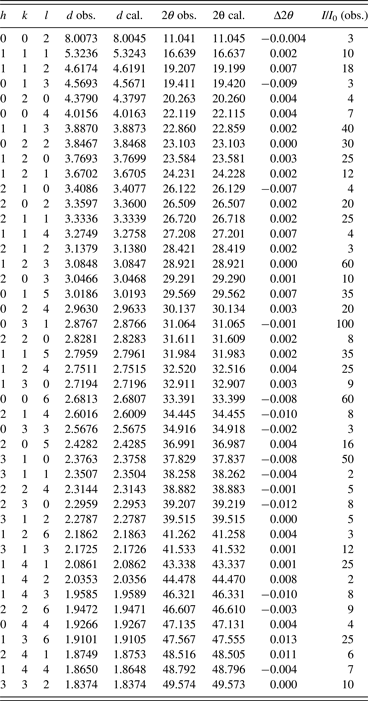
All the reflections before 50° in 2θ of polycrystalline Sr3Sm2(BO3)4 can be indexed on the basis of an orthorhombic unit cell with a = 16.120(1) Å, b = 8.7918(7) Å, and c = 7.4183(5) Å using the program DICVOL04 (Boultif and Louër, Reference Boultif and Louër2004). The systematic absence of h0l with l = 2n + 1, hk0 with h + k = 2n + 1, h00 with h = 2n + 1, 0k0 with k = 2n + 1, and 00l with l = 2n + 1 suggests the possible space group is non-standard P21 cn and Pmcn setting, which can be transformed into setting Pna21 and Pnma using the tidy method. Comparisons among Sr3Sm2(BO3)4 and Sr3Nd2(BO3)4 in the crystal system, unit-cell parameters and powder XRD pattern, show that the two compounds are isostructural. Hence, we choose the space group Pna21, with indexed unit-cell parameters changed into a = 7.4183(5) Å, b = 8.7918(7) Å, and c = 16.120(1) Å. Result of pattern indexing is given in Table I.
(Color online) Final Rietveld refinement patterns for Sr3Sm2(BO3)4 and the crystal structure of Sr3Sm2(BO3)4 along the [0 1 0] direction (inset). Small dots represent the experimental values and solid lines the calculated pattern. The solid line at the bottom is the difference between the experimental and calculated values. The vertical bars show the positions of the calculated Bragg reflections. Large gray circles stand for Sr atoms, small gray circles for B atoms, big black circles for Sm atoms, and small black circles for O atoms (in black-and-white for printing purpose).

Result of pattern indexing for a powder Sr3Sm2(BO3)4 sample.

a = 7.4184(4), b = 8.7922(6), c = 16.120(1), S.G. = Pna21(33), F(20) = 407, and M(20) = 59.
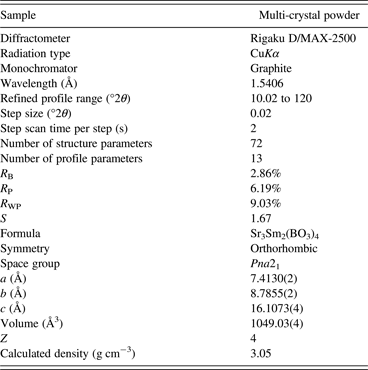
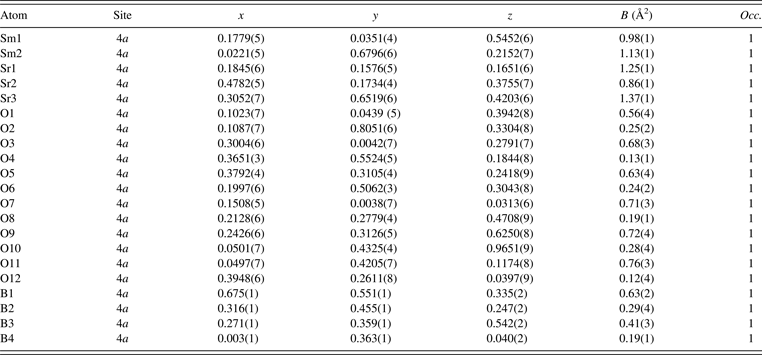
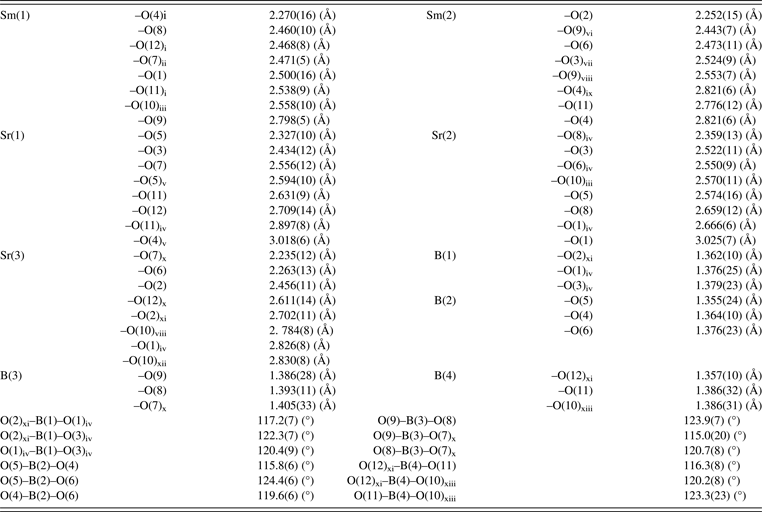
According to the structural model of Sr3Nd2(BO3)4, we refined the structure parameters of Sr3Sm2(BO3)4 from the powder XRD data by the Rietveld method (Rietveld, Reference Rietveld1967) using the program FullProf (Rodríguez-Carvajal, Reference Rodríguez-Carvajal1997). A total of 72 structural parameters and 13 profile parameters were refined. The final refinement pattern is shown in Figure 1. Details of Rietveld refinement and crystal data are given in Table II. Positional parameters obtained by the Rietveld refinement are listed in Table III. Some selected geometric parameters in the orthorhombic structure of Sr3Sm2(BO3)4 are listed in Table IV.
Details of Rietveld refinement and crystal data for the Sr3Sm2(BO3)4 structure.

Atomic coordinates and isotropic displacement parameters for Sr3Sm2(BO3)4.

Selected geometric parameters (Å or °) in the structure Sr3Sm2(BO3)4.

(i) 1/2 − x, −1/2 + y, 1/2 + z; (ii) −x, −y, 1/2 + z; (iii) 1/2 − x, −1/2 + y, −1/2 + z; (iv) 1/2 + x, 1/2 − y, z; (v) −1/2 + x, 1/2 − y, z; (vi) −x, 1 − y, −1/2 + z; (vii) −1/2 + x, 1/2 − y, z; (viii) 1/2 − x, 1/2 + y, −1/2 + z; (ix) −1/2 + x, 3/2 − y, z; (x) 1/2 − x, 1/2 + y, 1/2 + z; (xi) 1/2 + x, 3/2 − y, z; (xii) −x, 1 − y, −1/2 + z; (xiii) x, y, −1 + z.
III. RESULTS AND DISCUSSION
In our experiment, pure Sr3Sm2(BO3)4 samples were obtained at the temperature range from 1100 to 1250 °C through standard solid-state reactions. Crystallization of the samples increases with sintering temperature raised. The atomic ratio of Sr, Sm and B in the sample was about 3.01:2:3.99 (near to 3:2:4), determined by ICP atomic emission spectrometry.
A. Crystal structure
In the building units of a Sr3Sm2(BO3)4 structure, all species are located on the general position 4a. Sm species are surrounded by seven oxygen atoms with bond distances ranging from 2.270 to 3.025 Å, forming distorted SmO8 polyhedra. Similarly, Sr species are coordinated to eight oxygen atoms with bond distances ranging from 2.235 to 3.018 Å, forming irregular SrO8 polyhedra. One B with three different oxygen atoms form planar BO3 triangles. The B–O bond lengths vary from 1.355 to 1.405 Å with an average value of 1.377 Å, and the O–B–O angles are between 115.0 and 124.4°. These values are normal in a BO3 plane triangle. The planar B(3)O3 and B(4)O3 triangles are nearly parallel and perpendicular to each other along the c-axis. While the planar B(1)O3 and B(2)O3 triangles are almost antiparallel to each other along two different directions. Angles between planar B(1)O3/B(2)O3 and (100) lattice plane, planar B(1)′O3/B(2)′O3 and (100) lattice plane, and planar B(1)O3/B(2)O3 and planar B(1)'O3/B(2)'O3 are 43.729, 38.84, and 33.58, respectively.
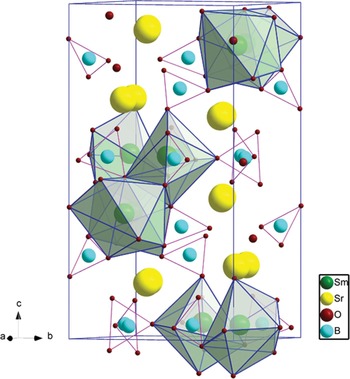
The structure of Sr3Sm2(BO3)4 in the (ac) plane is depicted in the inset of Figure 1, showing the bi-dimensional aspect for distribution of planar BO3 triangles. The Sm–O polyhedra constitute multi-layers parallel to the (bc) plane. The connection between two Sm–O polyhedra layers is ensured by the planar BO3 anionic groups through sharing common edges, corners running parallel to the (100) direction. The connection between Sm–O polyhedra and triangular BO3 groups was shown in Figure 2. Figure 3 illustrates the connection of distorted Sr–O polyhedra and triangular BO3 groups, which is similar to the case for the connection between Sm–O polyhedra and triangular BO3 groups. To sum up, the crystal structure of Sr3Sm2(BO3)4 is built up from Sm–O and Sr–O polyhedra, connected to each other by sharing common edges and vertices of BO3 and themselves.
(Color online) View of the connection between distorted Sm–O polyhedra and triangular BO3 groups. Large gray circles stand for Sr atoms, small gray circles for B atoms, small black circles for O atoms, and irregular polyhedra for Sm–O polyhedra (in black-and-white for printing purpose).

(Color online) The connection of irregular Sr–O polyhedra and triangular BO3 groups. Large black-gray circles stand for Sm atoms, small gray circles for B atoms, small black circles for O atoms, and irregular polyhedra for Sr–O polyhedra (in black-and-white for printing purpose).

To examine the validity of the determined structure of Sr3Sm2(BO3)4, Brown's bond valence theory (Brown and Altermatt, Reference Brown and Altermatt1985) was used to calculate the valence sum. The calculated valence sums for Sr and B ions are reasonable. Owing to lack of r 0 value for Sm ion (Brown and Altermatt, Reference Brown and Altermatt1985), the bond valence calculation results for the structure of Sr3Sm2(BO3)4 are not given in this paper.
To further confirm the coordination surroundings of B–O in the Sr3Sm2(BO3)4 structure, an infrared absorption spectrum for Sr3Sm2(BO3)4 was measured at room temperature and given in Figure 4. Bands below 500 cm−1 mainly originate from the lattice dynamic modes. According to previous work (Kamitsos et al., Reference Kamitsos, Karakassides and Chryssikos1987; Laperches and Tarte, Reference Laperches and Tarte1966), the fundamental vibrational modes of the [BO3]3− anion are the bands with maxima at about 592 (υ4), 732 (υ2), and 909 (υ1) cm−1. The strong absorption wavenumber profiles above 1000 cm−1 are generated by the stretching vibrations of the triangular BO3 groups. It is found that there are two broad peaks about 1078 and 1342 cm−1, which are believed to come from the different bond lengths of B–O. In the crystal structure of this complex borate, the boron atoms are trigonally coordinated by oxygen atoms, which is confirmed by the appearance of characteristic frequencies of an isolated plane triangle of symmetry in the spectral region studied. The absorption spectra of compound Sr3Sm2(BO3)4 indicate that its crystal structure is in agreement with the X-ray powder diffraction data, confirming the existence of the [BO3]3− groups.
(Color online) Infrared spectra for Sr3Sm2(BO3)4 at room temperature.

B. Diffuse reflectance spectrum
Generally, an absorption spectrum is an important evaluation indicator for potential optical materials. For an example, Wang's group investigated the absorption characteristics of several crystals for potential solid-state laser materials (Zhang et al., Reference Zhang, Lin, Hu and Wang2004; Pan et al., Reference Pan, Lin, Hu, Zhang and Wang2006, 2007). In our work, the absorption properties of relative orthoborates for powder samples were studied for the first time.
Figure 5 shows the diffuse reflectance spectra of a powder Sr3Sm2(BO3)4 sample. It is obvious that there are several absorption peaks in the UV-vis spectrum with different wavelengths and intensities, owing to the complicated energy-level structure of Sm3+ and the crystal structure of Sr3Sm2(BO3)4. The absorption peak centered about 215.5 nm should be ascribed to B–O group absorption, which is the common characteristic of most borate materials (Yang et al., Reference Yang, Pan, Li, Han, Chen, Zhao and Zhou2011). The bands for 4f n → 4f n−15d transitions of the Sm3+ electron configuration can also be observed in the range from 320 to 560 nm in the spectrum. Finally, the absorption edge is below 190 nm and visible transmittance reaches 90% for the title compound.
(Color online) UV-vis diffuse reflection spectra of Sr3Sm2(BO3)4 at room temperature.

C. Luminescence characteristics
To the best of our knowledge, the reported phosphors in the M 3 RE 2(BO3)4 (M = Sr, RE = La, Pr, Nd, Y, Er; M = Ba, RE = La, Pr, Nd, Y) family almost belong to doped luminescence (Zhang and Li, Reference Zhang and Li2004; He and Wang, Reference He and Wang2007; Li et al., Reference Li, Yang, Pang, Wang and Guo2008b; Kuo and Chen, Reference Kuo and Chen2010; Zhang and Wang, Reference Zhang and Wang2011; Han et al., Reference Han, Zhang and Lu2013). The luminescent properties of pure Sr3 RE 2(BO3)4 samples have not been studied yet.
Under 325 nm excitation, undoped Sr3Sm2(BO3)4 phosphor emits a sharp orange-red color with the emission peaks located at 562, 598, and 645 nm, which is attributed to a group of typical 4G5/2/ → 6H J (J = 5/2, 7/2, and 9/2) transitions of Sm3+ ion with the predominant 4G5/2/→6H9/2 transition peaking at 645 nm (as shown in Figure 6). This phenomenon is similar to the case for Sm3+ activated LaAlGe2O7 phosphor (Li et al., Reference Li, Chang, Lin, Chang and Lin2007).
(Color online) Room-temperature luminescence spectra for Sr3Sm2(BO3)4 (λ ex = 325 nm).

Except facile synthesis, the polycrystalline Sr3Sm2(BO3)4 is highly stable in air. Based on our experiment, it is a congruent melting compound and the melting point is above 1250 °C. Combined, these characteristics will likely increase the general range of applicability for this material.
IV. CONCLUSION
Pure Sr3Sm2(BO3)4 powder was synthesized through the standard solid-state reaction. Its crystal structure was investigated from powder X-ray diffraction data. The structure Sr3Sm2(BO3)4 is made up of planar BO3 groups parallel or antiparallel to each other along the four directions, irregular SmO7 polyhedra, and irregular SrO8 polyhedra to form an analogue of Sr3Nd2(BO3)4. In general, chemical stabilization, relatively simple preparation, deep UV absorption, high UV-vis transmittance, and luminescent characteristics make Sr3Sm2(BO3)4 a promising optical function material.
ACKNOWLEDGEMENTS
Financial supports from the National Natural Science Foundation of China (Grant number 51002189) and Youth Scientific Research Foundation of Central South University of Forestry & Technology (QJ2010001A) are gratefully acknowledged.