No Place to Run
Flem Otey dreamed of owning a chain of supermarkets stretching across Tennessee. As a college student in the late 1950s at Tennessee A&I State University, a historically black institution in Nashville, Otey wrote a thesis on the development of the novel shopping centers that he saw springing up alongside the nation's new National System of Interstate and Defense Highways. These emporia and the suburbs flourishing around them represented a new, interstate-linked geography of consumer capitalism in America. Interstate highways, shopping centers, and suburbs became both symbols and mechanisms of middle-class growth that shaped the bountiful yet unequal decades of economic expansion following World War II. The aspirations and opportunities that the interstate highway system appeared to make possible were appealing to a college student like Otey, looking ahead to a bright postwar future. And by the mid 1960s, Otey's dream had matured: he owned a small grocery in North Nashville's black business district and hoped to extend his enterprise with a series of satellite locations stretching along Interstate 40, which was under construction and, when completed, would connect to Knoxville in the east and Memphis in the southwest. In doing so, this infrastructure of mobility would accomplish exactly what its boosters, planners, and administrators had long intended: it would connect major cities and spur exchange among them. In this vision, I-40 was supposed to be Otey's path forward.Footnote 1
Otey supported the capitalistic promises of the fledgling interstate highway system's cartography. Observing the urban protests and uprisings of the 1960s, including those in his own city, he concluded that “the entrepreneurial route” was the best way “out of the ghetto.” And yet, he began to wonder if such a path was open to him. Ironically, Otey felt the interstates were instead “closing off that route.” While supporters had long promised that the interstate highways would lead to economic integration and expansion, the story for black businesses owners like Otey had a different ending. The problem lay with the impacts the interstate system had on poor and non-white urban neighborhoods. A 3-mile segment of I-40 was slated for construction at Otey's business's “front door” in North Nashville, the traditionally black area of the city. But instead of bringing customers into his neighborhood, it would overpass the area atop a massive viaduct, whose construction would transform 100 square blocks of homes and businesses into a vast swath of concrete pads, pylons, and foundation mounts for the four-lane highway above. The construction process would destroy “234 Negro-owned businesses,” representing “more than 80 percent of all the Negro-owned businesses” in Nashville. The few that escaped physical ruin would face slim financial prospects as the interstate system's development displaced the area's inhabitants throughout the 1960s.Footnote 2
The perils looming in Otey's neighborhood were as dramatic as they were commonplace, and dissension developed rapidly. Waves of “freeway revolts” soon erupted across the nation in communities similar to North Nashville. These uprisings, a constitutive element of the fractious 1960s, are enshrined in collective urban memories and live on in the nation's “folklore,” as Eric Avila puts it. Inhabitants of America's cities recall and continue to experience the manner in which the interstate system cleaved their lives, a reality recounted by historians and legal scholars attuned to the racist nature of mid-twentieth-century urban state building. Yet the consequences of the freeway revolts in the development of the nation's law and governance have been under-explored. When freeway fighters turned to the law to halt construction, they encountered and challenged the very structures of modern American state building that had enabled the interstate system to cause harm in the first place. By the 1970s, the result was an instantiation of federal administrative governance that included new but narrow opportunities for citizen input and participatory democracy. Change was limited and came in distinctly racist dimensions. The slightly reformed legal landscape favored environmental protection—an issue generally prioritized by whiter and wealthier freeway fighters—over neighborhood protection. By turning bulldozers and highway construction crews away from parkland and ever more concertedly toward neighborhoods, environmental victories were poised to come at the direct expense of poor communities of color. This article explores this dyadic reality and the deeper mechanisms of governance that structured it by examining the trajectory of the first two federal lawsuits involving interstate highway construction to be appealed to the Supreme Court. In doing so, the article reveals how the legacy of interstate highway contestation lives on not just in folklore, but also in the law and its spatial configuration of the built environment.Footnote 3
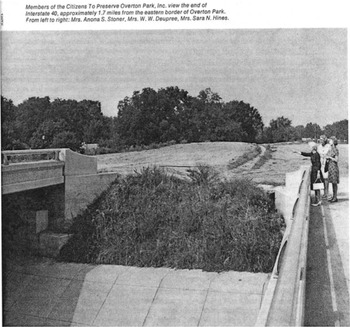
The first case this article takes up, Nashville I-40 Steering Committee v. Ellington, moved through the federal courts in 1967. Flournoy Coles, chairman of the Economics Department at Nashville's historically black Fisk University, worked with the National Association for the Advancement of Colored People (NAACP) to devise a legal strategy focused on civil rights and racial discrimination claims related to interstate development. Coles would soon publish a formative study of structural obstacles to “black entrepreneurship” and move to Vanderbilt University, where he became the university's first black faculty member to gain tenure. But the lawsuit to which he applied his expertise ended when the Supreme Court denied certiorari. The preceding circuit court ruling had found no evidence of discriminatory intent, and therefore administrators could continue their plans for interstate development. The second lawsuit to reach the Supreme Court was Citizens to Preserve Overton Park v. Volpe, in 1971. In this case, a local resident named Anona Stoner led the legal effort with assistance from the Sierra Club and other environmental organizations. Sporting carefully coiffed graying hair, a handbag, and white heels, Stoner embodied different gender and racial politics and possibilities as she surveyed the planned route of construction. Although the Supreme Court's ruling in Overton Park was not a decisive victory for environmentalism or for community participation, the result succeeded in blocking this particular instance of potential park destruction at the hands of highway builders.Footnote 4
While Ellington's outcome has been largely forgotten, the Overton Park decision became a canonical ruling on judicial review of administrative action. There are significant points of similarity and divergence in these cases. Neither, in the end, did much to alter the governing practices under challenge. Ellington was a failure for plaintiffs seeking administrative justice. Overton Park made highway officials newly wary of groups that made environmental claims, yet nonetheless guarded the boundaries of federal administrative authority carefully. Ultimately, the outcomes of the two cases reinforced rather than eroded the methods of infrastructural state building in question, even as Overton Park helped some litigants influence policy. It is on this point that the differences between the cases are important. Discrepancies between the two offer a window into the racist landscape of state building navigated by the cases’ respective litigants. The results of Ellington and Overton Park meant that neighborhoods would continue to be destroyed, while parkland would be protected. Read together, these cases lay bare the legal and administrative practices responsible for modern American liberalism's difficulties dealing with structural issues of racial inequality. Infrastructure combined with the mid-twentieth century legal regime to concretize racial and class hierarchies, privileging certain types of economic and political participation over others.Footnote 5
This meant Flem Otey's dreams of an interstate shopping center empire dried up. By the time an investigative journalist for the Saturday Evening Post met Otey and recorded his story in 1968, Otey's grocery was one of the lucky few businesses still standing as interstate construction cut through North Nashville. But I-40's construction altered Otey's neighborhood irreparably. While Otey was neither a leading freeway fighter nor a litigant, he was a keen observer of all that was afoot. He estimated that he lost half of his customer base when the I-40 viaduct reared up outside his doors. Walled in by pavement and on the edge of bankruptcy, he had few options. Relocation was necessary but nearly impossible; Otey found he was “trapped by the shortage of commercially zoned property in other Negro areas and by racial discrimination in white neighborhoods.” The interstates had created unprecedented mobility among the nation's cities, yet Otey told the journalist who spread his story that he had “no place to run.”Footnote 6
Entrapped by America's new infrastructure of supposed interconnection, Otey identified the problem at the core of the National System of Interstate and Defense Highways—and at the core of the legal and physical state building regime that the interstate system imposed on the nation. The infrastructure project had emerged from the minds of planners who prioritized aggregate national economic growth over local prosperity—an agenda inseparable from a related set of racial and class-based priorities that took hold in neighborhoods across the nation.
Journalists, Protestors, and Plaintiffs: The Interstate System and Its Discontents
In the interstate system's earliest phases of development, when it existed only as a cartographic blueprint for a better future, administrators cast the horizons it promised in a beneficent glow. The project appeared to be post-World War II Keynesianism made concrete, holding the concomitant hopes of an endlessly expanding economic pie. But the physical construction process was poised to produce startling inequalities. Throughout the 1960s, the interstate system's construction became synonymous with the destruction of neighborhoods and parks marked out for demolition, as the system's builders set about bulldozing pathways for America's new automotive infrastructure. The harsh duality of construction and destruction gave rise to dissent registered in street protests, newspaper columns, and courtrooms. Freeway revolts in the 1960s revealed the ways in which the highways—massive, imposing new technologies of governance—expressed the inequitable state building ideologies and practices that had created them. But just as the interstate system concretized the governing priorities that created it, the system also offered protestors a nation-sized object around which to array their dissent. Those who objected to the official scheme to improve the nation imagined a more participatory role for themselves within the processes of modern American state building made legible by the interstate system's development.Footnote 7
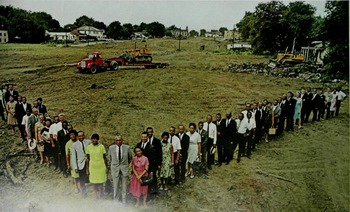
As the pavement flowed from coast to coast, certain realities became clear. Bulldozing pathways for 42,000 miles of planned interstate construction required “physical and social devastation” of the American landscape, as Francesca Russello Ammon writes. Planners set engineers and builders to work splitting farms in half, draining wetlands, and blasting through mountains. In urban areas, demolished homes and displaced residents put the harmful effects of interstate construction on clear display in neighborhoods like Flem Otey's. Such harmful effects, historian Nathan D.B. Connolly has concluded, were “intentional.” The interstate system's “disruption,” “pain,” and “displacements” operated according to plan. For local, state, and federal officials, interstate highway construction could reorder the nation's cities in accordance with racist and classist policies draped in convenient political slogans like “slum clearance” and “urban renewal.” At the peak of its destructive effects in the late 1960s, the interstate system displaced 200,000 people annually, and by the 1970s at least 1,600 neighborhoods in their entirety had fallen to clearance policies and the onslaught of the “concrete monsters”—the nickname soon appended to the interstates by those whose lives they upended. Displacement, as one interstate planner conceded, was “particularly serious in the big city black ghettos where the supply of housing is inadequate and relocation beyond the confines of the ghetto is severely limited by racial segregation.” Such outcomes produced a nation's worth of freeway revolts and increasingly vociferous critical commentary that explained to the public—and to future historians—exactly what was at stake when freeway fighters challenged the durable imposition of infrastructure in their communities (Figures 1 and 2).Footnote 8
Anona Stoner, left, gestures toward interstate highway construction near Overton Park, as W.W. Deupree and Sara N. Hines, fellow members of Citizens to Preserve Overton Park, look on. Source. Citizens to Preserve Overton Park Collection, collected, processed, and bound by Bette B. Tilly, Memphis and Shelby County Room, Memphis Public Library and Information Center, frontmatter.

Members of the Nashville I-40 Steering Committee, posing on a right of way that destroyed 650 homes. Source. Richard Whalen, “The American Highway,” Saturday Evening Post, December 14, 1968, np.

The challenges mounted by freeway fighters call attention not only to the twinned process of construction and destruction underway across the nation, but also to the governmental origins and undergirding administrative mechanics of the interstate highway project. Beginning in the early 1930s, plans for the interstate system emerged from within the lengthening halls of the American administrative state. Taking the form of committees, boards, agencies, and other bureaucratic units—all under the aegis of the increasingly strong executive branch of the federal government—the administrative state came into sight as never before during the New Deal and World War II years. Filled with an emboldened and expansive stratum of officials, the administrative state elicited new terminology, referred to by supporters and critics alike as the “fourth branch of government” or simply by its new nickname: “Leviathan.” This evoked the Biblical sea creature that had served as a symbol of central state power ever since Thomas Hobbes borrowed its name for his treatise on the theme. Leviathan's association with midcentury federal power reflected not only the newfound depths of administrative governance, but also the very essence of how the administrative state governed. It did not have a single purpose, but, like the many-limbed sea-dweller, could be characterized by a distinctive “multidimensionality,” as Anne Kornhauser puts it. Performing tasks that might previously have been left to local or state officials, the federal administrative state reached out to take a hand in everything from planning economic exchange to policing gender and sexuality to provisioning welfare. Its limbs and their far-reaching aspirations also took physical shape with the interstate highway system.Footnote 9
The concrete Leviathan that came to embody the American state in the middle decades of the twentieth century made abstract tensions between administrative authority and participatory democracy into physical matters of evaluation. Along the interstate system's routes, freeway fighters found tangible manifestations of fault lines running through the very foundations of modern American liberalism. Litigation subsequently probed toward deeper problems of governance. Plaintiffs may have gone to court to challenge the immediate perils of infrastructural state building—the destruction of a neighborhood or park—yet as they imagined alternatives in their communities and cohered demands in the courtroom, questions surfaced regarding the societal roles of citizens, politicians, judges, and administrators—questions, that is, concerning the deepest structures of the nation's governance.Footnote 10
Such questions had been present from the interstate highway system's inception, although they remained masked for a time by the widespread hope and optimism that suffused the project's early days. While the initial statutory construction of the interstate system was filled with political disagreement, journalists joined a political chorus that heralded the interstate highways as vital arteries whose connective presence would only spur the booming post-World War II economy to still greater heights. President Dwight D. Eisenhower proclaimed the interstate system to be “the greatest public-works program in the history of the world” when he authorized its creation in 1956, and soon after, the New York Times celebrated the “tangible…benefits” the interstate system would bring to all Americans. It would “modernize” and connect the nation, providing a “trunkline” whose automotive possibilities would be “vital” to the nation's growing “commercial needs” and “economic gain.” Yet scarcely more than a decade later in 1968, as I-40's shadow fell across Otey's door, a very different article in the Times lambasted the political establishment's heady embrace of highway development. Congress had “bow[ed] to the bulldozer,” and prioritized pavement over “parks, historic sites and wildlife areas.” Congress, according to the Times, had made clear its alliance was with road building interests and, more conceptually, with the interstate system's long-standing promises of aggregate national economic growth. In contrast, the newspaper averred, Congress was not serving the interests of “local conservationists, citizen groups and poor residents” who drew attention to the interstate system's problems with mounting urgency. The nation's lawmakers, the Times concluded, would be “memorialized by endless miles of highway blight that has already terribly scarred the face of this once-lovely land.” In 1956, optimistic Americans could imagine a better nation yet to be built. By the end of the 1960s, the “nation's faith” in the interstate system, now nearly complete, had been “painfully shattered,” as maps and blueprints became asphalt and concrete.Footnote 11
It was in this context that freeway revolts took hold across the nation. They sprang from neighborhoods like Flem Otey's, where demolished buildings and displaced residents made the paradoxes of infrastructural progress starkly legible. Against this backdrop of exploded hopes, communities began to mount legal challenges alongside their street protests. While the first freeway revolt had gathered force in San Francisco as early as 1959, it took time for the movement to spread. Throughout the 1960s, groups mobilized in and around eastern cities where urban construction was concentrated. Jane Jacobs's “park mothers” in New York City, Movement Against Destruction in Baltimore, and Boston Black United Front in Boston were just a few of the groups that spanned demographic, geographic, and political contexts to organize against interstate development.Footnote 12 Activists in the streets were joined in their protests by critics and a growing cadre of investigative journalists who wrote articles and books calling national attention to interstate-borne inequality, which showed itself most clearly in local contexts. Lewis Mumford, perhaps the world's leading urban theorist as interstate construction accelerated, called the project “absurd,” and disparaged it as nothing more than the manifestation of a “bulldozing habit of mind” that ignored the needs of people and communities.Footnote 13 The writer and journalist Karl Detzer tabulated instances of government fraud that followed interstate development from Nevada to Delaware to Georgia. Ben Kelley, the Director of Public Affairs at the Bureau of Public Roads (BPR), the agency responsible for interstate planning and construction, quit his post to become a prominent critic of interstate development. He called for abandoning the structures of governance that supported interstate development and advocated instead for placing decision making—particularly over fiscal matters like those addressed by Detzer—in the hands of citizens.Footnote 14
These critiques and their calls for citizen participation followed an intellectual and political current that, by the 1960s, pushed concertedly for enhanced democratization of the federal bureaucracy. The trajectory of the interstate highway system's development and reception, in fact, indexed changing sentiments toward the administrative state in this era. Administrators had drawn up the first interstate highway plans in the 1930s, as they embodied an iteration of administrative governance that enjoyed public and political support. During the Great Depression, administrators and their agencies successfully provided jobs, housing, and all manner of public works projects—the infrastructure of social stability and prosperity—at scales ranging from the local to the national.Footnote 15 In that setting, with administrators on the front lines of unprecedented economic crisis management, an “era of deference” developed, in the words of Reuel Schiller. Expertise-based administrative governance “dislodge[d] the judiciary from its role protecting property and economic liberty from administrative agencies.” By the end of the 1930s, courts were “subservient” to the administrative state now tasked with ordering and managing the nation. In this version of state action, democratic processes could identify general problems, and then administrators, with creativity and expertise, would solve them. Courts were on the other side of the equation: “inexpert” and “inflexible,” their role was to defer to agencies. It was in this context that the BPR had produced its first official plan for a federal highway system, in a 1939 report titled Toll Roads and Free Roads: the conceptual origin point of the interstate highway system as it exists today. Thus, federal administrators imagined the interstate highway system at a time when the courts deferred readily to their plans and expertise.Footnote 16
But that era of judicial deference to administrative expertise, authority, and action was short lived. By 1944, just as the interstate system came into statutory existence with the passage of the Federal-Aid Highway Act of 1944, the tide began to turn against administrative authority. That year, Addison v. Holly Hill Fruit Farms saw the Supreme Court shift its position of deference from administrators to legislators. Then came the Administrative Procedures Act of 1946 (APA). This so-called “constitution” of United States administrative law governed the ways in which administrative agencies could issue regulations and make decisions. Crucially for the issues that would emerge with interstate highway development, the APA directed courts to review agency actions that were “arbitrary, capricious, [or] an abuse of discretion,” as well as actions “unsupported by substantial evidence.” The APA did not define these terms, leading to ensuing legal debate, and the manner and extent of judicial supervision of administrative action was rather ambiguous. However, the APA created a presumption of judicial review of administrative action that indicated a clear divergence from the era of deference. If Addison and the APA saw the judiciary and the legislative branch checking the authority of administrators, these legal shifts were indications of broader concerns with the authority wielded by administrators—concerns that only mounted in the coming years.Footnote 17
Challenging the Interstate System in the Federal Courts
By the 1960s, interstate dissenters navigated judicial and legislative paths of reform as they challenged administrative authority and infrastructural state building. While the interstate highway project continued to prompt considerations of the roles of citizens and judges in administrative governance, congressmembers and administrators provided measured changes that tempered the freeway revolts and enabled interstate development to proceed. When it came to statutory reform, Congress proved particularly attentive to the destruction of natural areas and parkland. Senators such as Clifford Case of New Jersey, Wayne Morse of Oregon, Ralph Yarborough of Texas, and Joseph Clark of Pennsylvania spoke about the dangers of unchecked highway development and lined up their votes accordingly. Clark told his colleagues it was “time that Congress took a look at the highway program,” and stopped it from destroying “spots of historic interest and great beauty by the building of eight-lane highways through the middle of our cities.”Footnote 18
Yarborough was a particularly strong advocate. His amendment of the Federal-Aid Highway Act of 1966 required “maximum effort to preserve Federal, State, and local government parklands and historic sites and the beauty and historic value of such lands and sites.” This provision barred highway administrators from authorizing interstate construction in any parkland “unless such program includes all possible planning, including consideration of alternatives to the use of such land, to minimize any harm to such park or site resulting from such use.”Footnote 19 Section 4(f) of the Department of Transportation Act of 1966 reiterated the same protections, and applied them to transportation-related development of all kinds, not just highway construction. Two years later, the Federal-Aid Highway Act of 1968 extended the prohibitions still further, barring interstate construction in parkland “unless (1) there is no feasible and prudent alternative to the use of such land, and (2) such program includes all possible planning to minimize harm to such park, recreational area, wildlife and waterfowl refuge, or historic site resulting from such use.” The parallel provisions in these three acts became known as the “Parklands Statutes.”Footnote 20
Despite the striking emergence of the Parklands Statutes, there had not yet been a clarifying federal lawsuit that cohered the issues at stake. That began to change in 1967, when the first interstate highway case to reach the Supreme Court originated in Flem Otey's North Nashville community. There, local leaders turned to the law to claim that Interstate 40's development was producing racial discrimination and a deprivation of due process. The case, Nashville I-40 Steering Committee v. Ellington, came to a conclusion when the Supreme Court declined to hear it on appeal after the United States Court of Appeals for the Sixth Circuit ruled in favor of the administrators who were responsible for selecting I-40's North Nashville route. Meanwhile, 200 miles to the southwest, a group of predominantly white activists in Memphis grew concerned about the fate of Overton Park, their city's primary urban green space. Like Otey's soon-to-be-bulldozed neighborhood, Overton Park stood in the middle of I-40's planned path. A group of local residents calling themselves “Citizens to Preserve Overton Park” brought a series of legal challenges intended to block highway construction in the park. They sought instead to locate I-40's path through a nearby neighborhood where, presumably, construction would have consequences much like those Otey had experienced in Nashville. In 1971, the Memphis park protectors produced the second case to reach the Supreme Court, Citizens to Preserve Overton Park v. Volpe. The contrasts between these two cases reveal the skewed priorities of state builders, the challenges of accessing administrative justice, and the legal and physical inequalities of state building in modern America.Footnote 21
Nashville, Tennessee
The highway construction in question was a proposed 3.6 mile stretch of I-40's planned route through Nashville, Tennessee. The case that developed, Nashville I-40 Steering Committee v. Ellington, saw local neighborhood residents claim infringements of their Fifth and Fourteenth Amendment rights to equal protection and due process. The defendants were Tennessee Governor Buford Ellington, Tennessee Commissioner of Highways Charles Speight, and Nashville Mayor Beverly Briley. Seeking an injunction, the plaintiffs accused these officials of “erecting a physical barrier between [the] predominantly Negro area and other parts of Nashville,” and identified two central issues. First, that the administrators in charge had “failed to hold a public hearing with proper notice and failed to consider the economic effects of the proposed route as required by Section 116(c) of the Federal-Aid Highway Act of 1956.” And second, that officials had chosen the path of construction either “arbitrarily or with the purpose of discriminating against the Negro or low socio-economic segments of Nashville's population.”Footnote 22
After the United States District Court for the Middle District of Tennessee heard the case and refused to grant an injunction, the plaintiffs appealed. The United States Court of Appeals for the Sixth Circuit subsequently confirmed what was evident to the plaintiffs: I-40's construction would cause “heavy damage” to their predominantly black neighborhood. But the judges found that they had “no choice except to affirm the judgement of the District Court in refusing to grant a preliminary injunction.” On the question of discrimination, the Sixth Circuit relied on the testimony of Tennessee Highway Department officials from a hearing held a decade prior on May 15, 1957. The Sixth Circuit pointed to a statement made by an attorney for the Highway Department, who had claimed that with regard to “economic effects,” the 3.6 miles of planned interstate construction in question was “properly located and should be constructed as located.” The district court had done its duty, relying “upon the presumption of regularity of public records and compliance by public officials with duties imposed upon them by statute.” The Sixth Circuit took highway officials at their word and ruled in their favor. Construction could proceed, speeding the flow of traffic from one distant city to another, even as that traffic flow ruptured local circuits of exchange that had sustained the businesses of North Nashville.Footnote 23
Furthermore, the Sixth Circuit found “no proof of racial discrimination” in the selection I-40's route, and only the hypothesis that discrimination might follow the highway's construction. Without a smoking gun, there was no evidence to support claims of discrimination and deprivation of due process and equal protection. The Sixth Circuit would avoid undermining the expertise of administrators who made substantive decisions. “The routing of highways,” the judges wrote, was “the prerogative of the executive department of government, not the judiciary.” Routing highways, in other words, was a substantive matter beyond the purview of judges. Surely any route selection for I-40 would bring “hardships” upon some people. But it was for “engineers, not judges” to decide where to build, as long as they made that substantive determination within the bounds of legislative guidance and settled administrative law. This was the only role the judges would play: ensuring that administrators followed procedures prescribing how they were permitted to make their substantive choices about where and how to build I-40—and in Ellington, the judges did even this as narrowly as possible.Footnote 24
The issue of public participation, however, posed problems that concerned the Sixth Circuit judges. They were satisfied that administrators had followed procedure, yet they admitted the procedures in question were “unsatisfactory.” The Federal-Aid Highway Act required highway administrators to hold public hearings and listen to citizens’ input before deciding where and how to build any given segment of interstate. This offered a pretense, at least, of citizen participation. Yet in Nashville, administrators had made a series of suspicious choices regarding how they publicized the required public hearings on interstate route selection. They posted notices of the hearings only “in a ‘white’ neighborhood near the predominantly Negro community” that they sought to bulldoze for construction. The notices also listed an incorrect date for the hearing. Yet the judges found that “neither the statute nor the regulations of the Bureau of Public Roads prescribed how notice of hearings should be given.” One might think an erroneous date would be grounds for review and intervention. But here the judges turned, ironically, to a substantive point: despite the error, the hearing had been “well attended,” though they did not say by whom. In their deference to administrative authority over the entire process, they went so far as to say that “no literate citizen of Nashville” could have been unaware of the hearing. It was with these habits of mind and legal choices that the judges of the Sixth Circuit raised an eyebrow yet decided procedure had been followed, and that the highway administrators had operated within the bounds of the law in selecting I-40's destructive path through North Nashville.Footnote 25
The plaintiffs in Ellington continued their fight, but the Supreme Court declined to hear their appeal. The outcome—letting the Sixth Circuit's ruling stand—appeared to be a victory for highway administrators and the administrative state more generally. Despite the presence of glaringly inequitable procedural issues, the Sixth Circuit decided that procedure had, nonetheless, been followed. If the procedures in question gave citizens little opportunity to participate in administrative processes that would dramatically reshape their lives, that was not a matter for courts to evaluate. Such alterations of society, in this judicial perspective, were the purview of the political process of legislative change. But rather than emboldening state and federal administrators, the outcome in Ellington set them on edge and led them to consider more inclusive approaches to highway development. Internally, in their briefs, memoranda, and annual meetings, interstate highway officials were worried: the feeling they expressed was that they had verged too near the precipice of their power.
In one notable example that followed the Ellington decision, the Michigan State Highway Department spent 1968 conducting “research into the growing revolt against construction of urban highways” and issued a subsequent report on its findings. While Ellington had failed to alter the law, the state officials noted that protestors continued to thwart “one highway after another” with grassroots tactics and litigation that slowed construction even if it failed to stop it entirely. Michigan administrators, whether through self-interest or a genuine spirit of reform, sought to “develop a positive remedial program” of administration capable of keeping interstate construction on track. While it is archivally impossible to discern the survey methods used and thus to evaluate who the administrators talked to and how comprehensive their findings may have been, their report was unsurprising. They found that people were “sick and tired of having establishment programs imposed on them.” They concluded that it was often not the premise of interstate development that was objectionable, but rather the top-down approach to planning and construction. What irked many residents was not the presence of new highways but the sense that they had been constructed through “devious means.” This conclusion might have been wishful thinking among administrators, who may have hoped to find silver linings suggestive of basic support for interstate development. Still, their final pronouncement was striking. They reported that community residents wanted “a piece of the action and a voice in their future.”Footnote 26
Mindful of such issues weighing on administrative authority, Edwin Reis, Assistant Chief Counsel for the Federal Highway Administration (FHWA),Footnote 27 composed a report centered on questions about whether or not courts could intervene in existing practices of agency action. Regardless of outcome, Ellington had indicated that highway development was on a collision course with this legal issue. Reis made it plain that while administrators may have emerged victorious in Ellington, the war was hardly over. He called attention to another 1967 case, Abbott Laboratories v. Gardner.Footnote 28 The ruling in this case was important because it widened standing, effectively broadening who could sue federal agencies and under what circumstances. For the benefit of his audience, Reis explained Abbott Laboratories thus: “if someone is complaining that Federal action injures him, a Federal court can consider the case unless it is very clear that the Congress intended that there be no judicial review. The mere absence of review procedures in the statutes does not show that there was to be no judicial review.”Footnote 29 This was a significant interpretative step away from the legal tendencies that had marked the previous three decades, in which judges had repeatedly deferred to administrative expertise.Footnote 30 Abbott Laboratories showed that judges were willing to take on a larger role for themselves in the judicial review provisions included in the foundational Administrative Procedure Act of 1946.Footnote 31 And the door was open for citizens to continue pressing claims as they had in Ellington. Reis concluded that it was “plain that Federal courts will continue to feel that they can review the regularity of Federal administrative action.” The need to remind administrators of the point underscored the significance of the change.Footnote 32
If standing and review were revised, the civil rights and discrimination issues at the center of Ellington might take on new life with a judiciary less deferential to administrative expertise and more willing to think about substantive issues. Reis warned highway administrators that “the area of civil rights” law was likely to reshape court cases involving “government-aided construction.” Housing claims seemed particularly likely to draw the attention of judges, should interstate construction “force a minority group to seek housing in a segregated housing market or force a minority group to seek housing outside of a city.” Courts, he thought, would certainly “accept jurisdiction to hear such a case,” which was a striking point that, among other things, acknowledged the prevalence of de facto segregation. Citing Burton v. Wilmington Park Authority (1960) and Jones v. Alfred H. Mayer Co. (1968), Reis determined that it was “clear that operations on any Government financed or aided project can be enjoined where such operations perpetuate discrimination or otherwise deny equal protection of the law.” Civil rights, discrimination, and other “areas where laws have been passed to protect a particular group” were not the only issues that worried Reis. Abbott Laboratories helped produce a legal landscape in which “anyone who will be affected by a project” had “standing to go to court and challenge federal grants or approval of a project.” Standing, of course, only got plaintiffs in the courthouse door. The outcome of litigation was another matter. Still, signs pointed toward an elevated role for citizens in challenging the expertise and choices of administrators.Footnote 33
Reis closed by noting how “pessimistic” he was. “Those seeking to challenge the actions of the agencies we work for will not be stopped at the courthouse door,” he concluded. The era of deference was over, having given way to what he named “the age of protests.” The writing was on the wall: the “actions of the Federal Highway Administration” would be challenged “increasingly” in litigation.Footnote 34 He predicted, with keen accuracy, that such litigation would find the strongest support “in the conservation area.” This emerging body of law had just received an enormous boost with the National Environmental Protection Act of 1969 (NEPA). NEPA established a sweeping set of statutory guidelines that strengthened the already significant provisions for parkland protection included in interstate highway legislation, and Reis asserted that “any group claiming an interest in preserving the ecology, recreational value or beauty of an area” would be “granted standing to contest whether these factors were properly considered in approving a project.” If the discrimination issues at the heart of Ellington had failed to give citizens voice and expand judicial review, environmental concerns would succeed in doing so.Footnote 35
A year later in 1970, Reis's concerns about expanded review of administrative actions involving environmental change were at the center of his next report to highway administrators on the interaction of the courts and the administrative state. Regarding litigation related to environmental issues, he wrote that “recent developments in the law only mean that the administrator may, and indeed must, realistically consider the total highway effects of his decisions on the environment and not just the effect of these decisions upon fast, safe and efficient transportation.” This lawyerly rhetoric veiled a momentous shift. The need to “only” consider “the total highway effects” on the environment was no small matter. There were any number of issues within this framework that community members might now use to bring suit. There was a very real possibility that the environmental movement was going to produce a “vitiation of administrative choice” with the help of judges who sought to widen standing and the scope of judicial review of administrative procedures. The conclusion Reis drew was that “administrative action must meet the substance and procedural requirements of law and regulation.”Footnote 36 If substance was in play, the safeguard Reis identified was simply for administrators to get ahead of any issues. The example he pointed to was a federal case developing in Tennessee: Citizens to Preserve Overton Park v. Volpe. It included the only injunction issued up to that point in an interstate highway lawsuit, and soon the matter would become the second interstate highway lawsuit to reach the Supreme Court.
Memphis, Tennessee
The trouble began in Memphis, Tennessee, when a group of citizens took issue with I-40's planned route and questioned the authority of highway administrators to carry out construction. Whereas discrimination claims had not proved sufficient to prompt judicial intervention in statutory guidance in Ellington, the freeway fighters in Memphis had an environmental claim with which to file suit, which held more promise. The Parklands Statutes prevented the secretary of transportation from authorizing the dispersal of Highway Trust Fund capital for the construction of interstate highways through public parks if a “feasible and prudent” alternative route existed. If no such alternative existed, construction in parkland could occur only with “all possible planning to minimize harm.” Vague though the language was, the plaintiffs grabbed on as best they could as they devised a strategy that would stop Secretary of Transportation John Volpe from authorizing capital expenditure and construction of a six-lane interstate highway through Memphis's Overton Park.Footnote 37
Overton Park, a 342-acre area near the center of Memphis, contained recreational attractions including a zoo, a golf course, an outdoor theater, an art academy, and nature trails through 170 acres of forest. Local residents joined with the Sierra Club to claim that the Department of Transportation's planned route for I-40 would destroy 26 acres of the park. Their claim that this violated the Parklands Statutes was rejected first by the United States District Court for the Western District of Tennessee, and then by the United States Court of Appeals for the Sixth Circuit. I-40's construction reached the borders of Overton Park in 1966, just as that year's Federal-Aid Highway Act and Department of Transportation Act enacted the first components of the Parklands Statutes. With regard to Overton Park, administrators had to show the absence of “feasible and prudent” alternative routes before they could send I-40 through its green expanse. While this review process was underway, however, the locals who brought suit identified two issues.Footnote 38
First, federal funds had already been dispersed to purchase rights of way on either side of the park, a common if duplicitous procedure that officials had long employed to secure favored routes through potentially controversial or litigious construction areas. By laying pavement up to the park's edges, administrators created the conditions in which no other route would be feasible or prudent other than to lay pavement through the park to connect the already-completed segments of I-40. Second, despite such practices, neither Volpe nor other administrators appeared to have produced factual findings to support their choice to route I-40 through the park. Yet in subsequent litigation, the District Court and then the Sixth Circuit ruled that factual findings were not required and refused to order the deposition of Volpe or other officials regarding the route selection process. Neither court found that Volpe had exceeded his authority as secretary of transportation in locating interstate construction through parkland. But even if Volpe was not required to present factual findings, the guiding statute made clear that official determination was necessary to allow parkland construction to proceed. And evidence of that official determination was vague. Nonetheless, a majority of the Sixth Circuit judges, as in Ellington, ruled in favor of the administrators.Footnote 39
In dissent, Judge Anthony Celebrezze drew out several concerns with citizen participation and parkland destruction. He began by questioning procedure. Arlo Smith, a leader of the Citizens to Preserve Overton Park activist group, testified that there was no official statement from highway administrators attesting that Overton Park provided the only “feasible and prudent” route for interstate construction. Additionally, Lowell Bridwell, Administrator of the FHWA, had testified before Congress that the decision to send I-40 through Overton Park had been “completely in the hands of the city council,” despite the statutory requirement that its construction location must be approved by the Secretary of Transportation.Footnote 40 In different ways, Smith and Bridwell each called into question the possibility that statutory procedure had been flouted. Furthermore, was there a factual basis for the claim that Overton Park was the only possible place to locate I-40? Celebrezze thought that there was “a litany of other competent evidence that the route chosen was neither the only feasible nor prudent alternative.” His dissent implied that judicial deference had gone a step too far—in both procedural and substantive terms—in the matter of I-40's construction. Celebrezze agreed that the courts should “never interfere” with the technical expertise of engineers and builders in the construction of the interstate highways. But the courts did have a “solemn responsibility” to ensure that interstate highway construction not only followed “the laws of the United States” but also, crucially, served “the public welfare.” Celebrezze had laid the groundwork for judicial intervention in interstate highway planning, arming the case's plaintiffs with new arguments when they appealed to the Supreme Court.Footnote 41
As Overton Park moved through the courts in 1970, agency lawyers considered its implications. Edwin Reis, the FHWA lawyer who had warned his agency after Ellington that judicial intervention in administrative highway planning was possible, gave another update to his administrative colleagues on the changing legal landscape. Following the Sixth Circuit's Overton Park ruling, he reported that the FHWA had “prevailed” in the appeal because the injunction had been dissolved. Reis reported that the court had given “great stress to the presumed regularity of the acts of the administrator[s].” Most importantly, from the perspective of the administrators, the court had agreed that the highway agency had given proper consideration to “alternate routes and alternate methods of construction by Federal and State officials.” The judges found that highway administrators had “applied wisdom and reason,” and that this exercise of expertise had been in accordance with all necessary procedures. Reis felt sure that “no court” in the future would intervene and “determine the issues” if administrators continued to show the application of reason when they selected construction routes. In other words, Reis predicted that judges would not intervene in substantive matters if they were convinced administrators had followed administrative procedures in evaluating the substantive matters at hand. Administrators’ expertise would govern.Footnote 42
While Reis prematurely interpreted the Sixth Circuit's ruling as a victory for interstate highway development—and for administrative governance in general—he identified the issue the Supreme Court would soon take up when it evaluated the lower court's decision. The Parklands Statutes required the secretary of transportation not to approve any highway construction through parkland unless there was “no feasible or prudent alternative.” For highway administrators, this meant the central problem in Overton Park was to show how the Secretary of Transportation had made his decision to route I-40 through parkland—precisely where it was not supposed to go, unless there was no alternative. The lower courts had agreed with administrators that agency findings did not need to be articulated in any “contemporaneous document” created during the agency's route planning process. Essentially, the lower courts considered the findings to be within the protected purview of administrative expertise and discretion. Reis knew administrators were on shaky ground on this point. He admitted that convincing the lower court judges of the propriety of agency findings and decision making had been a “difficult task.” He recommended that future administrators should have “a formal document prepared on all projects affecting parks and recreation areas showing the factors considered in determining that there are no feasible or prudent alternatives and that all possible planning is done to minimize harm.” It was a prescient suggestion. As the Supreme Court's subsequent Overton Park ruling indicated, the tides had shifted against taking administrative decisions at face value.Footnote 43
In reviewing Overton Park, the Supreme Court began with the basic claim from highway administrators that there was “no feasible and prudent alternative to the use” of Overton Park for highway development, and that they had conducted “all possible planning to minimize harm” to the parkland. The plaintiffs, on the other hand, claimed that this determination was invalid because the administrators had not shown how they eliminated alternate route options. They further claimed that “the Secretary had to make the determination in writing, and with factual findings; and that the Secretary had not made an independent judgement, but merely relied on the judgement of the city officials.” Administrative authority had ruled the day—and threatened to destroy the park. The Supreme Court agreed with the lower courts that the secretary's determination did not have to be in writing, finding no procedural requirements on this point. But the Supreme Court also found that the lower courts “were in error in deciding merely on the basis of affidavits submitted by the defendants that the Secretary's decision was not arbitrary or capricious.” The claims of administrators, that is, were not sufficient to determine if procedure had been followed.Footnote 44
The Supreme Court remanded the case, ordering the district court to retry the case—and this time to review the secretary's determination “on the basis of the full administrative record which was before the Secretary at the time he made his decision,” including public commentary. If the lower court found that “the administrative record” was “not sufficient to disclose the factors which the Secretary relied on,” the court would have to hear testimony from “the Federal officials who participated in the decision.” Crucially, they would have to “explain their actions in court,” a departure from broad acceptance of and deference to administrative expertise. If it was not a positive assertion in favor of enhanced citizen participation in the administrative process, it was nonetheless the limited role of citizen participation displayed in the case that helped produce the outcome.Footnote 45
The Overton Park decision meant courts would no longer take administrators at their word, as the lower courts had in the preceding litigation. The Supreme Court still refrained from making its own substantive determination in Overton Park, but the decision undermined administrative authority just enough to make clear that the courts would give greater voice to citizens who challenged the substance of administrative decisions, albeit still via procedural claims. Overton Park opened space for litigation dealing with procedural review, yet was grounded in substantive harms. In this light, the decision may look like an attempt by the Supreme Court to tame the administrative state's non-participatory tendencies on behalf of citizens. And some citizens certainly appeared to benefit from the decision: park protectors in Memphis, in a functional sense, won the day. But this victory—also a victory for the politics of whiteness and environmentalism—did not fundamentally revise the deeper problems of governance that had come on display in the case. And those problems would continue to define the interstate highway system's social outcomes. The legal landscape had changed only slightly, and not for everyone.Footnote 46
The Fork in the Road
Ellington and Overton Park arose from protests over immediate harms, as citizens went to court in hopes of preventing the “concrete monsters” from bulldozing through their communities and parks. From those local contexts, lawsuits probed far deeper into the practices of modern American state building than the freeway-fighting litigants may have foreseen. The cases illuminated perilous governmental mechanisms that prefigured inequitable construction choices and drove the interstate system's destructive outcomes. Together, Ellington and Overton Park put racist and classist official priorities on display, while revealing tensions between administrative authority and participatory democracy. Inseparable, if abstract, questions about the roles of citizens, legislators, administrators, and judges in the work of state building hung in the balance.
In more tangible terms, the 1967 Ellington decision upheld a vision of administrative authority that, by the time the Supreme Court denied certiorari, was under sustained popular and political assault from all points of the political spectrum. Just a few years later in 1971, Overton Park created a presumption of judicial review of administrative action.Footnote 47 That presumption, encompassing expanded standing for litigation, appeared to give voice to citizens in a more direct manner than they might find through legislative representation. But Overton Park also allowed the administrative state to retain much of its authority. The root problem with which the Supreme Court took issue in the case was the absence of administrative justifications for actions planned and taken, justifications demanded by citizens through their lawsuit. And the Supreme Court insisted on the need for those justifications by invoking the Administrative Procedures Act as well as the Parklands Statutes, to which citizens could point as they demanded explanation for the destruction of Memphis's green space. The Overton Park decision thus enhanced judicial review of administrative action and expanded opportunities for citizen participation through litigation, while constraining both aspects of administrative oversight to close statutory adherence. While judicial review and citizen participation had been overriding issues as the litigation moved through the courts, it was on statutory matters that Overton Park focused the attention of administrators and their lawyers after the Supreme Court's ruling. The decision stands out in administrative law for its reformist inclinations, yet it certainly did not fashion participatory democracy.Footnote 48
Overton Park's outcome meant that citizen participation could, in some instances, now present a roadblock to interstate construction. The key for administrators—as agency lawyers like Edwin Reis had long made clear—was to pre-emptively identify the substantive issues on which citizens would now find widened standing to sue. Overton Park, in the end, established participatory opportunities for citizens in the work of administrative state building in a sharply limited manner: expanded participation was only possible on the terms set forth by the Parklands Statutes and the emerging tenets of environmental law that suffused the case. It was to this legal area that administrators and their lawyers shifted their focus in Overton Park's aftermath, while construction in neighborhoods proceeded to produce discriminatory outcomes nationwide. Overton Park revealed that the courts would insist on “strict compliance” with environmental laws, according to Lloyd Reeder, another FHWA lawyer tasked with updating state and federal agencies on legal changes in 1971. On this point, he felt that “the best advice” he could offer his administrative colleagues was to “anticipate problems” related to “hearings, civil rights, and the whole environment.” But based on his summary of case law, it was clear which of these issues would take precedence.Footnote 49
Administrators did not exactly have carte blanche to destroy communities while protecting parks, but the calculus was plain. Legal barriers to pushing interstate highways through neighborhoods were simply lower than legal barriers protecting parks. As Reeder summarized, the best bet for highway administrators was to give the protection of parklands “paramount importance” when selecting routes for highway development. The culmination of the litigation exacerbated rather than reduced inequities. Despite Overton Park's insertion of citizens into the administrative process, the case was poised to worsen the effects of interstate highway construction in urban communities. And even when it came to parkland, citizens had limited possibilities for participation. If administrators were mindful of “strict compliance,” they would have little trouble with the courts on environmental issues. This skewed result suggested the continued power of administrators to build how they pleased throughout much of the nation's social geography. The skew also indicates the significance and endurance of what Nathan D.B. Connolly calls “Jim Crow liberalism.” Judges and officials made way for the generally white preoccupation with park protection, while articulating “opaque” legal reasons to ignore the generally black preoccupation with community protection. Of course, the white concern with parkland and the black concern with community life were born of the blunt fact that white neighborhoods were rarely targeted for interstate highway development. This discrepancy was justified with the financial calculus of buying the cheapest available land, which meant land inhabited by poor communities of color. “Letting the ‘market’ decide,” writes Connolly, was itself a method for ensuring the preservation of “white power” and its priorities.Footnote 50
Such discriminatory priorities and practices had long been etched into the American landscape. But at the beginning of the 1970s, for a brief moment, the legal terrain was less settled. In different ways, Ellington and Overton Park at first seemed to signal other possibilities before harsher realities returned. Reformers at the time might have hoped that the Ellington decision was a remnant, a vestige of past lawmaking and jurisprudence that had been insufficiently protective of black citizens’ substantive concerns and civil rights. After all, the same term that the Supreme Court decided Overton Park saw the justices reach two separate decisions, both unanimous, that struck significant blows against racial discrimination and segregation. The first was Griggs v. Duke Power Co., holding that Title VII of the Civil Rights Act of 1964 prohibited employment practices that had disparate impacts on black workers, regardless of employers’ intent to discriminate. The second was Swann v. Charlotte-Mecklenberg School District, holding that busing was an appropriate remedy to school segregation. Only a few years later, however, the 1974 Milliken v. Bradley decision saw the Supreme Court hold that school district lines could not be redrawn to combat segregation unless there was evidence of discriminatory intent. Two years after that came Washington v. Davis, holding that evidence of discriminatory intent was a prerequisite to finding governmental discrimination, even if a policy had disparate impacts on protected groups. Ellington and Overton Park, in retrospect, helped pave the way for such developments by producing decisions that added further durability to “Jim Crow liberalism” and its cascading forms of segregation across the nation's geography.Footnote 51
In sum, Ellington and Overton Park reinforced a legal bulwark that protected the advantages of white, affluent litigants who wished to preserve unbuilt spaces, and blockaded black litigants who wished to preserve their neighborhoods. The wide disparities and narrow reforms reflected in Ellington and Overton Park combined to insulate and maintain the nation-spanning paradigm of infrastructural state building responsible for the interstate highway system and its dyadic promises and perils. That paradigm seldom impacted all equally as it bulldozed local prosperity in the name of national economic development, cementing racial and class hierarchies in place with all the permanence of asphalt and concrete. The legacy of this state building regime endures: the concrete Leviathan that defines the modern American state's territory is a creature of law that has inscribed spatial inequalities at dramatic physical and temporal scales throughout the national landscape.
Acknowledgments
An earlier version of this article received the Kathryn T. Preyer Award from the American Society for Legal History in 2021. I am grateful to the conveners of and the participants in the associated conference session for generous and generative input. A wonderful intellectual community has supported and sharpened this project from day one: my thanks especially to Margot Canaday, Joanna Grisinger, Daniel R. Ernst, José Argueta Funes, and Karen Tani. Three anonymous reviewers helped this research attain its full potential, and Gautham Rao provided excellent editorial input from start to finish.