Summations
-
The present systematic review highlights the effect of tDCS on neuro-metabolites at the site of stimulation.
-
The impact of medication on neuro-metabolites and their interaction with tDCS needs to be studied systematically.
-
Emphasis on MRS and tDCS should be given to understand the more holistic impact of tDCS and potentially unravel the neuro-metabolite × tDCS interaction effect that can be translated into individualised treatment.
Considerations
-
The majority of tDCS and MRS studies have focused on alterations in the motor cortex, making it challenging to translate the current findings across various disorders and brain regions.
-
Interpretation of tDCS and MRS studies is limited by small sample size, single-session tDCS, and varying tDCS stimulation protocols.
-
None of the current literature studies have reported the impact of medications on neuro-metabolite levels and its effect on tDCS-related outcomes.
Introduction
Non-invasive brain stimulation (NIBS) is a form of neuro-modulatory technique that attempts to modulate the neural activity through electrical stimulation at specific target regions of the brain without any breach or invasion of the tissues (Nitsche et al., Reference Nitsche, Cohen, Wassermann, Priori, Lang, Antal, Paulus, Hummel, Boggio, Fregni and Pascual-Leone2008). Because of its safety, tolerability, easy applicability, and minimal side effects (Antal et al., Reference Antal, Alekseichuk, Bikson, Brockmöller, Brunoni, Chen, Cohen, Dowthwaite, Ellrich, Flöel, Fregni, George, Hamilton, Haueisen, Herrmann, Hummel, Lefaucheur, Liebetanz, Loo, Mccaig, Miniussi, Miranda, Moliadze, Nitsche, Nowak, Padberg, Pascual-Leone, Poppendieck, Priori, Rossi, Rossini, Rothwell, Rueger, Ruffini, Schellhorn, Siebner, Ugawa, Wexler, Ziemann, Hallett and Paulus2017), it has been extensively explored in the fields of psychiatry, neurology (Auvichayapat et al., Reference Auvichayapat, Aree-Uea, Auvichayapat, Phuttharak, Janyacharoen, Tunkamnerdthai, Boonphongsathian, Ngernyam and Keeratitanont2017, Fregni et al., Reference Fregni, El-Hagrassy, Pacheco-Barrios, Carvalho, Leite, Simis, Brunelin, Nakamura-Palacios, Marangolo, Venkatasubramanian, San-Juan, Caumo, Bikson and Brunoni2020), and paediatric (Carlson et al., Reference Carlson, Ciechanski, Harris, Macmaster and Kirton2018, Nwaroh et al., Reference Nwaroh, Giuffre, Cole, Bell, Carlson, Macmaster, Kirton and Harris2020) disorders as a therapeutic as well as an investigational tool. Psychiatric disorders in which the use of NIBS has been maximally evaluated are schizophrenia (Agarwal et al., Reference Agarwal, Shivakumar, Bose, Subramaniam, Nawani, Chhabra, Kalmady, Narayanaswamy and Venkatasubramanian2013, Chang et al., Reference Chang, Kao, Chao, Tzeng and Chang2020), obsessive-compulsive disorder (OCD) (Gowda et al., Reference Gowda, Narayanaswamy, Hazari, Bose, Chhabra, Balachander, Bhaskarapillai, Shivakumar, Venkatasubramanian and Reddy2019, Palm et al., Reference Palm, Brunelin, Wulf, Mondino, Brunoni and Padberg2020), cognitive impairment (Sonmez et al., Reference Sonmez, Camsari, Nandakumar, Voort, Kung, Lewis and Croarkin2019), substance abuse (Medeiros et al., Reference Medeiros, De Souza, Vidor, De Souza, Deitos, Volz, Fregni, Caumo and Torres2012, Ekhtiari et al., Reference Ekhtiari, Tavakoli, Addolorato, Baeken, Bonci, Campanella, Castelo-Branco, Challet-Bouju, Clark, Claus, Dannon, Del Felice, Den Uyl, Diana, Di Giannantonio, Fedota, Fitzgerald, Gallimberti, Grall-Bronnec, Herremans, Herrmann, Jamil, Khedr, Kouimtsidis, Kozak, Krupitsky, Lamm, Lechner, Madeo, Malmir, Martinotti, Mcdonald, Montemitro, Nakamura-Palacios, Nasehi, Noël, Nosratabadi, Paulus, Pettorruso, Pradhan, Praharaj, Rafferty, Sahlem, Salmeron, Sauvaget, Schluter, Sergiou, Shahbabaie, Sheffer, Spagnolo, Steele, Yuan, Van Dongen, Van Waes, Venkatasubramanian, Verdejo-García, Verveer, Welsh, Wesley, Witkiewitz, Yavari, Zarrindast, Zawertailo, Zhang, Cha, George, Frohlich, Goudriaan, Fecteau, Daughters, Stein, Fregni, Nitsche, Zangen, Bikson and Hanlon2019), and depression (Sonmez et al., Reference Sonmez, Camsari, Nandakumar, Voort, Kung, Lewis and Croarkin2019). Some neurological conditions where NIBS has been found useful are Parkinson’s diseases (Cucca et al., Reference Cucca, Sharma, Agarwal, Feigin and Biagioni2019), stroke (Bai et al., Reference Bai, Guo, He, Ren, Mcclure and Mu2019), epilepsy (San-Juan et al., Reference San-Juan, Espinoza López, Vázquez Gregorio, Trenado, Fernández-González Aragón, Morales-Quezada, Hernandez Ruiz, Hernandez-González, Alcaraz-Guzmán, Anschel and Fregni2017), as well as chronic pain management (Nitsche et al., Reference Nitsche, Grundey, Liebetanz, Lang, Tergau and Paulus2004).
Based on different electric waveforms, TES is classified as transcranial direct current stimulation (tDCS), transcranial alternating current stimulation, transcranial pulsed current stimulation, transcranial random noise stimulation, transcranial vagal nerve stimulation, cranial electrotherapy stimulation, reduced impedance non-invasive cortical electrostimulation, and transcranial oscillatory direct current stimulation (Nitsche et al., Reference Nitsche, Cohen, Wassermann, Priori, Lang, Antal, Paulus, Hummel, Boggio, Fregni and Pascual-Leone2008, Antal et al., Reference Antal, Alekseichuk, Bikson, Brockmöller, Brunoni, Chen, Cohen, Dowthwaite, Ellrich, Flöel, Fregni, George, Hamilton, Haueisen, Herrmann, Hummel, Lefaucheur, Liebetanz, Loo, Mccaig, Miniussi, Miranda, Moliadze, Nitsche, Nowak, Padberg, Pascual-Leone, Poppendieck, Priori, Rossi, Rossini, Rothwell, Rueger, Ruffini, Schellhorn, Siebner, Ugawa, Wexler, Ziemann, Hallett and Paulus2017). In addition to causing local cortical activation or inhibition, these techniques have also been found to modulate neural oscillations across diverse neural networks (Nitsche et al., Reference Nitsche, Cohen, Wassermann, Priori, Lang, Antal, Paulus, Hummel, Boggio, Fregni and Pascual-Leone2008).
Among the aforementioned, tDCS is one of the most explored NIBS techniques in which a low electric current in the range of 0.5–2 mA is targeted on a specific area over the scalp that leads to underlying cortical stimulation or inhibition (Nitsche et al., Reference Nitsche, Cohen, Wassermann, Priori, Lang, Antal, Paulus, Hummel, Boggio, Fregni and Pascual-Leone2008, Brunoni et al., Reference Brunoni, Nitsche, Bolognini, Bikson, Wagner, Merabet, Edwards, Valero-Cabre, Rotenberg, Pascual-Leone, Ferrucci, Priori, Boggio and Fregni2012). The mechanism through which tDCS has been found to act is primarily through modulating the neuronal resting membrane potential; however, the exact putative mechanisms are still under exploration. The changes caused on account of tDCS have been grouped under immediate, short-term, and long-term effects (Medeiros et al., Reference Medeiros, De Souza, Vidor, De Souza, Deitos, Volz, Fregni, Caumo and Torres2012, Agarwal et al., Reference Agarwal, Shivakumar, Bose, Subramaniam, Nawani, Chhabra, Kalmady, Narayanaswamy and Venkatasubramanian2013), all possibly acting through different mechanisms. One of the models explaining the immediate effects of tDCS is based on the changes in the resting membrane potential of neurons depending on the polarity of the electrode over the scalp that is causing the underlying cortical effects. For instance, anodal stimulation is found to enhance cortical excitability, and cathodal stimulation facilitates cortical inhibition (Kuo et al., Reference Kuo, Grosch, Fregni, Paulus and Nitsche2007) unless the duration of stimulation is increased, in which case polarity reversal effects have also been found (Monte-Silva et al., Reference Monte-Silva, Kuo, Hessenthaler, Fresnoza, Liebetanz, Paulus and Nitsche2013). Another model that is used to explain the long-term effects of tDCS is the neuroplasticity model, which is based on the principle that current intensity leads to changes in the synaptic strength of a neuron that facilitates or inhibits the local neuronal transmission depending upon the anodal or cathodal electrode placement over the scalp. This process of synaptic potentiation is termed long-term potentiation (LTP) and long-term depression (LTD), respectively (Medeiros et al., Reference Medeiros, De Souza, Vidor, De Souza, Deitos, Volz, Fregni, Caumo and Torres2012). Two of the primary neurotransmitters, the glutamate (Glu) and the gamma-aminobutyric acid (GABA), have been extensively studied, and the alteration in their concentration has been linked to modulation of the receptors that play a role in LTP and LTD (Agarwal et al., Reference Agarwal, Shivakumar, Bose, Subramaniam, Nawani, Chhabra, Kalmady, Narayanaswamy and Venkatasubramanian2013, Nwaroh et al., Reference Nwaroh, Giuffre, Cole, Bell, Carlson, Macmaster, Kirton and Harris2020).
Interestingly, some evidence-based studies have been fruitful in aiding further understanding of the putative mechanism through which tDCS acts. For instance, one study looking at the role of N-methyl-D-aspartate (NMDA) receptor in tDCS found that the after-effects of tDCS (both anodal and cathodal activation) were suppressed following blockade of NMDA receptors suggesting the probable activity of tDCS through NMDA receptor (Filmer et al., Reference Filmer, Ehrhardt, Bollmann, Mattingley and Dux2019). Another study found that specific cortical excitability after an anodal stimulation with tDCS was further enhanced with acetylcholine, indicating the latter’s role in the observable effects (Monte-Silva et al., Reference Monte-Silva, Kuo, Hessenthaler, Fresnoza, Liebetanz, Paulus and Nitsche2013). The above result was in accordance with another study where tDCS was seen to induce synaptic changes that were more susceptible to cholinergic suppression (Medeiros et al., Reference Medeiros, De Souza, Vidor, De Souza, Deitos, Volz, Fregni, Caumo and Torres2012).
Magnetic resonance spectroscopy (MRS) is a robust non-invasive in-vivo magnetic resonance (MR) imaging technique. Akin to the science behind MR physics, where signals are traced from the hydrogen nuclei in water molecules, MRS involves tracing of signals from specific molecules of interest such as sodium, phosphorus, carbon, and fluorine (García-Larrea et al., Reference García-Larrea, Peyron, Mertens, Gregoire, Lavenne, Le Bars, Convers, Mauguière, Sindou and Laurent1999), which can be indicative of the concentration of varieties of neuro-metabolites such as N-acetyl aspartate (NAA), creatine (Cr), Glu, glutamine (Gln), GABA, and choline-containing compounds (Cho) (Chang et al., Reference Chang, Kao, Chao, Tzeng and Chang2020). MRS can help identify and quantify brain metabolites in the healthy and patient population with considerable reliability (García-Larrea et al., Reference García-Larrea, Peyron, Mertens, Gregoire, Lavenne, Le Bars, Convers, Mauguière, Sindou and Laurent1999, Chang et al., Reference Chang, Kao, Chao, Tzeng and Chang2020). In MRS, each molecule’s signal is quantified and separated based on its different frequency and molecular characteristics. By calculating the specific frequency and evaluating a good signal-to-noise ratio (SNR), molecular concentrations can be precisely measured (García-Larrea et al., Reference García-Larrea, Peyron, Mertens, Gregoire, Lavenne, Le Bars, Convers, Mauguière, Sindou and Laurent1999). This information can be studied in a region of interest, either a single voxel or several multiple voxels simultaneously (Palm et al., Reference Palm, Brunelin, Wulf, Mondino, Brunoni and Padberg2020).
Plasticity changes induced by tDCS involve regulating a wide variety of neurotransmitters, which may be used as a biomarker indicating the effectiveness of tDCS. MRS approach may provide us with an insight into these neurotransmitters, thereby facilitating our understanding of the biochemical events underlying tDCS intervention. Few studies support this claim. Recently, a multi-modal approach study showed a higher concentration of glutamate and glutamine (Glx) at the stimulated area with true tDCS (Marquardt et al., Reference Marquardt, Kusztrits, Craven, Hugdahl, Specht and Hirnstein2020). A survey by Narong and colleges on autism spectrum disorder reported a significant increase in brain metabolite like NAA, Cr, and myo-inositol (mI) concentrations and a decrease in Cho concentrations at left dorsolateral prefrontal cortex (DLPFC) and locus coeruleus after anodal tDCS (Auvichayapat et al., Reference Auvichayapat, Patjanasoontorn, Phuttharak, Suphakunpinyo, Keeratitanont, Tunkamnerdthai, Aneksan, Klomjai, Boonphongsathian, Sinkueakunkit, Punjaruk, Tiamkao and Auvichayapat2020). Another study looking at the long-term effect of anodal tDCS over the primary motor cortex reported modulation in GABA concentration claimed to be responsible for glutamatergic plasticity (Patel et al., Reference Patel, Romanzetti, Pellicano, Nitsche, Reetz and Binkofski2019). From these studies, MRS seems to have a potential role as an investigative tool in exploring the effects of add-on tDCS on the neurotransmitters and thereby the resulting plasticity.
The literature on the effects of add-on tDCS with MR spectroscopy has been explored in different neurological and psychiatric disorders (Antonenko et al., Reference Antonenko, Thielscher, Saturnino, Aydin, Ittermann, Grittner and Flöel2019, Cucca et al., Reference Cucca, Sharma, Agarwal, Feigin and Biagioni2019). This review aims to conduct a systematic observation of studies looking at the effect of tDCS through MRS from a systematic perspective. This review shall focus on the salient features of scientific rigour, methods used, neuro-metabolite changes, type of disorders, etc., which are likely to better understand the potential mechanisms of tDCS on neuro-metabolites, thereby also commenting on the robustness of MR spectroscopy.
Methodology
Article search
The relevant literature was obtained through PubMed (search till June 2020) using MeSH terms: transcranial direct current stimulation AND magnetic resonance spectroscopy, tDCS AND MRS, tES, and MRS. From the articles that were identified through the PubMed search, relevant cross-references were identified.
Study exclusion
Articles that were not original research had animal data, and those that had only tDCS or only MRS were not included in this review. Studies evaluating other transcranial electrical current techniques (other than tDCS) were also excluded.
Study sample
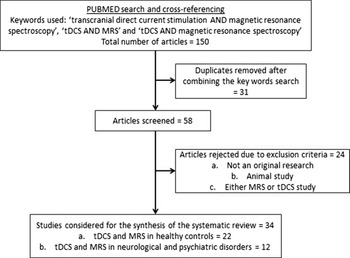
After considering the above-stated selection criteria, a total of 34 studies were reviewed, of which 22 reported results from healthy controls (HCs) and 12 were from patients with neurological and psychiatric disorders (Fig. 1).
The Preferred Reporting Items for Systematic Reviews and Meta-Analyses (PRISMA) flow chart.

Results
tDCS and MRS in healthy controls
Motor cortex
One of the earliest MRS and tDCS studies was done in a small sample of HCs to study the effect of single-session tDCS on mI level. In this double-blinded randomised control trials (RCT), single-session anodal tDCS over the right primary motor cortex showed a significant increase in mI levels only at the stimulation site compared to distant sites (Rango et al., Reference Rango, Cogiamanian, Marceglia, Barberis, Arighi, Biondetti and Priori2008). Similarly, in another study, anodal stimulation at the left primary motor cortex in HCs significantly reduced GABA. In contrast, cathodal tDCS significantly reduced Glu at the stimulation site compared to sham (Stagg et al., Reference Stagg, Best, Stephenson, O’shea, Wylezinska, Kincses, Morris, Matthews and Johansen-Berg2009). These findings demonstrated the differing effects of facilitatory (anodal stimulation) and inhibitory (cathodal stimulation) tDCS on neuro-metabolite levels at the site of stimulation. In yet another study, change in resting-state functional connectivity post-anodal tDCS was also correlated with neuro-metabolites changes at the site of stimulation in HCs. Anodal stimulation at the left primary motor cortex decreased the GABA level compared to baseline and sham stimulation (Bachtiar et al., Reference Bachtiar, Near, Johansen-Berg and Stagg2015). Furthermore, anodal tDCS at the motor cortex in elderly sample induced reduction in GABA and functional connectivity, but no correlation was observed between functional connectivity and GABA levels (Antonenko et al., Reference Antonenko, Schubert, Bohm, Ittermann, Aydin, Hayek, Grittner and Flöel2017). tDCS-induced changes in the elderly sample suggest that tDCS can lead to a reversal of age-related functional connectivity changes in the motor cortex. Further, in another study, a significant after-effect of tDCS was reported post-anodal tDCS over the primary motor cortex. It was observed that immediately following tDCS GABA reduced at the stimulation site, and the levels reduced further post-66 min of stimulation (Patel et al., Reference Patel, Romanzetti, Pellicano, Nitsche, Reetz and Binkofski2019). The continued change in GABA level suggests the effect of single-session anodal tDCS on long-term plasticity and neuro-metabolite and the role of neurotransmitters. Furthermore, anodal and cathodal tDCS at the left primary sensory-motor area reduced the GABA and Glu levels at the precentral gyrus. There was also an increase in the functional connectivity at this area during anodal stimulation (Antonenko et al., Reference Antonenko, Thielscher, Saturnino, Aydin, Ittermann, Grittner and Flöel2019).
To study the synergistic effect of tDCS and endogenous analgesia, tDCS was administered at the left primary motor cortex along with the diffuse noxious inhibitory control (DNIC) paradigm in HC. It was observed that both the tDCS and DNIC paradigm increased the pain threshold and had an additive effect. Post-tDCS increase in pain threshold was positively correlated with the baseline NAA levels at ACC and negatively correlated with the baseline Gln levels at thalamus (Reidler et al., Reference Reidler, Mendonca, Santana, Wang, Lenkinski, Motta, Marchand, Latif and Fregni2012). The findings supported the evidence that electrical stimulation modulates pain through a direct cortical effect on the thalamus and downstream effect on ACC (García-Larrea et al., Reference García-Larrea, Peyron, Mertens, Gregoire, Lavenne, Le Bars, Convers, Mauguière, Sindou and Laurent1999). A different study reported that tDCS had a region localised, polarity, and GABA-specific effect on motor learning and memory tasks. Only anodal tDCS at the left primary motor cortex decreased GABA concentration in the stimulated region. A decrease in GABA significantly correlated with increased motor memory retention in the force adaptation task. The study showed that tDCS-induced GABA changes can predict the performance in motor adaptation task (Kim et al., Reference Kim, Stephenson, Morris and Jackson2014). However, another study in the developmental age group observed no significant changes in either GABA or Glx levels when either anodal conventional tDCS or HD-tDCS was administered at the left motor cortex for five consecutive days (Nwaroh et al., Reference Nwaroh, Giuffre, Cole, Bell, Carlson, Macmaster, Kirton and Harris2020). The findings suggested that the developing brain and adult brain respond to brain stimulation differently.
Further, anodal tDCS at the left motor cortex decreased GABA level at the stimulation site and the contralateral site; cathodal tDCS decreased GABA at the contralateral site. However, bilateral motor cortex stimulation showed decreased GABA only at the targeted cathodal site (right motor cortex) in HCs (Bachtiar et al., Reference Bachtiar, Johnstone, Berrington, Lemke, Johansen-Berg, Emir and Stagg2018). Differences in the result of the three stimulation protocols might indicate an interaction between the networks determining the motor plasticity. Likewise, cathodal stimulation at the left motor cortex and anode at the right supplementary motor area showed an increased NAA ratio at the cathode site. There was a positive correlation between changes in absolute levels of NAA and Cr (Ryan et al., Reference Ryan, Wawrzyn, Gati, Chronik, Wong, Duggal and Bartha2018). However, when bilateral (anodal and cathodal active electrodes) primary motor cortex stimulation was administered to HCs, no significant changes were observed in neuro-metabolites in either of the motor cortex areas (Tremblay et al., Reference Tremblay, Lafleur, Proulx, Beaulé, Latulipe-Loiselle, Doyon, Marjańska and Théoret2016). The contradictory findings might suggest a limited impact of bilateral tDCS on the motor cortex in HCs compared to anodal/cathodal tDCS and need further evaluation in a larger sample size.
Dorsolateral prefrontal cortex
Pre, post, and online 31P MRS tDCS with anode at DLPFC and cathode at right DLPFC in a double-blinded sham-controlled single-session study have also reported insightful results. The results showed that brain pH rose during active tDCS and remained elevated post-stimulation. The discriminant analysis was able to classify the subjects into groups, one with decreased phosphomonoesters and inorganic phosphates (Pi) and increased pH and the other with increased phosphomonoesters and inorganic phosphates along with increased pH (Rae et al., Reference Rae, Lee, Ordidge, Alonzo and Loo2013). The finding showed that tDCS alters two separate biochemical processes: i) the cellular consumption of ATP causing hydrolysis of phosphocreatine, increasing the phosphomonoesters and Pi, which, in turn, increases the pH and ii) synthesis of ATP and phosphocreatine with a concomitant drop in Pi and phosphomonoester levels. Another study observed that when tDCS was administered on bilateral DLPFC and MRS was recorded during active tDCS, there were elevations in NAA and Glx at prefrontal cortex and striatum, respectively, but no change in GABA level was observed in either region. However, post-tDCS, there was no change in any neuro-metabolite levels compared to baseline (Hone-Blanchet et al., Reference Hone-Blanchet, Edden and Fecteau2016). The findings suggested that tDCS had immediate and short-lived excitatory effects at left DLPFC and that multiple tDCS sessions might induce long-term effects. However, another study showed that anodal or cathodal tDCS on left DLPFC in males did not impact working memory. There was no significant association between neurotransmitters’ level and the tDCS outcome (Talsma et al., Reference Talsma, Broekhuizen, Huisman and Slagter2018). The authors attributed these negative findings to large individual variations in strength and direction of tDCS effects and suggested future studies with larger sample size and individualised tDCS protocol.
Additionally, in another study, healthy individuals with greater GABA relative to Glu in the prefrontal cortex at baseline showed a different response to tDCS stimulation compared to those with lower GABA. It was observed that at left DLPFC, anodal or cathodal tDCS caused a higher level of disruption to response selection training gains in healthy individuals, associated with increased GABA following active tDCS compared to sham tDCS (Filmer et al., Reference Filmer, Ehrhardt, Bollmann, Mattingley and Dux2019). The study’s findings pointed towards the interaction between the cortical stimulation and pre-stimulation cortical metabolites level of the targeted cortex.
Parietal cortex
Other than motor cortex and DLPFC, few studies explored tDCS effects on the parietal cortex, temporal cortex, and cerebellar cortex. Anodal stimulation at the right parietal cortex in HC led to a combined increase in Glx only at the stimulation site and not the contralateral hemisphere, but total NAA (tNAA) was found to be elevated in both the hemispheres (Clark et al., Reference Clark, Coffman, Trumbo and Gasparovic2011). Further, anodal tDCS at the right parietal cortex increased the Glx compared to sham, and the change in Glx level predicted increased functional connectivity between the precuneus and other networks that included left frontal–parietal, superior parietal lobule, left frontal–parietal, basal ganglia, ACC, and related salience networks (Hunter et al., Reference Hunter, Coffman, Gasparovic, Calhoun, Trumbo and Clark2015). The observed relationship between Glx level and network connectivity might be useful to design tDCS protocols aimed at targeting specific brain networks.
Temporal and cerebellar cortex
It was also reported that anodal tDCS on the right temporal cortex could affect dormant memories’ re-expression. In the study, the participants were trained to identify coloured shapes, grey shapes, and their rotation and develop an association between the stimuli. If they made the correct associations, they were rewarded; otherwise, not. The participants were trained, and following tDCS, they were administered the test again and responded based on their memory. It was observed that following a single session of tDCS, there was a significant reduction in GABA, and it was correlated with an increase in cross-stimulus adaptation (Barron et al., Reference Barron, Vogels, Emir, Makin, O’shea, Clare, Jbabdi, Dolan and Behrens2016). However, in yet another study, no significant changes in GABA, NAA, or Glx levels were observed post-anodal or sham tDCS at the left posterior superior temporal gyrus (Dwyer et al., Reference Dwyer, Craven, Hirnstein, Kompus, Assmus, Ersland, Hugdahl and Grüner2018). The latter study’s contradictory finding can be attributed to the stimulation of different hemispheres and different temporal cortex regions compared to the Barron et al. study. While the former study stimulated the T6 region, Dwyer et al. stimulated the region between T3 and T5. Lastly, anodal tDCS on the right cerebellar cortex of HC did not affect the visuomotor adaptation but increased the retention of motor memory, which significantly correlated with decreased Glu level during online tDCS (Jalali et al., Reference Jalali, Chowdhury, Wilson, Miall and Galea2018). The study was the first to point towards the neural mechanisms that may underlie cerebellar tDCS.
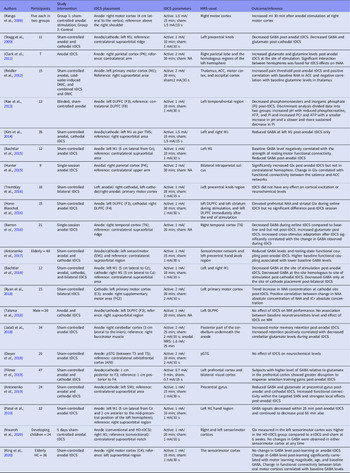
Altogether, the findings of MRS and tDCS studies in HC evidence that tDCS alters plasticity by modifying the resting membrane potential and affects the neuro-metabolites levels at the region of interest in a polarity-specific manner. These tDCS-specific changes in metabolites can be effectively studied by MRS. However, it has to be noted that the change in the neuro-metabolites during stimulation and post-tDCS through site-specific might not always be limited to the site of stimulation (Table 1).
Effect of tDCS on neurochemical levels in healthy controls

Glx, glutamine/glutamate; GABA, gamma-aminobutyric acid; NAA, N-acetyl aspartate; Cr, creatine; Cho, choline containing compounds; Gln, glutamine; Glu, glutamate; mI, myo-inositol; pSTG, posterior superior temporal gyrus; M1, primary motor cortex; DLPFC, dorsolateral prefrontal cortex; ACC, anterior cingulate cortex.
tDCS and MRS in neurological and psychiatric disorders
tDCS has been increasingly administered to alter the cortical excitability across various neurological and psychiatric studies. However, studies exploring the effect of tDCS on the level of neuro-metabolites are sparse.
Neurological disorders
One of the studies comparing the effect of tDCS on chronic stroke patients on the primary motor cortex reported that GABA levels in the ipsilateral motor cortex (motor cortex affected by stroke) in patients could predict the effect of anodal tDCS (O’Shea et al., Reference O’shea, Boudrias, Stagg, Bachtiar, Kischka, Blicher and Johansen-Berg2014). This study also reported that anodal and cathodal tDCS was better compared to bilateral tDCS concerning the findings that GABA levels under the site of stimulation were able to predict behavioural gains from anodal tDCS and no change in membrane potential after bilateral tDCS. Likewise, in adults with a history of stroke, the effect of cathodal tDCS on motor performance was negatively associated with GABA levels in the ipsilesional (same side as the lesion) area (McCambridge et al., Reference Mccambridge, Stinear and Byblow2018). Taken together, the neuro-metabolite markers and tDCS effects can be used to further optimise tDCS delivery protocol in stroke patients. Additionally, the effect of tDCS on neuro-metabolites was reported in patients with pelvic pain compared to HCs and in females with fibromyalgia. In patients with pelvic pain, it was observed that after 10 sessions of active tDCS increase in pain threshold had a significant positive correlation with Gln and Glx in thalamus and NAA in ACC. Also, there was a positive correlation between increased pain threshold and MI/Cr in the thalamus and primary motor cortex (Simis et al., Reference Simis, Reidler, Duarte Macea, Moreno Duarte, Wang, Lenkinski, Petrozza and Fregni2015). The study indicated that tDCS increases the pain threshold, and it was associated with biochemical changes in the pain circuit. In patients with fibromyalgia, post-5 sessions of active tDCS, there was a significant decrease in both pain and Glx at ACC and thalami compared to sham. Compared to baseline, post-sham tDCS, there was a substantial increase in NAA level in the posterior insula (Foerster et al., Reference Foerster, Nascimento, Deboer, Bender, Rice, Truong, Bikson, Clauw, Zubieta, Harris and Dasilva2015).
Additionally, in patients with neuropathic pain with spinal cord injury, anodal tDCS to the left motor cortex showed a reduction in pain with an increase in Glx and NAA ratios in the ACC (Auvichayapat et al., Reference Auvichayapat, Keeratitanont, Janyachareon and Auvichayapat2018). The findings from the above two studies imply that tDCS can have a possible benefit in pain, and tDCS-induced changes may in part be due to the alterations in neurochemical levels in ACC. On the other hand, although increased GABA levels were found to be associated with several mild traumatic brain injury episodes, anodal tDCS at the motor cortex in participants with mild traumatic brain injury did not alter either the GABA levels or the GABAB receptor activity (Wilke et al., Reference Wilke, List, Mekle, Lindenberg, Bukowski, Ott, Schubert, Ittermann and Flöel2017). No effect of tDCS might suggest that a single session of tDCS and small sample size in the study were underpowered. Experimental design deploying larger samples or multiple sessions can give more insight.
Interestingly, in children with muscle spasticity, anodal tDCS at the left motor cortex led to a significant increase in the ratio of NAA, Cho, and mI in the basal ganglia and Glx at the stimulation site. Also, post-tDCS, there was a negative correlation between change in spasticity and NAA and Glx levels (Auvichayapat et al., Reference Auvichayapat, Aree-Uea, Auvichayapat, Phuttharak, Janyacharoen, Tunkamnerdthai, Boonphongsathian, Ngernyam and Keeratitanont2017). In a different study, tDCS at the contralateral motor cortex in the stroke patients also significantly correlated with the change in neuro-metabolite levels at the stimulation site. In children with a history of perinatal stroke receiving cathodal tDCS at the contralateral motor cortex for 10 days, tDCS reduced Glx and Cr at the stimulation site compared to sham. It was also observed that baseline learning function was correlated with lesioned motor cortex NAA, Cr, and Glx (Carlson et al., Reference Carlson, Ciechanski, Harris, Macmaster and Kirton2018). The above studies’ observations suggest that multiple session tDCS is safe in children, and the changes in neuro-metabolite level reflect the plasticity mechanism of tDCS and can serve as possible response biomarkers.
Lastly, 15 sessions of anodal tDCS over the left inferior frontal gyrus and language therapy in progressive aphasia patients decreased the GABA level post-tDCS and remained decreased post 2 months (Harris et al., Reference Harris, Wang, Ficek, Webster, Edden and Tsapkini2019). The findings indicate the long-term effect of tDCS and clinical utility of tDCS in aphasia alongside language therapy.
Psychiatric disorders
In schizophrenia patients with auditory hallucinations cathodal stimulation at the left temporal, parietal junction (TPJ), and anodal stimulation at left DLPFC did not alter Glu. Still, there was a positive correlation between pre-tDCS Glu at left TPJ and hallucination improvement post tDCS (Iglesias et al., 2018). The study’s findings implied that tDCS-induced improvement was better in individuals with less severe TPJ glutamatergic hyperactivity. Similarly, in patients with pathological gambling, stimulation with anode at right DLPFC and cathode at left DLPFC elevated the prefrontal GABA level. Risk-taking, impulsivity, and craving during active stimulation were correlated with prefrontal Glx and striatal GABA, striatal NAA, and striatal Glx, respectively (Dickler et al., Reference Dickler, Lenglos, Renauld, Ferland, Edden, Leblond and Fecteau2018).
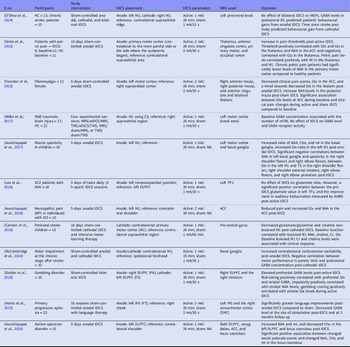
Altogether, in adult patients with stroke, multiple tDCS stimulation session at the primary motor cortex was negatively correlated with GABA level and that the baseline GABA level was able to predict the tDCS outcome. Whereas in adolescents with stroke, tDCS reduced Glx, and there was a significant correlation between learning and NAA and Glx. tDCS for pain management increased pain threshold and altered Glx and NAA in brain regions like the thalamus and ACC. tDCS at IFC and language therapy together reduced GABA lost tDCS. In the psychiatric population, baseline Glx at left TPJ was correlated with improved hallucinations post-tDCS in schizophrenia patients. Similarly, Glx, GABA, and NAA at baseline were correlated with risk-taking, impulsivity, and craving (Table 2).
Effect of tDCS on neurochemical levels in neurological and psychiatric disorders

Glx, glutamine/glutamate; GABA, gamma-aminobutyric acid; NAA, N-acetyl aspartate; Cr, creatine; Cho, choline containing compounds; Gln, glutamine; Glu, glutamate; mI, myo-inositol; pSTG, posterior superior temporal gyrus; M1, primary motor cortex; DLPFC, dorsolateral prefrontal cortex; ACC, anterior cingulate cortex; TPJ, temporoparietal cortex; IFG, inferior frontal cortex; SCZ, schizophrenia; SCI, spinal cord injury.
Discussion
Summary of the evidence
Overall, we reviewed 34 full-text articles and extracted the main findings of the effect of tDCS on neuro-metabolites, as evidenced by MRS. In both HCs and patients, tDCS alters the level of multiple neuro-metabolites, specifically but not limited to the site of stimulation. tDCS-induced neuro-metabolite changes were found to be evident not only during stimulation but also post-stimulation. Also, interactions between change in clinical scores, cognitive or motor tasks, and functional connectivity with the change in metabolite levels were noted. The findings from the studies reviewed demonstrate that the plasticity changes induced by tDCS not only involve the excitatory or inhibitory neurotransmitters but also involve the regulation of a broad spectrum of neuro-metabolites, including NAA, Cr, and more.
Key findings from HC MRS and tDCS state that, firstly, primary motor cortex and DLPFC are the most explored areas for tDCS stimulation, with few studies exploring other regions like the parietal and temporal cortex. Secondly, Glx and GABA are the frequently studied neuro-metabolites probably due to the excitatory and inhibitory nomenclature of these neuro-chemicals, which overlaps with tDCS stimulation parameters. Thirdly, stimulation with one active electrode (only cathode or anode on the scalp and reference away from the scalp) has a significantly different and positive outcome on metabolites level compared to two active electrodes (both anode and cathode placed on the scalp). Fourthly, it was also observed that the developing age-group, adults, and elderly have a different response to tDCS stimulation. Lastly, the changes in metabolites during active tDCS sessions (simultaneous tDCS and MRS) and post-tDCS and, during resting-state and active task-state differ significantly. However, it should be noted that even though the findings reported are from RCTs, they are reported from a single session, small sample size, and varying stimulation protocols. Even though the findings cannot be directly translated into the diseased state nevertheless, it can be said that MRS is a powerful tool to study the effects of tDCS on neuro-metabolite changes.
Further, key findings from the patient population showed that, firstly, multiple sessions of tDCS were effective in elevating the pain thresholds, and the tDCS outcome in stroke patients and pain was significantly correlated with baseline neuro-metabolite levels. Secondly, apart from Glx and GABA, NAA is also implicated considerably in neurological disorders, particularly stroke and pain. Thirdly, in adolescents, too, multiple sessions of tDCS were effective in alleviating the neurological symptoms, and there was a significant correlation between tDCS outcome and mainly Glx and NAA levels along with other neuro-metabolites. Even though there are only two studies with psychiatric disorders, it was observed that change in hallucination scores post-tDCS was correlated with baseline levels of Glx, and risk-taking behaviour during tDCS in pathological gamblers was correlated with Glx, GABA, and NAA. Based on these findings, it can be stated that Glx, GABA, and NAA are primarily implicated in a diseased state. The baseline levels of these metabolites can be a predictive factor in tDCS-related outcomes. To summarise, the review presents MRS as a potent tool to study the regional effects of tDCS on neuro-metabolite changes and to differentiate between the effects of facilitatory and inhibitory tDCS in health and disease (Stagg et al., Reference Stagg, Best, Stephenson, O’shea, Wylezinska, Kincses, Morris, Matthews and Johansen-Berg2009, Kim et al., Reference Kim, Stephenson, Morris and Jackson2014, Antonenko et al., Reference Antonenko, Schubert, Bohm, Ittermann, Aydin, Hayek, Grittner and Flöel2017, McCambridge et al., Reference Mccambridge, Stinear and Byblow2018, Antonenko et al., Reference Antonenko, Thielscher, Saturnino, Aydin, Ittermann, Grittner and Flöel2019). Bilateral tDCS has different outcomes compared to anodal, cathodal, or sham tDCS (O’Shea et al., Reference O’shea, Boudrias, Stagg, Bachtiar, Kischka, Blicher and Johansen-Berg2014, Tremblay et al., Reference Tremblay, Lafleur, Proulx, Beaulé, Latulipe-Loiselle, Doyon, Marjańska and Théoret2016, Bachtiar et al., Reference Bachtiar, Johnstone, Berrington, Lemke, Johansen-Berg, Emir and Stagg2018, Dickler et al., Reference Dickler, Lenglos, Renauld, Ferland, Edden, Leblond and Fecteau2018). Furthermore, the review highlights that the state of the subject during tDCS administration (resting-state or active task-state) can also significantly affect the tDCS-induced neuro-metabolite changes and neuro-metabolite and hence the outcome of tDCS (Barron et al., Reference Barron, Vogels, Emir, Makin, O’shea, Clare, Jbabdi, Dolan and Behrens2016, Hone-Blanchet et al., Reference Hone-Blanchet, Edden and Fecteau2016, Antonenko et al., Reference Antonenko, Schubert, Bohm, Ittermann, Aydin, Hayek, Grittner and Flöel2017, Carlson et al., Reference Carlson, Ciechanski, Harris, Macmaster and Kirton2018, Jalali et al., Reference Jalali, Chowdhury, Wilson, Miall and Galea2018, Filmer et al., Reference Filmer, Ehrhardt, Bollmann, Mattingley and Dux2019, Harris et al., Reference Harris, Wang, Ficek, Webster, Edden and Tsapkini2019). Additionally, baseline levels of the neuro-metabolite can also, to a certain extent, predict the level of tDCS-induced changes, which in the future could determine the dose of tDCS (Kim et al., Reference Kim, Stephenson, Morris and Jackson2014, Foerster et al., Reference Foerster, Nascimento, Deboer, Bender, Rice, Truong, Bikson, Clauw, Zubieta, Harris and Dasilva2015, Iglesias et al., 2018). Knowledge of the impact of administrative state and baseline levels can help map out the interaction effects between these parameters and tDCS, guiding us towards designing more individualised protocols and deriving more benefits from this non-invasive treatment modality.
Limitations in the current knowledge
Although tDCS is becoming an increasingly popular non-invasive neuromodulation technique, few studies examine the neurobiological mechanism associated with tDCS. The majority of the tDCS and MRS studies have primarily looked into motor cortex changes. Even though the motor cortex-related findings are relevant for disorders like chronic pain and stroke rehabilitation, translation of these findings might not apply to other brain regions and disorders. Another critical issue that has not been adequately addressed is the effect of multiple tDCS sessions. Even with the studies conducted in a sham-controlled randomised structure, the effect of single-session tDCS might give us insight into the short-term effect of tDCS on the neuro-metabolite levels. Nonetheless, the effect of multiple sessions and the after-effect of tDCS need further investigation.
Yet another significant limitation is the difference in tDCS stimulation parameters across the studies. For instance, the studies reporting the motor cortex findings have used different current strength and stimulation periods. With an additional limitation of small sample size in these studies, it is difficult to ascertain if the recent findings will hold or change with larger sample size and different tDCS parameter.
Lastly, the impact of medicines and treatment resistance on the neuro-metabolite levels and its interaction with tDCS modulations has been left unaddressed in the present literature. As medicines have a significant impact on tDCS effects (Nitsche et al., Reference Nitsche, Grundey, Liebetanz, Lang, Tergau and Paulus2004, Kuo et al., Reference Kuo, Grosch, Fregni, Paulus and Nitsche2007, Agarwal et al., Reference Agarwal, Bose, Shivakumar, Narayanaswamy, Chhabra, Kalmady, Varambally, Nitsche, Venkatasubramanian and Gangadhar2016), the clinical studies should report the interaction effects of tDCS-modulated neuro-metabolites and medications so has to interpret the results in a more informed and confounder controlled way.
Conclusions
In patients with multiple neurological and psychiatric disorders, alteration in neuro-metabolites has been identified relatively consistently. However, although tDCS has shown promising effects in alleviating symptoms of various neurological and psychiatric disorders, there are limited studies that have reported the effect of tDCS on neuro-metabolite levels. Moreover, the current evidence from electrophysiological, functional, and membrane potential studies examining the action mechanism of tDCS might be incomplete without looking into the effect on neuro-metabolites. However, there is a vast heterogeneity of published studies in terms of tDCS protocols and MRS acquisitions, with the majority of the studies being focused on single-session effects. The major challenges with MRS studies are varied methodology, metabolites assessed, resolution, correction methods, SNR, and more.
Moreover, it is crucial to examine these effects in randomised studies. Further, multi-modal assessment with evaluations of neuro-haemodynamic, neuro-metabolite, as well as an assessment of electrophysiological parameters might provide us better and wholesome, if not complete understanding of the mechanistic basis of tDCS. Therefore, studies should focus on exploring tDCS effects on neuro-metabolites of the brain in a systematic manner. Additionally, the current MRS studies have overlooked the potential impact of the medications on these neuro-metabolites. Hence, protocols on un-medicated patients would enable to delineate the stand-alone effects of tDCS. Lastly, emphasis on combined MRS and tDCS should be given towards studies in psychiatric patients in the light of promising effects of tDCS on clinical outcome in disorders like depression, schizophrenia, and OCD to understand the neurological changes and potentially unravel the neuro-metabolite × tDCS interaction effect that can be translated into individualised treatment.
Acknowledgements
This work is supported by the Wellcome Trust-DBT India Alliance Intermediate Fellowship grant to JCN. HC and VHT are supported by the grant to JCN. VSK is supported by the Wellcome Trust-DBT India Alliance Early Career Fellowship grant (IA/CPHE/18/1/503956). GV has a Research Grant from the Department of Science and Technology (Government of India) GV (DST/SJF/LSA-02/2014-5).
Authors contributions
Conceptualisation of the study: HC, JCN, and GV; article search and the first draft of the manuscript: HC, VHT; editing of manuscript: VSK; all other authors have contributed to the final draft.
Financial support
This work is supported by the Wellcome Trust-DBT India Alliance Intermediate Fellowship grant to JCN (IA/CPHI/16/1/502662).
Conflict of interest
There are no potential conflicts of interest to report for any of the authors.