The starting point of this paper is the proposition that in the twelfth and early thirteenth centuries the writings of philosophers and others on the city, its visual representation and its politics occupied a common space that historians can profitably explore. This approach to an understanding of urban culture is familiar enough in later medieval studies, most notably concerning Italy,Footnote 1 but it has not been adopted for London, especially in this much earlier period. Some of the texts concerning London are marked by a distinct visual sensibility, while the stories they told had an impact on the way in which the city was portrayed graphically. Some of those stories gave Londoners a strong sense of their past and were influenced by responses to the physical environment of the city, which thereby became an object for structured thought. That sense of history informed ideas of what was appropriate political action in the present, while at the same time political objectives informed rhetorical manipulations of texts concerning history, custom and law with a view to justifying what was currently desired.
London's politics in this period were complex and, as today, shaped by internal conflicts and by relations with powers outside the city itself. While some of the personal and family interests of Londoners and a few dramatic incidents emerge clearly from the records, much of the city's political life remains obscure and cannot be explored here.Footnote 2 A key relationship was that between London and the Crown, which drew heavily on the city for financial and other material support and exercised an undisputed lordship over it, while the same time acknowledging the collective rights of a large but ill-defined group of ‘citizens’ and allowing a degree of self-determination to certain specialised groups. This relationship was close, tense, ambiguous and sometimes confrontational, especially in periods of wider conflict, as during the baronial opposition to King John. Internally, the city's politics were structured in part by interests associated with commerce, manufactures and hierarchies of wealth and power, and in part by loyalties which could cut across class or family concerns. This paper's approach to the politics is through some of the London concerns apparent in that great collection of national laws, pseudo-laws and London customs which was put together around the time of Magna Carta and for more than a century afterwards remained intact within the city's archive. For convenience, it is described here as the ‘London Collection’.Footnote 3 The compilation illuminates the political struggle which led up to the charter, but also strongly indicates the way in which London's elite pursued its interests and defined and visualised them within a broad historical and geographical landscape.
Most parts of Europe in the eleventh and twelfth centuries witnessed a remarkable growth of towns and cities.Footnote 4 In England, the material evidence for rapid growth seems more apparent for the eleventh century than for the twelfth, but development picked up again rapidly from about 1180 onwards. Overall, however, the twelfth century was marked by the proliferation of literary and philosophical writing on the city. One strand focused on neo-Platonist ideas of the city or the state, and developed an organological notion of the hierarchical structure of these institutions, a model that became most widely known through John of Salisbury's Policraticus written in the 1150s. There were significant spatial and material elements in these discussions. Thus the arx or citadel was associated with the wise men or elders – the Senate – who governed the city under the prince, while the suburb outside the city was the preserve of those who tilled the fields and served as the feet of the body politic. Several treatises included, in the same low position, those craftsmen whose mechanical arts, sometimes listed in detail, sustained the city.Footnote 5 This indicates a striking scholarly engagement with everyday aspects of urban life. Another important strand was the revival of the literary genre of the description and praise of cities, of which an influential example was the Mirabilia Urbis Romae compiled at about the time of the establishment of the Roman commune and the restoration of the Senate in 1143.Footnote 6 Many such texts, though incorporating accurate observation of the urban scene, were rhetorical, idealising constructions that drew on ancient models and a standard repertoire of themes. These included the status of the city by comparison with notable places such as Rome; origins and heroic founders; the character and institutions of the inhabitants; and the appealing nature of the site and its landscape setting, which were often characterised with acute visual awareness.Footnote 7
It is hardly surprising that the most compelling of the twelfth-century visualisations of urban landscape is that of a poet, Chrétien de Troyes, who about 1180 adopted a viewpoint that reminds modern readers of the passage in de Certeau's La pratique de la quotidienne, concerning visual engagement with the city as seen from above and as a walker in the street.Footnote 8 De Certeau was inspired by the skyscraper view of New York, while Chrétien, in a work containing many allusions to the commerce and politics of towns, describes how Gawain observed a town as if from above, his gaze traversing the streets and squares, and encountering the variety of tradesmen with their specialised commodities and skills:
[Gawain] gazes on site of the castle, which sat on an arm of the sea, and saw that the walls and the tower were so strong that they feared no assault. He gazes on at the entire town, thronging with many fair people and the tables of the moneychangers all covered with gold and silver and coins. He sees the squares and streets all full of good workmen engaged in different crafts according to their various skills. One makes helmets and another coats of mail; one saddles and another shields; one bridles and another spurs; here they furbish swords. Here they full cloths and here they weave them; here they teasel them and here they shear them. Here they forge and cast silver, and they make fine and expensive things: chalices, cups and bowls and vessels worked in niello, rings, belts, and buckles. One might well believe and declare that the town held a fair every day, filled as it was with so many riches: wax, pepper, grain [an expensive dye], ermine and grey furs, and all kinds of merchandise. They gaze on all these things, looking here and there.Footnote 9
This evocation echoes contemporary philosophical concerns with the mechanical arts and prefigures thirteenth-century and later attempts to find a language for the exciting world of specialised luxury goods. Chrétien's repetition of verbs denoting seeing (esgarder, voire, regarder) emphasises the visual engagement both with city space and with the selection and consumption of commodities, a feature of later texts dealing with such topics.Footnote 10 Moreover, mundane legal and administrative records of English and French towns in the period confirm the essential veracity of Chrétien's account, which could easily concern English cities such as London or Winchester, both of which he probably knew.Footnote 11
Several twelfth-century texts engaged directly with London's landscape. The most popular and influential of them was Geoffrey of Monmouth's fictional ‘History of the Kings of Britain’, completed about 1136, a major theme in which is the destiny of the city and its association with a single realm of Britain.Footnote 12 In a careful exercise of literary construction, Geoffrey placed the ‘Prophecies of Merlin’ in his work just before his account of Arthur, thereby sacralising the prophesied events which subsequently unfolded in his story, including the fortunes of London.Footnote 13 Like later urban historians, Geoffrey includes among his starting points the real monuments and place-names of the city. By associating these landmarks with events in an invented history from his alleged Trojan foundation of London onwards and by connecting his fable in this way to the known world, Geoffrey lent an air of verisimilitude to his fable and at the same time invited his audience to reflect on the events and experiences of his own time.Footnote 14 Thus, Ludgate gives us King Lud, buried next to the gate, while Billingsgate gives us Belinus, the prince who had built a marvellous (but fictional) tower there with a gate opening on to the port where ships tied up, as indeed they actually did in Geoffrey's time at Billingsgate's distinctive harbour.Footnote 15 In a prophetic passage attributed to Merlin he seems to allude to plans to strengthen the defences by introducing the river into an enlarged city ditch, a project that was to be attempted at the Tower of London in 1190.Footnote 16 John Clark has noted that archaeological discoveries in London of Roman bronze statues, not in themselves unlikely, could explain Geoffrey's story of the embalmed body of Cadwallo being encased in a bronze equestrian statute placed on Ludgate.Footnote 17 On the other hand, awareness of the comparable statue of Constantine (as was then believed, but which we now know to be one of Marcus Aurelius) outside the Lateran palace in Rome, described in the Mirabilia,Footnote 18 may be a sufficient explanation and one which would allow an assertion of London's status by association with Rome. Geoffrey's account suggests a special interest in St Paul's cathedral and its environs, not least in the matter of the cathedral's claim to metropolitan status, but also in his mention of London as the burial place of kings and his references to Ludgate and the adjacent church of St Martin.Footnote 19 His audience of courtiers and clergy would have included its learned canons. A later dean, Ralph de Diceto, drew on Geoffrey's writings in his own historical work and John of Salisbury mocked the metropolitan pretensions of the see in a quasi-Galfredian remark about the bishop's intention to convert the cathedral into a Temple of Jupiter.Footnote 20 Such links may explain the fact that by the early thirteenth century a property between St Paul's and the river was known as ‘the house of Diana’, possibly an allusion to the goddess who in Geoffrey's story had prophesied that the Trojan Brutus would found a new city in a distant island. Brutus called his city ‘New Troy’, a notion that quickly became embedded in London's historical identity.Footnote 21
Today, the most famous twelfth-century account of London is that which William fitz Stephen wrote about 1173 and placed at the beginning of his life of Thomas the recently martyred archbishop of Canterbury, the city's most famous son and soon to be adopted by the citizens as their special patron.Footnote 22 This relentlessly rhetorical work in its idealisation of London deploys a horde of Latin tags and covers virtually the entire repertoire of city praise. Nevertheless, it contains much that is demonstrably true and is notable for its sense of the landscape of the city, the specialised trades there and the surrounding territory.Footnote 23 In these respects, William's text can be associated with a style of historical and quasi-historical writing in twelfth-century England that displays a special concern with the geography and landscape of the kingdom, associating them with a new interpretation of the structure of British and English history marked by successive phases of order and disorder and by new senses of the western and northern frontiers of the realm and of the lesser, barbarous peoples beyond.Footnote 24 William's reading of snippets from Virgil and other classical authors may have stimulated his visual imagination, but he also drew on twelfth-century writing in a way that indicates familiarity with discourses concerning London and cities in general. From Geoffrey of Monmouth he adopted the city's Trojan origin and the prophecy concerning its status as a metropolitan see, while Geoffrey's stories of the city walls and towers perhaps influenced his own detailed description. Notions of hierarchy and authority, which inform William's emphasis on good lordship, may also lie behind his use of the phrase arx palatina to denote the Tower of London, which is clearly intended to pair it with the palatium regium at Westminster. The other great fortresses at the west end of the city, no longer in royal hands, were simply castella.Footnote 25 Though proudly noting that London was older than Rome, he points out that both cities used ancient laws and had institutions in common, such as a Senate, lesser magistrates, separate courts and regular assemblies. The London senators were its aldermen, whom the archbishop of Rouen, perhaps thinking of contemporary events in Rome, had addressed by that title when he wrote to the London commune at a date between 1141 and 1144.Footnote 26 Claims specific to London lie behind William's mention of the citizens' hunting rights in the surrounding territory, detailed in the charter of Henry I to the Londoners, which has been claimed as a genuine royal charter issued in 1133 but is more likely to be a later compilation based on a charter of Stephen and possibly, as suggested below, further elaborated after William wrote his account of London.Footnote 27
To judge from the number of surviving manuscripts, William fitz Stephen's praise of London was not widely circulated, although it seems to have influenced some later writing, perhaps including a mid-thirteenth-century verse abridgement of Geoffrey's History, which elaborated the account of the setting of the city founded by Brutus by detailing the surrounding fields, meadows and woodland.Footnote 28 William's text was certainly known to thirteenth-century Londoners and was used to preface a later collection of the city's customs.Footnote 29 Moreover, the last quarter of the twelfth century was remarkable for a proliferation of brief descriptions of London's landscape, wealth and trade, most of which drew on Geoffrey of Monmouth's History and to a lesser extent on fitz Stephen's description, but in some cases added distinctive characterisations of their own. They include one perhaps by Hugh of Montacute and so dating to about 1170;Footnote 30 metrical descriptions by Alexander Neckam of about 1200, which emphasise London as the burial place of kings and especially note the fish of the river Thames;Footnote 31 and Gervase of Tilbury's remarkable account, which noted the stability of London's food supply, described the way in which the Thames at high tide flowed around the Tower and characterised the Thames as being more like a sea than a river, thereby suggesting a link with Chrétien's description of his fictional town. Gervase's description is embedded in a text that he addressed to the Emperor Otto IV about 1215, a critical period for the emperor's interest in the city.Footnote 32
Texts such as these almost certainly informed the earliest surviving graphic representations of medieval London, in what one could describe as reverse ekphrasis. The earliest of them are on the city's common seal, the ‘seal of the barons of London’, recently characterised as ‘one of the outstanding civic seals of medieval Europe’ (Figure 1). On one side it displays St Paul and on the other St Thomas, each in relation to the city landscape. Its style suggests that the seal was commissioned about 1220, the year of the translation of Thomas's remains at Canterbury on the Jubilee of his martyrdom, when the citizens were initiating an effort to commemorate him at his birthplace in the city.Footnote 33 It includes a striking and in many ways realistic panorama of London. St Paul's occupies a central position with its tall spire, probably the ‘tower’ completed in 1221. To either side are substantial fortifications, representing the Tower of London to the east and Baynard's Castle to the west. The view seems to show the river Thames lapping against the city wall. Roman London had been walled against the river, but visible traces of that part of the walled circuit had probably disappeared long before 1100, so the image may rather have been inspired by fitz Stephen's account of a wall with towers which had once enclosed the city on the south but had been washed away, a notion itself perhaps derived less from observation or from knowledge of actual events than from Geoffrey of Monmouth's story of how King Lud had entirely surrounded the city with walls and towers. Certainly, the accounts and depictions of this period convey the idea, common in representations of cities, that London's wall made a complete and perfect circuit. The great tower with the gate opening towards the river shown on the seal may be intended to represent Belinus's tower at Billingsgate. In this way Geoffrey's History both shaped perception of the city and became entwined with expressions of its political identity. The other side of the seal portrays the Londoners before St Thomas, in what seems to be a group of men on one side and a group of women, apparently portrayed as Roman matrons, on the other. This portrayal may refer to fitz Stephen's text, where there is a comparable juxtaposition between an account of the dignity of the citizens and a statement in praise of London's matrons as ipsae Sabinae.
Seal of the barons of London, c. 1220, drawings from surviving impressions.

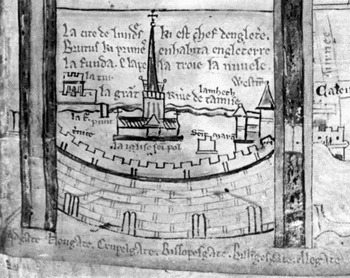
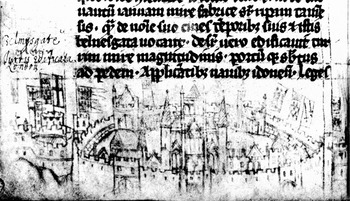
Matthew Paris's famous sketch of London (Figure 2) conveys similar messages.Footnote 34 Again, St Paul's is the focal point within a circuit of walls. The text above describes the city as chef dengleterre and founded by Brutus who called it New Troy. Below, six city gates are named and are indicated by distinctive signs. This underlines the fact that the drawing serves as an ideograph rather than an exact representation, for one important city gate, Aldersgate, is omitted and Billingsgate, which was not a gate at all, is included. The mythical ‘tower of Billingsgate’ may be intended by the words la tur just west of London Bridge (punt), while the Tower of London itself is shown on the other side of the river. This total of seven gates, one of them mythical, may justify William fitz Stephen's allusion to Thebes in his account of London's defences, which he said included seven double gates in the city wall. Indeed, Matthew Paris's signs indicate double gates. An equally meaningful graphic representation is an early fourteenth-century sketch added below the Billingsgate section of an earlier text of Geoffrey of Monmouth's History (Figure 3). Again, the view is south, with St Paul's at the centre and the Tower of London to the left. The city walls are shown as a complete circuit. Against the river, to the west of the Tower of London, the large gate-tower is presumably intended as that erected by Belinus.
London as depicted by Matthew Paris in his itinerary from London to Apulia, c. 1252. (© British Library Board. All Rights Reserved. BL, Royal MS 14 c.vii, fo. 2).

Drawing of London c. 1300, added to a text of Geoffrey of Monmouth's ‘History of the Kings of Britain’, below the story of Billingsgate. (© British Library Board. All Rights Reserved. BL, Royal MS 13 a.iii, fo. 28v).

The consistency in these representations suggests that this image of London and its expressions in historical or quasi-historical texts was widely appreciated. They also relate to an understanding of London as the capital and organising principle of the kingdom. This idea had been current for some time and in particular was articulated during the 1140s in accounts of the events in King Stephen's troubled reign: London was the ‘queen metropolis of the kingdom’ and the ‘head of the whole kingdom’, while the Londoners were ‘in effect magnates because of the greatness of their city in England’.Footnote 35 For fitz Stephen, some decades later, the city was the ‘seat of the kingdom of the English’ and the bishops and lay magnates were ‘almost to be counted as citizens because of their frequent attendance there for councils and on their own business’.
This conjunction of text and image brings us to the London Collection and politics. The collection now survives in two parts, one in Manchester and the other in the British Library, each containing about 130 folios.Footnote 36 The text is largely intact, but not without some damage and possible disordering in the final section of the work. It was written by two scribes. The first, using a script of an older style than that of the second, was at work after 1204 and wrote the whole of the Manchester part and the first four-fifths of the British Library part, carrying the collection of materials into the reign of John. The ruling and layout of the text demonstrates that the second scribe's work (beginning on fo. 104v, immediately below the final lines written by the first scribe) was intended as part of the same overall project. He copied several items originating before 1204 and others datable to 1205–6 and later, the latest of which is a list of the city's sheriffs holding office between the years 1188–9 and 1216–17.Footnote 37 The second scribe probably worked over a short period, perhaps at some time between 1214 and 1216, and at least a part of his text was completed after Prince Louis's invasion or even after the death of King John. His role was to order and copy texts relating specifically to the citizens of London and their objectives at that time. The first scribe's work, perhaps undertaken immediately before that of the second scribe, had consisted mostly of copying earlier laws, but it included linking material specially composed for the occasion. The many ‘London interpolations’ in the texts of the laws, especially those in the ‘Laws of Edward the Confessor’, may have been made at that time. Adjustments, and even additions, to an existing text of the supposed charter of Henry I to the citizens may have been part of this programme. The laws of Henry II are represented by a distinctive and somewhat confused version of Glanville.Footnote 38 The resonances between the two parts of the collection seem to be a deliberate literary and polemical device, indicating that the compilation as a whole and the interpolations in the earlier texts were planned and executed as a single programmatic scheme, most likely in London and during the years immediately before and after the granting of Magna Carta in June 1215.
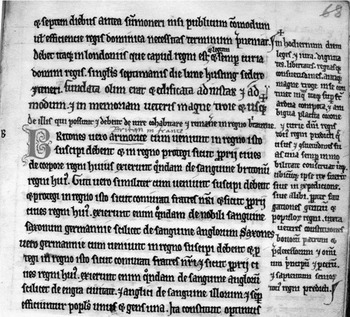
Although the text is well ordered and decorated overall, it is clear that both scribes were hasty and sometimes inaccurate, necessitating marginal corrections and additions. Haste is also indicated by the leaving of gaps for text to be inserted later. Insertions sometimes turned out to be too large for the space available and some gaps were not filled (Figure 4). The high incidence of ruled but unwritten gaps in the folios of the second scribe's section suggests that the project of gathering London's laws and customs was both hasty and not so much completed in 1216–17 as abandoned on the death of King John. The appearance of the manuscript thus conveys the drama of time in which it written, with much of the linking material or introductory material placed between sections apparently not having been fully composed by the time that the copying of those sections had been completed. Parts of a run of several blank folios left by the first scribe were used by a third for transcripts of two additional texts.Footnote 39 These were documents of London interest, but the folios were ruled and written in a format and style very different from that of the other two scribes and so the texts presumably were inserted after, but perhaps not long after, 1216–17. These two documents have been discussed as if they were an integral part of the collection and had a bearing on its purpose, but that was clearly not the case.Footnote 40 They are the only suggestion of any later use of the manuscript as a place for collecting additional material relevant to the city, although marginal annotations show that it was carefully scrutinised during the late thirteenth and early fourteenth centuries by those interested in the city's laws.
The hasty composition of the ‘London Collection’, showing how the account of London's foundation in memory of Troy was added after the description of the city's court of Husting and then continued in the margin. The description of Husting relates to a clause in Henry I's supposed charter to the citizens of London copied earlier in the collection. All the material on this folio is part of the longest of the ‘London interpolations’ in the text of the ‘Laws of Edward the Confessor’; for this section of the text, see Gesetze, ed. Liebermann, i, 657. (Manchester, the John Rylands University Library, Rylands Latin MS 155, fo. 69).

The overall context and purpose of this collection has long been appreciated, not least as a result of the careful analysis and pithy comments of Felix Liebermann. It served the purpose of the barons, of the mayor and leaders of London and of the canons of St Paul's in their confrontation with King John, as a statement of established laws and customs of the case against kings who acted unjustly and without due forms of consent, and of an ideal of responsible government by counsel. These principles underlay Magna Carta. Apart from the close involvement of London in the opposition to John, there are direct links between parts of the collection and the Articles of the Barons and clauses in Magna Carta. Secondly, the collection presents a providential sweep of British history emphasising the extent of what English rule should be and tracing elements of that dominion to the time of King Arthur. This vision drew on Geoffrey of Monmouth, but with an additional emphasis, which reflects mercantile interests (presumably those of the leading Londoners) and a concern for the links between the inhabitants of Britain and other peoples.Footnote 41 Ralph Hanna has recently drawn attention to the fact that this document is far more than a simple collection of laws and customs, which is how historians have tended to exploit it so far, and that its literary and rhetorical structure reveal much about its purpose and meaning. When Hanna's book appeared,Footnote 42 I was thinking on similar lines about the choices which determined the content of the collection, the light they threw on London interests outside the immediate context of the baronial opposition and what implications this might have for our understanding of the London customs as recorded in the document. My subsequent thinking has benefited greatly from Hanna's ideas.
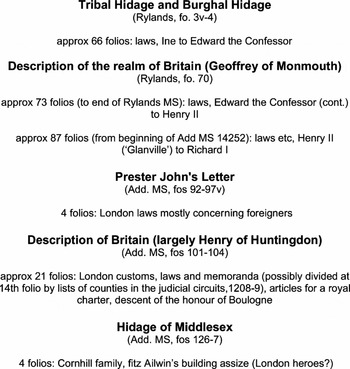
The arrangement of the material in the collection is striking (Figure 5). Laws are gathered in a chronological succession of groups according to the kings associated with them, from Ine, the king of Wessex who died in 726, through Alfred, Athelstan, Cnut, Edward the Confessor (said to have been confirmed by William I, decrees attributed to whom are entered before Edward's laws), to Henry II, who died in 1189. Several of these groups conclude with a few lines of praise on the monarch in question, perhaps inspired by the characterisations of kings from Arthur onwards that Henry of Huntingdon had included in his history.Footnote 43 Though not totally formulaic these encomia have much in common, stressing the military vigour of the king and the extent of his rule, sometimes using the adjective inclitus which, significantly, is deployed in connection with King Arthur in the most significant of the London additions to the version of the ‘Laws of Edward the Confessor’ contained in the collection.Footnote 44 The encomium on Athelstan, for example, declares that he ruled up to the limits of the kingdom established by Arthur, while the longer statement on Henry II emphasises his conquest of Ireland and the numerous territories that he ruled between Norway and Spain. There follows a brief but strikingly warm encomium on Richard I, informed by knowledge of the later loss of Normandy, and a rubric and a blank space indicate that at this point it was intended to include at least an extract from Geoffrey of Vinsauf's extravagant praise of that king.Footnote 45 After this the final section of the collection focuses on the reign of John, although without identifying him as king. These sections are framed by a sequence of texts of a different type, the purpose of which is to provide a geographical description or idealisation, indeed a visualisation, of the territory over which the monarchs ruled. Although the text is not illustrated, there is a strong visual element in this structure, recalling that of a narrative sequence of images, each defined by a frame (as in a mural or manuscript history of the world), or of a gallery of sculptures portraying kings or prophets holding the texts or tables of their laws, such as can be seen on Romanesque or early Gothic cathedrals.Footnote 46 Visual or architectural framing was an important mnemonic and cognitive device in rhetoric and oratory, adding expressive force to narratives which, as in the case of the London Collection, were often composed of multiple stories, interrupted but interlaced.Footnote 47 Sculptural programmes of this type sometimes portray the forerunners of Christ. The rather different message of this collection, compiled after the loss of Normandy in 1204, is that King John had much to live up to.
The geographical framing of the London Collection. The texts in bold are the framing element.

The choice of geographical texts is illuminating (Figure 5). At the beginning, before King Ine's laws, are placed texts of the Tribal and of the Burghal Hidages, early lists of territories and towns which serve to introduce the realm. Towards the end of the longest of the London interpolations in the ‘Laws of Edward the Confessor’ is a description of the kingdom of Britain, derived from Geoffrey of Monmouth. Significantly, this description marks a transition from an encomium on King Ine to an account of the ‘right and appendages of the crown of Britain’ containing praise of Arthur, the ‘most glorious of the kings of the Britons’, and a long list of the territories he had ruled.Footnote 48 At a later important transition point in the collection, the brief section on King Richard is followed by a copy of one of the earliest versions of Prester John's letter to the Emperor Manuel Comnenus, a fictitious text composed a generation so earlier. This introduces the controversial reign of King John and the part of the collection which explicitly focuses on London. As a piece of exotica, the letter may have been chosen for its appeal to an audience of barons and wealthy merchants who would have had some knowledge of the east and its commodities, including the pepper carefully described in the letter and mentioned in the documents which immediately follow it as one of the commodities brought to London. The letter is also a powerful statement of a ‘moral utopia’, a well-ordered, wealthy and extensive territory, where seventy-two kings and their provinces were subject to a priestly ruler.Footnote 49 In key respects this resembled the realm of King Arthur as presented in the interpolations and it certainly offered a model for John's kingdom of England, while its image of Christian rule, like Arthur's, would underline criticism of John's failure to protect the church. After the letter, there is entered the first of the texts which detail the laws and customs of London. This is in Anglo-Norman, in contrast to all previous and the majority of subsequent texts, which are in Latin. My current hypothesis is that the texts in Anglo-Norman, the vernacular of the leading citizens and the barons, deal with matters which might be specifically contested by the king and were in some sense drafts for internal discussion, rather than statements for public consumption or straightforward copies of earlier texts from the city's archive. This Anglo-Norman text, which occupies a crucial position in the collection, is in three distinct, but not strongly separated, sections. The first deals with legal procedures and rules concerning landholding and debt in the city's Husting court, with the roles of the sheriffs and aldermen and with the relationship between foreigners and the ‘law of London’; the second details regulations concerning merchants from Lorraine and elsewhere overseas; and the third deals with the city Folkmoot and its relation to the Husting. The concern with foreigners is emphasised by the text's proximity to the letter of Prester John. This text is followed immediately by another geographical description of Britain, in Anglo-Norman but largely drawn from Henry of Huntingdon, a description of the territory clearly paired with that of Prester John's exotic realm. The first scribe then completed his work by introducing the final section of the collection as ‘a part of the laws of the city of London and of its franchises’. At that point the second scribe took over. At the beginning of his, or his instructor's, selection of London material he placed the Latin text now known as the Libertas Londoniensis, which deals with some of the same matters, including Folkmoot, Husting and rules for foreign merchants, including one limiting their stay in the city to forty days. This text seems to be based on a mid-twelfth-century exemplar. At the end of his London material the scribe copied the Hidage of Middlesex, listing the components of the territory immediately subject to London. After that he added two more items, which, as we shall see, may have been intended as a heroic conclusion.
The clearest statements of political principle in the collection are to be found in the interpolations in two earlier sets of laws, those of King Henry I, originally compiled about 1117, and those attributed to Edward the Confessor, which in their first version appear to have been compiled in the 1130s or a little earlier.Footnote 50 The more extensive interpolations were in the latter, which seem very likely to have been made specifically for the purpose of this collection, and presumably resulted in the ‘laws of St Edward’ that the barons were said to have sought from King John in 1215.Footnote 51 Recurrent themes in the London interpolations to Edward's lawsFootnote 52 emphasise the rights of the Crown, the unity and extent of the kingdom, and the king's responsibility to protect the church and the realm, to promote good laws and abolish bad ones and to do justice according to counsel. They also outline an ideal, but historically based structure of local government and political assembly, informed by common counsel, communes and an oath of brotherhood which united nobility, townsmen and all people for the utility of the realm. This system was older than Arthur, who used it to consolidate the kingdom of Britain and drive out enemies. These ideas seem to have been informed by a memory of the great council convoked by John in London in 1205, following which the adult population was to be organised into a commune for the defence of the realm.Footnote 53 The interpolations emphasise the leading role of London as caput regni . . . et legum et semper curia domini regis and the way in which it had been founded and built in the ‘manner, form and memory of old, great Troy’, whose laws and liberties it still contained (Figure 4). These would have been the laws that Arthur found. In addition there were more or less direct allusions to London in the identification of aldermen as senators, in the mention of folkmoots being summoned by a bell and in references to hunting rights and to local armies being led by aristocratic constables or heretocii.
The term ‘common counsel’ (commune consilium) used several times in the interpolations may have a had a particular resonance for Londoners, for the copy of a city inventory, datable to between 1212 and 1214 and forming part of the collection, lists a ‘seal of the common council’ kept with some of the charters ‘in the treasury’ (in thesauro). This ‘common council’ (to be distinguished from the later medieval common council of the city) may have been identical with the body of twenty-four which in 1205–6 swore that it would legally see to counselling (ad consulendum) according to its custom by the right of the king and that no member of the body would take a bribe when giving judgement.Footnote 54 The oath taken by this body, which presumably comprised the twenty-four aldermen of the city, was perhaps influenced by the statute arising from the great council which John had summoned in London in 1205, according to the terms of which it would have represented the commune of the city. An alternative interpretation is that the ‘common council’ of this period also included a number of probi homines, who are recorded from time to time in this period as supporting the mayor and aldermen and who appear to be distinct from the larger body which constituted the commune.Footnote 55 The building code of 1212, for example, was made per consilium proborum virorum and refers to the way in which scotales could be licensed per commune consilium civitatis apud Gildehallam, although the code itself was enacted at Guildhall by ‘the mayor and other barons of the city’.Footnote 56 The ‘seal of the barons of London’, discussed above, appears stylistically to be later in date and so the ‘seal of the common council’ was presumably its predecessor, although it may not have been owned by a body precisely comparable to the ‘barons’. A letter from the mayor and universitas of London in 1219 was said to be sealed with the communi sigillo civitatis Londonie, a phrase which could denote either of the seals, if indeed there were two.Footnote 57 The treasury where this seal and the charters were kept is usually assumed to have been at the city guildhall, but given the close association between St Paul's and the London folkmoot and between the canons and the leading citizens at this time, plus the role of cathedrals as custodians of archives relating to county administration,Footnote 58 it is at least equally likely that the ‘treasury’ was the cathedral treasury at St Paul's.
The interpolations indicate the particular interest that Edward's laws had for the Londoners and the way in which that interest extended back beyond their commune of 1191 to Stephen's reign and the city's earlier commune of 1141 which had united citizens and barons in a common cause. In that year, when the Londoners were negotiating terms with the Empress Matilda, they had asked that they might be allowed to live under the excellent laws of King Edward rather than the severe ones of her father, King Henry. Matilda harshly refused and London turned against her.Footnote 59 Perhaps the idea of a distinctive London law of some antiquity was consolidated at that time, for the story that Brutus had given the Londoners their law was added to the original version of Geoffrey's History before 1155.Footnote 60 With regard to the kingdom as a whole, the laws of King Edward had by 1100 or soon after achieved a status as the best of all laws, but in 1141 it seems that the Londoners were seeking laws which would apply specifically to them. Moreover, there were reasons why rulers of London might have a particular regard for King Edward as the source of their law. Thus, the first mayor, Henry fitz Ailwin, members of the Cornhill family and possibly other leading families at the time of the 1191 commune could count among their ancestors members of the London guild of cnihtas, which had received from King Edward a writ confirming its jurisdiction and good laws. In 1125 that writ was placed on the altar of the London priory of Holy Trinity Aldgate as confirmation of the guild's gift of land and rights, and the writ would still have been at the priory when fitz Ailwin was buried there in 1212.Footnote 61 It may be that the two documents added at the very end of the collection (Figure 5) were intended to signal this Edwardian link, for the first of them was a genealogy, in Anglo-Norman, of the Cornhill and supposedly related London families and the second named fitz Ailwin in relation to his most well-known act as mayor, the city building code drawn up after the Great Fire of London in July 1212 and written in Latin. This code, as we shall see, may also have been included in the collection as a concluding expression of the effectiveness of the city's government based at Guildhall. This pairing may deliberately underline one of the collection's pervading themes, the unity of different peoples within the kingdom, for Henry fitz Ailwin was of English descent and, according to the genealogy, the Cornhills had a Norman ancestor.
Given primacy among the foreign groups named in the London interpolations to Edward's laws who by right should live in the kingdom of Britain as proprii cives were Bretons from Armorica. Here the interpolator drew on Geoffrey of Monmouth's account of the close connections between Britain and Brittany and of the prophecy that the cives (that is the Bretons) of the island shall return to it, a prophecy that William fitz Stephen related to London. From its context, later readers could relate this prophecy to the eventual loss of Normandy.Footnote 62 Thus the interpolator's highlighting of the Bretons might form part of the case against John, not least on account of his role in the murder of his nephew, Arthur of Brittany, in 1203.
The collection conveys a sense that the rules by which Londoners governed their public lives were regarded as law rather than custom, that is with a general and binding purpose rather than of merely local application. Such a distinction was made by the Pisans in the late 1150s when they envisaged a double code for their city, one of leges and one of usus. Footnote 63 Even in Pisa, however, the distinction between law and custom was fuzzy and some London rules were described as customs, while in a few other towns of the period the rules were described as ‘laws and customs’. Among English towns, only London, so far as I am aware, was marked by references to its ‘law’ in the singular alone.Footnote 64 Moreover, London customs were widely employed as models for those granted to other towns and this may have contributed to their standing as ‘law’. This actual or perceived special status of London's customs seems to explain certain choices concerning the documents that were included in the collection. For example, it was clearly not the aim to assemble a set of the citizens' royal grants of privileges, of which twelve (or seven, excluding duplicates) were listed in the inventory of 1212–14 already mentioned. The collection includes texts of only two such grants, that of Henry I, which, if it had ever existed, survived only as a copy in 1212–14, and that of Henry II, both copies of which were then in the custody of private citizens. In the London Collection, the texts of Henry I's and of Henry II's charters to the citizens are placed immediately after the monarch's ‘coronation charter’, as if to emphasise the high standing and wider significance of the privileges enjoyed by London. The former mentioned the law of London and the latter confirmed to the Londoners the law of his grandfather's day, seemingly authoritative statements which may have been the charters' principal value for the compiler. They would have resonated with the several references to the ‘law of London’ in the important first text detailing London customs which was entered in the collection immediately after Prester John's letter. Later royal charters to London which mention its law simply repeat the phrase from Henry II's charter, while in the thirteenth century, as the difference between what was fixed and general and what was local became more clearly established, references to London law faded away. It may be relevant here to note the royal letter of 1235 which directed the mayor and sheriffs to suppress the teaching of ‘laws’ in the city. Paul Brand suggested that this may relate to some developing synthesis of Roman and English laws,Footnote 65 but it seems possible that instead, or perhaps as well, it concerned the complex laws of London itself, perhaps as yet only imperfectly recorded in writing, the teaching of which could be viewed as subversive.
Important elements in the collection's argument concern trade. Especially significant is what is clearly an early thirteenth-century statement copied by the first scribe into a gap he had left in an early section.Footnote 66 This statement drew on earlier sources, but also included new ideas and some notions contrary to those favoured by the king. It affirmed the unity of weights, measures, currency, tolls and mercantile customs (possibly an allusion to London law) throughout the ports and the entire kingdom of Britain. In addition, it affirmed the freedom of merchants (presumably foreign merchants) to enter and return through the ports, with the qualification that they could neither go with their goods beyond the legal limits of the ports out into the kingdom nor stay in the ports more than forty days, restrictions which clearly allude to the customs of London recorded near the end of the collection. Magna Carta also stated merchants' freedom of entry and departure but, reflecting what had been royal policy since the time of Richard I, added that they were free to move about England and said nothing about restricting them to the ports, thereby ignoring what appears to have been older custom, at least in London. The statement notes the restriction on exporting materials of war, customary by 1200, but makes a significant addition by declaring that wool cannot be taken overseas out of the kingdom of Britain without having been woven into cloth. There was no royal policy of restricting the export of wool, except during periods of warfare, and so this prohibition must reflect the interest of native merchants who were active in the production and export of cloth and their fears concerning the loss of trade in the face of competition from Flemish towns. Here too, the London interest was strong, for the latter part of the collection includes, in Anglo-Norman, the ‘law of the weavers and fullers’ of Winchester and other towns which asserted weavers' subjection to merchants and was said also to be the custom of London, where in 1202 the citizens briefly managed to suppress the weavers' independence.Footnote 67 London was, or had been within living memory, a major centre of cloth manufacture and finishing and Henry fitz Ailwin and his family appear to have been active in that business since at least the early twelfth century.Footnote 68 The compiler of the collection endowed this powerful statement of London mercantile interests with special authority as long-standing custom in Britain by placing it among the laws of Ine. Thus, Liebermann named it ‘Pseudo-Ine’.
Commercial interests, especially London ones, were in several respects at variance with royal policy overseas during this period. Dynastic ties and periodic alliances between Plantagenet and German Welf kings, together with the position of Cologne as a focus of Welf interest and a major trading partner of London, shaped a diplomatic environment in which English and German monarchs manoeuvred to protect their interests against French kings by building up regional alliances which where possible included Cologne. Cologne merchants had long enjoyed special privileges in London, which in 1194 Richard I had extended by freeing them of a rent due from their guildhall in the city and allowing them freedom to travel throughout England and to visit fairs. This grant deprived Londoners of profitable distributive trade. John, in a letter to the mayor and commune of London in the first year of his reign, declared the freedom of all foreign merchants to travel in England, while immediately after the loss of Normandy in 1204, he acknowledged the freedom of the Cologne merchants to travel in his realm. After 1207, in association with Otto IV, John attempted to build up a Rhineland alliance against France, and in 1213, when both he and Otto were in weak positions, he confirmed Richard I's quitclaim to the citizens of Cologne in the rent they had been accustomed to pay from their London guildhall and in all customs, but with the caveat that it was to be ‘saving the liberty of London’.Footnote 69 That phrase and the assertion in Pseudo-Ine that foreign merchants were to remain in the ports indicates that despite the benefits of Rhineland trade, the Londoners' political programme at this time included opposition to the rights that Cologne merchants enjoyed in London and elsewhere. The importance of these issues is also indicated by the appearance in the final part of the collection of a genealogy of the counts of Boulogne, for Renaud of Damartin, count of Boulogne, was John's chief agent in building up an alliance against France in the Low Countries, and in 1212, in London, he and John publicly agreed not to make a separate peace with France.Footnote 70 It was presumably a few years later – following the defeat of Otto and the capture of Renaud at Bouvines and when London interests came to the fore in England – that the Cologne merchants lost possession of their guildhall, for in 1219–20 they had to pay 30 marks to recover it.Footnote 71
Although the London Collection for its Anglo-Saxon laws draws on the twelfth-century Latin collection known today as ‘Quadripartitus’, which probably originated during the reign of Henry I,Footnote 72 it includes no laws of Æethelred II, whose legislation is included in ‘Quadripartitus’. The reason for this may have been the London compiler's desire to present his collection of laws as the works of a succession of heroic kings and so to pass directly from Athelstan to Cnut omitting Æthelred. On the other hand, the London Collection contains one text which relates to legislation which at present is commonly attributed to Æthelred. That text is the highly commercial second part of the Anglo-Norman account of London customs placed in the collection after the letter of Prester John. The relevant material attributed to Æthelred is the set of regulations concerning the city and port of London, and in particular the well-known ‘Billingsgate tolls’, which form the opening part of the code known since 1840 as ‘IV Æthelred’ and so dated to c. 1000.Footnote 73 It is clear that ‘IV Æthelred’ is a composite document, its London element being of a very different character to the rest. Moreover, ‘IV Æthelred’ is not present in the earliest manuscripts of ‘Quadripartitus’ and appears only in those of the mid-twelfth century and later.Footnote 74 This raises the possibilities that the materials comprising ‘IV Æthelred’ were not put together before the twelfth century, that there was no earlier Old English version and that the London element may not have been composed until the twelfth century, possibly even in the reign of Stephen when the original version of the document we now know as Henry I's charter to London may also have been compiled. Furthermore, there now seems to be some uncertainty as to whether the towns in the Meuse valley (Huy, Liège and Nivelles) mentioned in ‘IV Æthelred’ were sufficiently developed as commercial centres by the year 1000 for their merchants to be regular visitors to England, as implied by the record of Billingsgate tolls.Footnote 75
One of the features of the account of Billingsgate tolls is the favoured position said to have been enjoyed in London by ‘the men of the Emperor’, merchants from Lorraine and the lower Rhineland and so essentially those trading through Cologne, especially by comparison with those from Rouen, Flanders, Ponthieu, Normandy, France and the Meuse valley towns. This part of the document was written in the imperfect tense. The men of the emperor who came to London in their ships were ‘held worthy of good laws, like us’ (bonarum legum digni tenebantur sicut et nos). This presumably means either that they were subject to the same laws as the Londoners or that, like the Londoners, they enjoyed good laws of their own. The reference here may be to the privileges in the city enjoyed by the men of Cologne, which were confirmed and extended by two royal charters granted in the 1170s, one of which enjoined the Londoners to give perpetual protection to the men of Cologne.Footnote 76 That privilege would have been acceptable in twelfth-century London and suggests a possible context for the Billingsgate toll record (although the men of Cologne could have enjoyed similar rights in London long before the royal charters), but it would have been a privilege too far for London merchants of the early thirteenth century.
The Anglo-Norman statement in the London Collection that includes a copy of regulations concerning Lorraine merchants in the city is usually assumed to belong to the mid-twelfth century or even much earlier,Footnote 77 but it now seems possible that those rules were drafted for the specific purposes of the Londoners during the early thirteenth century or that they were a heavily manipulated version of some earlier, probably twelfth-century, text or texts. The first part of the statement need be no earlier than the reign of John.Footnote 78 Dealing with procedures of the city's court of Husting concerning affray, rents and debts according to ‘the law of London’, it makes no mention of privileges enjoyed by foreigners, but it does define a specific procedure for a foreigner (forein) taking an oath concerning debt and then states that by the law of London no foreign merchant (marchant forein) has soke there ‘neither at the guildhall nor elsewhere’ (ne gildhalle ne aillurs).Footnote 79 This is usually is taken to be a reference to the guildhall of the citizens of London, but is more likely to concern the guildhall of the Cologne merchants on the Thames waterfront, described in one of Henry II's charters as their ‘house’ and subsequently as their guildhall. In this text the Londoners appear to be challenging the rights of the Cologners to an independent jurisdiction, contrary to the provisions of the Billingsgate toll record. As we have seen, the Cologners subsequently lost their guildhall for a while. The second part of this statement, which reads as a continuation of the first, opens with a statement concerning the ‘law of the Lorrainers’, clearly intending to differentiate it from the ‘law of London’ and thus perhaps alluding to the Billingsgate toll record, on which it draws in other ways but with some significant changes. Thus the toll record's statement that the men of the emperor could purchase unloaded (discarcata) wool (perhaps meaning wool that had been shipped down river to London and was available in the open market) and melted fat and three live pigs for their ships becomes more restrictive in the Anglo-Norman version of the same passage which asserts that no Lorrainer can purchase unworked (desfaite) wool, a variety of other goods (including ‘broken wines’, vinz descusuz, evidently derived from the dissutum unctum of the earlier text) or any more than three live pigs as provisions. In its aim to protect London's clothing industry and in its rule that the Lorraine merchants could stay in the city no longer than forty days, this statement is immediately comparable to Pseudo-Ine. Moreover, the first part of the statement, with references to Husting and to procedures concerning lands and debts seems to make a similar reference to another supposedly historic authority in the collection, Henry I's supposed charter to the citizens, which affirmed the procedure of Husting and the city's law concerning lands and debts. The conclusion of this Anglo-Norman section of the collection, with its account of the Folkmoot and its summoning by the authoritative bell at St Paul's, just possibly reflects the dramatic events at St Paul's between 1212 and 1216.Footnote 80 It certainly resonates with the account of folkmoots in the London interpolations to the Laws of Edward the Confessor,Footnote 81 which like this statement mention a bell and the need there to make provision against fire, a point reinforced by the inclusion later in the collection of the building code implemented after the fire of 1212.
Texts on later folios,Footnote 82 the majority of them in Latin and so perhaps long-standing records of city custom, are more in the nature of evidential memoranda concerning city procedures. Their selection and ordering are careful and relate to points made in the preceding section of the collection: the analysis of these connections is for another occasion. After the Libertas Londoniensis, they include further texts concerning merchants, oaths relevant to the commune, material associated with the citizens' right to choose their sheriffs (but, significantly, not John's charter granting them that right), statements concerning the ways in which the commune could levy money for collective purposes, a matter which been a cause of bitter conflict within the city, and articles which informed Magna Carta.
Finally, it is worth noting the collection's distinctive attention to Norway and its significance for London interest in that period. This reflects Norway's close trading,Footnote 83 religious and cultural relations (not least through the foundation of Cistercian monasteries)Footnote 84 with England during the twelfth century and Geoffrey of Monmouth's stories of Arthur's conquest of Norway and his overlordship of Gotland. It also builds on the emphasis in the original version of the ‘Laws of Edward the Confessor’ on Danish and Norwegian laws and customs being among those observed in England.Footnote 85 But the London Collection went much further, adding references to Norway to several texts, stressing the way in which Arthur had caused the one God to be venerated throughout Norway,Footnote 86 and providing a detailed listing, derived from German sources, of places in eastern Baltic regions which Arthur was supposed to have ruled.Footnote 87 Moreover, Edward the Confessor was credited with having established the Norwegians, once immigrants, as ‘sworn brothers’ and ‘almost citizens’ of the realm. Indeed, the collection's ‘law of the Lorrainers’ ends with an implication that Norwegians should enjoy the same freedom to trade in London as the Danes, that is a greater freedom than the Lorrainers. By the late twelfth century, London had seven churches dedicated to St Olaf (d. 1030) and one to St Magnus (d. 1116), while its four churches dedicated to St Botolph suggest indirect Norwegian connections via Boston. Trade in eastern Baltic goods to England, in which the Norwegians and Gotlanders were significant intermediaries, was increasing and Cologne merchants were attempting to gain a foothold there. In 1186 King Sverri of Norway came to Bergen where there was a great number of merchant ships and the ‘Southmen’ (evidently Germans from the Rhineland) had imported so much wine that it was cheaper than ale. This led to fighting between the Northmen and the Germans. Sverri then spoke at a public assembly against the evils of drink and the Germans' attempt to corner trade, contrasting them with the English, whom he thanked for bringing wheat, honey, flour and cloth. For Sverri St Botolph's day was a special feast and two Norwegians named in the saga were named Botolph.Footnote 88 The Norwegian references in the London Collection thus seem to reflect the Londoners' antagonism towards Cologne and a preference for dealing with a friendly people who had more direct access to Baltic trade. This explains a reference to Engra civitas, named in one of the interpolations to Edward's laws as the origin of the ‘Saxons of Germany’ who were one of the groups claimed as potential ‘sworn brothers’ and ‘proper citizens’ of the English. Engra was presumably Schleswig, at the neck of the Angeln peninsula and under the authority of the king of Denmark, who also periodically controlled Lübeck, its successor as a hub for Baltic trade.Footnote 89 It is especially striking, therefore, that a year after the death of John a commercial treaty was concluded with the king of Norway. That was made possible by the recent reconciliation of warring parties in Norway, but the terms, stating that the two lands shall be common so that their men and merchants shall have freedom to come and go, express the ideal of quasi co-citizenship stated in the London Collection and in Magna Carta.Footnote 90 Lübeck's imperial charter of less than a decade later indicates that Cologne had attempted to control that trade at the mouth of the Rhine, blocking the Lübeckers' access to markets in England, from which the charter released them.Footnote 91 Geoffrey of Monmouth had structured his history as the fulfilment of prophecy. Prophecy had informed William fitz Stephen's view of the city. The compiler of the London collection followed a similar prophetic line. Many of those London aspirations expressed in the collection came to fruition between 1215 and 1217, while there are signs that around 1220 a new settlement was made in the city's internal affairs and in its relations with Cologne and Lübeck.
This paper has argued that the resemblances and echoes between a variety of writings concerning cities in general, and London in particular, indicate that in the late twelfth and early thirteenth centuries there developed a widely shared community of ideas about London and its physical, cultural, social, historical, mythological and political identity. A developing capacity to visualise the city and to respond to its depiction was part of this process. Literary and visual modes of expression, two forms of story telling not so distinctly separated as they are today, informed both an appreciation of city landscape and strategies for achieving political ends. It is not necessary to assume that all involved in the process read the texts or even listened to readings from them: ideas, stories and vocabulary could circulate in many informal ways, including the visual. So far as Londoners were concerned, St Paul's and its environs was in this period probably the most important site for such exchanges. The cathedral linked them to the circles in which key texts were composed and debated. Some of its canons were members of leading London families and the cathedral and its precinct constituted the citizens' principal site of assembly, for religious, political and military purposes. Moreover, some of the writers involved wrote for a wide audience, ‘for the many . . . the less educated’, as Henry of Huntingdon had put it.Footnote 92 The ‘less educated’ middling groups in London, outside the ruling elite, certainly included people of some learning who engaged in controversial political debate, not least at St Paul's.Footnote 93 Those politics were informed by a strong sense of the city's standing and its role in relation to the nation (or Britain) and to ideas of law. The great collection of laws and other texts put together in London during the reign of John, itself a complex literary construction informed by spatial and visual principles, unites these aspects of the city's identity, not least by means of its historical and geographical breadth. Moreover, it indicates how the citizens, or their leaders, in rehearsing the legitimacy of their claims not only focused on contemporary concerns but also drew on their awareness of ideas developed in earlier episodes of communal crisis, on the documented rights of deeply entrenched groups and on an imaginative visualisation of the past. In the compilation of this collection, texts were selected, manipulated and fabricated to further the interests of those groups. This paper has done no more than scratch the surface of this particular topic, dealing with only a few elements in a single collection and leaving many problems unresolved. The findings raise serious questions as to how we should address this and other such collections of laws and customs in the future. It seems that those historians of London, including the present author, who have used some of these texts as evidence for much older city law and custom, should be more cautious from now on. For all its great achievements, the positivistic, decontextualising approach of the past, seeking to establish the ‘uncorrupted’ text, has missed more than a trick or two. At the same time we should rejoice at the new insights that these and other sources of the time continue to offer us into London's complex cultural and political identity.