Introduction
Extant studies have found that corporate longevity is affected by a variety of external and internal factors, such as institutional environment, governance mechanisms, managerial skills, decision-making processes, leadership style, succession planning, firm scale, and financial performance (Turetsky & McEwen, Reference Turetsky and McEwen2001; Thornhill & Amit, Reference Thornhill and Amit2003; Fahed-Sreih & Djoundourian, Reference Fahed-Sreih and Djoundourian2006; Piao, Reference Piao2010; Williams & Jones, Reference Williams and Jones2010; Yu, Orazem, & Jolly, Reference Yu, Orazem and Jolly2011; Carney, Gedajlovic, & Strike, Reference Carney, Gedajlovic and Strike2014). In addition, a thin but growing branch of literature argues that entrepreneur-specific characteristics can also exert remarkable impacts on keeping business running well in the long-run because entrepreneurs are viewed as valuable and crucial resources for contemporary enterprises (Bates, Reference Bates1990, Reference Bates1995; Nafziger & Terrell, Reference Nafziger and Terrell1996; Pennings, Lee, & Van Witteloostuijn, Reference Pennings, Lee and Van Witteloostuijn1998; Delmar & Shane, Reference Delmar and Shane2006; Williams & Jones, Reference Williams and Jones2010; King & Peng, Reference King and Peng2013). Nevertheless, to our knowledge and literature in hand, few studies address whether religious belief as an entrepreneur-specific feature affects corporate continuity. In response, this study examines the relation between religious entrepreneurs and corporate longevity using a sample of Chinese family firms, expanding the knowledge about religious influence on corporate behavior.
Chinese family firms contribute a lot to China's economic growth miracle by creating hundreds of millions of jobs and paying numerous taxes (Huang, Reference Huang2009; Du, Reference Du2015). However, an investigation conducted by Chinese Private Economic Research Association (CPERA) revealed that the average longevity of Chinese family firms is remarkably shorter than that of their Western counterpartsFootnote 1 (CPERA, 2011). As a result, the issue about how to maintain a family firm's going well in the long-run has become crucial in contemporary China. Against this context, it is urgent for scholars to explore the additional determinants of corporate longevity, in addition to the recognized external or internal factors.
Extant studies (Hilary & Hui, Reference Hilary and Hui2009; McGuire, Omer, & Sharp, Reference McGuire, Omer and Sharp2011; Dyreng, Mayew, & Williams, Reference Dyreng, Mayew and Williams2012; El Ghoul, Guedhami, Ni, Pittman, & Saadi, Reference El Ghoul, Guedhami, Ni, Pittman and Saadi2012; Du, Reference Du2013, Reference Du2014) have found that religion affects corporate behavior such as the cost of equity, agency costs, tunneling, risk-aversion, earnings quality, and accounting irregularity. However, most of them focus on Western religions (Catholicism, Islamism, etc.) and developed countries (Hilary & Hui, Reference Hilary and Hui2009; McGuire, Omer, & Sharp, Reference McGuire, Omer and Sharp2011; Dyreng, Mayew, & Williams, Reference Dyreng, Mayew and Williams2012; El Ghoul et al., Reference El Ghoul, Guedhami, Ni, Pittman and Saadi2012). Extant studies (Collins, Reference Collins and Murray1999; Roccas, Reference Roccas2005; Smith & Marranca, Reference Smith and Marranca2009) argue several differences between Western religions and Eastern religions, such as the number of Gods, birthplaces, and the ways of worship. In addition, previous studies do not notice that more and more entrepreneurs in family firms are actively participating in various religious activities in contemporary China – the largest developing country in the world (Cao, Reference Cao2007, Reference Cao2008; Du, Reference Du2017), and thus provide little evidence on the relation between religion and corporate longevity. Motivated by the findings in previous literature and inspired by the active religious attendance of entrepreneurs in China, we address whether religious belief as an important entrepreneurial characteristic affects corporate longevity.
The 2008 national survey provided information on religious belief of Chinese entrepreneurs in family firms, which provides researchers with an important opportunity to address the above issue. Using this unique set of data, we examine whether corporate longevity is related with religious entrepreneurs, and further investigate whether the development of factor markets across provinces in China can serve as the moderator in this relation. We find that religious entrepreneurs are significantly positively related with corporate longevity, implying that religious entrepreneurs can acquire managerial skills, raise individual social capital, and get managerial inspiration by engaging into religious activities, echoing the views in Cao (Reference Cao2007, Reference Cao2008) and Nwankwo, Gbadamosi, and Ojo (Reference Nwankwo, Gbadamosi and Ojo2012). Moreover, our findings reveal that the development of factor markets reinforces the positive effect of religious entrepreneurs on corporate longevity. Above findings are also supported by a variety of robustness tests, and our findings are still valid after using the propensity score matching (PSM) method to mitigate the selection bias. Furthermore, after differentiating Western religions from Eastern religions on the basis of differences in headstreams, the number of Gods, and the ways of worship, the positive impacts of religious entrepreneurs on corporate longevity are only valid for Western religions (but not for Eastern religions), implying the asymmetric effects between Western and Eastern religions on corporate longevity.
Our study makes several contributions as below. First, this study is the first to examine whether an entrepreneur's religious belief affects corporate longevity in the context of China. Second, the development of factor markets is significantly positively associated with corporate longevity, echoing the view that external institutional environment affects business continuity (Williams & Jones, Reference Williams and Jones2010; Yu, Orazem, & Jolly, Reference Yu, Orazem and Jolly2011; Carney, Gedajlovic, & Strike, Reference Carney, Gedajlovic and Strike2014). Third, the development of factor markets reinforces the positive association between religious entrepreneurs and corporate longevity, providing important support to the institutional embeddedness of entrepreneurial behavior theory (Schiff, Reference Schiff1992; Martinelli, Reference Martinelli2004; Dickson & Weaver, Reference Dickson and Weaver2008; Welter & Smallbone, Reference Welter and Smallbone2011). Finally, we document the asymmetric impacts of different religious beliefs (Western and Eastern religious beliefs that can be differentiated by their origin places, the number of Gods, and the ways of worship) on corporate longevity.
The remainders of this paper are organized as follows. The second section introduces institutional background, reviews prior literature, and develops research hypotheses. The third section reports methodology, including sample, data source, and variable definitions. The fourth section provides descriptive statistics, reports main findings, and conducts robustness checks. The fifth section conducts endogeneity tests using different approaches. The sixth section discusses theoretical contributions, managerial implications, and limitations of our study. The final section summarizes conclusions.
Background, Literature, and Hypotheses Development
Religions in China
In China, religious attendance had come to a standstill during the period from 1949 to the reform and opening-up in 1978. After the Cultural Revolution, China's constitution began to endow people with the freedom of worship. As a result, over the past decades, a growing tendency in religious boom (Du, Reference Du2013; Leithart, Reference Leithart2014) and the rise of religion in China are mainly reflected in two aspects.
First, the number of religious population has dramatically expanded beyond expectation (Goossaert & Palmer, Reference Goossaert and Palmer2011; Du, Reference Du2013). An investigation conducted by the Spirit Life of Contemporary Chinese People showed that about 25% of Chinese people had faith in a religion and the total number of religious population had already exceeded 300 million (Sun, Reference Sun2007). In addition, according to the Chinese Spirit Life Survey executed by the Centre on Religion and Chinese Society at Purdue University (CRCSPU, 2007), more than 80% of Chinese people had faith in a religion or engaged into some religious activities, and only less than 20% of Chinese people were absolutely unaffiliated with any religions. Overall, the findings in CRCSPU (2007) and Sun (Reference Sun2007) clearly display an obvious and upward trend in the number of religious believers in contemporary China.
Second, a number of religious sites have been restored. According to the State Administration for Religious Affairs (SARA, 2015), the number of religious sites is about 139,000, and the total amount of professional religious staff (e.g., monks, mullahs, and priests, etc.) has already outstripped 360,000. In addition, the SARA (2015) revealed that more than 100 religious schools had been established by religious organizations to be in charge of training religious staff. With regard to the specific number of religious sites, the SARA (2015) disclosed that the number of Buddhist monasteries (Taoist temples) was about 33,000 (9,000). In brief, the dramatically increasing religious sites imply that Chinese people are enjoying more religious freedom and enthusiastically engaging in religious activities.
Overall, both the increasing number of religious population and the flourishing religious sites challenge the traditional view that religious influence is trivial in China. Moreover, as Du (Reference Du2017) indicates, the relatively positive attitude of Chinese politicians towards religion creates the sound social and religious atmosphere for religious influence in contemporary China. As a result, we can rationally draw the conclusion that in contemporary China, religion may affect individual and corporate behavior.
Chinese family firms
The existing literature (Jefferson & Rawski, Reference Jefferson and Rawski1994; Putterman, Reference Putterman1995; Oi & Walder, Reference Oi and Walder1999) argues that China's miraculous economic achievements with an average annual GDP growth rate over 9% during the past decades should be attributed to the enormous benefits of property rights reform and the rise of the private sector. Actually, the private sector has played a crucial role in China's economic development, contributing more than 60% of GDP (Pistrui, Huang, Oksoy, Jing, & Welsch, Reference Pistrui, Huang, Oksoy, Jing and Welsch2001; Huang, Reference Huang2009). Moreover, Chinese family firms not only pay taxes to support a huge amount of public expenses, but also make great contributions towards the employment problem (Pistrui et al., Reference Pistrui, Huang, Oksoy, Jing and Welsch2001; Huang, Reference Huang2009; Du, Reference Du2015). Nevertheless, the Chinese Private Economic Research Association (CPERA, 2011) showed that the average longevity of Chinese family firms was less than 10 years, far shorter than that of their Western counterpartsFootnote 2. As a result, in recent years, scholars pay their special attention to the issue about how a family business can run well in the long run (Aronoff & Ward, Reference Aronoff and Ward1995).
First, in China, most family firms are typically controlled by paternalistic entrepreneurs who have unconditional sovereignty over their firms (Ding, Zhang, & Zhang, Reference Ding, Zhang and Zhang2008; Su & Carney, Reference Su and Carney2013). As a result, paternalism and nepotism shape the authoritarian culture in Chinese family firms (Li & Matlay, Reference Li and Matlay2006; Du, Reference Du2015), decisions made by authoritarian entrepreneurs must be implemented without any reservation (Weidenbaum, Reference Weidenbaum1996), and few subordinates challenge an entrepreneur's authority (Ding, Zhang, & Zhang, Reference Ding, Zhang and Zhang2008). Therefore, entrepreneurial features are bound to impact corporate decisions to a great extent.
Second, most Chinese family firms are headed by their founder entrepreneurs, who are inclined to operate their enterprises on the basis of their intuitions and past experience rather than standard governance mechanisms. Moreover, founder entrepreneurs have relatively less managerial education, compared with their counterparts in developed countries (Li & Matlay, Reference Li and Matlay2006; Su & Carney, Reference Su and Carney2013)Footnote 3. Furthermore, family members always participate into business operations, and thus parental altruism derived from the Chinese traditional culture endows them with perquisites and privileges, which has been proved to be harmful to their enterprises in the long run (Pistrui et al., Reference Pistrui, Huang, Oksoy, Jing and Welsch2001; Su & Carney, Reference Su and Carney2013).
Third, most Chinese family firms are small and medium-sized, and their operations depend closely on cheap labor (Pistrui et al., Reference Pistrui, Huang, Oksoy, Jing and Welsch2001; Li & Matlay, Reference Li and Matlay2006). Due to the lack of core competencies, Chinese family firms are always concentrated into low value-added industries (Pistrui et al., Reference Pistrui, Huang, Oksoy, Jing and Welsch2001; Li & Matlay, Reference Li and Matlay2006) and struggle to survive through lowering product price rather than improving quality. As a result, Chinese family firms are inclined to minimize their costs by purchasing cheap materials, simplifying production processes and duplicating Western product designs (Li & Matlay, Reference Li and Matlay2006). Under such a highly competitive environment, some Chinese family firms have to pursue short-term profit by cost minimization for their survival and thereof this strategy may erode their long-term success (Li & Matlay, Reference Li and Matlay2006; Du, Reference Du2015)Footnote 4, although most of them believe that long-term success is very important.
Finally, the relation-oriented culture plays a vital role in China (Li & Matlay, Reference Li and Matlay2006; Su & Carney, Reference Su and Carney2013). Most entrepreneurs in Chinese family firms operate their firms by the kinship ties and political connections (Weidenbaum, Reference Weidenbaum1996; Du, Reference Du2015), and thus decisions are made based on personal preferences rather than the long-term economic goals (Li & Matlay, Reference Li and Matlay2006; Su & Carney, Reference Su and Carney2013).
Overall, entrepreneurs play their crucial roles in Chinese family firms, and thus it is necessary to examine the impacts of entrepreneurial characteristics including religious belief on corporate longevity.
Literature review
The theoretical framework of affecting corporate continuity has been discussed in prior studies (Hogarth, Michaud, Doz, & Van der Heyden, Reference Hogarth, Michaud, Doz and Van der Heyden1991; Oliver, Reference Oliver1997; van Driel, Volberda, & Eikelboom, Reference van Driel, Volberda and Eikelboom2004). In addition, prior studies have identified external environment, long-term orientation, top management team, management process, organizational features, and industry sector as major determinants of corporate longevity at the different development stages of firmsFootnote 5.
First, derived from the institutional theory, the existing literature (Williams & Jones, Reference Williams and Jones2010; Yu, Orazem, & Jolly, Reference Yu, Orazem and Jolly2011; Carney, Gedajlovic, & Strike, Reference Carney, Gedajlovic and Strike2014) sheds the light on the influence of external institutional environment (e.g., inheritance laws, economic development, and regional culture, etc.) on corporate continuity. This stream of literature argues that external institutional environment affects the allocation of social wealth and leads to the transfer of wealth among individuals (generations; Oliver, Reference Oliver1997; Carney, Gedajlovic, & Strike, Reference Carney, Gedajlovic and Strike2014).
Second, based on the organizational theory, extant literature (Parker, Peters, & Turetsky, Reference Parker, Peters and Turetsky2005; Fahed-Sreih & Djoundourian, Reference Fahed-Sreih and Djoundourian2006; Piao, Reference Piao2010; Williams & Jones, Reference Williams and Jones2010) has found that organizational characteristics (e. g., leadership, succession planning, decision-making process, the spirit of exploration, and corporate governance, etc.) result in different extents of cohesion and the continuity of enterprises. In brief, organizational patterns affect resource allocation within firms, managerial efficiency, internal power distribution and division of labor, and eventually impact corporate longevity.
Third, derived from resource-based view, extant studies (Turetsky & McEwen, Reference Turetsky and McEwen2001; Thornhill & Amit, Reference Thornhill and Amit2003; Williams & Jones, Reference Williams and Jones2010) have highlighted that some external and internal resources (e.g., managerial skills, firm scale, financial leverage, and industry sector, etc.) are related with corporate longevity. This viewpoint recognizes firms as a nexus of explicit and implicit contracts among stakeholders (Fama & Jensen, Reference Fama and Jensen1983), and thus the efficient utilization of external and internal resources influences the long-term stability of contracts (Thornhill & Amit, Reference Thornhill and Amit2003; Harrison & Wicks, Reference Harrison and Wicks2013).
Finally and more importantly, a thin but growing branch of literature (e.g., Bates, Reference Bates1990, Reference Bates1995; Nafziger & Terrell, Reference Nafziger and Terrell1996; Pennings, Lee, & Van Witteloostuijn, Reference Pennings, Lee and Van Witteloostuijn1998; Delmar & Shane, Reference Delmar and Shane2006; Williams & Jones, Reference Williams and Jones2010; King & Peng, Reference King and Peng2013; etc.) has paid special attention to the impacts of entrepreneurial features (human capital) as internal resources on corporate longevity. Bates (Reference Bates1990) and Pennings, Lee, and Van Witteloostuijn (Reference Pennings, Lee and Van Witteloostuijn1998) argue that managerial human capital affects corporate performance and corporate continuity, and further find a positive relation between the educational level of entrepreneurs and corporate longevity. Bates (Reference Bates1995) finds that female entrepreneurs and managerial experience can be conducive to raising a firm's survival rate, echoing findings in Delmar and Shane (Reference Delmar and Shane2006) and King and Peng (Reference King and Peng2013). Moreover, Nafziger and Terrell (Reference Nafziger and Terrell1996) find the positive relation between corporate longevity and entrepreneurs in high castes, verifying the impacts of entrepreneurial ethnic background on corporate longevity in India.
Overall, a large body of prior literature (Bates, Reference Bates1990, Reference Bates1995; Pennings, Lee, & Van Witteloostuijn, Reference Pennings, Lee and Van Witteloostuijn1998; Fahed-Sreih & Djoundourian, Reference Fahed-Sreih and Djoundourian2006; Piao, Reference Piao2010; Williams & Jones, Reference Williams and Jones2010; Yu, Orazem, & Jolly, Reference Yu, Orazem and Jolly2011; Carney, Gedajlovic, & Strike, Reference Carney, Gedajlovic and Strike2014) has addressed the determinants of corporate longevity based on the institutional theory, the organizational theory, the resources-based view, and the entrepreneurial characteristics view. Nevertheless, little is known about whether religious belief as an entrepreneurial characteristic affects corporate longevity. In response, using the data of Chinese entrepreneurs from the 2008 national survey, we examine the influence of religious entrepreneurs on corporate longevity to fill the above gap.
Religious influence on corporate longevity (Hypothesis 1)
In China, religion was once considered to contradict the dominant ideology, and thus for a long time, religion has stayed at a weak position and religious influence mainly depends on social networks – especially believers’ kinship networks (Potter, Reference Potter2003; Cao, Reference Cao2007; Yang, Reference Yang2011). Moreover, in China, religion imperceptibly interacts with Chinese traditional culture. As a matter of fact, the clan culture and relationship-oriented culture affect the attitude of believers towards social networks and family relationship. According to the social identity theory, the common faith among group members and the perceived differences from other groups increase the in-group identification (Tafel & Turner, Reference Tafel, Turner, Worchel and Austin1979). As a result, in China, believers usually pay close attention to the social networks on the basis of religious identity and rely on it to share feelings, exchange information, teach experiences, and obtain the support. Finally, along with the increasing social diversity in China, religious identities are beneficial to the diversity of political systems, and thus can serve as a channel to form a favorable relationship with local government (Eng & Lin, Reference Eng and Lin2002; Potter, Reference Potter2003; Cao, Reference Cao2007; Du, Reference Du2017).
Prior literature indicates that entrepreneur-specific factors are directly related to corporate stability and continuity (Bates, Reference Bates1990; Williams & Jones, Reference Williams and Jones2010). Next, we further address how religious belief as an important entrepreneurial characteristic influences corporate longevity.
First, individuals can learn managerial and social skills (e.g., coordination, communication skills, and leadership, etc.) from continuous interactions with others when they participate in voluntary social activities (Hofstede, Reference Hofstede1984; Baron & Markman, Reference Baron and Markman2000; Hunt, Reference Hunt2000; Fernando & Jackson, Reference Fernando and Jackson2006; Nwankwo, Gbadamosi, & Ojo, Reference Nwankwo, Gbadamosi and Ojo2012). Indubitably, religious involvement is one of the typical voluntary social activities in a community, and thus it can serve as an important communication platform in which religious people are inspired to share their knowledge and experience (Greenberg, Reference Greenberg2000; King & Furrow, Reference King and Furrow2004; Du, Reference Du2015). As Nwankwo, Gbadamosi, and Ojo (Reference Nwankwo, Gbadamosi and Ojo2012: 156) argue, ‘some churches regularly arrange seminars on business management skills, investment, employment ability, job creation and debt management skills to encourage members towards entrepreneurship and develop proactive sensitivity to entrepreneurial opportunities in the community’. Similarly, Cao (Reference Cao2007) indicates that some fellowships – which consist of social elites with religious beliefs – have been emerged in China and provide the platform for members to share managerial experience and create a common vision of business activities and faiths.
Moreover, in China, some informal religious groups frequently hold seminars to enrich members’ managerial knowledge (Elephant Magazine (EM), 2015; Zhao, Reference Zhao2015). From 1980s, in China, many believers (e.g., Catholics) have involved in courses during religious festivals to teach parish management, communication skills, and catechetical methods (Leung, Reference Leung2000). Furthermore, Catholics in China have more opportunities to get in touch with Western culture (Leung, Reference Leung2000), which exerts great effects on corporate management. As shown in Eng and Lin (Reference Eng and Lin2002), in Chaozhou (a city located in Guangdong province of China), many overseas Chinese are invited to share their experiences about how to get ahead in the increasingly competitive economic environment in local religious festivities. Above examples suggest that religious attendance can act as an important channel for religious people to acquire managerial knowledge (skills), which mitigate operation uncertainty and are beneficial to corporate core competencies (Huselid, Jackson, & Schuler, Reference Huselid, Jackson and Schuler1997; Baron & Markman, Reference Baron and Markman2000; Hunt, Reference Hunt2000; Yamak, Ergur, Ünsal, & Özbilgin, Reference Yamak, Ergur, Ünsal and Özbilgin2015; Uygur, Spence, Simpson, & Karakas, Reference Uygur, Spence, Simpson and Karakas2017). As such, entrepreneurs’ involvement in religious activities may affect corporate longevity to some extent.
Second, according to the social capital theory, believers are often encouraged to share knowledge and the common value in religious organizations, and thus religious affiliation can combine believers together to form a stable community (Greenberg, Reference Greenberg2000; King & Furrow, Reference King and Furrow2004; Du, Reference Du2015; Vasconcelos, Reference Vasconcelos2010). These religious communities can be recognized as a nexus of social networks and personal ties, and thus they can serve as appropriate platforms to exchange information and allocate extended resources (Greenberg, Reference Greenberg2000; Du, Reference Du2015). Specifically, entrepreneurs who attend religious activities (e.g., ceremonies, meetings, discussions, parties, and etc.) can use social capital as a channel to gather valuable information such as investment opportunities, credit and financial policies, and economic analysis (Casson & Della Giusta, Reference Casson and Della Giusta2007). As such, the information obtained from religious communities increases the likelihood of success (Honig, Reference Honig1998; Baron & Markman, Reference Baron and Markman2000; Cao, Reference Cao2008).
In addition, social capital can facilitate individuals to obtain trust from others, and thus religious individuals are more likely to get financial assistances from others in the same religious community (Baron & Markman, Reference Baron and Markman2000; King & Furrow, Reference King and Furrow2004; Casson & Della Giusta, Reference Casson and Della Giusta2007). Honig (Reference Honig1998) finds that the trust derived from identical religious belief can multiply sources of clients, loan collateral, and recommendations, and thus affects the financial success of religious entrepreneurs. In a nutshell, through the conduit of religious attendance, entrepreneurs can raise social capital, which is beneficial to corporate longevity. Clearly, an entrepreneur's religious belief positively impacts corporate longevity.
Third, religious identities of entrepreneurs are beneficial to the diversity of Chinese political systems and religious entrepreneurs are more likely to be selected as deputies of the People's Congress or members of the Chinese People's Political Consultative Conference (Potter, Reference Potter2003; Cao, Reference Cao2007; Du, Reference Du2017). As a result, religious entrepreneurs can obtain more opportunities to build connections with government officials (Du, Reference Du2017). As a matter of fact, institutional flaws in China as an emerging economy hinder the development of the private sector, resulting in a huge amount of transaction costs for private enterprises (Wong & Chan, Reference Wong and Chan1999). Due to the crucial role of local governments in the economic development, for family (private) firms, good relationships with government officials can help them reduce transaction costs, which can be viewed as a key to the success in China (Wong & Chan, Reference Wong and Chan1999). As Cao (Reference Cao2007) indicates, in Wenzhou (a city of Zhejiang province in China), religious entrepreneurs always employ good relationship with local government officials – which are partially developed via religious identities – to obtain the support from local government. Similarly, Eng and Lin (Reference Eng and Lin2002) find that in Chaozhou (a city of Guangdong province in China), many newly rich families and private entrepreneurs have joined into officially authorized religious organizations. By virtue of religious identities, private entrepreneurs can communicate with local officials and mitigate political or policy uncertainties. In this regard, religious entrepreneurs can positively affect corporate longevity.
Fourth, during the period of the Cultural Revolution (1966–1976), believers had to rely on the kinship network to conduct religious rituals or engage into religious activities (Potter, Reference Potter2003; Yang, Reference Yang2011). Although the Chinese government recovers the freedom of worship since 1978, believers in China prefer to disseminate religious knowledge to their kinship rather than others (Potter, Reference Potter2003; Yang, Reference Yang2011). For example, Cao (Reference Cao2007) indicates that hundreds of unofficial churches operate in the suburban of Wenzhou to meet the demand. As a result, family members of religious entrepreneurs are more likely to have the same religious faith. The common faith among family members is conducive to forming harmonious family relation and long-term family value, which play an important role in the success of family businesses (Bertrand & Schoar, Reference Bertrand and Schoar2006; Dyer, Reference Dyer2006). In this regard, religious influence on entrepreneurs’ families is more likely to have positive impacts on the continuity of family firms.
Finally, major religions in the world have lasted for thousands of years, so entrepreneurs can draw special inspiration from long-lived religions. In religious organizations, the common value shaped by faith inspires believers to comply with common ethical norms (Pio & Syed, Reference Pio and Syed2014). Imperceptibly, due to long-term immersion in a religious atmosphere, believers are prone to take lessons from common value or faith and play close attention to its effects on other social activities (Cao, Reference Cao2008). As a result, religious entrepreneurs are more likely to create common value in their enterprises, which is conducive to the cohesion among stakeholders (Jiménez, Martos, & Jiménez, Reference Jiménez, Martos and Jiménez2015; Yamak et al., Reference Yamak, Ergur, Ünsal and Özbilgin2015; Uygur et al., Reference Uygur, Spence, Simpson and Karakas2017). Moreover, most religious organizations survive in the long-run and draw support from long-term oriented behavior to satisfy their stakeholders (Crittenden, Crittenden, & Hunt, Reference Crittenden, Crittenden and Hunt1988). As a response, long-term orientation has become a core managerial guideline in religions and has a positive effect on the continuity of religious organizations (Hogarth et al., Reference Hogarth, Michaud, Doz and Van der Heyden1991; Hill, Reference Hill2007). Previous studies (Hull & Bold, Reference Hull and Bold1995; Hilary & Hui, Reference Hilary and Hui2009; Cleveland, Laroche, & Hallab, Reference Cleveland, Laroche and Hallab2013) have found that religion can exert strong and continuous impacts on individual behavior (e.g., consumer preference, risk aversion, ethical behavior, and etc.). Extending above discussions, religious entrepreneurs are more likely to take inspiration from long-term orientation and thus the firm is inclined to be more long-lived.
Based on the above discussions, we can predict a positive association between religious entrepreneurs and corporate longevity, and then we formulate the first hypothesis as below:
Hypothesis 1
Ceteris paribus, for Chinese family firms, religious entrepreneurs are positively associated with corporate longevity.
The moderating effect of the development of factor markets (Hypothesis 2)
Oliver (Reference Oliver1997) argues that both economic and institutional contexts can affect entrepreneurial decision-making and long-term competitive advantage. As previous literature (e.g., Williamson, Reference Williamson1979; Hill, Reference Hill1990; Dickson & Weaver, Reference Dickson and Weaver2008; Carney, Gedajlovic, & Strike, Reference Carney, Gedajlovic and Strike2014; etc.) indicates, institutional factors can affect transaction costs and resource allocation, and thus have positive influence on corporate longevity (Williams & Jones, Reference Williams and Jones2010; Yu, Orazem, & Jolly, Reference Yu, Orazem and Jolly2011; Carney, Gedajlovic, & Strike, Reference Carney, Gedajlovic and Strike2014). Actually, factor markets are a set of important institutional systems (e.g., labor and land markets, capital markets, and entrepreneurship markets, etc.). In essence, stakeholders largely rely on factor markets to efficiently allocate resources. Companies can be recognized as a nexus of contracts among stakeholders (Fama & Jensen, Reference Fama and Jensen1983), and thus factor markets can remarkably affect the stability and continuity of contracts among stakeholders, which may impact the capacity of corporate sustainable development (Fama, Reference Fama1980; Leonard, Reference Leonard1990; Lang & Stulz, Reference Lang and Stulz1994; Groves, Hong, McMillan, & Naughton, Reference Groves, Hong, McMillan and Naughton1995). Moreover, the development of factor markets promotes the coalition of capital and labor and motivates enterprises to reshape business structure (Walker, Reference Walker1931; Schmitthoff, Reference Schmitthoff1939; Carlos & Nicholas, Reference Carlos and Nicholas1996; Lamoreaux, Reference Lamoreaux1998). Eventually, the development of factor markets positively affects corporate longevity. Extending the above discussions, we further address the moderating effect of the development of factor markets.
The institutional environment creates the rules of the game in the society (North, Reference North1990), and thus it reduces uncertainty (risk) and transaction costs associated with entrepreneurial conducts (North, Reference North1990; Welter & Smallbone, Reference Welter and Smallbone2011). Entrepreneurial behavior closely depends on the situational configuration of external institutional environment to a great extent, (Martinelli, Reference Martinelli2004; Dickson & Weaver, Reference Dickson and Weaver2008; Welter & Smallbone, Reference Welter and Smallbone2011). As Dickson and Weaver (Reference Dickson and Weaver2008) note, the institutional environment affects individual and corporate behavior through strategic choice and resource distribution. Thus, the external institutional environment can affect the restraints and opportunities for a firm, as well as entrepreneurial motivations and attitudes (Martinelli, Reference Martinelli2004). In this regard, different institutional environment results in asymmetric entrepreneurial responses (Welter & Smallbone, Reference Welter and Smallbone2011), and better institutional environment provides guarantees for entrepreneurial behavior (Dickson & Weaver, Reference Dickson and Weaver2008; Welter & Smallbone, Reference Welter and Smallbone2011). Alternatively, the immature institutional environment constrains the acceptable patterns of resource allocation and weakens the viability of positive actions (Dickson & Weaver, Reference Dickson and Weaver2008; Welter & Smallbone, Reference Welter and Smallbone2011). Schiff (Reference Schiff1992) argues that the demand for individual social capital also depends on the specific institutional environment and further finds that the mature factor markets increase the requirement for social capital which can improve social trust among strangers.
Based on the institutional embeddedness of entrepreneurial behavior theory, we can infer that the development of factor markets across different provinces in mainland China can reinforce the positive relationship between religious entrepreneurs and corporate longevity because entrepreneurial behavior can be promoted in better institutional contexts. Therefore, we formulate Hypothesis 2 as below:
Hypothesis 2
Ceteris paribus, the development of factor markets reinforces the positive association between religious entrepreneurs and corporate longevity.
Methodology
Sample selection
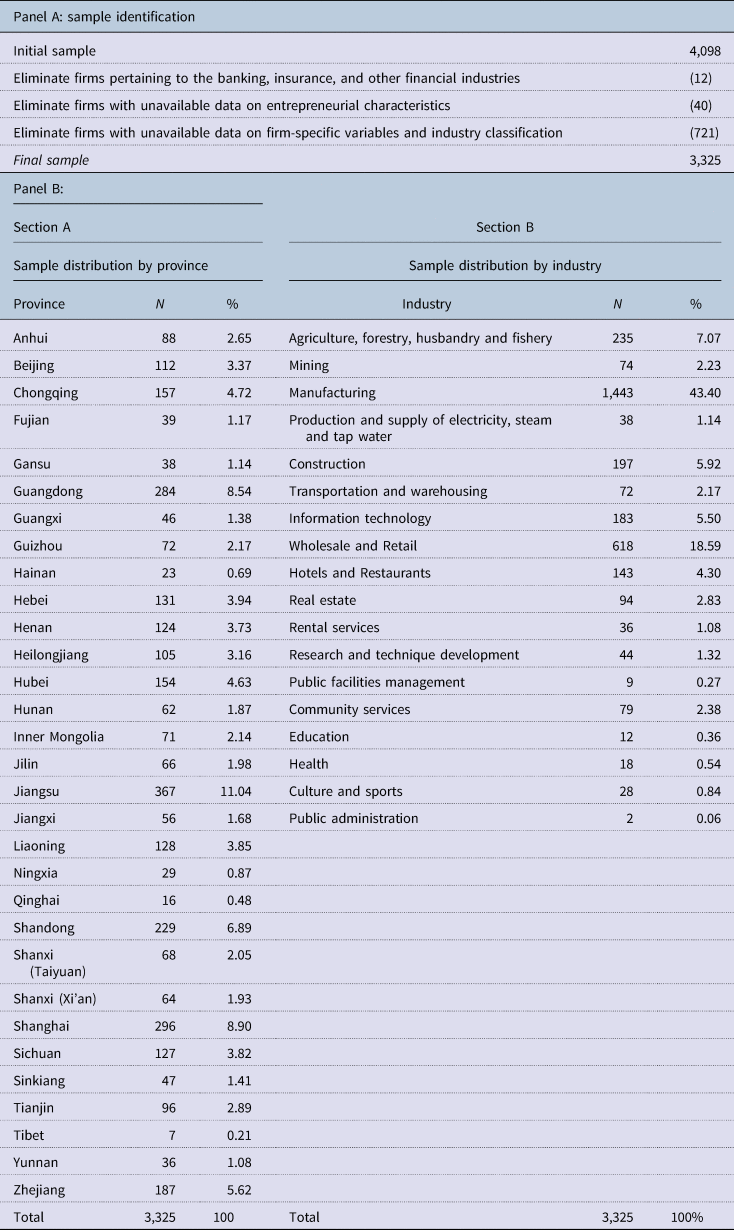
Our initial sample consists of 4,098 Chinese family firms in the 2008 national survey. Panel A of Table 1 reports the process of sample identification. First, we eliminate firms in the banking, insurance, and other financial industries due to different financial characteristics. Second, we eliminate firms with unavailable data on entrepreneurial characteristics (gender, educational level, political connections, and oversea experience). Finally, we eliminate firms with missing data on firm-specific variables and industry. As a result, the final sample covers 3,325 family firms. Then, we winsorize each continuous variable based on the top and bottom 1% quantiles to alleviate the extreme effectFootnote 6.
Sample identification

Panel B of Table 1 displays the sample distribution by province and industry, respectively. Section A shows that family firms evenly distribute in 31 provinces of mainland China. Except for Jiangsu province, the proportion of sample firms in each province is less 10%. Moreover, in Section B, most family firms cluster in the manufacturing industry (43.40%) and wholesale and retail industry (18.59%). Therefore, we calculate all t-statistics in regression analysis based on robust standard errors adjusted for clustering at firm level to mitigate the impacts of the clustering problem (Petersen, Reference Petersen2009).
Data source
We obtain the data on entrepreneurial characteristics (e.g., religious belief, gender, educational level, political connections, and overseas experience, etc.) from the 2008 national survey. Prior literature has employed similar survey database (e.g., Su & He, Reference Su and He2010; Zhou, Reference Zhou2013; Du, Reference Du2015, Reference Du2017; etc.). The executors of the 2008 national survey included: (1) the United Front Work Department of the CPC Central Committee; (2) the All-China Federation of Industry & Commerce; (3) the State Administration for Industry and Commerce of the People's Republic of China; and (4) the Private Economy Research Institute of China. The private entrepreneurs who attended the survey were randomly selected from 31 provinces, autonomous regions, and municipalities in China. Moreover, the 2008 national survey reported governance and firm-specific characteristics such as CEO-chairman duality (DUAL), the general meeting of shareholders (SGM), the board of directors (DBOARD), the board of supervisors (SBOARD), firm scale (SIZE), financial leverage (LEV), and profitability (ROS). Moreover, we obtain data on the province-level Development of Factor Markets index from Fan, Wang, & Zhu (Reference Fan, Wang. and Zhu2011) and hand-collect religious atmosphere variables (i.e., BUD, DAO, CHRST, CATH, and ISLAM), then match them to each firm according to the provincial information in the 2008 national survey. Finally, we gather the data on other variables from the 2008 China Statistical Yearbook.
Corporate longevity (dependent variable)
In this study, the dependent variable is corporate longevity, labeled as LONG. LONG is measured as the number of years from a firm's establishment to the year of 2007 (Smith, Heady, Carson, & Carson, Reference Smith, Heady, Carson and Carson2001; Piao, Reference Piao2010; Williams & Jones, Reference Williams and Jones2010; King & Peng, Reference King and Peng2013). In addition, we also use the nature logarithm of corporate longevity (LN (LONG)), industry-median-adjusted corporate longevity (LONG_IND), and province-median-adjusted corporate longevity (LONG_PRO) as other dependent variables to ensure the robustness of our findings, respectively.
Religious entrepreneurs (independent variable)
In this study, the main independent variable is religious entrepreneurs, labeled as REL. REL is an indicator variable, equaling 1 if an entrepreneur chooses a religion (e.g., Buddhism, Daoism, Catholicism, and Islamism, etc.) as his/her faith and 0 otherwise. Hypothesis 1 is validated by empirical evidence if the coefficient on REL is significantly positive. Moreover, this study also distinguishes Eastern religions (REL_EAST) from Western religions (REL_WEST) to investigate whether different religions exert asymmetric effects on corporate longevity.
The development of factor markets (moderating variable)
In this study, the moderating variable is the development of factor markets, labeled as DFM. DFM is measured as the Development of Factor Markets index in the year of 2008, which captures the extent of the development of factor markets across different provinces in China (Fan, Wang, & Zhu, Reference Fan, Wang. and Zhu2011). The Development of Factor Markets index, published by the National Economic Research Institute (Fan, Wang, & Zhu, Reference Fan, Wang. and Zhu2011), ‘consists of four components (i.e., the extent of Marketization in financial industries, foreign direct investment, the labor mobility, and commercialization of technological innovation) and various subcomponents. The value of each subcomponent in the year of 1999 serves as the base value and the range of each subcomponent is between 0 and 10. The total Development of Factor Markets index is calculated as the mean value of the subcomponents scores that are normalized by base values.’
If the coefficient on REL × DFM is positive and significant, Hypothesis 2 is supported by empirical evidence. In addition, drawing on previous studies (Fama, Reference Fama1980; Leonard, Reference Leonard1990; Lang & Stulz, Reference Lang and Stulz1994; Groves et al., Reference Groves, Hong, McMillan and Naughton1995), we predict both coefficients on REL and DFM are positive.
Control variables
To isolate the effects of other determinants on corporate longevity (Bates, Reference Bates1990; Pennings, Lee, & Van Witteloostuijn, Reference Pennings, Lee and Van Witteloostuijn1998; Smith et al., Reference Smith, Heady, Carson and Carson2001; Piao, Reference Piao2010; Williams & Jones, Reference Williams and Jones2010; Yu, Orazem, & Jolly, Reference Yu, Orazem and Jolly2011; King & Peng, Reference King and Peng2013), we incorporate a set of control variables in regression models. First, we introduce GENDER, EDU, POL_CON, and FOR_EXP to isolate the impacts of other entrepreneurial characteristics on corporate longevity (Bates, Reference Bates1990; Pennings, Lee, & Van Witteloostuijn, Reference Pennings, Lee and Van Witteloostuijn1998; Williams & Jones, Reference Williams and Jones2010; King & Peng, Reference King and Peng2013). GENDER is a dummy variable, equaling 1 if a family firm has a female entrepreneur and 0 otherwise (Wang & Coffey, Reference Wang and Coffey1992; Mersland & Strøm, Reference Mersland and Strøm2009; Zhou, Reference Zhou2013). EDU is an ordered variable for entrepreneurial educational level, and its value is 6, 5, 4, 3, 2, and 1 when an entrepreneur's diploma is postgraduate degree or above, bachelor degree, college degree, senior middle school degree, middle school degree, and elementary school degree, respectively (Su & He, Reference Su and He2010; Du, Reference Du2015). POL_CON denotes an entrepreneur's government experience, equaling 1 if an entrepreneur was an official in a governmental institution before he/she founded a family firm and 0 otherwise (Fan, Wong, & Zhang, Reference Fan, Wong and Zhang2007; Su & He, Reference Su and He2010). FOR_EXP is a dummy variable, equaling 1 if an entrepreneur studied or worked in one or more foreign countries and 0 otherwise (Herrmann & Datta, Reference Herrmann and Datta2006; Magnusson & Boggs, Reference Magnusson and Boggs2006).
Second, we include DUAL, SGM, DBOARD, and SBOARD to capture the effects of governance mechanisms on corporate longevity (Parker, Peters, & Turetsky, Reference Parker, Peters and Turetsky2005). DUAL is a dichotomous variable, equaling 1 for CEO-chairman duality and 0 otherwise (Du, Reference Du2015). SGM is a dummy variable, equaling 1 if a family firm has a general meeting of its shareholders (SGM) and 0 otherwise (Du, Reference Du2015). DBOARD (SBOARD) is an indicator variable, equaling 1 if a family firm owns a board of directors (a supervisory committee) and 0 otherwise (Du, Reference Du2015).
Third, previous studies show that corporate longevity is associated with firm scale, financial leverage, and profitability (Turetsky & McEwen, Reference Turetsky and McEwen2001; Thornhill & Amit, Reference Thornhill and Amit2003; Williams & Jones, Reference Williams and Jones2010). As a response, we incorporate SIZE, LEV, and ROS to control for the impacts of firm-specific financial characteristics on corporate longevity. SIZE represents firm scale, measured as the nature logarithm of total revenue (Zhou, Reference Zhou2013; Du, Reference Du2015, Reference Du2017). LEV denotes financial leverage, measured as bank loans scaled by total revenue (Su & He, Reference Su and He2010; Du, Reference Du2015, Reference Du2017). ROS denotes profitability, measured as net income divided by total revenue (Zhou, Reference Zhou2013; Du, Reference Du2015, Reference Du2017).
Finally, a set of industry and province dummy variables are included in regression models to capture the industry and province fixed effects.
A statistical remedy to control for the common method biases
The common method biases in behavior research may arise from the respondents’ common cognition and affectivity, which yield potential shared methods among measures. In response, we conduct a statistical remedy to control for the common method biases through three ways as below: (1) We use the confirmatory factor analysis to obtain the first unrotated factor, which can mitigate unobserved common method variance to some extentFootnote 7. (2) Using the scores of social, economic, and political status of private entrepreneurs – which are reported in the 2008 national survey, we measure the self-reported assessment. (3) We use confirmatory factor analysis to extract the first common factor from several variablesFootnote 8, which represent entrepreneurs’ judgments about the influence of the external environment on corporate operation in recent years. Finally, we remove the impacts of above factors from all variables in this study.
Results
Descriptive statistics and correlation analysis
Column (1) of Panel A in Table 2 reports results of summary statistics of all variables in this study. The mean value of corporate longevity (LONG) is about 9.3771, suggesting that Chinese family firms’ longevity is about 9.3771 years on average. The mean value of religious entrepreneurs (REL) is about 0.1456, suggesting that about 14.56% of Chinese entrepreneurs believe in a religion. The mean value of DFM is 6.8370, revealing the average level of the development of factor markets in China.
Descriptive Statistics, Pearson Correlation Matrix, and Partial Correlation Matrix

Note: ***, **, and * represent the 1%, 5%, and 10% levels of significance, respectively.
As for control variables, on average and approximately, 15.37% of family firms is founded by female entrepreneurs (GENDER), entrepreneurs have college-degree (EDU), 17.65% of entrepreneurs worked in (center or local) governments before they founded their family firms (POL_CON), 1.47% of entrepreneurs have foreign experiences before they established firms (FOR_EXP), the CEO and the chairman are the same person (DUAL) in 86.05% of Chinese family firms, 49.80%, 49.23%, and 29.44% of Chinese family firms set up the general meeting of shareholders (SGM), the board of directors (DBOARD), and the board of supervisors (SBOARD), respectively, firm size (SIZE) is 9.61 million RMB, financial leverage (LEV) is 20.95%, and profitability (ROS) is 9.69%.
Columns (2)–(4) of Panel A report results of univariate tests after the full sample is partitioned into the REL subsample (REL = 1) and the non-REL subsample (REL = 0). As shown in Columns (2)–(4), the mean (median) value of corporate longevity is significantly higher for the REL subsample than for the non-REL subsample, implying a positive relation between religious entrepreneurs and corporate longevity and preliminarily supporting Hypothesis 1. Moreover, compared with the non-REL subsample, the REL subsample (REL = 1) has a higher level of factor markets development (DFM), higher likelihood of female entrepreneurs (GENDER), lower education level (EDU), and lower likelihood of politically connected entrepreneurs, respectively.
Panel B of Table 2 reports Pearson correlation analysis. Corporate longevity (LONG) displays a significantly positive correlation with religious entrepreneurs (REL), preliminarily supporting Hypothesis 1. Second, the correlation coefficient between LONG and DFM is significantly positive, implying the positive influence of the development of factor markets on corporate longevity. Above results suggest the need to investigate the interactive effects between religious entrepreneurs and the development of factor markets on corporate longevity. Moreover, LONG is significantly negatively related to GENDER, EDU, and SGM, but is significantly positively associated with DUAL, DBOARD, and SIZE, respectively. Furthermore, correlation coefficients among independent variables are generally small as expected, implying mild multicollinearity in our modelsFootnote 9. Finally, we also provide partial correlation matrix to control for common method biases. Panel C of Table 2 shows that corporate longevity (LONG) has a significantly positive partial correlation with religious entrepreneurs (REL), and the partial correlation coefficient between LONG and DFM is also significantly positive.
Main findings
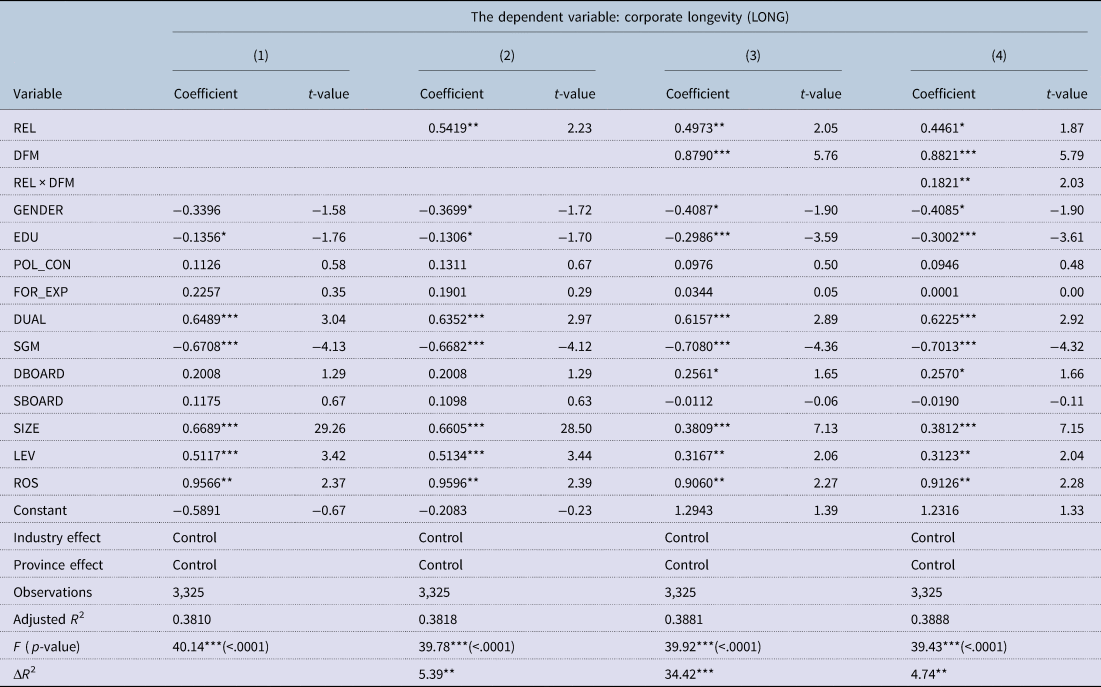
We estimate the pooled OLS regressions and report results of Hypotheses 1 and 2 after controlling for the common method biases in Table 3. All reported t-statistics are based on standard errors adjusted for clustering at firm level (Petersen, Reference Petersen2009).
Results of corporate longevity on religious entrepreneurs, the development of factor markets, and other determinants

Note: ***, **, and * represent the 1%, 5%, and 10% levels of significance, respectively (two-tailed tests). Results in this table are adjusted for common method biases. All reported t-statistics are based on robust standard errors adjusted for clustering at firm level (Petersen, Reference Petersen2009).
In Column (1) of Table 3, we address the influence of all control variables on corporate longevity. As shown in Column (1), corporate longevity of Chinese family firms is significantly positively associated with managerial power (DUAL), firm size (SIZE), financial leverage (LEV), and profitability (ROS), but is significantly negatively related with entrepreneurial educational level (EDU) and the establishment of shareholders’ general meeting (SGM), respectively.
Column (2) of Table 3 displays regression results of Hypothesis 1, which predicts that corporate longevity is positively associated with religious entrepreneurs. The coefficient on REL is positive and significant at the 5% level (0.5419 with t = 2.23), consistent with Hypothesis 1. Moreover, this finding reveals several aspects: (1) the significantly positive association between religious entrepreneurs and corporate longevity suggests that Chinese family firms with religious entrepreneurs are more long-lived than their counterparts. (2) This finding further echoes the view that individuals can learn managerial and social skills, raise social capital, have more opportunities to establish good connections with government officials, form long-term family value and harmonious family relation, and take inspiration from organizational continuity through voluntary religious participation (Hofstede, Reference Hofstede1984; Hogarth et al., Reference Hogarth, Michaud, Doz and Van der Heyden1991; Baron & Markman, Reference Baron and Markman2000; Hunt, Reference Hunt2000; Cao, Reference Cao2007; Yang, Reference Yang2011; Nwankwo, Gbadamosi, & Ojo, Reference Nwankwo, Gbadamosi and Ojo2012; Du, Reference Du2017). (3) The coefficient on REL implies that corporate longevity of Chinese family firms with religious entrepreneurs is 0.5419 year longer than that of their counterparts, equaling about 5.78% of the average longevity of Chinese family firms. Clearly, this amount is economically significant, in addition to its statistical significance.
In Column (3) of Table 3, we link corporate longevity with religious entrepreneurs, the development of factor markets, and all control variables. As Column (3) reports, the coefficient on REL is positive and significant at the 5% level (0.4973 with t = 2.05), lending additional support to Hypothesis 1. In addition, the moderating variable of DFM has a significant positive coefficient.
Column (4) of Table 3 reports regression results of Hypothesis 2, which predicts the reinforced effect of the development of factor markets on the positive association between religious entrepreneurs and corporate longevity. As presented in Column (4), the coefficient on REL is significantly positive (0.4461 with t = 1.87), providing additional support to Hypothesis 1. Moreover, the coefficient on DFM is significantly positive (0.8821 with t = 5.79), echoing findings in extant studies (Oliver, Reference Oliver1997; Carney, Gedajlovic, & Strike, Reference Carney, Gedajlovic and Strike2014) that institutional environment can affect corporate longevity to a great extent. More importantly, REL × DFM has a significantly positive coefficient (0.1821 with t = 2.03), lending important support to Hypothesis 2. This finding in Column (4) suggests that the development of factor markets reinforces the positive effect of religious entrepreneurs on corporate longevity, echoing the view that entrepreneurial behavior closely depends on institutional systems to a great extent (Martinelli, Reference Martinelli2004; Dickson & Weaver, Reference Dickson and Weaver2008; Welter & Smallbone, Reference Welter and Smallbone2011).
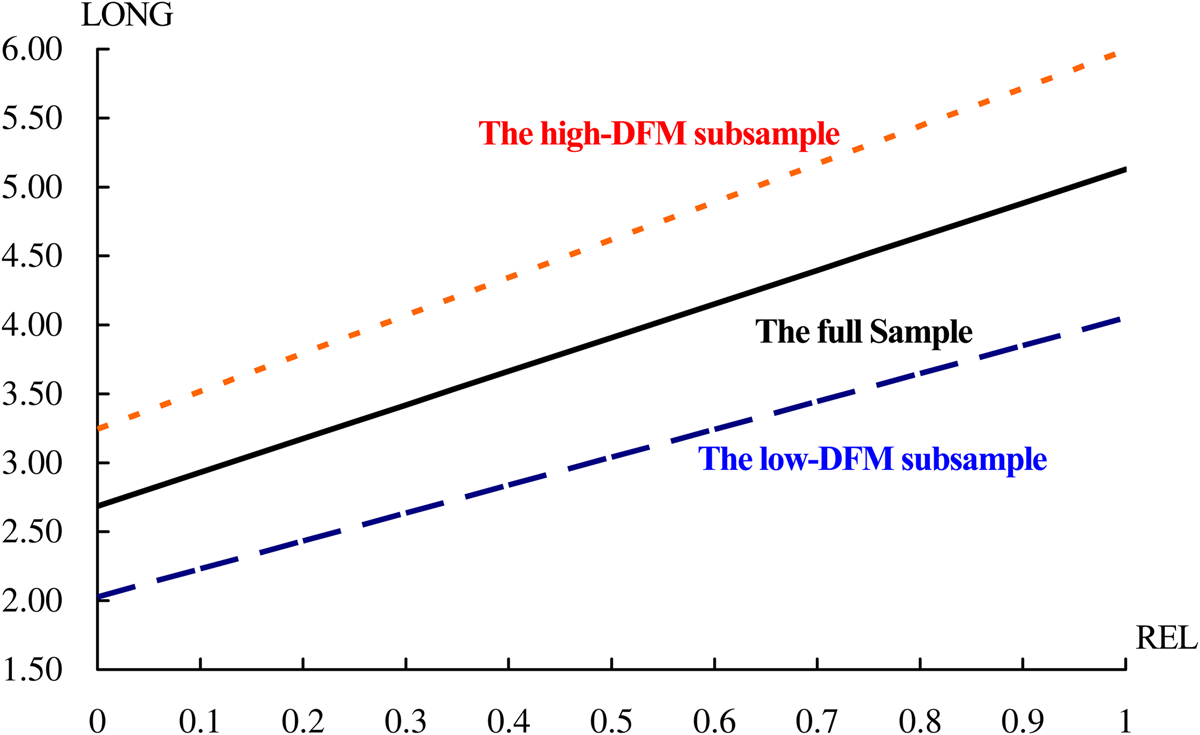
Next, we plot Figure 1 to better display the moderating role of the development of factor markets after controlling for common method biases. According to the mean value of the Development of Factor Markets index from Fan, Wang, and Zhu (Reference Fan, Wang. and Zhu2011), we partition the sample into two subsamples: the high-DFM subsample and the low-DFM subsample. As shown in Figure 1, the back, blue, and red lines represent the impact of religious entrepreneurs on corporate longevity for the full sample, the low-DFM subsample and the high-DFM subsample, respectively. Figure 1 shows an obvious tendency that the positive association between religious entrepreneurs and corporate longevity is more pronounced for the high-DFM subsample than for the low-DFM subsample, validating the reinforced effect of the development of factor markets on the positive relation between religious entrepreneurs and corporate longevity. Overall, Figure 1 provides visual and straightforward evidence for Hypothesis 2.
The interactive effects between religious belief (REL) and the development of factor markets (DFM) on corporate longevity (LONG) after controlling for common method biases. Note: In Figure 1, the black, red, and blue lines denote the impacts of religious belief on corporate longevity for the full sample, the high-DFM subsample, and the low-DFM subsample, respectively.

Additional tests using alternative measures of corporate longevity
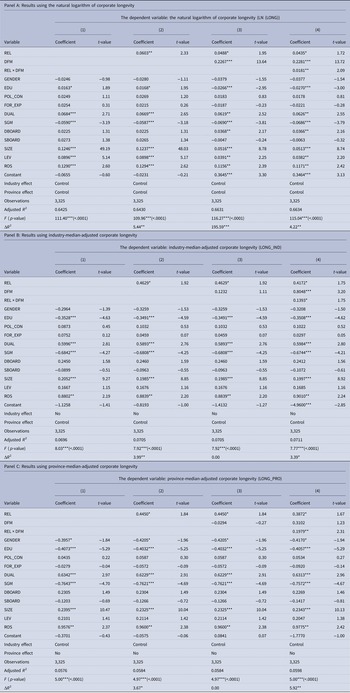
To ensure the robustness of our findings in Table 3, we conduct several sensitivity tests. First, we employ the nature logarithm of the number of years since firm establishment (LN (LONG)) as the dependent variable to re-test Hypotheses 1 and 2. As Column (2) of Panel A in Table 4 shows, the coefficient on REL is significantly positive (0.0603 with t = 2.33), lending additional support to Hypothesis 1. In Column (4) of Panel A, the coefficient on REL × DFM is positive and significant at 5% level (0.0181 with t = 2.09), validating Hypothesis 2 again.
Robustness checks using alternative measures of corporate longevity

Note: ***, **, and * represent the 1%, 5%, and 10% levels of significance, respectively (two-tailed tests). Results in this table are adjusted for common method biases. All reported t-statistics are based on robust standard errors adjusted for clustering at firm level (Petersen, Reference Petersen2009).
Second, using the industry-median-adjusted corporate longevity (LONG_IND) (the difference between the number of years since firm establishment and the median value of the number of years since firm establishment in the same industry) as the dependent variable, Column (2) of Panel B in Table 4 shows that REL has a positive and significant coefficient (0.4629 with t = 1.92), consistent with Hypothesis 1. Moreover, in Column (4) of Panel B in Table 4, the coefficient on REL × DFM is positive and significant (0.1393 with t = 1.75), consistent with Hypothesis 2.
Finally, we compute the median-adjusted corporate longevity at the provincial level (LONG_PRO) and use it as the alternative dependent variable to re-test Hypotheses 1 and 2. Column (2) of Panel C in Table 4 displays that REL has a significantly positive coefficient, supporting Hypothesis 1 again. In addition, as shown in Column (4) of Panel C, REL × DFM has a positive and significant coefficient (0.1979 with t = 2.31), lending additional support to Hypothesis 2.
Additional tests considering the difference between Eastern religions and Western religions
To address whether different religions asymmetrically affect corporate longevity, we follow Du (Reference Du2017) to distinguish Eastern religions from Western religionsFootnote 10, and then re-test Hypotheses 1 and 2. In doing so, we include Eastern religions (REL_EAST) and Western religions (REL_WEST) as two main independent variables. REL_EAST is a binary variable, equaling 1 if an entrepreneur believes in Buddhism or Daoism and 0 otherwise. REL_WEST is a dummy variable, equaling 1 if an entrepreneur chooses Catholicism (Christianity), Islamism, or other Western religions as the faith and 0 otherwise.
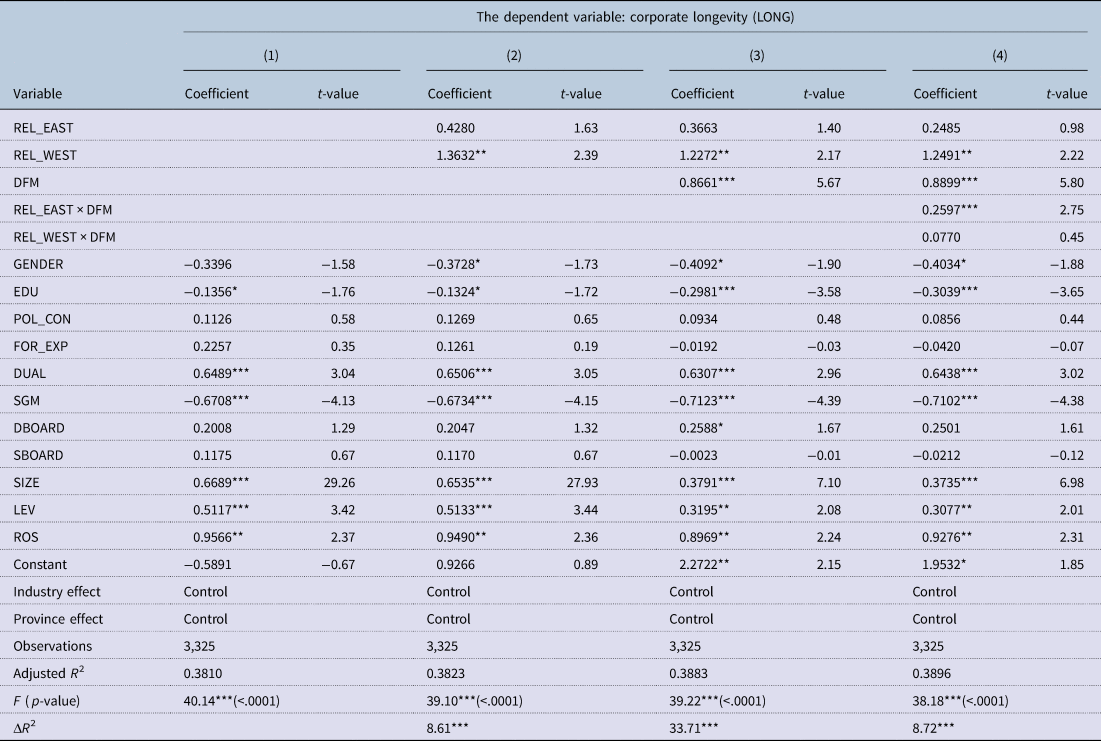
As shown in Column (2) of Table 5, REL_WEST has a significantly positive coefficient (1.3632 with t = 2.39). However, the coefficient on REL_EAST in Column (2) is insignificantly positive. These findings reveal that the positive association between religious belief and corporate longevity is only valid for Western religions, but invalid for Eastern religions. Moreover, Column (4) of Table 5 shows that REL_EAST × DFM has a significant and positive coefficient (0.2597 with t = 2.75), but the coefficient on REL_WEST × DFM is insignificant. These findings reveal that the reinforced role of the development of factor markets is only valid for Eastern religions.
Robustness checks considering the distinction between Western religions and Eastern religions

Notes: ***, **, and * represent the 1%, 5%, and 10% levels of significance, respectively (two-tailed tests). Results in this table are adjusted for common method biases. All reported t-statistics are based on robust standard errors adjusted for clustering at firm level (Petersen, Reference Petersen2009).
Endogeneity Tests
Endogeneity tests using the PSM approach
In this study, following Du (Reference Du2017), we employ the PSM (Rosenbaum & Rubin, Reference Rosenbaum and Rubin1983; Dehejia & Wahba, Reference Dehejia and Wahba2002) method to mitigate the influence of selection bias, which may result in the endogeneity between religious entrepreneurs and corporate longevity. In the first-stage model of the PSM regressions, the dependent variable is REL, equaling 1 if an entrepreneur believes in a religion and 0 otherwise. Referring to previous literature (e.g., El Ghoul et al., Reference El Ghoul, Guedhami, Ni, Pittman and Saadi2012; Du, Reference Du2013, Reference Du2017; etc.), we employ several exogenous variables to match the treatment team as below:
(1) Religious atmosphere including BUD, DAO, CHRST, CATH, and ISLAM, that affects an entrepreneur's religious belief. BUD (DAO) denotes Buddhist (Taoist) atmosphere, measured as the number of nationally famous Buddhist (Taoist) monasteries per capita in a province. CATH (CHRST) is measured as the number of nationally famous Catholic (Christian) churches per capita at the province-level. ISLAM denotes Islamic atmosphere, measured as the number of nationally famous mosques per capita in a province. Argyle and Beit-Hallahmi (Reference Argyle and Beit-Hallahmi2014) indicate that religion always belongs to both individual and social behavior. An individual who lives in a religious environment is more likely to interact with families, friends, marriage partners, and peer groups, who are adherents, and be affected by local religious media (Myers, Reference Myers1996; Kelley & De Graaf, Reference Kelley and De Graaf1997). Many scholars argue that local religious atmosphere is one of the most important determinants for religious belief (Myers, Reference Myers1996; Kelley & De Graaf, Reference Kelley and De Graaf1997; Argyle & Beit-Hallahmi, Reference Argyle and Beit-Hallahmi2014).
(2) Regional culture including EAST, WEST, and NORTH, which may affect the attitude of individuals towards religions. EAST is a dummy variable, equaling 1 if a family firm is located in Beijing, Shanghai, Tianjin, Hebei, Jiangsu, Zhejiang, Fujian, Shandong, Guangdong, or Hainan and 0 otherwise. WEST is an indicator variable, equaling 1 if a family firm is located in Sichuan, Shaanxi, Gansu, Chongqing, Guizhou, Yunnan, or Qinghai and 0 otherwise. NORTH is a binary variable, equaling 1 if a family firm locates in Jilin, Heilongjiang, or Liaoning and 0 otherwise. Because convention, custom, and habits in a region are historically affected by local religions, individuals who live in this region are more likely to interact with local culture, and thus prefer to choose local religions as their beliefs (Argyle & Beit-Hallahmi, Reference Argyle and Beit-Hallahmi2014). Prior studies reveal that local culture factors affect individual religiosity (Aleksynska & Chiswick, Reference Aleksynska and Chiswick2013; Argyle & Beit-Hallahmi, Reference Argyle and Beit-Hallahmi2014; Kelley & De Graaf, Reference Kelley and De Graaf1997). We partition mainland China into eastern, western, and northern regions, because most minorities who have different traditions from Han live in the northern and western regions of China.
(3) Province-level variables such as TRANS, UNEMPR, LNFDFF, and GDP_PC, may affect individual preference about engaging in religious activities. TRANS is measured as the natural logarithm of the total mileage of highway and railway at the province level. UNEMPR is measured as provincial unemployment rate. LNFDFF denotes financial deficit, measured as the natural logarithm of provincial financial deficit. GDP_PC is computed as provincial GDP per capita. Previous studies indicate that religious preference is associated with local development, such as transportation, unemployment, public deficit, and the level of economic (Osborne & Cormack, Reference Osborne and Cormack1986; Iannaccone, Reference Iannaccone1998; Barro & McCleary, Reference Barro and McCleary2003; Clark & Lelkes, Reference Clark and Lelkes2006; Timothy & Olsen, Reference Timothy and Olsen2006).
(4) Entrepreneurs-specific variables including AGE, GENDER, EDU, POL_CON, FOR_EXP, and DUAL. AGE denotes an entrepreneur's age. Individual religious preference is affected by various personal characteristics (e.g., age, gender, and education level, etc.) (Kelley & De Graaf, Reference Kelley and De Graaf1997; Iannaccone, Reference Iannaccone1998; Argyle & Beit-Hallahmi, Reference Argyle and Beit-Hallahmi2014). Moreover, China is a socialist country, and thus work experience in the government is more likely to reduce individual religious preference (Potter, Reference Potter2003; Yang, Reference Yang2011). However, overseas experience may increase the possibility of interacting with religion (Potter, Reference Potter2003; Yang, Reference Yang2011). In China, an entrepreneur can exert significant effects on corporate behavior (Huang, Reference Huang2000), and thus we use DUAL to capture the managerial power in a family firm.
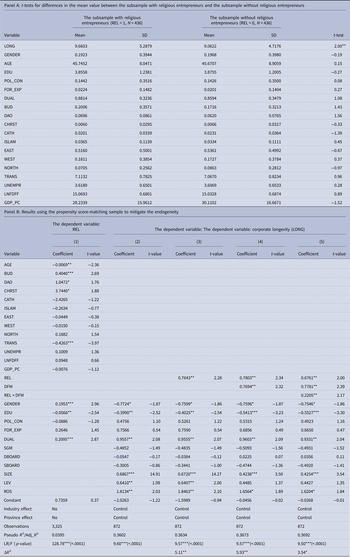
Next, we employ t-tests to address the rationale of exogenous variables used in the PSM process. In doing so, we examine differences in the mean value between the REL subsample (REL = 1) and the non-REL subsample (REL = 0). As shown in Panel A of Table 6, there is a significant and positive difference in LONG between the treatment and the control groups (t = 2.00). However, for all variables used in the first-stage selection model, there are no significant differences between these two subsamples, suggesting that exogenous variables are relatively appropriate.
Results after controlling for the endogeneity between religious entrepreneurs and corporate longevity

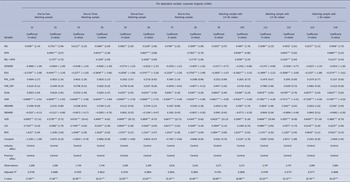
Notes: ***, **, and * represent the 1%, 5%, and 10% levels of significance, respectively (two-tailed tests). All results using the PSM sample are adjusted for common method biases. All reported t-statistics are based on robust standard errors adjusted for clustering at firm level (Petersen, Reference Petersen2009).
Column (1) of Panel B in Table 6 displays the results of the first-stage selection model. As shown in Column (1), REL is significantly negatively associated with AGE, TRANS, and EDU, but REL is significantly positively related to BUD, DAO, CHRST, GENDER, and DUAL.
As expected, using the PSM sample (872 observations), Column (3) of Panel B shows that REL has a positive and significant coefficient (0.7643 with t = 2.28), validating Hypothesis 1. In addition, Column (5) of Panel B shows that the coefficients on REL and DFM are both significantly positive and the coefficient on REL × DFM is positive and significant (0.2205 with t = 2.17), consistent with Hypothesis 2. To sum up, results after using the PSM method to control for the endogeneity are qualitatively similar to those in Table 3.
Space graph for matched samples and comparing PSM approach with other matching methods
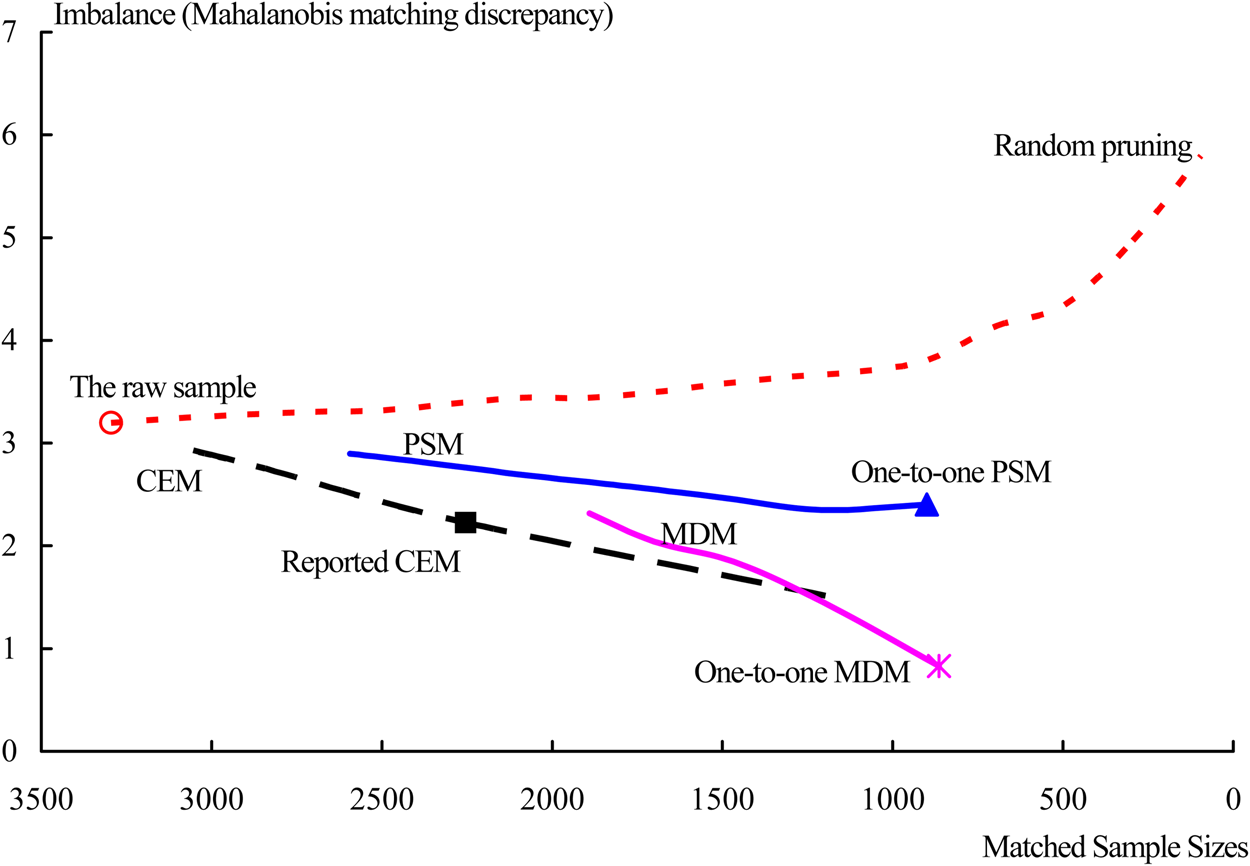
As King and Nielsen (Reference King and Nielsen2016) argue, a more restrictive caliper in PSM may threaten the validity of causal inference. Referring to King and Nielsen (Reference King and Nielsen2016), in Figure 2, we report space graphs for matched samples under different matching techniques, which can clarify how the imbalance is left after using PSM. In Figure 2, the vertical axis denotes Mahalanobis matching discrepancy and the extent of imbalance, but the horizontal axis represents a matched sample size. A line in the graph represents the approximation of the imbalance-matched sample size frontier under a specific matching techniqueFootnote 11.
The space graph for multiple matching solutions. Note: In Figure 2, each point represents one matching solution. The red dash line, blue solid line, pink solid line, and black dash line denote the observed frontiers for random pruning, for propensity score matching, for Mahalanobis distance matching, and for coarsened exact matching, respectively. The circle on the left of the red dash line, the triangle on the blue solid line, the star on the pink solid line, and the square on the black dash line represent the solutions for the raw sample, for the one-to-one propensity score matching sample, for the one-to-one Mahalanobis distance matching sample, and for the reported coarsened exact matching sample, respectively.

In Figure 2, the red dash line represents the observed frontier for random pruning. The imbalance of random pruning increases along with a decrease in matched sample size, implying serious biases in causal inference. The blue solid line, pink solid line, and black dash line denote the observed frontiers for PSM, Mahalanobis distance matching (MDM), and coarsened exact matching (CEM), respectively. As shown in Figure 2, the blue solid line, the pink solid line, and the black dash line slope downward, suggesting that imbalance decreases when matched sample size reduces. The triangle on the blue line represents the one-to-one PSM solution that has a moderate imbalance. However, MDM has a solution (star point on the pink line) with the lowest imbalance, and CEM reserves more information of raw data. Overall, Figure 2 suggests that the imbalance of matched samples under PSM is moderate, and that MDM and CEM have additional information for causal inference. Thus, we further compare the results of various matching methods.
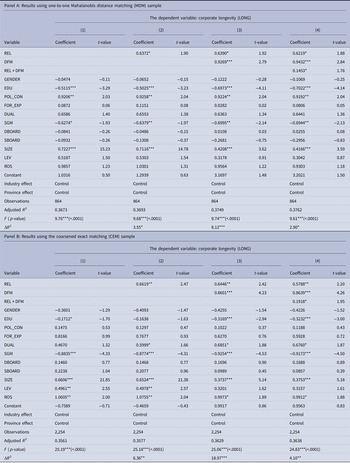
To further address the validity of PSM used in this study, Table 7 re-test Hypotheses 1 and 2 using MDM sample and CEM sample, and all results are adjusted for common method biases.
Results using one-to-one Mahalanobis distance matching sample and the coarsened exact matching sample

Note: ***, **, and * represent the 1%, 5%, and 10% levels of significance, respectively (two-tailed tests). Results in this table are adjusted for common method biases. All reported t-statistics are based on robust standard errors adjusted for clustering at firm level (Petersen, Reference Petersen2009).
Panel A of Table 7 reports results using one-to-one MDM sample. In Column (2) of Panel A, the coefficient on REL is significantly positive. Moreover, in Column (4) of Panel A, the coefficient on REL × DFM is significantly positive. Panel B of Table 7 presents results using CEM sample. In Column (2) of Panel B, the coefficient on REL is positive and significant at the 5% level (0.6619 with t = 2.47). Column (4) of Panel B shows that the coefficient on REL × DFM is positive and significant at the 10% level (0.1918 with t = 1.95). To sum up, results using MDM and CEM samples are qualitatively similar to those in Panel B of Table 6 (PSM sample is used), implying the validity of PSM for causal inference.
Results using multiple PSM samples
According to King and Nielsen (Reference King and Nielsen2016), a large sample is likely to improve the usefulness of PSM for causal inference. As a response, we loosen the matching calipers of PSM to increase matched sample sizes by using 1-to-2, 1-to-3, 1-to-4, 1-to-5 matching. Moreover, we also choose several most common calipers of PSM, such as one-quarter of a standard deviation of the propensity score, half of a standard deviation of the propensity score, and a standard deviation of the propensity score. Results are reported in Table 8 and all results are adjusted for common method biases.
Results using the larger propensity score-matching samples (adjusted for common method biases)

Note: ***, **, and * represent the 1%, 5%, and 10% levels of significance, respectively (two-tailed tests). All reported t-statistics are based on robust standard errors adjusted for clustering at firm level (Petersen, Reference Petersen2009).
In Columns (1), (3), (5), (7), (9), (11), and (13) of Table 8, the coefficients on REL are all significantly positive. Moreover, as shown in Columns (2), (4), (6), (8), (10), (12), and (14) of Table 8, the coefficients on REL × DFM are all significantly positive. These results are qualitatively similar to those in Panel B of Table 6.
Discussions
Theoretical contributions
Several theoretical contributions are implied in our study. First, to our knowledge and literature in hand, this study is the first to investigate the influence of religious entrepreneurs on corporate longevity in the context of China – the largest emerging market in the world. In this regard, our study contributes to the existing literature about religious influence on corporate behavior, as well as extant studies about the effects of entrepreneur-specific characteristics on corporate longevity (Bates, Reference Bates1990, Reference Bates1995; Nafziger & Terrell, Reference Nafziger and Terrell1996; Pennings, Lee, & Van Witteloostuijn, Reference Pennings, Lee and Van Witteloostuijn1998; Delmar & Shane, Reference Delmar and Shane2006; Hilary & Hui, Reference Hilary and Hui2009; Williams & Jones, Reference Williams and Jones2010; McGuire, Omer, & Sharp, Reference McGuire, Omer and Sharp2011; Dyreng, Mayew, & Williams, Reference Dyreng, Mayew and Williams2012; El Ghoul et al., Reference El Ghoul, Guedhami, Ni, Pittman and Saadi2012; King & Peng, Reference King and Peng2013; Du, Reference Du2017). Although previous studies have examined the determinants of corporate continuity, little attention is paid to the association between religious entrepreneurs and corporate longevity, and thus the following problems are pending: (1) whether religious entrepreneurs affect corporate longevity; (2) whether different religions have asymmetric effects on corporate longevity; and (3) whether the relation between religious entrepreneurs and corporate longevity depends on institutional environment. As such, our study fills above gaps and contributes to two branches of previous studies about religious influence on corporate behavior and the impacts of entrepreneurial characteristics on corporate decisions.
Second, this study adds to the existing literature by exploring the influence of the development of factor markets on corporate longevity. A stream of previous studies (Williams & Jones, Reference Williams and Jones2010; Yu, Orazem, & Jolly, Reference Yu, Orazem and Jolly2011; Carney, Gedajlovic, & Strike, Reference Carney, Gedajlovic and Strike2014) has found that institutional environment (e.g., macro-economic systems, legal systems, and regional culture, etc.) impacts corporate longevity. However, these studies are conducted in the context of developed markets, and thus the findings may not fit in well with the Chinese context. In this study, we recognize the positive effect of the development of factor markets on corporate longevity, echoing the crucial role of institutional environment in the allocation of social wealth (Oliver, Reference Oliver1997; Carney, Gedajlovic, & Strike, Reference Carney, Gedajlovic and Strike2014).
Third, this study validates the reinforced effect of the development of factor markets on the positive association between religious entrepreneurs and corporate longevity. This finding adds to the existing literature about the institutional embeddedness of entrepreneurial behavior theory, which argues that the impacts of entrepreneurial behavior and decisions are affected by external institutional environment (Schiff, Reference Schiff1992; Martinelli, Reference Martinelli2004; Dickson & Weaver, Reference Dickson and Weaver2008; Welter & Smallbone, Reference Welter and Smallbone2011). A stream of extant literature suggests that different institutional contexts bring out a variety of differences in economic consequences of entrepreneurial characteristics, but few studies address whether the development of factor markets moderates the effect of religious entrepreneurs on corporate behavior. In this regard, our findings lend important and additional support to the institutional embeddedness of entrepreneurial behavior theory through exploring the moderating role of the development of factor markets in the positive relation between religious entrepreneurs and corporate longevity.
Finally, our study finds asymmetric effects between Western religions and Eastern religions on corporate longevity, echoing the findings in Du (Reference Du2017) – different religions affect corporate behavior asymmetrically. A large body of studies mainly focus on a specific religion and investigate religious influence on corporate decisions (e.g., Hilary & Hui, Reference Hilary and Hui2009; McGuire, Omer, & Sharp, Reference McGuire, Omer and Sharp2011; Dyreng, Mayew, & Williams, Reference Dyreng, Mayew and Williams2012; El Ghoul et al., Reference El Ghoul, Guedhami, Ni, Pittman and Saadi2012; Du, Reference Du2013, Reference Du2014; etc.), but they do not address the asymmetric effects of different religions on specific corporate behavior. Focusing on the Chinese context, our study contributes to prior literature by examining the asymmetric impacts of entrepreneurs with different religious beliefs on corporate longevity.
Managerial implications
In addition to theoretical contributions, our study also has several managerial implications. First, for a long time, there are many doubts on whether religion affects individual and corporate behavior in China. Using a sample of Chinese family firms, we show that religious entrepreneurs are significantly positively associated with corporate longevity, revealing religious influence on corporate longevity and validating religious effects on corporate behavior in contemporary China. In this regard, our findings can motivate scholars, practitioners, policymakers, and Chinese officials to pay special attention to the positive effects of religious attendance on corporate behavior including promoting corporate longevity.
Second, the positive relation between religious belief and corporate longevity implies that religious attendance can serve as an important channel or platform for religious entrepreneurs to learn managerial and social skills (Cao, Reference Cao2007; Nwankwo, Gbadamosi, & Ojo, Reference Nwankwo, Gbadamosi and Ojo2012; Elephant Magazine (EM), 2015; Zhao, Reference Zhao2015), raise individual social capital (Honig, Reference Honig1998; Cao, Reference Cao2008; Du, Reference Du2017), and draw inspiration of long-term success, and further exert positive influence on corporate longevity (continuity; Huselid, Jackson, & Schuler, Reference Huselid, Jackson and Schuler1997; Baron & Markman, Reference Baron and Markman2000; Hunt, Reference Hunt2000; King & Furrow, Reference King and Furrow2004; Casson & Della Giusta, Reference Casson and Della Giusta2007; Nwankwo, Gbadamosi, & Ojo, Reference Nwankwo, Gbadamosi and Ojo2012). Moreover, religious attendance would be especially valuable and significant in the cases that authoritarian entrepreneurs or relation-oriented culture plays a crucial role in corporate development under the context of China. Therefore, our findings provide useful and practical insights for entrepreneurs to achieve the long-term success in their family business.
Third, our finding about the positive effect of religious entrepreneurs on corporate longevity reveals that religious attendance affects corporate behavior through the way of sharing knowledge or enlightening believers’ wisdom. This finding indicates that religious organizations should not only satisfy the spiritual world, but also fulfill important social responsibility such as disseminating positive knowledge. Moreover, religious organizations should realize their roles in building social capital and maintaining social trust, and further endeavor to provide support for the above effects.
Finally, the reinforced effect of the development of factor markets on the positive relation between religious entrepreneurs and corporate longevity motivates entrepreneurs to pay their special attention to the interactions between external institutional environment and religious entrepreneurs on corporate behavior. Because institutional environment embodies the rules of the game (North, Reference North1990), different institution environment might lead to asymmetric impacts on entrepreneurial behavior (Martinelli, Reference Martinelli2004; Dickson & Weaver, Reference Dickson and Weaver2008; Welter & Smallbone, Reference Welter and Smallbone2011). As such, institution construction becomes increasingly important to moderate religious entrepreneurs on corporate behavior.
Limitations and future research
Our study has several limitations that can be further addressed in future research. First, we use the cross-sectional data from the 2008 national survey to conduct empirical analysis in this study. In this regard, our findings need additional evidence from future research to be further validated. Second, our study employs the number of years since a firm's establishment as the proxy for corporate longevity. Although this method is widely employed in previous studies, it may not fully capture a firm's actual continuity. We call on future research to explore new and additional measures of corporate longevity and further validate the effect of religious entrepreneurs on corporate longevity. Third, we use an indicator variable to denote whether an entrepreneur believes in a religion or not, but this method is hard to measure the extent of religiosity, which limits our study to further explore whether corporate longevity prolongs along with stronger religiosity. As a response, future research should focus on the Chinese context to obtain data on the extent of religiosity, and then examines whether Chinese family firms are more long-lived when entrepreneurs’ religious beliefs strengthen. Fourth, our study is conducted in the context of China, and thus our conclusions may not fill in well with other countries. Therefore, future research should consider the impacts of religious entrepreneurs on corporate longevity under different contexts. Fifth, our study provides an interesting angle about how religiosity is important in management and organization, which can motivate further discussions and deep follow-up research. Finally, as Du (Reference Du2017) suggests, future studies should jointly employ survey data and archival data to enhance the reliability of research conclusions.
Conclusion
This study focuses on the Chinese context to examine the relation between religious entrepreneurs and corporate longevity, and further explores the moderating role of the development of factor markets. Using a sample of Chinese family firms, we document that, for religious belief as a whole, religious entrepreneurs are significantly positively related with corporate longevity, and further the development of factor markets reinforces the positive association between religious entrepreneurs and corporate longevity. However, after differentiating religious beliefs, the findings show that the positive relation between religious entrepreneurs and corporate longevity is only valid for Western religions (but not for Eastern religious beliefs), and the reinforced role of the development of factor markets only stands for Eastern religions. Overall, our study extends the existing literature about religious influence on corporate decisions, and thus lends important support to the social capital theory, the institutional theory, and the institutional embeddedness of entrepreneurial behavior theory.
Author ORCIDs
Quan Zeng, 0000-0003-0229-9221.
Acknowledgements
We acknowledge our greatest thanks to Prof. Bevan Catley (the Associate Editor) and two anonymous reviewers for their constructive comments and valuable suggestions. We appreciate constructive comments from participants of our presentations at Xiamen University, Shandong University, and Shanghai University. Especially, we must acknowledge our great thanks to Professor Di Cai for his generous providing the original survey data. This study is funded by the National Natural Science Foundation of China (the approval number: NSFC-71790602; NSFC-71572162; NSFC-71702158), the Key Project of Key Research Institute of Humanities and Social Science in Ministry of Education (the approval number: 16JJD790032), the Training Program of Fujian Excellent Talents in University (FETU), and the China Scholarship Council (CSC).