1 Introduction
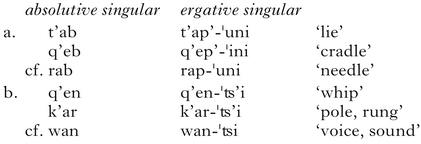
Lezgian (Nakh-Daghestanian) has a four-way laryngeal contrast among plain voiceless, aspirated voiceless, ejective and voiced stops/affricates, which often interact in alternations. Of particular interest here are long-distance alternations in morphemes, in which the alternants differ in whether they surface with one or two ejectives. As shown in (1a), roots in underived (absolutive singular) forms end in voiced stops, while the same roots in derived (ergative singular) forms end in either ejectives or plain voiceless stops. Crucially, root-final ejectives are observed in such cases only if the root begins with an ejective. Similarly, in (1b), the ergative suffix, in this case underlyingly /-di/, surfaces with either an ejective or a plain voiceless affricate. We analyse these alternations as ejective harmony which is triggered by word-initial ejectives and targets (surface) plain voiceless stops occurring before stressed vowels, both within and across morpheme boundaries.
(1)

In this paper, we present an analysis of these ejective alternations, considering the broader patterns in the Lezgian lexicon. We thoroughly analyse the lexicon for morpheme structure constraints (MSCs) using Talibov & Gadzhiev's (Reference Talibov and Gadzhiev1966) Lezgian–Russian dictionary, and show that combinations of plain voiceless stops and ejectives in onsets within the foot are banned. These results are consistent with the alternations, which also apply solely within the foot, and target combinations of plain voiceless stops and ejectives.
This case is the first reported example of ejective harmony involving alternations; all known cases of ejective harmony in the phonological literature involve MSCs rather than alternations. Moreover, the Lezgian patterns are typologically interesting in several respects. First, on the surface it appears that alternations involve featurally dissimilar voiced stops and ejectives, yet harmony in fact targets plain voiceless stops. This pattern is masked in alternations by the pretonic devoicing of voiced stops, but is clearly manifested within roots as MSCs. Second, harmony is sensitive to the prosodic structure of a word, occurring only within the initial binary foot, even though consonant harmony is generally not sensitive to prosody (Hansson Reference Hansson2010). Finally, although ejective harmony occurs within roots and across root–suffix boundaries, laryngeal dissimilation is found across prefix–root boundaries. While limited to a single prefix, this alternation is interesting, as it shows how harmony and dissimilation can conspire to resolve problematic co-occurrences of laryngeal features.
We first present the complex patterns of laryngeal alternations and MSCs in Lezgian, then provide a formal analysis of these patterns as an interaction of local constraints on laryngeal features and long-distance Agreement by Correspondence constraints (ABC; Hansson Reference Hansson2001, Reference Hansson2010, Rose & Walker Reference Rose and Walker2004).
The paper is organised as follows. In §2, we present background on the typology of laryngeal harmony, while §3 gives background on Lezgian laryngeal contrasts, phonotactics and local alternations. §4 documents long-distance alternations in stems and affixes. §5 presents the lexicon analysis of laryngeal co-occurrence restrictions in roots. §6 provides an account of the Lezgian harmony using ABC, for both alternations and static lexical MSCs, and §7 concludes.
2 Typology of laryngeal consonant harmony
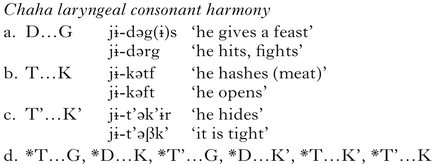
To contextualise Lezgian ejective harmony, we begin by reviewing the typology of laryngeal harmony. Chaha (Ethio-Semitic) presents an example of harmony involving all laryngeal classes of stops found in the language: voiceless, voiced and ejective (Rose & Walker Reference Rose and Walker2004). As seen in (2), each form contains two stops occurring across a vowel, and sometimes other consonants (data from Banksira Reference Banksira2000, Rose & Walker Reference Rose and Walker2004; 475). Crucially, the stops in all forms are both either (a) voiced, (b) plain voiceless or (c) voiceless ejective. Forms in which stops show disagreement in any combination of the features [voice] and [constricted glottis], as in (d), are prohibited in the language (or at least strongly underrepresented; Rose & King Reference Rose and King2007). Notably, in Chaha, as in all cases of laryngeal harmony, intervening segments are seemingly unaffected, showing no voicing/devoicing or glottalisation.Footnote 1
(2)
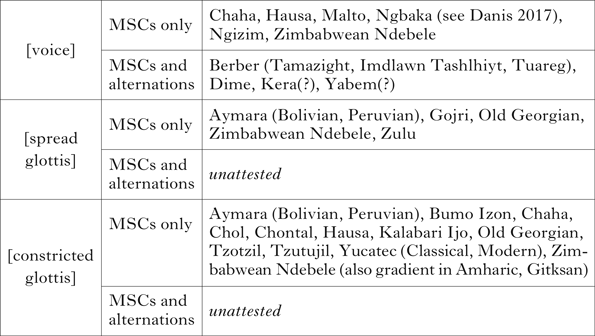
Laryngeal consonant harmony is fairly well attested cross-linguistically (although it is less common than coronal harmony), and therefore its typology has been worked out in considerable detail (e.g. Hansson Reference Hansson2001, Reference Hansson2010, Rose & Walker Reference Rose and Walker2004, Mackenzie Reference Mackenzie2009, Reference Mackenzie2013, Gallagher Reference Gallagher2010). Table I provides a summary of laryngeal harmony cases reported in the previous literature. As shown, harmony can involve the features [voice], [spread glottis] (aspiration) and [constricted glottis], or a combination of these (as in Aymara, Chaha and Old Georgian).
A summary of laryngeal harmony cases, based on Hansson (2010: 381–390).

One interesting fact about laryngeal harmony is that it typically operates as static co-occurrence restrictions within root morphemes, i.e. as MSCs (MacEachern Reference MacEachern1997), as we saw in (2) for Chaha. Only a handful of languages are known to exhibit morphologically conditioned alternations in laryngeal features, and at least some of them have been reanalysed as involving tone rather than voicing (see Hansson Reference Hansson2004 on Yabem and Pearce Reference Pearce2005 on Kera). One unambiguous case of laryngeal alternations occurs in the Berber language Tamajaq Tuareg, where the voiceless sibilant fricative /s/ of the prefix becomes voiced if there is a voiced sibilant anywhere in the root, as in /s-əntəz/ → [z-əntəz] ‘cause to extract’ and, combined with sibilant harmony, /s-kuʒət/ → [ʒ-əkːuʒət] ‘cause to saw’ (Alojaly Reference Alojaly1980, Hansson Reference Hansson2010: 114). As the same kind of agreement operates in Tamajaq Tuareg within morphemes, it can be argued the voicing agreement MSC in the language is extended to alternations. Importantly, laryngeal alternations of this kind are very rare, and all known cases involve the feature [voice]. Alternations involving the features [spread glottis] and [constricted glottis] are unattested (cf. Rose & Walker Reference Rose and Walker2004: 480–481, Hansson Reference Hansson2010: 111), as indicated in Table I. This gap in the typology has been ascribed by some researchers to the fact that the marked laryngeal features [spread glottis] and [constricted glottis] tend to be restricted to roots, rarely appearing in affixes (Rose & Walker Reference Rose and Walker2004: n. 8). However, as illustrated in (1), Lezgian [constricted glottis] harmony does involve alternations.
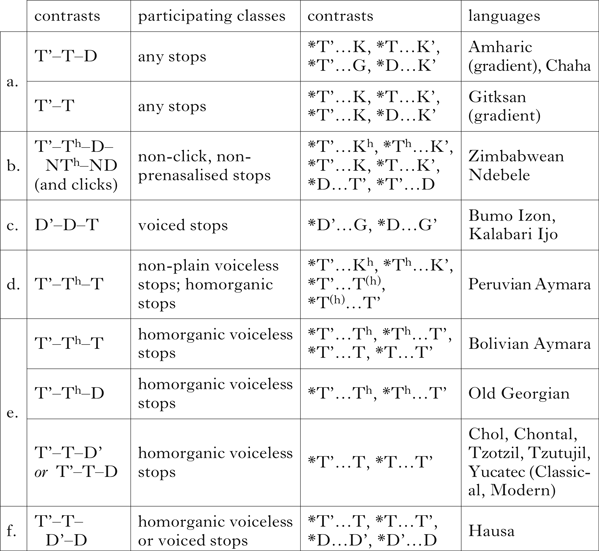
Another central characteristic of laryngeal harmony is that it is often ‘parasitic’ on agreement in other features of participating consonants, most frequently other laryngeal or place features (Hansson Reference Hansson2001, Reference Hansson2010, Rose & Walker Reference Rose and Walker2004). That is, segments that are required to agree in laryngeal features are typically a subset of possible segments, sharing certain non-harmonising features. Such ‘similarity-sensitivity’ is illustrated in cases of [constricted glottis] harmony in Table II (based on Hansson's Reference Hansson2010 survey), with languages showing agreement among a subset of the categories ejectives, implosives and non-glottal segments. While harmony in the languages in (a) applies to all contrastive stops (ejective, plain voiceless and voiced in Amharic and Chaha, and glottalised and plain voiceless in Gitksan), all other languages have agreement in only a subset of stops. Specifically, Zimbabwean Ndebele in (b) limits harmony to non-click and non-prenasalised stops, Bumo Izon and Kalabari Ijo in (c) harmonise only voiced stops and Peruvian Aymara in (d) requires agreement for non-plain voiceless stops or any homorganic stops. Homorganicity restrictions are also applied in similar ways in the languages in (e) and (f), despite some differences in the inventory of laryngeal contrasts.
Cases and patterns of [constricted glottis] harmony (based on Hansson 2010).
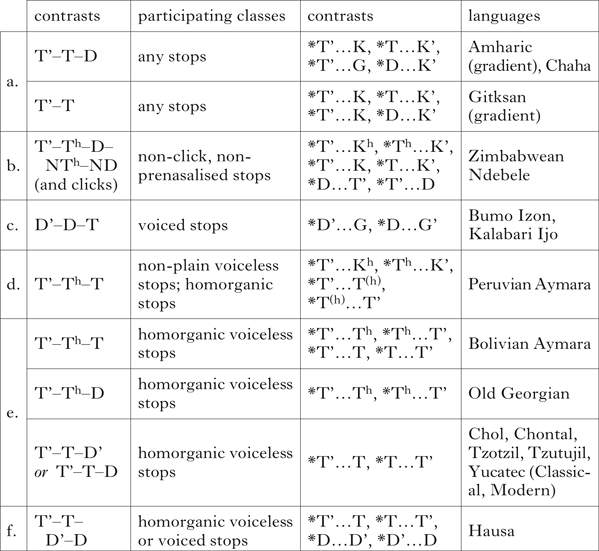
It is worth noting from Table II that [constricted glottis] harmony most commonly involves segments that agree in voicing, and cases involving segments that disagree in voicing also involve segments that agree in voicing. For example, harmony in Bumo Izon involves only voiced stops, despite the fact that the language also has a voiceless series, and harmony in Old Georgian involves only voiceless stops, even though the language has a voiced series. While languages like Amharic and Chaha have [constricted glottis] harmony that crosses voicing categories, no language has harmony between voiced stops and ejectives to the exclusion of voiceless stops. Rose & Walker (Reference Rose and Walker2004) and Hansson (Reference Hansson2001, Reference Hansson2010), among others, suggest that this typological pattern may be due to relative similarity of the interacting segments. While plain voiceless stops and ejectives share the feature [―voice], voiced stops and ejectives do not; thus voiced stops are less (featurally) similar to ejectives than plain voiceless stops are. (It should be noted that how exactly consonant similarity is defined or computed seems to be at least in part language-dependent; see Hansson Reference Hansson2001, Reference Hansson2010, Rose & Walker Reference Rose and Walker2004.) We will see in later sections that while Lezgian harmony on the surface appears to involve voiced stops and ejectives, it actually follows this typologically common pattern, in which harmony is parasitic on agreement in [―voice].
The final property of laryngeal harmony that we will consider is directionality, i.e. whether it is regressive, progressive or bidirectional. Given that most cases of laryngeal harmony involve static co-occurrence restrictions, no definitive statements can be made about its preferred directionality. Nevertheless, a few cases suggest some preference for regressive harmony, triggered by the marked feature value (ejectives in [constricted glottis] harmony). Specifically, forms from related (non-harmonic) languages show that harmony in Chaha and Ngizim has applied regressively (e.g. Chaha [t'ik’ək’] ‘be crushed’ and [k'ida] ‘draw liquid!’ vs. Amharic [dik’ək’] and [k'ida]; Rose & Walker Reference Rose and Walker2004). Similarly, various languages prohibit ejectives preceded by, but not followed by, plain voiceless stops, so that *T…K’ is disallowed, but T’…K is permitted (Gallagher Reference Gallagher2010, Hansson Reference Hansson2010). Such observations are consistent with Hansson's (Reference Hansson2001, Reference Hansson2010) generalisation that the default directionality in consonant harmony is regressive. Indeed, Hansson (Reference Hansson2010: 137) claims that all cases of progressive-only consonant harmony can be attributed to other factors, such as morphological constituency. Based on this generalisation, he builds the regressive nature of many types of consonant harmony into constraints in his theoretical analysis. For Lezgian, the harmony appears to be strictly progressive on the surface, but we argue that this apparent pattern is due to independent distributional restrictions on the interacting segments.
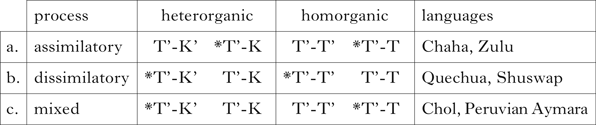
This typology would not be complete without mentioning related dissimilatory patterns. A particular fact about laryngeal features, unlike features such as [anterior] or [nasal], is that assimilatory and dissimilatory co-occurrence restrictions often occur together within a language, with the choice between harmony and dissimilation modulated by relative similarity of interacting segments or morphological domains (MacEachern Reference MacEachern1997, Gallagher Reference Gallagher2010). Peruvian Aymara (MacEachern Reference MacEachern1997) is one language that shows a combination of laryngeal harmony and dissimilation; two ejectives or two aspirates are prohibited within a root, unless they agree in place (i.e. are identical) (see also Gallagher & Coon Reference Gallagher and Coon2009 on [constricted glottis] in Chol). This ‘mixed’ co-occurrence pattern, shown in Table IIIc, exhibits properties of both the assimilatory-only and dissimilatory-only restrictions in (a) and (b), depending on the consonants’ place of articulation.
The typology of assimilatory and dissimilatory [constricted glottis] co-occurrence restrictions, based on Gallagher (2010).

As with the assimilatory restrictions discussed above, dissimilatory laryngeal restrictions also occasionally appear in alternations. For example in some dialects of Bade, prefix stops dissimilate in voicing from voiceless obstruents in the root: /də́-bàkà/ → [tə́-bàkà] ‘burned’ (Schuh Reference Schuh1978, Hansson Reference Hansson2010: 115, Bennett Reference Bennett2015). Similarly in Moro, voiceless obstruents in prefixes and roots become voiced when they precede morphemes with voiceless obstruents: /ék-ətám/ → [ég-ətám] ‘neck’, /lap-at̪ó/ → [lab-at̪-ó] ‘they carry (into/at)’ (Bennett & Rose Reference Bennett and Rose2017) (see also Bennett Reference Bennett2015 on Dahl's Law in Bantu). As the same kinds of co-occurrence restrictions occur (categorically or gradiently) in the Bade and Moro lexicons (Schuh Reference Schuh1978, Bennett & Rose Reference Bennett and Rose2017), it can be argued that the languages extend voicing MSCs to alternations across morphemes. Again, however, long-distance laryngeal alternations of this kind are very rare, and all known cases happen to involve the feature [voice]. This further emphasises the typological gap in alternations involving the feature [constricted glottis].
While the focus of this paper is on assimilatory laryngeal patterns (alternations and MSCs involving [constricted glottis]), dissimilatory patterns are also of interest, given that Lezgian also illustrates a case of dissimilation.
Before concluding this section, we note briefly that local phonological processes – such as devoicing of voiced stops and aspiration of ejectives – may also affect laryngeal features. This may particularly be the case in languages with a rich set of laryngeal contrasts, like Lezgian. While a full discussion of the typology of such processes is beyond the scope of the paper, it is worth noting that other languages with extensive laryngeal distinctions, such as Kashaya (Buckley Reference Buckley1994), also show various local laryngeal phenomena, including restrictions on distinctions in clusters and codas similar to those we find in Lezgian.
3 Lezgian: contrasts, phonotactics and local alternations
3.1 Basic facts
Lezgian is a Nakh-Daghestanian language spoken in the north-east Caucasus, in the autonomous republic of Dagestan, Russian Federation, and in northern Azerbaijan. The language is unusual in having a four-way laryngeal contrast in stops and affricates. Haspelmath (Reference Haspelmath1993: 2, 34; cf. Yu Reference Yu2004) classifies these segments as voiceless ejective, voiceless unaspirated, voiceless aspirated and voiced. As seen in (3), the four contrasts involve consonants of all places of articulation. Affricates and uvular stops do not have a voiced series; however, in alternations the fricatives /z ʒ ʁ/ pattern as the voiced counterparts of /ʦ’ ʦ ʦʰ/, /ʧ’ ʧ ʧʰ/ and /q’ q qʰ/ respectively (Talibov Reference Talibov1980, Bokarev Reference Bokarev1981). For convenience, we will simply use the term ‘stops’ to refer to stops and affricates, as well as voiced fricatives that alternate with stops/affricates.
(3)
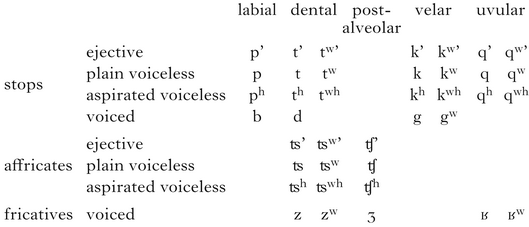
Examples of these contrasts in word-initial position are shown in (4). We will assume the features [constricted glottis], [spread glottis], [voice] and [tense] to distinguish the classes, following Haspelmath's (Reference Haspelmath1993) description of Lezgian and the binary laryngeal specifications in Clements (Reference Clements1985). The first three features, as expected, uniquely distinguish ejectives ([+constricted glottis]), aspirates ([+spread glottis]) and voiced stops ([+voice]). We use [+tense] to capture the joint patterning of ejectives and plain voiceless stops, and in particular the preference for these segments in prosodically strong contexts, which we discuss in §3.3 (see Jessen Reference Jessen and Hall2001, Kim & Clements Reference Kim, Clements, Rialland, Ridouane and van der Hulst2015 on [tense]).Footnote 2 That is, ejectives and plain voiceless stops are [+tense], while aspirated and voiced stops are [―tense]. The full specifications of all classes are shown in (4).
(4)

The basic syllable structure in Lezgian is (C)V(C)(C), with an additional CC(C)V(C) type that has developed recently as a result of vowel syncope (Haspelmath Reference Haspelmath1993: 2–3; see §3.4). Syllables with a final CC cluster can only occur at the end of a root morpheme; examples include sonorant + stop and fricative + stop/fricative, but apparently no stop + stop combinations (Haspelmath Reference Haspelmath1993: 40).
3.2 Stress and feet
Most native roots are monosyllabic; a small number of nominal and verbal roots are disyllabic or trisyllabic. Stress, which is important to the distribution of laryngeal contrasts (and ultimately ejective harmony; see §4), falls on the second syllable in polysyllabic roots (e.g. [bal.ˈk'an] ‘horse’, [ʒa.ˈna.wur] ‘wolf’; Haspelmath Reference Haspelmath1993: 64–67). Exceptions to this pattern include certain verbs (e.g. [ˈga.da.r-un] ‘throw’), adverbs (e.g. [ˈgi.la] ‘now’) and interjections, as well as a couple of dozen nouns and adjectives borrowed from Arabic, Persian and Turkish (e.g. [ˈʃe.her] ‘town’, [u.mu.ˈmi] ‘general’).
Most affixes are ‘stress-neutral’ (Haspelmath Reference Haspelmath1993: 67–69). In derived forms involving such affixes, stress falls on the root/stem, and thus either on the first or second syllable (e.g. [ˈhal.tʰ-a] ‘meet (imp)’, [a.ˈqʷa.z-u-n] ‘to stop’). A smaller number of affixes are ‘stress-attracting’. These typically attach to monosyllabic roots and attract stress, which as a result falls on the second syllable, producing the canonical iambic pattern (e.g. [tar] ‘tree’ – [ta.ˈr-ar] ‘tree (abs pl)’). Several stress-attracting affixes can attach to both monosyllabic and polysyllabic stems; in the latter case, stress would fall on that suffix, beyond the first two syllables (e.g. ([xabar-ˈdar] ‘informed’; cf. [xaˈbar]). (See Appendix A for a full list of affixes by stress type.Footnote 3)
It should be noted that stress-attracting suffixes attached to monosyllabic roots often trigger alternations determined by the phonotactics of laryngeal contrasts (e.g. [rab] ‘needle (abs sg)’ – [ra.ˈp-ar] (abs pl)), which will be discussed in §3.4. Here and below, we will refer to consonants occurring immediately before stressed vowels (onsets of stressed syllables) as ‘pretonic’, and consonants occurring after stressed vowels (codas of stressed syllables as well as onsets and codas of unstressed syllables) as ‘posttonic’.
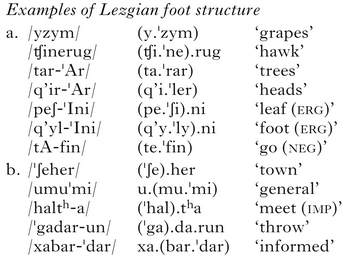
Given the dominant stress pattern described above, and the apparent lack of secondary stress (Zhirkov Reference Zhirkov1941: 25–30), we analyse the language as having a single foot per word. This foot is maximally binary and always iambic, and is aligned to the left edge of the word, as shown in (5a). Monosyllabic words and words with exceptional initial stress have degenerate monosyllabic feet, while words with exceptional stress after the second syllable have non-initial binary feet, as in (5b). We assume that roots with exceptional stress patterns and stress-attracting affixes are lexically specified. Foot structure plays a role in vowel harmony, with vowels in the stressed syllable of the iambic foot agreeing in backness and rounding with a preceding unstressed vowel, both within roots and in affixes (as seen in (5a); capitals indicate suffix vowels which alternate in backness or rounding). This harmony does not affect vowels outside the binary foot (see (5b)), providing support for the proposed foot structure (data from Haspelmath Reference Haspelmath1993: 48–49, 56–59). As we will see in §4, the initial binary foot is also a domain for consonant harmony.
(5)
3.3 Phonotactic restrictions
Stress and foot structure are relevant for the distribution of laryngeal contrasts, and as we will see later (§4), for the consonant-harmony patterns. This is specifically because the segments targeted by consonant harmony – plain voiceless stops – are restricted in occurrence to onset position within the initial foot.
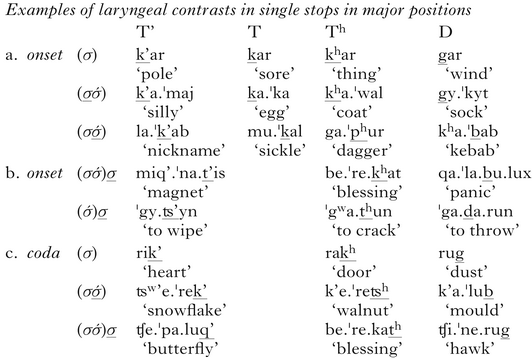
The data in (6) illustrates the distribution of stop laryngeal contrasts in roots. All laryngeal contrasts occur as syllable onsets within the initial foot (degenerate or binary, as in (6a)). All the contrasts except plain voiceless stops also occur as onsets outside the initial foot (6b), as well as codas anywhere within the word (6c) (Trubetzkoy Reference Trubetzkoy1931, Talibov Reference Talibov1980: 45–54, 64–68, Bokarev Reference Bokarev1981: 104–106, Haspelmath Reference Haspelmath1993: 41–48; see also Yu Reference Yu2004). However, there is a restriction against voiced stops as onsets in the strong syllable of the binary foot ((σσ́)); while these are not uncommon in loanwords, they are rarely permitted in the native vocabulary (Talibov Reference Talibov1980, Bokarev Reference Bokarev1981).Footnote 4 The prohibitions on plain voiceless stops in coda position and beyond the initial foot, as well as the restriction on voiced stops in the strong syllable, are important to laryngeal alternations.
(6)
The distribution of laryngeal contrasts is further complicated by additional restrictions on consonant clusters. Briefly, the set of word-medial monomorphemic clusters consists of aspirated–plain, aspirated–ejective, ejective–ejective and voiced–voiced clusters (Haspelmath Reference Haspelmath1993: 41–46). This shows that stops in clusters have to agree in voicing. In voiceless clusters, not all combinations are possible; specifically, plain stops can only occur as C2, and aspirates only as C1. Restrictions are even more severe in word-initial clusters that have arisen through syncope (see §3.1): C1 is always aspirated, while C2 is either ejective or plain voiceless (i.e. TʰK- or TʰK’-). Voiced stops do not occur in initial clusters (Haspelmath Reference Haspelmath1993: 36–38).
In summary, there is a phonotactic restriction on plain voiceless stops, which occur only as onsets within the initial foot (either as single consonants or in clusters).Footnote 5 There is also a native vocabulary restriction on voiced stops in pretonic position. Both facts are important, as they are responsible for local alternations between voiced and plain voiceless stops, which ‘feed’ ejective harmony. These local alternations are described in §3.4.
3.4 Local alternations
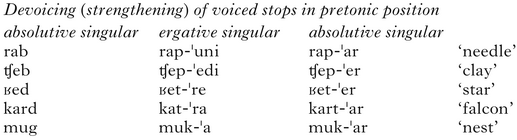
The first type of local alternation is manifested when monosyllabic roots take on the stress-attracting suffixes /-ˈUni/ (ergative singular) and /-ˈAr/ (absolutive plural) (see Haspelmath Reference Haspelmath1993: 48–49). As seen in (7) (based on Talibov & Gadzhiev Reference Talibov1966, Haspelmath Reference Haspelmath1993: 53–55), root-final voiced stops in underived forms correspond to plain voiceless stops in derived forms. Crucially, voiceless stops occur before stressed vowels, while voiced stops occur word-finally. Note that this alternation is driven by phonotactics, as voiced stops do not occur pretonically in the native vocabulary (as illustrated in (6a)), and plain voiceless stops are prohibited in codas (see (6c)). Assuming that voiced stops are underlying, following Talibov (Reference Talibov1966, Reference Talibov1980) and Bokarev (Reference Bokarev1981), we will refer to this process as pretonic devoicing, or strengthening. This interpretation is consistent with our feature system, where voiced stops are weak ([―tense]), while plain voiceless ones are strong ([+tense]). In this sense, the process fits well in a larger typology of consonant fortition in stressed syllables (Lavoie Reference Lavoie2001); it can also be regarded as a sonority-decreasing augmentation in a prosodically strong position (Smith Reference Smith2005). As we will see in §4.1, pretonic devoicing is an important precondition for ejective harmony alternations.
(7)
The second kind of local alternation is driven by the same phonotactic constraints, but involves the stress-attracting variant of the ergative suffix /-di/, which attaches to a closed set of native CVR roots (where R is a sonorant; Zhirkov Reference Zhirkov1941: 54, Talibov Reference Talibov1966: 550–551, Reference Talibov1980: 80–82, Haspelmath Reference Haspelmath1993: 63, 67–68, 74–77). As the onset of the stressed syllable, the stop in the suffix undergoes devoicing, and is affricated, as shown in (8). While affricates and coronal stops are contrastive in most positions, this contrast is neutralised in native vocabulary before a stressed /i/; affrication is an independent process that occurs elsewhere in the language (e.g. Lezgian [ʦif] ‘cloud’ vs. Tabasaran [dif]; Lezgian [qʰɨˈʦiq’] ‘sheepskin’ vs. Budukh [q’ɨdɨq’]; Lezgian [ʦ’il] ‘rope’ vs. Agul [t'il]; see Talibov Reference Talibov1980: 82–83, Bokarev Reference Bokarev1981: 61). As such, the occurrence of the alternant of the suffix with a voiceless alveolar affricate rather than a voiced alveolar stop is entirely determined by the stress of the following vowel. Note that neither devoicing nor affrication applies to the stress-neutral variant of the suffix /-di/ (preceded in some forms by a stress-attracting thematic vowel): [ʧʰan] – [ˈʧʰan-di] ‘soul’, [ʧʰkal] – [ˈʧʰkal-di] ‘peel’, [lil] – [lil-ˈa-di] ‘sludge’, [marf] – [marf-ˈa-di] ‘rain’ (Haspelmath Reference Haspelmath1993: 69, 75).
(8)
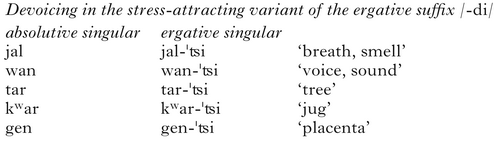
Both kinds of voiced–plain voiceless alternations reviewed above involve single stops. There are, however, a number of alternations related to the restrictions on the co-occurrence of laryngeal contrasts in clusters (Haspelmath Reference Haspelmath1993: 52–56; see also §3.1). We will focus only on the aspiration of tense stops, which will be relevant for our analysis of opaque harmony in §4.1. Aspiration alternations involve ejective and plain voiceless stops vs. aspirates, with aspirates occurring word-initially when pretonic high vowel syncope has applied (Haspelmath Reference Haspelmath1993: 61; see also Chitoran & Babaliyeva Reference Chitoran, Babaliyeva, Trouvain and Barry2007 for phonetic evidence for vowel deletion). As seen in (9a), the deletion of pretonic high vowels, which applies between voiceless obstruents, results in initial stop–stop clusters in the absolutive plural. The first stop is aspirated in such contexts, whereas it is ejective in the absolutive singular when the high vowel is present. The same happens when the initial stop in the absolutive singular is plain voiceless, as seen in (9b). Note that the absolutive plurals of the second and third examples in (9b) also show pretonic devoicing (see (7) above), while the first example shows deaspiration of the second stop. The latter process applies independently, whenever an aspirate is preceded by a stop, as seen in (9c) (Haspelmath Reference Haspelmath1993: 55).
(9)
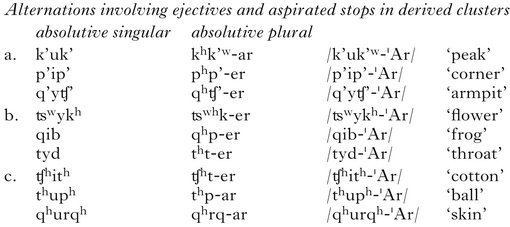
As Haspelmath (Reference Haspelmath1993: 70) notes, vowel syncope affects neither stress placement nor any phonological or morphological rules referring to stress. Thus, forms like [kʰk’ʷar] (/k'uk’ʷ-ˈAr/) are still considered disyllabic. As such, it is possible that the vowel is not deleted phonologically.
To summarise, local alternations are triggered by phonotactic restrictions on the laryngeal contrasts. Specifically, the prohibition against plain voiceless stops posttonically (in codas or outside the initial foot: *(CV.ˈCV)Ft.TV, *(CVT)Ft), combined with the avoidance of voiced stops in medial pretonic position (*(CV.ˈDV)Ft), results in alternations root-internally and in suffixes, with voiceless stops appearing pretonically and voiced stops elsewhere. Further, the restriction on word-initial tense stops before voiceless obstruents (*ˈT'KV, *ˈTKV) results in aspiration when pretonic high vowel syncope applies. All of these processes are crucial to understanding the patterns of laryngeal harmony alternations presented in the next section.
4 Lezgian long-distance alternations
4.1 Stem and suffix harmony alternations
Lezgian long-distance assimilatory alternations have been previously noted in grammatical descriptions (Talibov Reference Talibov1966: 545, 547, Reference Talibov1980: 64–65, 74–78, Haspelmath Reference Haspelmath1993: 61, 63, 77), but have not been studied systematically or even mentioned in surveys of consonant harmony (Hansson Reference Hansson2001, Reference Hansson2010, Rose & Walker Reference Rose and Walker2004). Both Trubetzkoy (Reference Trubetzkoy1931) and Haspelmath (Reference Haspelmath1993) note that an ejective cannot be followed by a plain voiceless stop in the first two syllables of a word, even if there is an intervening vowel. Our analysis of the lexicon presented in §5 confirms this restriction, but it is also apparent in harmonic alternations, which are the focus of this section.
As discussed above, word-final stops in Lezgian undergo devoicing (strengthening) when they appear before a stressed vowel of a suffix, as in (10a), repeated from (7). However, the stop in question surfaces as ejective when the root begins with an ejective, as in (10b) (Haspelmath Reference Haspelmath1993: 61). We interpret these alternations as harmony which is triggered by root-initial ejectives and targets root-final stops that would otherwise be plain voiceless, due to pretonic devoicing. Note that the process cannot be analysed as ejective voicing, as ejectives are freely permitted in coda and do not alternate in similar contexts; e.g. [k’ʷat’] – [k’ʷat’-ˈuni] ‘lump’.
(10)
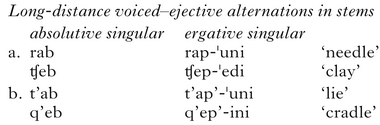
The examples in (10b) are clear cases of ejective harmony; however, the alternations are often obscured by pretonic high vowel syncope and related aspiration (see (9)). That is, if an absolutive singular form contains an ejective + high vowel + voiced stop sequence, the vowel in the corresponding ergative plural form is subject to deletion, and the initial stop is subject to aspiration. However, the root-final stop still surfaces as ejective. In other words, ejective harmony here is obscured by syncope and aspiration. Examples of such opaque harmony alternations are given in (11) (data from Haspelmath Reference Haspelmath1993: 52, 61, 68). Note that aspirate–plain stop clusters are possible in Lezgian (see (9c)), but not in absolutive plural forms of ejective-initial roots; this further supports our analysis of the pattern as related to harmony.
(11)

Given the data in (11), harmony is not always apparent on the surface in Standard Lezgian, with trigger segments losing ejectivity. This is thus an apparent case of derivational opacity. It is worth noting that other cases of ejective agreement appear to require reference to underlying forms, such as in Chaha (Rose & King Reference Rose and King2007) and many Mayan languages (e.g. Dayley Reference Dayley1985 on Tzutujil and Bennett et al. Reference Bennett, Tang and Sian2017 on Kaqchikel).
To summarise the root alternations, Lezgian voiced and plain voiceless stops have distributional restrictions that result in alternations between posttonic and pretonic environments, and these feed the harmony alternations seen in (10) and (11). Additionally, the opaque cases of harmony relate to a local restriction against non-aspirated voiceless stops immediately preceding other stops, as well as pretonic high vowel syncope.
In addition to the root-final context, Lezgian has laryngeal harmony alternations involving the stress-attracting variant of the ergative suffix /-di/. Recall from §3.4 that the voiced stop of this suffix undergoes phonotactically motivated devoicing and affrication when the vowel is stressed. Examples in (8) above involve roots that begin with sonorants or non-ejective obstruents (e.g. [jal-ˈʦi], repeated in (12a)). However, when roots begin with an ejective, as in (12b), the suffix consonant becomes ejective ([-ˈʦ’i]).
(12)

As in the root-final case, the alternant with an ejective is limited specifically to pretonic context within the initial binary foot. Importantly, the stress-neutral variant of the ergative suffix shows no laryngeal alternations (e.g. [q'ar] – [q'ar-ˈa-di] ‘dirt’, [nek’] – [nek’-ˈe-di] ‘milk’; Talibov & Gadzhiev Reference Talibov and Gadzhiev1966, Haspelmath Reference Haspelmath1993: 63, 77), as it occurs posttonically, outside the initial foot.
4.2 No harmony with other affixes
We have seen that Lezgian harmony alternations apply in two contexts: for root-final consonants before stressed vowel-initial suffixes (T'VD-ˈV → T'VK’-ˈV), and for the stress-attracting ergative suffix /-di/ (T'VC-ˈG'V → T'VC-ˈK'V). These appear to be the only long-distance assimilatory alternations attested in the language. Given the independent pretonic devoicing process (/CVD-ˈV/ → [CVT-ˈV]), the alternations effectively occur between ejectives and plain voiceless stops, rather than ejectives and voiced stops. In both cases, the consonants harmonise within the initial foot, and both occur in onset position. While we have so far seen only alternations in ejective–plain combinations (T’…K), there are typological reasons to believe that plain–ejective combinations (T…K’) may also alternate, since consonant harmony is typically not strictly progressive (Hansson Reference Hansson2010; see §2).
Apart from the question of directionality, it also remains unclear why suffix harmony is limited to a single morpheme, /-di/, and does not affect other affixes. One possibility would be that ejective harmony is morpheme-specific (with /-di/ lexically specified to undergo harmony). Another possibility would be that there are no other contexts in which harmony could potentially apply. Note that such contexts would require a heteromorphemic combination of an ejective and a voiceless stop (or the reverse) within an initial foot.
To evaluate these two possibilities, we examined the full list of Lezgian affixes with ejectives and plain voiceless stops (from Haspelmath Reference Haspelmath1993: 557; see Appendix A for additional information). We ignored preverbs, which are described by Haspelmath (Reference Haspelmath1993: 167) as morphologically opaque, and as not being analysed as decomposable by native speakers. Given this, there are no other suffixes that meet the condition. There are only two affixes with ejectives (the suffixes /-t'a/ and /-k'a/), and neither is stress-attracting. As such, the ejectives occur outside the foot (e.g. [tir-t'a] (ˈtir).t'a ‘to be (past cond)’), in a context where we would not expect harmony to apply; the fact that disharmonic combinations are indeed permitted with these suffixes is further evidence for our foot-based analysis. Further, there are no suffixes with plain voiceless stops, which can be attributed to the prohibition on plain voiceless stops posttonically.
There is, however, one prefix, negative /tA-/, that meets the foot-structure criterion of the ejective harmony alternations. As illustrated in (13), we do not find harmony in plain–ejective sequences created by attaching /tA-/ to roots beginning with an ejective; instead, there is dissimilation, as we can see by comparing (13a), with ejective-initial roots, and (13b), with roots without an ejective. (The voicing in (13a) is not represented in the Lezgian orthography.)
(13)

As Zhirkov (Reference Zhirkov1941: 92–93) observes, the /t/ of the prefix shows optional alternations: the [d] variant occurs before ejectives, [tʰ] occurs when followed by a high vowel (due to syncope) and [t] is found elsewhere (see also Uslar Reference Uslar1896: 332–603, Moor Reference Moor1985: 131–132). On the assumption that the underlying form of the prefix is /tA-/, the voicing of /t/ before ejectives is a dissimilatory process (TA-K'V → DA-K'V). It is typologically interesting and highly unusual that Lezgian resolves this particular disharmonic co-occurrence through dissimilation, but resolves other combinations of these sounds using harmony. In particular, it seems that plain–ejective sequences are resolved by dissimilation, while ejective–plain sequences are resolved by harmony.
While there are languages that show both assimilatory and dissimilatory long-distance consonant interactions (e.g. Kinyarwanda; Bennett Reference Bennett2015), Lezgian is unusual in that these processes affect the same consonants, i.e. ejectives and plain voiceless stops, along the same feature dimension, i.e. [constricted glottis]. In other cases, with the possible exception of Sundanese, these factors differ; for example, Kinyarwanda has voicing dissimilation and sibilant harmony, though these processes occur in separate domains (Bennett Reference Bennett2015). It is worth noting, however, that ejectives in Lezgian never appear in synchronically decomposable prefixes (and there are just a handful of prefixes in the language; see Appendix A). This corresponds to the established cross-linguistic fact that prefixes tend to host fewer segmental contrasts compared to suffixes (Hyman Reference Hyman2008, Rice Reference Rice, Avelino, Coler and Wetzels2016). In this respect, Lezgian is not exceptional. We will argue that this restriction against ejectives in prefixes motivates the choice of dissimilation instead of harmony for the negative prefix.
4.3 Summary
To summarise, Lezgian shows two cases of harmonic long-distance alternations, root-final and suffix-initial, with roots beginning with an ejective. While the surface alternation involves posttonic voiced stops and pretonic ejectives, we argue that the harmony restriction is actually between ejectives and plain voiceless stops; harmony is mediated by the independent process of pretonic strengthening, and in some cases further masked by ejective aspiration. The domain of Lezgian consonant harmony is the same as that of vowel harmony, namely a word-initial foot (Haspelmath Reference Haspelmath1993: 48–50). This is unusual, because, as Hansson (Reference Hansson2010: 137) observes, no known consonant-harmony systems are sensitive to stress or prosody. The only possible exception, voicing harmony in Yabem, has been alternatively attributed to tone–voicing interactions (Hansson Reference Hansson2004, Reference Hansson2010: 203–207, Rose & Walker Reference Rose and Walker2004). In the next section, we further explore these generalisations about plain/ejective co-occurrence restrictions holding only within a foot, and show that the same pattern holds as an MSC within roots.
5 Long-distance phonotactic restrictions in roots
As briefly mentioned in §4.1, Haspelmath (Reference Haspelmath1993: 48) notes that, in words with initial ejectives, plain voiceless stops are forbidden as the onset of the second syllable. This statement is based on Trubetzkoy (Reference Trubetzkoy1931), who states that Lezgian words beginning with an ejective cannot have a plain voiceless stop in the second syllable. Thus the authors suggest that forms of the type ejective–plain (word-initially across a vowel) are not permitted, but do not mention any restrictions on ejective–ejective or ejective–aspirated forms (across a vowel). (Ejective–voiced forms across a vowel are ruled out in the native vocabulary by pretonic devoicing.) In this section we test these generalisations more systematically throughout the Lezgian lexicon, using a large database and word types beyond CVCV.
5.1 Methodology
We created a corpus using an electronic version of Talibov & Gadzhiev's (Reference Talibov and Gadzhiev1966) Lezgian–Russian dictionary, which contains approximately 28000 words.Footnote 6 After extracting words containing two or more stops, and excluding derived words, recent loans and local co-occurrences (see Appendix B for specific criteria and other details), we obtained a list of 1284 words that can be assumed to accurately reflect the patterns in Lezgian roots. In words with more than two stops, only non-local co-occurrences adjacent on a stop tier were counted, giving 1418 co-occurrences in all.
These co-occurrences were organised into co-occurrence count tables based on stop series. Following Pierrehumbert (Reference Pierrehumbert1993) and Frisch et al. (Reference Frisch, Pierrehumbert and Broe2004), among others, we then used these counts to compute the observed over expected (O/E) values in order to find cases of under- and overrepresentation of particular combinations of consonants. χ 2 tests were used to determine the significance of any differences from random distribution. If there is no root-internal consonant harmony (or dissimilation), the hypothesis is that the co-occurrences of stop series are randomly distributed (with O/E values being close to 1.00). The χ 2 test determines deviations from such random distribution, which would indicate statistically significant patterns in which consonants can co-occur. Crucially, O/E ratios approaching or equal to zero would indicate (near-)categorical restrictions on combinations of segments or laryngeal features.
Before examining the results, we should mention that our dictionary analysis was limited by the fact that plain and aspirated voiceless stops are not distinguished orthographically in Lezgian, except in minimal pairs and for uvulars. As such, we checked forms with these consonants against other sources, which often provide more accurate transcriptions (Zhirkov Reference Zhirkov1941, Gajdarov Reference Gajdarov1961, Mejlanova Reference Mejlanova1964, Reference Mejlanova1970, Talibov Reference Talibov1966, Reference Talibov1980, Bokarev Reference Bokarev1981, Haspelmath Reference Haspelmath1993). A subset of items was also checked with a native speaker, Ayten Babalieva, who is also a linguist. Those cases for which we had no information were treated as neither aspirated nor plain, and are not included in the tables below. There were 320 stops with unknown aspiration occurring in words with other stops (sometimes two within one word); among these, 17 words contained an ejective with a stop with unknown aspiration.
5.2 Results
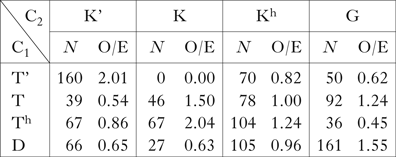
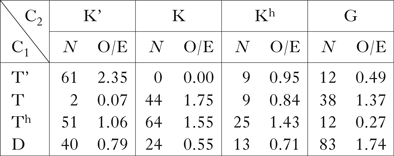
Table IV shows the co-occurrences of all stops in the entire corpus, with each cell providing a number of attested occurrences and an O/E value for combinations of stops. For example, the corpus contains 160 roots with two ejectives (T’…K’); given that the expected value for this combination is 79.59, the O/E ratio is 2.01, indicating an overrepresentation of the pattern. Note that the overall number of tokens in the table (1168) is due to the exclusion of co-occurrences involving consonants with unknown aspiration. In this and the following table, χ 2 tests show that the distribution of the counts among the co-occurrence categories is significantly different from what we would expect if it were random (p<0.001).
Co-occurrences of non-adjacent stops (N=1168).

The analysis reveals no counterexamples to Trubetzkoy's (Reference Trubetzkoy1931) generalisation: there are no words with an ejective followed by a plain voiceless stop (shown with the 0 in the T’…K cell); only one item with unknown aspiration may have fitted this category. The categorical absence of such forms is particularly significant, given that the expected value for such occurrences is 33.56.
However, the categorical MSC on ejectives and plain voiceless segments was only in the ejective–voiceless direction, not the reverse: there were 39 words with a plain voiceless stop followed by an ejective (O/E = 0.54). That is, the categorical co-occurrence restriction is ‘progressive’, under the interpretation of directionality in static MSCs offered by Hansson (Reference Hansson2010: 152–158), while any ‘regressive’ restriction is gradient and relatively weak.Footnote 7 It is worth noting that the pattern here is the opposite of what is found in languages like Quechua and Aymara, where the regressive restriction is categorical, but the progressive one is not (MacEachern Reference MacEachern1997, Gallagher Reference Gallagher2010).
Co-occurrences of ejective stops with aspirated and voiced stops were not nearly as restricted as those of ejectives and plain voiceless stops, with O/E values of 0.65 and 0.62 for voiced–ejective and ejective–voiced respectively, and 0.86 and 0.82 for aspirated–ejective and ejective–aspirated respectively. These values include only cases where aspiration is known. This result confirms that the MSC holds between ejective and plain voiceless stops, but not (strongly) between ejectives and other non-[constricted glottis] stops.
Note that the data presented in Table IV is based on the entire corpus, and thus contains stops that may or may not occur in the same foot or in the same syllable position. (See Appendix B for counts of roots by prosodic pattern.) Recall that the domain of harmony in alternations is the foot, and that both interacting segments have to occur in onset position. Given this, it is important to examine laryngeal co-occurrences between onset stops within the canonical initial iambic foot. These co-occurrences accounted for 43% of the data. The results for within-foot onset–onset co-occurrences are shown in Table V, where co-occurrences between plain voiceless stops and ejectives in this subset are very strongly underrepresented (T…K’: O/E = 0.07, expected = 29.41). This underrepresentation is consistent with the laryngeal alternations considered above; the other case of substantial underrepresentation in Table V (aspirated–voiced sequences: O/E = 0.27) is not, to our knowledge, avoided by any alternations.
Co-occurrence restrictions for non-adjacent stops in onsets within the initial weak- strong foot (N = 487).

The O/E value of 0.07 for T…K’ is due to two examples. The first word, [teˈk'eni] ‘would you?’, is a secondary variant of the main entry in the corpus, [deˈk'eni], where the ejective is preceded by a voiced stop. The second word, [taˈq'atʰ] ‘strength’, is a loan (from Arabic according to Selimov Reference Selimov2001, and from Turkish according to Haspelmath Reference Haspelmath1993), which could account for its exceptional behaviour. Leaving these two words aside, the plain/ejective co-occurrence restrictions between onsets within the canonical foot is categorical.
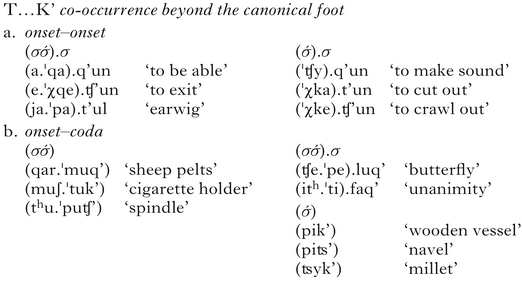
Thus categorical harmony is found between ejective and plain voiceless stops when both are onsets in the canonical foot, which is exactly the context where ejective harmony applies in alternations. Note that outside of this context, when one segment is outside the foot or when the syllable roles differ (one onset, one coda), ejectives and plain voiceless stops can co-occur. (14a) presents examples of this with both consonants as onsets (in canonical and degenerate feet respectively), while (14b) gives examples with onset and coda (within a canonical foot, outside the foot and within a degenerate foot).
(14)
It should be mentioned that the corpus includes forms that are variants of the same lexical item. Examples of these are [daˈp'ar] ~ [t'aˈp'ar] ‘lock’, [biˈp'inar] ~ [p'iˈp'inar] ‘smut’, [gaˈp'al] ~ [k'aˈp'al] ‘heap’ and [baˈp'rus]~[p'aˈp'rus] ‘cigarette’, and all include combinations of voiced and ejective stops (D…T’ ~ T’…T’). These forms suggest that the weak gradient restriction on voiced/ejective combinations (O/e = 0.79 within the foot) may nonetheless be active to some degree in the phonology. However, in all such cases, there are no alternations that create a plain stop, as in *[piˈp'inar]. Further discussion of these patterns is given in §6.5.
A final important note is that ejective–plain co-occurrences are impossible even when the second stop immediately follows an obstruent and is in pretonic position. For example, in the corpus, we have related forms [qaʃˈqa] and [q'aʃˈq'a], which are variants of the same word; in the former both stops are plain, and in the latter ejective. What we do not observe, however, are disharmonic forms like *[q'aʃˈqa]. If we were to expect any exceptions to the ejective–plain ban, it would be in such cases, given the favourable environment for plain voiceless stops after fricatives (and the prohibition on aspirates in this context). The impossibility of these forms, as well as the alternating forms of the same word, illustrates the strength of the harmonic restriction.
To conclude this section, our detailed analysis of the Lezgian lexicon has shown that there are essentially categorical restrictions against the co-occurrence of plain voiceless stops and ejectives as onsets within the foot, regardless of the order of segments and place of articulation. In contrast, outside the foot or with distinct syllable roles (onset vs. coda), these sounds can co-occur. This pattern is consistent with the alternations described in §4. Overall, the distribution in Lezgian is a categorical restriction on the co-occurrence of ejectives and plain voiceless stops as onsets within a foot, illustrated in both MSCs and alternations; co-occurrences of other types of categories do not appear to show the same kinds of restrictions.
6 Lezgian harmony as Agreement by Correspondence
Before we turn to the analysis of Lezgian harmony patterns, in (15) we summarise the main facts that need to be accounted for.
(15)
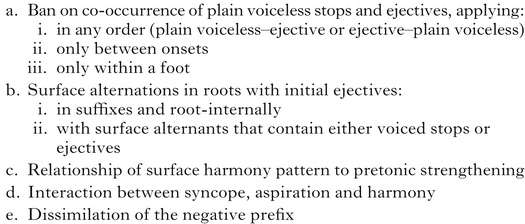
The analysis presented below attempts to account for all these facts. Specifically, §6.1 and §6.2 provide an analysis of the basic pattern in roots, addressing the points in (15a), §6.3 and §6.4 extend the analysis to alternations (15b–d), and §6.5 analyses dissimilation (15e).
Although stress and foot structure are important for our analysis of Lezgian harmony, the constraints related to them do not interact with harmony constraints. We therefore do not include these constraints in the subsequent analysis.
6.1 General pattern
For our formal account of these Lezgian patterns, we adopt the Agreement by Correspondence (ABC) approach (Hansson Reference Hansson2001, Reference Hansson2010, Rose & Walker Reference Rose and Walker2004), which has been successfully applied to many known cases of consonant harmony. In ABC, harmony is achieved through a combination of correspondence constraints, which require segments sharing particular features to be in a formal correspondence relationship with each other (Corr-CC), and Ident-CC constraints, which require corresponding segments to agree. To give a simple example (cf. Rose & Walker Reference Rose and Walker2004), the two non-adjacent consonants in (16) share a feature [F]. The consonants in (a) are not in formal correspondence, as indicated by the different subscripts, x and y respectively. This configuration violates the Corr-CC constraint pertaining to consonants sharing the feature [F], but Ident-CC is not relevant. In contrast, the consonants in (b) do correspond, as indicated by coindexation with the same subscript, x. This configuration satisfies Corr-CC, and is therefore subject to agreement through Ident-CC constraints.
(16)

In an ABC account, we need an Ident-CC constraint, in this case one which forces agreement in the feature [constricted glottis] (Ident-CC[cg]), plus Corr-CC constraints, which in this case reference consonants that share [―voice, ―spread glottis, +tense].Footnote 8 Since there are no apparent homorganicity effects, we do not include a homorganic-specific correspondence constraint. As harmony applies only within a foot, the domain of the relevant constraints must be restricted. Following Bennett (Reference Bennett2015), we use Corr-D constraints to restrict correspondence to domain D, in this case the foot. Definitions of these constraints are given in (17). (17a) provides a general schema, for which only the specific version, (b), is used in the analysis; (c) is a specific constraint, used as is.
(17)
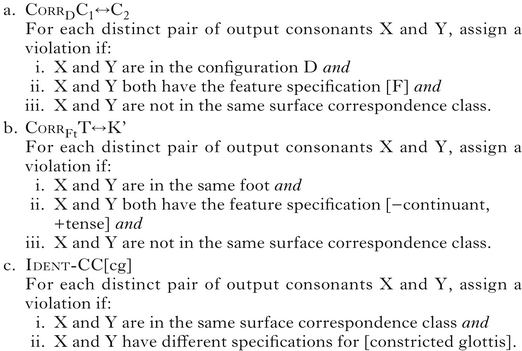
We also assume standard Ident-IO faithfulness constraints, including Ident-IO[cg] in (18). Note that while Rose & Walker (Reference Rose and Walker2004) use both Ident-IO and Ident-OI for faithfulness in dealing with consonant harmony, we use only Ident-IO, as we are using binary rather than privative features.
(18)

The ranking Ident-CC[cg], CorrFtT↔K’ ⪼ Ident-IO[cg] enforces harmony between ejective and plain voiceless stops within a foot. These consonants must correspond, and agree at the expense of faithfulness. We assume that all other correspondence constraints are ranked below Ident-IO[cg], so that harmony does not occur in any other combinations of consonants (ejective–voiced, aspirated–voiced, etc.).
Finally, we need the additional constraint Max-IO[+cg] in (19), which will ensure that harmony is always triggered by the ejective. This constraint is distinct from Ident-IO[cg], in that it specifically refers to preservation of the [+constricted glottis] feature anywhere in the word, rather than faithfulness between corresponding input and output segments. The combination of Ident-IO and Max-IO constraints has been used previously for consonant-harmony systems, for example by Mackenzie (Reference Mackenzie2009). The presence of Max-IO[+cg] requires harmony to occur through ejectivisation rather than the opposite; its ranking does not matter, but it is not violated, so we rank it at the top.
(19)

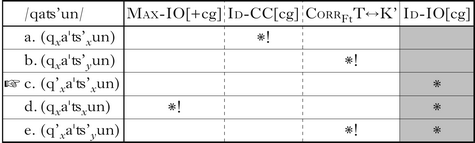
The tableau in (20) shows the application of these constraints to produce the typical harmony pattern. Here, harmony occurs between onset consonants within the foot; disharmony is ruled out by the combination of CorrFtT↔K’ (which enforces the correspondence of [+tense] segments) and Ident-CC[cg] (which forces corresponding segments to agree in [constricted glottis]). Harmony is triggered by the ejective because of Max-IO[+cg]. Note that the same output would be selected regardless of which consonant is underlyingly [constricted glottis] (/qaʦ’un/ or /q'aʦun/), due to harmony being bidirectional and [constricted glottis]-dominant.
(20)
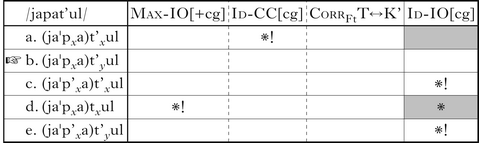
The proposed constraints also correctly derive the lack of harmony outside the foot, as shown in (21). Since the consonants are no longer both within the domain of the foot, CorrFtT↔K’ does not apply, and the form will surface faithfully. Note that the winning candidate in (21), (b), would have violations of a lower-ranked constraint such as CorrWdT↔K’, which would require harmony within the domain of the word. Such a constraint is not active in Lezgian, and is therefore not shown here.
(21)
6.2 Limiting harmony to onsets
The above constraints alone will not predict the Lezgian harmony patterns correctly, because harmony only applies when both consonants are onsets; it fails to occur between onset and coda. Given this, we also adopt the constraint SRole-CC in (22), initially proposed as StRole by McCarthy & Prince (Reference McCarthy and Prince1993) and used for consonant harmony by Rose & Walker (Reference Rose and Walker2004).Footnote 9
(22)

The ranking SRole-CC ⪼ CorrFtT↔K’ effectively limits harmony to onsets; consonants are not required to correspond if they do not share syllable roles. As seen in (23), the addition of SRole-CC correctly prevents harmony from occurring between onset and coda, even within a foot.
(23)
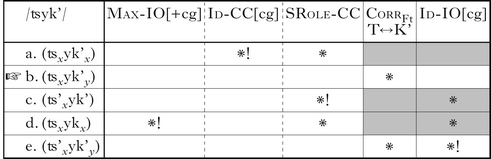
The ranking in (24) summarises the account of Lezgian harmony MSCs holding between ejectives and plain voiceless stops. This same ranking will be expanded with additional constraints to capture the relevant alternations.
(24)

6.3 Interaction with pretonic strengthening
In order to account for alternations, we require a constraint referring to the phonotactic restriction that feeds harmony, namely pretonic devoicing, understood here as avoidance of voicing in a prosodically strong position, *Vd/Strong (25). (Alternatively, this constraint can be formulated as a prohibition on voiced onsets in a strong prosodic position – [*Onset/D]/σ́Ft, which is ranked above [*Onset/T]/σ́Ft; see Smith's Reference Smith2005 analysis of Pirahã.) We assume standard faithfulness constraints for the features [spread glottis] and [voice]: Ident-IO[sg] and Ident-IO[voi]. These constraints are defined in the same way as Ident-IO[cg] in (18), except for their respective features.
(25)

Ranking the markedness constraint *Vd/Strong above the faithfulness constraints for [voice] and [constricted glottis] correctly derives the basic pretonic strengthening pattern in non-harmony contexts, as seen in (26).
(26)
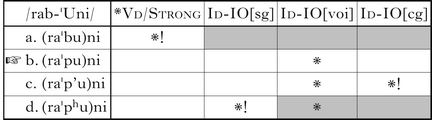
Combining these constraints with the harmony constraints discussed above, we correctly derive the harmony alternations in Lezgian, both within roots (27a) and in suffixes (27b). Crucially, the ranking *Vd/Strong ⪼ Ident-IO[voi] ensures that the pretonic stop cannot be voiced, the previously derived harmony ranking ensures that it cannot be plain, and the ranking Ident-IO[sg] ⪼ Ident-IO[cg] ensures that it surfaces as ejective rather than aspirated.Footnote 10
(27)
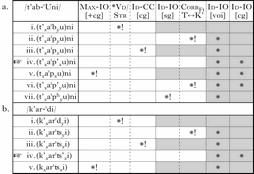
To sum up, our analysis straightforwardly accounts for ejective harmony patterns in MSC and basic (non-opaque) alternations. Other aspects of the ranking are derived in the following subsections.
6.4 Interaction with aspiration and syncope
This approach can be extended to handle the opacity pattern in (11) in §4.1, where it appears that harmony must precede high vowel syncope and related pre-obstruent aspiration. In order to capture this pattern in the non-derivational framework of standard OT, we argue that it is not in fact an instance of harmony. Instead, the pattern is motivated by the preservation of the [constricted glottis] feature from the root-initial stop. Since the initial stop is required to be [―tense] in pre-obstruent position, it cannot maintain its [constricted glottis] feature, which is then realised on a subsequent stop, if available.
The local patterns of pre-obstruent aspiration and high vowel syncope require two additional prosodically driven markedness constraints, defined in (28), as well as a Max-IO[V] faithfulness constraint that is violated in order to satisfy the syncope-triggering constraint.
(28)
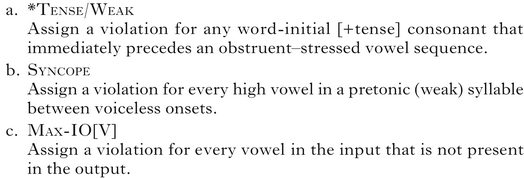
The ranking Syncope ⪼ Max-IO[V] enforces deletion of pretonic high vowels between voiceless segments, triggering syncope. Similarly, the rankings *Tense/Weak ⪼ Ident-IO[sg] and *Tense/Weak ⪼ Ident-IO[cg] require plain voiceless stops and ejectives to aspirate before obstruents. This analysis therefore derives the basic pattern of syncope and aspiration, as illustrated in (29) with a form underlyingly containing two ejectives. We consider only candidates which satisfy voicing agreement between strictly adjacent stops within a morpheme, and which do not change the height of the pretonic vowel. We assume, following Mackenzie (Reference Mackenzie2009: 148), that [+constricted glottis] is multiply linked to both ejectives, so that Max-IO[+cg] can be violated only once per candidate.
(29)
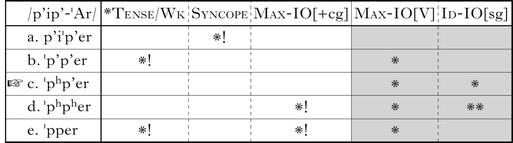
The pattern for the ‘opaque harmony’ examples is due to preservation of [+constricted glottis], not harmony. As mentioned, the established rankings of aspiration and syncope constraints ensure that the vowel is deleted and the first stop in the resulting CC cluster aspirated. The ranking Max-IO[+cg] ⪼ Ident-IO[cg] requires the second stop to be ejective; it is more important to maintain [+constricted glottis] from the input, even if it appears on a different segment, than it is to avoid changing the [constricted glottis] feature of the second consonant. The ranking Max-IO[+cg] ⪼ Ident-IO[voi], through the markedness requirement that [+constricted glottis] consonants cannot be voiced, further ensures that the voicing of the second consonant must change. To simplify the presentation of the tableau in (30), we omit candidates without pretonic devoicing and syncope.
(30)
6.5 Dissimilation in the negative prefix
Finally, we turn to dissimilation in the negative prefix. As discussed in §4.3, there are no synchronic prefixes containing ejectives, since preverbs are not analysed as morphologically separate by native speakers. Thus we assume that the lack of harmony with the negative prefix is due to a ban on ejectives in prefixes (which is typologically common; Hyman Reference Hyman2008). As such, resolving a problematic plain–ejective sequence cannot be accomplished through harmony; another mechanism, such as dissimilation, must be used. In Bennett's (Reference Bennett2015) Agreement by Correspondence analysis, dissimilation is avoidance of correspondence; segments become less similar in order to avoid the requirement to correspond. In Lezgian, the ban on ejectives in prefixes essentially results in a conspiracy of harmony and dissimilation to avoid plain/ejective co-occurrences. To formalise this analysis, we add a constraint *[+cg]prefix, defined in (31).
(31)

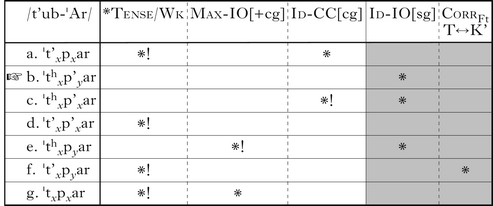
As in the examples with harmony, the ABC constraints prohibit combinations of plain voiceless stops and ejectives within the foot. However, in this case, the ranking *[+cg]prefix ⪼ Ident-IO[voi] prevents harmony from targeting the prefix consonant, because an ejective is prohibited in that position. The additional ranking Max-IO[+cg] ⪼ Ident-IO[voi] ensures that the result is not de-ejectivisation of the root, which means that the problematic co-occurrence must be resolved by dissimilation. Ident-IO[sg] ⪼ Ident-IO[voi] determines that dissimilation creates a voiced rather than an aspirated stop. This is shown in (32).
(32)

One potential complication involving the dissimilation pattern is that the outcome is a sequence that is apparently dispreferred to some degree in Lezgian. Specifically, as discussed in §5.2, our corpus contains a number of forms with variation between a voiced–ejective sequence and an ejective–ejective sequence (see §5.2 for examples). Such variation suggests optional ejective harmony for DVK’ sequences, which are precisely the combinations created by dissimilation. If this analysis of these variant forms is accurate, then DVK’ sequences must be dispreferred to some degree within the phonology of Lezgian, and so it is unclear why dissimilation would create them. However, an alternative analysis of these lexical items is that optional voicing is here also dissimilation, of an underlying or historical plain voiceless stop. For example, /taˈp'ar/ could dissimilate to [daˈp'ar] or harmonise to [t'aˈp'ar].
In sum, we have provided an analysis of the Lezgian patterns using the ABC framework for harmony and dissimilation, combined with constraints related to Lezgian phonotactics. We have accounted for the MSCs, the alternations in roots and suffixes, the opaque interaction between harmony and syncope/aspiration, and dissimilation. The final ranking is given in (33).
(33)

7 Conclusions
This paper has shown that Lezgian has long-distance laryngeal alternations and MSCs involving ejectives and plain voiceless stops within the canonical foot. These patterns arise from simple constraint interactions that can be captured by Agreement by Correspondence constraints and positional constraints on laryngeal features. Nonetheless, the harmony pattern exhibited by Lezgian is unique in many respects, and therefore the paper has various implications for the typology of laryngeal harmony.
First, Lezgian provides the only attested case of ejective harmony alternations within the typology of consonant harmony; all other instances of ejective harmony have been classified as MSCs – co-occurrence restrictions applying statically within roots (see Table I, and Hansson Reference Hansson2001, Reference Hansson2010, Rose & Walker Reference Rose and Walker2004). Moreover, laryngeal harmony alternations in general are rare, and many cases which have been proposed have been questioned. The case of Lezgian confirms that laryngeal harmony alternations are possible, and extends the typology to ejective harmony.
Second, we have shown how consonant harmony can be masked by interactions with local phonotactic processes, and that any analysis that ignores these interactions would lead to erroneous generalisations. Specifically, while the surface Lezgian pattern appears to involve a typologically odd interaction between voiced stops and ejectives, the true prohibition is on the combination of ejectives with plain voiceless stops. Viewing the pattern in this way permits a connection between the alternations and the MSCs we uncovered in the lexicon analysis.
Third, Lezgian harmony is sensitive to foot structure, as it applies only between onsets within the foot. This is parallel to Lezgian vowel harmony, but differs from standard cases of consonant harmony, which is not known to be sensitive to prosody (Rose & Walker Reference Rose and Walker2004, Hansson Reference Hansson2010). As such, this analysis has shown that consonant-harmony systems may, in fact, be sensitive to prosodic structure and operate in a prosodically defined domain such as the foot (as is common for many types of vowel harmony).
Fourth, Lezgian illustrates a regressive dissimilatory pattern in the negative prefix that is typologically unusual for two reasons: co-occurrences of ejective and plain voiceless stops are resolved through harmony, while, root-internally, voiced–ejective sequences are optionally resolved by harmony. This conspiracy of harmony and dissimilation to avoid plain/ejective co-occurrences is typological unusual, and is therefore a particularly interesting aspect of the Lezgian pattern. Nonetheless, we have shown that dissimilation is not driven entirely by ABC constraints (unlike cases analysed in Bennett Reference Bennett2015 and Bennett & Rose Reference Bennett and Rose2017), but rather results from an independent factor: a prohibition on laryngeal features in prefixes (cf. Beckman Reference Beckman1999 on the avoidance of laryngeal features in affixes in Cuzco Quechua).
To conclude, the phonological system of Lezgian is extremely rich and remarkably complex. The laryngeal harmony patterns are not obvious on the surface, and at a first glance are typologically unusual. Given this, it is not surprising that, despite considerable previous work on the language, these patterns have been largely overlooked. An important empirical contribution of this paper is the pulling together of disparate facts and specific observations about Lezgian phonology. In doing this, we have uncovered some highly systematic and well-motivated generalisations about consonant harmony in the language, thus further developing our understanding of cross-linguistic variation and phonological typology.